Data Monetization Platform Guide: Build, Price, and Scale
Master the data monetization platform model. Learn architecture, pricing strategies, compliance rules, and real examples to turn data into revenue safely.
The popular advice is to package your data, put it in a marketplace, and wait for buyers. That approach confuses access with value. Raw exports are difficult to price, difficult to govern, and difficult for a buyer to trust. In production, the durable business is usually built on trusted, metered outputs, such as an aggregated signal, a forecast, a benchmark, or an API with enforceable usage rules.
A data monetization platform succeeds when it connects four disciplines that companies often keep separate: data architecture, privacy engineering, product management, and finance. The hard work isn't finding a dataset. It's proving what the dataset contains, who may use it, how reliably it can be delivered, and what the customer should pay for each permitted use.
Table of Contents
- Why Data Monetization Is Not About Selling Raw Data
- Market Growth and the Shift Toward Platform Infrastructure
- Architecture of a Production-Grade Data Monetization Platform
- Privacy Engineering as a Commercial Requirement
- How SourceX Can Help
- Pricing Data Products Without Destroying Trust or Margins
- Internal Data Products as a Path to External Monetization
- Proving Legal and Technical Safety Before Commercialization
- Building a Practical Data Monetization Roadmap
Why Data Monetization Is Not About Selling Raw Data
Raw data sales are failing as a default strategy because the raw form creates problems for both sides of the transaction. The supplier may expose personal, confidential, or contractually restricted information. The buyer receives records without sufficient context, quality guarantees, or stable semantics. Even when a deal closes, the supplier may carry the operational cost of cleansing, support, compliance, and dispute resolution without knowing whether the price reflects the value delivered.
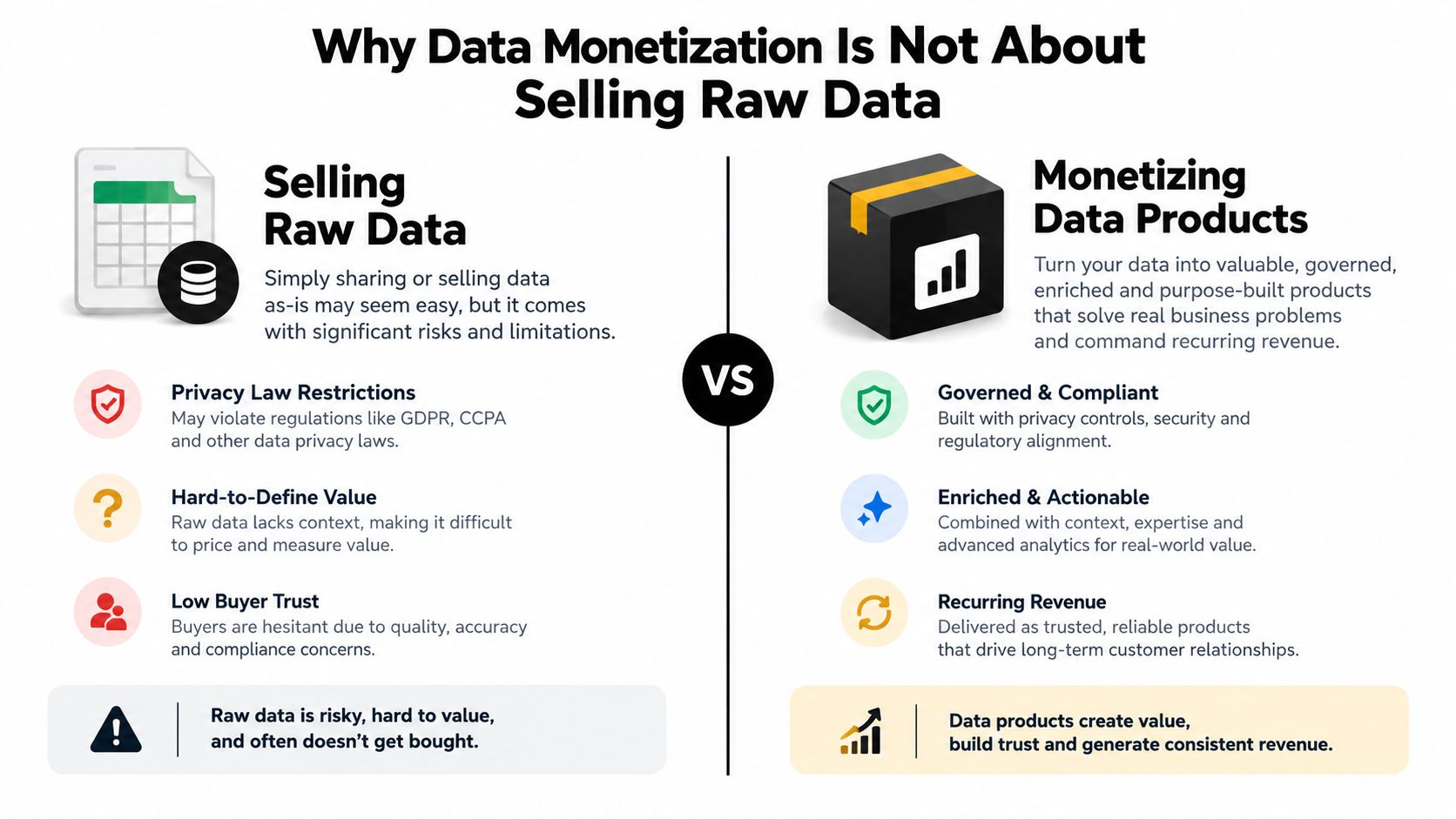
A governed data product changes the unit of value. Instead of selling an uncontrolled table, the provider sells a defined output with a documented purpose, schema, freshness expectation, access scope, and support boundary. That output might be a regional demand index, a fraud-risk benchmark, a supply-chain forecast, or an API that returns an aggregated metric without exposing the underlying records.
The raw-data trap
Spreadsheets and database extracts look inexpensive to distribute, but they push hidden work onto the customer. Buyers must interpret fields, repair inconsistent values, establish lineage, assess lawful use, and build controls around an asset they didn't create. Those costs reduce willingness to pay and increase the chance that the buyer will abandon the product after evaluation.
The supplier also loses power. A raw file is easy to copy, difficult to meter, and hard to update without issuing another extract. If the customer needs a new field or a correction, the provider may perform custom work that wasn't included in the original price. Margins disappear through one-off requests.
Practical rule: If you can't describe the buyer's permitted use, the billable unit, the quality promise, and the revocation process, you don't have a finished data product.
Productization creates a clearer commercial boundary. A provider can expose only the fields required for a decision, aggregate records to reduce re-identification risk, and use an API or controlled workspace instead of transferring a permanent file. The product can include versioned schemas, documentation, test responses, usage limits, and a support process.
Trusted outputs create repeatable value
The strongest offerings don't try to maximize the amount of data released. They maximize the usefulness of a controlled output. An aggregated signal can serve many customers without revealing individual records. A forecast can combine proprietary inputs with transformation logic that remains inside the provider's environment. An embedded analytics feature can monetize insight without making the customer manage a separate dataset.
This approach also supports indirect monetization. Internal teams may use the same governed product to improve targeting, automate operations, or enhance partner services. External licensing then becomes an extension of a product that already has owners, quality checks, and operating routines.
The central shift is simple: sell a decision-ready capability, not a pile of records. Governance isn't an administrative layer added after product design. It determines what can be sold, to whom, under which conditions, and with what evidence.
Market Growth and the Shift Toward Platform Infrastructure
The commercial category is expanding because enterprise data is moving beyond internal reporting. Organizations now package data as subscriptions, licensed datasets, APIs, analytics services, embedded features, and controlled exchanges. That shift makes platform infrastructure more important than isolated sales experiments.
The global data monetization market was valued at approximately USD 3.9 billion in 2025 and is projected to reach USD 17.6 billion by 2033, representing a 20.4 percent CAGR from 2026 through 2033, according to Grand View Research's data monetization market estimate. The same estimate places North America's 2025 share at 31.8 percent. These figures are industry benchmarks, not a universal accounting total, because market definitions and vendor coverage vary.
Software is becoming the commercial control plane
A separate market assessment estimates that software and tools represented 64.58 percent of spending, while IT and telecommunications generated 29.22 percent of revenue by end-use industry. It also reports 45.26 percent North American market share and forecasts Asia-Pacific growth at an 18.24 percent CAGR through 2031 in its covered market definition, as described by Mordor Intelligence's market assessment.
The important implication isn't the exact boundary between estimates. It's that the category is software-heavy. Buyers and suppliers need catalogs, policy controls, secure collaboration, standardized schemas, usage measurement, billing, and customer-facing product interfaces. Professional services still matter for integration and compliance, but services alone don't create a repeatable marketplace or API business.
The same infrastructure supports generative AI and other data-intensive products. Teams evaluating generative AI platforms should apply the same discipline to training data, inference inputs, usage rights, and metering rather than treating AI as an exemption from data governance.
Cloud distribution changes the operating model
Cloud adoption makes it practical to distribute standardized outputs across customers and regions. Data-as-a-service, privacy-aware collaboration, and analytics products can generate revenue without requiring an organization to sell raw personal information. A provider can retain sensitive data in a controlled environment while exposing only a permitted metric, query result, or derived insight.
That model creates two kinds of value:
- Direct value: Subscriptions, licenses, API charges, transaction fees, and analytics products generate revenue.
- Indirect value: Better targeting, more efficient operations, and stronger partner services improve the economics of the core business.
The platform is therefore not just a storefront. It's the system that turns governed data into a product with discoverability, access rules, delivery reliability, and a financial record.
Architecture of a Production-Grade Data Monetization Platform
A production-grade data monetization platform is a governed data-product stack, not a storage bucket with a checkout page. The architecture has to preserve the relationship between source data, transformation logic, customer entitlement, usage, and invoice. If any link breaks, the provider can't explain what was sold or defend the resulting charge.
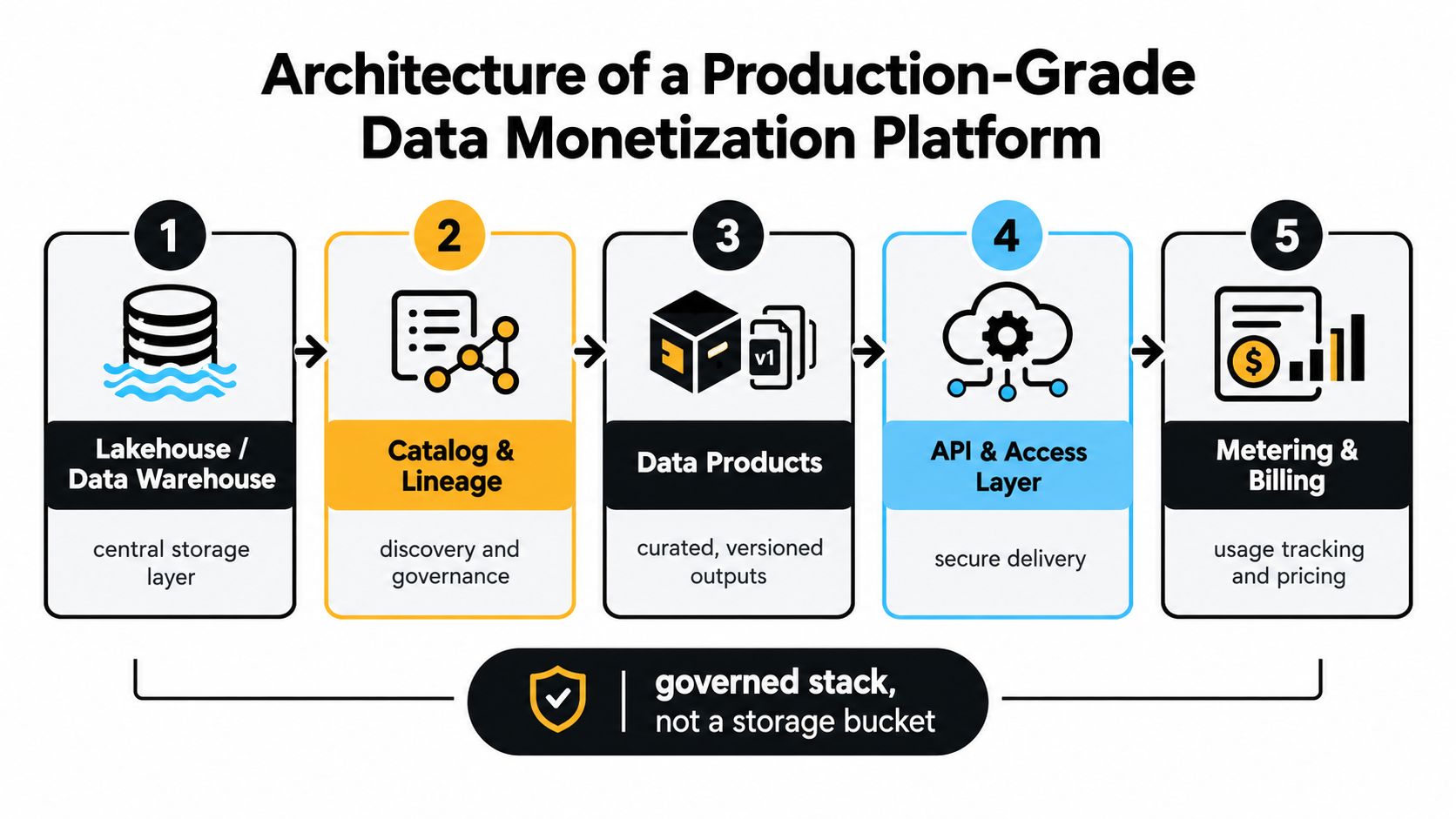
The architecture described in this production-oriented data monetization paper combines a lakehouse or warehouse, catalog and lineage services, data-quality monitoring, privacy-preserving transformations, entitlement and purpose-based controls, an API gateway, metering, billing, sandboxes, and observability. Each layer answers a different operational question.
Start with storage, context, and quality
The lakehouse or warehouse provides the central storage layer, but it shouldn't be the customer product. The catalog records what each asset means, where it came from, who owns it, and which transformations produced the current version. Lineage lets an operator trace an API response or derived metric back to its sources.
Data-quality monitoring belongs close to the product lifecycle. Check freshness, completeness, validity, consistency, and unexpected distribution changes before a release reaches customers. A quality failure should create a visible product event, not remain buried in an engineering dashboard.
The product layer then turns source assets into curated outputs. Each product needs a stable schema, business definitions, versioning rules, sample responses, update expectations, and a service-level objective. A customer should know whether a field is an observed value, an estimate, an aggregation, or a model-generated result.
Put policy between the product and the customer
Entitlement and purpose-based access controls determine who can use which product and for what purpose. Apply restrictions at request time, including row or column limits, geography, retention, customer tier, and permitted use. Revoking an entitlement should take effect without redeploying the data service.
For API distribution, OAuth2 or OIDC, mutually authenticated TLS, and an API gateway can protect access. Rate limiting, schema validation, anomaly detection, and Web Application Firewall controls help reduce abuse and denial-of-service exposure. These controls also create useful commercial signals, because the platform can distinguish normal consumption from suspicious or contractually excessive activity.
A practical request log should record:
- Identity: The customer, user, service account, or delegated actor.
- Context: The product, endpoint, purpose, entitlement, and geographic route.
- Timing: The request timestamp and response status.
- Consumption: The payload size, records, queries, or other agreed usage units.
- Outcome: Errors, throttling, policy decisions, and any correction event.
Architecture principle: Cataloging improves discoverability, standardization reduces integration work, policy enforcement limits unauthorized use, and metering converts consumption into auditable billing events.
Metering should produce an immutable usage record that finance can reconcile. Billing then applies the active rate plan, while observability connects latency, errors, quality incidents, policy decisions, and revenue impact. A sandbox gives buyers a safe evaluation path without exposing unrestricted production data.
The most common failed design is a direct connection from a warehouse to a customer. It may work for a pilot, but it lacks stable contracts, entitlement enforcement, usage accounting, and an evidence trail. Production systems need all four.
Privacy Engineering as a Commercial Requirement
Privacy engineering determines whether a data product can be sold repeatedly at a defensible price. Buyers need evidence of lawful use, controlled transformations, and restricted access before procurement teams will approve a recurring purchase. Without that evidence, the supplier faces delays, exceptions, and avoidable exposure.
A practical productization pipeline applies data minimization, aggregation thresholds, masking or anonymization, lineage tracking, consent and license checks, geographic routing, and periodic re-identification testing before exposing a table, API, stream, or derived insight. The controls should align with this data monetization privacy framework and a separate guide to data privacy compliance covering consent, minimization, and retention controls.
Reduce exposure without destroying utility
The useful test is whether the output serves the buyer's stated purpose while making unauthorized identification and inference difficult. An aggregated demand index can support planning without exposing customer-level activity. A benchmark can show performance relative to a peer group without disclosing any individual participant.
Data clean rooms support joint analysis when several parties need combined insight but should not exchange identifiable records directly. For an external API, a decision-ready metric or aggregated signal is often a safer commercial unit than row-level personal data.
Build these decisions into policy-as-code. Each request should evaluate access scopes, column and row restrictions, retention limits, purpose restrictions, geography, and revocation status. Log the decision and its supporting evidence so auditors can reconstruct why access was granted.
Turn controls into differentiated products
Privacy controls can support commercial segmentation. Providers may define tiers by freshness, geography, query volume, permitted purpose, or support level. The contract then states what the customer receives, while safeguards remain consistent across account sizes.
Documented provenance, repeatable deidentification, controlled geography, and auditable usage restrictions can justify a higher price because they reduce the buyer's internal review effort. The charge reflects a more usable, lower-risk product, not paperwork alone.
A cross-functional approval process should include product, legal, privacy, security, and risk representatives. They should review new products and material changes to schemas or policies, define launch evidence, specify what remains available after delivery, and trace deletion or revocation requests through derived products.
A single privacy review does not prove ongoing control. Monitor transformation outcomes, retest re-identification risk, and version policy changes so each decision remains traceable. Buyers trust products whose safeguards can be demonstrated in operation.
How SourceX Can Help
Some enterprises don't need to build a public marketplace. They need a controlled transaction layer for licensing operational datasets to AI labs and other data buyers. SourceX is designed for that narrower problem, standardizing sourcing, rights validation, deidentification, contracting, delivery, and payment while keeping supplier approval at each step.
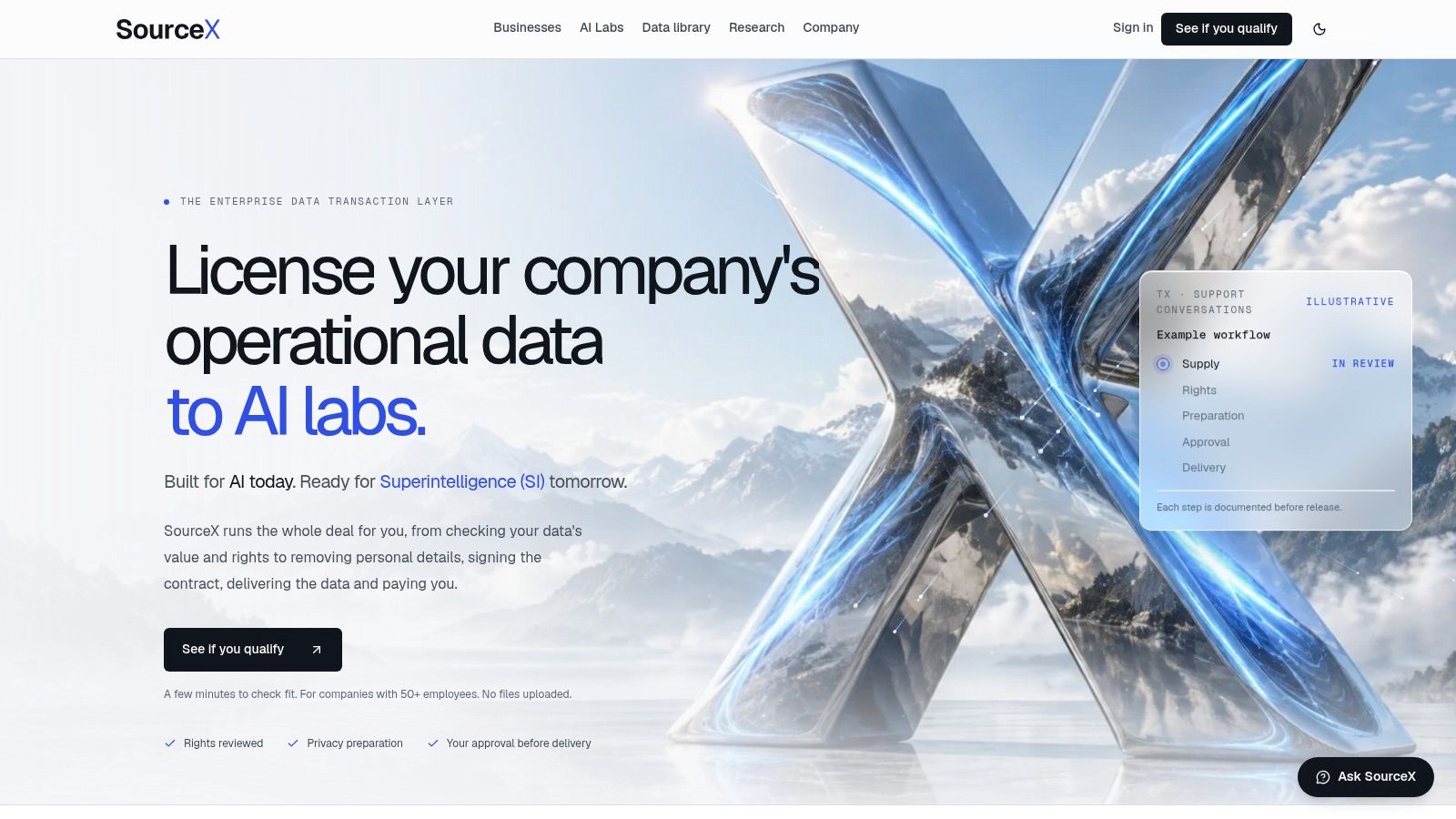
The useful distinction is control. SourceX can assess licensing potential without requiring uploads, map data across business systems and historical records, and create a private inventory describing source, depth, fields, and availability. It supports exports from systems such as Zendesk, Salesforce, GitHub, Jira, SharePoint, and Google Workspace, which matters because operational data rarely arrives in a clean warehouse schema.
Where the service fits
SourceX handles rights review, provenance confirmation, dataset-specific deidentification, pricing and terms, buyer outreach, negotiation support, agreement execution, packaging, and delivery coordination. Its workflow includes an evidence packet documenting system origin, licensing rights, purpose, and usage constraints before release.
That makes it a candidate for organizations with valuable support, sales, engineering, document, or finance records but without the internal capacity to build a buyer network and licensing operation. It isn't a replacement for a full internal data platform when the goal is continuous API delivery, embedded analytics, or high-frequency usage billing.
A company evaluating the SourceX data monetization platform should ask which transaction it needs:
- Operational dataset licensing: A fit when buyers need a defined corpus and the supplier wants approval over scope and permitted use.
- Continuous product delivery: Better served by an internal API, catalog, entitlement, and metering stack.
- Marketplace participation: Requires careful review of discovery, commissions, supplier control, and whether the operator can influence margins.
SourceX also addresses messy deal mechanics. Suppliers retain ownership of original data, deidentified datasets are subject to the stated ownership and intellectual-property terms, confidentiality applies, and selected data can be covered by permanent license terms that avoid retraining or deletion of models already built on it. Those terms need legal review for each dataset, especially where collection rights, prior AI licensing, or regional privacy obligations are unclear.
The strongest use case is a business that wants to commercialize rights-cleared operational data without handing control to an opaque intermediary. The weaker use case is a company that already operates a mature governed data-product stack and needs granular, real-time API monetization.
Pricing Data Products Without Destroying Trust or Margins
Pricing determines whether a data product remains profitable after delivery, support, governance, and infrastructure costs. A record-based fee can miss the value of a forecast, encouraging customers to optimize for volume instead of outcomes. A flat subscription can make heavy API users unprofitable. Per-query billing can give procurement an unpredictable budget and stop a product before technical evaluation begins.
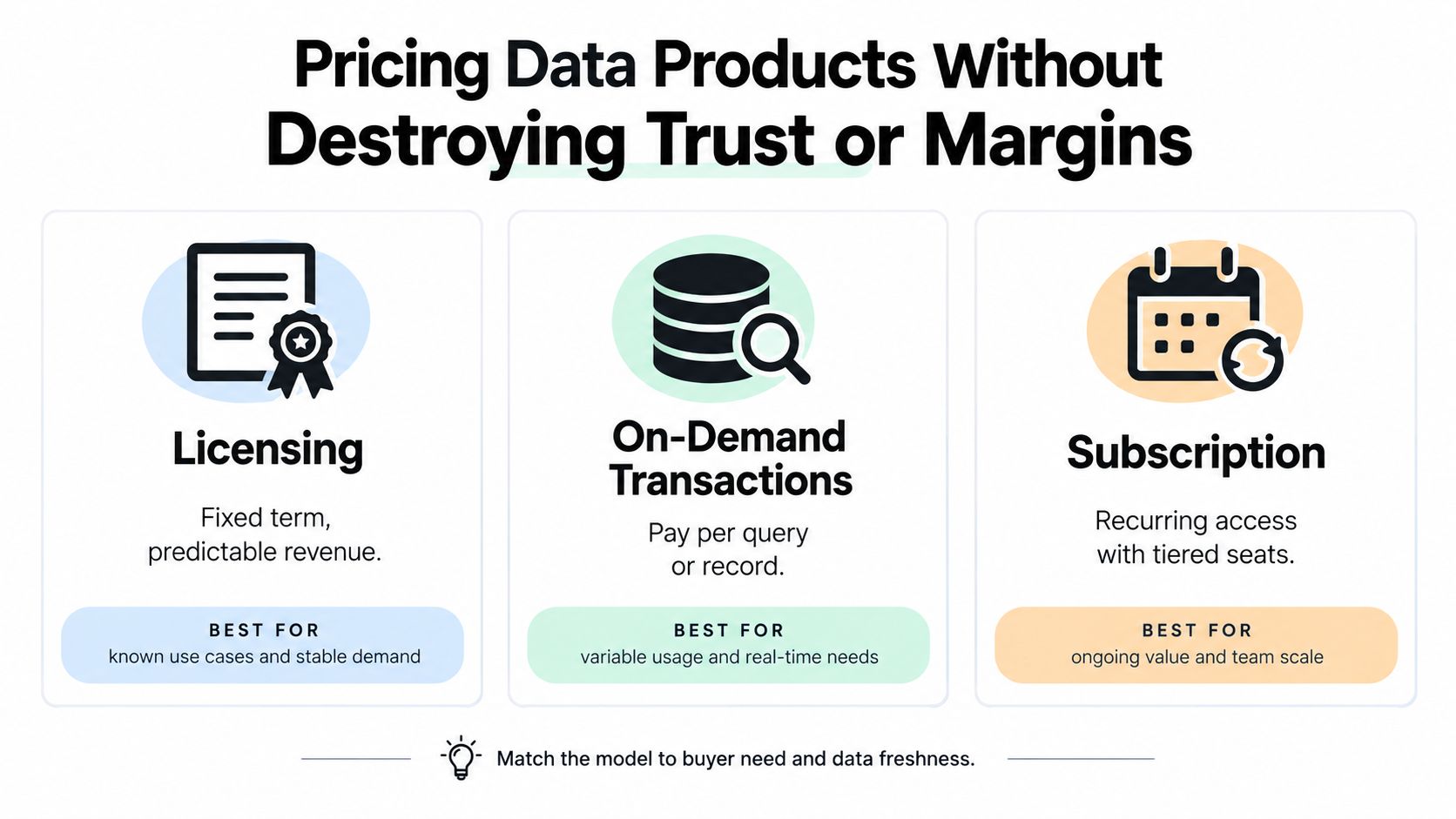
Choose a billable unit that buyers can understand and the provider can measure. Common mechanisms include licensing, on-demand transactions, subscriptions, and structured exchanges of value, as described in McKinsey's analysis of data marketplace models.
Choose the mechanic by buyer behavior
Licensing suits a defined asset, known scope, and predictable usage rights. The contract may specify a one-time fee, fixed term, renewal, or payment when the customer selects the data. This approach is easy to explain and govern, but revenue can become uneven when the product needs frequent updates, monitoring, or support.
On-demand pricing matches variable consumption. An IoT provider could offer a base dashboard and charge for API calls or processed sensor records. Revenue follows usage, but the provider must control quotas, absorb traffic spikes, resolve billing disputes, and address customer concern about invoices that are difficult to predict.
Subscriptions suit buyers who need stable access and a reliable budget. They work when the offer defines service levels, support, update frequency, and a usage allowance. Unlimited access should be offered only after the provider has measured the cost of high-volume customers. A hybrid can combine a base subscription with metered usage above an agreed threshold.
Price the characteristics buyers actually value
A useful rate card separates the underlying unit from the attributes that change its commercial value:
| Product characteristic | Commercial question |
|---|---|
| Freshness | Does more frequent updating change the customer's decision or operating cost? |
| Accuracy | What evidence supports the quality promise, and what remedy applies when quality drops? |
| Latency | Does the buyer need current results, or is periodic delivery sufficient? |
| Exclusivity | Does restricted access create measurable value for one customer? |
| Support | Are implementation, interpretation, and service recovery included? |
| Permitted purpose | Do model training, resale, or internal analysis require different rights or pricing? |
A marketplace can fund operations through transaction fees or commissions. The arrangement still needs scrutiny. If the operator controls discovery, billing, and buyer access while suppliers fund data preparation, the provider may lose bargaining power and margin.
The national bank example shows why reuse should precede expansion. A single data product deployed across more than 60 use cases generated USD 60 million in added revenue and USD 40 million in annual savings through credit scoring and automation, according to N-iX's data monetization strategy example. Those figures describe that specific case, not a pricing benchmark.
Start with a governed internal product and calculate its operating cost, reuse rate, support burden, and contribution to customer outcomes. Test external demand with a narrow offer, explicit usage rights, and a metered output that protects sensitive data. The pricing model should reward valuable use without making every additional customer a margin risk.
Internal Data Products as a Path to External Monetization
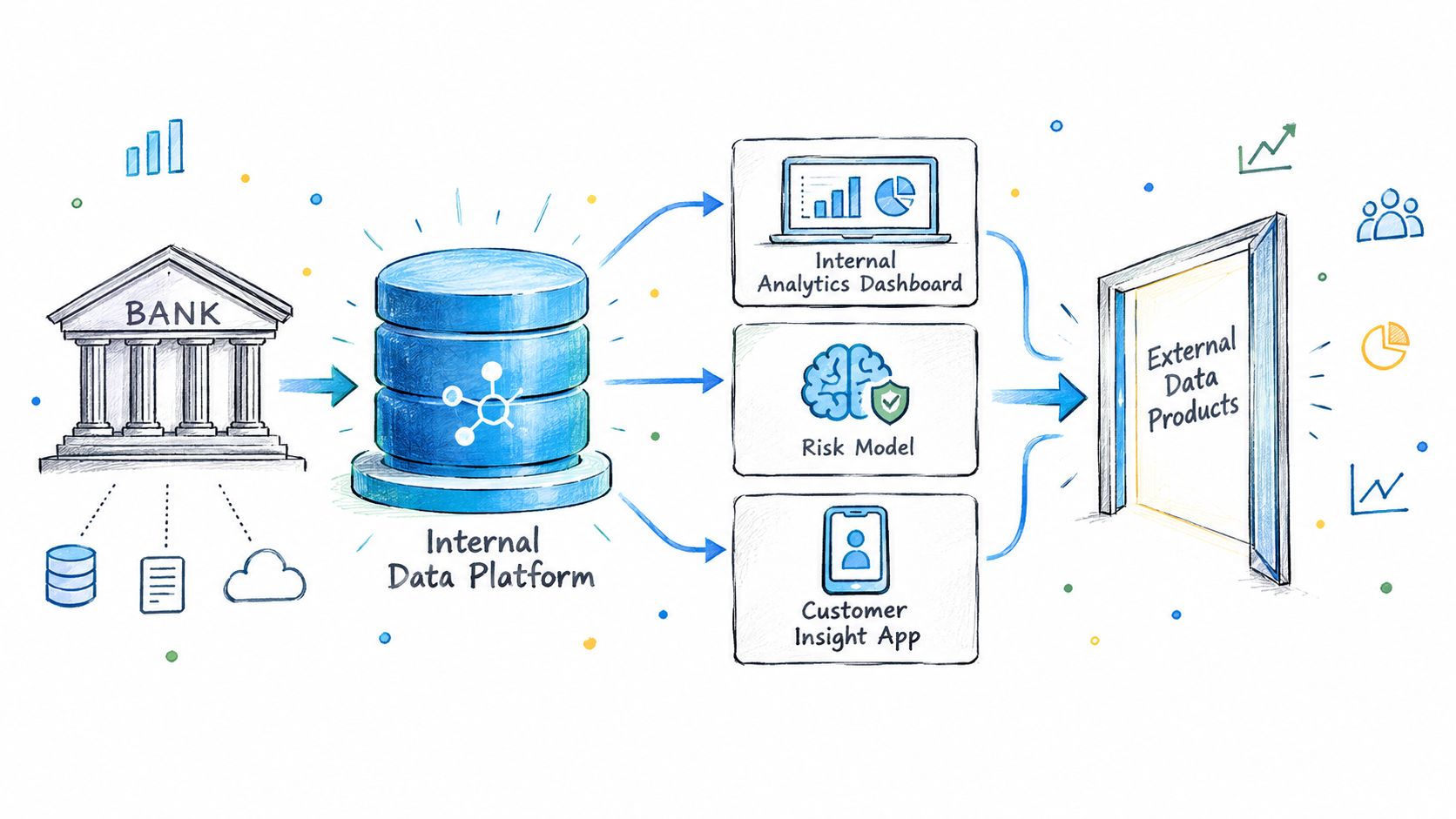
External buyers should come after internal proof, not before it. Internal teams provide a controlled setting for testing definitions, refresh schedules, quality checks, access rules, and support procedures before those commitments reach a contract.
A trusted internal product can later support an external benchmark, API, or analytics service. The external offer should expose the smallest governed output that solves a buyer's problem. It should not inherit every field, permission, or operational dependency available to internal users.
Prove reuse before expanding scope
The national bank example shows the value of reuse. One governed data product supported more than 60 use cases, including credit scoring and automation, with reported gains in revenue and annual savings. Those results belong to that specific example, not to the market as a whole or to a pricing model.
Reuse matters because it spreads development, infrastructure, and governance costs across multiple workflows. It also tests whether the product has a stable abstraction. If every department needs a different schema, definition, or exception, the organization may have built a set of custom reports rather than a reusable data product.
Track internal value in separate categories:
- Incremental revenue: New sales or improved conversion linked to the product.
- Avoided losses: Better risk decisions, fraud controls, or reduced leakage.
- Processing improvement: Faster decisions and less manual handling.
- Operating savings: Lower duplication, infrastructure costs, or support effort.
- Reuse: The teams, workflows, or customer segments using the same governed output.
Governance can speed this work when it is operational rather than ceremonial. Clear ownership prevents repeated debates, while shared policies and controls reduce review time for similar use cases. A catalog, policy template, and evidence packet give reviewers specific material to approve.
Externalize only what has earned trust
Before commercialization, confirm ownership, source permissions, quality thresholds, refresh schedules, permitted uses, and monitoring for any derived predictions. Test the output outside its original operational context. An internal risk score may rely on fields, workflows, or intervention processes that an external customer cannot reproduce.
The sellable product may therefore be a benchmark, documented signal, or managed service instead of a copy of the internal table. Buyers need to understand how the output was created, monitored, restricted, and corrected. That operating evidence often creates more commercial confidence than a larger opaque extract.
Start with a narrow external offer, explicit usage rights, and metering that limits exposure of sensitive data. Price and support it against measured operating costs, reuse, and buyer outcomes. Internal reuse earns the right to expand.
Proving Legal and Technical Safety Before Commercialization
A buyer shouldn't have to take your word that a dataset is safe. Before commercialization, the platform needs evidence for three separate questions: Can the supplier legally provide it? Can the buyer technically rely on it? Can both parties manage downstream risk?
The urgency is increasing as data-access obligations and privacy scrutiny evolve. The EU Data Act applies from September 12, 2025, introducing broader access to data generated by connected products and rules around fair use and compensation, as described in this analysis of moving data from asset to product. McKinsey also identifies increasing regulatory scrutiny and greater complexity when personal-data use depends on clear upfront consent.
Build an evidence packet
Classify each asset before it enters a commercial catalog. Separate personal, confidential, proprietary, synthetic, and public data. Then attach evidence to the product rather than keeping it in an email thread.
A useful packet contains:
- Provenance: Source systems, owners, collection context, and transformation history.
- Rights: Supplier permissions, contractual restrictions, consent basis where relevant, and permitted purposes.
- Quality: Definitions, validation results, freshness expectations, known gaps, and service-level commitments.
- Privacy: Deidentification method, aggregation logic, re-identification testing, and geographic controls.
- Commercial terms: License scope, retention, resale restrictions, model-training rights, and deletion obligations.
- Operations: Delivery method, incident process, correction workflow, and audit-log availability.
Represent the restrictions in both the contract and the API. A contract that bans resale but exposes unrestricted download access leaves the provider relying on enforcement after the fact. Machine-readable scopes, row or column policies, purpose tags, and revocation controls make the restriction operational.
Design for downstream combinations
Liability becomes harder when a customer combines your data with another dataset or uses it to train an AI system. Define what the supplier warrants, what the buyer must validate, how quality failures are handled, and whether derived outputs fall within the permitted use. Deletion workflows must cover the source product, delivery locations, caches, sandboxes, and any contractual downstream obligations that apply.
Technical reliability deserves equal attention. Version the schema, measure quality continuously, document service-level objectives, and retain enough event history to investigate disputes. A buyer should be able to distinguish a source-data change from a transformation change and a delivery failure.
Teams handling AI-related use cases should also monitor evolving obligations through practical resources on what AI law means for data and product teams. Legal review shouldn't happen only at contract signature. It should be triggered by changes to purpose, geography, fields, customer type, model use, or retention.
The result is more than compliance. Verifiable provenance, granular permissions, audit logs, and machine-readable restrictions can differentiate the product and support premium pricing because buyers can defend their own use of the data.
Building a Practical Data Monetization Roadmap
A useful roadmap starts with a business decision, not a marketplace. Identify a problem where a trusted data product can improve revenue, reduce cost, support a partner, or create a service customers already understand.
Then work through the following sequence:
- Inventory candidate assets. Record ownership, source, sensitivity, quality, update pattern, and likely buyer problem. Reject assets with unclear rights before engineering begins.
- Choose an internal use case. Use the asset where teams can validate definitions, quality, and operational value without introducing external contract risk.
- Define the product boundary. Decide whether the output is an API, benchmark, forecast, embedded metric, managed report, or controlled dataset. Remove fields that don't serve the stated purpose.
- Create the evidence packet. Capture provenance, permissions, transformations, privacy checks, quality expectations, and downstream restrictions.
- Implement the governed stack. Connect storage, catalog, lineage, quality monitoring, policy enforcement, access delivery, observability, metering, and billing.
- Select the billable unit. Use records, queries, API calls, devices, reports, seats, subscription access, or a fixed license only when that unit matches buyer value and provider cost.
- Pilot with controlled customers. Offer a sandbox, explicit limits, versioned contracts, and a feedback process. Watch support load and policy exceptions as closely as revenue.
- Measure reuse and margin. Track internal and external value separately, including revenue, avoided losses, operating savings, consumption, quality incidents, support effort, and corrections.
- Expand by policy, not by exception. Add tiers, geographies, purposes, and products through reusable controls. If every customer needs a bespoke bypass, the platform isn't scaling.
The organizations that sustain monetization don't treat governance as a final gate. They make it part of product design, pricing, delivery, and customer experience. That is how a data asset becomes a reliable commercial capability instead of a risky one-time sale.
If you're building or evaluating a data monetization platform, start with one candidate product and document its source, permitted use, quality promise, billable unit, and evidence trail. Before publishing it to buyers, use Humantext.pro to review the customer-facing documentation and make sure your technical and legal explanations read clearly, naturally, and credibly.
Pasiruošę paversti DI sugeneruotą turinį natūraliu, žmogiškai skambančiu rašymu? Humantext.pro akimirksniu patobulina jūsų tekstą, užtikrindamas, kad jis skambėtų natūraliai ir autentiškai. Išbandykite mūsų nemokamą DI humanizatorių jau šiandien →
Susiję straipsniai

AI Detector Score: What It Means and How to Use It
Understand AI detector scores, learn how they are calculated, and discover practical ways to interpret and use them for quality assurance and compliance.

10 Different Words for Sad: Ranked by Intensity and Tone
Explore different words for sad, ranked by intensity, register, and context, with example sentences and usage notes for writers and students.

AI Detector Essay Checker: A Step-by-Step Guide
Learn to use an AI detector essay checker with practical steps for students and teachers. Verify text authenticity, interpret scores, and humanize AI content

