How to Test AI: Metrics, Bias Checks and Detector Tests
How to test AI outputs step by step: set metrics, run bias and robustness checks, and verify text, image, video and voice content.
You're staring at a 70% AI probability score on a student essay, a freelancer's article, or a product image, and someone is waiting for you to decide what happens next. Penalize, publish, reject, or ask for a rewrite. That one number can't carry that decision on its own.
Learning how to test AI properly means treating every score as one signal inside a protocol. You define the decision first, set thresholds before you score anything, check who the system fails, and verify provenance separately. Do that, and a score becomes evidence. Skip it, and you're guessing with decimals.
Six Steps to Test an AI Output or System
A school I audited trusted one headline accuracy figure from a detector vendor. The overall number looked strong. It hid a cluster of false flags on short, edited drafts. The team didn't learn that until students appealed and nobody could rerun the original test.
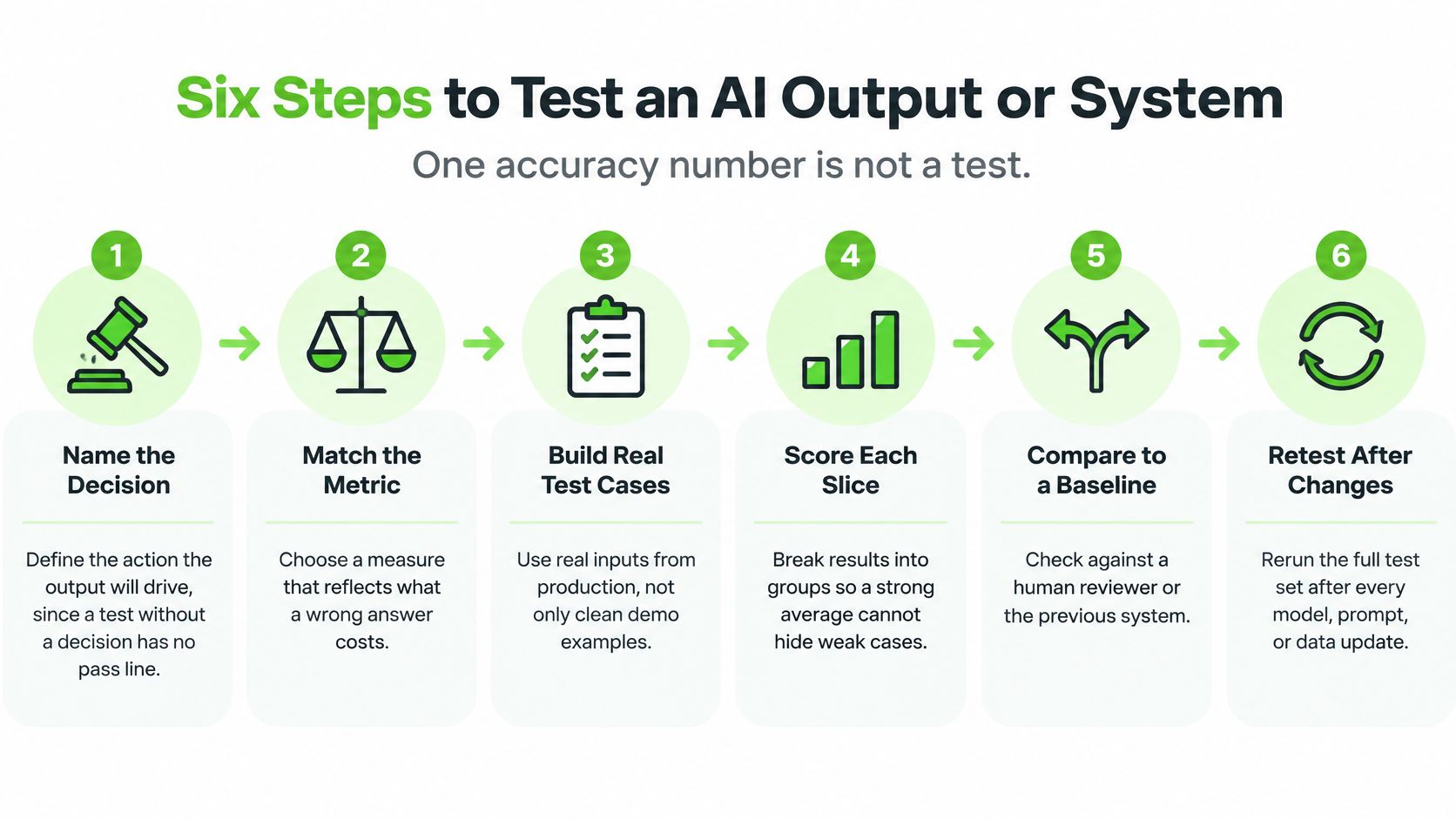
A Controlled Experiment in Six Moves
- Name the decision. State what the test supports, grading essays, approving a model release, or labeling media. Rate what a wrong answer costs, because a test without a decision has no pass line.
- Build a real test set. Pull 200 to 500 real items from your actual domains, languages, and user groups. Make roughly a quarter deliberately hard, including short texts, slang, edited drafts, and unusual images, so you don't test only average cases.
- Split the data. Separate development, validation, and untouched test sets. Keep the test set out of prompt tuning, or you'll tune to the exam instead of measuring generalization.
- Freeze the configuration. Lock the model version, prompt template, decoding settings, retrieval configuration, and hardware. If you can't repeat a run exactly, you can't compare two runs fairly.
- Run identically and log everything. Send every item through under the same conditions. Record the output, score, and timestamp for each item, not just the aggregate.
- Write the acceptance report. Include per slice results, confidence intervals, error examples, and trade offs. A model can gain accuracy while getting worse on calibration or spelling variation, and the report should say so.
The reference design here is HELM. HELM's standardized evaluation across 16 core scenarios, seven metrics, and 30 language models raised shared coverage from 17.9% to 96.0% of core scenarios. That jump shows what standardization buys you. Without it, teams compare models tested on different slices and call the gap a finding.
Practical rule: The test is done when the report answers the original decision, not when the headline number looks good.
Add human review for high impact outputs and keep a hidden regression set that's never used for tuning. Measure accuracy alongside calibration, resilience, fairness, latency, and efficiency, because any one of those can block a release even when accuracy passes.
Metrics to Track and the Thresholds to Set
A detector score is one signal inside a protocol, so the metrics have to expose where that signal breaks: false flags for non native writers, provenance that disappears after edits, and calibration drift between score bands. Write the thresholds before scoring. Moving them after results turns a test into a justification.
The figures below are illustrative starting points for a pilot, not established standards. Set them from the cost of a wrong flag versus a missed case in your own risk assessment, then freeze them.
| Metric | What it reveals | Starting threshold | Common trap |
|---|---|---|---|
| Precision | Share of flagged items that really are AI | 95% or higher for high stakes decisions | Drops when AI content is rare in your sample, because even a low false positive rate creates many false flags relative to true flags |
| Recall | Share of AI items the system catches | 80% or higher for screening use | Rises as you lower the threshold, usually at precision's expense |
| False positive rate | Human work wrongly flagged as AI | Below 1% on your human baseline for grading decisions | Hidden when reported only as overall accuracy |
| False negative rate | AI work that slips through | Set per use case and report by modality | Edited or paraphrased AI text drives it up |
| Calibration error | Whether a 70% score matches about 70% AI in practice | Gap under 10 points in every score band | A detector can rank items well yet stay miscalibrated |
| Subgroup gap | Difference in false positive rate between groups | Flag any gap above 2 percentage points | Aggregate scores hide it completely |
| Confidence interval | Uncertainty around each rate | Report beside every rate, no exceptions | Small samples give wide, misleading results |
| Latency per item | Time to return a result | Under 5 seconds for interactive review | Batch jobs need throughput, not single item speed |
Reading the Trade Offs
Precision tells you how often a flag is right. Recall tells you how many AI items you catch. Lower the decision threshold and recall climbs while precision usually falls. Choose the balance from the harm you named before the run, not from the score you hoped to see.
The false positive rate carries the human cost. A detector can report high overall accuracy and still wrongly flag a meaningful share of human essays, with the burden often landing on non native writers. Calibration is just as concrete. If items scored 70% AI turn out to be AI only about half the time, that score cannot support a penalty, whatever the ranking looks like. Understanding what an AI detector score actually means starts with that check.
Sample size decides whether any of this holds up. A 50 item pilot, treated as an example, produces intervals too wide for discipline or release decisions. Expand the sample until each subgroup interval is narrow enough for the action at stake, and report the interval beside every rate. NIST's statistical modeling work with 22 frontier model APIs across three benchmarks makes the same distinction: performance on a fixed benchmark and generalized performance on future items are different quantities, and naive analyses produce invalid uncertainty estimates.
For classifiers, report precision, recall, F1, ROC-AUC, and threshold analysis. For generative systems, add rubric based human evaluation with factuality, safety, calibration, and task completion. Treat the table as a first pass to tune to your risk, then lock it.
Detecting AI in Text, Images, Video and Voice
No single detector settles the question. A detector returns a signal, not a verdict, and each modality needs a different confirming check.
| Media type | Detector signal | Verify with | Main failure point |
|---|---|---|---|
| Text | Classifier score or statistical pattern score | Draft history, a second detector, a follow up discussion | Non native English and heavily edited text |
| Image | Visual artifact classifier plus C2PA Content Credentials | Validate the manifest and compare the asset hash to the original file | Resizing, recompression, or screenshots strip credentials |
| Video | Frame level classifier scores and any provenance record | Sample at least 10 frames across the clip and check the manifest | Re encoding, short clips, and cropped frames |
| Voice | Spectral classifier and any embedded watermark | Compare with a verified recording of the same speaker | Background noise, compression, and cloned voices built to pass |
Text and Images
Text detectors score a passage on statistical patterns, so the decisive test is whether a second source confirms the result. Run the same sample through two tools, for example GPTZero or ZeroGPT as the second check, and log every disagreement. Then look at draft history or ask the writer to explain the argument.
Images start with provenance, not pixels. C2PA Content Credentials bind a cryptographic manifest to an asset, recording origin, modifications, and AI use. Check the digitalSourceType field, where trainedAlgorithmicMedia marks content created by an AI or ML system, and confirm the asset hash matches the file you downloaded.
The walkthrough below shows how these checks fit together in practice.
Video and Voice
For video, sample at least ten frames spread across the clip, because a single frame can mislead you. Check the manifest alongside frame scores, especially after re encoding. A deepfake detector workflow for video and voice follows the same logic, one signal plus a confirming source.
For voice, compare the clip against a verified recording of the same speaker. Note background noise or compression in your log, because both lower confidence and both are common in real submissions.
If a credential is missing or the hash fails after resizing or recompression, report provenance unavailable or altered. That is not proof the work is human made.
Bias and Robustness Checks That Catch Hidden Failures
An overall accuracy score doesn't prove fairness. A detector can pass a clean test and still fail the exact people it serves, and the aggregate number will not tell you.
| Check | How to run it | Red flag |
|---|---|---|
| Non native writing sample | Test 100 or more essays each from native and non native writers | Non native false positive rate more than twice the native rate |
| Paraphrase test | Rewrite 50 AI texts with a different model or by hand | Detection drops by more than 15 points |
| Typo and spelling noise | Insert 2 to 5% character errors into each sample | Score moves more than 10 points from typos alone |
| Translation round trip | Translate each sample into another language and back | Flag rate shifts sharply for one language |
| Image transformation | Resize, recompress to JPEG quality 70, and crop 10% | Credentials fail or the detector verdict flips |
| Adversarial prompt | Ask the generator to write in a casual voice or with deliberate errors | Miss rate rises above your false negative target |
| Time drift | Rerun the same fixed set every month | Recall drops with no model or detector change |
Start With Who Gets Flagged
Build two equal groups of essays, one from native writers and one from non native writers, and compare false positive rates for each group separately. One study shows how wide that gap can run: controlled research on seven detectors found a mean false positive rate of 61.3% on authentic TOEFL essays by non native English speakers. A single aggregate rate hides exactly this kind of skew, because a low average can sit on top of a much higher rate for one small group.
Treat the score as a signal, not a verdict. If an essay scores 70% AI, don't impose a penalty from that alone. Compare drafts, request an oral explanation, review citation history, and test with more than one detector.
Then Break Your Own Inputs
Stress checks ask what happens when inputs get messy. Paraphrase AI text, add typos, round trip samples through translation, and recompress images. For each check, log the score before and after the change and decide in advance which shift triggers human review. A detector score is one input inside a protocol you designed, and the protocol only holds if you set the decision rules before you see the numbers.
Rerun these checks after every model or detector update. A score that held last quarter can drift without any visible change, and the monthly fixed set is how you catch it.
Sample Workflow for Checking a Batch of Content
A publisher receives 300 freelance articles a month and needs to decide which ones to hold for editorial review. Checking everything by hand isn't realistic. Trusting one detector isn't defensible.
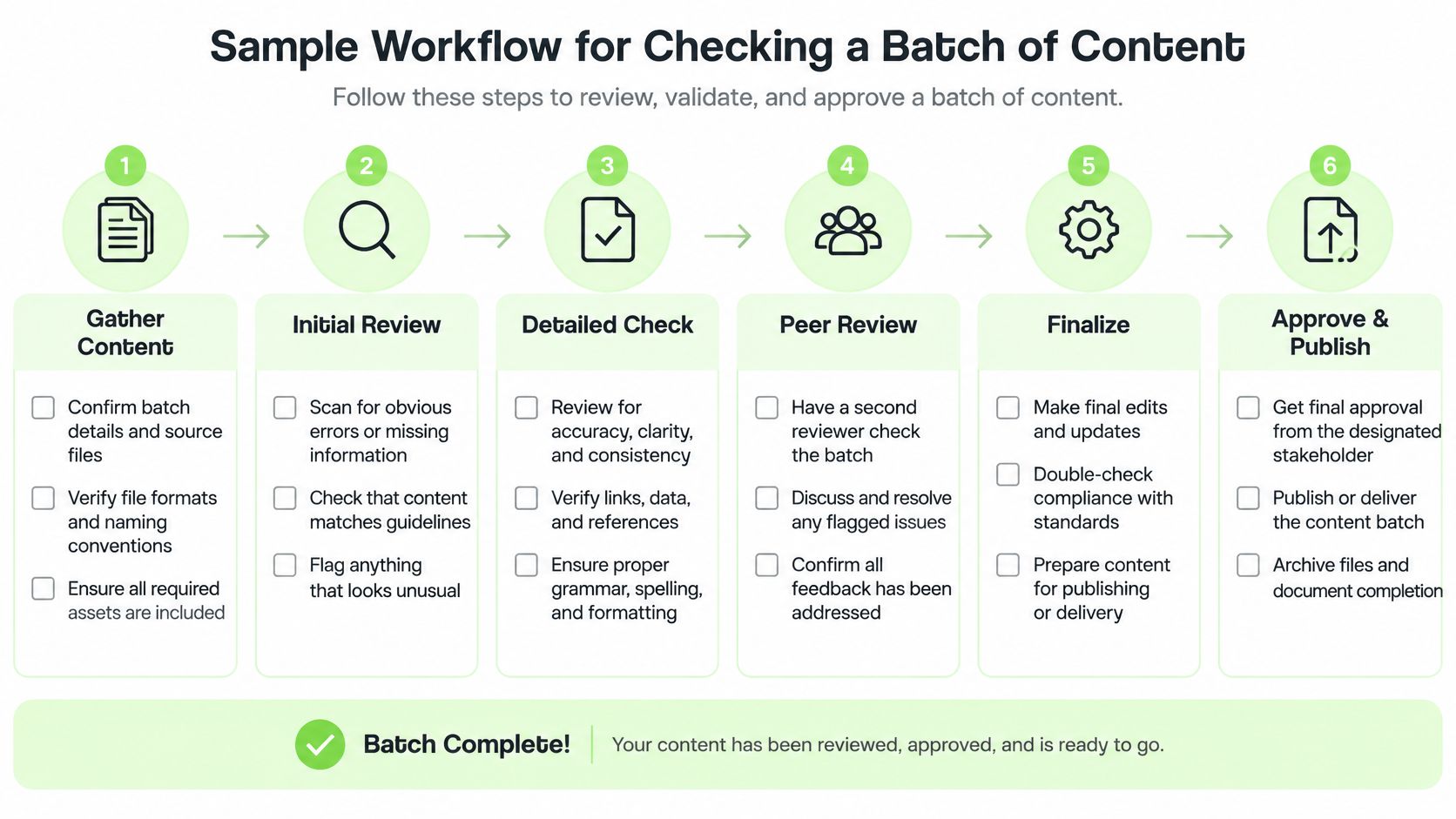
Every article gets scored by two detectors at intake, so the decision rule covers all 300 submissions. On top of that automated pass, the team samples 15% of submissions, weighted toward new contributors, for a human read regardless of score. The sample estimates the miss rate: how many articles below the publish cutoff still read as machine-written. Every result goes into a sheet with columns for writer, date, tool, and score. That sheet is the audit trail. Without it, a disputed flag becomes a memory contest.
The Decision Rule Comes First
The team writes the cutoffs before any scoring runs:
- 80% or above on both tools: Send the article to an editor for a full read and a draft history request.
- Between 30% and 80% on either tool, or the tools disagree: Give it a second read before any decision, and log the disagreement.
- Below 30% on both tools: Publish through the normal process described in your content quality assurance routine.
- Any high stakes case: Add human verification regardless of score.
The unsampled 85% follow the same rule. Sampling buys a calibration check, not a free pass.
Images in the Same Batch
Articles arrive with attached illustrations, so the disclosure check runs on every image in the batch, sampled or not. Record the generation date, note whether the image was substantially altered, and verify the machine readable mark survives export. Article 50 transparency obligations under the EU AI Act apply from 2 August 2026: synthetic content needs machine readable marking, and AI-generated material published to inform the public needs disclosure unless a person has reviewed it and holds editorial responsibility for it. For this publisher, the disclosure decision rides on the editor's sign-off, not on the tool's score.
What the Publisher Keeps
At month end, the publisher keeps one report. It lists the flag rate, review outcomes, and the number of detector disagreements. If disagreements cluster around one writer group or topic, that's a sampling problem to fix next month, not a verdict on those writers.
Set the rule before scoring: A threshold invented after results arrive will always confirm what the team already wanted to do.
Benchmark Scores and Reproducible Failures
A benchmark score is a starting point, not a verdict. Evaluate on a dataset the model never trained on and you measure whether it generalizes beyond its training examples. That says nothing yet about production readiness.
Scores also saturate fast. The 2025 Stanford AI Index reported that benchmarks introduced in 2023, MMMU, GPQA, and SWE-bench, gained 18.8, 48.9, and 67.3 percentage points respectively in a single year. A test that everyone passes stops separating systems. Test set quality matters too, so inspect invalid or ambiguous questions before crediting a gain.
Keep two questions separate. How did the system do on this fixed benchmark, and how will it do on unseen items drawn from your target population. NIST's AI Risk Management Framework treats these as different measurement problems, benchmark validity versus deployed risk, and conflating them produces confident wrong answers. Contamination checks sit with the first question, and spotting data leakage in LLM evaluations is a practical reference for keeping test items out of training and tuning corpora.
Make Failures Replayable
Reproducibility is where teams struggle most. A 2025 survey of more than 2,100 software development and testing professionals found 92% struggled with changing requirements, 87% faced inconsistent environments, 85% lacked testing time, and 84% had difficulty reproducing defects.
A failure you cannot rerun is a rumor, not a defect.
Discipline fixes this, not volume. Keep a versioned evaluation set that grows with each failure. Preserve every failing conversation with its prompt, model version, settings, and timestamp. Rerun failing items on the frozen configuration before filing a defect, across languages and user groups, so last quarter's failure can be replayed exactly.
Mistakes That Invalidate Results
Three errors quietly invalidate otherwise careful work. Each has a direct fix.
The Gut Check Trap
People are poor detectors. A 2025 Temple University study of 194 participants found identification accuracy of only 57%, slightly above chance. An impression is not a test.
Fix: Score a blind set against known origins before forming any view. Let the labels, not your reading instincts, set the baseline.
The Tuning Trap
Testing on prompts or items you already tuned against turns your test set into training data. Scores rise and tell you nothing about new inputs.
Fix: Keep a hidden regression set that nobody tunes against. Confirm none of its items appear in prompt examples, templates, or fine tuning data.
The Drift Trap
When two runs of the same items disagree, the cause is often infrastructure or a version change rather than the model. Teams blame the model and chase the wrong fix.
Fix: Diff the run sheet for model version, prompt, settings, and hardware, then rerun failing items on the frozen configuration. One rule covers all three traps. No result is reported until its full configuration is logged.
Run a Five-Sample Pilot Before You Trust Any Score
Don't debate detectors in the abstract this week. Run a five sample pilot on material you already have.
- Pick your fifteen. Choose five texts you know are human written, five you know are AI generated, and five edited hybrids. Known origin is the whole point.
- Score with two tools. Run all fifteen through Humantext.pro, which needs no signup and includes a 500 word trial, and through a second detector. Use identical text in both.
- Record every result. Log each score and whether it matched the known origin, in the same sheet format you'd use for a batch.
- Count errors by group. Tally false positives and false negatives separately for human, AI, and hybrid texts. Hybrids are where most methods wobble.
- Compare against your thresholds. Use the starting thresholds from the metrics table and decide whether the method fits the decision you named at the start.
Be plain about the limit here. Fifteen items only catch gross failures. They can't certify a method, support a penalty policy, or clear a release. Confidence intervals on fifteen items are wide enough to hide serious problems.
If the pilot passes, scale in stages. Move to a 300 item sample split by language and user group, then extend to 500 items per decision group before any release or penalty decision. That's how a quick sanity check becomes a test you'd defend to a student, a writer, or a regulator.
Run your pilot today with Humantext.pro, where you can check text, images, video, and voice for AI signals, compare results against other detectors, and humanize AI assisted drafts without losing meaning. It's privacy first, works across 26 languages, and fits the score plus verification protocol covered above. Start your free check at Humantext.pro and bring your fifteen known samples with you.
Pasiruošę paversti DI sugeneruotą turinį natūraliu, žmogiškai skambančiu rašymu? Humantext.pro akimirksniu patobulina jūsų tekstą, užtikrindamas, kad jis skambėtų natūraliai ir autentiškai. Išbandykite mūsų nemokamą DI humanizatorių jau šiandien →
Susiję straipsniai
Most Natural AI Voice in 2026: 7 Top Picks Compared
Find the most natural AI voice tools in 2026, from ElevenLabs to Murf. Compare prosody, language support, and pricing, and learn how to test samples yourself.

Storytelling in Marketing That Drives Real Results
Learn how storytelling in marketing drives results, craft memorable campaigns, measure outcomes, and avoid common pitfalls with practical frameworks.
Conversion Rate Improvement That Actually Moves the Needle
A hands-on guide to conversion rate improvement using proven CRO methods. Audit, test, and optimize for measurable lift without guesswork.

