
AI Disclosure Requirements You Must Meet in 2026
AI disclosure requirements under the EU AI Act hit on 2 August 2026. See who labels what, the exceptions, and a workflow you can run now.
Article 50 transparency duties apply from 2 August 2026, with machine-readable marking for certain systems already on the market deferred to 2 December 2026 and no retroactive labels for content created before 2 August 2026. The practical distinction is between what a provider builds into an AI system's output and what a publisher or other user tells the audience.
A generic AI-written sticker won't solve both jobs. Your team needs a technical provenance path, a publishing decision, and a notice that appears where people encounter the content. A human editor can change whether a visible text disclosure is required without erasing the underlying machine-readable mark.
Who Must Disclose What and by When
Build your release plan around 2 August 2026, the principal application date for Article 50 transparency duties, according to the European Commission's transparency obligations FAQ. The same guidance establishes the staged timetable below, including the limited transition for qualifying pre-existing systems and the absence of retroactive labelling.
AI disclosure duties and deadlines
| Duty | Who owns it | What people get | Applies from |
|---|---|---|---|
| AI literacy and general provisions | Providers and deployers | Staff who can recognise and use AI responsibly | 2 February 2025 |
| Notice of direct AI interaction | Providers | A clear statement that the person is interacting with an AI system | 2 August 2026 |
| Machine-readable synthetic-content marking | Providers of generative or manipulative systems | Markings or other means enabling detection of synthetic audio, image, video and other formats | 2 August 2026 |
| Marking for systems already on the market | Providers of qualifying pre-2 August 2026 systems | The same Article 50(2) marking and detection capability | 2 December 2026 |
| Deepfake label | Deployers | A clear, distinguishable, accessible label on synthetic or manipulated image, audio or video at first exposure | 2 August 2026 |
| Public-interest text disclosure | Deployers | Disclosure of AI-generated or manipulated text meant to inform the public, unless the editorial exception applies | 2 August 2026 |
| Older published content | No retroactive labelling duty | No retroactive label for content created before 2 August 2026 | Not required |
Read the literacy row as an organisational task, not a publishing badge. Staff need to recognise when they're using AI and understand the limits of the tools they operate. Giving an editor access to a generator without explaining disclosure responsibilities leaves a gap that a vendor contract won't close.
The direct-interaction row concerns the person using the system. For a customer-facing assistant, plan the notice into the opening interface rather than assuming users will recognise AI from the writing style.
The synthetic-content marking row concerns the output itself. Your technical owner should establish what the generator produces, how the mark can be detected, and whether ordinary processing preserves it. The transition row applies only to qualifying systems, not to every publication using an older tool.
Turn the calendar into release gates
The deepfake and public-interest text rows concern what the audience encounters. Assign those decisions to the people who publish, commission or distribute the output, rather than leaving them entirely with procurement.
The older-content row means you don't need to relabel an archive solely because its creation predates the application date. Keep creation records so your team can distinguish an old asset from a newly generated replacement.
Planning rule: Treat potential EU reach as a reason to assess scope before publication, not as a problem to investigate after a complaint.
If an output can reach EU users, confirm the applicable duties and have provenance handling, reader-facing notices and synthetic-media identification processes ready before the main deadline. The December transition is narrow, not a general extension for websites, newsrooms or marketing teams.
Providers Mark It and Deployers Show It
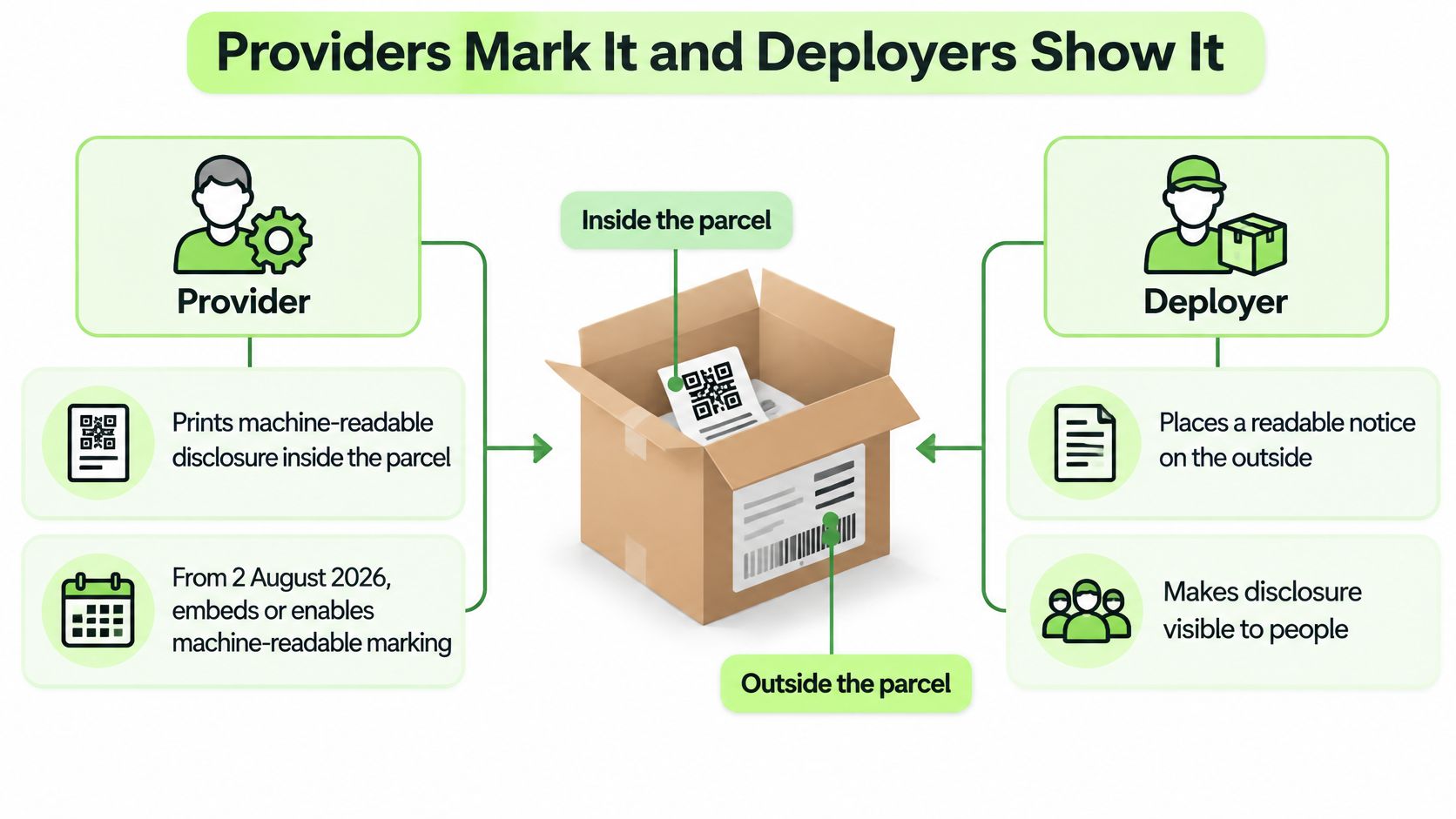
Think of a parcel. The provider prints a machine-readable barcode inside it; the deployer puts a readable note on the outside. A person shouldn't need a scanner to understand the note, and the scanner shouldn't depend on somebody remembering to attach it.
The European Commission's quick facts on transparency rules describe this division as a transparency-risk regime: providers enable machine-readable identification of synthetic content, while deployers make specified disclosures visible to people. The purpose is recognition, both when someone interacts with AI and when they encounter AI-generated material.
The parcel analogy separates the responsibilities without suggesting either can replace the other.
Where commercial handoffs fail
Say a newsroom buys a generator that supplies detectable provenance. Its production team exports an image, adds a caption and publishes it through a template that hides the disclosure below unrelated recommendations. The technical marking doesn't rescue an inadequate reader-facing notice.
Reverse the problem. A vendor displays an excellent AI banner but hasn't implemented the required marking or detection capability for synthetic outputs. The banner addresses what a person sees, not what downstream systems can identify.
These are different acceptance tests:
- Technical acceptance: Can the responsible team identify the marking or detection mechanism and demonstrate what survives export?
- Editorial acceptance: Has someone classified the asset and recorded whether a visible notice is required?
- Interface acceptance: Can an ordinary reader perceive that notice when encountering the asset?
Don't ask procurement to certify all of this with a single checkbox. Put the technical questions in vendor review, the content decision in editorial review, and the display test in publishing quality assurance.
Headquarters don't settle responsibility
A company outside the EU shouldn't assume its office address ends the analysis when it serves European users or distributes into the European market. Map the service, audience and publishing role before deciding which obligations apply.
The calendar also represents different workstreams: staff capability, principal transparency controls and a limited legacy-system transition. Assign an owner to each rather than treating them as interchangeable deadlines. For a closer explanation of the legal split, use the Article 50 guide alongside your product and publishing review.
Your team should be able to produce a written disclosure decision, a provenance method and a notice a non-technical reader can perceive. If nobody can show one of those artefacts, the handoff isn't complete.
Labels People Can See and the Editorial Exception
A weak label says AI may have been used and sits in a footer. A useful label identifies the actual involvement and appears beside the material before the reader mistakes it for an authentic recording or wholly human-produced account.
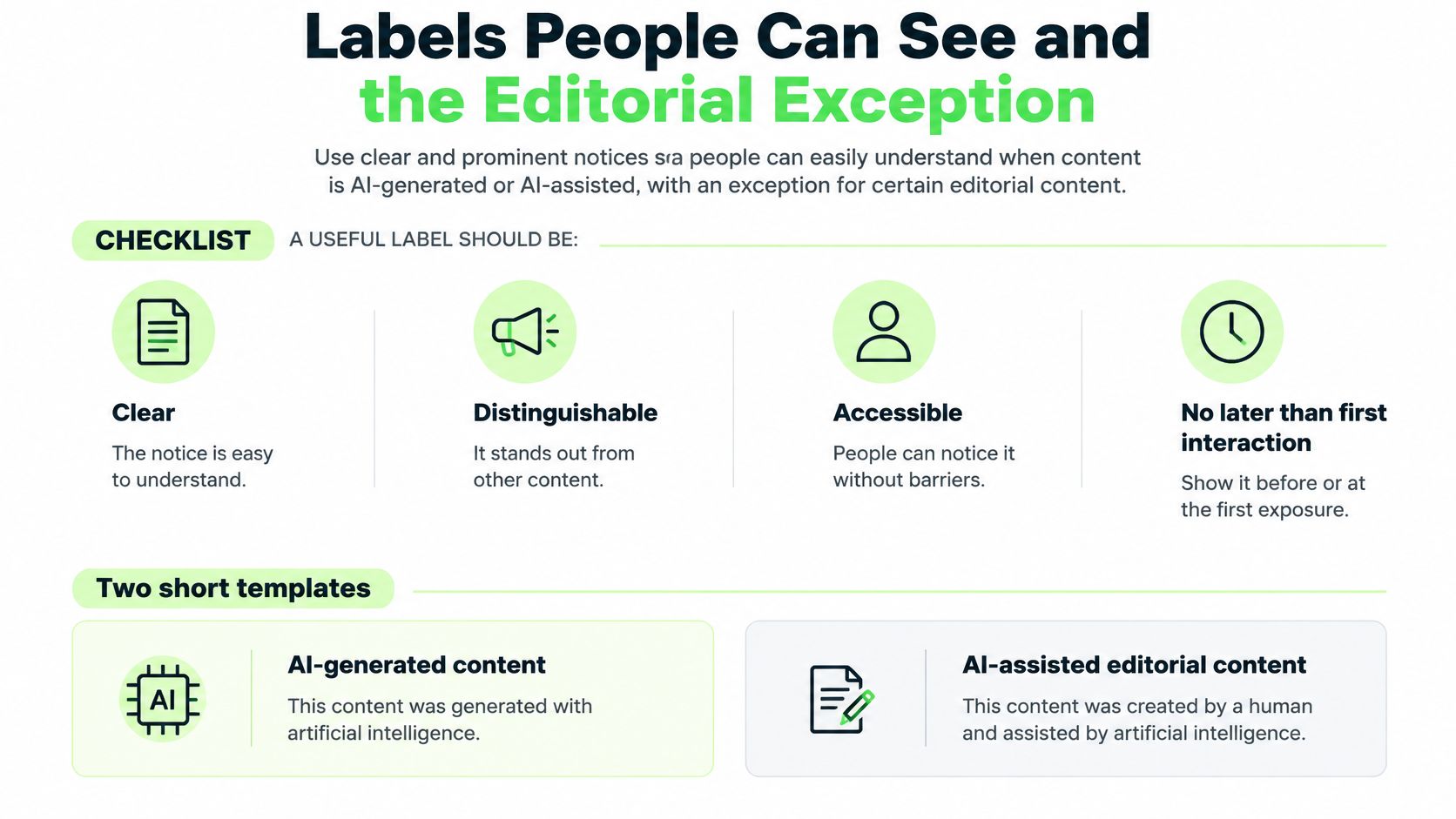
Under the Article 50 text published by the EU AI Act Service Desk, the relevant disclosure must be clear, distinguishable, accessible and provided no later than first interaction or exposure. Deepfake media and public-interest text need separate decisions because the text exception isn't a general exemption for every edited asset.
Write the notice for the actual asset
Use wording like these examples, adapting it to what happened:
- Synthetic image template: This image was generated with AI and does not depict a photographed event.
- AI-assisted article template: Parts of this article were drafted with AI and reviewed by the named editor before publication.
Replace the editor description with the actual responsible person. Don't describe a manipulated photograph as entirely generated, or imply that an unverified reconstruction shows a real event.
For a video, put the notice in the viewing experience rather than only in a description that disappears when somebody embeds the clip. For audio, design an audible disclosure where appropriate, not just a visual caption that listeners never encounter.
Use this checklist when reviewing the final interface.
Human editing changes the text decision
The text exception concerns material that has undergone human review or editorial control, with a natural or legal person holding editorial responsibility. That can remove the visible public-interest text disclosure obligation; it doesn't automatically remove provider-side provenance requirements.
An editor's approval can change the text-label decision. It doesn't turn a synthetic video into authentic footage.
A casual glance at a draft isn't a useful basis for claiming editorial responsibility. Require the reviewer to check facts, sources, meaning and suitability for publication, then record who accepts responsibility.
Don't stretch this exception to unreviewed chatbot answers or a deepfake video. It also isn't permission for a student to pass off AI-assisted work as original under a school's academic rules. For media-specific decisions, consult the deepfake disclosure rules guide.
Keep an audit record containing:
- Generation details: Model or tool and transformation history.
- Human accountability: Reviewer and editorial owner.
- Publication evidence: Channel, label shown at first exposure when required, and the reason for any exception.
Test generation-time provenance and the interface separately. A clean editorial record can't show whether a mobile reader saw the notice.
What Changes Outside the European Union
Disclosure rules by place the audience sits
| Where the audience is | Binding content rule in 2026 | Typical owner | What to do in practice |
|---|---|---|---|
| European Union | Article 50 transparency framework, with a limited marking transition for qualifying existing systems | Providers and deployers | Assess machine-readable marking and perceptible-notice duties separately |
| United States | No single federal law labelling all AI content; FTC deception rules and state deepfake or political-ad laws can apply | Advertisers, campaigns and platforms | Check whether silence would mislead and review the relevant state rules |
| United Kingdom | No direct Article 50 equivalent; consumer, advertising and data rules remain relevant | Publishers and advertisers | Explain AI use where omission would mislead |
| Canada | Content labelling is a patchwork; Ontario job-posting AI disclosure concerns hiring rather than media labels | Some employers and publishers | Keep recruitment notices separate from publishing disclosures |
| Any headquarters serving EU users | EU duties can reach relevant services and publications beyond EU-based organisations | The responsible provider or deployer | Assess EU reach instead of relying on the office address |
For the United States, don't translate the absence of a universal federal label into permission to conceal material facts. A fabricated endorsement, political clip or synthetic testimonial needs a review of the representation being made, the audience and applicable state rules. A general AI policy page doesn't explain a misleading individual advertisement.
For the United Kingdom, evaluate the impression a reader receives. If an advertiser presents a synthetic person as an actual customer, the problem isn't merely whether AI appears in the credits. The team must examine the claim, the presentation and the relevant advertising and privacy expectations.
For Canada, separate employment processes from published media. Ontario's employer job-posting disclosure concerns AI in hiring; it isn't a universal instruction to place an AI label on every article. Recruitment and editorial teams should maintain distinct templates rather than reuse the same notice.
A syndication decision
Say a US magazine distributes a synthetic photo essay to EU readers. If the images qualify as deepfakes, the publisher should apply the relevant perceptible disclosure and preserve provenance even if its home state has no matching requirement. A stylised illustration shouldn't automatically be classified identically to a realistic fabricated news photograph.
Ask the syndication partner what happens to captions, image overlays and embedded metadata. A notice that survives on your website may disappear in the partner's feed.
Follow the strictest applicable regime for the distribution you actually undertake, not simply the rules nearest your headquarters.
Use a broader guide to AI law to organise the questions, then obtain jurisdiction-specific advice for contested cases. Don't assume a US or UK policy page satisfies EU asset-level duties.
Enforcement Risks and Who Gets Caught
Rank exposure by audience, representation and likely harm. A realistic synthetic news photograph distributed publicly deserves a different review from an internal brainstorming draft. Both need responsible handling, but they don't necessarily trigger the same publishing duties.
A missing disclosure can become a regulatory issue where a legal duty applies. It can also breach a publication agreement, a client policy or a school's academic rules without becoming the same kind of enforcement case.
Build a file that answers the complaint
Prepare evidence around the questions a reviewer would reasonably ask:
- What did the audience see? Retain the published asset and evidence of the notice's placement.
- What technical identification existed? Keep the provenance file and the relevant provider documentation.
- Who approved publication? Name the reviewer, editorial owner and person who decided whether an exception applied.
These records help distinguish a display failure from a classification error or a missing technical control. They also give your team something concrete to correct instead of arguing over whether the material looked AI-generated.
Give complaints a correction path
Outside the EU, assess whether the same asset raises deception, political-advertising, deepfake, advertising or data-protection concerns. Don't treat an AI label as a defence to an otherwise misleading claim or unlawful use of someone's identity.
A student essay submitted without the required acknowledgement generally calls for the school's academic process, not an automatic assumption of a regulatory fine. Equally, a detector score alone shouldn't determine misconduct.
Name an enforcement contact who can assemble the asset record within a working day as an internal service target. Give that person authority to pause distribution, restore a missing notice, notify syndication partners and document the correction. A complaint shouldn't spend days moving between marketing, engineering and legal while the same unlabeled asset remains live.
Examples for Newsrooms Workplaces and Classrooms
In the 2025 KPMG–University of Melbourne study covering more than 48,000 people in 47 countries, 40% of employees said their workplace had generative-AI guidance, while 57% said they had hidden AI use and presented AI-generated work as their own, according to Fast Company's account of the study. Those are employee findings, not measurements of student behaviour.
Different teams need different records, even when they use similar tools.

A regional newsroom
A newsroom publishes an AI-illustrated flood map with a realistic generated scene. The editor separates verified geographic information from illustrative material and applies the media template, using the on-image notice AI-generated illustration at first view.
The text exception doesn't remove an applicable image disclosure duty. Nor should the label imply that generated flood boundaries are verified measurements.
Keep: the label text, model name, provenance result and caption owner in the CMS asset record.
A marketing team
A team uses AI to draft a product email that isn't intended to inform the public on a matter of public interest. That particular text-disclosure duty may not require a label, but the client's policy can still require acknowledgement.
The internal approval note reads AI-assisted, edited by the campaign editor, with the actual editor named. If the team also uses a video-production resource such as the ShortGenius AI ad generator, review the resulting media separately rather than treating approval of the email as approval of every campaign asset.
Keep: the approval note, reviewer name and relevant detector or provenance result in the campaign file.
Use the accompanying video as a discussion prompt for your team's disclosure training.
A classroom submission
A student submits an essay without acknowledging AI assistance. The school policy states: Students must disclose the tool used, explain its contribution and retain sources and revision notes.
The teacher asks the student to explain the argument and drafting process. A detector can prompt that conversation, but it shouldn't replace the student's sources, revision history or opportunity to respond.
The corrected acknowledgement identifies the tool and the actual assistance, such as outlining or language revision. Keep: that acknowledgement, the teacher's review record and any detector result with its limitations noted.
Run the Disclosure Workflow and Get Ready by August 2026
Make disclosure a repeatable publishing process, not a final-minute search for an AI badge. In 2025, 41.2% of corporate reports mentioned AI as a risk, but only 4.3% contained substantive AI-risk disclosure, according to the AI Risk Observatory's analysis of corporate reports. Mentioning the topic isn't the same as documenting how your organisation handles it.
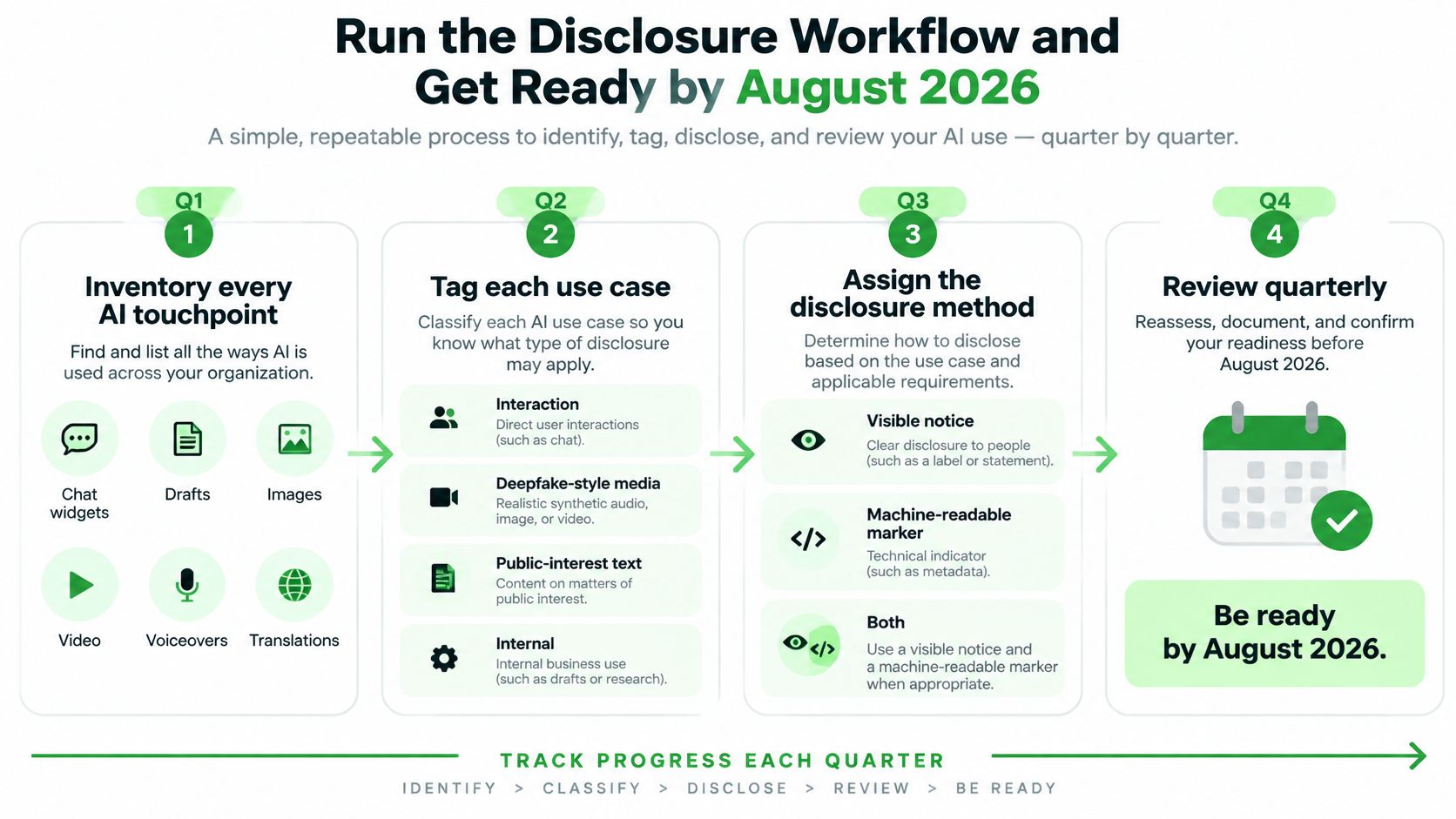
Use this roadmap to assign responsibilities, then maintain an asset-level record.
Put the workflow into production
Inventory every AI touchpoint. Include chat widgets, drafts, images, videos, voiceovers and translations. Record embedded AI features as well as standalone generators.
Classify the use. Tag each asset as an interaction, potential deepfake, public-interest text or internal draft. Flag uncertain classifications for review instead of forcing them into a convenient category.
Record the provider. Document whether the system emits machine-readable marking or enables detection. Log gaps and test what happens after export, compression or syndication.
Assign a deployer owner. Write the exact notice for each channel. A webpage, audio feed and embedded video need different placement decisions.
Document editorial exceptions. Name the human reviewer and editorial owner, explain the review undertaken and retain the provenance log even when the visible text notice isn't required.
Place the notice at first exposure. Test mobile views, screen readers, embeds and previews. The common failure is a correct notice that never reaches the reader because the template hides or strips it.
Review high-stakes assets before publication. Use appropriate text and media detection alongside source verification and provenance checks. Humantext.pro offers text, image, video and voice detection and a free 500-word trial; compare text results with tools such as GPTZero, Turnitin or ZeroGPT where appropriate. The common failure is treating a humanizer pass or detector score as permission to omit a required disclosure.
Store the audit row. Retain the tool, edits, reviewer, channel, label and detector result. Record uncertainty rather than turning a probability score into a factual authorship claim.
Schedule continuing review. As an internal operating cadence, review readiness monthly until the principal deadline, then reassess at model changes and conduct a quarterly inventory. Assign the next review when closing the current one.
Make the readiness decision explicit
Connect these checks to your editorial calendar. TheContentMap's guidance on how to set content planning goals and horizons can help teams reserve review capacity instead of discovering compliance work on publication day.
This month, identify systems reaching EU users, add applicable notices to templates and name an editorial owner for every exception claim. Test a combined text-and-image asset through placement, verification and record retention. Put the limited legacy transition in your calendar only after confirming eligibility.
For procurement, we ask customers who need more than our listed plans to contact us. Clicking our Subscribe button means agreeing to our Terms of Service and Privacy Policy.
Ready means every applicable duty has evidence. If a required marking path or reader-facing notice is missing, pause publication until the gap is resolved. Where no notice is required, retain the reason rather than leaving an unexplained blank.
Humantext.pro offers AI detection for text and media, plus text-humanising tools for improving AI-assisted drafts while preserving meaning. Visit Humantext.pro to check a draft or media asset, then retain the result alongside your disclosure decision and editorial review. Use those checks to support your workflow, not to replace required provenance or audience notices.
Bereit, Ihre KI-generierten Inhalte in natürliche, menschliche Texte zu verwandeln? Humantext.pro verfeinert Ihren Text sofort und sorgt dafür, dass er natürlich und authentisch klingt. Testen Sie unseren kostenlosen KI-Humanisierer →
Verwandte Artikel

10 Best AI Detector Online Tools Compared in 2026
Compare the 10 best AI detector online tools of 2026: how they work, accuracy limits, privacy, free access, and which audience each one fits.

EU AI Act Compliance: A 2026 Action Guide
EU AI Act compliance for 2026: deadlines, risk classes, Article 50 labels, audit records, and a practical workflow for publishers and businesses.
Incorporating Paraphrasing Restating or Generating in New Form: A Guide
Learn incorporating paraphrasing restating or generating in new form so drafts stay clear, cited, and original. Step-by-step checks inside.

