What Is Natural Language and How Does It Shape AI
Learn what is natural language, how its layers of meaning work, why ambiguity matters, and how NLP and AI turn human communication into usable technology.
Natural language is spoken, signed, or written communication that develops through use in human communities, rather than a code engineers deliberately design. The Ethnologue reference tradition documented 7,099 living languages in its 20th edition, published in 2017, reflecting the many distinct systems people use to communicate. (Ethnologue language-count reference)
You may be looking at an AI draft right now that reads smoothly but still feels a little off. Perhaps the wording is polished, yet the emphasis lands in the wrong place, a pronoun points to the wrong person, or the tone doesn't fit the audience. That uneasy feeling is useful: it can signal that fluent sentences have failed to carry the intended meaning.
To understand why, it helps to look beyond the usual contrast between human language and computer code. Natural language works through syntax, which organizes words; semantics, which contributes meaning; and pragmatics, which connects an utterance to its situation. The way those layers interact explains why a sentence can sound natural and still say the wrong thing.
A Clear Definition of Natural Language
An editor's draft can be grammatically correct and still say the opposite of what was intended. “The editor approved the change” differs from “The editor didn't approve the change” by one small word. A reader can understand both sentences immediately, yet only one matches the writer's purpose. For a marketer reviewing AI-generated copy, that distinction matters more than whether the sentence sounds fluent.
Natural language is communication that people develop and use in communities, in spoken, signed, and written forms. Its patterns are learned through interaction, then adapted to new speakers, audiences, and situations. Words can convey literal meaning while also expressing politeness, identity, humor, urgency, or uncertainty.
There is no single template shared by every natural language. Even deciding whether a variety counts as a language or a dialect can be contested: the classification may depend on its history, how speakers understand one another, and social or political conventions. A language catalogue is therefore a way to organize human communication, not a perfect map of clear-cut boundaries.
A working definition, not a dictionary label
Consider “Could you open the window?” Grammatically, it asks whether someone has the ability to open it. In a room where the window is shut, a listener will often hear a courteous request instead. The situation supplies information that the sentence leaves unstated. For writers, this is a reminder that a line can be clear word by word but still come across differently from what they intend.
Students practicing grammar, close reading, or writing can use English Language exam prep to build the habit of noticing how wording shapes meaning. That habit also helps when editing AI-assisted text. Ask not only, “Does this sound right?” Check whether the draft preserves the intended people, action, tone, and purpose.
Natural language is best understood as communication shaped by both shared conventions and the circumstances in which people use them. That explains why fluent AI text can still misfire: it may produce plausible wording without matching the relationship between writer, reader, and situation. It also gives writers a practical test. Read a sentence in its intended context, then ask whether a real reader would infer the same point.
The Linguistic Layers That Carry Meaning
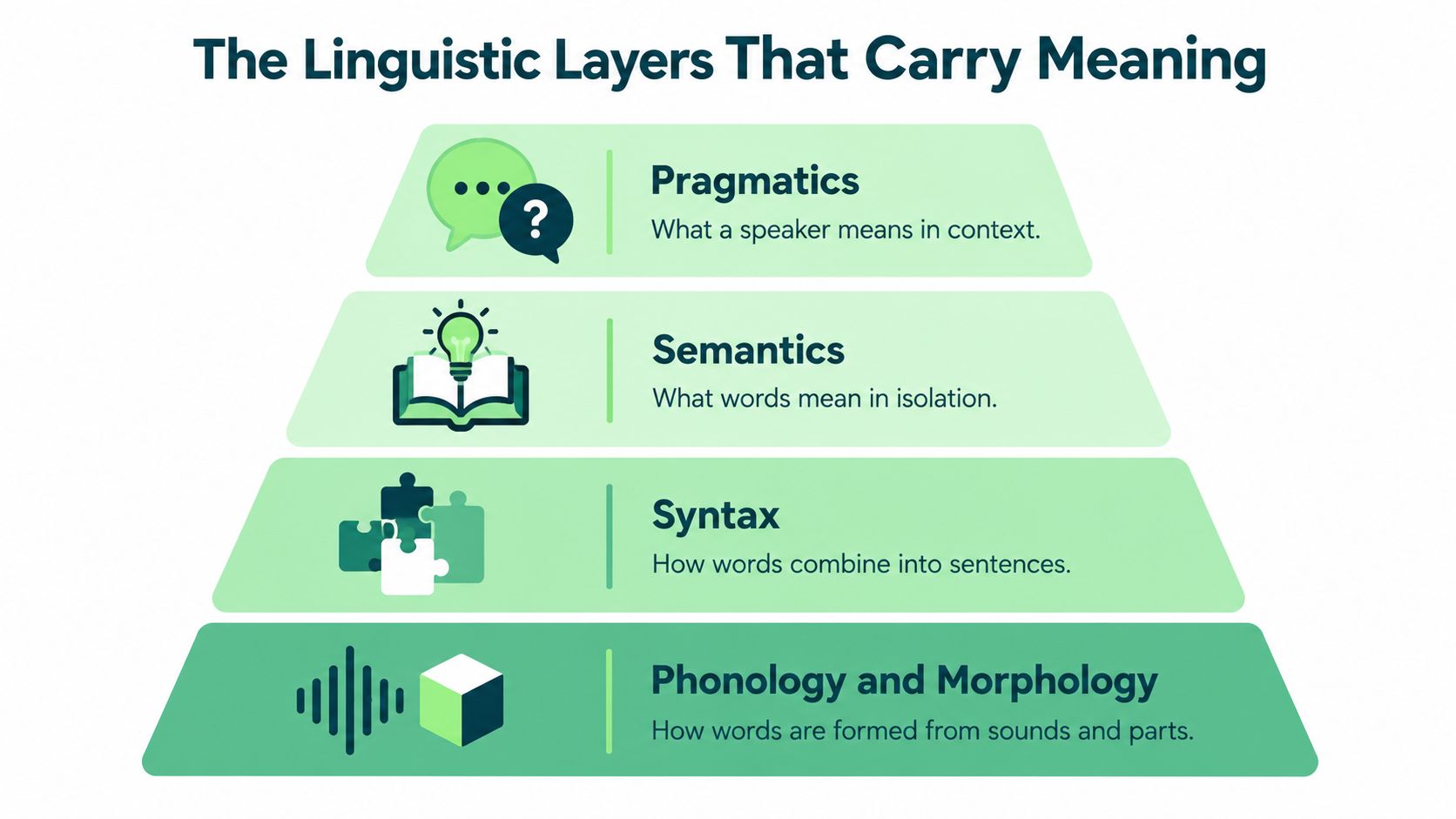
Think of a sentence as a small structure built from several kinds of information. A listener doesn't just match words with a dictionary. They recognize sound patterns, identify word parts, work out how the words fit together, and use context to infer what the speaker means. Stanford's NLP curriculum describes natural-language processing as an intersection of computer science, artificial intelligence, and linguistics, with tasks that span morphemes, syntax, and semantic representations. (Stanford NLP curriculum)
From sounds and word parts to sentence structure
Phonology concerns the sound patterns of a language. In English, the difference between the first sounds in “bat” and “pat” can distinguish words, so a listener has to recognize sound contrasts that matter in that language.
Morphology looks at how meaningful parts combine inside words. In “walked,” the ending “-ed” marks past time; changing it to “walks” changes the grammatical information.
Syntax is how words combine into sentences. Compare “The dog chased the cat” with “The cat chased the dog.” The same nouns and verb appear, but word order changes who did what.
If you're comparing word meaning and the associations a word carries, this guide to denotative and connotative meaning offers a useful companion concept. For a different language, sentence structure may use different patterns; a practical introduction to Irish sentence structure can help you notice those differences instead of assuming English word order is universal.
From literal meaning to meaning in context
Semantics concerns what words and sentences mean. “The glass is empty” describes a glass without anything in it, though context may suggest a next step, such as refilling it.
Pragmatics is how a situation changes what someone means. “It's cold in here” can describe the temperature; said beside an open window, it might indirectly ask someone to close it.
Discourse concerns how meaning connects across sentences. In “Maya dropped the cup. It broke,” readers link “it” to “the cup,” rather than treating the second sentence as an unrelated observation.
These layers matter because a system can produce grammatical sentences without interpreting a request, reference, or implied intention correctly. Syntax can look right while pragmatics goes wrong. When editing a draft, check that the sentence structure, literal meaning, intended implication, and links to earlier sentences all support the same message.
Natural Language vs Formal and Computer Languages
Natural language and formal languages both rely on patterns, but they use those patterns differently. People develop natural language through shared use. Engineers design formal languages, such as programming and query languages, to specify operations or represent information in ways a system can parse.
| Dimension | Natural Language | Formal / Computer Language |
|---|---|---|
| Who creates it | Communities develop and adapt it through use. | Designers define its symbols and rules. |
| How strict the rules are | Patterns vary by context, dialect, and convention. | Syntax rules are defined so systems can parse expressions. |
| Where ambiguity lives | Words, sentence structure, intent, and context can all be ambiguous. | Meaning is intended to be constrained by explicit rules and definitions. |
| How meaning works | Speakers and readers draw on shared knowledge and situation. | Meaning depends on defined symbols and operations. |
| How errors behave | People often infer intended meaning despite mistakes. | A syntax error may prevent a program or query from running as intended. |
The table describes tendencies, not a claim that people always understand one another or that formal systems never produce unexpected results. A listener may misunderstand a vague sentence; a program may run while giving an unintended result. The difference is that formal languages are built to make rules explicit enough for a machine to process, while everyday communication routinely leaves some meaning unstated.
Why the boundary isn't a wall
Natural language tolerates fragments, variation, and implied meaning. A person might answer “Coffee?” with “Please,” and the exchange makes sense because both people infer the missing structure. A program generally needs its inputs to follow the grammar and conventions its designers established.
Yet the two kinds of systems aren't opposites. Programming languages use words such as if and return; databases accept queries; regular expressions describe patterns in text. These formal tools borrow familiar ideas and words, even though their rules are narrower and more explicit.
That overlap helps explain the appeal of language-based AI. People can give directions in ordinary wording, while a computational system attempts to map those words onto a task. But the ability to accept natural-language prompts doesn't remove the difference between interpreting a person and following a defined command. A useful test for a writer is to ask whether a sentence depends on shared context that the reader or tool may not have.
How NLP and AI Learned to Handle Human Text
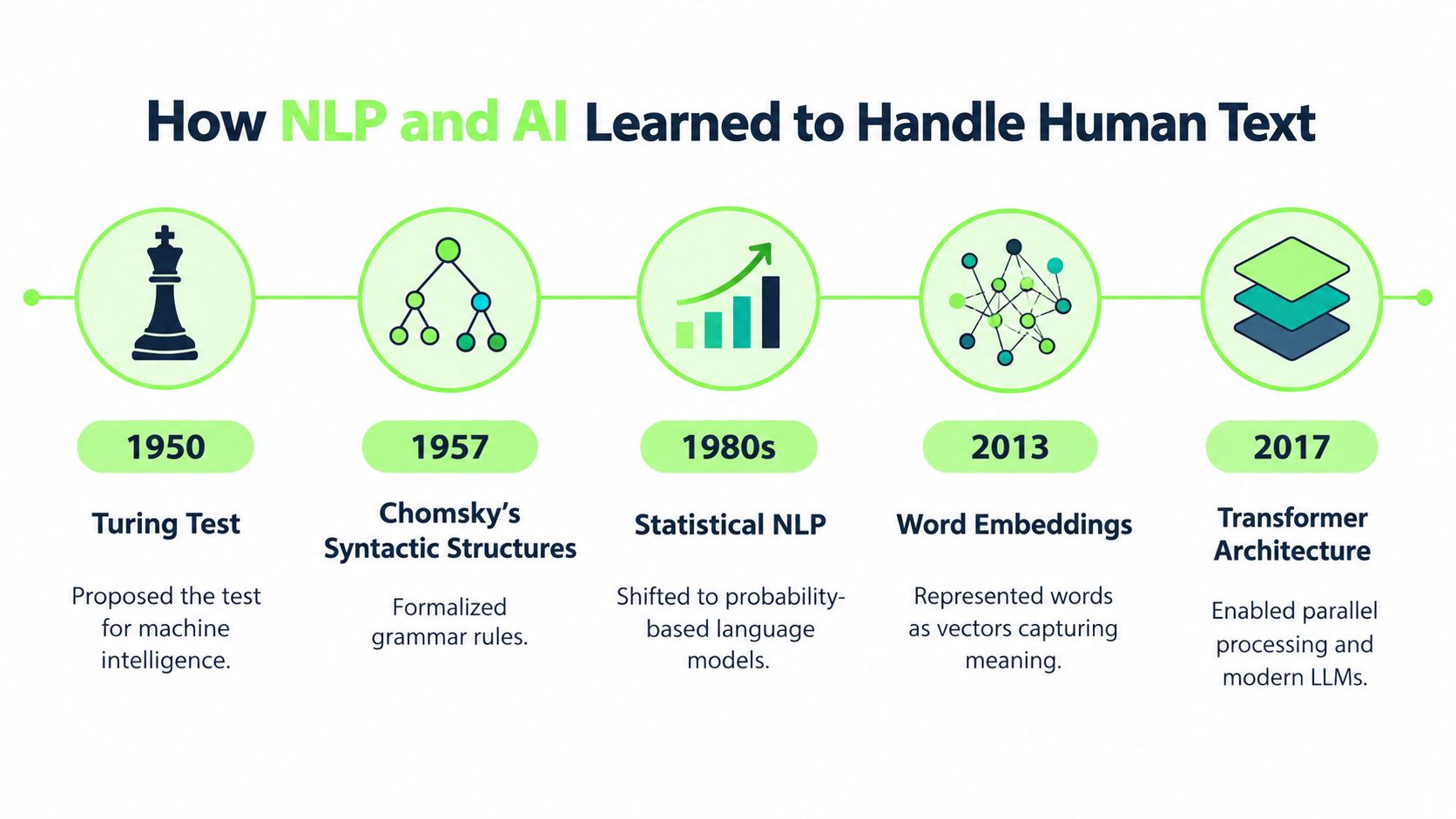
A marketer asks a language tool to summarize customer comments. The sentences may be clear, yet the tool still has to work out what each comment means, which details matter, and how context changes the interpretation. Natural-language processing, or NLP, is the field that develops computational methods for analyzing and generating human language. Its history traces a shift from hand-built rules toward models that learn patterns from language data. Historical overview of NLP milestones
From rules to data-driven models
Early machine-translation research is often traced to Warren Weaver's 1948 proposal to use computers for translation. NLP publication activity followed around 1958. In the late 1980s and 1990s, statistical methods, including n-grams and hidden Markov models, gained importance in speech recognition and translation. Rather than relying only on rules written by people, these systems estimated likely patterns from examples of text or speech.
That change resembles learning from many examples rather than memorizing a grammar book. BLEU, introduced in 2001, gave researchers a shared method for comparing machine translations with human translations. Word2vec, published in 2013, represented words as vectors, allowing models to learn relationships from patterns in data. These tools helped researchers build and compare systems, but a plausible translation or word association could still miss what a writer meant.
From Transformers to widely used chat systems
Introduced in 2017, the Transformer architecture helped models track relationships among words across longer passages and scale with more data and computing power. GPT appeared in 2018, followed by GPT-3 in 2020, with up to 175 billion parameters. These models generated fluent text by learning patterns from training data. NLP and language-model timeline
ChatGPT arrived in 2022, giving users a conversational way to interact with a language model. For marketers, language understanding can also help sort useful information from noisy online discussion, as explained in how NLU triages social noise. Writers using AI for brainstorming or drafting can refer to this guide to AI writing assistance, while treating the output as a draft to review rather than a finished statement of their intent.
The history shows a steady improvement in how systems process text, not a guarantee that they understand it as a person would. Fluency can make an answer sound convincing, but it does not establish factual accuracy, suitable tone, or preserved meaning. A writer or marketer still needs to check that the words fit the context and communicate the intended point.
Why Ambiguity Is the Core Challenge
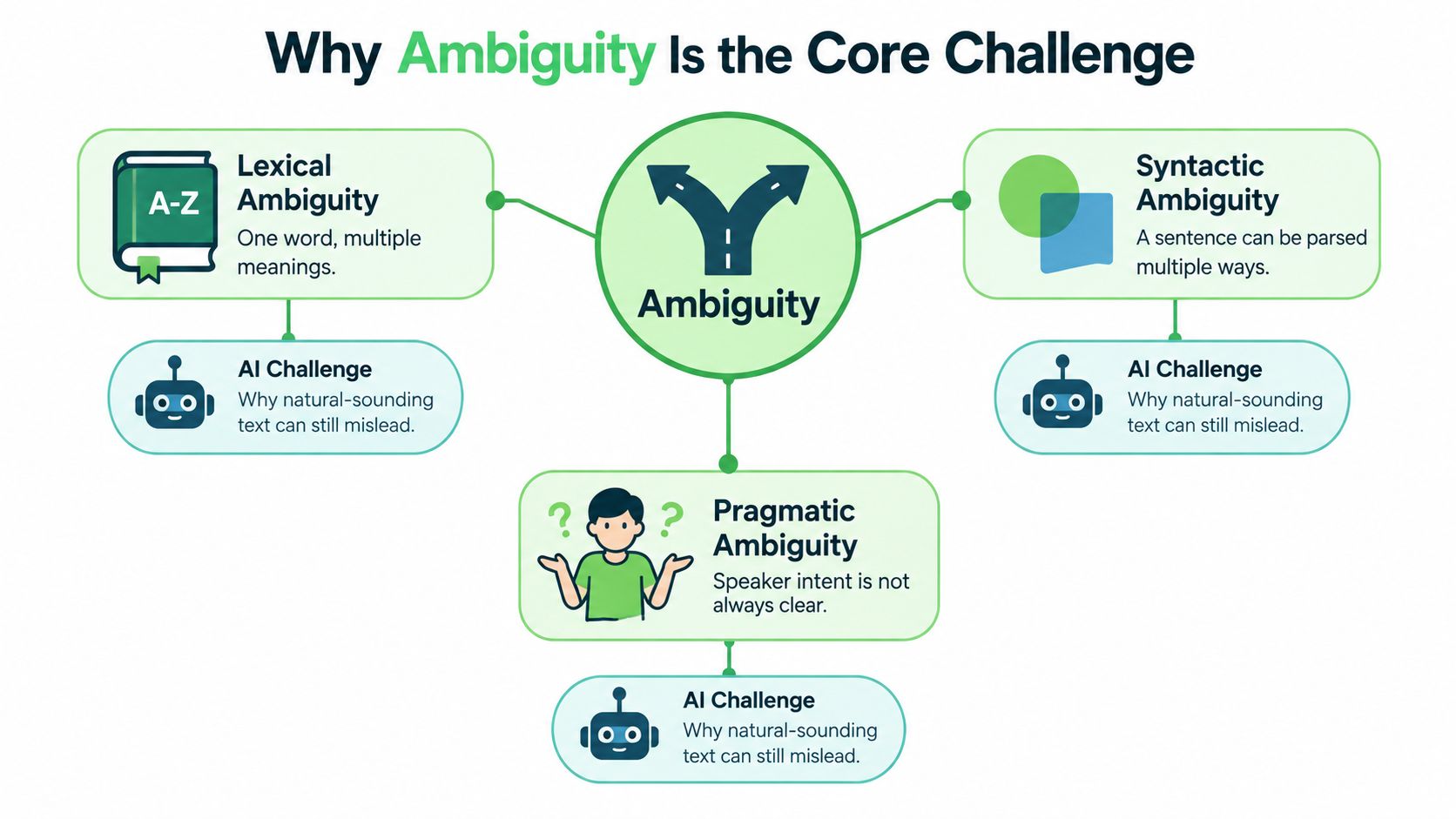
Fluent text isn't necessarily meaning-preserving text. Ambiguity is a normal feature of language: people often resolve it through surrounding words, shared knowledge, and the situation. A tool that chooses the wrong interpretation can still produce a sentence that reads smoothly.
Ambiguity can arise in several ways. Lexical ambiguity happens when one word has multiple senses: “bank” might mean a financial institution or the side of a river. Syntactic ambiguity appears when a sentence can be grouped in more than one way, changing who or what a phrase describes. Semantic ambiguity may require knowledge of the world to settle what a statement means. Pragmatic ambiguity occurs when the words don't make the speaker's intention clear, as when a question might function as a request.
What a benchmark tells editors
The AmbiEnt benchmark contains 1,645 linguist-annotated examples of ambiguity. Crowdworkers judged GPT-4's disambiguations correct 32% of the time, compared with 90% for the dataset's human reference disambiguations. Those figures apply to this benchmark, not every language task, but they make a clear editorial point: a natural-sounding answer can still settle on the wrong interpretation. (AmbiEnt ambiguity benchmark)
When you review an AI rewrite, check the points where a changed interpretation could alter the message:
- Pronouns: Does “they,” “it,” or “this” clearly refer to the intended person or idea? A guide to vague pronoun reference can help you spot sentences that leave the reader guessing.
- Word senses: Does a term with several meanings fit this subject and audience?
- Causality: Does the text claim that one event caused another, or does it only show that they occurred together?
- Negation and modality: Did “not,” “may,” “must,” or “could” change or disappear during the rewrite?
Practical rule: Compare the original and revised versions for what each one asserts, denies, allows, and leaves uncertain. Don't use readability as a substitute for that check.
This habit is especially valuable in education, marketing, translation, and accessibility work, where a vague reference or shifted qualification can confuse readers even if every sentence passes a grammar check.
Writing Tips That Make Text Feel More Natural
Natural-sounding writing doesn't need grand vocabulary. It needs words that carry the intended action clearly. Plain-language guidance from the U.S. Bureau of Indian Affairs recommends describing actions directly rather than relying on figures of speech, and choosing familiar words over unnecessarily formal alternatives. (BIA plain-language guidance)
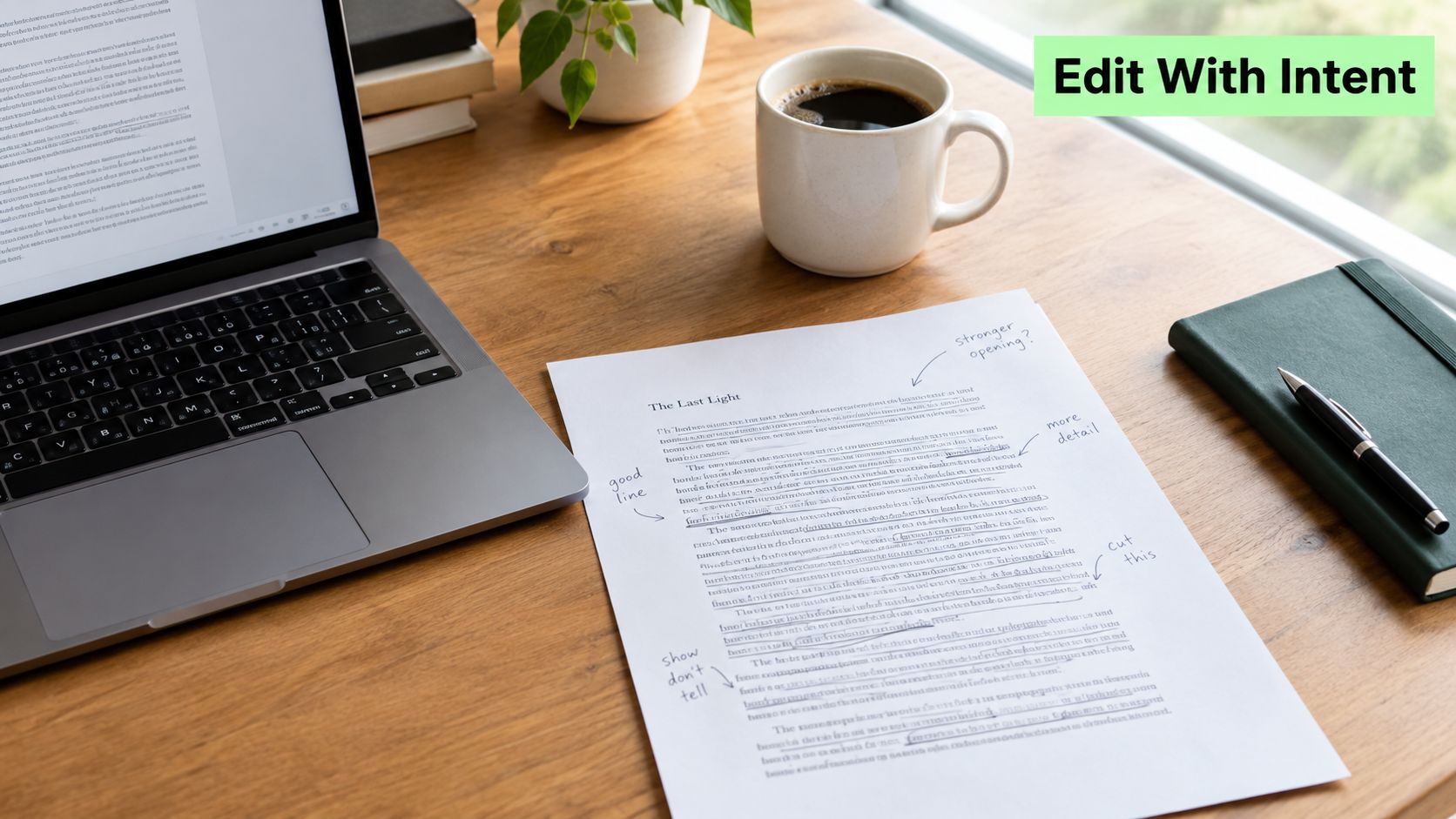
Try these straightforward edits in your next draft:
- Use a familiar verb: Replace “utilize” with “use.”
- Name the action plainly: Replace “assist” with “help.”
- Choose everyday wording: Replace “approximately” with “about.”
- Keep ordinary transactions direct: Write “buy” instead of “purchase.”
- Simplify technical-sounding phrases: Change “use the methodology” to “use the method.”
These edits reduce unnecessary distance between the reader and the meaning. They can also reveal whether a sentence has a clear actor and action, rather than hiding both behind abstract nouns.
Before: “The team conducted an analysis of customer responses to facilitate improvements in the signup process.”
After: “The team analyzed customer responses to improve the signup process.”
The second version names what the team did and why. As you edit, circle the main verb and ask whether it tells the reader what happened. If the action sits inside a phrase such as “conducted an analysis,” see whether a simpler verb can say the same thing. Natural writing isn't about lowering standards. It's about removing needless effort so readers can reach the meaning sooner.
Putting It All Together
Natural language is plural, layered, ambiguous, and shaped by context. A system trained on one language or variety can't be assumed to handle another equally well. Dialect, spelling, cultural references, code-switching, and the availability of digital language data can all affect how useful an AI response is. So a tool that claims support for several languages shouldn't be treated as if it understands every language and community in the same way.
A practical review starts with the message, not the polish. Does the syntax assign actions to the right people? Does the sentence preserve the original meaning, including negation, time, and uncertainty? Does the tone suit the audience, and can readers understand references without extra background? Use those questions for a student essay, a marketing landing page, or public-facing text that may carry disclosure obligations.
Every sentence is syntax carrying semantics, shaped by pragmatics. Check that each layer still says what you meant.
That same approach helps you assess AI detectors and rewriting tools. A score or a claim that text sounds human can't, on its own, confirm who wrote it or whether the message is accurate. Compare the output with the source, review its evidence, and decide whether you can stand behind each sentence. The more clearly you understand how language carries meaning, the more confidently you can use AI without handing it the final say.
Humantext.pro offers an AI detector for checking text and other media, along with a text humanizer for revising AI-assisted drafts into clearer, more natural writing. Try its tools on a passage you're reviewing, then check that the revised wording still expresses your intended meaning: Humantext.pro.
Valmis muuntamaan tekoälyn tuottaman sisältösi luonnolliseksi, ihmismäiseksi tekstiksi? Humantext.pro hioo tekstisi välittömästi varmistaen, että se kuulostaa luonnolliselta ja aidolta. Kokeile ilmaista tekoälyn inhimillistäjäämme →
Liittyvät artikkelit
AI Detector Score: What It Means and How to Use It
Understand AI detector scores, learn how they are calculated, and discover practical ways to interpret and use them for quality assurance and compliance.

Data Monetization Platform Guide: Build, Price, and Scale
Master the data monetization platform model. Learn architecture, pricing strategies, compliance rules, and real examples to turn data into revenue safely.
10 Different Words for Sad: Ranked by Intensity and Tone
Explore different words for sad, ranked by intensity, register, and context, with example sentences and usage notes for writers and students.

