AI Detector Essay Checker: A Step-by-Step Guide
Learn to use an AI detector essay checker with practical steps for students and teachers. Verify text authenticity, interpret scores, and humanize AI content
You submit an essay you wrote yourself, then receive an unfamiliar percentage from an AI detector essay checker. No explanation, no highlighted reasoning, just a number that seems to question your work. Teachers face the other side of the same problem: a score can look precise even when the evidence behind it is uncertain.
An AI detector can help identify writing that deserves a closer look, but it can't prove who wrote an essay. Fair evaluation requires context, process evidence, and human judgment, especially when the writer is multilingual or has edited the text extensively.
Understanding What the AI Score Actually Means
A student named Maya submits an essay about environmental policy. Her teacher runs it through a detector and sees a high AI-probability score. Maya knows she wrote the draft herself, but she doesn't know how to challenge a percentage that appears objective.
The first step is to understand what the number represents. A detector estimates whether linguistic patterns resemble text produced by an AI system. It doesn't observe the writing process, identify the author's hands, or establish intent. A score is therefore a screening signal, not a verdict about authorship or academic misconduct.
Why the percentage can change
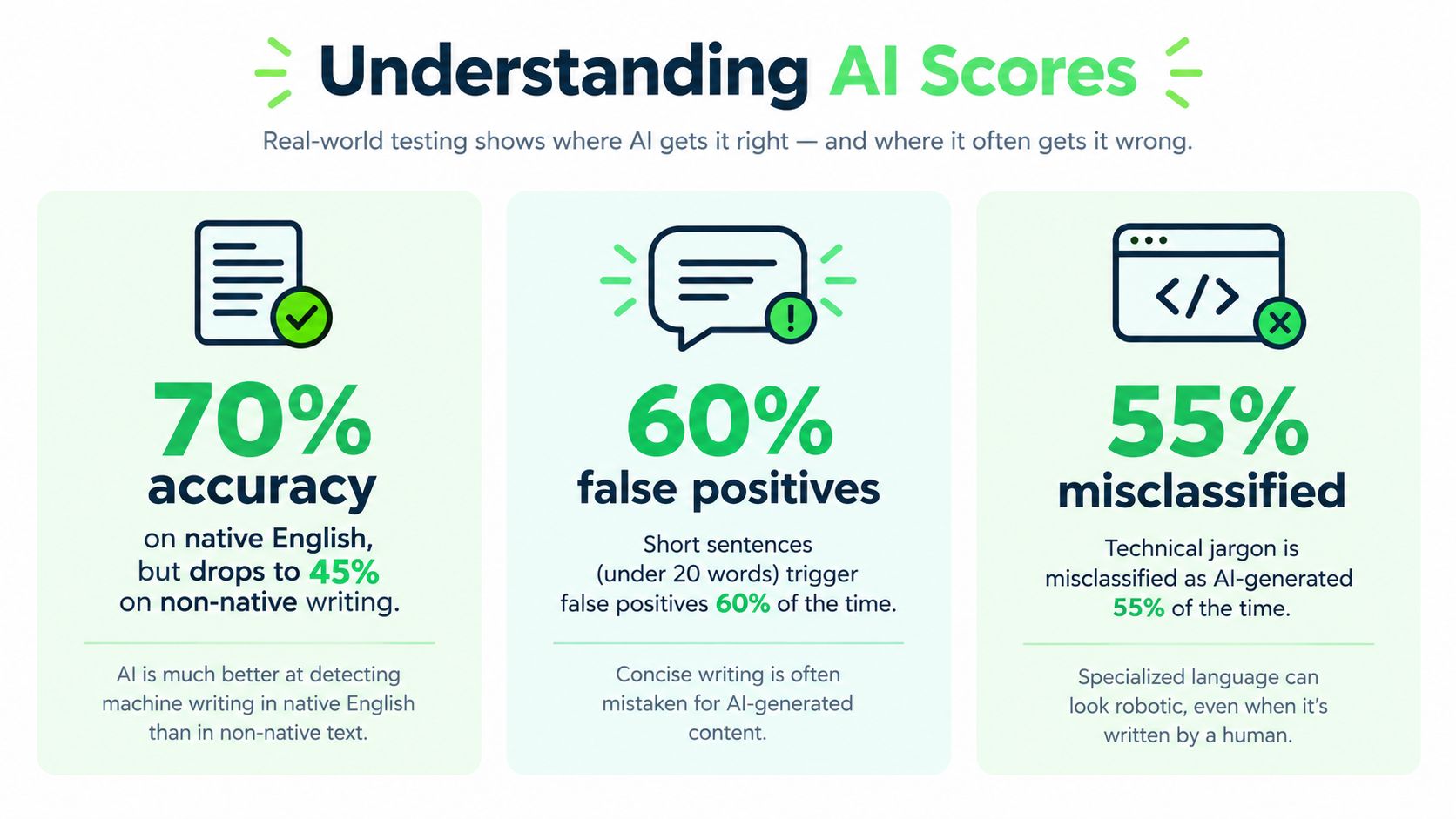
Small changes in wording, sentence order, editing, essay length, genre, or language background can influence a result. A formal introduction may look more predictable than a personal conclusion. A polished paragraph may receive a different assessment after ordinary editing, even though its author hasn't changed.
A 2025 study published by the American Physiological Society on AI essay detector performance reported an average false-positive rate of 1.3% ± 0.7%. In plain language, some human writing was incorrectly classified as AI-generated. The study also found that combining detector results reduced the likelihood of a false positive to nearly zero for the limited assignments examined, particularly when generated writing hadn't been altered.
That finding supports a careful workflow, not automatic trust. If a detector incorrectly flags approximately 13 essays in a sample of 1,000 human-written essays, assuming similar conditions, a single score can't settle a serious dispute.
Practical rule: Treat the score as a reason to ask better questions, not as proof that answers them.
Students can also consult this explanation of what counts as a good AI score, but even a low score shouldn't be treated as authorship clearance. The meaningful question is whether the result agrees with drafts, citations, revision history, and the writer's ability to explain the work.
Why Detectors Often Miss the Mark on Student Writing
Detector bias becomes especially serious when the writing comes from a non-native English speaker. Predictable vocabulary, straightforward sentence structures, and repeated academic phrases can resemble generated prose, even when a student developed every idea independently.
A 2026 study found that authentic TOEFL essays written by non-native English speakers were wrongly classified as AI-generated at an average rate of 61.3%, while native-speaker comparison essays were detected much more reliably. The result doesn't show that multilingual students write artificially. It shows that a detector may confuse a particular linguistic style with machine generation. The research on the fairness gap in AI detectors makes that distinction important for anyone evaluating student work.

Editing can change the result without changing the author
Paraphrasing creates another problem. Research summarized by Illinois State University on AI detectors reports that passing text through GPT-3.5 for paraphrasing reduced detection accuracy by 54.83%. That means a detector's result can shift after a transformation, even when the underlying ideas and source material remain the same.
This matters in both directions. A student might be wrongly flagged because their formal writing resembles generated text. Someone else might receive a lower score after paraphrasing, but that lower score doesn't prove the work is original. Changing the score isn't the same as proving authorship.
Teachers should be especially cautious with English learners, students who have received language support, and assignments that require formal or highly structured prose. A responsible response is to compare the essay with supervised writing, ask the student to explain key choices, and review the development of the document.
For a broader discussion of classroom policies and responsible AI use, educators may browse the AI in schools guide. The central lesson is simple: a detector score can identify text for review, but it can't replace a fair process.
How to Run a Reliable Multi-Tool Verification Check
A fair check starts with a simple rule. Treat any AI detector score as a signal for review, not a verdict about who wrote the essay.
Different detectors are built in different ways, so they do not react the same way to the same paper. In testing across 16 detection tools and 126 documents, results varied widely, especially across model outputs and writing styles. That pattern matters for schools because a single score can look more certain than it really is.
A careful checking sequence
Save the original first. Keep an untouched copy before you test anything. Record the date, word count, language, and whether the draft includes quotations, citations, or translated passages. This gives you a fixed reference point, like keeping the first lab sample before running more tests.
Run an initial check. Use one detector that gives an AI-likelihood score and, if available, highlights passages that shaped the result. Humantext.pro includes text detection and also supports image, video, and voice checks, which can help in a broader verification process.
Compare independent tools. Test the same unchanged text in services such as GPTZero or Turnitin. For a clearer view of how systems differ, see this comparison of AI detection tools. Keep the input identical. If you revise the essay between checks, you are no longer comparing the tools. You are comparing different documents.
Record disagreements carefully. If one system flags the essay and another does not, mark the outcome as uncertain. This is the point where fairness matters. Disagreement is a warning that the score may depend on the detector, not just the writing.
Test ordinary revisions separately. Save a new version after grammar edits, clarification, or language support, then record any score change. If a small wording change causes a large score shift, the detector is sensitive to style. It may be reacting to surface patterns rather than authorship.
Move to human evidence. Review drafts, source notes, document history, citation choices, and the writer's ability to explain the argument. That step is especially important when working with formal prose or multilingual writers, because detector bias and false positives can distort the picture.
This process separates detection, comparison, and investigation. Used that way, a detector helps you ask better questions and avoid turning an uncertain score into an unfair accusation.
Documenting Your Results and Proving Authorship
When a student is questioned about an essay, the strongest response usually isn't another detector score. It's a visible record of how the work developed.
Keep the outline that shaped the argument, research notes, downloaded sources, citation decisions, and rough drafts. Word processors often preserve version history, but students shouldn't assume it will remain available forever. Export important records or keep dated copies in a secure location.
Build a simple authorship file
A useful file might contain:
- Planning evidence: The original prompt, outline, thesis changes, and questions you intended to answer.
- Research evidence: Source notes, quotations, page references, and explanations of why particular sources were used.
- Revision evidence: Earlier drafts, comments, tracked changes, and dated versions showing how paragraphs developed.
- Disclosure evidence: A clear record of any permitted AI assistance, including brainstorming, grammar support, translation, or restructuring.
- Explanation evidence: A short note describing your argument, difficult decisions, and the meaning of technical terms in your own words.
Students who need help with citations should learn to reference correctly without plagiarizing. Accurate sourcing doesn't prove that every sentence was written without assistance, but it demonstrates engagement with the evidence and makes the work easier to verify.
A document history can show development. A score can only show a model's estimate.
Teachers can use the same principle during an investigation. Compare the submitted essay with earlier supervised work, but don't treat stylistic differences as conclusive. Ask the student to explain the thesis, summarize a difficult source, or describe why a paragraph appears in its current form. Oral follow-up is most useful when it invites explanation rather than acting as a surprise interrogation.
If AI assistance was allowed, the policy should focus on disclosure and permitted use. A student who used a tool for grammar correction has a different situation from a student who submitted generated arguments as their own, and a detector can't reliably make that distinction alone.
Next Steps for Humanizing and Revising Text
A student opens an essay checker, sees a high flag, and starts swapping words just to make the number drop. That reaction is understandable, but it points revision in the wrong direction. The next step is to make the paper clearer, better supported, and easier for a reader to recognize as your work.
Begin with the argument itself. If you had to explain your thesis without looking at the page, could you do it plainly? Then move paragraph by paragraph. Some drafts sound polished but stay general. They make broad claims, repeat the prompt, or summarize sources without showing what the writer thinks those sources mean. Revision should close that gap. Replace broad statements with specific analysis based on the sources you used, and state the connection to the assignment so the reasoning is visible.
Revise for ownership, not camouflage
Read slowly, one paragraph at a time, and test each part of the draft with a few simple questions:
- What do I mean here? Remove vague wording and say the point directly.
- What evidence supports it? Link the claim to a source, example, observation, or calculation.
- What is my interpretation? Add the reasoning that connects the evidence to the thesis.
- Would I say this naturally? Adjust wording that does not sound like your normal academic voice, but do not add mistakes to seem human.
- Can I defend this sentence? Cut claims, citations, or technical terms you cannot explain in your own words.
This process works like cleaning a window. The goal is not to paint over the glass. The goal is to make the view clear.
Stylistic tweaks like varied sentence length may shift a score, but they change the estimate, not the provenance of the text. Personal examples can help when the assignment allows them, yet clear definitions, accurate citations, and strong transitions usually do more to show real understanding.
Humantext.pro offers a detector and a guide to humanizing AI-generated text that can help identify AI-like passages and revise AI-assisted drafts while preserving meaning. Use any suggestion carefully. Read every change yourself, check each citation, and save the earlier version so you can still show how the draft developed.

A fair final check
Before submitting, compare the final essay with your notes and earlier drafts. Make sure each citation supports the sentence it follows, the conclusion answers the prompt, and you can explain the main ideas aloud in plain language. If your instructor has an AI-use policy, follow its disclosure rules. A low score is not clearance. A strong paper is one you can explain, support, and stand behind.
מוכנים להפוך את התוכן שנוצר על ידי AI לכתיבה טבעית ואנושית? Humantext.pro משפר את הטקסט שלכם באופן מיידי, ומבטיח שהוא נקרא בטבעיות ובאופן אותנטי. נסו את הממנש החינמי שלנו היום ←
מאמרים קשורים

10 Websites That Humanize AI Writing in 2026
Compare 10 websites that humanize ai writing by features, pricing, privacy, language support, and best use cases for writers, agencies, and educators.
AI Generated Text Detection: How It Actually Works
Explore AI generated text detection methods, accuracy limits, and how to choose the right tool for publishers, educators, and compliance workflows.
AI Humanizer Free Trial: Your Step-by-Step Playbook
Try an AI humanizer free trial the smart way. Learn what to expect, how to test quality, and how to choose the right paid plan for your workflow.

