AI Content Rewriter Guide: What It Does and How to Choose
Learn what an AI content rewriter changes, how it differs from paraphrasers and humanizers, and how to choose and verify one for natural output.
The most popular advice is to find the best AI content rewriter, paste in a weak draft, and let the tool fix it. That's backwards. A rewriter can't rescue claims you haven't checked, and it can't invent an argument your draft doesn't have. Your first decision isn't which tool to buy. It's whether the draft going in is worth editing, and how you'll prove the version coming out still says what you meant.
What an AI Content Rewriter Changes in a Draft
A polished rewrite can still be a poor edit. If a draft contains vague claims or an unclear argument, smoother sentences only hide the problem. Start by checking what the draft says; then decide which changes would help a reader follow it.
An AI content rewriter reshapes existing text for clarity, flow, tone, and audience fit while aiming to preserve its meaning. It works like an editor revising pages already on the desk: it can improve the wording and arrangement, but it cannot verify what happened or supply evidence the draft lacks.
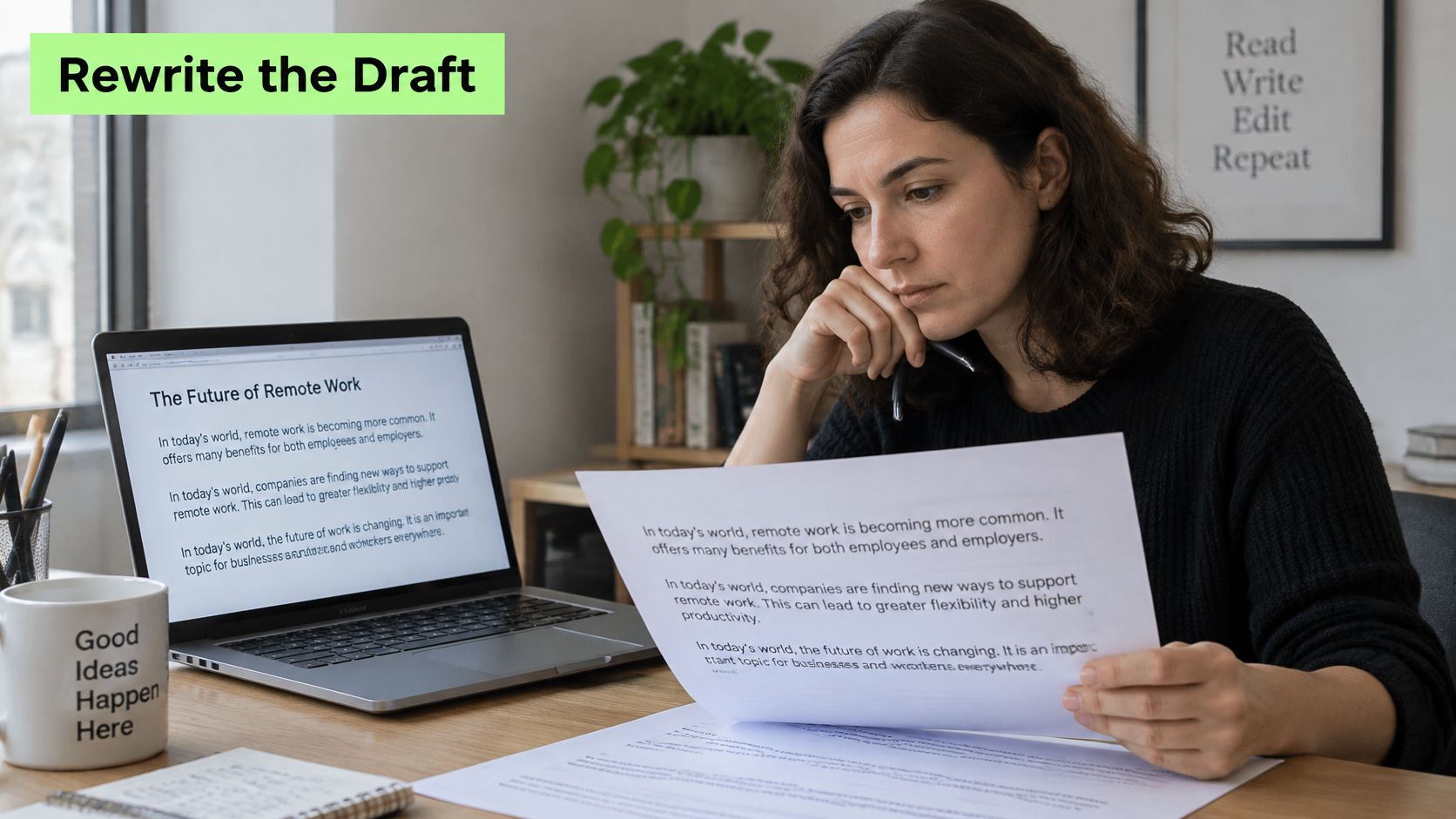
Three layers of change
- Word level: The tool can cut filler, reduce repeated vocabulary, and replace vague terms with clearer ones. Check that a more specific word does not make the claim stronger than the evidence allows.
- Sentence level: It can vary sentence length and structure to make the rhythm less mechanical. Read the result aloud; a sentence that sounds smooth can still change a qualification or comparison.
- Paragraph level: It can reorder points, adjust transitions, and move emphasis. Compare the revised paragraph with the source to make sure the sequence still supports the same conclusion.
The editing effort depends on the draft. A paragraph with clear claims and a logical order may need only a few wording changes. One with repeated ideas, vague claims, or tangled reasoning usually takes longer because each sentence needs attention. The tool can rearrange the furniture, but it cannot tell whether the room has the right pieces.
Try this test: Choose one paragraph and mark every sentence you would revise by hand. Then check whether the changes are mostly wording fixes or whether you need to repair the argument, add support, or clarify a claim. That distinction helps you estimate the work and decide whether rewriting is the right next step.
When most sentences need substantive repair, revise the argument and check its sources first. Use a rewriter only after the draft has a sound point to make.
Rewriters, Paraphrasers and Humanizers Side by Side
| Tool type | Main job | What it changes | Best for | Main risk |
|---|---|---|---|---|
| AI content rewriter | Rebuilds sentences, paragraphs and flow for clarity and fit | Structure, transitions, tone, audience fit | Full drafts with the right facts in the wrong shape | Meaning drift if output is not checked against the source |
| Paraphraser | Swaps wording while keeping the same ideas | Word choice and phrasing | Rewording one sentence or passage | Synonym swaps can read stiff or shift nuance |
| AI humanizer | Targets robotic AI phrasing and rhythm | Cadence, stock transitions, generic openers | Accurate AI drafts that sound mechanical | Detector results are signals, not proof of authorship |
A paraphraser keeps your structure and changes the wording. Use it on one clumsy sentence or a cited passage you need in your own words. If you're weighing options in this category, this guide to the QuillBot paraphrasing tool shows what that narrower job looks like in practice.
A rewriter works bigger. It rebuilds sentences, paragraphs, and transitions, so it's the right tool when a full draft has correct facts in the wrong order or the wrong tone for its reader.
A humanizer targets the patterns that make AI text sound machine-made, such as stock transitions, evenly sized sentences, and generic openers. Humanizer tools such as the humantext.pro AI Humanizer belong here, and you should judge them on the same columns as everything else.
The limit readers miss
Humanizing changes how text reads. It doesn't guarantee a detector result. The NAACL 2025 study on AI text detection found detection performance varies sharply by domain, language model, and evasion strategy, and under a strict 1% false-positive rate, some detectors achieved a true-positive rate as low as 0%.
So don't ask a humanizer to clear an essay. Keep your drafts, disclose permitted AI help where rules require it, and treat any score as a signal to investigate, not a verdict. Match the tool to the problem in front of you, whether that's wording, shape, or phrasing.
Who Uses Rewriters and Where They Fall Short
Different readers bring different drafts, so the same tool helps and hurts in different places.
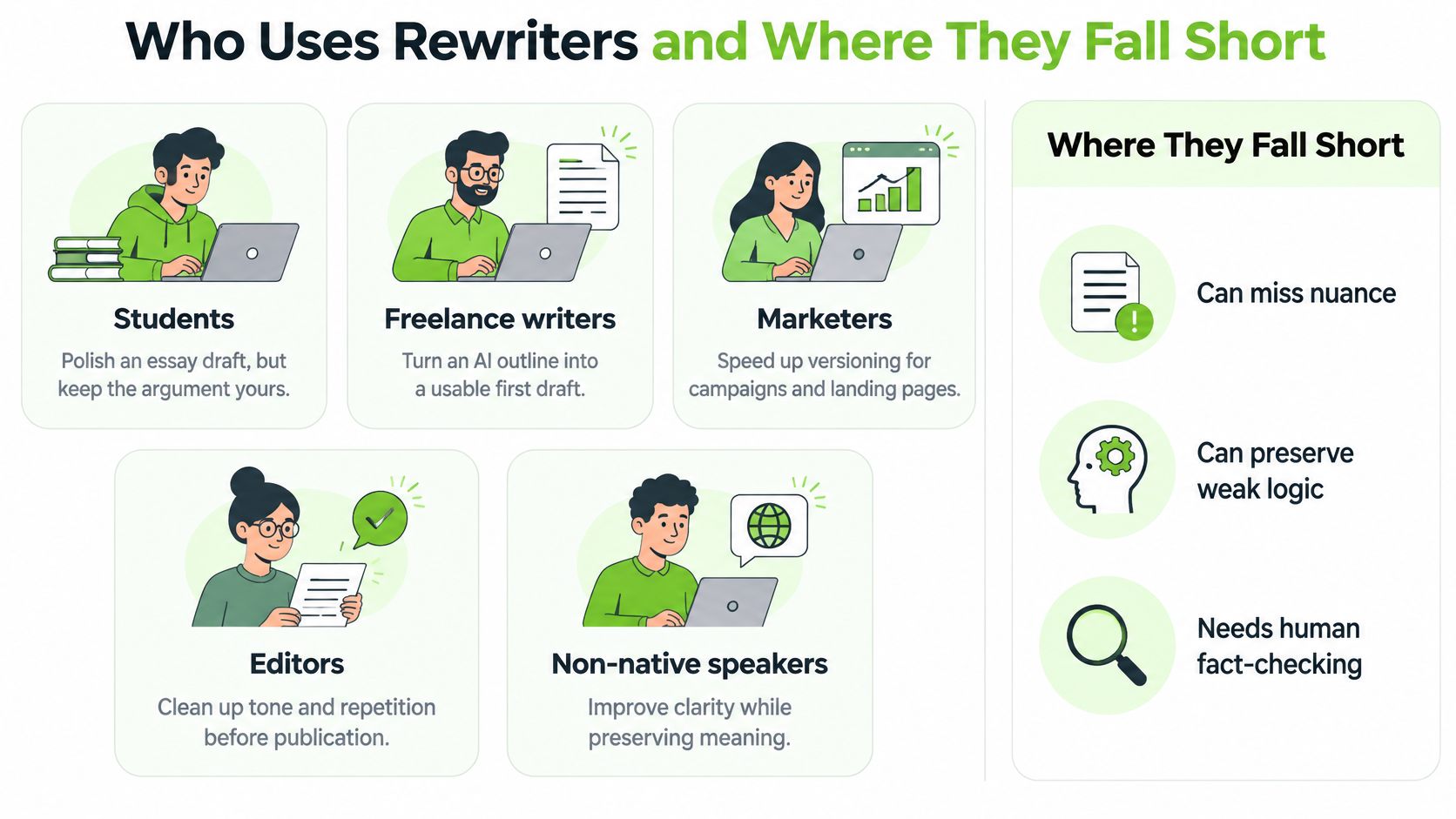
Students polish an essay draft an AI tool helped outline. The benefit is cleaner sentences. The limit is ownership, because the argument, evidence choices, and conclusions still have to be theirs.
Freelance writers turn a rough client-brief draft into copy in the client's voice. Rewriting speeds up that voice matching. It can also flatten a distinctive style into the same smooth tone every other freelancer ships.
SEO specialists rewrite bulk category and product copy while keeping target terms, prices, and specifications exact. Anyone scaling that work also needs a promotion plan, which is where a vetted list of link building sites helps them place finished pages instead of just producing more of them. The risk is quiet, because one altered dimension or price can survive an otherwise clean rewrite.
Publishers and editors check AI-assisted pieces and record which passages changed. Rewriting evens out readability across contributors. It doesn't tell an editor whether a claim is true.
Agencies produce high volumes that must still read naturally for each client. Speed is real. So is sameness, when ten clients end up sounding like one.
This short walkthrough shows how those trade-offs look during an actual edit.
Pros and cons in one view
- Pros: Faster first-pass revision, more even readability, fewer repeated phrases.
- Cons: Meaning drift, a flattened voice, and false confidence that clean-sounding text is accurate text.
Rewriting helps when a draft is structurally sound. It can't repair a draft whose claims are wrong.
Criteria for Choosing a Rewriter You Can Trust
| Criterion | What good looks like | Red flag |
|---|---|---|
| Meaning preservation | Claims, names and numbers match the source | Facts shift or details disappear |
| Stylistic naturalness | Sentence length varies and the text reads like a person wrote it | Repeated patterns or stiff synonyms |
| Entity and number handling | Names, dates and figures are kept exactly | Figures rounded or reworded without notice |
| Length handling | Works at paragraph or section level | Only swaps individual words |
| Audit trail | Input, settings, version and edits can be exported | No record of what changed |
| Privacy and language coverage | Clear data policy and support for your language | Vague storage terms or no language support |
Don't judge these from a feature list. Run a test you can score.
A three-passage test you can run today
Pick three passages of about 150, 300, and 500 words from work you publish. Rewrite each one with two tools. Then compare every output against its source sentence by sentence, and mark each changed number, name, date, and claim in a different color.
Score each tool twice, once for meaning preservation and once for stylistic naturalness. Keep the scores separate. A fluent rewrite that moves a figure fails, and a faithful rewrite that reads stiffly also fails, just for a different reason.
Length matters more than most buyers expect. In a benchmark summarized in the NIST publication on watermark detection, recursively paraphrasing approximately 225-word passages reduced watermark-detection rates to about 20%, while texts longer than roughly 400 words retained substantially greater resistance. Short passages behave unstably, so a tool that looks brilliant on one sentence may drift badly across a full section.
That's also why a lower detector score alone proves nothing about quality. Judge at paragraph and document level, where your readers meet the text.
Procurement teams face the same trap with polished demos, which is why criteria-first guides like this one on choosing software for tender responses are useful models. Write your pass marks before you test, not after a sales page impresses you.
How to Rewrite AI Text in Eight Steps
Work in small pieces, check as you go, and keep a record. That's the whole method.
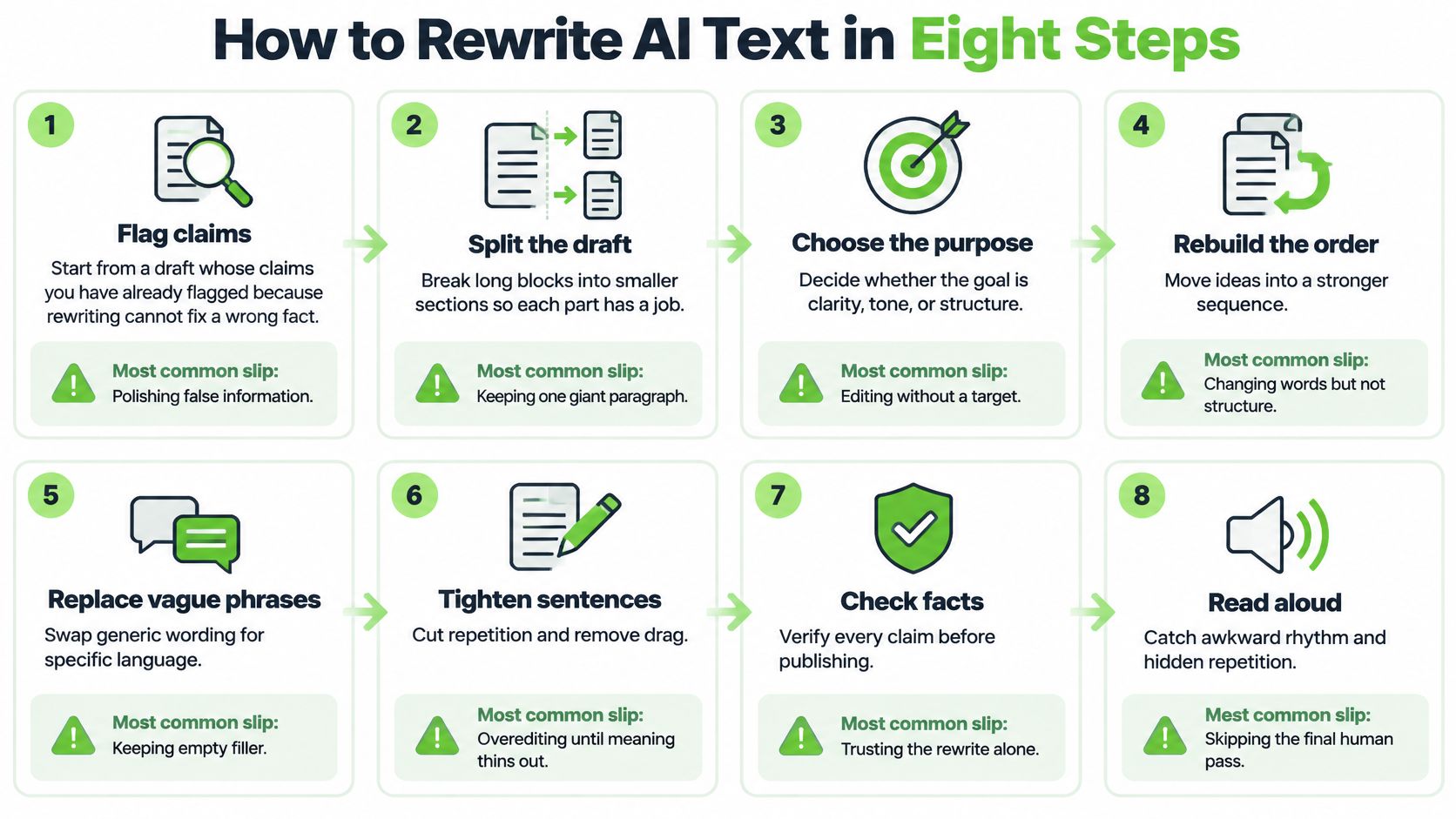
Flag the claims first. Highlight every fact, figure, and quotation in your draft before you open any tool, because rewriting can't fix a wrong fact. The common slip is polishing a false claim until it sounds authoritative.
Split the draft into chunks. Work a few paragraphs at a time, since long documents rewritten in one pass are where meaning drifts most. Keeping one giant block is how a changed detail hides until publication.
Choose the mode per chunk. Use a sentence rewriter for choppy flow, a paragraph rewriter for weak structure, and a humanizer for stock AI phrasing. Editing without naming the target produces changes you can't evaluate.
Run the chunk through the tool. Our homepage describes a three-step process, paste your text, check the AI score, then get the humanized text, and most tools follow a similar flow. Don't accept the first output just because it arrived quickly.
Restore protected items. Put back names, numbers, quotations, citations, and links exactly as they were, because tools sometimes round, reword, or drop them. Check these before you read for style, not after.
Read it aloud and edit by hand. Rewrite openings, transitions, and conclusions yourself, since those carry your voice. If you stumble reading a sentence, your reader will too, and this guide to improving writing clarity gives fixes for the spots where people usually trip.
Compare source and output sentence by sentence. Log every material change in claims, evidence, or position. Skipping this comparison is the slip that turns editing into accidental authorship changes.
Save everything together. Keep the source draft, rewritten version, settings or model used, and your edit log in one folder. You'll need that bundle if an editor, teacher, or client later asks what changed.
What finished looks like
A finished section has specific claims, your own example rather than a generic one, varied sentence lengths, and no unexplained changes to numbers or names. If you can't say why a sentence changed, it isn't finished.
Annotated Rewrites and Pre-Publication Checks
| Sentence type | Original AI draft | Rewritten output | Check before publishing |
|---|---|---|---|
| Generic opener | In today's fast-paced world, content creation is important for every business. | Content teams publish faster than their review process can keep up. | Confirm the claim fits the piece |
| Vague claim | Many experts believe rewriting tools help a lot with quality. | Editors who rewrite first drafts usually spend their effort on structure rather than wording. | Find a source for the claim or remove it |
| Robotic transition | Furthermore, it is important to note that rewriting matters. | Rewriting matters for one reason, the draft's weak spots get fixed first. | Check the point survived the edit |
| Factual sentence | The study found that expert-edited paragraphs were preferred in 65% of comparisons. | Readers preferred expert-edited paragraphs in 65% of comparisons. | Confirm the number matches the source exactly |
Notice what each row teaches. The opener swap only works if the new claim is your point. The vague claim doesn't need better wording, it needs a source or deletion. The factual sentence keeps its number untouched, because rewording a figure is how statistics change meaning.
Classify each edit before you publish
Grammar fixes, readability changes, and restructuring that leaves meaning intact are routine editing. Generating a new article, changing a factual claim, or shifting the author's position is substantive AI transformation. The distinction has legal weight too. The European Commission's quick facts on AI transparency rules explain that Article 50 includes an exception for AI systems used only for an assistive function in standard editing or that do not substantially alter input data or its semantics.
So set a disclosure rule you can apply without debating it each time. Label a piece when an edit substantively changes meaning, or when the piece informs the public on matters of public interest, and keep your edit log to support that decision.
Run the final checks
- Keep the original draft: Retain it beside the published version so any change can be traced.
- Re-run the three-passage comparison: Apply the same source-versus-output check to final text, not just test samples. A documented routine like the one in this content quality assurance guide keeps that step from being skipped under deadline pressure.
- Run a plagiarism check: We offer an AI text humanizer, a paraphrasing tool, and a plagiarism check, plus sentence, paragraph, and essay rewriters, so originality screening can sit inside the same workflow.
Search adds one more constraint. Google's guidance on AI content and search doesn't prohibit generative AI assistance, but it warns that generating many pages without adding user value can violate its scaled-content-abuse spam policy, including separate pages for every variation of a search query. The safer pattern is consolidation. Say an agency merges dozens of near-duplicate keyword pages into one authoritative guide with distinct sections, original examples, and firsthand expertise. That page earns its place. Teams that want that consolidation handled as a managed program often look at content SEO services rather than producing more lightly altered versions.
Your next step: Take one paragraph this week, rewrite it, and run the two-axis check for meaning and naturalness. Don't rewrite anything else until that paragraph passes.
Choose your tool by the problem in the draft, run the checks, and keep the receipts. That's a workflow you can defend to a reader, an editor, or a regulator.
Humantext.pro gives you a humanizer, paraphrasing and rewriting tools, and a plagiarism check in one place, so you can polish an AI-assisted draft and run the meaning and originality checks described here without juggling separate apps. Paste in one paragraph, compare the output against your source sentence by sentence, and see whether it passes your own two-axis test. Start that first checked rewrite at Humantext.pro.
Készen áll arra, hogy MI által generált tartalmát természetes, emberi hangzású szöveggé alakítsa? Humantext.pro azonnal finomítja szövegét, biztosítva annak természetes és hiteles hangzását. Próbálja ki ingyenes MI-humanizálónkat még ma →
Kapcsolódó cikkek
AI Disclosure Requirements You Must Meet in 2026
AI disclosure requirements under the EU AI Act hit on 2 August 2026. See who labels what, the exceptions, and a workflow you can run now.

10 Best AI Detector Online Tools Compared in 2026
Compare the 10 best AI detector online tools of 2026: how they work, accuracy limits, privacy, free access, and which audience each one fits.
EU AI Act Compliance: A 2026 Action Guide
EU AI Act compliance for 2026: deadlines, risk classes, Article 50 labels, audit records, and a practical workflow for publishers and businesses.

