What Is AI Law and How It Shapes Content in 2026
What is AI law? Learn EU AI Act, US rules, liability and IP risks, plus practical steps for creators to stay compliant in 2026.
AI law is an emerging patchwork of risk-based rules governing AI development and use, anchored by the EU AI Act, which entered into force on 1 August 2024 and introduces major transparency duties from 2 August 2026. For creators and publishers, that means AI compliance increasingly follows the content lifecycle, from generation and editing to labeling, publication, verification, and recordkeeping.
You finish an article with an AI writing assistant, edit the awkward passages, check the facts, and prepare to publish. Then an editor asks a simple question: Do we need to tell readers that AI helped create this? The answer may depend on the type of output, where you publish it, how much human editorial control you exercised, and which rules apply to your audience.
That's why understanding what is AI law requires more than memorizing a definition. AI law includes rules about transparency, privacy, copyright, safety, discrimination, accountability, and the use of automated systems. For a freelancer, it can affect a blog draft. For a newsroom, it can affect a synthetic image. For a teacher, it can affect how student work is reviewed.
The practical challenge is that AI law doesn't arrive as one universal code. It's developing through national laws, state legislation, sector rules, international principles, and platform requirements. A creator working across borders may face different duties for the same video, image, or article.
This guide treats compliance as a content workflow problem. You'll learn how to identify the relevant risk, understand the EU transparency model, distinguish visible disclosure from machine-readable marking, and build a repeatable review process. For a useful foundation on the difference between assisted writing and fully generated material, see this guide to AI-generated content.
Introduction What AI Law Means for Everyday Creators
A freelance writer uses an AI tool to produce a rough article outline. The writer replaces several sections, checks sources, adds original examples, and rewrites the introduction. The final article reflects substantial human work, but the writer still needs to ask how the AI system was used and whether the publication's audience falls under a transparency rule.
That question is different from ordinary editorial quality control. Traditional publishing law has long dealt with copyright, defamation, privacy, advertising, and consumer protection. AI law adds another layer by examining how an automated system contributed, whether people can recognize that contribution, and whether the output carries risks that require special controls.
The EU AI Act is the clearest foundational milestone. The European Parliament formally adopted it in March 2024, the Council endorsed it in May 2024, it was published in the EU Official Journal on 12 July 2024, and it entered into force on 1 August 2024. It's the first horizontal legal framework for AI across all 27 EU member states, rather than a rule limited to one industry. The EU AI Act implementation timeline shows how its obligations phase in, with major provisions applying from 2 August 2026 and the main milestones scheduled for completion by 2 August 2028.
For creators, the central lesson is straightforward:
- AI assistance doesn't end your responsibility: Human editing still requires fact-checking, rights review, and a decision about disclosure.
- The output's context matters: A private brainstorming note and a public-interest article may not receive identical treatment.
- Publication is a compliance event: The workflow should record what was generated, what was changed, and what readers need to know.
AI law therefore asks a practical question: Can your organization explain and verify the role AI played in the content? If the answer is unclear, the problem isn't limited to the model. It may involve the editor, publisher, platform, vendor, and final decision-maker.
Understanding AI Law as a Risk Based System
AI law is easier to understand through a traffic-light analogy. A green-light system may involve limited risk and light controls. A yellow-light system needs assessment, monitoring, and documentation. A red-light system may face strict requirements or bans because the potential harm is serious.
The European Commission describes the EU AI Act as a risk-based model with 4 risk categories, with Article 50 addressing transparency risks. The Commission's implementation guidance explains that relevant systems may require disclosure, machine-readable marking, and other controls depending on how they're used.
Practical rule: Don't ask only whether a tool uses AI. Ask what the system does, who is affected, where it operates, and what happens after the output is produced.
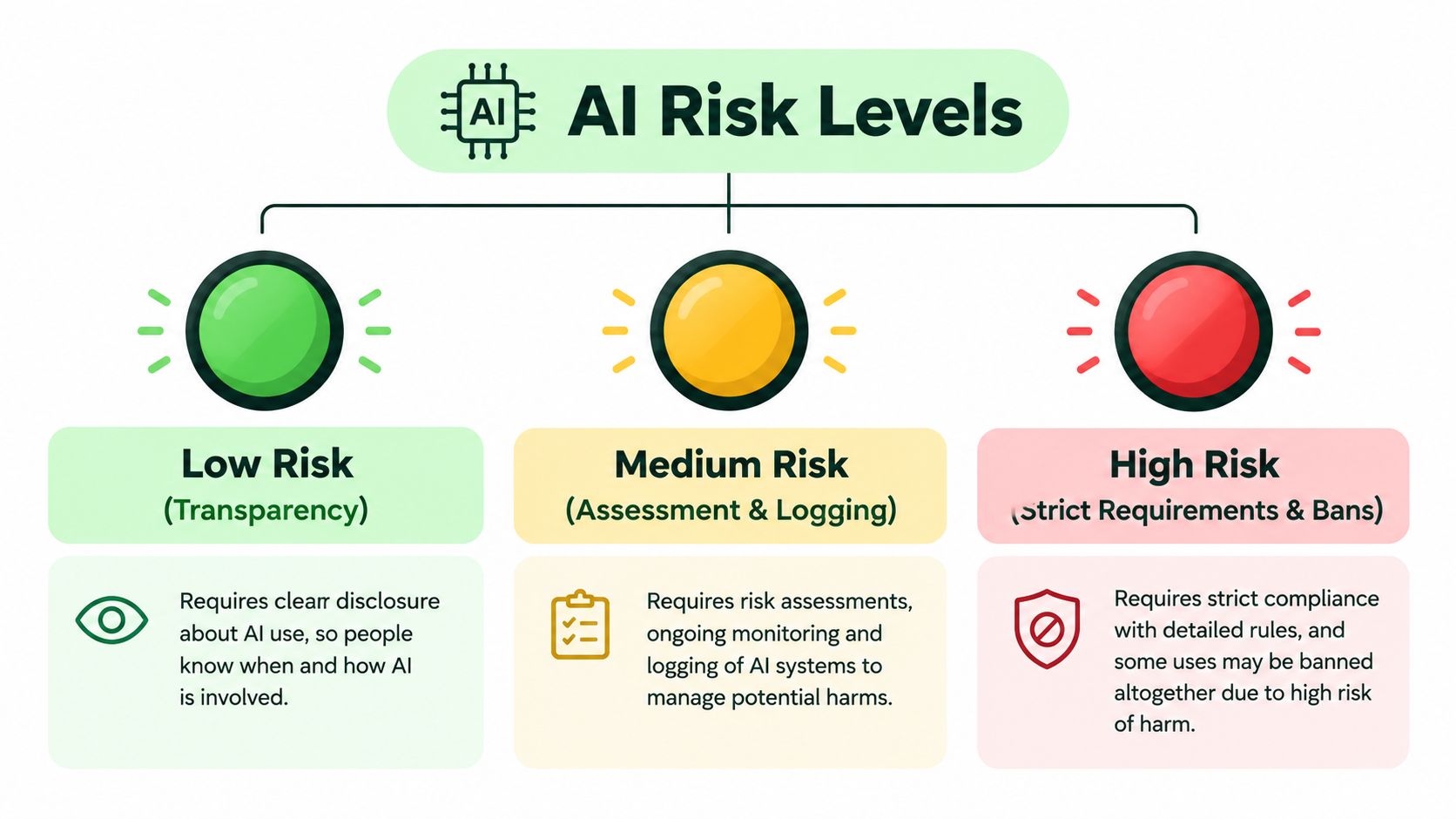
The traffic-light model in practice
Green, lower-risk use might include an assistant suggesting headings for an internal draft. That doesn't remove the need for editorial review, but the legal controls may be lighter than those for content that imitates a real person or influences a consequential decision.
Yellow, medium-risk use calls for stronger process controls. A publisher might need to retain prompts, source notes, edit history, and approval records when an AI system helps produce public-facing material. The point is traceability. If a reader, client, or regulator asks how the content was created, the organization should have evidence rather than relying on memory.
Red, high-risk use can involve strict requirements or prohibited practices. The relevant question isn't whether the model is impressive. It's whether the use creates unacceptable risks involving safety, rights, manipulation, or discrimination.
Transparency sits in a distinct place because it can apply even when the underlying content isn't otherwise high risk. A customer-support chatbot, for example, may need to tell people they're interacting with AI. Synthetic media may need both a visible label and a machine-readable mark so software can identify it.
The same generation pipeline can therefore receive different treatment in different contexts. A system that creates a fictional illustration for a private concept board may require fewer public-facing controls than a tool producing a realistic image presented as a genuine news photograph.
Major Regulatory Frameworks Shaping AI Law Today
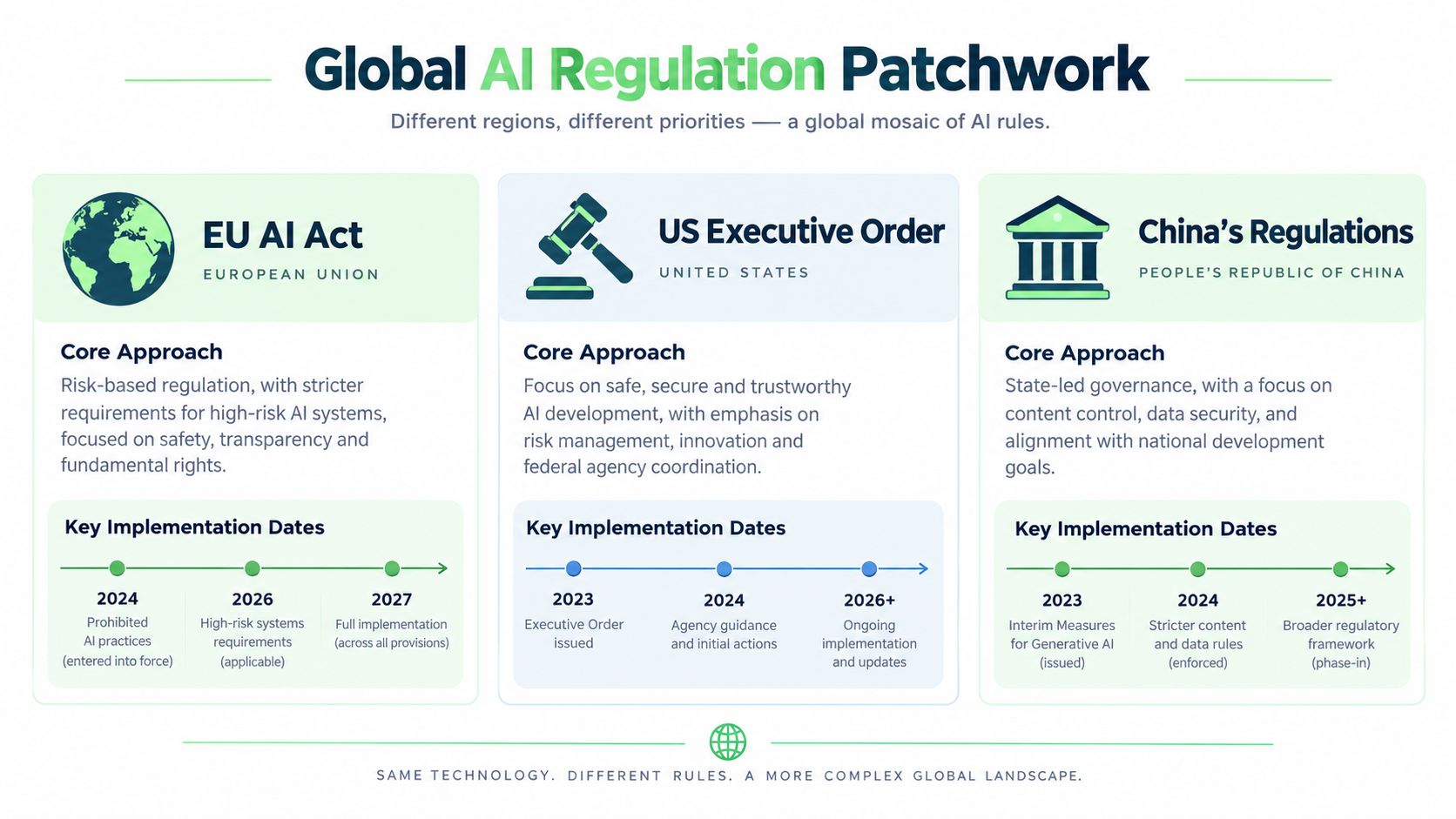
The current area has three overlapping layers. The EU provides a horizontal legal framework. The United States is developing a more fragmented state-led environment. International organizations are establishing principles and policy baselines that influence future legislation and organizational governance.
The EU AI Act applies across sectors and uses risk categories to connect AI uses with obligations. Its timeline matters to publishers because the regime doesn't activate all at once. Prohibited practices and AI literacy obligations began applying in February 2025, while the main regime becomes applicable on 2 August 2026, with further milestones continuing through 2 August 2028. For a focused explanation of the content rules, consult this guide to EU AI Act Article 50.
The U.S. approach is more dispersed. In the 2025 to 2026 state legislative sessions, 146 AI bills were proposed, passed, or enacted, and trackers reported 1,561 AI-related bills introduced in 45 states by March 2026. Those figures are documented in the 2026 state and federal AI legislation update. A company may therefore need to analyze the location, sector, customer, and use case rather than search for one national AI rule.
International principles add another layer. The OECD AI Recommendation was first adopted on 22 May 2019 and revised on 3 May 2024. UNESCO adopted its Recommendation on the Ethics of Artificial Intelligence on 23 November 2021 through 193 states, while the UN General Assembly passed its first AI resolution on 21 March 2024. In 2025, the UN created a Global Dialogue on AI Governance and an Independent International Scientific Panel. These developments are summarized in the international AI policy tracker.
| Framework | Scope and Approach | Key Obligation Example |
|---|---|---|
| EU AI Act | Horizontal, risk-based regulation across the EU | Transparency, prohibited-use controls, and rules for general-purpose AI |
| U.S. state rules | Patchwork legislation shaped by jurisdiction and use case | Duties may vary by state, sector, and automated activity |
| OECD, UNESCO, and UN architecture | International principles and multilateral policy coordination | Fairness, privacy, transparency, safety, accountability, and human rights |
Businesses that need a broader explanation of how regulation interacts with technology strategy can use this technology policy guide as additional context. The useful decision lens is location plus use case. Identify where the creator, publisher, user, and audience are located, then map the content activity against each applicable rule.
Key Legal Issues Every AI User Should Understand
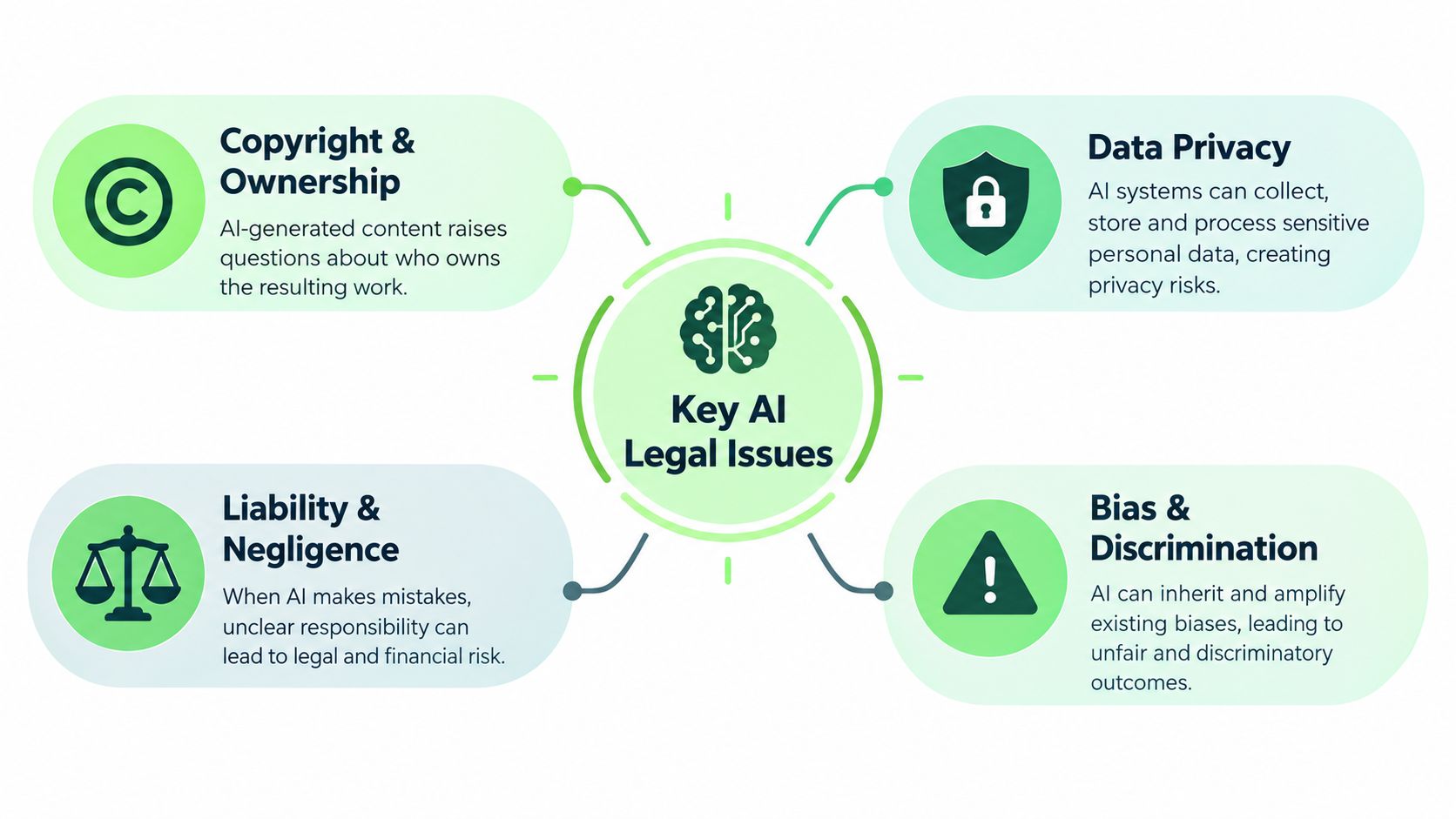
Creators usually encounter AI law through four practical questions: Who owns the output? What data entered the system? Who carries responsibility for harm? And when must people be told that AI was involved?
Copyright and ownership
AI-assisted content can raise questions about the rights in the input, the output, and any material used to train or operate the system. A publisher might ask an AI tool to imitate the structure of a source article, generate an illustration resembling a living artist's style, or summarize licensed research. Each scenario requires a rights review rather than an assumption that the tool provider has solved the issue.
Keep records of source materials, permissions, prompts, edits, and final approvals. A human editor should also check whether the output reproduces distinctive protected expression or includes material that the publisher didn't intend to use. Educators working with online course material may find this licensing and fair use checklist for educators useful when planning lessons or assignments.
Privacy and data protection
A prompt can contain personal data even when the user doesn't think of it as sensitive. Student writing, customer messages, unpublished manuscripts, and interview transcripts may include names, contact details, health information, or confidential business details.
Before pasting material into an AI system, identify the data, confirm the vendor's handling terms, and remove details that aren't necessary. A classroom teacher can replace student names with neutral labels. An editor can work from a redacted transcript until the publication has approved the tool and workflow.
Liability and negligence
AI doesn't automatically become the responsible party when an output causes trouble. A publisher still needs a process for checking factual claims, identifying misleading imagery, reviewing safety-sensitive instructions, and correcting errors.
Accountability follows the workflow: The person who approves content should know what the system did and what checks were completed.
Liability can also extend beyond text. A synthetic voice, altered video, or generated image may mislead audiences, damage reputation, or create contractual problems if presented as authentic. Maintain an approval trail that identifies the human decision-maker.
Bias and discrimination
Automated systems can produce unequal or stereotyped outputs, especially when creators use them for recommendations, moderation, hiring content, educational evaluation, or audience targeting. A teacher assessing student submissions, for example, shouldn't treat an AI detector score as a final judgment about authorship.
Use human review, explain the limits of automated signals, and offer a path for correction. The NIST Generative AI Risk Management Framework emphasizes aligning AI development and use with applicable laws and regulations, while OECD principles focus on inclusive growth, human rights, fairness, privacy, transparency, explainability, security, safety, and accountability.
This short explainer can help teams discuss the legal issues visually:
How AI Law Affects Creators Publishers and Educators
A freelance writer receives an AI-generated draft from a client. The writer doesn't publish it untouched. Instead, they verify claims, replace generic language, add interviews, remove unsupported statements, and keep a note describing the AI's role. That record helps distinguish drafting assistance from a publication decision made without review.
The writer should then check the destination. If the article falls within a transparency rule, the writer and publisher need to determine whether a disclosure is required and whether meaningful human editorial control changes the analysis. The answer depends on the final content and the applicable legal guidance, so the workflow should preserve evidence rather than rely on a blanket “AI used” label.

A newsroom publishing synthetic media
An editor commissions an AI-generated image for a news explainer. The newsroom should separate illustration from documentation, avoid presenting the image as a real event, and apply the organization's visible disclosure policy. It should also preserve the original asset and relevant metadata so later reviewers can inspect what happened.
For synthetic text, image, audio, and video, providers must add machine-readable markings so software can detect AI-generated or manipulated content. The European Commission also created 3 optional icons for labeling AI-generated content, as explained in its quick facts on AI transparency rules.
A teacher evaluating student work
A teacher uses an AI detector to flag a submission, but treats the result as a prompt for conversation rather than proof. The student can explain their drafting process, provide revision history, or discuss the ideas in the assignment. Human judgment remains essential because detection tools can inform review without establishing authorship on their own.
The same principle applies to publishers. A detector can identify content that deserves closer inspection, but an editor still needs to assess facts, sources, originality, consent, and disclosure.
Practical Steps to Stay Compliant With AI Transparency Rules
A workable process follows the content from creation to publication. Start when someone generates or imports material, rather than waiting for the deadline. For creators and publishers, transparency is a workflow record, similar to an editorial chain of custody.
Step 1: Record the AI contribution
Create a simple content log showing the tool used, generation date, material type, human editor, and major changes. Keep prompts or source notes when they influenced the editorial decision.
The record can stay lightweight. A shared editorial field or project note should answer three questions: What did AI produce? What did a person change? Who approved publication?
For detailed AI content labeling requirements, see the guide to AI content labeling requirements.
Step 2: Decide whether people need notice
Article 50 transparency rules apply from 2 August 2026. They require providers of certain systems to inform people when they are interacting directly with AI, unless that interaction is already obvious. The Commission's guidance on transparency obligations also addresses AI-generated and manipulated content.
A chatbot should make its AI nature clear before or during the interaction. Publishers should review each generated article, image, audio clip, or video and decide whether its context and the applicable rule call for a visible disclosure.
Step 3: Add machine-readable marking
Visible labels communicate with people. Machine-readable marks communicate with software. For covered synthetic text, image, audio, and video, providers must support detection through machine-readable marking. Publication systems should therefore preserve metadata and avoid stripping it during editing, compression, or export.
Use three connected records where appropriate:
- Visible disclosure: Tell readers or viewers that content was generated or manipulated.
- Machine-readable marking: Embed information that automated systems can detect.
- Editorial record: Keep the source file, review notes, and approval history.
Step 4: Verify before publication
Use a detection workflow when authenticity matters. Humantext.pro offers an AI detector and text humanizer, as well as tools for checking image, video, voice, and SynthID signals. These tools can identify material that merits closer review, but they do not replace source verification or human judgment.
Step 5: Handle older material carefully
The rules do not apply retroactively in the same way to every format. A legal summary of the final guidance explains that image, audio, and video deepfakes created before 2 August 2026 do not need retroactive labeling, while text for public-interest publications is linked to the publication date. Text generated earlier but published on or after 2 August 2026 may therefore still require labeling, unless meaningful human review or editorial control applies to the facts of the case. This summary of Article 50 guidance provides detail for editorial teams.
Some generative AI systems placed on the market before 2 August 2026 may also receive a grace period until December 2026, according to the Commission's guidance. Treat that period as preparation time. Continue recording, labeling, and reviewing content rather than postponing the process.
Building a Future Ready Approach to AI Law
A future-ready approach treats compliance as an ongoing editorial habit. Teams should review their tools when laws change, but they should also review the evidence produced every time content moves from generation to publication.
The strongest workflow connects four records:
- Origin: Which system created or altered the material?
- Review: Which person checked facts, rights, privacy, and potential harm?
- Disclosure: What did the audience need to know?
- Verification: Can people and software identify the content's AI involvement?
The regulatory direction also points toward more operational evidence. California's AB 2013 requires publicly accessible training-data summaries for covered generative AI systems effective 1 January 2026, while California's SB 942 AI Transparency Act requires watermarking, latent disclosures, and detection tools effective 2 August 2026. These developments are listed in the AI regulatory developments tracker. They show why publishers and creators should ask vendors for provenance information, documentation, and usable controls.
The EU's main AI Act milestones continue through 2 August 2028, so policies should include an owner responsible for monitoring updates, revising templates, and training editors. Compliance isn't a one-time label added at the end. It's a quality signal built into the content lifecycle.
Start today by mapping every AI-assisted workflow, adding a human approval point, preserving source files, and testing disclosure language with real readers. Then use a detector or verification tool to support review, while keeping the final decision with an accountable person.
Humantext.pro helps creators, publishers, educators, and editors check AI signals across text and media, then improve AI-assisted drafts so they read naturally without changing their intended meaning. Visit Humantext.pro to test a draft and build verification into your publishing workflow.
Pronto a trasformare i tuoi contenuti generati dall'IA in testi naturali e simili a quelli umani? Humantext.pro perfeziona istantaneamente il tuo testo, assicurandosi che risulti naturale e autentico. Prova gratuitamente il nostro umanizzatore IA oggi →
Articoli Correlati

How to Write a Newsletter That Readers Trust
Learn how to write a newsletter that drives engagement. Master subject lines, mobile-first structure, AI humanization, and deliverability

How to Improve Writing Clarity That Actually Reads Well
Learn how to improve writing clarity with proven sentence-level edits, structure fixes, and before-and-after examples that make any draft sharper and more

10 Blog Post Writing Tips That Get Results
Use these blog post writing tips to plan, structure, optimize, humanize, and promote posts that attract readers and drive action.

