AI Hype vs Reality: What Actually Works in 2026
AI Hype vs Reality in 2026: Which Claims Hold Up, Where AI Fails, and Realistic Timelines for Business Use
In 2025, 39% of surveyed organizations reported any positive EBIT impact from AI, but most of those organizations said AI contributed less than 5% of total EBIT, according to McKinsey & Company findings compiled on enterprise AI sources. That single contrast frames AI Hype vs Reality better than any demo. AI can produce output quickly, but quick output doesn't automatically become profit, saved time, or trustworthy work. You have to subtract verification, editing, rework, and the cost of errors that slip through.
AI Claims Checked Against the Evidence
A demo measures peak output on a clean prompt. A business result measures what survives fact checking, brand review, customer contact, and publication. Those aren't the same test, and most inflated claims blur the difference.
Say a vendor shows an agent drafting a polished report in two minutes. That tells you nothing about whether the citations exist, whether the numbers match your records, or how long your editor spends repairing confident errors. The useful question isn't whether AI can generate something. It's whether the finished, checked result costs less time or money than your current method.
Six Claims and Their Verdicts
| Claim | What the evidence shows | Verdict |
|---|---|---|
| AI will replace most knowledge work within a few years | Studies measure task-level assistance, not wholesale job replacement | Overstated |
| AI makes every worker faster | Customer-support study: 14% more issues resolved per hour on average, 34% for novices, minimal for experts | Conditional |
| AI agents finish long projects on their own | METR 50% horizon of about 59 minutes on selected tasks; the agent still fails about half the time at that length | Bounded tasks only |
| AI pays back quickly | 39% of organizations report any positive EBIT impact; most say AI adds under 5% of EBIT | Unproven at scale |
| AI detectors prove who wrote a text | Scores are probability signals and do not establish authorship | False |
| Human-sounding text is trustworthy | Natural style and factual accuracy are separate properties | False |
Two rows deserve emphasis because they cause expensive mistakes. First, a detector score doesn't establish who wrote a passage. It gives you a signal that may justify asking for drafts, sources, or disclosure records. Treating it as proof can punish genuine writers and miss polished fabrications.
Second, fluent prose isn't evidence of accuracy. A paragraph can read beautifully while inventing a date, reversing a finding, or citing a source that never said what it claims. That's why a disciplined approach to testing AI output before you rely on it matters more than another prompt trick.
Practical rule: Judge every AI claim by the conditions under which it was measured, including who used it, on which task, and whether checking time was counted.
What Investment and Adoption Numbers Actually Show
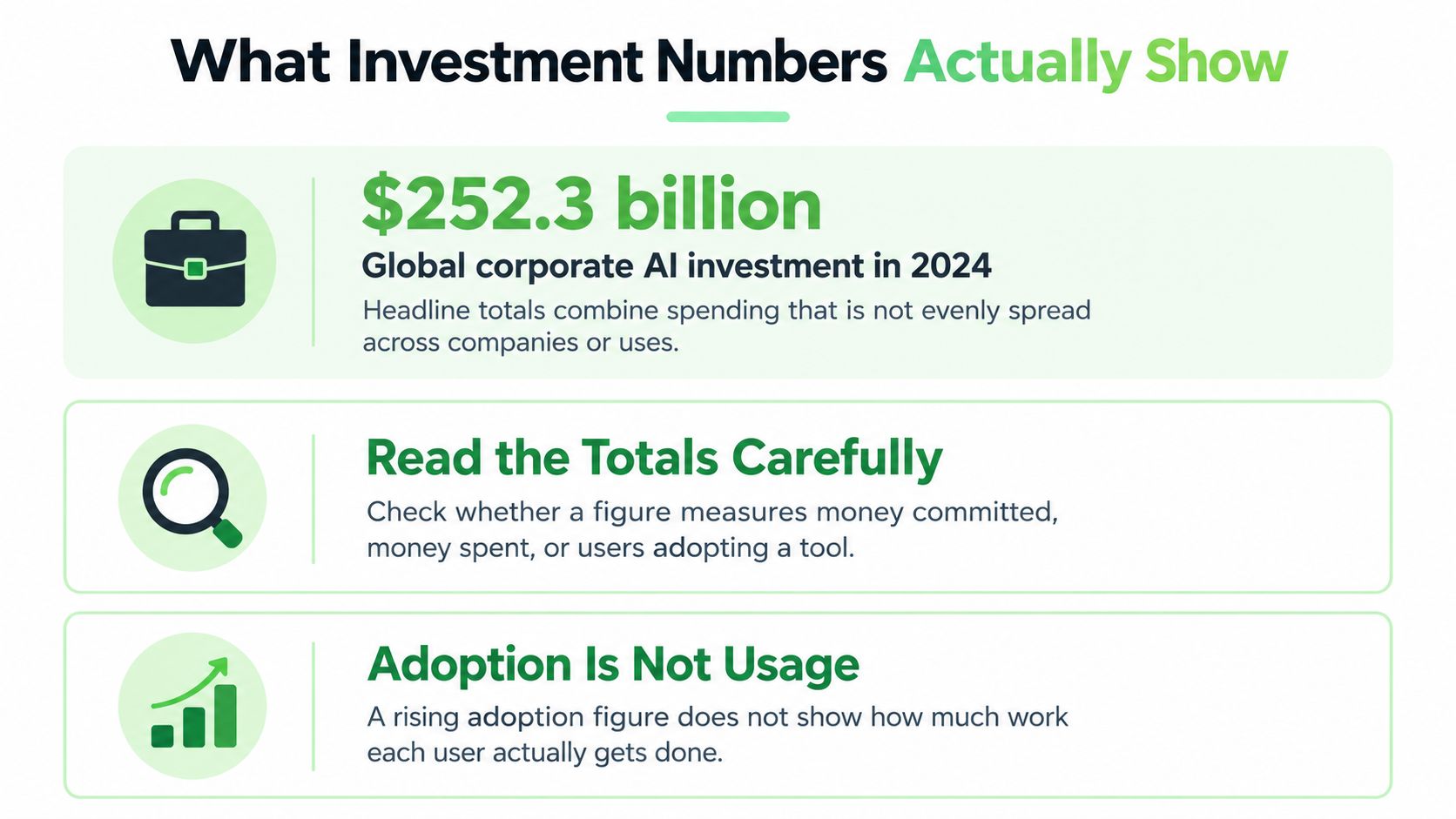
The spending figures are real, and they're easy to misread. Stanford's 2025 AI Index reported that global corporate AI investment reached $252.3 billion in 2024, while private generative-AI investment alone reached $33.9 billion, an 18.7% increase from 2023 and more than 8.5 times the 2022 level.
Adoption moved just as fast. The same report found that 78% of surveyed organizations said they used AI in 2024, compared with 55% in 2023, and reported generative-AI use in at least one business function more than doubled from 33% to 71%.
Here's a visual summary of why those headline totals need careful reading.
Returns Are Smaller Than the Headlines
| Metric | Reported figure | What it means |
|---|---|---|
| Global corporate AI investment, 2024 | $252.3 billion | Shows spending scale, not return |
| Private generative-AI investment, 2024 | $33.9 billion, up 18.7% from 2023 and more than 8.5 times the 2022 level | Capital chasing growth, not proven profit |
| Organizations using AI | 78% in 2024, up from 55% in 2023 | Broad experimentation |
| Generative AI in at least one business function | 33% in 2023 rising to 71% in 2024 | Pilots and workflow changes |
| Cost savings in service operations | 49% of AI users; most savings below 10% | Real but incremental |
| Revenue gains in marketing and sales | 71% reported increases; most increases below 5% | Small gains are the norm |
That pattern doesn't mean AI is useless. It means most organizations are still experimenting, redesigning workflows, and collecting incremental gains. If you want a stricter business test, a framework for scaling profitable AI solutions can help you separate a promising pilot from spending that only looks strategic.
Before you repeat any headline figure in a budget meeting, ask three questions.
- Spending or use: Does the figure measure money committed, money spent, licenses bought, or people actually doing work with the tool?
- Dollars or adoption: Is the benefit expressed as profit, cost saved, and revenue gained, or only as the share of organizations trying something?
- Typical or best case: Are you looking at a median result, an average pulled up by outliers, or the strongest example a vendor could find?
Adoption tells you AI is being tried. It doesn't tell you an organization has been transformed.
Productivity Gains by Worker and Task Type
The average productivity gain is the least interesting number in the best workplace study. The spread between workers is the finding.
In the NBER study published in 2023, customer-support workers who received access to a generative-AI assistant increased issues resolved per hour by 14% on average, while productivity among novice and lower-skilled workers improved by 34% and experienced, highly skilled workers saw minimal impact. The lowest-performing or least-experienced workers achieved gains of up to 35%. Within four months, assisted workers were outperforming unassisted employees who had been on the job for more than twice as long.
What the Tool Actually Did
The assistant didn't replace the support team. It transferred effective practices from stronger workers to weaker ones, suggesting phrasing, relevant information, and approaches that experienced agents already used. A new hire therefore borrowed part of a veteran's judgment on routine cases.
That mechanism predicts where you'll see gains. Expect the largest lift when a task has clear structure, good examples exist, and the worker hasn't yet internalized them. Expect little lift when an expert already knows the shortcuts, handles unusual cases, or must spend extra time checking suggestions they wouldn't have needed.
Say you're training junior claims staff to summarize repair estimates. AI can propose a consistent summary from documents while a senior adjuster checks amounts and exclusions. If you want a sector-specific comparison before designing that workflow, you can compare insurance document automation implementations and note where human approval remains in each design.
The Caution You Should Not Skip
One customer-support setting doesn't automatically generalize to every profession, language, or task. Support tickets are comparatively bounded, repetitive, and measurable. Strategy work, original research, negotiation, and sensitive client judgment don't share those properties.
Execution risk is also substantial. In July 2024, Gartner forecast that at least 30% of generative-AI projects would be abandoned after proof of concept by the end of 2025 because of poor data quality, inadequate risk controls, escalating costs, or unclear business value.
A tool that lifts novices sharply and experts barely at all isn't a universal accelerator. It's a training and standardization aid, and you should budget for it that way.
Actionable step: List your team's tasks in two columns, structured and repeatable versus novel and judgment-heavy. Pilot AI in the first column with your least experienced staff, measure resolved work per hour, and don't promise the same percentage to senior specialists.
How to Measure Net Time Saved After Editing
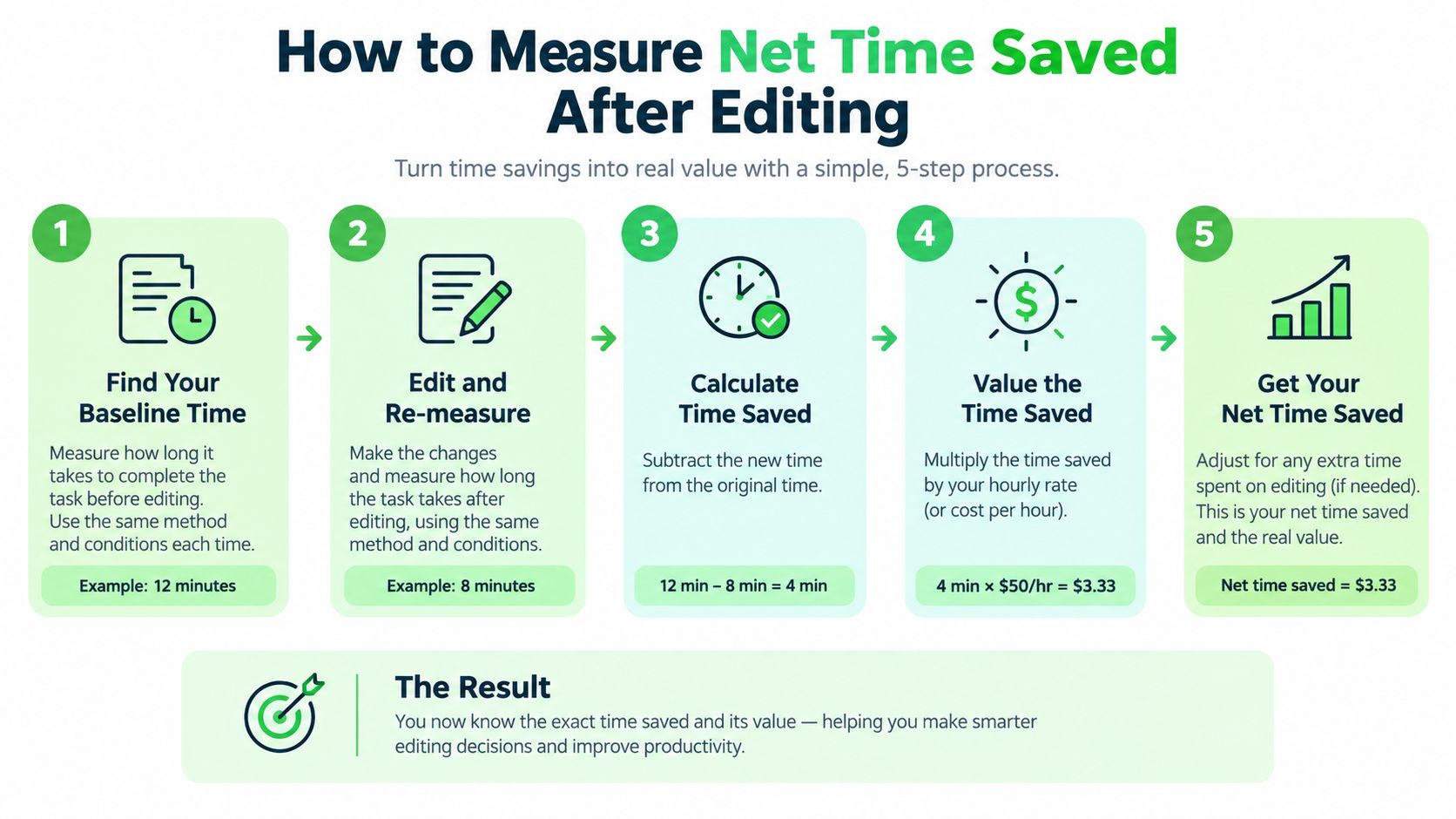
Generation speed is a vanity metric. Data summarized by the Federal Reserve Bank of St. Louis reported that generative-AI use among adults increased to 54.6%, while workplace adoption reached 37.4%, yet workers reported savings equivalent to only 1.6% of total work hours, implying a modeled productivity increase of up to 1.3% since ChatGPT's launch. Wide access hasn't produced equally wide time savings.
The missing measurement is simple. This process diagram outlines the stages you need to time separately.
Seven Steps to a Net Figure
- Time a baseline. Record how long five to ten past pieces of the same type took without AI, from brief to publishable draft.
- Time the AI draft stage. Include every prompt, regeneration, and instruction rewrite, not just the final generation.
- Time verification. Check each factual claim against a source, log how many claims you checked, and note how many were wrong or unsupported.
- Time editing and rewriting. Count work on accuracy, tone, structure, and brand fit separately from proofreading.
- Log downstream errors. Record corrections found in review or after publication, because each one carries reputational or compliance cost.
- Calculate net minutes saved. Subtract draft, verification, and editing time from the baseline for each piece.
- Compare by content type. Keep AI only where the net stays consistently positive across several pieces, not where one easy topic flatters the average.
The short video below walks through the same measurement problem from a practitioner's perspective.
A Worked Example
Say a 1,200-word article normally takes 180 minutes. With AI, drafting takes 25 minutes, fact checking takes 50 minutes, and rewriting takes 60 minutes. The total is 135 minutes, so you've saved 45 minutes, or 25%. That's a genuine gain worth keeping.
Now change one assumption. If the draft invents two statistics and muddles the argument, verification and rewriting can easily consume the apparent saving. A fast first draft that needs heavy correction can be slower than writing manually.
Net time, not generation speed, predicts whether AI belongs in that workflow.
Task Length and Reliability Limits
A model that succeeds half the time on an hour-long task isn't dependable automation. It's a capable assistant that still needs supervision.
METR's task-completion time-horizon benchmark estimates the length of a task, measured by expert human completion time, that an AI agent can complete autonomously with 50% reliability. Across frontier models over roughly six years, this horizon doubled approximately every seven months. On selected software, machine-learning, cybersecurity, and reasoning tasks, Claude 3.7 Sonnet reached a 50% success horizon of about 59 minutes for tasks human experts could complete in that time.
That is real progress. It also means the agent still fails about half the time at that threshold, so you can't hand it an unsupervised project and treat completion as expected.
The image below captures the planning discipline this limit requires, breaking long work into stages a person can inspect.

Deploy in Stages, Not Leaps
- Constrain the task. Define the input, output format, length, and prohibited claims before generation starts.
- Provide source and tool access. Give the system the documents or data it must use instead of letting it improvise missing facts.
- Log every output. Keep prompts, drafts, and revisions so a reviewer can reconstruct what happened.
- Run automated validation. Check length, required fields, banned phrases, links, and formatting with rules where possible.
- Escalate uncertainty. Send high-impact, ambiguous, or failed-validation cases to a named person.
Rewriting 50 product descriptions from catalogue fields, with length limits and a banned-claims list, fits this model. Letting an agent plan and run a six-week campaign, choose audiences, and approve its own copy doesn't.
A doubling trend describes benchmark progress across frontier models. It doesn't guarantee reliability on your task, with your data, under your deadline.
AI Use Cases Ranked by Human Oversight Needed
Good AI use cases pass four tests. The work is repeatable, the output is checkable, an error is cheap to fix, and a named person reviews it. Fail two or more tests and you're not automating work. You're automating risk.
Fit From Strongest to Weakest
| Use case | AI role | Human control required | Fit |
|---|---|---|---|
| Product descriptions from catalogue data | Generates variants from structured fields | Brand reviewer checks claims | High |
| Customer-support reply drafts | Suggests answers from a knowledge base | Agent reads and sends each reply | High |
| Student essay feedback | Flags structure, clarity and repetition | Teacher judges argument and originality | Medium |
| Publisher explainer articles | Drafts background sections | Named editor verifies claims and approves | Medium with controls |
| Marketplace product image screening | Flags likely synthetic or edited images | Human reviews disputed listings | Medium |
| Medical, legal or financial advice | Summarizes documents | Licensed professional makes the decision | Low for autonomous use |
Product descriptions work because the source data is structured. If dimensions, materials, and compatibility sit in catalogue fields, AI can vary the wording while a reviewer checks that no unsupported benefit appears. Support drafts work for a similar reason. The agent reads the suggestion, compares it with the customer's actual problem, and sends only what's correct.
Education sits in the middle. AI can flag a repetitive paragraph or a missing transition, but it can't fairly judge whether a student's argument is original or whether feedback matches the course rubric. For a related classroom workflow, turning reading passages into effective quizzes shows the same division of labor, with the teacher checking questions against the passage and learning goal.
Publisher explainers need stronger controls than routine copy because errors travel under your brand. A named editor should verify claims, inspect sources, and approve the final version. Building that checkpoint into a documented content creation workflow for AI-assisted publishing prevents review from depending on whoever happens to be available.
Marketplace image screening is useful as triage, not as a final ruling on a seller. Flag the suspicious listing, preserve the original asset, and let a person review disputes before penalties apply.
Medical, legal, and financial advice sits at the bottom for autonomous use. AI may summarize a long document for a professional, but the licensed professional must interpret it, decide, and carry responsibility.
The less checkable and more consequential the output is, the more human review it needs. That rule scales better than any vendor capability chart.
Realistic Adoption Timelines
Three clocks run at different speeds, and confusing them produces unrealistic plans. Capability improves quickly on benchmarks, organizations change slowly, and legal deadlines don't move because your pilot is behind schedule.
Do Not Let Benchmark Speed Set Your Date
A longer task horizon doesn't mean your team can deploy unsupervised agents on the same timetable. Your limiting factors are data quality, review capacity, staff training, and whether the work can be checked without recreating it from scratch. Many projects stall after proof of concept because the demo never answered those operational questions.
Experimentation also isn't scaled use. A department may hold licenses, run workshops, and still produce most final work manually. Until a task type survives repeated deadlines with measured net savings, call it a pilot and budget for learning rather than return.
A Six-Month Evidence Cycle
- Months 0 to 1, baseline. Record time and error rates for five to ten past pieces or tasks in each candidate category.
- Months 1 to 2, bounded pilot. Choose one repeatable task type, log drafts, and time verification separately.
- Months 2 to 4, compare and retire. Keep only categories with consistently positive net minutes and acceptable post-review errors.
- Months 4 to 6, expand carefully. Add similar task types, formalize reviewer roles, and build disclosure and provenance records into publication.
- Ongoing, retest quarterly. New models may change which tasks clear the bar, but your measured results should make the decision.
Say a marketing team pilots AI on product pages, email subject lines, and research explainers at once. They'll learn quickly that these categories have different checking costs. Product pages may scale in month three, subject lines may need brand testing, and explainers may stay in pilot because source verification eats the gain.
Plan for a multi-month evidence cycle, not a quick payoff. Teams that skip the baseline usually can't tell whether AI helped, so they either expand on enthusiasm or cancel on frustration.
Compliance Deadlines and the Review Workflow
Scale AI only where measured net time saving stays positive and post-review errors remain acceptable. Pilot everywhere else. Compliance then becomes part of the same workflow, not a cleanup exercise after publication.
According to European Commission quick facts on transparency rules for AI systems, Article 50 applies from 2 August 2026, and providers of systems placed on the market before 2 August 2026 receive a limited grace period until 2 December 2026 for the marking and detection obligation under Article 50(2). As you prepare, detailed guidance on EU regulations on AI and publishing obligations can help you map those duties to your own content types.
| Requirement | Scope or date | What to do |
|---|---|---|
| EU AI Act Article 50 transparency | Applies from 2 August 2026 | Record whether content is synthetic and whether Article 50 applies |
| Machine-readable marking under Article 50(2) | Systems on the market before 2 August 2026 have until 2 December 2026 | Plan technical marking for existing tools |
| Public-interest text exception | Requires human review or editorial control plus a responsible person | Keep named reviewer and approval records |
| Multiple media formats | Text, images, video, audio all in scope | Classify each asset by medium before publishing |
Your Review Checklist
- Classify each asset as text, image, video, or voice.
- Record the originating tool and preserve draft versions.
- Assign a named reviewer to every piece.
- Verify each factual claim against a source and log the result.
- Edit for accuracy and voice, tracking substantive changes.
- Approve with a timestamp under an accountable person.
- Treat any detector result as a prompt for review, never as legal proof by itself.
A missing marker doesn't prove human authorship, and a detector can be wrong in either direction. Combine provenance records, human review, labeling procedures, and technical detection instead.
Start concretely this month. Choose one content type, run the net-time method on ten pieces over 30 days, and compare the result with your baseline. Next quarter, expand only where the numbers hold.
If you're putting this review discipline into practice, Humantext.pro lets you check text, images, video, and voice for AI-generation signals and improve AI-assisted drafts so they read naturally while preserving meaning. Use it as one control inside your verification workflow, alongside source checks, version history, and named editorial approval. Visit the site to test a draft before your next publication deadline.
Gotowy, aby przekształcić treści generowane przez AI w naturalny, ludzki tekst? Humantext.pro natychmiast udoskonala Twój tekst, zapewniając naturalne i autentyczne brzmienie. Wypróbuj nasz darmowy humanizator AI już dziś →
Powiązane artykuły
How to Test AI: Metrics, Bias Checks and Detector Tests
How to test AI outputs step by step: set metrics, run bias and robustness checks, and verify text, image, video and voice content.
Most Natural AI Voice in 2026: 7 Top Picks Compared
Find the most natural AI voice tools in 2026, from ElevenLabs to Murf. Compare prosody, language support, and pricing, and learn how to test samples yourself.
Storytelling in Marketing That Drives Real Results
Learn how storytelling in marketing drives results, craft memorable campaigns, measure outcomes, and avoid common pitfalls with practical frameworks.

