
EU AI Act Compliance: A 2026 Action Guide
EU AI Act compliance for 2026: deadlines, risk classes, Article 50 labels, audit records, and a practical workflow for publishers and businesses.
In 2025, 68% of European businesses surveyed for Strand Partners' report said they struggled to understand their responsibilities under the EU AI Act, a figure AWS published while summarizing that report in its AWS summary of the Strand Partners report. That confusion is still the main risk for content teams. Teams don't lack a detector. They lack a record of what system made a file, how a human changed it, and why a label was or wasn't shown.
EU AI Act compliance for publishers, educators, and agencies now turns on that record. The main transparency date has passed, so treat this as live operations, not preparation. Work through role, risk, materiality, and proof that labels survive publishing.
Deadlines That Already Bind Your 2026 Plan
2 August 2026 has already passed. That's the date that matters most for your publishing calendar. Don't plan as if you're waiting for it.
The European Commission FAQ on Article 50 transparency obligations explains that the EU AI Act entered into force on 1 August 2024 with a phased timetable, that prohibited AI practices and AI literacy rules began applying on 2 February 2025, and that obligations for providers of general-purpose AI models applied from 2 August 2025. Most remaining provisions, including Article 50 transparency obligations, generally apply from 2 August 2026. Certain providers of systems already placed on the EU market before that date may have until 2 December 2026 for the Article 50(2) marking and detection requirement.
Read that December date narrowly. It gives qualifying providers extra time for one marking duty. It doesn't pause a deployer's reader-facing disclosure duties.
Say a magazine uses a vendor model that met earlier model duties. The magazine still decides today whether its AI cover image needs a visible label, whether an AI-assisted explainer on a public issue needs disclosure, and whether the label appears when a reader first sees it. The vendor's earlier work doesn't answer those questions.
The timeline below puts the passed dates and the one narrow window in order.
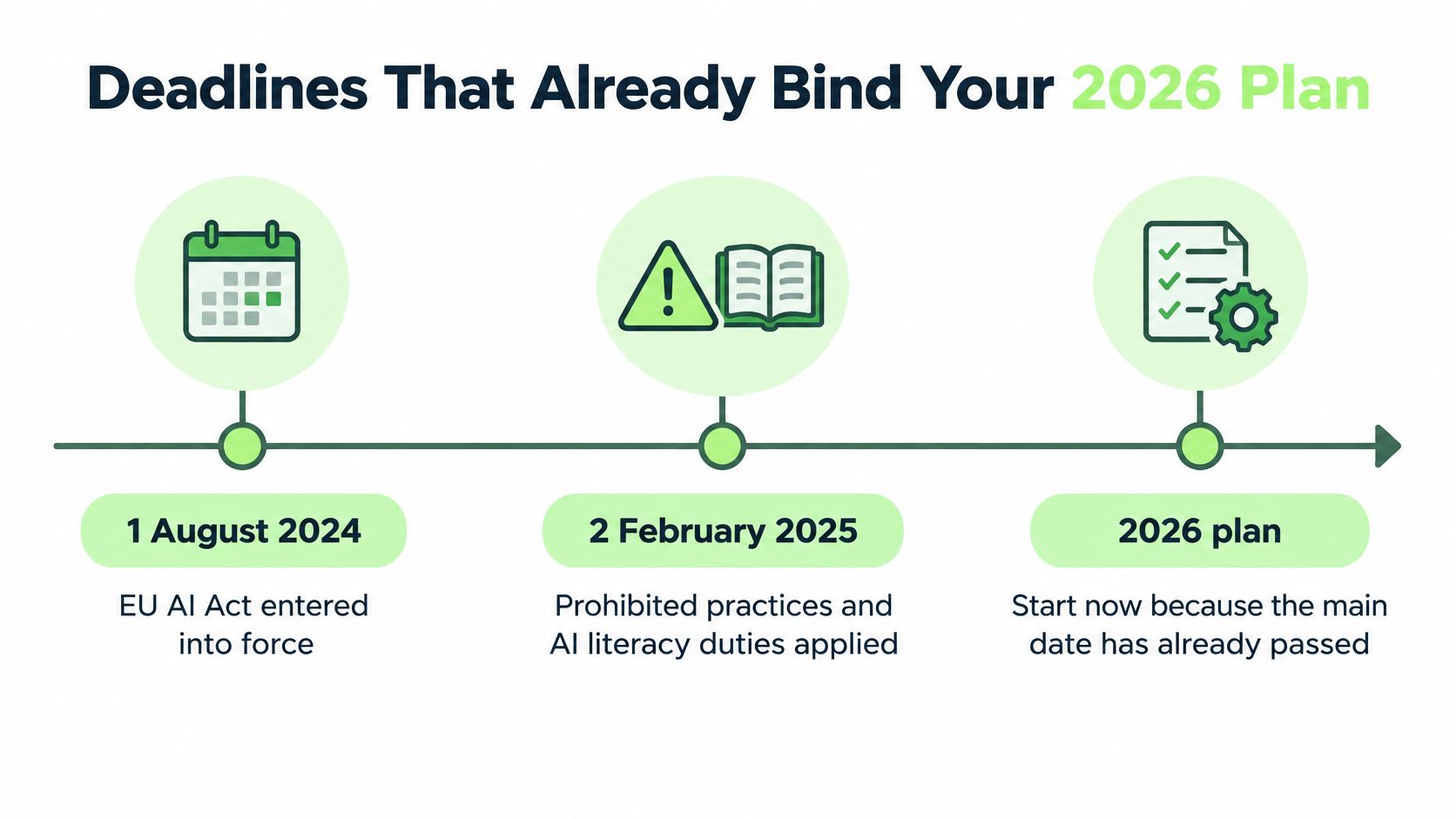
EU AI Act Milestones That Change What You Must Do
| Milestone | Date | Who it hits | What starts |
|---|---|---|---|
| Act enters into force | 1 August 2024 | In-scope providers, deployers, importers, distributors | Phased timetable begins, not every duty at once |
| Prohibited practices and AI literacy | 2 February 2025 | Providers and deployers | Bans on prohibited uses and literacy duties apply |
| GPAI model obligations | 2 August 2025 | Providers of general-purpose AI models | Model governance and related provider duties apply |
| Main application including Article 50 | 2 August 2026 | Providers and deployers of covered systems | Transparency, enforcement, and many high-risk rules apply |
| Limited marking transition | 2 December 2026 | Providers of certain systems already on the market before 2 August 2026 | Extra time only for Article 50(2) marking and detection |
What To Mark On Your Calendar This Week
Find your row first. Are you a provider placing a system on the market, a deployer using it, or an importer or distributor bringing it into the EU supply chain? Your answer changes which date controls your work.
Then ask one narrow question for each system. Was it already on the EU market before 2 August 2026, and are you the provider relying on the December marking window? If you can't answer yes to both parts, don't use that date as cover.
Calendar rule: Treat 2 December 2026 as a provider marking deadline for certain legacy systems, not as a general extension for publishing disclosures.
Back-schedule the next 30 days from today. Week one is inventory. Week two is label decisions. Weeks three and four are evidence and spot checks on live pages.
If you need a broader governance structure around those dates, work through an AI governance compliance checklist for 2026 and map each item to a named owner on your team. A checklist without an owner and a date won't help when someone asks why a page went live unlabeled.
Your immediate proof is simple. One dated list of systems, your role for each, and a yes or no note on the December window. Keep it where editors can find it, not in a legal folder no one opens.
Classify Each System by Role and Risk
Start with a lookup you can fill in, not a legal memo. Every tool gets one row. Every row gets a role, a risk band, an owner, and an audience.
You're likely a provider if you place a system on the market or put it into service under your own name. You're a deployer if you use a system in your work. Importers and distributors sit in the supply chain that brings a system into or across the EU market.
One company can hold several roles at once. That's normal. Don't force the whole business into one label.
Risk Band and The Duty That Follows
| Risk band | Typical uses | Main duty | Practical first move |
|---|---|---|---|
| Unacceptable | Social scoring; untargeted facial-image scraping; prohibited manipulation | Ban | Stop the use and record the decision |
| High-risk | Employment, credit, education scoring, critical infrastructure and other listed uses | Conformity, documentation, human oversight, registration where required | Name an owner and open a technical file |
| Transparency | Chatbots interacting with people; deepfakes; qualifying synthetic or public-interest text | Article 50 disclosure and, where required, machine-readable marks | Decide visible label and provenance signal |
| Minimal | Spam filters; ordinary assistive edits that do not substantially change meaning | General law, not a special AI Act file | Note why it sits outside the marking duty |
| GPAI overlay | A general-purpose model embedded in any band above | Upstream model duties plus the downstream role's duties | Record model name, version, and your role |
Use the table as a sorting tool. Unacceptable means stop, not label and continue. High-risk means you need a fuller file, including technical documentation and human oversight, before you argue about wording on a webpage.
Transparency is where most content teams live. A chatbot that talks to readers, a synthetic voice, a deepfake style video, or qualifying public interest text needs people to understand what they're seeing. Minimal risk tools still need a short reason on file, so a later reviewer can see why you treated them lightly.
One Agency, Three Different Answers
Say an agency runs three tools. A public website chatbot answers course questions for a training client. The agency is deploying it, and users should know they're interacting with AI. That's a transparency case.
The same agency also uses an in-house hiring scorer to rank applicants. Employment scoring changes people's opportunities, so treat it as high-risk work with an owner, documentation, and real human oversight. Don't let a recruiter click accept on every ranking and call that oversight.
The third tool checks headline spelling. If it fixes typos and doesn't change meaning, it's often minimal. Write that reason down in one sentence and move on.
Notice what the GPAI overlay does here. A general-purpose model under the chatbot or the scorer brings upstream model duties for its provider. It doesn't erase the agency's duty as the deployer using the output with the public or with applicants.
- Role first: Write provider, deployer, importer, or distributor before you discuss labels.
- Use case second: Classify what the system does in practice, not what the sales page calls it.
- Audience third: Note who sees or is affected by the output, because that drives disclosure.
Finish the row before any labeling debate. If a row has no owner, no audience, and no risk band, your team will guess later under deadline pressure.
Choose the Label from Context and Materiality
A grammar fix and a raw AI article about a public health claim aren't the same case. Treating them as identical creates noise in one place and risk in the other.
Article 50 of the EU AI Act distinguishes outputs that substantially alter content from ordinary assistive editing that does not substantially change the input data or its semantics, and the latter may fall outside the machine-readable marking requirement. The public interest text trigger is also narrower than many teams assume. It focuses on AI-generated or manipulated text concerning matters of public interest published without human review or editorial control, rather than every AI-assisted marketing sentence.
The comparison below shows the split editors need to make before they choose a badge.
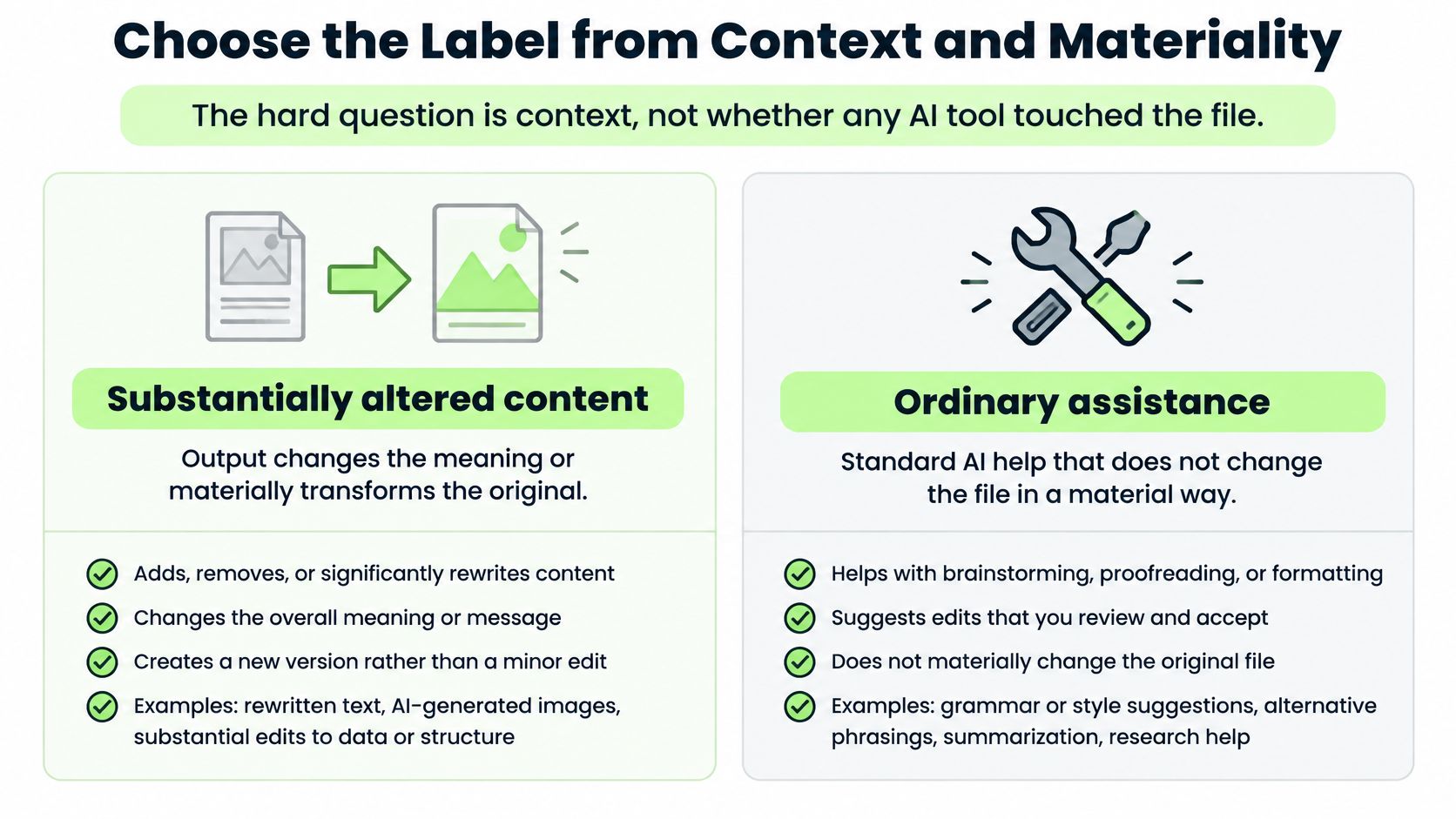
Ask Five Questions Before You Publish
Use these in order, and write the answers down. Short answers beat a long policy no one reads.
- What did AI do: Did it create, transform, translate, or only correct the file?
- Did meaning change: Would a reader understand a claim, image, or voice differently after the edit?
- Is it public interest: Does the piece inform the public on a matter people may rely on?
- Was control real: Did a named editor check facts and wording, or did someone skim and approve?
- Which control fits: Choose a visible label, a machine-readable mark, both, or neither, and state why.
That fifth answer is your decision record. For multilingual teams, record the reason in the language of publication so the local editor isn't translating your intent later. Our detailed walkthrough of AI content labeling requirements by format and context can help you turn those answers into consistent label wording.
Materiality And Context Matrix For Article 50 Decisions
| Case | What AI did | Meaning or context | Disclosure to choose |
|---|---|---|---|
| Synthetic news image | Created the image | New public-facing content | Visible label plus machine-readable mark |
| Deepfake of a real person | Substantially transformed | Must be clear at first exposure | Perceivable deepfake disclosure plus mark where feasible |
| Public-interest article published raw | Created the text | No real editorial control | Visible text disclosure and a process record |
| Grammar or spelling polish | Corrected only | Meaning unchanged | Often outside marking; record the reason |
| Translation that shifts a public claim | Translated | Possible semantic change | Document editorial control; label if AI shaped the claim |
| Satire, fiction, or analogous creative work | Created or transformed | Artistic or similar treatment may apply | Record the exception; do not hard-code one badge |
| Heavily edited or humanized AI text | Transformed after generation | Detector may be unreliable | Keep origin, edits, reviewer, and final disclosure decision |
Watch the translation row. A translation can look like light assistance until it softens a warning, changes a number's implication, or turns a cautious claim into a promise. That's a meaning change, even if the grammar is perfect.
Heavily edited text needs the same care. A detector may miss it after rewriting, but your process record still shows where the draft started and who took editorial responsibility.
This short video walkthrough is useful background before you test the matrix on live assets.
Avoid two shortcuts. A blanket label everything policy can mislead readers about a simple spelling fix. A blanket human reviewed stamp fails when the model wrote the claim and the human only checked the layout.
If meaning or public reliance changed, don't hide behind a grammar tool exception.
Run an Article 50 Transparency Workflow
Turn the label decision into a workflow your team can run on a busy Tuesday. The EU AI Act Service Desk guidance on Article 50 supports a workflow that starts with an inventory, classifies outputs, documents audience and public interest, and attaches controls at generation, post-processing, publication, and first exposure. Providers must use effective, reliable, and interoperable machine-readable marks where technically feasible, while deployers provide clear, distinguishable, human-perceivable disclosures for deepfakes and qualifying text.
The process graphic below sums up the publishing flow before the detailed steps.
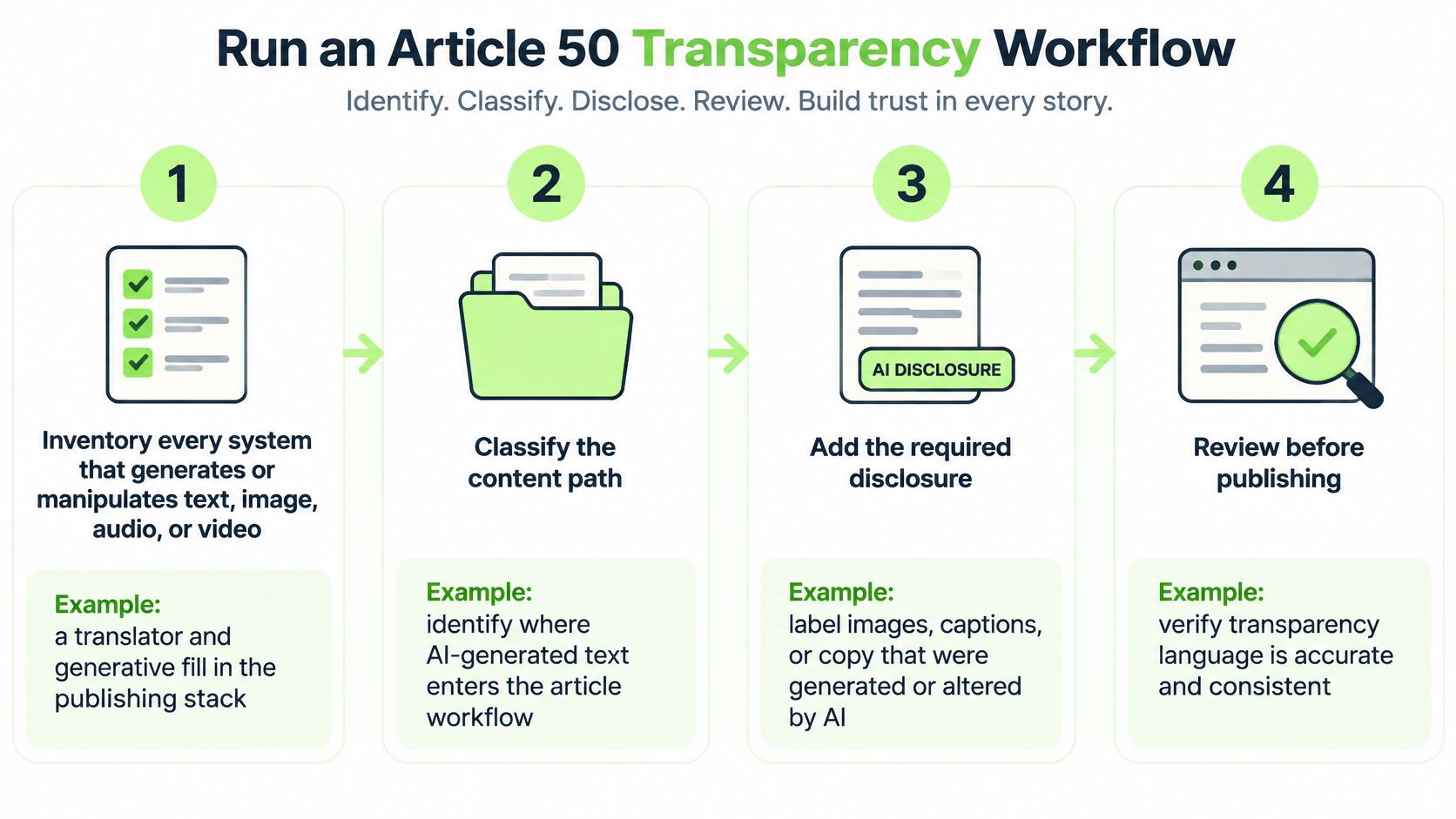
Eight Steps From Intake To First Exposure
- Inventory every generator: List systems that create or manipulate text, image, audio, or video. Include translators, voice cleanup, and generative fill in photo tools, not only your main writer.
- Mark the content path: Note whether the output is provider-generated or deployer-published and name the accountable person. An editor publishing a vendor image owns the reader-facing decision.
- Record audience and trigger: Write who will see it and whether it informs the public on a public interest matter. Use your materiality answers here, in plain words.
- Place four controls: Check generation, post-processing, publication, and first exposure. A label added in a draft but stripped by your content system hasn't done its job.
- Apply the machine-readable mark: Where technically feasible, use a mark that's effective, reliable, durable, and interoperable. Record the method, such as watermarking, metadata, or content credentials, and its status.
- Add the human disclosure: For deepfakes and qualifying AI text published without real editorial control, show a clear and distinguishable disclosure people can perceive. Put it where readers first encounter the content, not in a footer three screens away.
- Keep the evidence: Save model and version identifiers, prompt or source metadata, transformation history, provenance status, reviewer identity, channel, and timestamp. Store them with the published URL.
An AI-probability score is not legal provenance. Pair any detector flag with generation logs, content credentials or another machine-readable signal, and a written human decision.
- Test as a reader: Open the page, app, or video in the ordinary interface. If a reader needs a forensic tool or a special click to understand the disclosure, fix the placement or wording.
A Product Video Example
Say a small retailer creates a short demo with a tool such as ShipTeaser's product video generator. Step one puts that generator on the inventory. Step three asks whether the video shows a real person, a synthetic presenter, or only product shots.
If a synthetic presenter appears to be a real person, the team needs a perceivable disclosure at first view and a record of the source file, edits, reviewer, and channel. If the tool only cuts existing product footage and adds captions without changing what's shown, the record should say that clearly. Same tool, different evidence.
Don't use a generic AI badge on every page as a substitute for that judgment. It can still leave a deepfake unlabeled at first view while over-labeling harmless edits.
Keep the result as a one-page register. One row per output or output type, linked to its evidence. That's what you'll open when a client, platform, or assessor asks how a label was chosen.
Prove Labels Survive Publishing
A policy says what should happen. A sample shows what did happen. EU AI Act compliance needs the second one.
The European Commission code of practice on AI-generated content covers machine-readable marking and detection for synthetic audio, image, video, and text, plus visible disclosure of deepfakes and certain public-interest text. It supports a four-stage loop and warns that a single detector accuracy figure isn't the right benchmark. Measure label visibility, signal survival, error rates, time to fix problems, and how many records contain complete evidence.
Run A Four Stage Assurance Loop
Stage one, intake. Detect or collect provenance signals when a file arrives. Don't trust a filename like final_real_photo.png. Check metadata, credentials, watermark status, and the sender's generation log where available.
Stage two, assessment. Decide whether the asset is fully synthetic, materially manipulated, or only AI-assisted. A color correction on a staff photo and a generated crowd scene belong in different buckets, even if both passed through the same editor.
Stage three, publication. Apply the visible label at publication or first interaction and preserve the underlying machine-readable mark. For video and social clips, check our guide to deepfake disclosure rules at first exposure before you settle on placement and timing.
Stage four, distribution sampling. After publishing, test what compression, crops, screenshots, translation, and reposts did to the signal. Open the live asset where readers see it, including the social embed and the mobile view.
Judge The Whole Control, Not One Score
Build separate test sets so you know where failures occur. Keep one set for fully synthetic media, one for AI-edited human work, one for translations, and one for authentic files after ordinary compression.
- Label visibility: Can a reader see and understand the disclosure without hunting?
- Signal survival: Does the machine-readable mark remain after resizing, compression, and reposting?
- Error balance: Track false positives and false negatives on a representative multilingual set.
- Repair time: How long does a broken label stay live after someone spots it?
- Record completeness: What share of sampled items link to model, reviewer, decision, and URL?
The common failures are predictable. Teams assume a watermark survives every platform, trust one detector, hide the only label in metadata users never see, or call automated post-editing human editorial control. Each failure breaks a different stage of the loop.
Artistic, satirical, fictional, and similar works may need specific treatment. Record the exception and who approved it. Don't hard-code one rule for a news photo, a novel excerpt, and a satire clip.
Weekly sampling habit: Pull ten published URLs, view them as a reader, and log whether the label and the mark both remain.
That log is your audit pack in miniature. It shows dates, failures, fixes, and repeat problems with a platform that keeps stripping metadata. A slide about policy intent doesn't show any of that.
Build the Register and Audit Pack Now
Start with actions you can finish this week. You don't need a new platform to create the first register. You need an export, a few decisions, and a place to keep evidence.
Action Horizon And Evidence Kept
| Horizon | Action | Evidence kept |
|---|---|---|
| This week | Export system inventory and assign provider or deployer | Dated inventory with role per row |
| This week | Check whether a system falls under the 2 December 2026 window | Signed scope note per system |
| This month | Pilot the materiality matrix on ten live assets | Disclosure decision with model version, edits, reviewer, URL |
| Weekly | Sample ten published URLs as a reader | Log showing label and machine-readable mark still visible |
| Before any tool upload | Check detector or humanizer retention terms | Vendor terms note and data-handling decision |
Pilot the matrix on assets that force real choices. Pick one synthetic image, one public interest text, one translation, and one grammar only edit. Add a product script if your team uses tools to turn scripts into videos, because script, voice, and presenter may each need a separate decision.
Store each decision next to the model version, edits, reviewer, and published URL. If the label changes after a platform repost strips a signal, add the fix and date. Don't overwrite the first decision, or you'll lose the audit trail.
Use Detection As A Second Check
Detection helps at intake and during post-publication sampling. It doesn't replace the legal mark, the visible disclosure, or the editor's decision.
We offer AI detectors for video, image, voice, music, and text, including Turnitin, Grammarly, ChatGPT, and Claude detectors. Our Universal AI Scanner works with an uploaded file and returns an instant verdict with no signup required, and each paid plan includes unlimited AI detection. Use a result to trigger review, then confirm origin from logs and provenance signals.
If you're building that review routine, follow a repeatable method for how to test AI content before publication so different editors don't run different checks on the same asset. Keep the test result, but keep the human decision beside it.
A humanizer may improve clarity in an approved draft. It doesn't remove the origin record. If a covered system created the draft, keep the system, reviewer, edits, and label decision intact after any style pass.
Check privacy before uploads. Confirm a tool's retention and training terms, and keep personal data out of shared logs unless you have a lawful basis. Student work, client briefs, and unpublished manuscripts need that check before anyone pastes them into a detector.
Your finished audit pack should fit together without explanation. Inventory, role, risk band, materiality decision, label, mark status, reviewer, URL, and weekly sample log. That's the pack an assessor can follow. A single probability score can't do that work.
Use Humantext.pro as your second check in an Article 50 workflow, with detectors for text, image, video, voice, and music that help you flag assets for disclosure review before and after publishing. Upload a file to the Universal AI Scanner for an instant verdict with no signup, then record that result beside your provenance log, reviewer decision, and visible label. Visit today and build your next ten-URL sample into evidence your team can show.
Pronto para transformar o seu conteúdo gerado por IA numa escrita natural e humana? Humantext.pro refina instantaneamente o seu texto, garantindo que é lido de forma natural e autêntica. Experimente o nosso humanizador de IA grátis hoje →
Artigos Relacionados

Incorporating Paraphrasing Restating or Generating in New Form: A Guide
Learn incorporating paraphrasing restating or generating in new form so drafts stay clear, cited, and original. Step-by-step checks inside.
AI Content Checker: How It Works and What Scores Mean
How an AI content checker works, how accurate it is, where it fails, and how to read its score before you act on it.
AI Hype vs Reality: What Actually Works in 2026
AI Hype vs Reality in 2026: Which Claims Hold Up, Where AI Fails, and Realistic Timelines for Business Use

