AI Detector Score: What It Means and How to Use It
Understand AI detector scores, learn how they are calculated, and discover practical ways to interpret and use them for quality assurance and compliance.
An AI detector score is a probabilistic signal, not proof of authorship. Even a result such as 80% AI probability doesn't mean that 80% of the sentences were written by a machine, just as a weather forecast predicting rain doesn't guarantee that a storm will arrive.
You may encounter the score after submitting an assignment, reviewing a client article, or checking a manuscript before publication. The number can feel like a verdict, especially when the text is entirely your own. A more useful response is to treat the result as a prompt for context, evidence, and human review.
The Moment Your AI Score Arrives
You've finished a client article, checked the citations, and read the draft aloud. Then the detector returns 78% AI probability. Your first reaction might be to rewrite every paragraph, remove polished sentences, or assume the client will reject the work.
Pause before changing anything. The number doesn't establish who wrote the article, which tool produced the supposed AI text, or whether the writing violates a policy. It indicates that the language resembles patterns the detector associates with generated text.
That distinction matters because a detector can misread formal, predictable, carefully edited, or multilingual writing. A methods section, an examination answer written in a second language, and a polished marketing article may all contain regular sentence structures without sharing the same authorship.
Practical rule: Treat a score as a review trigger, not a verdict.
A useful analogy is a weather forecast. If the forecast predicts rain, you might carry an umbrella and check the sky. You wouldn't conclude that rain must fall at every location for the entire day. An AI detector score works similarly. It can suggest that you should inspect the text, but it can't independently prove what happened during drafting.
The 2024 RAID benchmark evaluated more than 10 million documents across recipes, news articles, blog posts, and other genres. It found that many detectors performed well mainly on text resembling their training data, while reliability declined substantially when generated text was edited or disguised. That finding makes the surrounding circumstances essential.
Start with the writing process
Suppose the writer can show an outline, early drafts, tracked changes, source notes, and a revision history. Those materials provide evidence about how the work developed that a headline score cannot provide.
Suppose instead that the article contains unsupported claims, citations that don't resolve, or paragraphs the author can't explain. Those are reasons for a closer editorial conversation, regardless of the detector result. The central question isn't “What number appeared?” It's “What evidence supports a responsible decision?”
For an educator, that may mean asking a student to explain the argument and discuss the sources. For an editor, it may mean comparing the submitted draft with earlier versions. For a content manager, it may mean checking facts, brand guidance, and the author's revision process before requesting changes.
How AI Detectors Calculate Your Score
An AI detector doesn't read your mind or inspect your drafting history. It processes the text and looks for statistical patterns associated with examples in its evaluation or training data.
A simple way to understand the process is to compare it with a spell-checker. A spell-checker identifies patterns that resemble misspellings. An AI detector identifies patterns that may resemble generated language. Neither system understands authorship in the human sense.
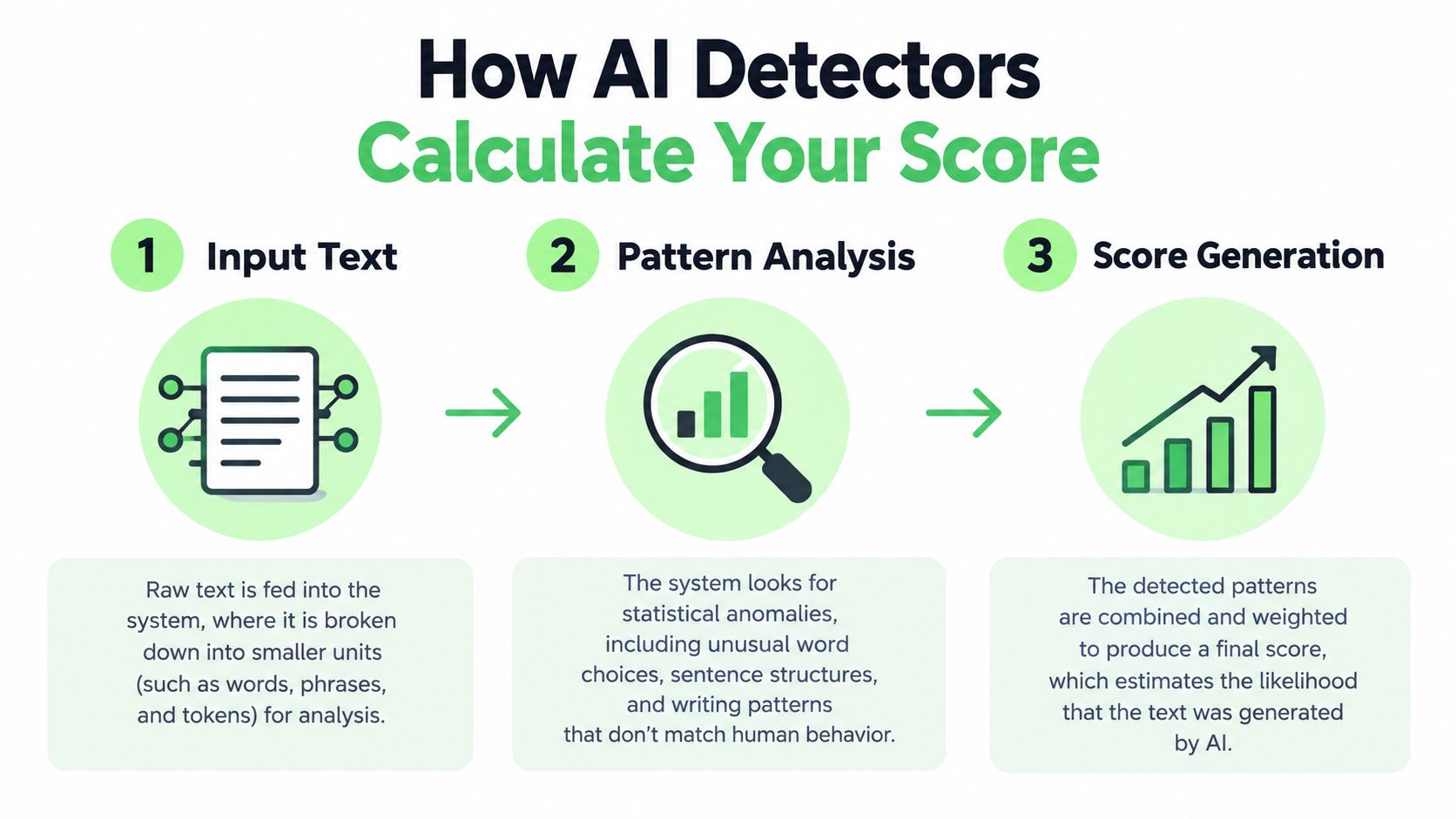
Three stages behind the number
First, the system receives the text. It may consider the passage as a whole or examine smaller sections. Length, genre, language, and formatting can affect the available signal.
Second, it analyzes patterns. These can include how predictable word choices are, how sentences are structured, and how consistently the prose follows familiar statistical patterns. A formal article may appear more predictable because it uses established terminology and a controlled style.
Third, it generates a classification or probability-like result. The output might be described as an AI probability, human score, or detection percentage. The label varies by product, and the number doesn't have a universal meaning across tools.
An 80% AI score therefore doesn't mean that 80% of the words came from an AI system. It means the detector's internal model judged the text to resemble its AI-associated examples to that degree under its own method.
The NIST evaluation of text discriminators uses measures such as area under the ROC curve and Brier score because a useful system must assess both ranking performance and probability calibration. NIST also reports substantial variation across generators and discriminators. A score is consequently dependent on the model, dataset, and testing conditions.
Two tools can produce different results because they may use different reference data, thresholds, classifiers, or ways of dividing the passage. A result from one service shouldn't be treated as directly interchangeable with a result from another.
For a deeper technical explanation, read how AI detectors work and what their signals mean. The practical lesson is simple: read the score as a model output, not as a measurement of a person's behavior.
What Independent Research Says About Accuracy
Suppose an AI detector gives a high score on a carefully edited report. Before treating that result as evidence, ask how the system performed on comparable texts. The more useful question is whether a result remains dependable across writers, genres, languages, editing styles, and model sources.
A study summarized by James Cook University researchers tested six major AI detectors on 805 samples. The tools achieved a mean accuracy of 39.5% for unmodified AI-generated text, and they correctly classified human-written control samples in 67% of tests. The strongest system identified 64.8% of AI-generated texts, while GPTZero achieved approximately 26% accuracy in that evaluation. These figures appear in the researchers' study of AI-detector performance.
The findings describe performance across a test set, not the certainty of an individual result. A detector can classify one passage correctly while relying on signals that do not apply to another writer, subject, or revision history. That distinction matters whenever a score could affect academic standing, employment, publication, or reputation.
Accuracy is not the same as evidence
Accuracy measures how often a system reached the expected classification in testing. It does not establish whether a particular person used AI. Formal phrasing, a short sample, extensive editing, or a domain outside the detector's training conditions can all affect the output.
A high score may reflect predictable language rather than machine authorship. A low score may miss generated text after substantial revision. Neither result reveals intent or provides a record of how the document was written.
Language background requires separate attention. Research on authentic TOEFL essays found an average false-positive rate of 61.3% across seven detectors for non-native English writers, as summarized in the evidence reviewed by James Cook University researchers. The finding points to a fairness risk: detector classifications can interact with vocabulary, grammar, and learned academic conventions. It does not show that multilingual writers use AI more often.
A score can show what a detector noticed. It cannot, by itself, explain why the text has those features.
For a responsible workflow, treat screening as a prompt for review rather than a verdict. Check drafts, source records, revision history, and the writer's explanation. For multilingual material, compare like with like and record the language context. In EU settings, document the basis for any consequential decision and provide human review, since an automated score alone is weak evidence for judging a person.
Understanding Thresholds and What Different Scores Mean
When a report returns a percentage, first identify the system and its display policy. A score belongs to the detector that produced it. One platform may show a detailed figure across a wide range, while another may hide low results because they are too uncertain to quantify.
Turnitin reports a document-level false-positive rate below 1% when its system detects at least 20% AI-generated writing, compared with an approximately 4% sentence-level false-positive rate (Turnitin's false-positive reporting). These figures describe Turnitin's own document, model, and testing conditions. They do not establish a universal accuracy rate for every detector or text type.
Use the report according to its level:
| Result type | Sensible interpretation |
|---|---|
| Document-level result | Review the entire document and its context. Treat the percentage as a screening signal, not proof of authorship. |
| Sentence-level highlight | Read the surrounding passage. A highlighted sentence may still have been written by a person. |
| Low or suppressed result | Do not interpret the absence of a precise percentage as proof that no AI assistance occurred. |
Turnitin's documentation states that results from 1% through 19% receive no attributed score or highlights, and may appear as an asterisk instead of a percentage (Turnitin's guidance on asterisk results). The asterisk reflects a reporting rule for a range with greater false-positive risk. It is not a finding that the text contains no AI assistance.
Read thresholds as interface rules
Suppose one report shows 18% and another shows “*%.” The second document is not automatically more human, and the first figure is not a precise measure of authorship. The tools may just be applying different display rules to results they consider too uncertain for detailed attribution.
The same principle applies to thresholds such as 50% or 80%. A platform can use a threshold to route text for human review, but the cutoff does not create a universal boundary between human and AI writing. Interpretation depends on the tool's calibration, the available text, and the consequences attached to the result.
Educators should avoid treating a percentage as automatic proof of misconduct. Publishers should record the detector, preserve the original report, and note the language and context of the text. Writers should retain drafts and revision records, giving reviewers process evidence to examine alongside a borderline score. In EU settings, that documentation also supports a human, accountable review when an automated result may affect a person.
When Scores Fail You Most Often
Detector reliability becomes more fragile when the text is short, paraphrased, heavily edited, or written by someone working in a second language. These conditions change the statistical patterns that the system uses, so the result may become less informative even when the meaning stays the same.

NIST reports that recursive paraphrasing can reduce detection rates to about 20% for text of roughly 225 words, showing how semantic-preserving rewriting can increase false negatives. A passage may keep its argument while losing the signals a detector expects to find.
Language background creates a different risk. Authentic TOEFL essays by non-native English speakers were misclassified as AI-generated at a mean rate of 61.3% across seven detectors, according to the research evidence on multilingual false positives.
Use a risk-aware reading rule
A high score deserves extra care when:
- The passage is short: There may not be enough text for stable classification.
- The writer is multilingual: Formal or carefully controlled English can resemble detector training examples.
- The text has been translated or paraphrased: Rewriting changes the signals without necessarily changing the author's ideas.
- The genre is formulaic: Academic methods, compliance language, and structured business copy often use conventional phrasing.
- The draft has undergone heavy editing: Human revisions can alter the score in either direction.
The guide to AI-detection false positives is useful when a score appears to reflect style more than authorship. A practical response is to compare the original draft with the revised version, ask the writer to explain key choices, and inspect the source trail.
The video below offers another accessible way to think about why detector outputs require interpretation rather than automatic judgment.
The fairest conclusion is not that detectors are useless. It's that their strongest role is triage. They can point a teacher, editor, or content manager toward passages worth discussing, but they shouldn't carry the full burden of proving authorship.
Your Responsible AI Score Workflow
A responsible workflow combines the score with evidence that the detector can't see. The same approach works for a student assignment, a publisher's manuscript, or a marketing team's AI-assisted draft.
Preserve the process before judging the product
Save outlines, drafts, tracked changes, notes, and revision history. If you're working in Word, Google Docs, or another collaborative editor, retain the available document history. A writer who can explain how the argument developed has stronger contextual evidence than a writer who only has a final file and a detector screenshot.
This is also why a documented five-step writing process can be more useful than repeatedly rewriting text to chase a lower score. Good records show development, decisions, and accountability.
Review the whole work
Don't begin with the highlighted sentence. Read the document for:
- Source integrity: Open citations and confirm that they support the claims made.
- Factual consistency: Check whether names, dates, definitions, and conclusions agree throughout.
- Argument quality: Ask whether the writer can explain the reasoning and evidence.
- Assignment or editorial fit: Compare the work with the brief, instructions, and expected audience.
- Writing history: Look for meaningful development rather than relying on stylistic impressions.
For students preparing an English composition or literature assignment, an AP English exam study guide can help clarify expectations around evidence, analysis, and organized writing. Those criteria provide more educational value than asking whether a single score crossed an arbitrary line.
Apply a human decision standard
A teacher can ask the student to discuss a thesis, source choice, or revision. An editor can request the draft history and verify citations. A publisher can record what assistance was used and apply its disclosure policy consistently.
Humantext.pro offers an AI detector that returns an AI-likelihood score and separate results from multiple detection models, along with tools for reviewing AI-assisted text. Whatever tool you use, compare the output with process evidence and never present a detector score as a percentage of proven AI authorship.
The European Union's AI Act adds a separate compliance obligation. The European Commission requires providers to ensure that AI-generated synthetic media, including text, is marked in a machine-readable format and detectable as artificially generated or manipulated. The transparency obligations apply from August 2, 2026, with a grace period until December 2, 2026 for certain systems already on the market. A detector score can support verification, but it doesn't replace labeling, provenance records, or disclosure procedures.
Final checkpoint: Before acting on a score, ask what evidence you have beyond the score, whether the same process would be fair to multilingual writers, and what your policy requires.
Start today by saving the original draft, recording the detector and its result, checking the citations, and inviting a factual explanation from the writer. If you need a structured way to review AI likelihood while preserving meaning and improving clarity, visit Humantext.pro and compare its detector results with your documented human-review workflow.
Готовы превратить контент, созданный ИИ, в естественный, человеческий текст? Humantext.pro мгновенно улучшает ваш текст, придавая ему естественное, живое звучание. Попробуйте наш бесплатный гуманизатор ИИ-текста сегодня →
Похожие статьи

Data Monetization Platform Guide: Build, Price, and Scale
Master the data monetization platform model. Learn architecture, pricing strategies, compliance rules, and real examples to turn data into revenue safely.
10 Different Words for Sad: Ranked by Intensity and Tone
Explore different words for sad, ranked by intensity, register, and context, with example sentences and usage notes for writers and students.
AI Detector Essay Checker: A Step-by-Step Guide
Learn to use an AI detector essay checker with practical steps for students and teachers. Verify text authenticity, interpret scores, and humanize AI content

