AI Generated Text Detection: How It Actually Works
Explore AI generated text detection methods, accuracy limits, and how to choose the right tool for publishers, educators, and compliance workflows.
A polished article lands in an editor's queue. The sentences are smooth, the structure is tidy, and the claims appear plausible. Yet the prose feels strangely uniform, so the editor checks it with several AI detectors and receives sharply different assessments. One tool raises concern, another is more cautious, and a third finds nothing unusual.
That experience is now routine. AI generated text detection can help editors, teachers, publishers, and compliance teams decide where to look more closely, but it can't establish authorship by itself. The useful question isn't “Is this text definitely AI?” It's “What level of review does this signal justify, given the cost of a false accusation?”
The Suspicious Paragraph Problem
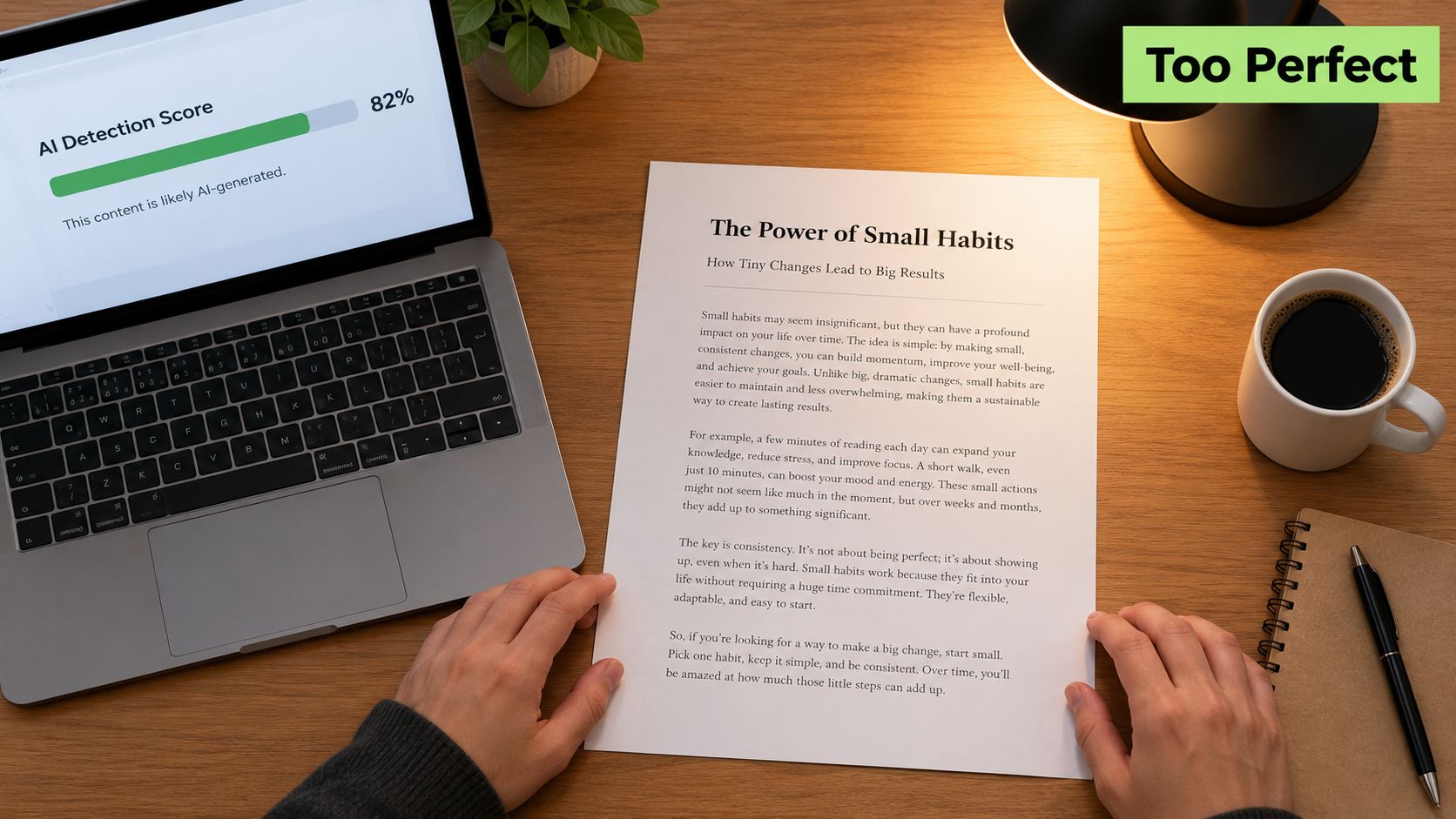
An editor reviewing a technology article notices that one paragraph sounds unlike the author's previous work. The wording is polished, transitions arrive at regular intervals, and every sentence seems balanced. None of those details proves AI involvement, but together they justify a closer look.
The editor runs the passage through several detectors. The tools disagree. One treats the paragraph as strongly suspicious, another gives it a moderate signal, and a third considers it close to ordinary human prose. The disagreement isn't a software malfunction that can be solved by choosing the most dramatic score. Each system may be measuring different features, using different training data, or applying a different threshold.
Early research already showed why certainty was dangerous. A peer-reviewed clinical study evaluating GPTZero reported 0.65 sensitivity, 0.90 specificity, and 0.80 overall accuracy, alongside a 10% false-positive rate and 35% false-negative rate in distinguishing ChatGPT-generated text from human writing. Those findings are discussed in the peer-reviewed evaluation of GPTZero, and they illustrate a central editorial problem. A detector can identify many AI passages while still misclassifying human prose and missing generated text.
What the editor does next
The responsible response isn't to reject the article or confront the writer with a score. The editor compares the paragraph with the writer's established work, checks factual sources, examines revision history where available, and asks the author to explain an unusual claim or wording. The detector helps prioritize that review. It doesn't replace it.
A practical editorial record might include:
- Signal: Several tools flag the same passage, or one tool flags an unusually large section.
- Context: The passage is short, translated, heavily edited, or written by someone with a different linguistic background.
- Verification: The editor checks sources, drafts, notes, document history, and the author's explanation.
- Decision: The final action reflects evidence and policy, not an isolated probability score.
Practical rule: Treat a detector result as a request for human attention, never as proof of misconduct.
This approach protects both sides. It gives publishers a way to investigate suspicious work without ignoring quality risks, while preventing fluent human writers from being penalized because their style resembles a model's output. The strongest workflow turns uncertainty into a documented review process.
How Detection Methods Actually Work
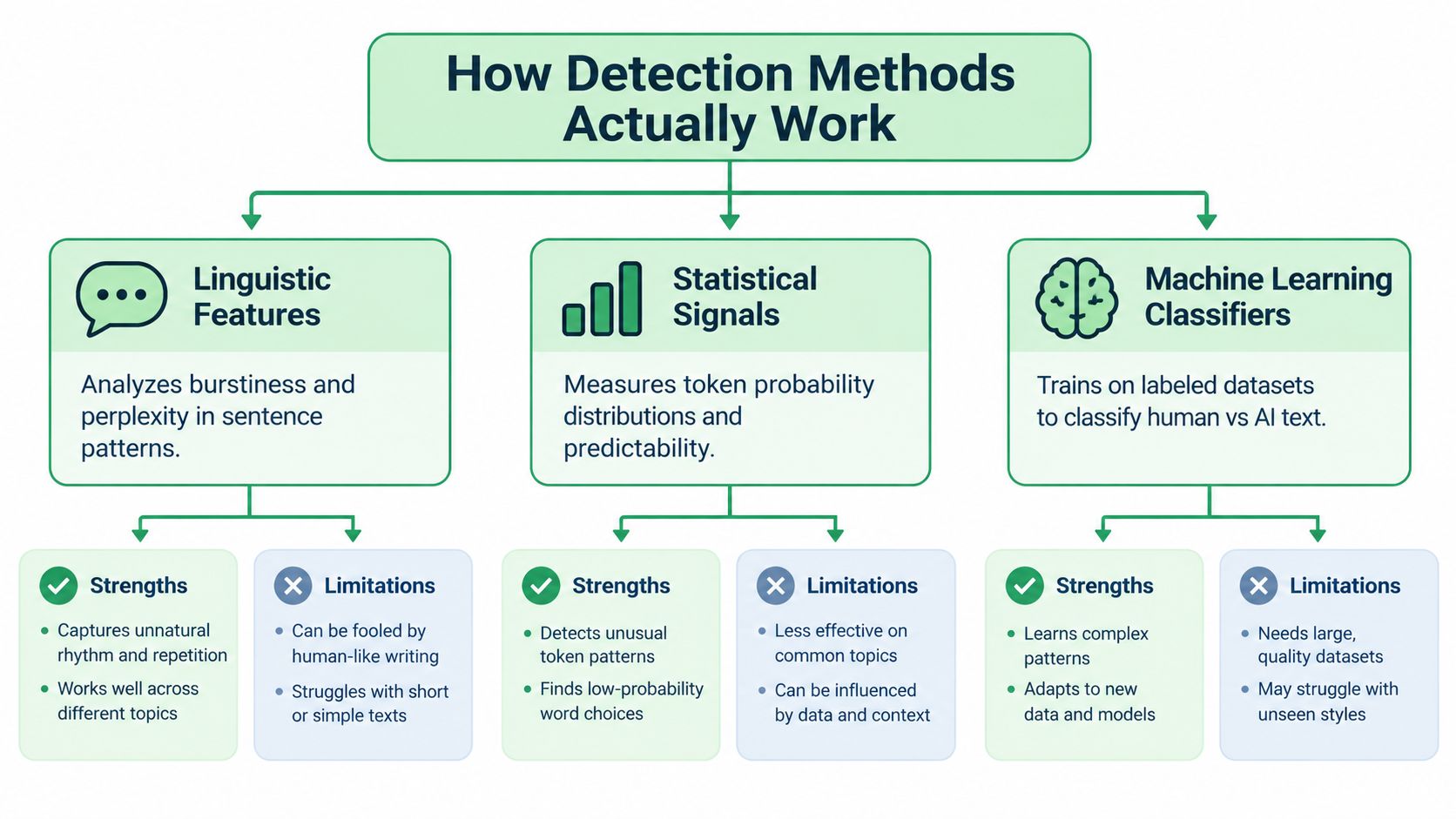
A detector result becomes easier to interpret once you know what the system is measuring. Most tools combine several approaches rather than relying on one universal test.
Linguistic features
Linguistic analysis looks at how the text behaves on the page. Two common ideas are perplexity and burstiness.
Perplexity describes how predictable a sequence of words is to a language model. A passage built from highly expected word choices may receive a different signal from one with unusual phrasing, abrupt shifts, or more surprising vocabulary. Burstiness describes variation across sentences. Human writing often moves between short and long sentences, dense and simple explanations, and direct and indirect phrasing. A highly even rhythm can attract attention.
These are clues, not fingerprints. A corporate editor may deliberately produce consistent prose. A student writing in a second language may use predictable sentence structures. A skilled human writer may also revise every paragraph until the rhythm is exceptionally smooth.
Statistical signals
Statistical systems examine token probabilities and recurring distributions across a passage. In plain language, they ask whether the word choices and transitions resemble patterns found in known human or generated samples. A classifier trained on labeled examples can detect combinations that are difficult for a reader to notice.
That training creates a dependency on the examples used to build the system. If the detector sees one domain, language, model family, or editing style during development, its performance can change when the text comes from another. A marketing page, academic essay, product review, and translated policy notice don't present identical detection conditions.
Watermarking
Watermarking takes a different route. Instead of inferring authorship from style after publication, a generation system embeds a statistical pattern into its output. A compatible detector can then look for that pattern.
Watermarks work best when the output remains close to its original form. An empirical study of watermarked OPT-13B text at 300 tokens reported a fall from 99.8% true-positive rate at a 1% false-positive rate to 9.7% after five paraphrasing rounds, with performance dropping below 50% after two paraphrases. The study of watermark robustness under paraphrasing also used AUROC and TPR at 1% FPR, because a broad ranking score can conceal weak performance at the operating point a real organization requires.
A practical interpretation looks like this:
- The detector extracts signals. It may inspect predictability, sentence variation, token distributions, or a watermark.
- The model combines those signals. A classifier estimates how closely the passage resembles its labeled examples.
- The system applies a threshold. The output becomes a probability, category, or warning level.
- A human interprets the result. The decision depends on context, policy, and the consequences of being wrong.
Paraphrasing, translation, grammar correction, and substantial editing can change the evidence. That doesn't make detection useless. It means the tool measures resemblance to a pattern, not a hidden record of who typed every word.
Why Perfect Accuracy Is a Myth
A detector can score highly on a controlled benchmark, then flag a short email written by a human. Headline accuracy reflects the test conditions as much as the tool itself. A 2025 academic benchmark reported 89.17% accuracy on the HC3 dataset, while a comparative study reported GPTZero at 100% sensitivity and 96% specificity for original-versus-AI text classification. That study also reported average scores of 99.10±2.08 for AI-generated texts and 3.12±4.25 for original texts. The available GPTZero benchmark reporting shows that detectors can separate carefully defined datasets very strongly.
Those results do not establish equal performance on a short email, an edited article, a translated essay, or a mixed human-AI draft. Dataset composition affects the outcome, as do passage length, language, genre, model family, revision history, and the threshold chosen by the organization using the tool. A detector provides evidence about a passage, not a definitive record of who wrote it.
False positives are a policy problem
A false positive can trigger an unfair misconduct investigation in education, damage a contributor relationship in publishing, or create an unsupported record about someone's work in hiring or compliance. The appropriate response depends on the consequence of acting on an incorrect flag.
Independent evaluations found commercial detector false-positive rates ranging from 0.05% to 68.6%, with false-negative rates ranging from 0.3% to 99.6%. Another peer-reviewed comparison reported one detector at 97.22% accuracy with 0% false positives, while other systems reached 64.35% accuracy with 16.67% false positives and 45.14% false negatives. The independent review of detector reliability shows why a tool's output requires local testing and a defined response policy. False positives carry different costs by setting, as explained in this guide to AI detection false positives.
Writing style can widen the gap. A 2026 study found false-positive rates on human academic writing ranging from under 1% to nearly 100% for different detectors on the same corpus. Another benchmark found GPTZero and OriginalityAI at 0.01 or below on medium-to-long human passages, while a RoBERTa baseline misclassified roughly 30% to 69% of human samples. The study of false positives across writing styles supports calibrating a tool to the actual user population and passage length.
Language changes the evidence
English-focused performance does not automatically transfer to other languages. A 2025 cross-linguistic comparison of English and Indonesian reported higher detection accuracy for English, citing linguistic complexity and dataset bias as relevant factors. A Spanish evaluation also highlighted that multilingual detector development remains underway, while the COLING 2025 shared task expanded evaluation across nine languages and showed wide variation between systems and languages. The cross-linguistic review of AI detection warns international publishers and multilingual education teams to test each language separately.
The practical conclusion is reliability is conditional. Test representative samples, including known human writing from the people and languages your workflow serves, before using detector scores to guide review. Treat the result as a probability and risk signal, then reserve consequential decisions for evidence a detector cannot provide alone.
Evaluating Detectors Beyond Headline Metrics
Overall accuracy answers a broad question: how often did the system classify examples correctly in a particular evaluation? Operational teams need a narrower question: how many genuine AI passages will the detector catch while allowing only an acceptable number of human passages to be flagged?
That's why true-positive rate at a fixed false-positive rate, often written as TPR@1%FPR, matters. TPR measures how much of the target class the system catches. FPR measures how often it flags material that should not have been flagged. Fixing the false-positive threshold forces the evaluation to reflect the cost of real decisions.
The metric that exposes the trade-off
A detector can post strong overall results because its test set is balanced, its examples are long, or its threshold is permissive. A school or publisher may operate under a much stricter requirement. If an institution can tolerate very few false alarms, it needs to know what happens at that low-FPR point, not just how the tool ranks examples across every possible threshold.
A practical examination of detector performance argues for TPR at 1% FPR as a more useful standard and reports that some detectors fell to 0% TPR at a 1% FPR setting. It also notes that a detector with 0.89 AUROC could deliver less than 20% TPR at 1% FPR on a task. The analysis of threshold-based detector evaluation explains why AUROC alone can make a system look more useful than it is under strict operating conditions.
Compare tools by decision cost
Commercial and open-source systems also behave differently. A University of Chicago and BFI working paper found commercial detectors performed substantially better than open-source baselines, while short passages remained harder to classify and results shifted with policy thresholds. In some scenarios, an open-source RoBERTa system produced human-text false-positive rates of roughly 30% to 78%. The BFI working paper on automated detection is especially relevant for teams choosing between a hosted service and an internally deployed model.
A selection process should therefore ask:
| Evaluation question | Why it matters |
|---|---|
| What is the false-positive rate on our own human samples? | Your writers, students, and languages may differ from the benchmark corpus. |
| What is TPR at the threshold we can tolerate? | A high score at a loose threshold may be unusable in a high-stakes workflow. |
| How does the tool handle short passages? | Short text offers fewer stylistic signals and often produces less stable results. |
| Does it support mixed or edited writing? | Human revision can move a passage away from the patterns seen in training data. |
| Can reviewers inspect evidence and document decisions? | A reviewable signal is more useful than an unexplained label. |
A good test set contains known human passages, known generated passages, edited drafts, translated text, and the shortest content your team reviews. The practical comparison of AI detectors can help define the tools worth including, but your own calibration set should determine which system fits your policy.
Detection Workflows for Publishers and Educators
A detector works best inside a workflow with clear escalation rules. The organization should decide in advance what happens after a low, medium, or high signal, and who has authority to make the final decision.

A publisher's verification queue
A publisher can start with a triage pass rather than scanning every document as if it were an investigation.
- Screen the complete document. Record the tool, version if available, passage length, score, and date.
- Locate concentrated signals. Review the sections that triggered the result instead of treating the entire manuscript uniformly.
- Compare the author's record. Look at prior submissions, terminology, source selection, and typical sentence patterns.
- Verify the substance. Check citations, quotations, technical claims, and original reporting independently.
- Ask neutral questions. Request notes, source material, or an explanation of a disputed passage without presenting the score as a verdict.
- Record the outcome. Keep the reason for acceptance, revision, escalation, or rejection separate from the detector's raw output.
A high signal with weak sourcing deserves editorial scrutiny. A high signal on a well-documented article from a writer whose style consistently looks similar may require less intervention. The reviewer should weigh the evidence rather than applying an automatic cutoff.
A short video can help teams understand why detection outputs need interpretation rather than blind acceptance:
A teacher's academic-integrity process
Teachers should avoid using a detector as an automated grading mechanism. A better sequence is to compare the result with the student's previous writing, assignment requirements, citations, draft development, and ability to discuss the submitted work.
The conversation matters. Ask the student to explain a central argument, show planning materials, or revise a paragraph in person. Those steps assess understanding directly and give the student an opportunity to clarify legitimate editing, translation, or accessibility support. Guidance on using an AI checker for teachers can support policy design, but every institution should test its chosen tool with representative student writing before taking disciplinary action.
A compliance team's disclosure path
Article 50 of the EU AI Act requires deployers of systems that generate or manipulate text and publish it to inform the public when the text concerns matters of public interest. The information must be provided clearly and no later than the first interaction or exposure. The European Commission also states that providers must apply a machine-readable mark to synthetic content and make it detectable, except where the system is used only for assistive editing or doesn't substantially alter the input semantics. These requirements are set out in the European Commission's Article 50 guidance.
Detection shouldn't be the only compliance control. Create a content register, identify whether AI generated or substantially altered the text, preserve the label through publication, and show the disclosure where readers will encounter the material. Teams can also review a study tool AI statement when drafting internal disclosure language and approval procedures.
The key distinction is simple. Detection investigates what happened. Disclosure communicates what happened. A compliance workflow needs both, but a detector score can't substitute for a truthful label or an auditable decision.
Building a Practical Detection Strategy
A workable strategy starts with the consequence of error. If a false positive could suspend a student, reject a writer, or create legal exposure, use a conservative threshold and require corroboration. If the purpose is editorial triage, a broader signal may be acceptable because a human will review the passage before action.
Choose tools against your real conditions. Test the languages, genres, passage lengths, and editing patterns your team handles. Keep a small evaluation set of known human and generated samples, rerun it when the tool changes, and record both false alarms and missed cases.
Use scores to allocate attention
A score should answer, “Where should a reviewer spend time?” It shouldn't answer, “Who is guilty?” Set a review policy that distinguishes between:
- Low concern: Publish or accept normally, while retaining ordinary quality checks.
- Unclear signal: Request supporting drafts, verify sources, or hold a short author conversation.
- High concern with corroboration: Escalate under a documented policy, giving the writer or student a fair opportunity to respond.
Don't hide uncertainty behind a precise-looking percentage. Explain which tool produced the signal, what text it analyzed, and what evidence supports the final decision. Keep detector results separate from authorship claims unless additional evidence justifies that conclusion.
A detector is most valuable when it improves a reviewer's next action.
The mature approach to AI generated text detection is therefore neither blanket trust nor blanket rejection. It combines calibrated measurement, transparent policies, source verification, human judgment, and clear disclosure. That approach catches obvious problems while preserving legitimate human work, including writing that is polished, translated, edited, or produced with permitted assistance.
Humantext.pro offers text AI detection with an instant probability score and tools for refining AI-assisted drafts while preserving their meaning, which can support a documented review workflow. Visit Humantext.pro to test your content and build a more practical verification process before relying on detector scores in publishing, education, or compliance decisions.
Redo att förvandla ditt AI-genererade innehåll till naturligt, mänskligt skrivande? Humantext.pro förfinar din text omedelbart och säkerställer att den läses naturligt och autentiskt. Prova vår gratis AI-humaniserare idag →
Relaterade artiklar

AI Humanizer Free Trial: Your Step-by-Step Playbook
Try an AI humanizer free trial the smart way. Learn what to expect, how to test quality, and how to choose the right paid plan for your workflow.

Sightengine API Review for Media Moderation
Explore how the Sightengine API handles image and video moderation. Learn about its accuracy, pricing, and when a browser-based checker is a better fit.

10 PimEyes Alternatives for Safer Image Verification
Compare 10 PimEyes alternatives for face search, image reuse, privacy, pricing, and safer verification of online identities and media.

