Marketing Campaign Optimization: The Complete 2026 Guide
Learn marketing campaign optimization with proven frameworks, KPIs, and channel tactics. Includes A/B testing, incrementality, personalization
You're staring at a dashboard where every platform claims credit for the same sale. Spend went up, platform-reported conversions look fine, and actual revenue hasn't moved. That's not a creative problem you can fix with one more variant. It's a measurement problem, and until you fix it, every optimization decision is a guess dressed up as data.
Why Most Campaigns Plateau and What Optimization Actually Fixes
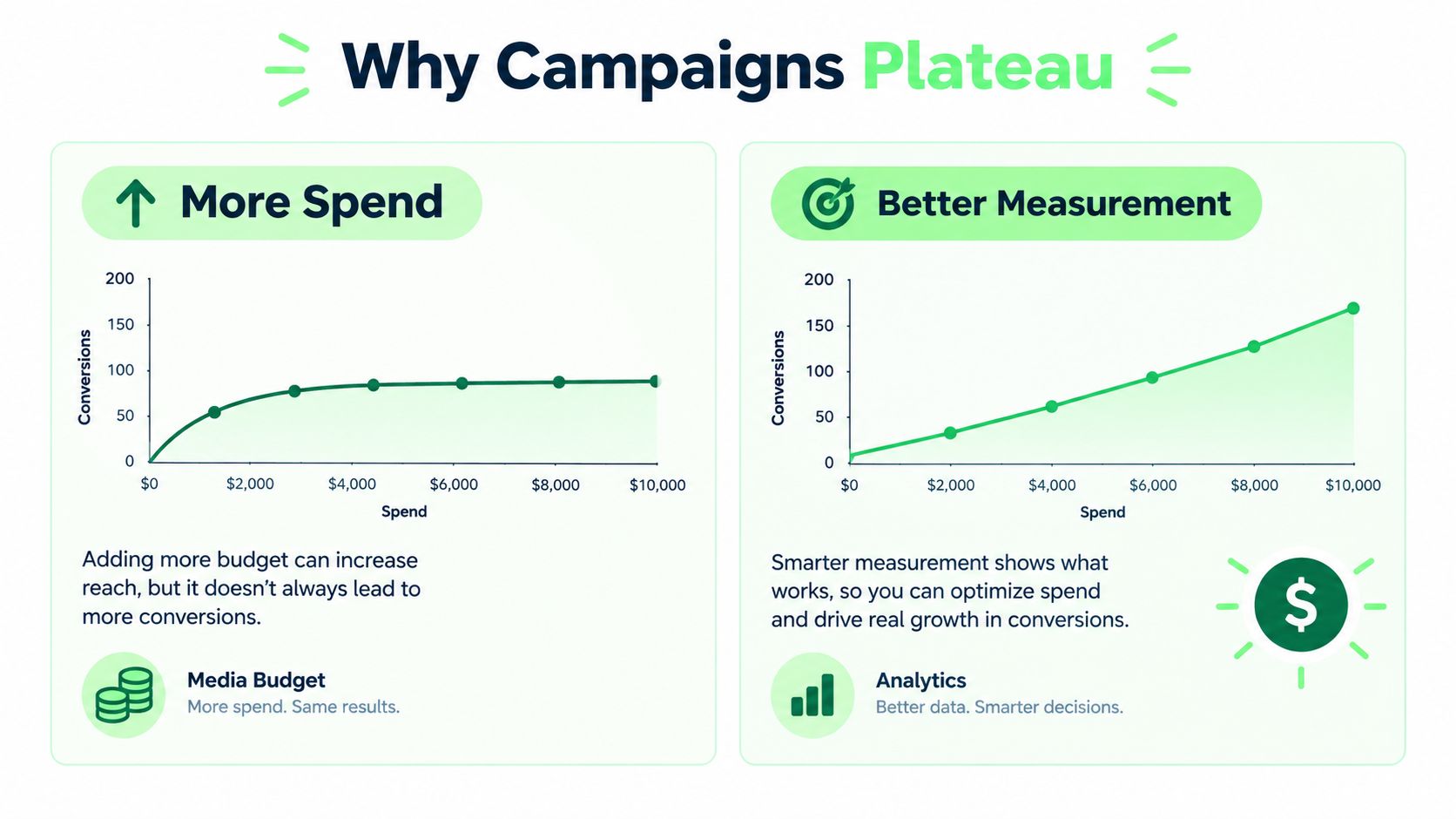
A mid-market DTC brand I worked with kept raising paid spend while conversions stalled. The team swapped headlines, rebuilt landing pages, and added channels. Nothing moved the revenue line until they stopped asking which ad got the last click and started asking which spend caused sales that wouldn't have happened anyway.
That shift is the work of marketing campaign optimization. It's not tweaking for its own sake. It's a structured comparison between your current setup and a changed version, judged against a control, so you can separate genuine lift from demand you would've captured for free.
Four Pillars That Hold Up Every Fix
Plateaus usually trace back to one of four weak spots. Measurement tells you whether a result is real. Channel tactics determine whether the right people see a relevant message. Experimentation proves whether a change caused the outcome. Trust and compliance decide whether people believe you enough to act, and whether you can defend how the asset was made.
When measurement is weak, the other three don't matter much. You'll scale a retargeting pool that's mostly harvesting existing intent, cut a prospecting campaign that was creating demand, and call both decisions data-driven.
| Concept | What it answers | Common mistake |
|---|---|---|
| Optimization | Did this change cause better qualified outcomes than the control? | Treating any tweak as an improvement without a comparison |
| Automation | Can a system adjust bids, pacing, or delivery faster than a person? | Letting automated bidding chase a flawed conversion signal |
| Attribution | Which touchpoint gets credit under a chosen rule? | Mistaking credit assignment for causal proof |
More budget amplifies whatever your measurement gets wrong. Fix the signal first, then scale.
Start by naming the bottleneck plainly. If you can't tell incremental sales from organic sales, don't buy more media. Build the comparison that lets you tell them apart, then decide which campaigns earn more budget and which ones get cut.
The Optimization Mindset from Clicks to Incremental Revenue
Think of performance as a ladder. Each rung is closer to money, and each one supports a different decision. Confusing rungs is how teams celebrate traffic while revenue stays flat.
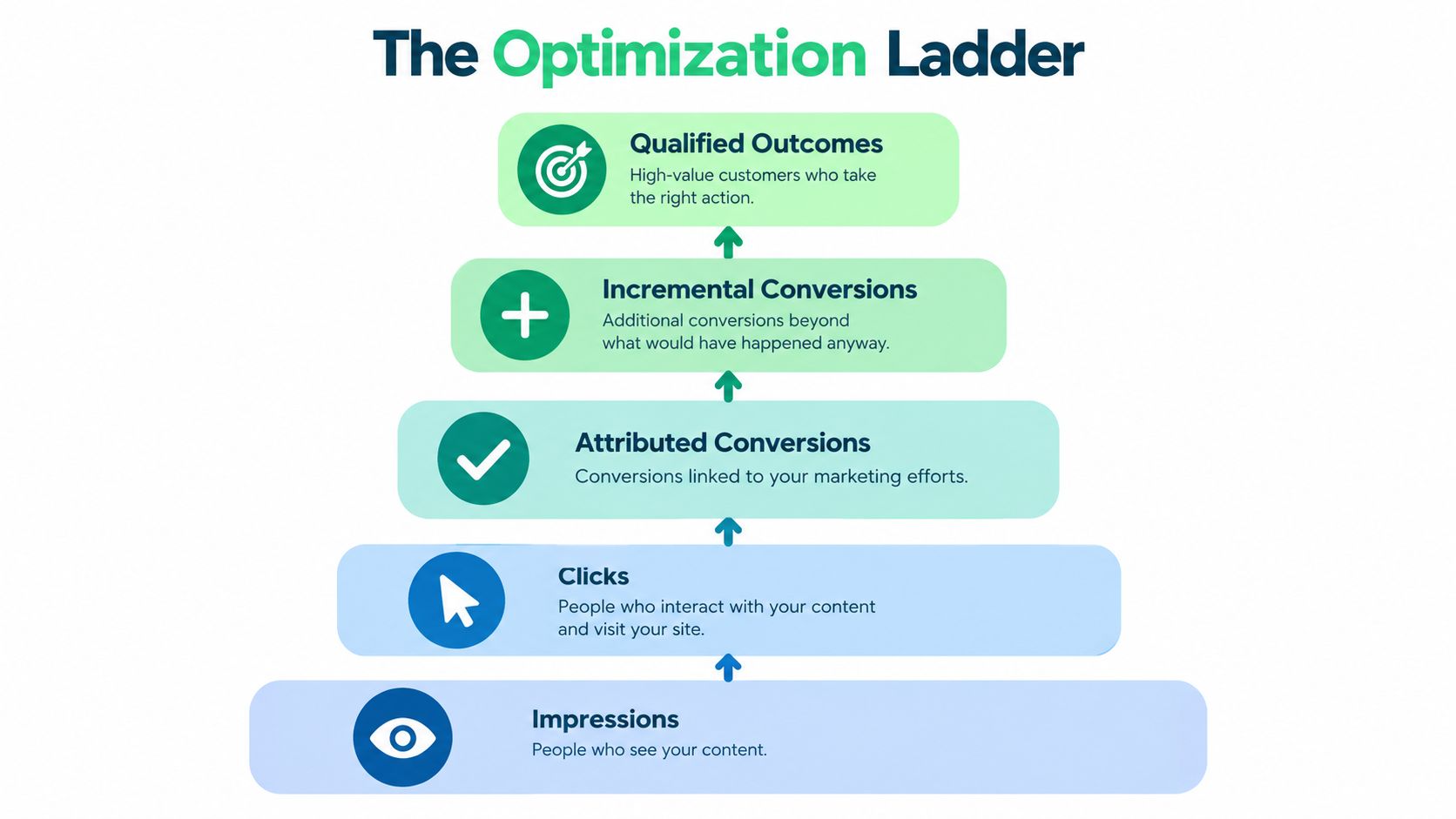
Impressions confirm delivery. Clicks confirm curiosity. Clicks are like counting people who walk into a kitchen showroom. Useful, but plenty of visitors were never going to buy a renovation.
Attributed conversions assign credit after a click or view. Incremental conversions go further. They estimate how many buyers wouldn't have bought without exposure, like counting only the showroom visitors who purchased because they saw the remodeled kitchen. Qualified outcomes sit at the top: paid activation, retained customers, profit, or another result your finance team values.
The Metrics Worth Governing
- Incremental return on ad spend: Calculate this as incremental revenue divided by media spend, so budget follows caused revenue rather than claimed revenue.
- Holdout-adjusted CPA: Recalculate acquisition cost using only incremental conversions, not every attributed conversion.
- Conversion lag: Track the gap between exposure and purchase so you don't kill a test before outcomes mature.
- Brand and search lift: Use these when influence shows up as awareness or later searches rather than an immediate click.
Leading indicators, such as qualified click quality or early engagement from the right segment, help you steer during a flight. Lagging indicators, such as profit and retention, confirm whether the steering worked. You need both, but you shouldn't promote a campaign based on leading signals alone.
The value of incrementality isn't theoretical. In one reported geographic experiment, retailer JYSK saw Performance Max produce a 3% incremental lift in sales and a 7.7 incremental return on advertising spend, as described in Google's experimentation framework for incremental lift. A modest percentage can still be commercially large when it's applied to a substantial baseline, and that's exactly why raw platform totals are the wrong scoreboard.
Judge every tactic that follows by one question: does it improve an incremental or qualified outcome? If it only lifts a lower rung, it's activity, not optimization.
Choosing a Measurement Stack When Attribution Is Broken
You didn't break attribution. Privacy changes, consent choices, and fragmented journeys did. Platforms now report conflicting conversion totals, and user-level paths are incomplete by design.
The confidence gap is measurable. A 2025 global survey of 750 employees at large companies found only 18% were very confident they could accurately attribute app installs to the correct source, while 41% reported greater cross-channel attribution challenges after privacy changes, as reported in MediaPost's coverage of the attribution survey. Chasing one perfect number in that environment wastes time.

Three Tools, Three Different Jobs
Think like a carpenter. A hammer, a tape measure, and a level aren't rivals. They answer different questions on the same job.
Last-click attribution is fast and cheap. Use it for tactical decisions inside one channel, such as pausing a clearly broken ad set. Don't use it to set cross-channel budgets, because it systematically overcredits bottom-funnel touches.
Marketing mix modeling works at aggregate level and suits quarterly allocation across channels. It's slower, needs historical data, and gives directional ranges rather than user-level certainty. If you're weighing that trade-off, it helps to compare attribution models for ad teams before committing to a stack your team can't maintain.
Incrementality testing is the expensive, high-confidence option. Reserve it for decisions with real money attached: launching a channel, making a major creative shift, or defending a large budget increase. A randomized holdout tells you what the spend caused, not what it touched.
How to Combine Them Without Lying to Yourself
Use last-click for daily hygiene, modeling for quarterly planning, and controlled tests to calibrate both. Report confidence ranges, not single-point ROAS figures that imply precision you don't have. Set a weekly cadence for operational reporting and a slower cadence for budget moves, because modeled and lagged outcomes don't settle overnight.
Accept the constraint upfront. No stack restores the old user-level view. A good stack makes decisions defensible anyway.
Channel Tactics That Actually Move the Number
Measurement tells you where to push. Channel work is where you push. The levers below are the ones that repeatedly change qualified outcomes when they're validated properly.
Email and Paid Search
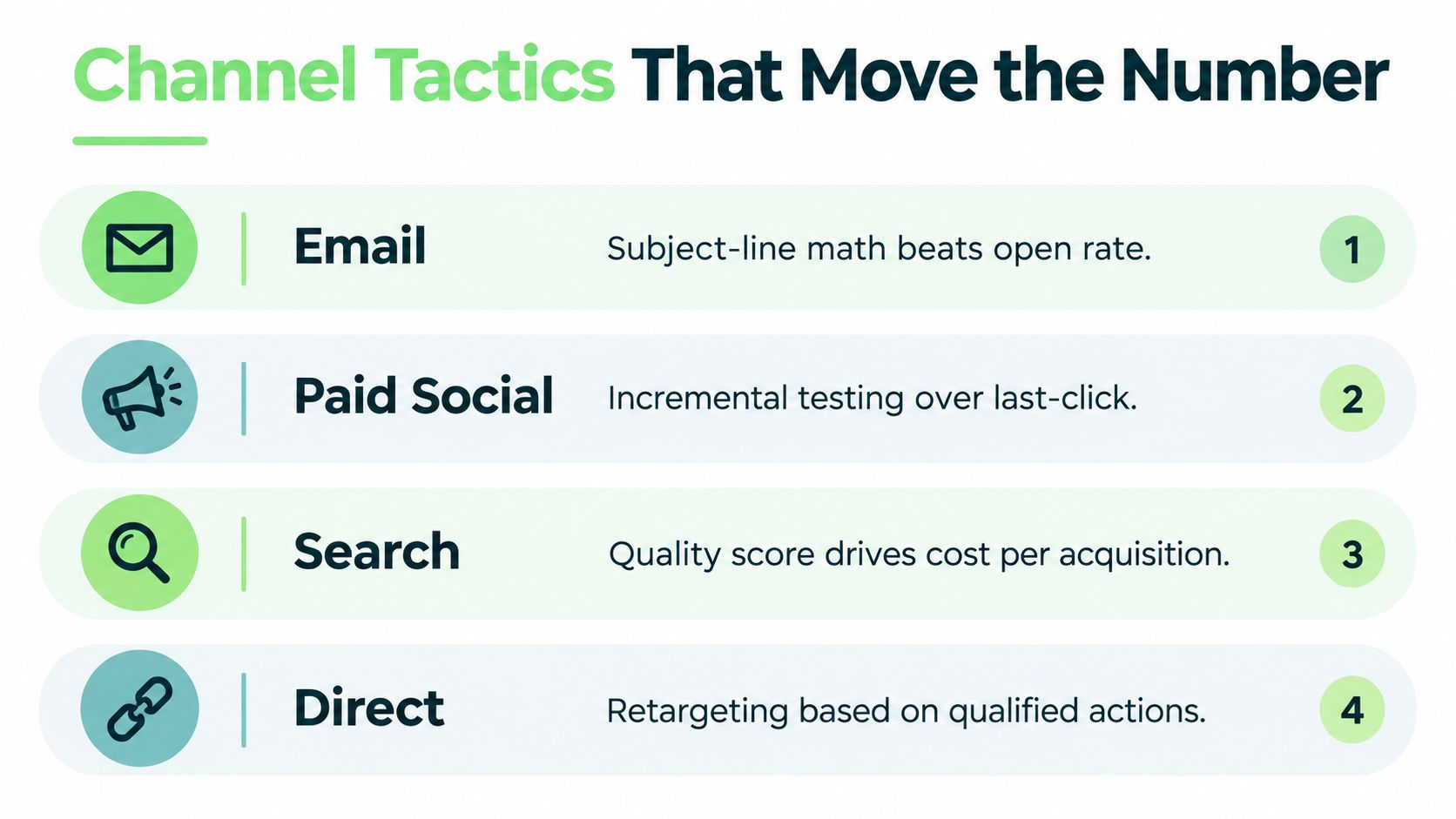
For email, open rate is a weak proxy that's easily distorted. Optimize click-to-conversion instead, segment by behavior rather than demographics alone, and test one variable per send so you know what caused the change. Authentication failures destroy all of that work, so getting SPF, DKIM and DMARC explained and implemented correctly is a deliverability prerequisite, not an IT side quest.
Paid search rewards controlled expansion. Google reports that advertisers upgrading exact-match keywords to broad match in target-CPA campaigns can see an average of 35% more conversions, while phrase-to-broad upgrades can see approximately 25% more conversions in target-CPA campaigns and approximately 12% more conversion value in target-ROAS campaigns while meeting the bidding target, according to Google's guidance on reaching customers with broad match. Those are averages, not promises. Keep brand and non-brand campaigns separate, enforce strict negative-keyword governance, use target CPA for a stable trial or lead goal, and use target ROAS only when conversion values reflect real downstream revenue.
The walkthrough below shows how search structure and bidding choices interact in practice, which is useful before you widen match types.
SEO and Social
SEO compounds when you treat content as an asset portfolio. Cluster pages by search intent, score quality before publishing, refresh decaying pages, and judge success by qualified organic conversions rather than raw traffic. That discipline is central to strong content marketing best practices for compounding organic growth.
Social is a creative cadence problem. Lead with the hook, build native assets for each platform instead of cropping one master video, and rotate based on fatigue signals rather than a calendar. For every channel, validate the change with a controlled comparison. A before-and-after read can't separate your tactic from seasonality or auction shifts.
Running Experiments You Can Actually Trust
Most tests fail before they launch. The team picks a winner after the fact, changes something mid-flight, or stops early because an early spike looks exciting. Discipline, not tooling, is the scarce resource.
Pick the Right Design for the Question
A/B testing compares one changed version against a control. It's the default for landing pages, offers, and campaign settings because the read is clean and the sample requirement is manageable.
Multivariate testing changes several elements at once and needs far larger samples than many teams expect. With modest traffic, it often ends without a clear winner even when a real improvement exists somewhere in the mix. Don't choose it just to seem more advanced.
Geo-based experiments split regions into exposed and unexposed groups. They're heavier to run, but they work when user-level tracking is unreliable and you have first-party revenue data by location.
Read Statistics Like a Decision Maker
A p-value works like a courtroom standard. A significant result means the evidence is strong enough to act, not that the effect is guaranteed or large. Sample size and statistical power determine whether your test can even detect the effect you care about, so estimate both before launch rather than hoping traffic will be enough.
Google Ads experiment reporting returns control-arm and treatment-arm metrics together with statistical comparison data, including uplift and p-values, as documented in Google Ads experiment reporting documentation. That lets you apply a standard you agreed in advance instead of shopping for a flattering metric afterward.
Practical rule: Pre-register one primary metric, a stopping rule, and the uplift that justifies rollout. If it isn't written down before launch, it isn't a decision rule.
A Short Pre-Flight Checklist
- One primary outcome: Name profit, purchases, or qualified leads, and demote everything else to diagnostic status.
- Frozen variables: Don't change targeting or creative mid-test, or you can't attribute the lift to anything specific.
- Confidence interval review: Read the range, not just the headline uplift, before rolling a variant to all traffic.
- Holdout protection: Keep the control group intact even when early results tempt you to reallocate.
Trustworthy experiments are boring by design. That boredom is what makes the answer usable.
AI-Assisted Copy as a Trust Variable You Can Test
Teams usually treat AI copy as a cost lever: more variants, faster drafts, cheaper production. That's the wrong frame. AI-assisted content is a trust variable, and trust changes whether people click, believe, and buy.
Consumer skepticism is real. A 2025 SurveyMonkey study of 2,329 U.S. adults found only 20% believed AI was better than humans at creating content, while 46% said AI-generated content would make them view a company negatively and 43% said they'd be less likely to buy from a company relying on it, as reported in SurveyMonkey's 2025 marketing trends research.
But visible AI use doesn't automatically destroy trust. Separate consumer research covered in the verified data found no statistically significant relationship between displayed AI format and perceived trust, authenticity, or credibility, and rational content performed more strongly than emotional content. Execution and message type matter more than a simplistic AI-versus-human label.
What to Test Instead of Arguing About It
- Disclosure language: Test whether a clear AI-assistance note changes conversion, complaints, or brand trust for your audience.
- Human-editing depth: Compare light proofreading against substantive restructuring, fact-checking, and voice editing.
- Rational versus emotional framing: Run the same offer with evidence-led copy and feeling-led copy, then measure qualified conversion, not just engagement.
- Perceived authenticity: Ask users directly through post-exposure surveys alongside behavioral metrics.
A clean design compares three arms: raw AI draft, human-edited AI draft, and fully human draft. Hold offer, audience, and placement constant. This matters for commercial pages too, since the principles in strong product description writing that earns buyer confidence only help if shoppers believe the copy.
Measure trust-adjusted conversion: completed purchases or qualified leads, comprehension, refund or complaint signals, and downstream quality. A variant that wins clicks but produces confused buyers isn't a winner.
Treat the AI workflow like a media channel. Give it a primary outcome, a holdout, and a rollout rule. If human review improves qualified conversion enough to cover its cost, keep it. If it doesn't for a low-risk format, document that finding and move on.
Personalization Automation and a Privacy-First Measurement Plan
Personalization without consent-grade data creates a subtle bias. You end up optimizing for people who are easiest to track, then assume they represent everyone. Automation accelerates that mistake if the underlying signal is skewed.
Consent Mode changes the mechanics directly. When users decline cookies, blocked tags collect no direct data and Google Ads conversion modeling estimates missing conversions using general, non-identifying signals, so you should separate observed from modeled results, as explained in Google's Consent Mode guidance for modeled conversions. Modeled conversions are estimates, not observations. They're useful for directional decisions, not for pretending precision survived consent loss.
Build the Plan Around Signal Loss
Record consent status, keep event definitions consistent, and annotate every consent-banner or tagging change with a date. Without that annotation, a future analyst will misread a measurement drop as collapsing demand and cut spend that was working.
Combine geo-holdouts, marketing mix modeling, and first-party signals such as consented email engagement and actual revenue records. That combination survives fragmented tracking because none of it depends on following an individual across the open web. It's also why a documented approach to data privacy compliance for marketing teams belongs in the measurement plan, not in a legal folder nobody opens.
Compliance as an Operating Layer
EU AI Act Article 50 transparency labeling, AI-generated media disclosure, and clear human-review trails aren't optional polish. They're part of whether your personalization program can run at all. Labeling can also become a test axis: measure whether clear disclosure changes trust or conversion for a given audience, while keeping the underlying compliance requirement fixed.
Design for privacy on day one. Retrofitting consent, provenance, and review records after campaigns scale costs more and produces messier data.
The 90-Day Campaign Optimization Playbook and Common Pitfalls
Ninety days is enough to replace opinion-led tweaking with a working system, if you sequence the work and refuse to run more tests than your traffic can support.
Weeks 1 to 4 Audit and Baseline
Audit conversion tracking, consent behavior, campaign structure, and creative quality. Write a one-page measurement plan naming your primary qualified outcome, your reporting cadence, and how you'll separate observed from modeled conversions. Build a hypothesis backlog ranked by expected value and traffic requirements, then measure a clean baseline before changing anything.
Don't skip the baseline. A 2025 study analyzing 8,000 digital-marketing records using ANOVA and regression found no statistically significant differences in conversion rates across campaign categories, as shown in the 2025 statistical analysis of digital-marketing records. Labels alone don't create performance. Controlled comparisons, adequate samples, and significance checks do the work, because pre-and-post reads can be mimicked by seasonality or demand shifts.
Weeks 5 to 10 Two Parallel Experiments
Run two well-powered experiments in non-overlapping areas, for example one paid search structure test and one landing page or copy test. Each gets a pre-registered test card with the hypothesis, primary metric, holdout design, duration, and rollout threshold. Review weekly for delivery problems, not for early winners.
Weeks 11 to 13 Decide and Document
Roll out winners that meet your pre-agreed standard, kill losers, and log inconclusive results accurately. Hold a quarterly retro covering what you learned, what you'll test next, and which budget moves the evidence supports.
Pitfalls that derail programs:
- Changing creative mid-test: You'll never know which version caused the result.
- Optimizing for tracked users: You scale toward measurability instead of value.
- Treating modeled as observed: Estimates get reported as facts and budgets follow.
- Too many simultaneous tests: Traffic splits too thin and nothing reaches significance.
- Skipping significance checks: Random noise gets promoted to strategy.
Your Monday-morning artifacts are simple: the measurement plan, test cards, a holdout schedule, and a disclosure and human-review log. Campaign optimization compounds when every change faces a control, every test has a decision rule set in advance, and every AI-assisted asset gets human review before it ships. Pick your first test this week and write the rule before you launch it.
If your experiments now include AI-assisted copy, you need a way to verify drafts, check AI probability, and humanize robotic text before it reaches customers. Humantext.pro offers AI detection and text humanization for text and media, so you can test trust and quality with cleaner inputs. Visit Humantext.pro to check your next campaign draft before you spend media budget behind it.
Готові перетворити згенерований ШІ контент на природний, людський текст? Humantext.pro миттєво вдосконалює ваш текст, забезпечуючи природне та автентичне звучання. Спробуйте наш безкоштовний гуманізатор ШІ сьогодні →
Пов'язані статті

AI Writing Detector Free: 10 Tools Worth Testing
Compare 10 AI writing detector free options for accuracy, privacy, limits, and practical use by students, editors, and publishers.

What Is Natural Language and How Does It Shape AI
Learn what is natural language, how its layers of meaning work, why ambiguity matters, and how NLP and AI turn human communication into usable technology.
AI Detector Score: What It Means and How to Use It
Understand AI detector scores, learn how they are calculated, and discover practical ways to interpret and use them for quality assurance and compliance.

