How to Write Descriptively with Vivid Sensory Detail
Learn how to write descriptively with sensory detail, strong verbs and vivid examples. Practical techniques, rewrites and prompts to make your writing shine.
You've written “the room was nice,” “the street was busy,” or “she felt nervous,” then reread the paragraph and realized the reader can't see, hear, or feel anything. The problem usually isn't a lack of imagination. It's that the draft names a conclusion instead of selecting the details that let the reader reach that conclusion independently.
Learning how to write descriptively means making deliberate choices about what the reader notices, where that detail appears, and how precisely the sentence delivers it. Strong description isn't decoration added after writing. It controls attention, builds credibility, establishes mood, and gives abstract ideas a physical form.
What Descriptive Writing Really Does for Readers
A flat description gives the reader a label. A vivid description gives the reader evidence.
Compare these two sentences:
The café was crowded and uncomfortable.
Coats hung from every chair, a spoon clattered onto the tiled floor, and the only empty table sat beside the kitchen door, where hot oil and garlic drifted through the room.
The first sentence tells readers what to think. The second lets them experience the setting and form the same judgment. It also gives them something to remember. They can reconstruct the café instead of merely storing the adjective “crowded.”

Description creates an experience
Readers process description through selected signals. A character's wet sleeve, a loose shoelace, or a voice that keeps dropping at the end of each sentence can communicate more than a general statement such as “he was struggling.” The detail works because it gives the reader a visible or audible route into the meaning.
That route also improves comprehension. In an explanation, concrete description helps readers understand how an object looks or works. In fiction, it anchors a point of view. In marketing, it helps a reader imagine using a product rather than receiving a stack of unsupported praise.
Description must serve a purpose, though. Listing every object in a room slows the reader without deepening the scene. The useful question is not “What else can I describe?” It's “Which detail changes what the reader understands?”
Practical rule: Choose details that reveal condition, character, movement, mood, function, or consequence.
Age doesn't supply the skill automatically
A long-running U.S. writing assessment found that 17-year-olds showed no statistically significant change in overall descriptive-writing quality over a 10-year span, while 13-year-olds showed a significant decline in descriptive writing between the first two assessments (the assessment discussion and report). The result matters because it measures descriptive writing across national benchmark years, not merely a teacher's preference for richer vocabulary.
The broader lesson is practical. Writers don't automatically become vivid because they become older or more experienced. They improve when they practice choosing significant details, controlling sentences, and revising vague language. Anyone working on writing effectively for different audiences will find the same principle applies across purposes: detail must match the reader, situation, and intended effect.
By the end of this guide, you'll have a repeatable method for moving from summary to evidence, vague nouns to exact ones, and overloaded prose to controlled imagery. The mindset shift is simple: description is deliberate selection, not verbal decoration.
Ground Your Scenes in Sensory Detail
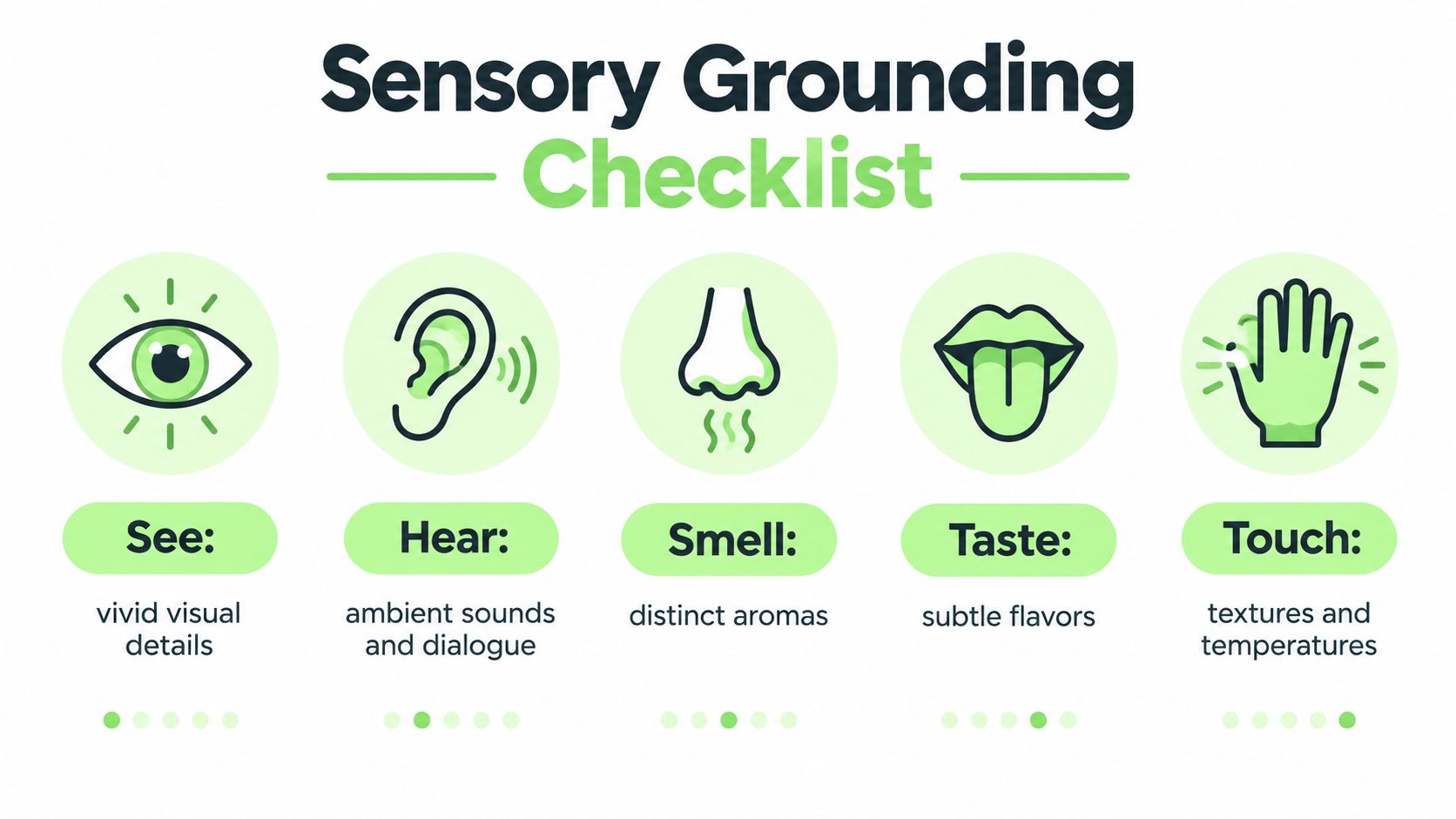
The kitchen was busy” gives the reader a conclusion without supplying evidence. Replace that conclusion with the physical details a person in the room would notice. The five senses provide useful prompts, but they are not a checklist for every paragraph. Sight may establish the setting, while sound, smell, taste, or touch can reveal its mood, pressure, or history.
Start with evidence, not adjectives
Use these prompts to generate possibilities:
- Sight: What catches the eye? Open cupboards, flour on the counter, steam on the window.
- Sound: What does the room produce? Oil sizzling, a timer chirping, a knife tapping the board.
- Smell: Which aroma is distinct? Garlic, scorched butter, citrus peel.
- Taste: Is someone eating or cooking? Bitter coffee, sweet tomato, salt on the lips.
- Touch: What physical sensation matters? A hot pan handle, a rough wooden spoon, damp heat.
Select only the details that serve the scene. A kitchen in a family memory might need the smell of garlic and the warmth of a radiator. A suspense scene might depend on the timer's sharp chirp and the cold metal of a drawer handle.
Vivid description gives readers material they can mentally reconstruct.
For example:
Oil hissed in the shallow pan. Garlic browned at the edges, filling the kitchen with a sweet, bitter smell, while the rough wooden spoon pressed against her palm.
“Busy” has vanished, yet the reader understands activity, heat, and concentration. The details also establish viewpoint. Someone standing in that kitchen notices what the body can encounter, rather than reporting an inventory from above. This distinction matters when revising AI-assisted prose: a humanizer may smooth awkward wording, but a detector-aware workflow should still test whether the details feel observed instead of generically assembled.
Use a sensory chart before drafting
Place the scene or object in the center of a short chart, then record one possible observation for each sense. Mark the details that reveal the strongest emotion or function. Draft from that smaller group, not from the entire chart. The method limits repetitive visual description and makes selection part of revision.
A study of sensory-detail instruction found that the experimental group's posttest mean was significantly higher than the control group's after students learned to use the five senses deliberately (the sensory-detail writing study). Another study reported that a sensory-detail chart used in collaborative experiential learning improved descriptive writing across ideas, organization, voice, word choice, sentence fluency, and conventions (the sensory chart study).
For additional models, review these creative nonfiction examples. Notice how the strongest passages connect sensory evidence to memory, movement, and interpretation, instead of scattering isolated sensory words through a paragraph.
Choose Precise Words That Show Rather Than Tell
Sensory detail gives you raw material. Specific diction determines whether that material stays blurry or becomes exact.
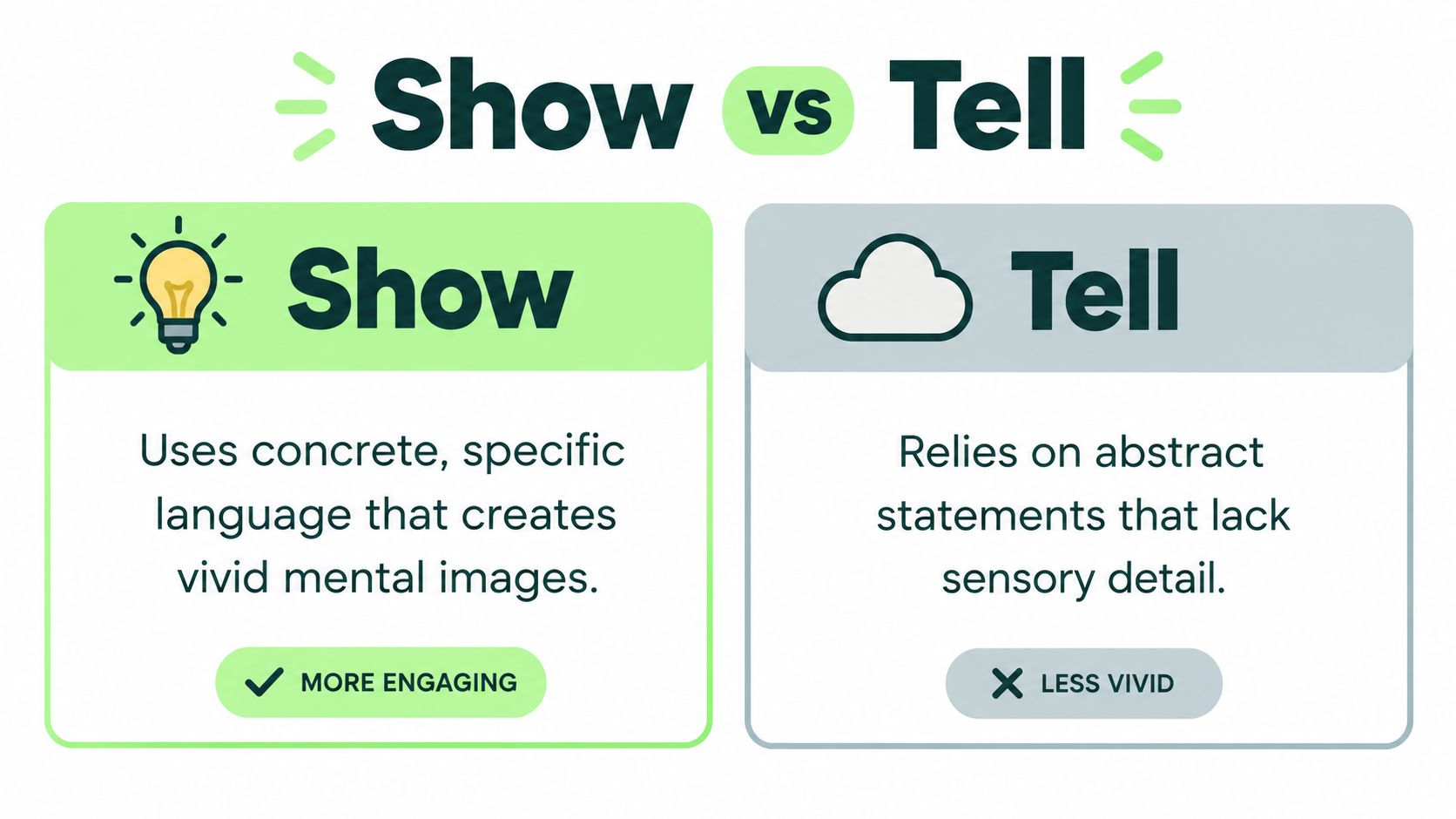
“An animal crossed the road” is technically descriptive, but “a golden retriever trotted across the road” gives the reader a narrower, more useful image. “A vehicle waited outside” becomes “a blue delivery van idled beside the curb.” The second version doesn't win because it contains more words. It works because the nouns identify the referents more accurately.
Research on concreteness and specificity links descriptive effectiveness to tangible nouns and narrowly named referents, where concreteness concerns things readers can see, hear, smell, or touch, and specificity concerns how precisely a thing is identified (research on concreteness and specificity).
Upgrade the noun before adding adjectives
Writers often pile on modifiers because the central noun is weak:
The big, old, beautiful house stood on the street.
Try choosing a more informative noun and one meaningful modifier:
The weathered Victorian house leaned over the narrow street.
The sentence now gives shape, age, and posture without asking three adjectives to do all the work. Strong nouns reduce padding. Strong verbs complete the improvement:
The door was opened slowly.
She eased the door open.
The revised verb carries pace and intention. “Eased” suggests resistance or caution without explaining either one.
Concrete nouns create the image. Precise verbs create the movement. Modifiers should refine, not rescue, them.
Separate vividness from clutter
Description becomes unnatural when every object receives a color, texture, sound, and metaphor. Readers need hierarchy. Give the most important detail the clearest position, then let supporting details remain quiet.
A useful editing pass asks:
- Can I replace a broad category with the exact object?
- Does the verb show what the subject actually does?
- Which adjective adds information, and which merely expresses approval?
- Have I repeated an idea through several similar modifiers?
- Does this detail matter to the reader's understanding?
“Nice,” “interesting,” “beautiful,” and “strange” aren't forbidden. They're incomplete when they carry the entire burden of description. Replace “a beautiful garden” with “marigolds crowded the cracked stone border,” if that's what makes the garden beautiful in context.
The same discipline applies to claims about writing or research. A recent academic writing guide warns that weak gap statements can stack filler phrases such as “however, despite this,” and that claims like “no research has examined X” need narrow scope and verification before submission (guidance on precise gap statements). In descriptive prose, the equivalent mistake is overclaiming through words like “always,” “completely,” or “everyone.” Say what the detail supports, no more.
Watch the contrast between summary and evidence in this short demonstration:
For a closer look at how individual word choices affect tone, this guide to an example of diction offers a useful companion exercise.
Shape Imagery With Figurative Language and Rhythm
Precise language gives readers a firm image. Figurative language can then connect that image to an emotion, idea, or movement that literal description can't express as efficiently.

Consider the difference:
The rain fell heavily against the windows.
Rain drummed against the windows, quick and impatient.
The second sentence uses personification to give the weather a character. That choice works if the scene needs urgency or irritation. It would be less effective in a calm, technical explanation, where “steady rain struck the glass” may be clearer.
Use one image with a job
A simile or metaphor should sharpen the reader's understanding, not announce the writer's cleverness.
The hallway was dark, like a cave, black as ink, and as silent as a grave.
Three comparisons compete for the same effect. The reader notices the performance instead of the hallway.
The hallway narrowed into darkness, and her footsteps returned from somewhere ahead.
This version uses physical space and sound to create unease. It doesn't label the mood, and it doesn't need several decorative comparisons.
A figurative image earns its place when it does at least one of the following:
- Clarifies scale: “The suitcase was the size of a small refrigerator.”
- Expresses perception: “The meeting room felt staged, every smile fixed in place.”
- Controls mood: “Fog pressed against the windows.”
- Reveals character: A practical narrator may reject an elaborate metaphor while an anxious narrator may create several.
You can explore more examples in this guide to different rhetorical devices, then test each device against the scene's purpose.
Let sentence rhythm control attention
Sentence length changes how readers move. Longer sentences can gather detail and create a flowing impression. Short sentences stop the eye and give an image weight.
The river moved beyond the field, pale under the morning light, carrying leaves and thin branches toward the bridge.
The river stopped.
The short sentence creates shock because the earlier rhythm prepared the reader for continuation. In a quieter passage, varied structure prevents description from sounding like a catalog:
The fan clicked above her. Dust lifted from the sill, crossed the beam of sunlight, and settled on the piano keys. Nobody played.
The first sentence establishes sound. The second stretches time. The final sentence closes the image with absence.
Read your paragraph aloud. If every sentence has the same length and syntax, revise one opening, combine two related observations, or isolate the detail that deserves emphasis. Rhythm is not decoration. It tells the reader when to linger and when to move.
Structure Description and Polish AI Assisted Drafts Naturally
A vivid detail still fails if the reader can't tell how it relates to the subject. Structure gives description a path.
Technical-description guidance recommends identifying the object, presenting its overall appearance, introducing component parts, and explaining how those parts work together. It also emphasizes significant, precise details such as material, color, texture, shape, size, dimensions, patterns, and interactions (guidance on organizing technical descriptions).
Give the reader an order to follow
Suppose you're describing a bicycle. Don't jump from the bell to the rear tire, then back to the handlebars, because each detail came to mind. Establish the object, present its overall form, move through the major parts, and finish with function.
The bicycle has a narrow steel frame painted dark green. Drop handlebars curve above the front wheel, while two brake cables run toward the calipers. Beneath the seat, the chain links the pedals to the rear gears, converting each turn into forward motion.
This sequence moves from whole to parts to interaction. For a person or setting, you might move from a first impression to the detail that changes it, then to movement or consequence.
Sentence structure supports that order. A practical guide to sentence structure for clarity can help when a paragraph contains strong observations but tangled relationships between them.
Use AI for speed, not for final perception
AI-assisted drafting can produce a quick starting point, but it often smooths away the irregular details that make prose sound owned by a person. A 2024 global survey of 31,000 workers across 31 countries found that 75% used AI at work, and 94% of those users said it saved time. The same source reported that 77% of leaders said their organizations needed to move faster on AI adoption (the survey summary).
The practical response isn't to reject assistance. It's to separate drafting from judgment.
- Generate or outline the passage. Give the tool the purpose, audience, point of view, and factual boundaries.
- Restore observed detail. Replace generic phrases with objects, actions, textures, and sounds you can defend.
- Cut symmetrical filler. AI prose often balances clauses too neatly or repeats patterns such as “not only... but also.”
- Humanize carefully. A humanizer can rephrase sentences and adjust vocabulary, but you still need to check whether the new wording preserves your meaning and voice.
- Verify the result. Read aloud, compare it with your source notes, and use a detector as a signal for review, not as proof of literary quality.
Humantext.pro combines an AI detector with a text humanizer. Its workflow can provide an AI-probability score and revise AI-assisted drafts into more natural, human-sounding prose while preserving meaning. Its privacy-first positioning is relevant for students, editors, and content teams handling unpublished work, but every automated revision still requires a human pass for accuracy, intention, and specificity.
The strongest workflow is therefore draft, select, restructure, humanize, and verify. Don't ask a tool to manufacture personal observation. Supply that observation yourself.
Your Revision Checklist and Practice Prompts
Description improves during revision because the first draft is busy discovering its meaning. The next pass decides what the reader actually needs to notice, feel, or understand.
Use this checklist on a printed page or in a separate document:
- Sensory grounding: Does the passage include a meaningful physical or sensory signal where the scene needs one?
- Specific nouns: Could “thing,” “animal,” “building,” or “vehicle” become a more exact referent?
- Active verbs: Does the verb show movement, posture, sound, or change without depending on an adverb?
- Selective modifiers: Does each adjective add information, or repeat a judgment the noun and verb already imply?
- Figurative restraint: Does each simile or metaphor clarify perception, mood, scale, or character?
- Logical order: Can the reader follow the subject from whole to parts, outside to inside, or observation to consequence?
- Sentence rhythm: Have you varied sentence length and avoided a string of identical openings?
- Human voice: Does the passage contain a perspective, preference, or precise observation that a generic draft could not supply?
Practice with short transformations
Revise a vague sentence in stages, adding evidence before interpretation.
Vague: The old shop was creepy.
Sensory version: The shop's front window was filmed with dust, and a loose sign tapped the glass whenever the wind moved.
Point-of-view version: She slowed before the shop. The sign tapped once, then again, as if someone inside were asking to be let out.
The final version does not declare that the shop is objectively frightening. It gives the reader evidence, then filters that evidence through a character's response. That distinction keeps description vivid without forcing an emotion onto the reader.
Try these prompts:
- Describe a crowded bus without using “crowded,” “busy,” or “full.”
- Describe an anxious person through hands, posture, speech, and one nearby object.
- Describe a familiar room from the perspective of someone returning after many years.
- Describe a meal using one smell, one texture, and one sound, but no general taste adjectives.
- Describe a bicycle or another object in an order that explains how its parts work together.
Keep a sensory notebook as you move through ordinary places. Record the exact sound of a closing door, the feel of a paper receipt, or the difference between old paint and new paint. These observations become usable material later. Revisiting a draft after a short break also makes repeated patterns and vague wording easier to spot.
Practice does not mean adding more description every time. It means deciding which details deserve space, which should be cut, and which need a more exact form.
Return to one paragraph today and run only two checks: sensory grounding and sentence rhythm. Add or replace a detail only where the scene lacks physical evidence, then vary the cadence where several sentences move alike. Compare the revision with the original side by side. Keep the changes that sharpen the reader's experience, and restore any detail that made the original voice more natural.
If you're polishing an AI-assisted draft, visit Humantext.pro to check its AI-probability score and revise robotic phrasing into clearer, more natural writing while preserving your meaning. Treat the result as a working draft, then apply the sensory, specificity, and rhythm checks before publishing or submitting it.
准备好将AI生成的内容转化为自然、人性化的文字了吗? Humantext.pro 能即时优化您的文本,确保阅读自然流畅、真实可信。 立即免费试用我们的AI人性化工具 →
相关文章

What Is AI Law and How It Shapes Content in 2026
What is AI law? Learn EU AI Act, US rules, liability and IP risks, plus practical steps for creators to stay compliant in 2026.

How to Write a Newsletter That Readers Trust
Learn how to write a newsletter that drives engagement. Master subject lines, mobile-first structure, AI humanization, and deliverability

How to Improve Writing Clarity That Actually Reads Well
Learn how to improve writing clarity with proven sentence-level edits, structure fixes, and before-and-after examples that make any draft sharper and more

