Sightengine API Review for Media Moderation
Explore how the Sightengine API handles image and video moderation. Learn about its accuracy, pricing, and when a browser-based checker is a better fit.
A marketplace editor uploads a product image, a publisher receives a synthetic-looking contributor photo, and a trust and safety team needs an answer before the content reaches the public. The immediate temptation is to open a browser checker, inspect the result, and move on. That works for a single file. It becomes a very different problem when every upload needs consistent classification, structured output, logging, and a route to human review.
That distinction is the key to evaluating Sightengine. It isn't primarily a consumer-facing image checker. It's an API-first moderation service for images and videos, designed to sit inside an application or publishing pipeline. Its AI-generation detection is useful, but the more important product question is operational: can your team turn its scores into reliable verification and quality decisions without treating an automated result as a final verdict?
Understanding Sightengine and Its Core Purpose
A small editorial team can review a handful of images manually. A marketplace with continuous seller uploads, a social product with user profiles, or a publisher accepting visual submissions needs a repeatable process. Someone has to check for adult content, violence, weapons, manipulated media, and other policy risks while keeping decisions consistent across thousands of assets.
Sightengine fits that infrastructure problem. The company launched in 2012 in Paris, France, and independent business databases consistently identify 2012 as its founding year and Paris as its headquarters, as documented in this Sightengine company overview. That places its origins well before AI-generated media detection became a mainstream product category. Its early identity was tied to deep-learning-based image and video analysis, not to a short-lived consumer application built around one detection trend.
Infrastructure rather than a one-off checker
The practical difference is the workflow. A browser-based checker asks a person to upload or inspect one file. An API lets an engineering team submit media from an existing product flow, retrieve structured results, and apply internal rules such as allow, review, or hold.
Consider a publisher receiving contributor photography. A browser tool can help an editor investigate a suspicious image. Sightengine can be called as part of the submission process, with the result stored alongside the asset and routed according to the publisher's policy. The editorial team still needs to decide what to do with an uncertain result, but the initial check no longer depends on someone remembering to perform it.
Sightengine's company profile says it serves hundreds of businesses worldwide, while independent listings describe it as a privately held specialist with a small workforce and no publicly recorded funding rounds, as reported in this company information profile. That combination matters to buyers. The product presents as focused moderation infrastructure rather than a broad consumer platform with a large suite of unrelated features.
Practical rule: Choose Sightengine when moderation must run repeatedly inside your product. Choose a browser checker when a person is verifying an individual file and doesn't need an automated decision path.
The platform's value therefore depends less on a single AI score than on how well its output fits your publishing, marketplace, or compliance process. Teams should evaluate the detector alongside retention practices, review ownership, logging, and threshold governance.
Exploring the Multi-Model Moderation Architecture
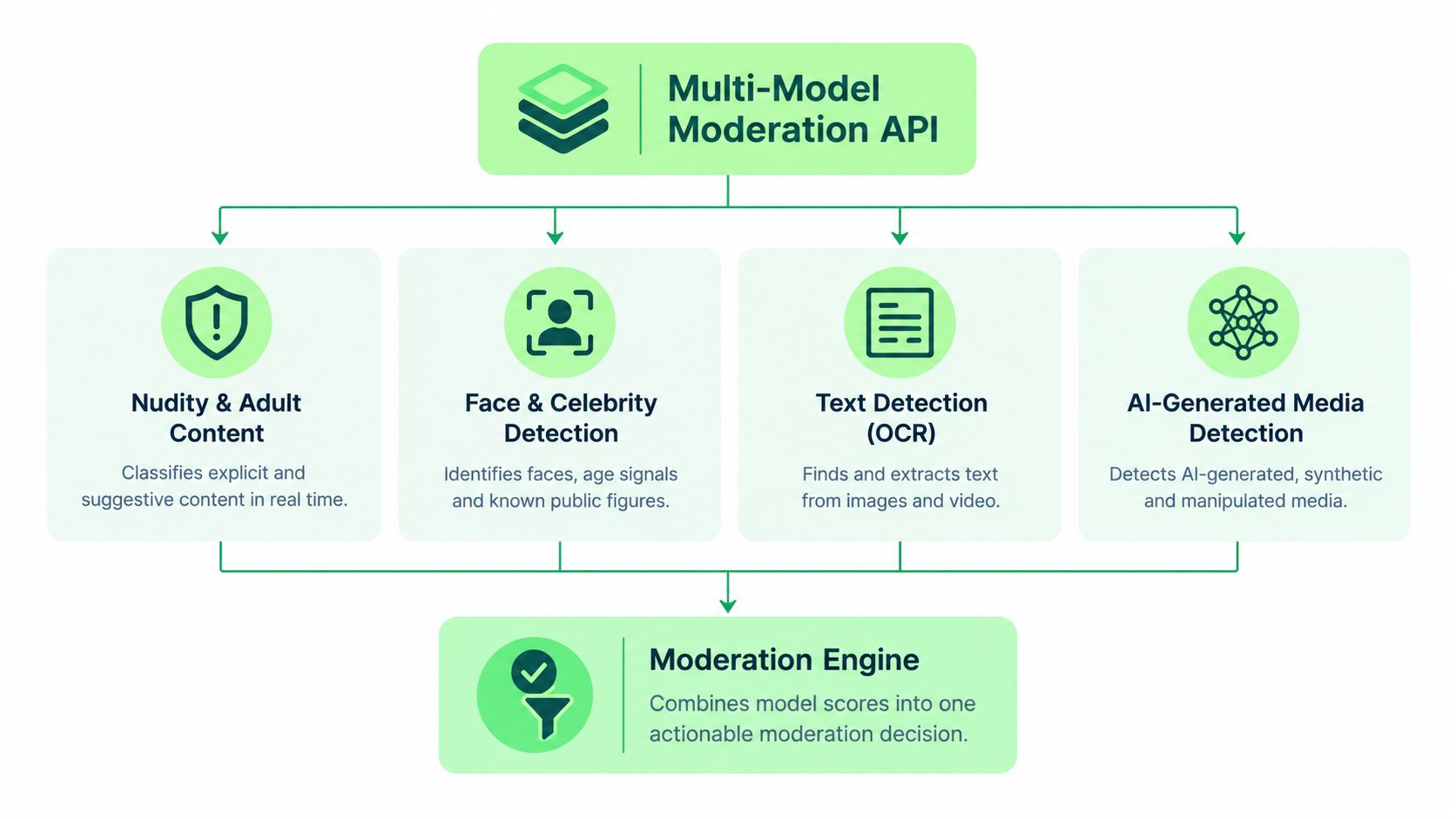
Sightengine's central technical choice is to treat moderation as a collection of specialized models rather than one universal detector. Its API documentation says developers can select the models they need and combine multiple models in one API call. That reduces integration overhead when one asset must be evaluated for several risk categories at once.
Why combined checks matter
Suppose a marketplace receives a seller image. The same file might need an adult-content check, a weapons check, an offensive-content check, and an AI-generation assessment. Separate vendor integrations would create several authentication paths, response formats, monitoring systems, and failure modes. A multi-model request gives the product team a more coherent way to collect signals before applying its own policy.
Sightengine says its platform covers 150 moderation classes across categories including nudity, hate, violence, drugs, weapons, and self-harm, according to its content moderation product page. The image documentation also identifies adult content, offensive content, commercial text, children, and weapons as examples. Those categories make the service broader than a dedicated synthetic-media detector.
This breadth is useful for a publisher that wants to check both content safety and authenticity in one media pipeline. It can also help a marketplace distinguish between a routine product image, an image containing prohibited material, and an image that deserves additional authenticity review. The API doesn't make the policy decision for you. It supplies the signals your application can normalize.
The model output still needs policy logic
A product manager should avoid treating multi-model output as an automatic blocklist. A high-confidence safety violation may justify holding content immediately, while an AI-generation score might only trigger a provenance check or editorial review. The right action depends on the content category, the consequences of an error, and whether the asset can be published while review is pending.
For example, a school publisher may treat a likely synthetic image as a request for attribution or labeling rather than evidence of misconduct. A financial marketplace may apply stricter review to identity imagery, but still require a human to examine the account context. The same API signal can support different operational decisions.
Teams comparing moderation architectures can also review this Hive moderation API comparison to understand why model coverage, workflow ownership, and review design matter as much as the category list. Sightengine's strongest architectural argument is consolidation. Its main trade-off is that your team remains responsible for converting model scores into defensible actions.
Navigating the API Workflow and Integration
The documented Sightengine workflow is straightforward for a backend team. Authenticate with an API user ID and API secret, submit image or video media, specify the models or image lists to check, and process structured scores and labels in the response. The image moderation principles describe an immediate response flow without callbacks or a built-in moderation queue.
A practical request path
A reliable integration usually follows this sequence:
Receive the asset. Accept the upload through your application and decide whether to pass raw bytes or a public URL. Sightengine's documentation supports both approaches for images.
Select the checks. Request only the models relevant to the policy decision. A product-image workflow may need different checks from a community-profile workflow.
Persist the result. Store the returned labels, scores, model selection, timestamp, asset identifier, and policy version in your own system. The API response is an input to your audit trail, not the entire audit trail.
Route the asset. Use internal rules to allow low-risk content, hold uncertain content, or block content that clearly violates a policy. Keep the thresholds configurable rather than embedding them permanently in application code.
Record human outcomes. If a moderator overturns an automated result, log that decision and the reason. Those cases are valuable for evaluating whether a threshold is too strict or too permissive.
The machine-readable response is the main advantage over a browser workflow. An editor can read a result, but software can place it in a queue, attach it to a content record, or trigger a notification without manual copying.
Images and videos create different engineering concerns
Image checks are usually easier to place in a pre-publication request because the application can submit the asset and wait for a response before completing the upload flow. Video moderation requires more attention to file handling, user experience, and failure recovery. Sightengine positions its video offering as a real-time moderation API with webhook and SDK-friendly integration, while its pricing information distinguishes ordinary video limits from larger video and live-stream workflows, as described on the video moderation page.
Don't let the presence of an API make the integration design casual. Define what happens when the vendor response is delayed, unavailable, incomplete, or contradictory. A safe fallback might hold the asset for review, while a lower-risk editorial workflow could allow publication and scan after upload. That decision belongs in your policy documentation.
A useful implementation test uses representative content rather than only clean demonstration files:
- Normal material: images your users submit every day.
- Borderline material: content that moderators regularly debate.
- Edited material: resized, compressed, cropped, or re-exported assets.
- Mixed-risk material: an image that is acceptable in one context but problematic in another.
- Operational failures: inaccessible URLs, oversized files, and repeated submissions.
Integration insight: The hard part isn't sending a request. It's defining what your application does with uncertainty, outages, reversals, and reviewer disagreement.
Evaluating Accuracy and Real-World Limitations
A benchmark can establish that a detector performs well under defined conditions. It can't establish that every future upload will receive a dependable verdict. Sightengine cites an independent benchmark in which researchers from the Universities of Kansas and Rochester tested AI-media detectors on 80,000 images, with Sightengine achieving 98.3% accuracy and ranking first among the evaluated tools, according to the AI image detector benchmark.
That result is relevant, especially because a large dataset is more informative than a small product demonstration. It suggests strong performance in the benchmark's test conditions. It still shouldn't become a production policy by itself.
Pixel analysis has a defined blind spot
Sightengine's own documentation says its AI image detection is purely pixel-based. It ignores metadata, C2PA signals, and watermarks, and it may struggle with newer generators it hasn't encountered before, as explained in the AI-generated image detection documentation.
That limitation changes the compliance conversation. Provenance information can answer questions that pixels alone can't, such as whether an asset carries a content credential or whether its creation history has been preserved. A pixel detector can provide a useful screening signal, but it isn't a replacement for provenance checks, source records, contributor declarations, or human assessment.
Post-processing also matters operationally. Compression, cropping, resizing, screenshots, and re-exports can change the visual evidence available to a detector. Conversely, an authentic image may contain unusual visual patterns that cause an automated system to request review. These aren't reasons to discard the tool. They're reasons to define its role carefully.
Calibrate for the cost of each error
A team publishing educational illustrations may tolerate a review request for an uncertain image. A marketplace handling identity or fraud risk may have a different tolerance. Set thresholds by workflow, not by copying a headline benchmark score into a global rule.
Use at least three outcomes:
- Allow: the result is consistent with the policy and no additional signal requires attention.
- Review: the score or context is uncertain, so a trained person checks the asset.
- Hold or reject: the result meets a clearly documented policy threshold.
Keep the AI-generation signal separate from a safety violation. An image can appear synthetic without being harmful, and an authentic image can still violate a content policy. Combining unrelated signals into one binary label makes appeals harder and hides the reason for the decision.
For a broader evaluation, teams can compare their own samples with an AI image detector guide, then measure reviewer agreement and appeal outcomes rather than relying only on vendor-reported accuracy. The useful production question is whether Sightengine is accurate. It's whether the system gives your team enough reliable information to make proportionate, explainable decisions.
Comparing Pricing Tiers and Verification Methods
Sightengine uses an operation-based pricing structure, which is easier to model than a fixed-seat license when traffic changes with uploads. The published pricing page lists a Free tier with 2,000 operations per month, capped at 500 per day, a Starter plan at $29 per month with 10,000 operations, and an overage price of $0.002 per extra operation on the stated plans, according to the Sightengine pricing page. The page also describes a higher tier with 40,000 operations at $99 per month, plus a Pro-style tier with 200,000 operations and lower overage pricing.
Calculate workflow cost, not just API cost
An operation count is only one part of the budget. A team should also account for engineering maintenance, storage of moderation decisions, queue management, reviewer time, support handling, and the cost of false positives. A low API bill can still produce an expensive process if every uncertain result goes to a poorly designed manual queue.
For example, a publisher checking occasional contributor images may not need an automated API call for every file. An editor can use a browser-based checker for a single verification, record the outcome, and request supporting context from the contributor. That workflow has less setup and is often faster for one-off work.
An API becomes more compelling when checks must run repeatedly, consistently, and without requiring an editor to upload files manually. It fits ingestion pipelines, seller onboarding, profile review, and large media libraries where the application already knows when a check should happen.
| Use Case | Best Approach | Primary Advantage |
|---|---|---|
| Repeated checks during upload | Sightengine API | Automated, structured results inside the product workflow |
| Multiple moderation categories on one asset | Sightengine multi-model API | One integration can collect several model outputs |
| A single suspicious image | Browser verification | Quick inspection without API credentials or engineering work |
| Editorial review of a small submission batch | Browser verification | Human context remains central and setup stays light |
| High-volume marketplace intake | API plus human review | Consistent first-pass screening with escalation for uncertainty |
| Compliance-oriented quality checks | API, provenance records, and human review | Creates a documented process rather than a standalone score |
Browser tools have a legitimate place
Browser-based verification isn't an inferior version of an API. It solves a different problem. A teacher checking one submitted image, an editor reviewing an attribution question, or a creator validating a draft can benefit from a direct upload flow. The user sees the result in context and doesn't need to build authentication, retries, queues, or response handling.
The API is the better fit when the decision must happen as part of a product event. A marketplace shouldn't depend on staff manually checking every seller image. A publisher shouldn't ask editors to copy results into a content management system. The right choice is often a split model, automated screening for recurring intake and browser verification for exceptions.
Aligning Moderation with Compliance and Quality
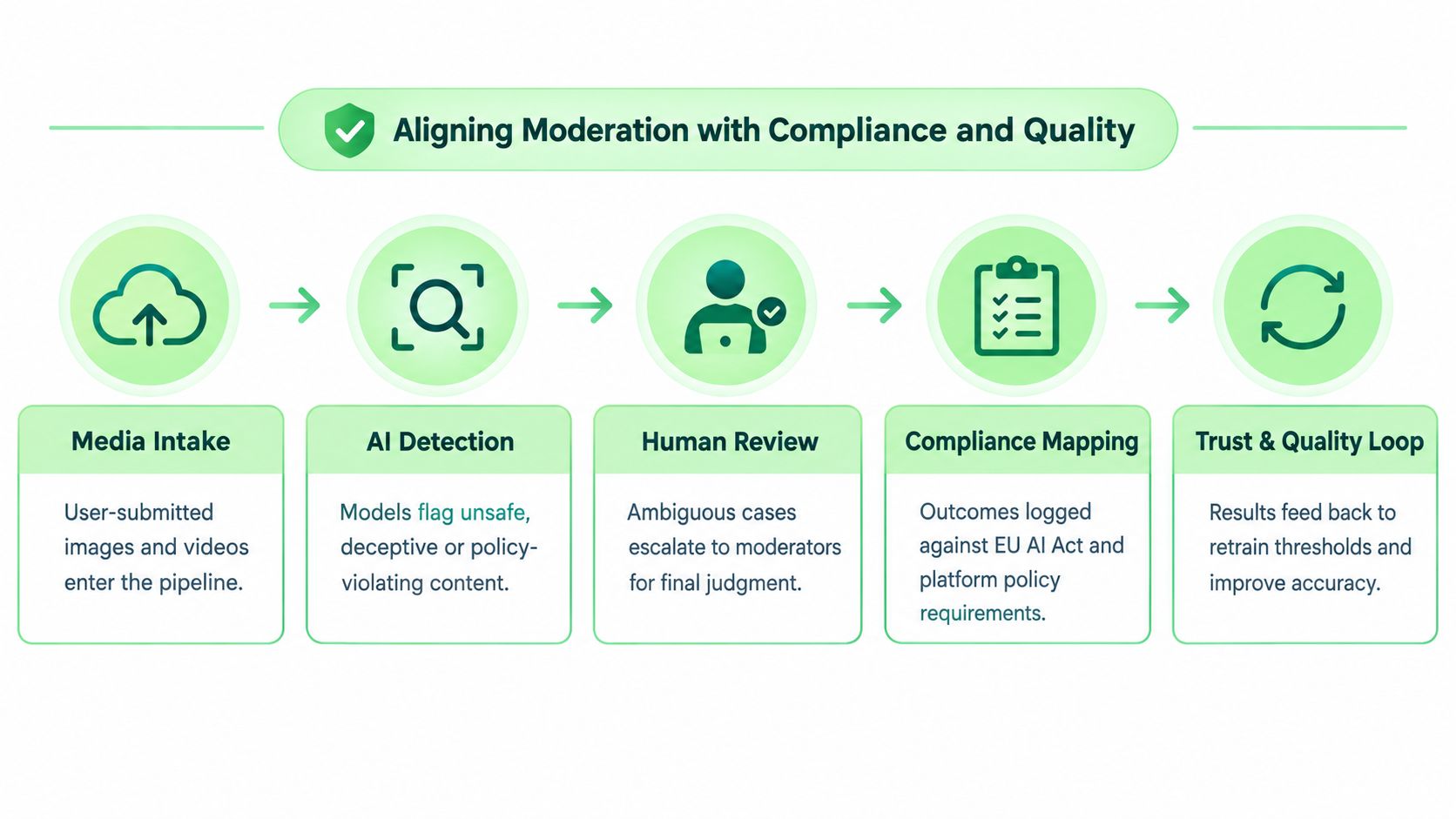
Automated detection becomes more defensible when it supports a documented quality process instead of acting as an invisible gate. The system should show what was checked, which result triggered review, who made the final decision, and whether the outcome changed after an appeal or policy update.
Sightengine's pixel-based AI detection is useful as one layer in that process. It isn't a provenance registry, and its documentation explicitly says it doesn't inspect metadata, C2PA, or watermarks. A compliance workflow should therefore combine detector output with source information, labeling requirements, internal policy, and human judgment.
Build an evidence chain
A practical record for each asset can include:
- Asset context: uploader, source, submission time, intended use, and relevant account information.
- Automated signals: models requested, scores returned, and the application threshold in force.
- Decision path: allowed, held, rejected, or escalated.
- Human outcome: reviewer decision, reason, and appeal result where applicable.
- Transparency action: any disclosure, label, contributor statement, or provenance record attached to publication.
This structure helps a publisher explain why an image was reviewed without claiming that an AI score is an objective truth. It also gives product and compliance teams evidence for threshold changes. If moderators regularly overturn one category, the team can investigate the model, the policy language, or the routing rule.
The deepfake disclosure rules guide is useful background for teams considering how detection, labeling, and publication policies should work together. The operational principle is simple: automated verification can identify content that needs attention, while the organization remains accountable for the final action.
Compliance principle: A detector result is evidence in a decision record. It isn't the decision record by itself.
Human review should be reserved for cases where context changes the outcome, not used as a vague fallback for every result. Train reviewers on category-specific policies, require reason codes, and monitor disagreements. That approach improves content quality while giving users a clearer path to challenge an incorrect decision.
For EU-facing teams, connect the moderation record to the organization's broader transparency and governance work, including requirements that may apply to AI-generated or manipulated content. Confirm the legal interpretation with qualified counsel. The technical system should make compliance easier to evidence, not pretend to replace legal analysis.
Choosing the Right Verification Strategy
Sightengine is a sensible choice when image and video moderation belongs inside an application. Its multi-model API reduces the need to maintain separate integrations for every visual risk, and its usage-based plans give smaller teams a way to test the workflow before scaling. The product is less suitable as a complete compliance operation because your organization must supply the policy engine, review queue, provenance layer, and audit process.
Use this decision test:
- Choose an API pipeline when uploads are recurring, decisions must be machine-readable, and the application needs consistent routing.
- Choose browser verification when a person is checking one file, context matters more than throughput, and engineering setup would be disproportionate.
- Combine both when automated intake handles routine volume while editors, educators, or trust teams investigate uncertain cases.
- Test your own media across normal, edited, recent, and borderline examples before setting thresholds.
- Separate safety from authenticity. A likely AI-generated image isn't automatically unsafe, and a real image isn't automatically acceptable.
AI detectors work best as verification and quality tools. They help teams identify media that deserves closer attention, improve publication standards, and create a repeatable review trail. They work poorly when an organization treats one score as conclusive evidence or ignores how generator type, image quality, post-processing, and policy context affect the result.
A practical next step is to run a controlled sample through the intended workflow, compare automated outcomes with trained human judgments, and document the action taken for each category. That exercise will tell you more about operational fit than a feature list alone.
Humantext.pro provides browser-based AI image verification for checking whether an uploaded image appears AI-generated or real, with a confidence assessment that can complement an enterprise moderation workflow. Visit Humantext.pro to test individual media files and add a quick quality check before publication or review.
准备好将AI生成的内容转化为自然、人性化的文字了吗? Humantext.pro 能即时优化您的文本,确保阅读自然流畅、真实可信。 立即免费试用我们的AI人性化工具 →
相关文章

10 PimEyes Alternatives for Safer Image Verification
Compare 10 PimEyes alternatives for face search, image reuse, privacy, pricing, and safer verification of online identities and media.

Fake Profile Picture Detector: How to Verify Photos Online
Learn how a fake profile picture detector works and verify online photos manually. Step-by-step guide for detecting AI images, catfish, and scams.

Who Is This Person Photo: A Practical Verification Guide
Wondering who is this person photo? Use reverse image search, face search, and AI checks to verify online identities safely and protect yourself from scams.

