What Is an AI To Human Converter and How Does It Really Work?
Discover how an AI to human converter transforms robotic text into natural, undetectable writing. Learn the techniques and use cases for flawless content.
An AI to human converter is a tool that polishes AI-generated text to make it sound like a person wrote it. It adjusts the text's phrasing, sentence structure, and rhythm to mirror the subtle patterns of human writing, which helps it fly under the radar of AI detectors.
Why Does AI Content Need a Human Touch?
Artificial intelligence is amazing at churning out content at lightning speed, but it almost always misses a key ingredient: the human touch. The text can feel robotic, repetitive, and just plain… boring. It lacks the personality and nuance needed to actually connect with a reader.
This is a huge headache for students, marketers, and writers who lean on AI to be more efficient. The problem goes beyond just sounding unnatural. AI content has a digital fingerprint that advanced detection tools like GPTZero and Turnitin are specifically trained to find. An AI-drafted essay or blog post can easily get flagged, gutting its credibility. This is exactly where an AI to human converter saves the day.
Bridging the Gap Between Machine and Person
It’s tempting to think of an AI to human converter as just a fancy "article spinner," but that's not quite right. A better way to think about it is as a sophisticated editing assistant. It scans the text and reworks it to introduce the kind of variety and cadence a real person would use.
Its main goals are to:
- Make It More Readable: It finds and replaces repetitive sentence structures and common AI phrases with more engaging language.
- Add Authenticity: The tool tweaks the text to give it the natural rhythm and flow you'd expect from a human writer.
- Bypass AI Detection: By changing the underlying statistical patterns, it helps the content avoid being flagged by AI detectors.
The need for these tools is exploding. The global AI text generator market was valued at $534.78 million in 2024 and is set to climb even higher. This growth highlights just how many people are looking for ways to humanize AI content. A good converter can preserve the original meaning while achieving bypass rates of up to 99% against major detectors.
Before we dive deeper, here's a quick overview of what these tools do.
AI To Human Converter At a Glance
| Aspect | Description |
|---|---|
| What It Is | A specialized tool designed to refine AI-generated text. |
| Primary Function | It modifies word choice, sentence structure, and flow to mimic human writing patterns. |
| Key Benefit | Makes AI content sound authentic and helps it bypass AI detection software. |
| Who Uses It | Students, content creators, marketers, and writers looking to improve AI drafts. |
Essentially, these converters are the bridge between raw AI output and polished, reader-ready content.
It's About More Than Just Dodging Penalties
Humanizing AI text isn’t just about sneaking past a detector. Truly good writing has to resonate with people, build trust, and get ideas across clearly. Raw AI text often puts up a wall between the message and the reader.
By adding that layer of human-like quality, you're making sure your work is not just compliant but actually compelling. As AI becomes a standard part of our toolkit, understanding the implications of unlocking the power of content creation automation makes it clear why that final human touch is so valuable.
The ultimate goal is to use AI as a powerful assistant, not a final author. An AI to human converter is the crucial final step that polishes a machine's draft into a piece of writing that feels genuinely human.
By learning how to effectively humanize AI-generated text, you can get all the efficiency benefits of AI without sacrificing the quality and authenticity that only a human voice can deliver.
How AI Humanizers Work Their Magic
Let’s be clear: an AI-to-human converter doesn’t just swap out a few words. It's not a glorified thesaurus. Think of it more like a skilled editor who fundamentally restructures AI-generated text to give it a human heartbeat. The process digs much deeper than a simple find-and-replace.
At its core, the technology is built on a deep understanding of what makes human writing feel, well, human. It’s not about making the text grammatically flawless; it’s about making it perfectly imperfect, with all the natural rhythm and quirkiness that defines how we actually talk and write.
This whole process really has two main goals: adding that genuine human touch and, just as importantly, slipping past increasingly sophisticated AI detection systems.
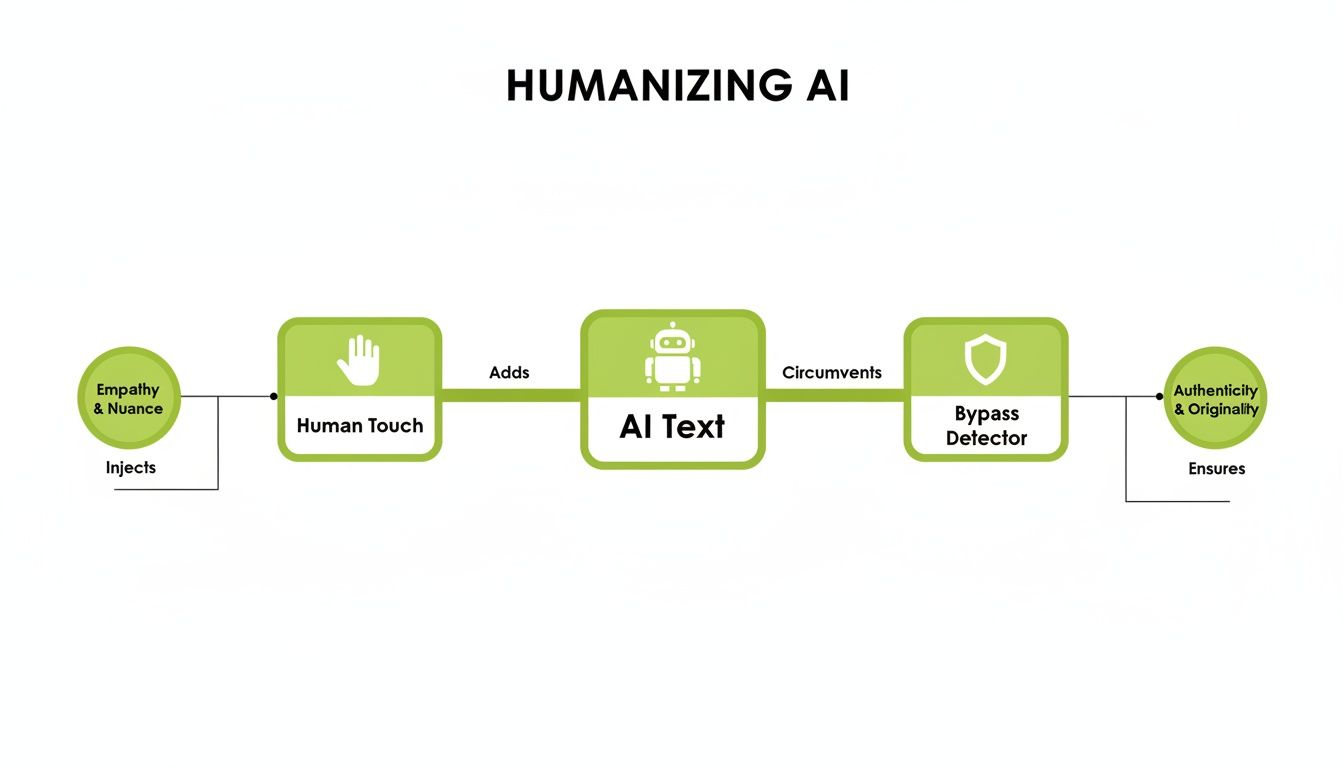
As the visual shows, these tools work to inject empathy and nuance into robotic text, which in turn helps ensure the final output is both authentic and original. So, how do they pull it off? Let’s look under the hood.
Mastering Language Through Linguistic Modeling
First things first, you have to teach the machine what human writing actually sounds like. This is done through linguistic modeling, where the converter is trained on absolutely massive datasets of human-written text—we're talking everything from classic novels and news articles to casual blog posts and dense academic papers.
By chewing through millions of examples, the AI starts to pick up on the subtle rules we follow without even thinking. It absorbs our natural cadence, our common idioms, and the varied ways we structure our sentences. Imagine an apprentice artist who studies the great masters for years, learning not just how to paint a face, but how to capture an expression.
This intense training allows the tool to spot the rigid, predictable patterns that scream "AI-generated!" and rewrite them with more organic, human-like phrasing. The goal is to move beyond just grammatically correct sentences and create text that flows naturally from one idea to the next.
Introducing Perplexity and Burstiness
Two crucial concepts that separate our writing from a machine's are perplexity and burstiness. Stick with me here. Perplexity is just a fancy word for unpredictability. Human writing is highly perplexing; we mix common and unusual words, making it tough for a machine to guess what comes next. AI text, on the other hand, is often boringly predictable.
Burstiness is all about rhythm. Humans write in bursts, naturally mixing long, complex sentences with short, punchy ones for emphasis. AI models tend to produce sentences of uniform length and structure, which creates that monotonous, robotic drone.
An effective AI to human converter actively manipulates these two factors. It injects surprising word choices to increase perplexity and varies sentence lengths to introduce burstiness, breaking up the machine-like rhythm.
This step is critical. It not only makes the text read better, but it's also one of the key ways it sidesteps AI detectors, which are specifically trained to flag content with low perplexity and burstiness.
Engineering for AI Detector Awareness
The most advanced converters use what you could call detector-aware engineering. This means the tool isn't just trying to sound human in a vague, general sense. It’s specifically trained to recognize—and rewrite—the digital signatures that AI detectors are hunting for.
These tools have a deep understanding of the statistical red flags that get content flagged as machine-generated. This includes things like:
- Overly formal tone: AI often defaults to a stuffy, academic tone even when it’s completely out of place.
- Repetitive phrasing: Machines love to overuse certain transitional phrases ("In conclusion...") and sentence starters.
- Lack of personal voice: AI really struggles to inject a unique perspective or personality into its writing.
The converter targets these weaknesses head-on. It systematically reworks the text to eliminate these tell-tale signs, effectively camouflaging it from algorithmic scrutiny. This is a huge reason why the market for conversational AI is set to explode from $14.79 billion in 2025 to an incredible $82.46 billion by 2034—its ability to produce natural, contextual text is in high demand.
If you want to dig deeper into these features, you can explore a dedicated AI Content Humanizer tool. Ultimately, it's this clever blend of linguistic analysis, rhythmic variation, and detector-aware tweaks that allows these tools to transform sterile, machine-made text into something that truly connects with a reader.
Where These Tools Really Shine: Practical Uses for Students and Pros
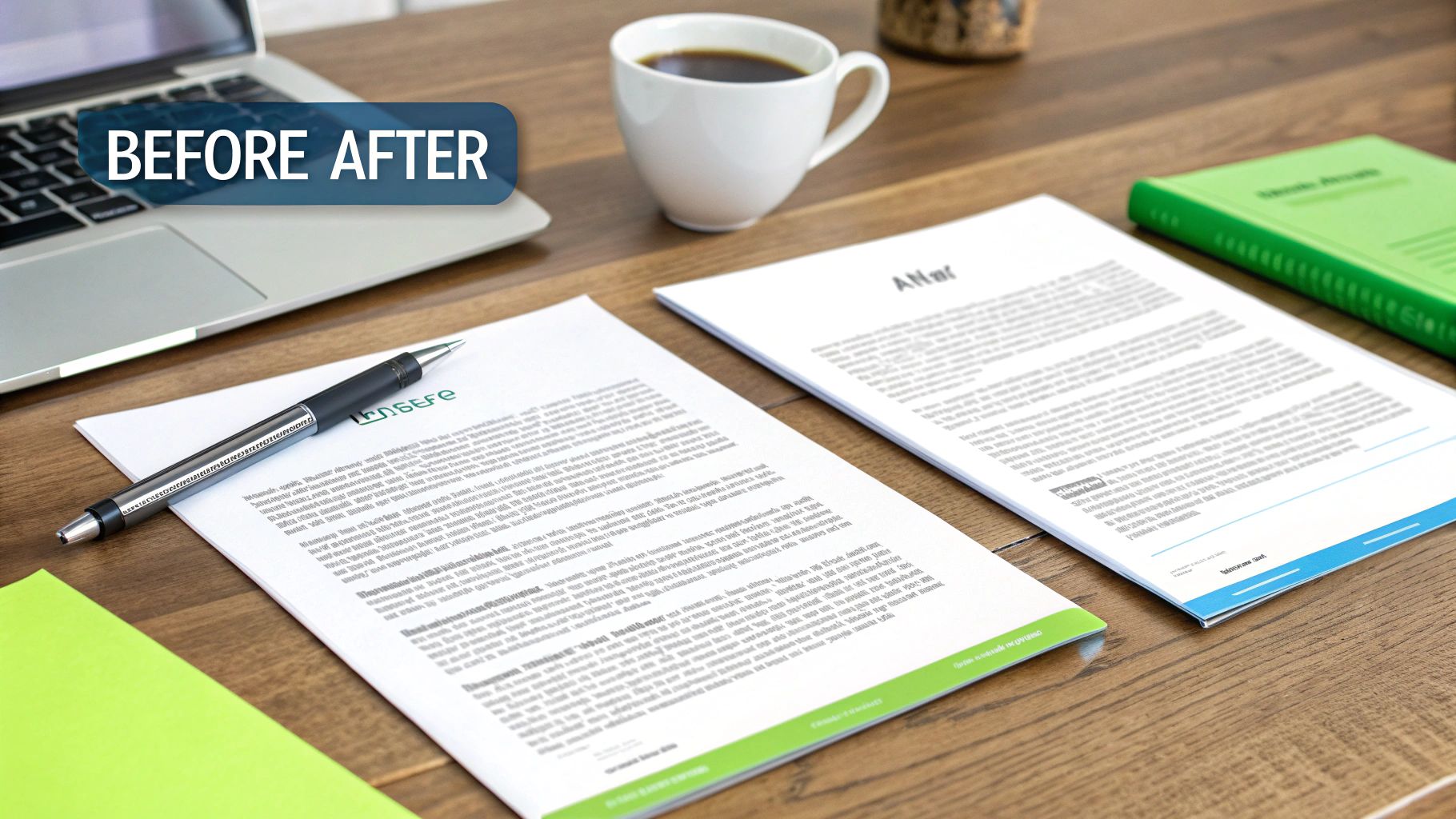
The real magic of an AI to human converter isn't in the technology itself, but in what it lets you accomplish. Once you move past the theory, you start to see just how much time and effort these tools can save in the real world.
Think about it: from academic essays to marketing copy, the ability to instantly humanize text cuts out hours of painstaking manual edits. The core benefit is simple—you get to be efficient without sacrificing quality. Instead of getting bogged down rephrasing clunky sentences or stressing about AI detection, you can focus on the big-picture ideas.
Let's look at a few scenarios where this technology is a game-changer.
For SEO Specialists Crafting Product Descriptions
Picture an SEO specialist staring at a list of 50 new ergonomic office chairs. They need product descriptions for every single one, and fast. Using an AI writer gives them a functional first draft, but it's as dry as toast. It lacks the persuasive flair needed to actually sell a chair.
Before AI to Human Converter
“This ergonomic office chair is constructed from high-quality materials. It features adjustable lumbar support and armrests for user comfort. The chair's five-point base ensures stability. The breathable mesh back promotes air circulation. It is an optimal seating solution for professional environments.”
Technically accurate, but completely forgettable. This reads like an instruction manual, listing features without connecting them to any real-world benefit for the person sitting in the chair.
An AI to human converter flips this robotic description into something that speaks to a customer's actual problems and desires, weaving in a natural tone that builds trust.
After AI to Human Converter
“Tired of stiff, uncomfortable chairs? Our ergonomic office chair was designed with your comfort in mind, built from premium materials that last. You can easily adjust the lumbar support and armrests to fit your body perfectly, while the stable five-point base keeps you secure. Plus, the breathable mesh back helps you stay cool and focused all day long. It's the ideal upgrade for any professional workspace.”
See the difference? The "after" version is far more compelling. It asks a question to hook the reader, connects features to benefits ("stay cool and focused"), and uses a conversational voice that feels trustworthy. That's how you turn features into sales.
For Students Polishing Academic Papers
Students are increasingly using AI as a research partner to summarize dense articles or draft initial arguments. The problem is, the output is often too formal or simplistic. It doesn't meet the standards for nuanced academic writing and can easily get flagged by AI detectors.
Let's say a student is writing a paper on the socio-economic impacts of renewable energy. Their first AI-generated paragraph is clunky and basic.
Before AI to Human Converter
“Renewable energy sources have significant socio-economic impacts. The creation of jobs in the manufacturing and installation sectors is a primary benefit. Furthermore, it reduces reliance on volatile foreign fossil fuel markets. This transition also stimulates local economic development and can lower energy costs for consumers over time.”
The information is there, but the writing is flat. It reads more like a bulleted list than a cohesive argument, lacking the sophisticated flow expected in college-level work.
An AI humanizer helps refine this draft into something much stronger.
After AI to Human Converter
“The shift toward renewable energy triggers substantial socio-economic effects. One of the most immediate benefits is significant job creation across the manufacturing and installation sectors. Additionally, this transition helps insulate national economies from the volatility of foreign fossil fuel markets, fostering greater stability. By stimulating local development, the move to renewables can also lead to more affordable energy for consumers in the long run.”
The humanized version uses stronger, more academic language ("triggers substantial," "insulate national economies") and smoother transitions. It preserves the core message but presents it with an authentic, analytical voice. For students worried about originality, learning how to ethically use writing aids to bypass Turnitin is becoming a crucial skill.
Key Takeaway: An AI to human converter helps students elevate their AI-assisted drafts to meet academic expectations, ensuring their final submission is polished and reflects their own critical thinking.
For Bloggers and Content Creators
For a blogger, engagement is the name of the game. AI can whip up a solid outline with all the key talking points, but it almost always lacks the personality and storytelling that actually hooks a reader. A generic, robotic tone is the fastest way to get someone to click away.
Before AI to Human Converter
“This article will discuss the benefits of remote work. Remote work provides flexibility and eliminates commute times. Companies can access a wider talent pool. Employees report higher job satisfaction. However, challenges like isolation exist.”
This draft is a total snooze-fest. It’s an impersonal list of facts that does nothing to connect with the reader on a human level.
Running this text through a converter can instantly inject a more personal and engaging style.
After AI to Human Converter
“Let’s talk about the real benefits of working remotely. It’s about more than just flexibility—it’s about reclaiming hours of your day once lost to commuting. For businesses, it opens the door to hiring amazing talent from anywhere in the world. It's no wonder so many employees feel more satisfied with their jobs. Of course, it’s not without its hurdles, like tackling feelings of isolation.”
The revised version is conversational, relatable, and much more likely to keep someone reading. It uses a storyteller's voice to draw the audience in, transforming a sterile report into a compelling blog post.
AI Humanizer Versus Manual Editing
So, you've got a piece of AI-generated text that sounds... well, like a robot wrote it. Now you face a classic choice: roll up your sleeves and edit it yourself, or turn to an AI to human converter? Both paths can lead to more natural-sounding content, but they take you there in completely different ways.
The right choice really boils down to what you value most in the moment—speed, creative control, or cost.
Manual editing puts you in the driver's seat. You have the final say on every single word, letting you weave in personal anecdotes, specific brand jargon, or subtle humor that an automated tool might gloss over. But this level of control comes with a hefty price tag: your time. A thorough edit of a long article can easily eat up hours, and keeping your tone consistent across dozens of documents is a real challenge.
An AI humanizer, on the other hand, is all about speed and efficiency. It delivers results in seconds, making it an incredible asset for anyone battling a deadline or managing content at scale. While it might not capture the unique quirks of your personal voice, it excels at the heavy lifting—restructuring clunky sentences, improving flow, and eliminating that tell-tale robotic feel.
A Head-to-Head Comparison
To help you decide, let's put these two methods side-by-side. This direct comparison breaks down how each one performs on the factors that matter most to writers, marketers, and students.
AI Humanizer vs. Manual Editing: A Direct Comparison
Here’s a head-to-head comparison of using an AI to human converter versus editing AI text by hand, evaluating key factors for writers and marketers.
| Factor | AI To Human Converter | Manual Editing |
|---|---|---|
| Speed | Nearly instantaneous. Processes thousands of words in seconds, making it ideal for high-volume tasks and tight deadlines. | Slow and methodical. Requires significant time investment, especially for longer or more complex documents. |
| Cost | Subscription-based or pay-per-use. Generally a low, predictable cost that can be budgeted for easily. | "Free" if you do it yourself, but your time has value. Hiring a professional editor can be expensive. |
| Consistency | Extremely high. Applies the same stylistic rules and improvements to every piece of text, ensuring a uniform voice. | Variable. Tone and quality can fluctuate depending on your energy, focus, or if multiple editors are involved. |
| Authenticity | High. Advanced models create text that sounds genuinely human, but it may lack deep personal or brand-specific insights. | Highest possible. Allows for the infusion of unique personality, specific anecdotes, and expert domain knowledge. |
As the table makes clear, there’s no single "best" choice for every situation. If you need to turn around a high volume of content quickly and consistently, the AI humanizer is a no-brainer. But for that final, personalized polish, nothing beats the human touch.
The Best of Both Worlds: A Hybrid Strategy
Why force a choice between the two? The smartest and most effective workflow combines the raw speed of AI with the nuanced precision of a human editor. This approach treats the AI humanizer as a powerful assistant, not a replacement for your own judgment.
The Smart Workflow: Run your robotic text through the AI humanizer for the first pass. Then, give it a quick manual review to add your unique voice, inject personality, and double-check key facts.
This method truly gives you the best of both worlds. You can slash up to 80% of your editing time by letting the tool handle the tedious structural work. Your final review becomes faster and more focused, freeing you up to concentrate on the high-impact edits that make the content truly yours.
Think of it like a professional chef using a food processor. The machine does the grunt work of chopping and dicing in seconds, but the chef adds the final seasoning and artful plating. By pairing automation with your expertise, you produce better content in a fraction of the time.
Tips for Getting Flawless Results
Simply pasting text into an AI to human converter is just the first step. To get truly natural-sounding content, you have to treat the tool less like a magic button and more like a collaborator. A few smart habits can make a world of difference in your final output.
These aren't complicated tricks, just proven ways to move beyond basic humanization. It all starts with a simple rule that applies to any workflow: what you put in directly shapes what you get out.
Start With a Strong AI Draft
The old saying "garbage in, garbage out" has never been more true. An AI-to-human converter is a phenomenal polisher, but it can't read your mind or fix a fundamentally flawed argument. If your initial AI draft is vague, factually wrong, or poorly structured, the humanized version will just be a slightly more eloquent version of that same mess.
Actionable Insight: Before converting, review your AI draft for factual accuracy and logical flow. For example, if you ask an AI to write about the benefits of solar panels and it includes outdated cost data, correct that number before humanizing the text. A polished sentence with wrong information is still wrong.
Process Text in Smaller Chunks
It’s tempting to dump an entire 2,000-word article into the converter and hit "go." But you'll get far better, more controlled results by working in smaller sections. Humanizing your text paragraph by paragraph—or even a few at a time—gives you way more precision.
This method pays off in a few ways:
- Greater Control: You can check the tone and style of each section individually, making sure everything stays consistent.
- Easier Revisions: If you don't love the output for one chunk, it’s much faster to tweak a small section than regenerate the whole document.
- Preserves Nuance: It helps maintain the specific context of each argument without it getting lost in one massive block of text.
Always Perform a Final Human Proofread
No matter how advanced the tool gets, the final touch should always come from you. This is non-negotiable. This last step is where you inject the real personality, inside jokes, and brand-specific language that an AI simply can’t invent.
Your final read-through is your chance to weave in personal anecdotes, specific industry terms, or your unique brand voice. This is what separates good content from great content and makes your writing truly connect with an audience.
This is also the perfect time to run your humanized text through a separate grammar checker for a final polish. This two-step process ensures your content is not only natural but also technically flawless. The demand for AI-powered text tools is exploding precisely because they excel at this kind of enhancement. In fact, the global AI transcription market—a closely related field—is projected to hit $19.2 billion by 2034, driven by AI's ability to slash manual editing time by up to 80%.
Over time, this final check helps you learn how to bypass AI detection more effectively because you start to internalize what truly makes writing feel human.
Frequently Asked Questions
Whenever a powerful new tool comes along, it's smart to ask questions. It’s totally normal to wonder about how effective an AI-to-human converter really is, where the ethical lines are, and what it does to your original message. Let's tackle the biggest questions to give you a clear picture.
Getting these details straight will help you use the technology the right way and get the best results, whether you're working on an essay, a blog post, or a report for work.
Can AI Detectors Still Flag Humanized Content?
This is the big one. The short answer? Yes, it’s possible, but a good AI humanizer makes it much, much less likely. You can think of it as a constant game of cat and mouse. As detectors like GPTZero and Turnitin get more sophisticated, the best humanizers are always updating their own tech to stay a step ahead.
The whole point of these converters is to rewrite the statistical fingerprints that AI detectors are trained to find. They zero in on boosting the text's perplexity (making it less predictable) and burstiness (mixing up sentence lengths), which are two of the classic signs of real human writing.
Here’s the breakdown:
- High Bypass Rates: The top-tier tools often boast a 99% bypass rate against the major detectors. They pull this off by training their models on huge libraries of authentic human-written text.
- No Tool is Bulletproof: The detection world is always evolving. A piece of content that sails through today might get flagged by a smarter detector a month from now.
- The Hybrid Approach is Your Best Bet: For anything important, your safest move is to use the converter and then give it a final manual read-through. That last human touch adds a layer of personal style that’s nearly impossible for a machine to spot.
So, while no tool can promise a 100% guarantee that lasts forever, using a quality AI-to-human converter drastically improves your odds of creating content that reads and scans as genuinely human.
Is Using an AI Humanizer Considered Plagiarism?
This is a critical ethical question, and the answer is a firm no—as long as you’re using it the right way. Plagiarism is when you take someone else’s ideas or words and pass them off as your own. An AI humanizer doesn't steal content; it refines and polishes text you’ve already created.
Think of it like using a grammar checker or hiring a human editor. These tools help you improve your writing's clarity, style, and flow. They don't generate the core ideas for you.
Where it gets tricky, though, is in academic settings. Most universities have very clear academic integrity policies. Handing in an essay that was 100% generated by AI and then lightly "humanized" would almost certainly be considered cheating. The ethical way to use it is as a final editing assistant to polish your own AI-assisted drafts, not as a machine to do the heavy lifting for you.
It's a tool for assistance, not authorship. The original ideas and arguments should always be yours.
Do These Tools Change the Original Meaning of My Text?
A common worry is that the converter will spin your content so much that the original message gets lost in translation. It's a valid concern, but a quality AI to human converter is built specifically to prevent this. Its main job is to preserve the core meaning while completely changing the delivery.
Instead of messing with your key points, a good humanizer focuses on:
- Restructuring Sentences: It rephrases a sentence to sound more natural without altering its basic message.
- Adjusting Word Choice: It swaps out predictable AI vocabulary for more varied and human-sounding synonyms.
- Improving Flow: It smooths out the transitions between sentences, making the entire piece read more cohesively.
Practical Example: The tool might turn "The utilization of this methodology effectuates superior outcomes" into "Using this method gets better results." The meaning is identical, but the tone and style are night and day. Always give the final output a quick review to make sure your key arguments and data are still intact. The best tools are masters at staying true to the source material.
Are There Free AI to Human Converters Available?
Yes, you'll find plenty of free options out there, but they usually come with some serious strings attached. It’s helpful to know the difference so you can pick the right tool for your needs.
- Freemium Models: This is the most common setup. Tools will offer a free trial with a tight word count limit (like 500 words) so you can test the waters. To work on longer documents or unlock better features, you’ll need to upgrade.
- Totally Free Tools: Some sites offer a completely free service, but these are often running on older, less sophisticated technology. They might work more like basic article spinners, which can butcher the original meaning and are pretty bad at getting past modern AI detectors.
- Paid Subscriptions: For anyone who relies on this for their work—students, marketers, writers—a subscription is almost always the way to go. It gives you unlimited use, higher-quality results, and better privacy.
Free trials are a great way to see if a tool is a good fit before you buy. Just know that for consistent, high-stakes work, a reputable paid service is the more reliable choice.
Ready to turn your AI text into compelling, human-sounding content? Humantext.pro uses advanced linguistic modeling to help you bypass AI detectors and create authentic writing in seconds. Try it now and see the difference for yourself.
Ready to transform your AI-generated content into natural, human-like writing? Humantext.pro instantly refines your text, ensuring it reads naturally and authentically. Try our free AI humanizer today →
Related Articles
AI Detector Score: What It Means and How to Use It
Understand AI detector scores, learn how they are calculated, and discover practical ways to interpret and use them for quality assurance and compliance.
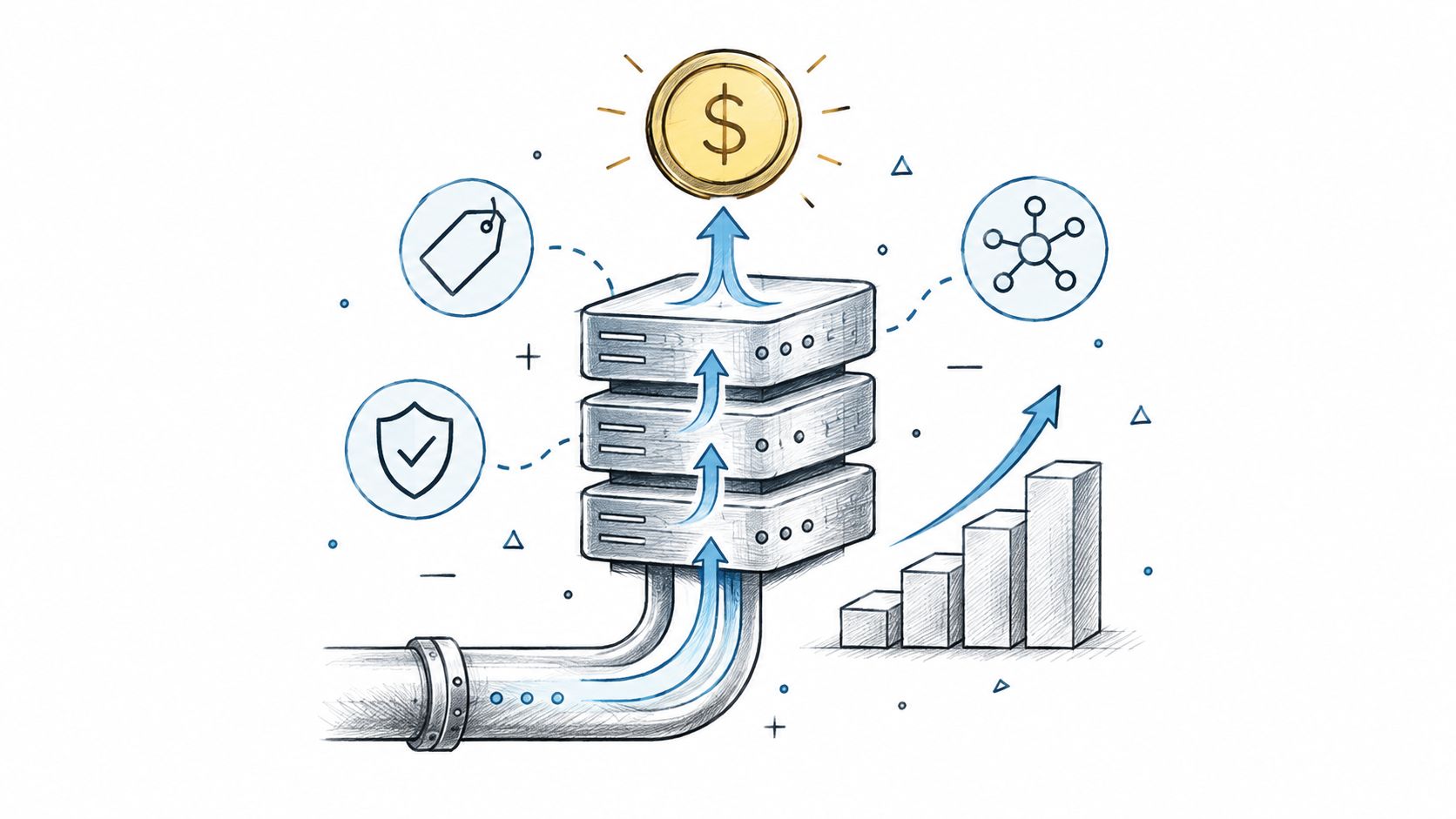
Data Monetization Platform Guide: Build, Price, and Scale
Master the data monetization platform model. Learn architecture, pricing strategies, compliance rules, and real examples to turn data into revenue safely.
10 Different Words for Sad: Ranked by Intensity and Tone
Explore different words for sad, ranked by intensity, register, and context, with example sentences and usage notes for writers and students.

