A Guide to Bypass AI Detection and Humanize Your Content
Discover a proven workflow to bypass AI detection. Learn how to transform AI-generated drafts into human-sounding content that connects with readers and ranks.
So, what does it actually mean to bypass AI detection? At its core, it’s about taking AI-generated text and carefully rewriting it to sound like a human wrote it. This process, which many of us call humanizing, is all about injecting natural writing patterns, sentence variety, and a distinct personal voice. The entire goal is to transform that clean, predictable, often robotic text into something with genuine perplexity and burstiness—the kind of stuff that sails right past tools like GPTZero or Turnitin without raising a flag.
The Reality of AI Detection in Content Creation
There’s an arms race happening right now in the digital world. On one side, you have AI content generators getting scarily good at churning out text. On the other, a whole market of AI detectors is popping up to catch that very same content. For creators, this isn't just some tech-nerd squabble; it has very real consequences.
The stakes are surprisingly high for anyone using AI to be more efficient, from students to seasoned professionals:
- Content Marketers: An AI-flagged article can absolutely tank your SEO. Search engines are getting smarter about prioritizing authentic, human-centric content, and a bad score can hurt your rankings.
- Students: Handing in an essay that gets flagged for AI, even if you only used it to brainstorm, can trigger serious academic penalties. We're talking plagiarism accusations and failing grades.
- Writers: If you lean too heavily on raw AI output, your professional credibility takes a hit. Clients will start rejecting generic, uninspired work that lacks a human touch.
What makes this even trickier is that the detectors themselves are far from perfect. They spit out false positives all the time, incorrectly flagging genuinely human-written text. This makes learning to bypass AI detection less about cheating the system and more about a necessary defense.
Why Detectors Flag AI Content
To successfully humanize text, you have to get inside the detector's head. These tools aren't reading for meaning; they're scanning for statistical patterns common in machine writing but rare in human expression.
It all boils down to two core concepts:
- Perplexity: This is just a fancy way of measuring how predictable a text is. AI models are trained to pick the most statistically probable next word, which creates smooth but very predictable sentences. Human writing, with its quirks and unexpected word choices, has much higher perplexity.
- Burstiness: This is all about rhythm and flow—the variation in sentence length and structure. Humans naturally mix short, punchy statements with longer, more descriptive ones. AI often falls into a monotonous rhythm, with sentences that are all roughly the same length.
Key Takeaway: The goal of humanizing isn't just swapping out a few words. It's about fundamentally messing with the text's structure to crank up its perplexity and burstiness. You're trying to make it statistically indistinguishable from something a person would write. You can dive deeper into this in our detailed guide on making AI undetectable.
The AI detection market is blowing up in response to this dynamic, projected to grow from USD 0.58 billion in 2025 to USD 2.06 billion by 2030. That’s a staggering 28.8% CAGR, fueled by the pressure in education and marketing to tell human and machine work apart.
This means that simply running your text through a thesaurus or a basic article spinner won’t work anymore. The only way to win is through a thoughtful, hands-on editing process that injects personality, nuance, and even a little intentional imperfection—the very hallmarks of human creativity that algorithms just can't fake.
My Go-To Workflow for Humanizing AI Text
So, we've talked about the theory behind AI detection. Let's get our hands dirty. Turning a robotic draft into something that sounds like it was written by a real person takes more than swapping a few words around. It’s a process—a way of rewriting, restructuring, and injecting some much-needed personality.
The goal isn't to dumb it down or add mistakes. It's about introducing the natural rhythm and occasional quirks that algorithms are trained to see as human.
This is the exact workflow I use to produce content that not only flies under the AI detection radar but actually connects with readers. Think of it less like a rigid formula and more like a flexible framework you can adapt to any project.
First, Overhaul the Structure (Not Just the Words)
The biggest mistake I see people make is jumping straight into a thesaurus. That’s an old trick, and modern detectors see right through it. Instead, start by tearing apart the sentence structure. AI models love a monotonous, predictable rhythm—sentence after sentence of similar length and construction.
Your first job is to shatter that pattern.
- Combine short, choppy sentences: Find those staccato phrases and merge them. Use conjunctions or subordinate clauses to create a more natural flow.
- Break up long, rambling sentences: If a sentence feels like a marathon, split it into shorter, punchier thoughts that are easier to digest.
- Vary your sentence starters: Does every other sentence begin with "The," "It," or "This"? Mix it up.
This initial pass immediately messes with the statistical predictability detectors are looking for. You're changing the text’s burstiness—a key metric AI detectors use to flag machine-written content.
Find Its Voice and Inject a Consistent Tone
Once the structure feels less robotic, it's time to figure out the article's voice. AI content is notoriously toneless. It’s informative, sure, but it has zero personality. You need to decide what you want the piece to feel like. Is it supposed to sound authoritative? Casual and friendly? Maybe even a little witty?
Honestly, establishing a consistent tone is probably the most critical step in making content feel human. An AI can mimic different styles, but it really struggles to maintain one authentic voice across an entire article without a human guiding it.
For instance, an AI might say, “It is important to consider…” A more conversational approach would be, “But here’s something you really need to think about…” That simple shift turns a lecture into a conversation. This is a core idea we explore in our more comprehensive guide on how to humanize AI-generated text for better reader connection.
Purge Predictable AI Phrases
Language models have their favorite words and phrases—little statistical tells that scream "a robot wrote this." Your next job is to hunt them down and replace them with something a person would actually say.
This table highlights some of the most common AI phrases I see and offers human-sounding alternatives that instantly improve the text's authenticity.
AI Text vs Humanized Text Transformation
| Robotic AI Phrase | Humanized Alternative | Why It Works |
|---|---|---|
| "Delve into" | "Let's break down" or "Let's dig into" | It's less formal and more conversational, inviting the reader in. |
| "In conclusion" | "So, what's the bottom line?" | This shifts from a stuffy academic summary to a direct, practical takeaway. |
| "Moreover," or "Furthermore," | "On top of that," or "And another thing..." | These are common transitions people use when they're actually talking. |
| "It is crucial to" | "You've got to remember that" | It speaks directly to the reader, making the advice feel personal. |
Getting rid of these crutch words is a high-impact edit. It makes the writing feel less like it was assembled from a template and more like an original thought.
Weave in Human-Centric Elements
This is the final layer of polish, where you add the flourishes that are uniquely human. AI detectors simply aren't trained to expect these elements, which makes them incredibly effective.
Try weaving some of these into your text:
- Personal Anecdotes: A quick, relevant story goes a long way. "I remember struggling with this exact problem when I first started..."
- Opinions and Asides: Don't be afraid to state a clear opinion. "(which, in my view, is a huge mistake)."
- Rhetorical Questions: Pull the reader in directly. "But how can you be sure this will actually work for you?"
- Figurative Language: Use simple metaphors or analogies to clarify. "Think of it like building a house; you need a solid foundation first."
These elements introduce a level of nuance and subjectivity that AI models just can't replicate on their own. If you’re curious about the deeper mechanics, learning how an undetectable AI writer operates can provide some excellent context. Understanding the tool’s perspective can seriously improve your own manual editing process.
At the end of the day, these techniques work because they mimic human quirks. They vary sentence lengths, inject subtle personality, and swap tired AI phrases for natural language. It’s no surprise that humanized text often scores 73% higher on readability, simply because it flows better without that robotic repetition.
How to Reliably Test Your Content Against AI Detectors
You’ve spent the time rewriting your AI draft, injecting your own voice, and hunting down every last robotic phrase. So, how do you know it actually worked? Trusting a single AI scanner is a rookie mistake, one that gives you a false sense of security right before you hit publish.
The only way to be truly confident is to build a solid, multi-layered testing process. This isn't just about chasing a high "human" score; it's about understanding why your text passes and spotting any lingering weaknesses.
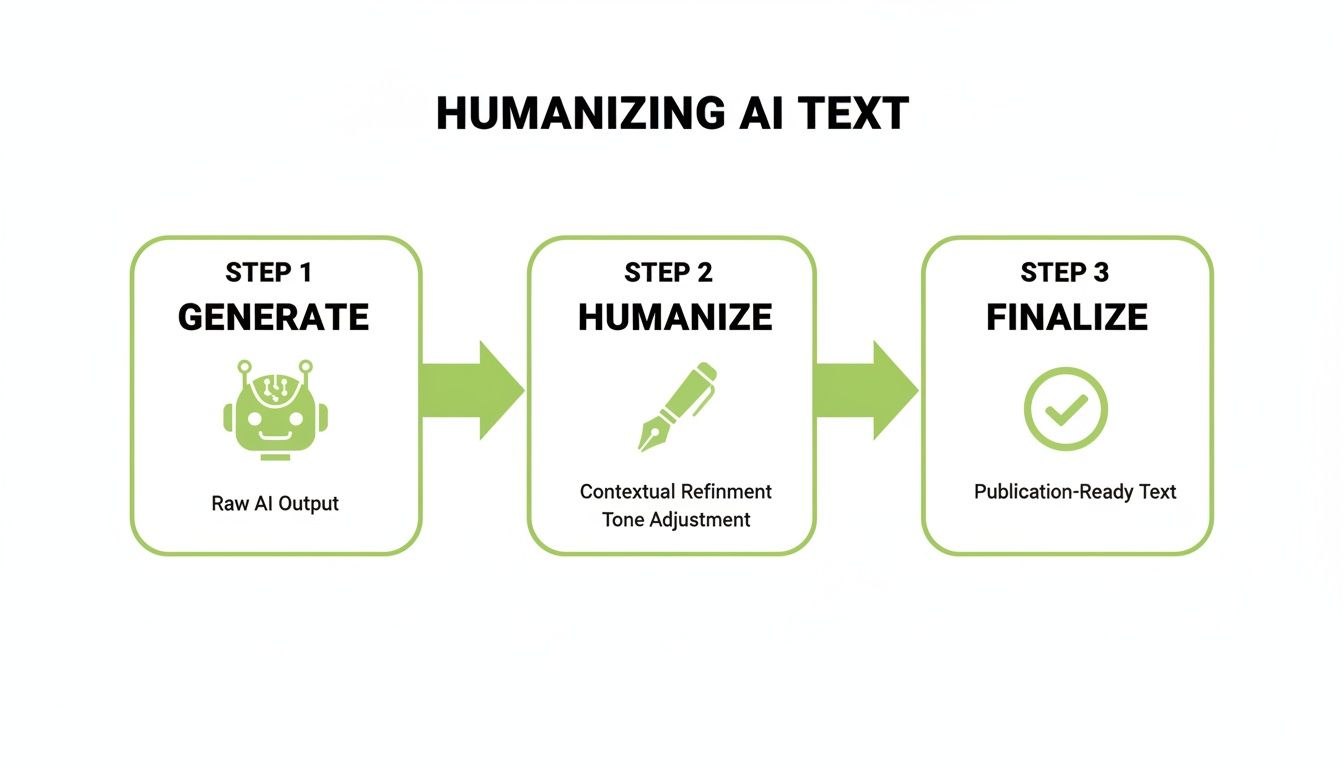
This workflow shows the core idea—humanizing isn't just a quick final edit. It's an active, iterative step that bridges the gap between raw AI output and a piece of content that's genuinely yours.
Build a Diverse Testing Toolkit
Here’s the thing about AI detectors: they all use slightly different algorithms. One might be hyper-sensitive to uniform sentence lengths (what they call "burstiness"), while another hones in on predictable word choices ("perplexity"). If you only use one tool, you’re completely blind to its specific weaknesses.
To get around this, you need to cross-reference your content against a few reliable detectors. I always recommend building a small testing suite with at least three distinct tools.
- GPTZero: This is often seen as an industry benchmark. It gives you a clear probability score and highlights the specific sentences it thinks are AI-generated, making it a great first-pass check.
- Originality.ai: Known for its strictness, this tool is a favorite among serious content marketers and SEOs. If your text can pass Originality.ai, you can be pretty confident it's well-humanized.
- Copyleaks: While many know it as a plagiarism checker, its AI detector is surprisingly sharp. It provides another valuable data point to confirm what the other tools are telling you.
Running your text through all three gives you a much more complete picture. If one tool flags a section that the others missed, you know exactly where to go back for a final polish.
Look Beyond the Final Score
That percentage score is just the headline. The real gold is in the highlighted text—the specific parts a detector flags as suspicious. Don't just glance at the score and call it a day. Dig in.
Start asking yourself a few questions:
- Is there a pattern here? Are all the highlighted sentences simple, straightforward statements? Do they all have a similar word count?
- What phrases keep getting flagged? You might notice a certain transition phrase or sentence structure is a recurring offender in your writing.
- Do the tools agree? If GPTZero and Originality.ai both highlight the same paragraph, that section absolutely needs another round of heavy editing. No question.
This kind of analysis helps you spot your own bad habits during the humanizing process. Maybe you realize you’re leaning too heavily on a specific sentence starter, creating a pattern the algorithms can easily pick up on.
Crucial Insight: The goal isn't just to pass the test; it's to understand why you passed. Analyzing the flagged text trains you to spot robotic patterns on your own, making you a much more effective editor over time.
Understand the Reality of False Positives
It's critical to remember that AI detectors are not perfect. Not even close. The problem of false positives—where genuinely human-written text gets flagged as AI—is a well-documented issue. In fact, studies show even top-tier detectors can wrongly flag human content in as many as 1 in a few dozen cases.
This is why a 100% "AI-generated" score can sometimes be less alarming than it looks, and a 0% score isn't a bulletproof guarantee. Even the creators of these tools admit to their imperfect accuracy.
This reality check is your friend. If a detector flags a sentence you know for a fact contains a personal story or a unique opinion you wrote from scratch, you can probably ignore it. Your multi-tool approach helps here, too. If two out of three detectors give a passage the all-clear, the third is likely just an outlier.
Use the feedback as a guide, not a command. In the end, trust your human judgment to make the final call.
Using Tools to Speed Up the Humanizing Process
While editing every line by hand is the surest way to get authentic, human-sounding content, let's be realistic—it's incredibly time-consuming. This is where AI humanizer tools can be a total game-changer, stepping in as a powerful first-pass editor to do most of the heavy lifting.
Think of these tools less like magic wands and more like hyper-efficient assistants. They work by rewriting your draft, breaking up those predictable AI sentence structures, and swapping out common robotic phrases to better mimic human writing patterns.
This initial pass can save you hours. It tackles the most obvious, glaring signs of AI generation, giving you a much cleaner starting point for your manual review. You get to skip the most tedious parts and jump straight into refining the tone, injecting your personal insights, and making sure the core message lands perfectly.
Choosing and Using a Humanizer Tool Wisely
Not all humanizer tools are created equal, and how you use them matters just as much as which one you pick. The goal is to gain efficiency without sacrificing quality. If you're looking to turn around AI drafts quickly, specialized AI Content Humanizer platforms can be a massive help.
When you start using one, keep a few key principles in mind to get the best results:
- Treat It as a First Draft: Never just copy, paste, and publish. The output from a humanizer is your new first draft, not the final product.
- Fact-Check Everything: During the rewriting process, details can sometimes get twisted or lost. Always double-check that all facts, figures, and key arguments are still accurate after the tool has worked its magic.
- Focus on the Final Polish: This is where you add the elements only a human can. Use the time you saved to weave in personal anecdotes, unique opinions, and a consistent authorial voice. That's what truly makes content undetectable.
My Personal Takeaway: I see these tools as a way to get my drafts about 80% of the way there. The final 20% is where the real value is created—that last round of manual polishing adds the nuance and authenticity that automated systems just can't replicate.
This approach combines the speed of an algorithm with the irreplaceable touch of human experience. It’s all about working smarter to bypass AI detection and create content that genuinely connects with readers.
Manual vs. Tool-Assisted Humanization
Deciding whether to edit purely by hand or use a tool depends entirely on your project's needs—things like deadlines, the volume of content, and how much personal flair is required. Neither method is universally superior; they just serve different functions.
To help you decide which path makes sense for your situation, it's useful to compare them side-by-side.
Manual vs Tool-Assisted Humanization
| Aspect | Manual Editing | Tool-Assisted |
|---|---|---|
| Speed | Slow and methodical, demanding a significant time investment for each piece. | Blazing fast, capable of processing huge amounts of text in minutes. |
| Authenticity | The highest possible, allowing for a completely unique voice and personal touch. | Good, but the output can sometimes feel a bit generic without a final human review. |
| Best For | High-stakes content like cornerstone blog posts, personal essays, or brand-defining copy. | High-volume content production, getting initial drafts ready, and scaling marketing efforts. |
| Effort | High. This requires focused attention on every detail, from structure and tone to word choice. | Low initial effort. The real work is concentrated in the final polishing stage. |
Often, the most effective workflow is a hybrid one. You can leverage the speed of an AI humanizer for the initial rewrite and then apply your own meticulous manual review to finish the job. This lets you produce high-quality, undetectable content at a much faster clip.
If you're curious about which tools are worth your time, our guide on the best AI to human text converter offers a detailed breakdown of the top options available.
Common Pitfalls When Trying to Bypass AI Detection

So you've got an AI draft and you’re ready to make it human. It seems straightforward, but this is where a lot of people go wrong, and their efforts end up backfiring. Even with the best intentions, it's incredibly easy to fall into traps that either fail to fool the detectors or, even worse, just make your content a pain to read.
Understanding these common mistakes is the first step to avoiding them. Let's walk through the big ones I see all the time.
The Synonym Swap Trap
The most common mistake, hands down, is treating this like a simple search-and-replace game. You take a sentence spit out by AI, open up a thesaurus, and start swapping words. It’s an old trick, and modern detectors see it coming from a mile away.
An AI might write, "The utilization of renewable energy is pivotal for sustainability." The rookie move is to change it to, "The employment of green power is crucial for ecological balance." You’ve changed the words, but the robotic sentence structure is still perfectly intact. Detectors look at patterns like sentence rhythm and word probability, not just vocabulary.
This approach often makes the text sound clunky and unnatural, which ironically, can be another huge red flag for AI detectors. The goal isn’t just to change the words; it's to rebuild the sentence from the ground up. Think about changing the subject of the sentence or combining it with another idea to create something more complex and human.
Over-Editing into Oblivion
On the other end of the spectrum, you have the over-editor. In an attempt to sound intensely "human," some writers pile on so much fluff, personal opinion, and convoluted sentence structures that the original message gets completely lost.
The goal is to sound authentic, sure, but not at the expense of clarity. You're trying to communicate an idea, not just hide its robotic origins.
Key Takeaway: Your number one job is still clear communication. If your attempt to bypass detection makes the content harder for a real person to understand, you've completely defeated the purpose. Always ask yourself, "Is the original point still crystal clear?"
A good habit is to keep the original AI draft visible while you work. After you rewrite a paragraph, glance back at the original to make sure you haven't wandered off into the weeds and lost the essential information.
Forgetting to Fact-Check After the Rewrite
This one is subtle but absolutely critical. It’s surprisingly easy to accidentally change a fact when you're busy rephrasing everything. A humanizer tool or even a manual edit might tweak a number, misinterpret a technical term, or twist a statistic.
For example, a phrase like "over 75% of users reported satisfaction" could easily get softened to "the vast majority of users were satisfied," which loses the specific data point. Even worse, it might be rewritten as "almost 80% of users were happy," introducing a flat-out error.
Here’s a quick mental checklist to run through when you're done:
- Verify all numbers: Double-check every single statistic, date, and percentage against your source material. No exceptions.
- Confirm technical terms: Make sure that specialized vocabulary is still being used correctly in its new home.
- Check direct quotes: If you have any quotes, ensure they are still verbatim and haven't been accidentally paraphrased.
Skipping this final fact-check is a recipe for disaster. It not only undermines your credibility with your audience but could also get you flagged by plagiarism checkers. Consider this step non-negotiable.
When you start talking about making AI text sound human, you inevitably run into some thorny ethical questions. The whole idea of how to bypass AI detection isn't a simple case of right versus wrong. It's a massive gray area, and your intent is what really matters.
Think about it. A non-native English speaker using AI to polish a professional email isn't trying to deceive anyone; they're aiming for clarity. A marketer trying to get past a biased detector that flags perfectly good human writing as AI-generated is just trying to level the playing field. In these cases, the goal is fairness, not fraud.
Navigating Responsible Use
But there's a clear line, and you cross it when your goal is to be dishonest. Using these methods to cheat on a school essay is academic fraud, plain and simple. Pumping out huge volumes of low-quality, "humanized" spam content just adds noise to the internet and makes things worse for everyone. That's not what this is about.
Responsible use really comes down to a few core principles:
- Academic Honesty: Never, ever pass off AI-generated work as your own for an academic assignment.
- Transparency: When it’s appropriate, be open about using AI as a writing assistant. It’s a tool, not a secret.
- Value Creation: Your final product must be accurate, genuinely helpful, and provide real value to the person reading it.
This isn’t about moralizing. It’s about being thoughtful. The technology itself is neutral. Like any powerful tool, its impact—good or bad—is determined by the person using it.
Looking ahead, the cat-and-mouse game between AI generation and detection is only going to get more intense. As the algorithms get smarter, the need for deep human insight, creativity, and critical oversight will become more important than ever.
The future of quality content isn’t a battle between humans and AI. It's a partnership. The best model will be a hybrid one: human experts will guide AI to create rough drafts, then step in to apply their unique experience, storytelling skills, and critical thinking. They'll craft a final piece that no algorithm could ever replicate on its own.
In the end, authenticity will be the most valuable currency.
Common Questions About Bypassing AI Detection
When you start humanizing AI text, a few key questions always come up. Let's tackle them head-on, based on what I’ve seen content creators, marketers, and students ask most often.
Is Bypassing AI Detection Illegal?
Let's get this straight: bypassing an AI detector is not illegal. There's no law against rewriting text to sound more human.
The real question is about ethics and rules, which are entirely context-dependent. For a student, using these techniques to pass off AI work as their own is almost certainly a violation of academic integrity policies. In short, it’s cheating.
For content marketers, SEO specialists, and other professionals, it’s a different story. If your goal is to refine an AI draft to improve its quality, add your expertise, and avoid getting unfairly flagged by imperfect detection tools, you’re in the clear. The intent is what matters. You're not deceiving; you're editing.
The core issue isn't the act of rewriting but the purpose behind it. Using humanizing techniques for academic dishonesty is a clear violation. Using them to refine professional content for clarity and authenticity is just a standard part of the modern writing process.
Can AI Detectors Ever Be 100% Accurate?
No, and they likely never will be. AI detectors don't deal in certainty; they deal in probabilities. They analyze patterns and predict the likelihood of a text being AI-generated, which means they are always prone to getting it wrong.
This leads to two major headaches for writers:
- False Positives: When the detector incorrectly flags your genuinely human-written content as AI. Super frustrating.
- False Negatives: When the detector fails to spot text that was, in fact, written by an AI.
This built-in inaccuracy is exactly why you can't trust a single detector's score as the absolute truth. A much smarter strategy is to run your content through several different tools. This gives you a more balanced consensus instead of relying on one flawed opinion.
Will an AI Humanizer Guarantee I Pass Detection?
No tool can offer a 100% guarantee to fool every detector, every single time. It's a constant cat-and-mouse game where detection algorithms are always evolving to catch up with the latest generation models.
AI humanizers are incredibly useful for doing the heavy lifting—restructuring sentences and swapping words to break up the robotic patterns. Think of them as a powerful first step in your editing workflow.
But for a truly future-proof strategy, you need a human in the loop. Use a tool to speed up the process, but always perform a final manual review. This is where you inject your unique voice, add nuanced insights, and give the text a final polish. That human touch is what truly makes the content your own and ensures it will consistently fly under the radar of AI detectors.
Ready to transform your AI drafts into undetectable, human-quality content? HumanText.pro uses advanced algorithms to help you bypass AI detectors effortlessly while preserving your original meaning. Try it now and see the difference.
Ready to transform your AI-generated content into natural, human-like writing? Humantext.pro instantly refines your text, ensuring it reads naturally and authentically. Try our free AI humanizer today →
Related Articles
AI Face Search Explained: Verify Identity and Stay Safe
Understand how AI face search works, including embeddings, accuracy, and legal issues. Learn to use these tools for personal safety and verify identity online.
Reverse Face Search: A Verification Safety Guide
Learn how reverse face search works, when to use it for safety, and how to pair it with AI image checks to verify online contacts and reused photos.
Face ID Search Explained: How It Works and How to Verify
Learn how face ID search works, why it differs from reverse image search, and how to verify identities and photos safely with practical checks and tools.

