Copy Editing vs Proofreading Unpacking the Key Differences
Confused about copy editing vs proofreading? This guide breaks down the critical differences with real examples to help you choose the right service.
It really boils down to this: copy editing improves the clarity, flow, and quality of your writing, while proofreading is the final check for surface-level errors just before you hit "publish." Think of a copy editor as an interior designer, making a room functional and stylish, and a proofreader as the final inspector checking for scuff marks on the paint.
Unpacking the Core Differences
Many writers toss around "copy editing" and "proofreading" as if they're the same thing. In the world of publishing, though, they’re two very different, equally crucial stages. Mixing them up can lead to hiring the wrong pro at the wrong time, leaving you with a document that’s not quite ready for your audience.
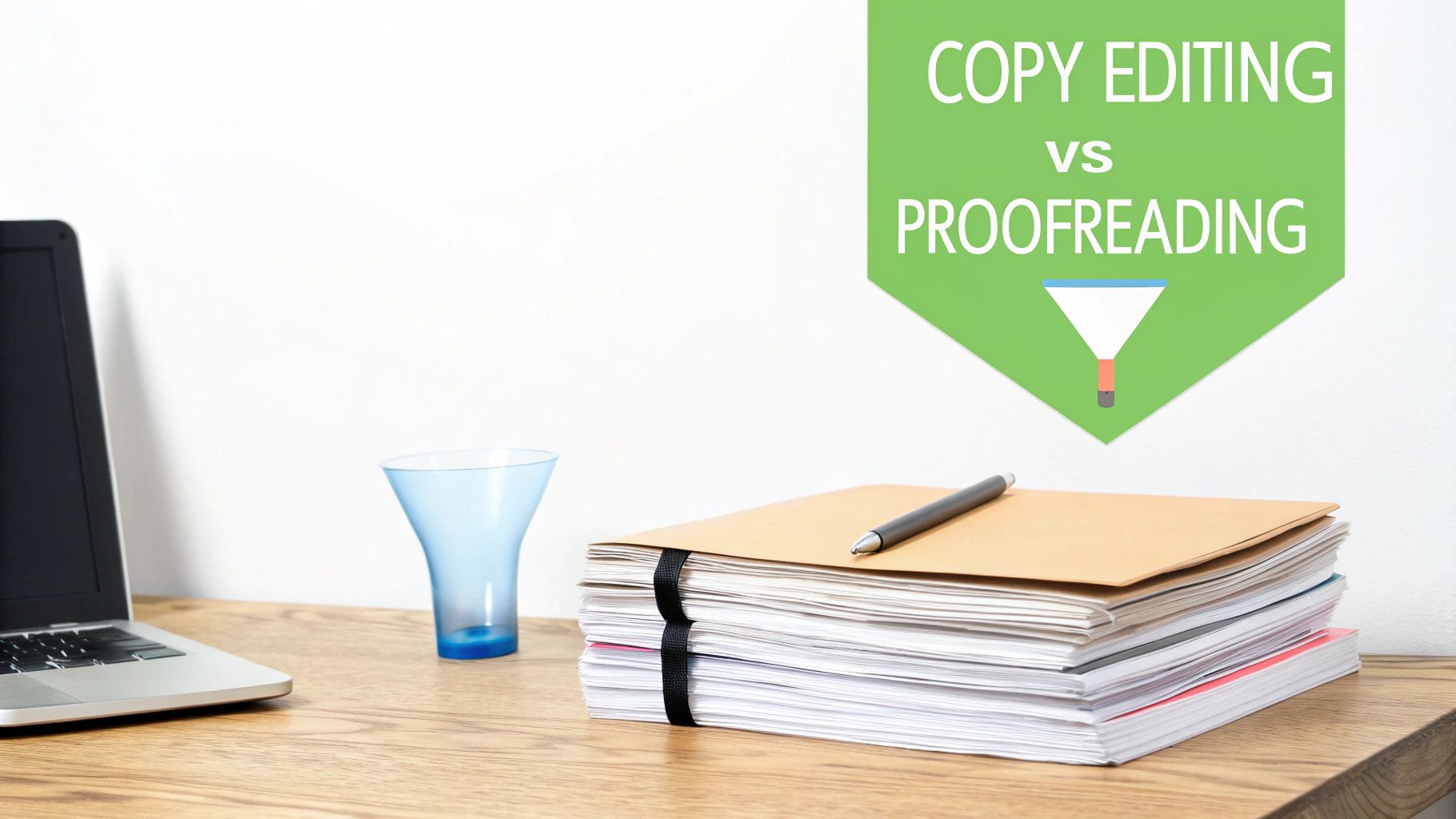
The editing process is best seen as a funnel, moving from big-picture ideas down to the tiniest details. Copy editing sits right in the middle of that funnel. It takes a solid draft and makes it sing by focusing on style, consistency, and readability.
Proofreading, on the other hand, is the absolute last stop. It’s the final quality check before your work goes out into the world. Its only job is to catch any lingering mistakes that slipped through—or were accidentally introduced—during previous edits and design. It’s a meticulous final scan, not a creative overhaul.
The Editing Funnel Explained
To really get the copy editing vs proofreading distinction, you have to see where each one fits on the timeline.
- Big Picture Edits: Developmental and structural editing focus on the core message, organization, and overall narrative. This is where you fix the story. Practical Example: An editor might suggest moving Chapter 3 before Chapter 2 to improve the story's pacing.
- Sentence-Level Refinement: Copy editing gets into the weeds, polishing the text for clarity, consistency, and flow. This is where you make the writing good. Actionable Insight: This is the stage to create a style sheet that documents decisions like whether to use the serial comma or how to capitalize specific brand names.
- Final Quality Control: Proofreading is your last defense against typos, punctuation goofs, and formatting glitches. This is where you make the writing correct. Actionable Insight: Try reading your text backward—from the last sentence to the first—to disrupt your brain's natural flow and spot errors more easily.
Think of it like building a house. A developmental editor is the architect designing the blueprint. A copy editor is the interior designer ensuring every room is functional and stylish. A proofreader is the final inspector who checks for scuff marks on the paint before the open house.
This step-by-step approach ensures each stage builds on the last, giving you a professional, error-free final piece.
At a Glance: Copy Editing vs Proofreading
For a quick summary, this table breaks down the main differences between the two services. It’s a handy reference for deciding which one you need right now.
| Aspect | Copy Editing | Proofreading |
|---|---|---|
| Primary Goal | Improve clarity, flow, and consistency | Eliminate final surface-level errors |
| When It Occurs | Mid-stage, after major revisions | Final stage, before publication |
| Scope of Work | Comprehensive (grammar, style, tone) | Narrow (typos, punctuation, format) |
| Focus | Making the text better | Making the text correct |
Ultimately, knowing the role of each service helps you invest your time and money wisely, ensuring your final document is as polished as it can be.
What a Copy Editor Actually Does

Let's clear something up: a copy editor is much more than a human grammar checker. They are the architects of a polished document, tasked with turning a good draft into a professional, engaging, and genuinely effective piece of writing. Their job isn’t just to catch mistakes; it’s to elevate the quality and impact of the entire text.
To get there, a skilled copy editor zeroes in on what we call the "4 Cs" of editing. This framework acts as their guide, ensuring they scrutinize everything from sentence flow to overall tone.
Mastering the Four Cs of Editing
The copy editor’s work is a detailed, line-by-line review that refines a piece’s substance and style.
- Clarity: Is the message impossible to misunderstand? The editor cuts through ambiguity, simplifies jargon, and untangles convoluted sentences so the reader gets the point without a headache. Practical Example: Changing "The implementation of the strategic realignment precipitated a paradigm shift" to "The company's restructuring changed how we work."
- Coherency: Does the writing flow logically? They make sure ideas connect seamlessly from one sentence to the next, creating a smooth, uninterrupted reading experience. Actionable Insight: A copy editor might add transition words like "however," "therefore," or "additionally" to bridge logical gaps between paragraphs.
- Consistency: Is the style and formatting uniform? This covers everything from maintaining a consistent tone of voice to ensuring that terms, capitalization, and punctuation rules are applied the same way throughout. For tricky bits of punctuation, our article on mastering et al. punctuation is a great resource.
- Correctness: Is the grammar, spelling, and punctuation accurate? This is the bedrock of their work, where they fix objective errors to build the document's credibility.
This multifaceted approach reveals the true difference between copy editing and proofreading. It's a much deeper, more involved process that fundamentally shapes how a reader experiences the information.
From Awkward to Articulate: A Practical Example
Seeing the transformation in action is the best way to appreciate what a copy editor brings to the table. They don’t just find typos; they rephrase, restructure, and refine.
Before Copy Editing:
The company’s new initiative, it was decided that it would be launched in the third quarter, will focus on customer retention due to the fact that recent data showed a decline. A lot of people were involved in the plan.
The sentence is technically correct, but it’s clunky and passive. "Due to the fact that" is wordy, and "a lot of people" is frustratingly vague.
After Copy Editing:
The company will launch its new customer retention initiative in the third quarter to address a recent decline in data. The marketing and sales teams collaborated on the strategic plan.
The edited version is clear, direct, and professional. It switches to active voice, swaps wordy phrases for concise alternatives, and adds specific details that give the reader real context.
A great copy editor doesn't just clean up your text; they amplify your voice. They preserve your unique style while ensuring your message is delivered with maximum precision and impact.
The Financial Side of Substantive Work
The intensive nature of copy editing is reflected in its price tag. Across the professional editing industry, you'll see a clear price difference based on the complexity of the work. Industry data shows that copy editing services command hourly rates from $25 to $75, whereas proofreading is more accessible at $20 to $50 per hour.
This premium makes sense when you consider that copy editing a 3,000-word document can easily take twice as long as proofreading the same text. That time difference is a testament to its comprehensive scope.
Ultimately, hiring a copy editor is an investment in quality. They are the partner who ensures your writing isn’t just error-free but also compelling, readable, and ready to achieve its goal.
What a Proofreader Actually Does
If the copy editor is an interior designer arranging the furniture and choosing the color scheme, the proofreader is the final inspector who walks through with a white glove. They aren’t there to suggest a new layout; their job is to spot the tiny scuff mark on the baseboard that everyone else missed.
Proofreading is the absolute last step before your work goes public. It’s a crucial safety net, intentionally narrow in scope. A proofreader’s mission is to hunt down and eliminate objective, surface-level errors—the kind of mistakes that undermine credibility in an instant. They aren't concerned with sentence flow or tone of voice. Their focus is purely on mechanical correctness.
Think of it as the final quality control check on an assembly line. The product has already been designed, built, and polished. The proofreader makes sure it leaves the factory without a single visible defect.
The Last Line of Defense
A proofreader’s review must happen after every other edit is complete—and that includes formatting and graphic design. Why? Because the very process of editing and typesetting can introduce brand-new errors. A comma might get deleted during a revision, or an awkward word might get split across two lines when the text is poured into a layout.
The proofreader's job is to catch these last-minute gremlins. They are meticulously scanning the final version of the document (the "proof") to see exactly what the end-user will see.
A common misconception is that proofreading is just a "light" edit. In reality, it's a highly specialized skill requiring intense focus. A proofreader isn’t reading for meaning—they're reading for error, spotting tiny details most of us are trained to overlook.
This is precisely why a fresh set of eyes is so vital. The author and copy editor have read the text so many times their brains start to auto-correct mistakes on the page. A proofreader, coming in cold, sees only what is actually there.
The Proofreader’s Checklist
So, what exactly is a proofreader looking for? Their checklist is technical and unforgiving, targeting issues that spell-check and grammar tools almost always miss.
A proofreader meticulously checks for:
- Spelling Errors: Typos and misspellings that slipped through every other stage. Practical Example: Catching "definitly" instead of "definitely."
- Grammatical Slips: Lingering subject-verb agreement issues, incorrect verb tenses, or other objective goofs. Practical Example: Fixing "The team of experts are ready" to "The team of experts is ready."
- Punctuation Mistakes: A missing comma, an incorrectly used semicolon, or a misplaced apostrophe. Practical Example: Changing "its a great day" to "it's a great day."
- Formatting Issues: Inconsistent spacing, incorrect indentation, weird page breaks, or rogue fonts. Actionable Insight: A proofreader will ensure that the spacing between paragraphs is uniform and that there aren't any "widows" (a single word on its own line at the end of a paragraph).
- Consistency Errors: Ensuring headlines, page numbers, and captions all follow the style guide perfectly.
- Typographical Errors: Things like straight quotes instead of curly ones or incorrect dash usage.
For example, a proofreader is the one who will catch that "it's" should be "its," fix an accidental double space between words, or ensure every single chapter title is formatted identically. These might seem like minor details, but their cumulative effect is the difference between a professional publication and an amateur one.
A Detailed Comparison of Key Responsibilities
While we've defined what copy editors and proofreaders do, the real magic is in seeing how they differ in practice. This isn't just a matter of semantics; it directly affects who you hire, when you hire them, and ultimately, the quality of your finished work.
Getting a handle on their specific duties shows you exactly what value each role brings to the table. Let’s break down the key areas where their jobs diverge to see what truly separates copy editing from proofreading.
Scope of Review: What They Look For
The biggest difference comes down to the scope of their review. Think of it this way: a copy editor uses a wide-angle lens, while a proofreader pulls out a microscope.
A copy editor’s mission is to make the text more effective. They are actively improving sentence structure, ensuring the tone is consistent, and making everything more readable. They're the ones who will rephrase an awkward sentence, question a confusing metaphor, or flag a potential factual error.
On the other hand, a proofreader has a much narrower, almost surgical focus. They aren't there to improve the writing's style; their job is to make it technically perfect. They hunt for definitive errors—typos, misplaced commas, and formatting glitches that were either missed in previous rounds or accidentally added during design.
Key Takeaway: A copy editor asks, "Is this the best way to say this?" A proofreader asks, "Is this written correctly according to the rules?"
Timing in the Workflow: When They Step In
The publishing world runs on a strict, sequential editing process, where each stage builds on the last. Copy editing happens after the big-picture developmental edits are done, but before the text is finalized. Proofreading is the absolute final check before the curtain goes up—right before publication.
This timing isn't random. It’s a waste of everyone's time to have a proofreader hunt for typos in a paragraph that a copy editor might delete entirely. The copy editor must first shape the clay; only then can the proofreader check for fingerprints. A skilled copy editor is expected to catch around 95% of errors, but that final proofreading pass is crucial for snagging anything that slipped through, like weird page breaks, extra spaces, or incorrect page numbers. Check out this guide to publishing workflows to see how the pros map out this process.
Types of Errors Corrected: A Practical Breakdown
Let’s use a single sentence to really illustrate the difference in what each role tackles.
Original Sentence:
The companies new marketing plan will effectivly target millenials, utilizing social media influencers to drive brand awareness and engagement.
The Copy Editor's Focus
A copy editor sees this sentence and immediately thinks about clarity, flow, and consistency—not just the obvious mistakes.
- Clarity and Word Choice: "Utilizing" feels a bit stiff; "using" is more natural. "Drive" is a tired marketing buzzword; "increase" or "boost" would be stronger.
- Consistency: Does the company's style guide use "millennials" or "Millennials"? The editor makes sure it matches the rest of the document.
- Flow: Is the sentence too long? They might suggest splitting it into two for better pacing, especially if the surrounding text is dense. For more on this, check out these tips for improving reading comprehension skills.
After a copy edit, the sentence might look like this:
The company's new marketing plan will effectively target millennials. It will use social media influencers to increase brand awareness and engagement.
The Proofreader's Focus
Now, let's say the edited sentence goes to a designer, who accidentally puts a typo back in. The proofreader gets the final version and zeroes in only on what's objectively wrong.
- Spelling: They would instantly spot and fix "effectivly" to effectively.
- Punctuation: They would add the missing apostrophe in "companies" to make it company's.
- Typos: They'd correct the misspelling of "millenials" to millennials.
The proofreader isn't paid to worry about word choice or rhythm. Their one job is to ensure the final text is free from embarrassing and distracting mistakes. It's a structured review process, much like how peer feedback in academia works, where different reviewers focus on different layers of the work. If you're curious, you can see some great peer review feedback examples to understand how layered feedback strengthens a final document.
To make this even clearer, here's a quick checklist you can use to see which service your document actually needs.
Checklist for Copy Editing vs Proofreading Tasks
This table breaks down the typical tasks for each role. A quick scan will help you diagnose what stage your own writing is in.
| Task | Copy Editing | Proofreading |
|---|---|---|
| Correcting spelling, grammar, and punctuation | ✅ | ✅ |
| Ensuring consistency in style and tone | ✅ | ❌ |
| Improving sentence structure and flow | ✅ | ❌ |
| Checking for clarity and word choice | ✅ | ❌ |
| Verifying adherence to a style guide | ✅ | ❌ |
| Fixing formatting errors (e.g., spacing, line breaks) | ❌ | ✅ |
| Checking page numbers and headings | ❌ | ✅ |
| Spotting typos introduced during design | ❌ | ✅ |
| Fact-checking names, dates, or stats | ✅ | ❌ |
| Eliminating jargon and awkward phrasing | ✅ | ❌ |
Understanding these distinct responsibilities is the key to planning your editing workflow. It helps you hire the right pro at the right time, ensuring your final project is not just correct, but truly compelling.
Making the Right Choice for Your Project
So, copy editing or proofreading? This isn't just about picking a service from a menu; it's a strategic decision. The right choice hinges entirely on your project's goals, where it is in its lifecycle, and what's on the line if mistakes make it through.
Getting this right from the start saves a ton of time and money. More importantly, it ensures your final piece—be it a novel, a website, or a research paper—actually lands the way you want it to.
To figure this out, you have to be honest about where your draft really stands. Is it a solid first draft that still needs some shaping and polishing? Or is it a nearly perfect, beautifully designed document that just needs one last look for typos? Each situation calls for a completely different kind of expert.
This graphic breaks down the distinct roles of a copy editor and a proofreader side-by-side.
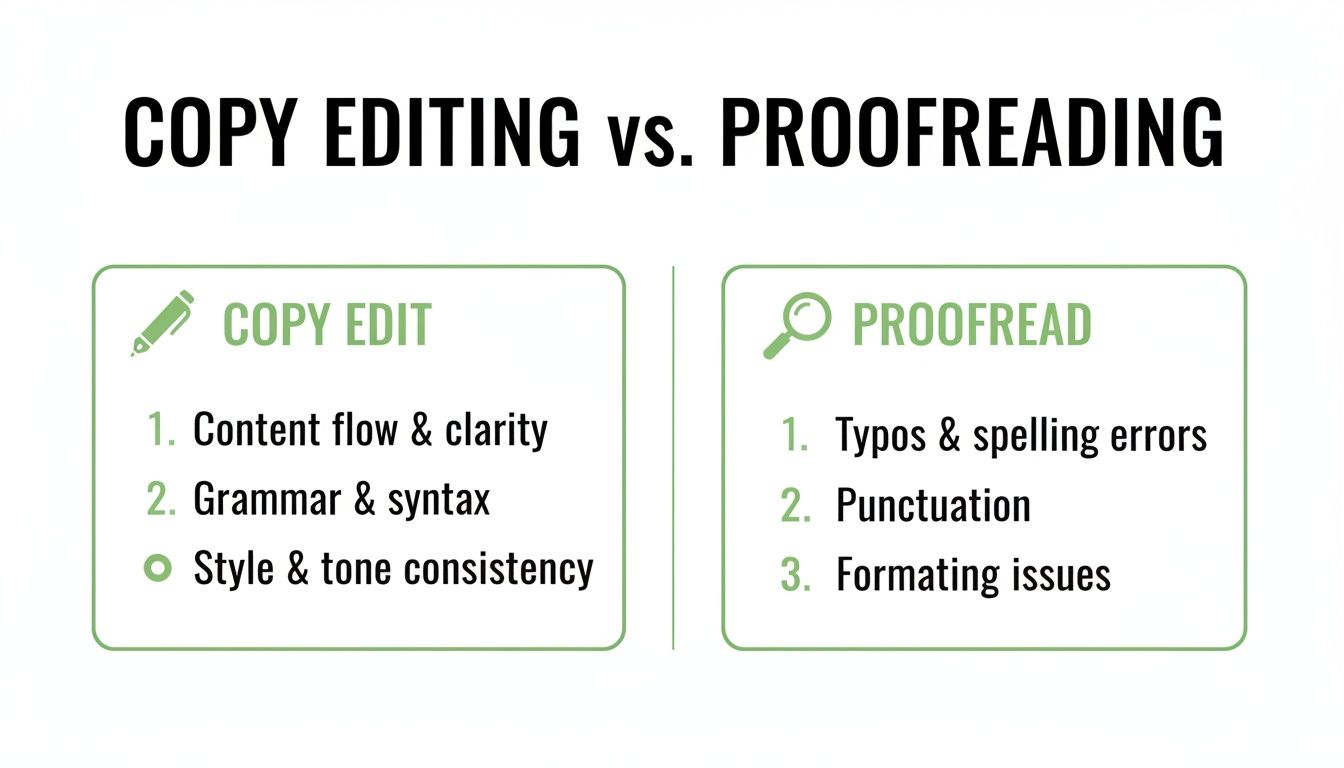
The visual drives home the key difference: copy editing is a deep, substantive review focused on improving the text, while proofreading is a final, precise check for surface-level correctness.
Choosing for Your Specific Scenario
Let's ground this in the real world. Once you analyze the unique needs of a project, the right choice becomes obvious.
Scenario 1: The Author Finalizing a Novel
An author has poured their heart into a manuscript, gone through multiple drafts, and even gotten feedback on the story. The plot is locked in, but the prose needs that final layer of polish to make it sing before it goes to an agent or gets self-published.
- Project Stage: Post-developmental edits, pre-formatting.
- Primary Goal: Sharpen readability, smooth out awkward phrasing, and lock in stylistic consistency.
- Recommendation: Copy Editing. The manuscript is ready for a deep dive into sentence structure, word choice, and voice. A proofread here would be a waste of money, since the copy editor will almost certainly make changes that would require another proofread later.
Scenario 2: The Marketer Launching a High-Stakes Campaign
A marketing team has locked in the copy for a new website, a big email campaign, and a glossy brochure. Every stakeholder has signed off, and the content is already laid out in its final design.
- Project Stage: Final, post-design.
- Primary Goal: Hunt down any last-minute typos, punctuation goofs, or weird formatting glitches before the public sees it.
- Recommendation: Proofreading. The message, style, and layout are set in stone. The only thing that matters now is catching those small but costly mistakes that can kill credibility. A proofreader's job is to focus exclusively on these final-stage errors.
Scenario 3: The Academic Submitting a Research Paper
A researcher has drafted a paper for a prestigious journal. The data is solid and the arguments are sound, but the writing is dense with complex sentences and jargon. Plus, it has to follow the journal's ridiculously specific style guide to a T.
- Project Stage: Complete draft, pre-submission.
- Primary Goal: Guarantee clarity, coherence, and perfect adherence to academic formatting and citation styles.
- Recommendation: Both, in order. First, a copy editor who specializes in academic writing will refine the text for clarity and ensure it meets every single rule in the style guide. After the author approves those changes, a proofreader performs the final sweep to catch anything that was missed.
Choosing the right service is a strategic decision. Investing in copy editing for a rough draft transforms its potential, while a final proofread on a polished document protects its professionalism.
Ultimately, your project's maturity dictates the need. An early-stage document benefits from the shaping hand of a copy editor, whereas a finished product requires the meticulous eye of a proofreader. By matching the service to the stage, you ensure your resources are used as effectively as possible.
Modernizing Your Content Editing Workflow
The old debate between copy editing and proofreading is getting a much-needed update. Today’s tools have completely changed the game, letting creators produce great work faster than ever. To keep up, you need a smart, layered workflow that balances speed, quality, and cost.
By mixing AI assistance with the irreplaceable expertise of a human editor, you can build a system that makes the entire revision process smoother. This isn't about replacing editors; it's about empowering them to do what they do best—provide the kind of high-level, nuanced feedback that machines just can't replicate.
This approach helps you deliver a cleaner, more coherent document to your editor from the start. The result? Editors spend less time on basic fixes and more time elevating your content, which often means lower costs and a better final product for everyone.
A Four-Step Process for Maximum Efficiency
Think of modern content creation like a specialized assembly line. Each stage builds on the last, embedding quality control from start to finish.
Generate the Initial Draft: Start with a trusted AI writer to get your first draft on the page. This stage is all about speed and structure—getting the foundational ideas down quickly.
Humanize the Text: Raw AI output can feel robotic and soulless. This is where a tool like HumanText.pro is essential. It refines the AI-generated text to sound natural and authentic, giving it a genuine human touch while also bypassing AI detection.
This screenshot shows just how simple it is to transform AI text into engaging, human-like content.
Running your draft through a humanizer creates a document that reads smoothly and feels personal, making every subsequent editing stage far more effective. You can learn more about how to effectively convert AI text to human text in our detailed guide.
Submit for Copy Editing: With a polished, human-sounding draft, it’s time to bring in the copy editor. Because the text is already coherent and clean, they can skip the tedious mechanical corrections and jump straight into high-value improvements: strengthening your arguments, refining your tone, and elevating the overall style.
Engage a Proofreader: The proofreader is your final quality check. Once the copy editor's changes are in and the document is formatted for publication, the proofreader performs a final, meticulous review. They are hunting for any stray typos, formatting glitches, or punctuation errors to ensure the final product is absolutely flawless.
The Strategic Advantage of a Layered Approach
This layered system gives you a huge strategic advantage. By using AI tools for the initial drafting and refinement, you’re handing your human editors a much stronger starting point. This lets them apply their expertise where it truly counts, delivering deeper value in less time.
This modern workflow doesn't diminish the role of human editors; it elevates it. Instead of getting bogged down in basic mechanical fixes, they can act as strategic partners, focusing on the nuance and artistry that truly make writing great.
As AI becomes more common for generating text, a specialized skill like verifying a transcript against its original audio becomes even more vital. Understanding effective proofreading in transcription shows how this final, meticulous check for accuracy remains a critical part of any professional workflow.
Ultimately, blending technology with human skill creates a powerful and efficient system for producing exceptional content, no matter the scale.
Common Questions About Editing & Proofreading
Writers often have a few lingering questions when deciding between copy editing and proofreading. Getting clear on the practical side of things helps you invest your time and money wisely, ensuring your final draft is exactly what you need it to be.
Let's dig into some of the most common queries.
Can Grammar Tools Replace a Human Editor?
In short, no. While a tool like Grammarly is a fantastic first line of defense, it can't replicate the nuanced judgment of a professional editor. It’s like the difference between a calculator and a mathematician.
A copy editor goes far beyond grammar, refining your flow, tone, and clarity in ways software simply can't grasp. A proofreader, on the other hand, catches contextual slip-ups and formatting blunders that algorithms routinely miss.
Think of it this way: a spell checker sees that a word is spelled correctly. A human editor tells you it's the wrong word for the sentence. Use software as an initial check, but never as the final word.
When Do I Need Both Services?
For high-stakes projects—think books, academic dissertations, or critical business proposals—using both services sequentially is the industry standard. There's no shortcut to true quality. Copy editing first strengthens the core of the writing, and then proofreading ensures a flawless final presentation.
But what about less formal content, like a weekly blog post? You can probably choose one based on your biggest weakness. If you know your ideas are solid but your phrasing gets tangled, hire a copy editor. If your writing is generally clean but you live in fear of typos, a proofreader is your safety net.
How Are Editing Services Typically Priced?
Pricing can feel all over the map, but it usually hinges on the editor's experience, how complex the project is, and how quickly you need it back. Copy editing almost always costs more than proofreading, which makes sense—it’s a much deeper and more time-consuming process.
You'll usually see prices structured in one of three ways:
- Per-word: The most common model for articles, blog posts, and manuscripts. Actionable Insight: This model is great for budgeting, as the cost is predictable. A typical rate might be $0.02 to $0.05 per word.
- Per-hour: Often used for tricky projects where the scope is hard to predict upfront. Practical Example: Editing a technical manual with dense jargon might be billed hourly.
- Per-page: A longtime standard in academic editing and book publishing, often based on a 250-word page.
Always get a clear quote and ask to see an editor's portfolio before you commit. It’s the best way to know if their style is a good fit for yours.
Should I Proofread My Own Work?
Honestly, it’s next to impossible. After spending hours, days, or weeks on a document, your brain knows what it's supposed to say and will autocorrect errors right before your eyes. You become "content-blind," seeing what you intended to write, not what's actually on the page.
For any piece of writing that matters, you absolutely need a fresh pair of eyes for the final check. This is one of the most critical steps in the copy editing vs proofreading workflow. A new reader will instantly spot the glaring mistakes you’ve become completely blind to.
Ready to perfect your AI-generated drafts before they even reach an editor? HumanText.pro transforms robotic text into natural, human-sounding content that bypasses AI detection. Ensure your writing is authentic and engaging from the very beginning. Try it now at https://humantext.pro.
Ready to transform your AI-generated content into natural, human-like writing? Humantext.pro instantly refines your text, ensuring it reads naturally and authentically. Try our free AI humanizer today →
Related Articles
10 PimEyes Alternatives for Safer Image Verification
Compare 10 PimEyes alternatives for face search, image reuse, privacy, pricing, and safer verification of online identities and media.
Fake Profile Picture Detector: How to Verify Photos Online
Learn how a fake profile picture detector works and verify online photos manually. Step-by-step guide for detecting AI images, catfish, and scams.
Who Is This Person Photo: A Practical Verification Guide
Wondering who is this person photo? Use reverse image search, face search, and AI checks to verify online identities safely and protect yourself from scams.

