How to Make AI Writing Undetectable
Learn how to make AI writing undetectable. Our guide covers ethical techniques to humanize AI text and move beyond the limits of AI content detectors.
So, you're trying to make AI-generated text sound human. Good. It’s a necessary skill, not a sneaky trick. The goal isn't just to fool a machine; it's to transform robotic, predictable drafts into writing that genuinely connects with people. This means going way beyond just swapping out a few words. You have to fundamentally change its rhythm, structure, and voice.
The Reality of AI Content Detection
Before we get into the "how," let's talk about the battlefield. The world of AI detection is a constant cat-and-mouse game, and just hitting "generate" and publishing is a guaranteed way to get flagged. These detection tools aren't just scanning for clunky phrases anymore. They’re sophisticated algorithms trained on massive datasets to spot the statistical fingerprints that AI language models leave behind.
They're primarily looking for two dead giveaways: perplexity and burstiness.
Perplexity is just a fancy way of measuring how predictable a piece of text is. AI models are trained to pick the most statistically probable next word, which creates sentences that are grammatically perfect but painfully unsurprising. Humans? We're far less predictable. We use weird phrases and unexpected word choices, which gives our writing higher perplexity.
Burstiness is all about rhythm and flow—the variation in your sentence length and structure. Humans write in bursts. We use short, punchy sentences for impact, followed by longer, more complex ones to explain. AI, on the other hand, tends to produce sentences of uniform length, creating a monotonous, flat rhythm that detectors can spot from a mile away.
The Challenge of Modern Detectors
Make no mistake, these tools are shockingly good at their job. The whole situation has become an arms race, with "humanizer" tools popping up to rewrite AI text, and detectors evolving right alongside them to catch those tricks, too.
One eye-opening case study found that top-tier detectors like Originality.ai and CopyLeaks hit detection rates between 97.21% and 99.94% on standard, unedited AI content. That leaves virtually no room for raw output to slip through. If you're curious, you can explore the full findings on AI detection accuracy and see the numbers for yourself.
Key Takeaway: You can't beat AI detection with another AI tool. The real secret is understanding what detectors are looking for—low perplexity and low burstiness—and then manually editing your content to introduce the beautiful, messy chaos of human writing.
To get a better handle on this, let's break down the specific patterns these tools are trained to find.
Common AI Writing Patterns Flagged by Detectors
This table shows the typical characteristics of raw AI output that scream "robot" to a detection tool.
| AI Writing Characteristic | What It Means | Why Detectors Flag It |
|---|---|---|
| Uniform Sentence Length | Most sentences are of a similar word count, creating a monotonous rhythm. | Humans naturally vary sentence length for emphasis and flow. Uniformity is a strong statistical signal of machine generation. |
| Low Perplexity | The word choices are highly predictable and statistically common. | AI models choose the most "likely" word. Humans use more surprising, creative, and sometimes less logical language. |
| Overly Perfect Grammar | The text is flawless, with no minor errors, fragments, or conversational quirks. | Human writing is rarely perfect. We use sentence fragments for effect or make minor, natural mistakes that AI avoids. |
| Lack of Personal Voice | The tone is generic, lacking unique opinions, anecdotes, or stylistic flair. | Authentic human content is colored by personal experience and a distinct point of view, something AI can only mimic poorly. |
| Repetitive Transitions | Frequent use of generic transition words like "Furthermore," "Moreover," "In conclusion." | These formulaic connectors are a hallmark of AI trying to logically structure text, whereas humans use more subtle transitions. |
| Consistent Formality | The tone remains flat and consistently formal or informational throughout the piece. | Humans modulate their tone based on the content, shifting from informational to persuasive to conversational, even in one article. |
Looking at this, it becomes pretty clear why a simple spin isn't enough.
Why Simple Paraphrasing Is Not Enough
Many writers fall into the trap of using a basic paraphrasing or "humanizer" tool, thinking a quick word swap will do the job. It won’t. These tools usually just substitute synonyms or shuffle clauses around, but they fail to change the underlying predictable structure and rhythm of the AI's writing.
This kind of superficial edit almost never fools an advanced detector. More importantly, it doesn't make the content any better for the reader. The real path to making your text undetectable is paved with thoughtful, strategic editing that adds layers of authenticity and value an algorithm could never replicate.
Let's be honest: those one-click "humanizer" tools are a dead end. They usually just run a synonym-swap script that makes your text sound even weirder and more stilted than the original AI draft. If you want to create content that genuinely feels human, you need to roll up your sleeves and get your hands dirty.
This isn't just about tweaking a few words. It's a full-blown transformation. You have to shift your mindset from being a prompter to being an aggressive editor, taking complete ownership of the text. Think of the AI draft as a lump of raw clay—your job is to shape it into something intentional and valuable.
The whole game is about understanding the predictable pattern AI detectors look for. It's a simple, linear process that's easy to disrupt if you know how.
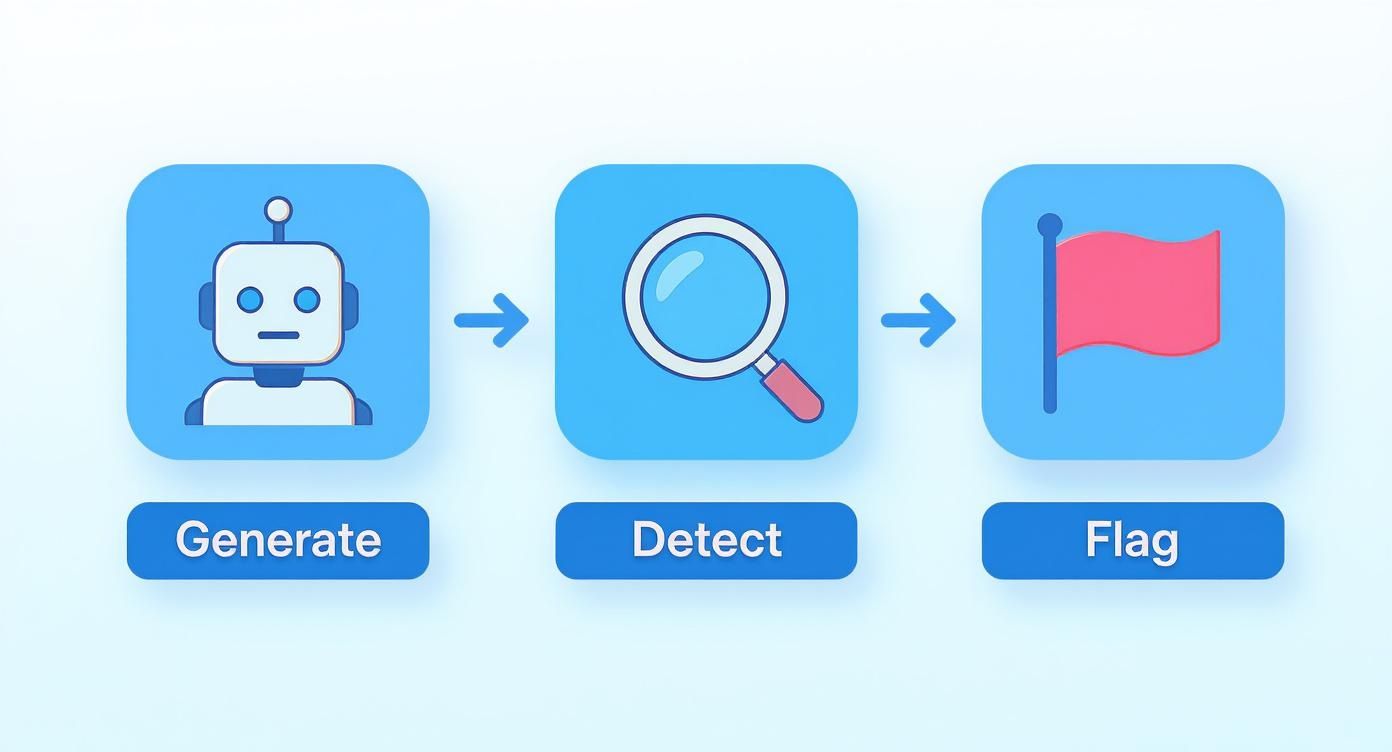
Your workflow is the intervention that breaks this chain. By fundamentally changing the statistical makeup of the text, you ensure it never even gets close to that final "flagged" stage.
First, Demolish the Foundation: Structural and Logical Edits
Before you even think about word choice, zoom out. Take a hard look at the article's skeleton. AI tools are decent at dumping information, but they’re terrible at building a compelling narrative or a logical argument that flows from one point to the next.
Your first pass is all about structure. Ask yourself these questions:
- Does the intro actually grab you? AI writes incredibly bland, summary-style intros. Rip it out and replace it with a bold claim, a relatable story, or a question that makes the reader need to know the answer.
- Is everything in the right order? Often, an AI will arrange paragraphs based on whatever it thinks is statistically relevant, not what makes sense for a human reader. Don't hesitate to drag and drop entire sections to build a better story or a stronger argument.
- Where's the fluff? AI loves filler content. Be absolutely ruthless here. If a paragraph doesn’t add real value or directly support your main point, kill it.
This stage is pure deconstruction. You’re breaking down the AI's robotic framework so you can rebuild it with a clear, human-driven purpose.
Pro Tip: Read the entire draft out loud. Seriously. Your ears will catch clunky transitions and logical jumps your eyes skim right over. If it sounds robotic when you say it, it will feel ten times more robotic to your audience.
Second, Get Granular: Sentence-Level Refinements
Once the structure is solid, it's time to zoom in and start fighting at the sentence level. This is where you directly attack the low "burstiness" and predictable sentence patterns that AI detectors are built to find. The goal here is simple: create rhythm and variety.
- Vary Your Sentence Length: Actively hunt for long, rambling sentences and chop them into shorter, punchier statements. Then, find a series of short, choppy sentences and combine them into a more elegant, flowing thought. The contrast is what makes writing feel alive.
- Kill the Passive Voice: AI loves writing in the passive voice ("The content was generated by a language model"). Flip these on their head to be more direct and engaging ("A language model generated the content").
- Simplify the Vocabulary: Language models have a strange obsession with unnecessarily complex words like "utilize" instead of "use." Swap these academic-sounding words for simpler, more common ones. It makes the text far more accessible and natural.
I know, this part can feel tedious. But every tiny change chips away at the AI's statistical fingerprint, making a huge cumulative difference. For an even deeper look, our guide on how to humanize AI-generated text has more specific tactics for this stage.
Finally, Add Your Fingerprints: Layers of Authenticity
This final pass is what truly separates your work from any machine-generated text. It's where you add the unique, un-replicable human elements that an AI simply cannot fake. These are the touches of real-world experience that build trust and make your content stick.
Try to weave these elements into the text wherever they fit naturally:
- Personal Anecdotes: Share a short, relevant story. Instead of just saying, "Editing is important," you could say, "I once spent an entire hour reworking a single paragraph because the rhythm felt off—and it ended up being the most quoted part of the article."
- Unique Data or Insights: Go beyond the generic stats everyone has already seen. Pull a surprising number from a niche report, quote an expert you actually talked to, or share an original observation that can’t be found with a simple Google search.
- Specific, Real-World Examples: Replace the AI's bland, generic examples with vivid, concrete ones. Don't say "a successful marketing campaign"; describe "the Dollar Shave Club's viral launch video." Specificity makes your points tangible and way more credible.
By working through these three stages—structure, sentences, and authenticity—you methodically transform a generic AI draft into something polished, compelling, and genuinely yours. This workflow is the only reliable way to beat the detectors, because it focuses on creating true quality, not just trying to trick an algorithm.
Injecting Your Authentic Voice and Style
Let's be honest, raw AI writing can be perfectly correct but completely soulless. It’s like a factory-perfect piece of furniture with no scuffs, no character, and no story to tell. This is where you, the human editor, come in. This part of the process is all about breathing life into sterile text, turning it into something that feels genuinely human.

The goal here isn't just to fool a detector; it's to create something memorable. You want your audience to feel like they’re hearing from a real person with a unique perspective, not a machine spitting out data. The secret is to intentionally break the perfect, predictable patterns that AI models are trained to produce.
Master the Art of Cadence
One of the biggest tells of AI-generated content is its monotonous rhythm. Every sentence tends to be about the same length, creating a flat, boring cadence that puts readers to sleep. Human writing, on the other hand, is varied. We use short, sharp sentences for emphasis. We use longer, flowing ones to explain complex ideas.
Your first mission is to disrupt this uniformity.
- Hunt for long paragraphs: Find those dense blocks of text where every sentence is a medium-to-long drag. Break them up. Toss in a few short, punchy statements.
- Combine choppy sentences: Sometimes AI spits out a series of short, robotic sentences. Don't be afraid to combine them using conjunctions or rephrase them into a single, more elegant thought.
This deliberate variation in sentence length is a game-changer. It creates a natural ebb and flow that mimics how people actually talk, making the content far more engaging and less predictable.
Before and After Example
AI Version: "The implementation of new software requires careful planning. It is important to consider the potential impact on existing workflows. Employee training is also a critical component for success."
Humanized Version: "Rolling out new software? It demands serious planning. You have to think about how it will disrupt current workflows. And don't even think about skipping employee training—that's a recipe for disaster."
See the difference? The humanized version uses a question, a short sentence, and one with an idiomatic expression. The rhythm is completely different, and it carries a real, authoritative tone.
Swap Generic Vocabulary for Vivid Language
AI models love statistically safe—and boring—words. Terms like "important," "beneficial," "significant," and "utilize" are classic AI tells. They're correct, but they have zero personality.
Your job is to swap out this bland vocabulary for words that carry emotional weight and paint a picture.
Instead of saying a strategy is "effective," describe how it's effective. Is it "game-changing," "deceptively simple," or "a powerhouse for lead generation"? Each choice injects a specific flavor that a generic AI word could never capture. Making these specific swaps is a powerful technique if you're learning how to make ai writing undetectable.
Embrace Strategic Imperfections
Perfect grammar and flawless syntax aren't the hallmarks of great writing; they're the hallmarks of machine writing. Humans are beautifully imperfect. We use contractions. We start sentences with "And" or "But." We use sentence fragments for effect.
These aren't mistakes; they're stylistic choices that make writing feel authentic.
Here are a few "imperfections" to start sprinkling in:
- Use Contractions: Change "do not" to "don't" and "it is" to "it's." This is one of the fastest ways to make your writing sound less stuffy and more approachable.
- Add Colloquialisms: Weave in common phrases and idioms that fit your voice. Words like "heads-up," "deep dive," or "bottom line" make the text feel grounded and real.
- Incorporate Rhetorical Questions: Questions pull the reader into the conversation. Instead of just stating a fact, why not frame it as a question? "So, what's the takeaway here?" is far more engaging than "The conclusion is..."
These small touches are what break the rigid, academic structure of AI text. For a closer look at this, our guide on converting AI text to human text offers more actionable tips on this very topic.
From AI Sterility to Humanized Style
Let's pull it all together and see how these techniques transform generic AI output into something with personality.
AI vs Humanized Text Examples
The table below shows a direct comparison of how to apply these stylistic adjustments.
| Technique | Generic AI Example | Humanized Version |
|---|---|---|
| Varying Sentence Cadence | It is essential to conduct thorough market research. This process provides valuable data. The data informs strategic decisions. | You can't skip market research. Period. It's the bedrock data that informs every single strategic move you make. |
| Using Vivid Language | The new feature is very beneficial for users. | The new feature is a lifesaver for users, slashing their workflow time in half. |
| Adding Imperfections | You should not overlook this critical step. | Look, you just can't afford to overlook this step. It's that important. |
By weaving these elements throughout your AI-generated draft, you're not just editing; you're infusing the text with a soul. You're adding the subtle layers of nuance, rhythm, and style that are, for now, uniquely human. This is the real secret to making AI writing not just undetectable, but genuinely compelling.
Putting Your Content to the Test
After all that strategic editing, how do you know if you’ve actually pulled it off? You've injected your voice, varied the cadence, and layered in authentic details. Now it's time for the final quality check—pitting your work against the very algorithms you’re trying to satisfy.
This isn't about blindly chasing a 100% human score. It's smarter to think of AI detectors as a feedback tool. They can help you spot any lingering robotic patterns your own eyes might have missed, giving you a chance for one last polish before hitting publish. The goal is to use their feedback intelligently, not to treat their verdict as gospel.

Why One Detector Is Never Enough
Relying on a single AI detector is a classic rookie mistake. Each tool uses a slightly different algorithm and is trained on its own unique dataset. This means one detector might be hyper-sensitive to repetitive phrasing, while another is better at spotting predictable sentence structures.
Because of this, you'll often see wildly different results for the exact same piece of text across various platforms. One might give you a confident "human-written" score, while another flags it as "likely AI." This doesn't mean one is right and the other is wrong; it just means they're looking for different things.
To get a more reliable picture, you need to triangulate your results. Run your text through at least two or three different, well-regarded detectors.
- GPTZero: Often considered one of the standards in detection.
- Originality.ai: Known for its strict algorithm, making it a good stress test.
- Copyleaks: Another popular option widely used in various industries.
Cross-referencing these tools gives you a more balanced and actionable consensus. If all three flag the same paragraph, you know exactly where to focus your final edits.
Interpreting the Results Beyond the Score
Honestly, the overall percentage score is the least useful piece of information a detector gives you. The real value is in the details.
Most good detectors highlight the specific sentences or phrases their algorithm finds suspicious. This is your roadmap for targeted revisions. Instead of nuking the whole piece, zoom in on the highlighted sections and ask yourself:
- Does this sentence sound a little too formal or academic for my voice?
- Is the structure too predictable compared to the sentences around it?
- Could I rephrase this using a more unique analogy or a personal insight?
This process is less about tricking a tool and more about using it to sharpen your writing. The detector is just a machine pointing out a lack of human-like statistical randomness. A quick tweak to a flagged sentence—often just changing the rhythm or swapping a generic word for a vivid one—is usually all it takes.
The Unspoken Truth About False Positives
It's crucial to have an honest conversation about the limitations of these tools. AI detectors are not perfect. They make mistakes. The risk of false positives—where genuinely human-written content gets incorrectly flagged as AI—is very real.
This is a significant concern in the industry. For instance, Turnitin, a major player in academic integrity, has stated it aims for a 1% false positive rate, prioritizing the avoidance of false accusations. Research has also shown that some leading tools flagged only 4.2% of pre-ChatGPT human writing as AI-generated, but the risk is still there. You can read more about these findings on AI detection accuracy to get the full picture.
This is exactly why you should never panic over a less-than-perfect score. If you've followed a robust humanization process, trust your work. The detector might just be flagging a perfectly natural sentence that happens to fit a statistical pattern. Your ultimate goal should always be quality and reader engagement, not a perfect score on an imperfect tool.
Ultimately, the best feedback on your writing will always come from other people. After running it through detectors, consider getting a second opinion from a colleague. This combination of machine feedback and human review is the most reliable way to ensure your content is truly ready. For more on this, check out our guide with some great peer review feedback examples to help you get the most out of that process.
Navigating the Ethics of Undetectable AI
So far, we've been deep in the weeds on the "how"—the specific tactics for making AI writing sound human. But now we need to zoom out and tackle a much bigger question: the "why."
These techniques are powerful. And with that power comes a serious responsibility to use them ethically. When it comes to humanizing AI text, your intent is everything. There’s a Grand Canyon of difference between using AI to augment your abilities and using it to deceive. This isn't about finding a clever way to avoid doing the work. It's about using a tool to get past a specific hurdle, elevate quality, or automate a tedious step so you can pour your energy into what actually matters—your ideas.
The Bright Line Between Right and Wrong
The ethical line in the sand is drawn between enhancement and deception.
Are you polishing your own draft to communicate your unique ideas more clearly? Or are you trying to pass off machine-generated thoughts as your own original work? One is a smart use of technology; the other is just dishonest.
Think of it like using a calculator for complex math. It isn’t cheating; it’s just a tool to get to the answer more efficiently so you can focus on the bigger problem. In the same way, using AI to fix a clunky sentence or clean up your grammar is a perfectly fine way to improve your writing.
The real ethical pitfall isn't using an AI tool. It's misrepresenting authorship. If the core ideas, the structure, and the unique insights aren't yours, no amount of editing can make the work ethically sound.
This gets particularly dicey in places like academia or professional settings where originality is the entire point. Submitting an AI-generated essay as your own is academic fraud, plain and simple. Publishing a blog post under your byline that an AI wrote from a single prompt undermines your credibility and flat-out lies to your audience.
When Humanizing AI Is a Force for Good
The whole conversation around undetectable AI often gets dragged into shady scenarios, but there are countless legitimate—and even noble—reasons to humanize AI-generated text. The goal isn’t to fool anyone, but to communicate better.
Let's look at a few real-world examples:
- Breaking Down Language Barriers: Imagine a brilliant researcher who isn't a native English speaker. They can use AI to get a first draft of their groundbreaking paper on the page. The research, data, and conclusions are 100% theirs, but the AI acts as a sophisticated language assistant. The humanization process that follows simply ensures their ideas are communicated with the clarity and nuance they deserve.
- Helping with Disabilities: A writer with dyslexia might use an AI tool to get their thoughts down without getting bogged down by spelling or sentence structure. The creative spark and the substance are all human-driven; the AI just helps with the mechanical side of writing, which is then refined for a specific voice and style.
- Boosting Small Business Productivity: A busy entrepreneur could use AI to generate a rough draft for a marketing email. They then dive in, injecting their brand’s unique personality, weaving in personal customer stories, and adding specific details about a new promotion. Here, the AI is an assistant, not the author.
In every one of these cases, the human is the one driving. They are the source of the core message. The AI is just the vehicle they use to deliver it.
A Quick Framework for Responsible Use
Before you start tweaking an AI draft, run it through this simple ethical checklist. And be honest with yourself.
- Who is the real author here? Are the main arguments, insights, and ideas my own?
- What’s my true intent? Am I trying to make my own work better and clearer, or am I just trying to skip the work entirely?
- Am I being transparent where it counts? You don’t need to add a disclaimer to every email, but are you being upfront about the work's origin in contexts where it matters, like a research paper or a journalistic article?
- Is this adding real value? Is the final piece genuinely helpful and original, or is it just more low-quality, machine-made noise cluttering up the internet?
At the end of the day, the most important detector you need to worry about isn't a piece of software—it's your own ethical compass. The whole point of this guide is to empower you to create better, more authentic content, not to hand you a playbook for plagiarism or spam. Use these skills responsibly to elevate your work, protect your integrity, and build real trust with your audience.
Common Questions About AI Writing
Even when you have a solid workflow, it's normal to have a few questions hanging around. The world of AI writing and detection changes fast, so let's clear up some of the most common uncertainties people have when they start this process.
Can AI Writing Really Be 100% Undetectable?
Honestly, trying to hit a 100% undetectable score is like chasing a moving target in the dark. You can absolutely get AI-generated text to pass every single detector out there today, but the technology on both sides is in a constant arms race. AI models get smarter, and detection algorithms get sharper to keep up.
A much better strategy is to stop focusing on fooling a machine. Your real goal should be to create content that's so high-quality and human-centric that its origin is a complete non-issue. When an article is valuable, insightful, and has a real voice, nobody cares if AI gave you a head start.
The real win isn't a perfect score on a detector. It's creating content so good that no one even thinks to check in the first place. Quality is the ultimate cloaking device.
Are AI Humanizers or Paraphrasing Tools Any Good?
Those one-click "humanizer" tools are tempting, I get it. But they are almost never a real solution. Most of them just run automated synonym swaps and shuffle sentence structures, which can often make the text sound even more bizarre and clunky than the original AI draft.
Relying on them alone is a huge gamble. The output can still get flagged by smarter detectors, or worse, you end up with awkward prose that alienates your actual human readers.
If you use them at all, use them sparingly. Think of one as a potential starting point for a single stubborn paragraph, not your entire editing strategy. The manual work—adding your own stories, mixing up sentence rhythms, and injecting a unique voice—is something no automated tool can fake.
What’s the Biggest Mistake People Make When Humanizing AI Text?
The single biggest mistake is only fixing the surface-level stuff. Too many people just run a grammar check, swap out a few words, and call it done. That’s like putting a fresh coat of paint on a house with a crumbling foundation.
Real humanization goes much deeper. It means questioning the AI's logic, reordering entire sections to tell a better story, and ruthlessly deleting the generic filler that adds word count but zero value. It's about weaving in your own original thoughts and specific examples that an AI could never come up with.
In short, the mistake is just polishing what the machine gave you. The goal is to take complete ownership of the content.
Does Google Penalize AI-Generated Content?
This is probably the most common fear, but Google's official stance is pretty clear: they reward high-quality content, no matter how it’s made.
What Google actually penalizes is low-quality, spammy content created just to manipulate search rankings—which, let's face it, a lot of unedited AI text is.
If you're using AI as a tool to create genuinely helpful, original, and well-written articles that make a searcher happy, you're playing right by their rules. Google's algorithms are built to prioritize a good user experience. As long as your final piece is valuable to a human, you're in the clear.
Stop wasting time fighting AI detectors and start producing content that connects. Humantext.pro transforms your AI drafts into natural, undetectable text in seconds. Try it now and see the difference for yourself at https://humantext.pro.
Ready to transform your AI-generated content into natural, human-like writing? Humantext.pro instantly refines your text, ensuring it reads naturally and authentically. Try our free AI humanizer today →
Related Articles
AI Face Search Explained: Verify Identity and Stay Safe
Understand how AI face search works, including embeddings, accuracy, and legal issues. Learn to use these tools for personal safety and verify identity online.
Reverse Face Search: A Verification Safety Guide
Learn how reverse face search works, when to use it for safety, and how to pair it with AI image checks to verify online contacts and reused photos.
Face ID Search Explained: How It Works and How to Verify
Learn how face ID search works, why it differs from reverse image search, and how to verify identities and photos safely with practical checks and tools.

