
How to Pass AI Detection and Humanize Your Content
Learn how to pass AI detection with proven strategies. Our guide covers manual editing, smart tool usage, and ethical practices to humanize your content.
To get your text past an AI detector, you have to understand how these tools think. They aren't spellcheckers looking for errors; they're pattern-sniffing bloodhounds hunting for predictability.
An AI model, at its core, is just a hyper-advanced prediction engine. Your job is to break those predictions. The goal isn't to be messy, but to reintroduce the beautiful, slightly chaotic rhythm that makes human writing feel, well, human.
What AI Detectors Are Actually Looking For
Before you can beat the system, you need to know the rules of the game. AI detectors aren't magic. They are sophisticated pattern-recognition algorithms trained on mountains of text—some written by people, some by machines.
They don't understand your meaning or care if your facts are straight. They only analyze the mathematical and linguistic quirks of your writing.
When a tool like Originality.ai slaps your content with a 93% AI score, it's not a final verdict. It’s a probability score. It’s simply saying, "The patterns in this text look a whole lot like the machine-generated patterns in my training data."
The Two Big Signals: Perplexity and Burstiness
Almost every AI detector is built on two core concepts: perplexity and burstiness. Get these right, and you're most of the way there.
Perplexity is just a fancy word for predictability. AI models are trained to pick the most statistically likely next word, which results in writing that is perfectly logical but utterly unsurprising. Humans, on the other hand, are weird. We choose less common words and twist sentences in unexpected ways. This creates high perplexity.
Burstiness is all about variation. Think about how you talk. You use a mix of short, punchy sentences and longer, more descriptive ones. That up-and-down rhythm is "bursty." AI, left to its own devices, often produces text with a monotonous, uniform sentence length that's a dead giveaway for detectors.
A recent study from SurferSEO confirmed this, showing that detectors zero in on these linguistic fingerprints to tell us apart. By making smart edits that target these traits, you can dramatically lower your AI score. You can learn more about how to do that by improving your content to align with human writing traits.
The Other Telltale Signs
Perplexity and burstiness might be the stars of the show, but detectors are looking at other clues to build their case.
Think of it like digital forensics. They also scrutinize:
- Vocabulary & Phrasing: AI models have their favorite crutch words. They love formal transition words like "Furthermore," "Moreover," and "In conclusion," and often use sophisticated but generic vocabulary.
- Syntactic Consistency: The machine loves a good formula. If every sentence follows the same subject-verb-object structure, it’s a massive red flag.
- Sterile Flow: Human writing has a distinct voice. It might have slight imperfections, personal stories, or a bit of humor. Unedited AI text is often too polished, too perfect. That sterile, flawless flow is one of the biggest giveaways.
To show you exactly what to change, let’s compare the robotic traits AI detectors flag against their natural human counterparts.
AI Detector Flags vs Human Writing Traits
| AI Detector Flag | Typical AI-Generated Trait | Human Writing Counterpart |
|---|---|---|
| Low Perplexity | Uses the most common, predictable word choices. (e.g., "The man walked down the street.") | Uses a mix of common and less-expected words; employs metaphors and idioms. (e.g., "The man ambled down the crowded avenue.") |
| Low Burstiness | Sentences are of uniform length and structure. | Varies sentence length significantly, mixing short, direct statements with longer, complex thoughts. |
| Repetitive Starters | Often begins paragraphs or sentences with the same phrases. ("In addition...", "Furthermore...") | Uses varied sentence openings and natural transitional phrases. (e.g., "But that's not all...", "Another thing to consider...") |
| Overly Formal Tone | Uses complex vocabulary and a consistently formal, academic tone, even when inappropriate. | Adapts tone to the audience; can be conversational, authoritative, or humorous as needed. |
| Lack of Voice | The writing feels generic and lacks a distinct personality or point of view. | Has a clear, unique voice; you can "hear" the author's personality. |
| Perfect Grammar | Flawless grammar and syntax without the slight imperfections common in human writing. | Grammatically correct but may include stylistic fragments or colloquialisms for effect. |
| Generic Lists | Uses simple, uninspired bullet points or numbered lists without elaboration. | Uses lists with commentary, personal insights, or unique framing. |
Ultimately, understanding these mechanics is your secret weapon. You can stop guessing and start editing with surgical precision, targeting the exact robotic habits these algorithms are trained to catch. This shifts the process from a frustrating game of whack-a-mole into a clear strategy: reverse-engineering your text to give it a human signature.
The Manual Editing Method: Adding a Human Touch to AI Drafts
Relying solely on automated tools to "humanize" AI text is a rookie mistake. The surest way to create content that sails through detection is to roll up your sleeves and get into the weeds with a thoughtful, manual edit. This is where you transform a technically correct but soulless draft into something that actually connects with people—and as a result, becomes invisible to AI scanners.
The goal isn't just to swap out a few words here and there. It's about fundamentally changing the text's DNA. It's about injecting your unique voice, your perspective, and even your quirks into the draft. That human touch is the one thing algorithms still can't replicate or reliably spot.
From Robotic to Relatable
First things first: you have to tackle the robotic sentence structures that AI models love. AI-generated text often falls into a predictable, almost monotonous rhythm with sentences that are all roughly the same length. Your job is to smash that pattern with deliberate variety.
- Chop them up: Find those long, convoluted sentences and break them into two or three shorter, punchier ones. This creates impact and makes your writing way easier to read.
- Stitch them together: Combine short, choppy sentences to form a more descriptive or nuanced thought. This adds depth and keeps the rhythm from getting boring.
- Vary the openings: If you notice several sentences in a row starting the same way (e.g., "The system does X," "The process is Y," "The report shows Z"), rewrite them to create a more natural flow.
This workflow shows the basic journey from AI generation to a detector's final score.
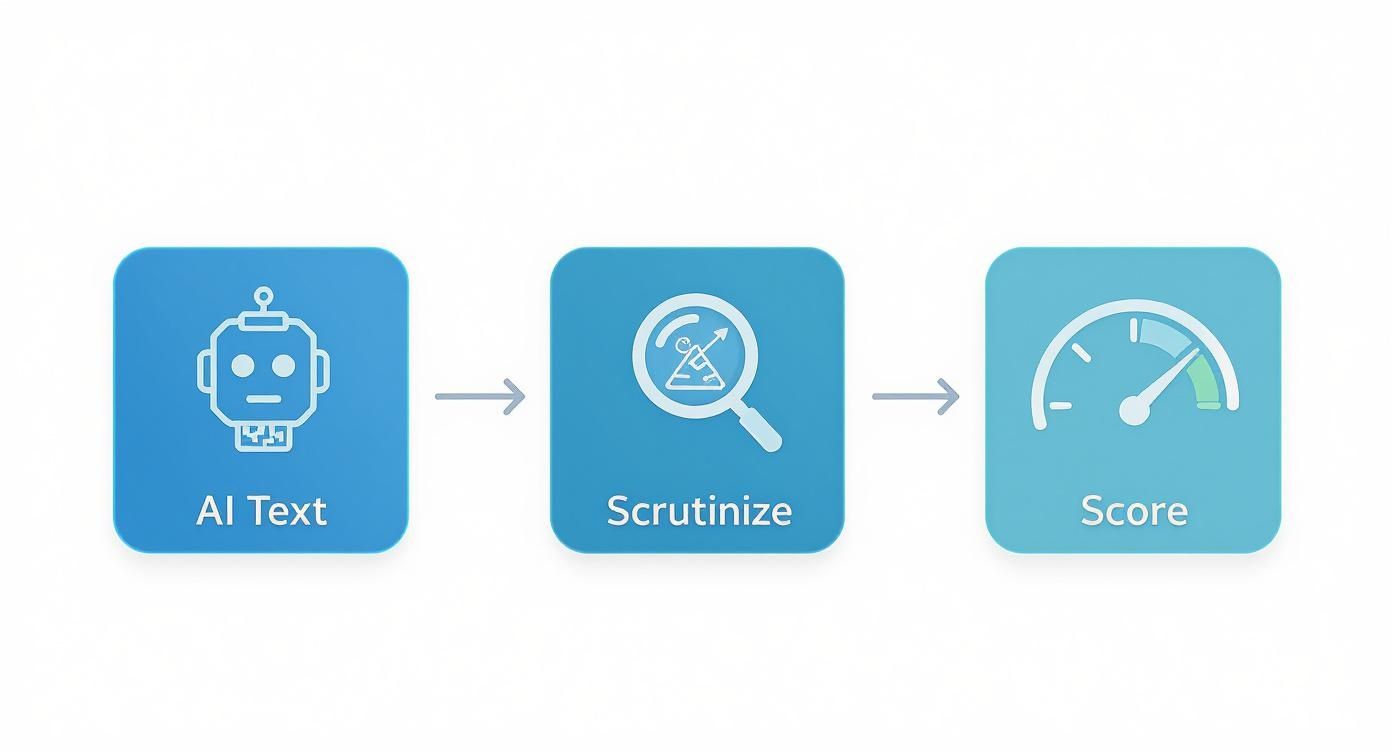
Understanding this simple sequence is key. It shows you exactly where your manual edits can disrupt the process and make the biggest difference.
Injecting Your Authentic Voice
Authenticity is the ultimate AI detector kryptonite. An AI can't fake your personal experiences, your genuine opinions, or the unique insights you've gathered over the years. Weaving these elements into your text is one of the most powerful moves you can make.
Try adding things like:
- Personal anecdotes: A brief story from your own life makes the content instantly more human. Instead of saying, "It's important to proofread," you could say, "I learned the importance of proofreading the hard way after sending a client proposal with a glaring typo."
- Unique opinions: Don't be afraid to take a stance. Phrases like "I was surprised to find..." or "The most frustrating part is..." are dead giveaways that a real person is behind the keyboard.
- Industry-specific insights: If you're an expert, add a detail that only someone with your experience would know. This provides value that a generic AI model simply can't pull from its database.
Over the last few years, figuring out how to pass AI detection has become a critical skill in tons of different fields. One study I saw found that while some platforms can detect AI content with up to 93% accuracy, that number plummets when writers manually rephrase sentences and add personal stories. The best approach always seems to be a mix of careful human editing and the smart use of AI rewriting tools.
Simplify and Clarify Your Language
AI models often try to sound authoritative by using unnecessarily complex words and jargon. This "academic" tone is a huge red flag for detectors and, frankly, a pain for readers. Your mission is to simplify the language and make it more accessible.
Go through your draft and hunt for opportunities to:
- Replace jargon: Swap out technical terms for simpler explanations unless you're absolutely sure your audience is made up of experts.
- Use active voice: Change passive sentences like "The report was written by the team" to active ones like "The team wrote the report." Active voice is more direct and engaging.
- Add colloquialisms: Sprinkling in a few informal phrases or idioms can make the text feel much more natural and conversational.
This hands-on editing process does more than just help you evade detection. It forces you to engage deeply with the content, ensuring it's not only undetectable but also more accurate, valuable, and genuinely helpful for your readers. For a deeper dive into specific techniques, check out our guide on how to humanize AI-generated text. By applying these manual refinements, you're not just cheating a machine; you're creating superior content.
Using AI Rewriting Tools and Humanizers The Right Way
Manual editing is the undisputed champ for creating high-quality, authentic content. No argument there. But let's get real—sometimes you just don't have the time to rebuild an AI draft from the ground up.
This is where AI rewriting tools, or "humanizers," can be your secret weapon. The key is knowing how to use them. If you treat them like a one-click magic button, you’ll end up with text that still feels hollow and weirdly off.
The smart move? Think of these tools as the first-pass editor who does the heavy lifting. Their main job is to smash the most obvious AI tells—like repetitive sentence structures and predictable word choices. They're great at scrambling that robotic DNA, giving you a much better starting point for your own edits.
How to Use Humanizers Strategically
The best workflow is a partnership. You feed the raw AI draft into a humanizer, which churns out a version that's less predictable. Then, you step in as the quality control expert to add the final layers of nuance, clarity, and your own genuine voice.
This tag-team approach saves a ton of time. Instead of spending hours wrestling with monotonous paragraphs, you can jump straight to the high-value edits, like weaving in personal stories or dropping in industry insights that no tool could ever dream up.
You can see this approach becoming standard practice. Tools are now building these features directly into their platforms.
This integration shows just how common it is for creators to need a quick way to process text and get it past AI detectors.
This isn't just a gimmick; it's a direct response to a real need. For example, when SurferAI rolled out its own anti-detection tool, one case study was a real eye-opener. They took an article that scored a blatant 93% on an AI detector and ran it through their feature. The result? The score dropped to just 7%.
For anyone creating content at scale, that’s a game-changer. It makes the text practically invisible to most detectors.
Humanizing Workflow Before and After
To really see how this hybrid process works, let's walk through a common scenario. We'll start with a clunky, AI-generated paragraph about cybersecurity and transform it step-by-step.
| Stage | Text Example |
|---|---|
| Stage 1: Raw AI Draft | "It is imperative for modern enterprises to implement robust cybersecurity measures. The proliferation of digital threats necessitates a comprehensive strategy that encompasses firewalls, antivirus software, and employee training. Failure to secure digital assets can result in significant financial and reputational damage." |
| Stage 2: After a Humanizer Tool | "Modern businesses really need to lock down their cybersecurity. With digital threats popping up everywhere, a full strategy including firewalls, antivirus programs, and staff education is a must. If you don't protect your online assets, you could face major hits to your money and reputation." |
| Stage 3: Final Polish with Manual Edits | "Forgetting about cybersecurity is like leaving your front door wide open. With new digital threats popping up daily, you need more than just a firewall; you need a full-blown security mindset that includes the right software and, crucially, a team that knows how to spot a phishing attempt. I've seen firsthand how one small slip-up can cost a company its reputation overnight." |
The difference is night and day.
The raw draft is technically correct but completely sterile—it screams "AI" to any detector.
After the humanizer, the stiff, formal language is gone. It's more conversational with phrases like "lock down" and "popping up." The robotic predictability has been broken, but it still lacks a distinct personality.
The final manually polished version is where the magic happens. It’s now undetectable. By adding an analogy ("leaving your front door wide open"), a personal touch ("I've seen firsthand"), and more varied sentence rhythms, the text feels genuinely human.
Using a tool for that middle step makes the final edit faster and lets you focus on adding real value. If you're looking for the right tool for the job, you can check out our guide on the best AI to human text converters. This hybrid method is, without a doubt, the most efficient way to create content that’s both authentic and invisible to AI detectors.
So, Did It Work? How to Test and Verify Your Edits
You’ve spent time carefully editing your text, injecting your own voice and style. But here’s the million-dollar question: did it actually work? This is the moment of truth, and skipping the verification step is a huge mistake.
Think of it like proofreading your own writing—you’re just too close to the material to see the lingering flaws.
AI detectors are like a panel of judges, and each one scores differently. One might be obsessed with sentence length variety, while another is a stickler for word choice. Relying on a single tool's verdict is just asking for trouble. What sails through one detector might get flagged by another.
That’s why using multiple tools isn't just a good idea; it's a non-negotiable step for anyone serious about creating content that reads human. By running your text through two or three different checkers, you get a far more reliable picture of how human it really sounds.
Building Your AI Detection Toolkit
Let’s be clear: not all AI detectors are created equal. Some are notoriously unreliable, while others have become the gold standard. Your mission is to assemble a small, trustworthy toolkit to get a balanced view.
Here are a few of the heavy hitters we consistently use for accurate results:
- Originality.ai: This one is often seen as the final boss. It's known for being one of the most stringent and accurate detectors out there. It’s a paid tool, but its tough analysis is worth it for a final, confident check.
- GPTZero: As one of the OGs in the space, GPTZero is well-known for a reason. It gives you a detailed sentence-by-sentence breakdown, highlighting the exact phrases that feel robotic. This is incredibly helpful for making surgical revisions.
- Copyleaks: This tool is widely used by universities and big companies, so its results are a great indicator of how your text might perform in academic or corporate settings.
A Quick Word of Warning: Be careful with the free, ad-covered detectors that pop up on the first page of Google. Studies have shown their false positive rates can be sky-high, meaning they frequently accuse human writing of being AI. Stick with the established players for results you can actually trust.
Making Sense of the Scores and Doing Final Touch-Ups
Once you’ve run your text through the tools, you'll get a score, usually a percentage. Don’t freak out if the numbers vary between detectors—that’s completely normal. You’re looking for a general consensus.
If two out of three tools give you a low AI score (anything under 30% is decent, but the lower, the better), you're probably in the clear. But if you're still seeing high AI probability scores, it's time to roll up your sleeves for one last round of edits.
Here's how to approach it when your score is too high:
- Follow the Highlights: Tools like GPTZero are your best friend here. They literally highlight the problem sentences for you. Zero in on these sections. They're almost always the parts that still sound a bit too perfect or structured.
- Shake Up the Sentences: The flagged sections are your roadmap for what to fix. If a long, winding sentence gets flagged, chop it into two shorter ones. If a series of short, punchy sentences gets flagged, try combining them into a more complex thought.
- Inject More You: This is the final, secret ingredient. Go back to those flagged paragraphs and add a genuine opinion, a short personal story, or a unique metaphor. This introduces the kind of human unpredictability that algorithms just can’t replicate.
The verification process isn't just a simple pass/fail exam. It's a powerful diagnostic tool. It gives you the concrete feedback you need to polish your work with total confidence. When your text consistently passes across a few reliable detectors, you can finally hit publish.
Navigating the Ethics of AI-Assisted Writing

Let's get one thing straight: learning to make AI text pass detectors isn't just a technical skill. It’s a conversation about responsibility. At the end of the day, the push to "humanize" content boils down to a fundamental need for authenticity, whether you're submitting a term paper or publishing a blog post that you want to rank.
The entire system—from Google's algorithm to your university's honor code—is built on the assumption that the work being reviewed is the product of genuine human effort and insight. Dropping unedited AI text into that system shatters the trust it's built on.
For search engines, the name of the game is rewarding content that is helpful, reliable, and people-first. Blasting out a fleet of low-effort, machine-written articles is the modern equivalent of keyword stuffing. It’s an attempt to game the system, not to provide real value, and it gets treated exactly like that.
In academia, the stakes are obviously much higher. Handing in an AI-generated essay as your own isn't a gray area; it's academic dishonesty, plain and simple. It completely bypasses the learning process the assignment was designed for in the first place.
Augmentation Versus Deception
The ethical line really gets drawn between using AI as a tool to augment your work and using it to deceive.
Think of AI as a brilliant but totally inexperienced research assistant. It can pull information, structure an outline, and even churn out a first draft with breathtaking speed.
But it has no critical thinking skills. It has none of your personal experiences. It doesn't have your unique voice. The ethical path is to take that raw material and build on it—infusing it with your own analysis, stories, and style. That's how you transform a machine's output into your own creation.
The goal isn't just to make content that's undetectable. It's to produce work that is undeniably yours—accurate, valuable, and a true reflection of your unique viewpoint.
Deception, on the other hand, is taking that first draft and just running it through a spinner or a basic humanizer tool with the sole purpose of fooling an algorithm. This approach completely misses the point. It might sneak past a detector, but it fails the far more important test of actually being valuable to a human reader.
Real-World Consequences and Responsibilities
Ignoring these ethical lines comes with very real consequences. In the world of SEO, sites that lean on spammy, unedited AI slop risk getting hammered by Google updates or even de-indexed, making them invisible. This happens because that kind of content almost never satisfies what a user is actually looking for, leading to terrible engagement signals.
For students, the fallout is severe, ranging from a zero on an assignment to expulsion. And don't think institutions aren't catching on. They're actively updating academic integrity policies to define exactly what is and isn't acceptable AI collaboration.
Ultimately, your reputation as a writer, marketer, or student is your most valuable asset. The techniques in this guide are about elevating AI-assisted drafts to a professional standard, making sure they’re not only high-quality but also a genuine extension of your own work. If you're new to this, you can try out some basic strategies to humanize AI text for free to see the difference for yourself.
This responsible approach ensures your content doesn’t just pass a scan—it achieves its real purpose: to inform, persuade, and connect with other human beings.
Common Questions About AI Detection, Answered
Even with the best strategy, you're bound to have questions. This whole AI writing world is new and a little weird. Let's tackle the most common concerns I hear so you can move forward with confidence.
Is It Illegal to Bypass AI Detection?
No, it's not illegal. The real question is about ethics, and that comes down to your specific situation and, most importantly, your intent.
For a marketer or an SEO pro, using AI as a starting point is just smart business. You take a draft, then weave in your own expertise, fresh data, and unique voice to create something genuinely helpful. The goal isn't to trick anyone; it's to produce top-notch content more efficiently.
But in a classroom? That's a completely different story. Handing in a raw AI essay and calling it your own is academic dishonesty, plain and simple. It's misrepresenting someone else's (or something else's) work as your own intellectual effort. In that world, the only ethical path is using AI for brainstorming, then adding your own critical analysis and original thought.
Can AI Detectors Be 100% Accurate?
Not even close. No AI detector on the market is perfect. They work with probabilities, not absolute certainties, and they make mistakes all the time.
One big problem is false positives—when a tool incorrectly flags human-written text as AI-generated. Research has shown that some free tools are notoriously bad about this, sometimes flagging human work at alarming rates. This is exactly why a single detector's report should never be treated as definitive proof.
Then there are false negatives, where a tool completely misses text that was written by a machine. Because no single tool is foolproof, your best bet is to check your work on a couple of reputable platforms, like Originality.ai or GPTZero. If you can pass two or three of the best, you're in a very good spot.
Will Google Penalize My Site for AI Content?
Google has been crystal clear on this: they penalize low-quality, unhelpful spam, no matter who or what wrote it. They don't have a vendetta against AI itself.
It all boils down to whether you're helping the reader. If you use AI to draft a well-researched, genuinely useful article that you've meticulously edited and fact-checked, Google is perfectly happy with that. It can rank just as well as anything written from scratch.
On the other hand, if you're just cranking out hundreds of generic, unedited AI articles to try and game the system, you're asking for trouble.
The bottom line is that Google rewards value, not the method of creation. High-quality, human-refined, AI-assisted content that serves the reader is perfectly acceptable.
Is Manual Editing Better Than an AI Humanizer?
This isn't an "either/or" situation. The smartest approach is a hybrid one that uses both. Combining them is where the real magic happens.
Think of it as a one-two punch:
- Let the humanizer do the heavy lifting. An AI humanizer like HumanText.pro is brilliant at the first pass. It instantly smooths out the robotic sentence structures, swaps predictable word choices, and fixes the most obvious AI tells. This gets you 80% of the way there in seconds.
- You step in for the final touch. After the tool gives you a solid foundation, you add the things a machine can't: personal stories, unique industry insights, your specific brand voice, and genuine emotion. This is the irreplaceable human element.
If you only use a tool, the content can still feel a bit soulless. If you only edit by hand, it can take forever. The combination of a humanizer's speed and your own authentic edits is the fastest and most effective path to creating content that truly feels human.
Ready to stop worrying about AI detectors and start creating content with confidence? HumanText.pro transforms robotic AI drafts into natural, undetectable text in seconds. Try it for free and see how our advanced humanizer can help you bypass detection while keeping your message clear and authentic. Visit https://humantext.pro to get started.
Ready to transform your AI-generated content into natural, human-like writing? Humantext.pro instantly refines your text, ensuring it reads naturally and authentically. Try our free AI humanizer today →
Related Articles

10 Blog Post Writing Tips That Get Results
Use these blog post writing tips to plan, structure, optimize, humanize, and promote posts that attract readers and drive action.

8 Animals That Fit “Animal with A”
Explore 8 memorable examples of an animal with a unique adaptation, from alpacas and axolotls to ants and aye-ayes, with creative prompts.

10 Creative Nonfiction Examples to Study
Explore 10 creative nonfiction examples with excerpts, craft analysis, techniques to emulate, essay tips, and practice prompts for stronger writing.

