AI Content Checker: How It Works and What Scores Mean
How an AI content checker works, how accurate it is, where it fails, and how to read its score before you act on it.
You've opened a draft, pasted it into an AI content checker, and received a percentage that looks more certain than you feel. Perhaps you wrote the text yourself. Perhaps you're reviewing someone else's work. Either way, you need to know what that number justifies before you revise, publish, grade, or raise a concern.
What an AI Content Checker Tells You
Say an editor receives a feature article and the checker returns 62%. That hypothetical result doesn't establish that the writer used AI, that most sentences were generated, or that the article violates the publication's rules.
An AI content checker is software that estimates whether text, or supported media, contains patterns associated with AI generation or substantial AI editing. Its output is an estimate, not an authorship certificate. Think of a thermometer: it gives you a reading, but it doesn't explain the cause of a fever.
Start with the score's definition
Before interpreting the number, read the tool's explanation. Some percentages describe confidence in a classification. Others describe the proportion of text flagged. Those measurements aren't interchangeable.
Publishers screen submissions, educators review assignments, SEO teams audit drafts, and compliance teams check disclosure requirements. Each needs a different response to the same result.
How to read an AI score band
| Score band | Typical reading | Next action |
|---|---|---|
| 0-20% | Few AI-associated patterns detected | Treat as low concern and keep drafts on file |
| 21-50% | Some passages contain AI-associated patterns | Inspect highlighted passages and check the writing context |
| 51-80% | Substantial AI-associated patterns detected | Request process evidence and review the text closely |
| 81-100% | Strong AI-associated patterns detected | Investigate independently before making a consequential decision |
These are illustrative review bands, not validated thresholds or an industry standard. A tool's documentation takes priority, and a low result doesn't certify human authorship.
For a writer, the useful next action may be editorial rather than investigative. RedactAI's guide to make AI LinkedIn posts sound authentic offers a relevant starting point for improving voice in permitted AI-assisted work. Improving communication and establishing authorship remain separate tasks.
Practical rule: A score starts a review. It doesn't end one.
How AI Content Checkers Work Behind the Score
Most text detectors infer origin from wording. They don't watch an author compose a document, and they usually don't possess a complete record of how it was created.
Patterns, classifiers, and provenance
Language models generate text by selecting likely continuations. Detectors may examine predictability, often discussed through perplexity, and burstiness, a shorthand for variation in sentence structure, length, and word choice. The peer-reviewed detector evaluation in Acta Neurochirurgica describes the limitations of relying on these surface-level signals, particularly after rephrasing.
Perplexity concerns how surprising wording is to a particular language model. Predictable wording may contribute to an AI classification, but clear instructions, conventional definitions, and carefully edited human prose can also be predictable. Burstiness isn't a human fingerprint, either.
A trained classifier adds another layer. It learns distinctions from labelled examples of human and machine writing, then applies those learned distinctions to unfamiliar material. Its usefulness depends on whether those examples resemble the document being checked.
Provenance is different. Rather than guessing from style, a verifier checks an available machine-readable mark or origin record. A sommelier guessing a wine's region from its taste is making an inference; reading an authenticated production record is checking provenance.
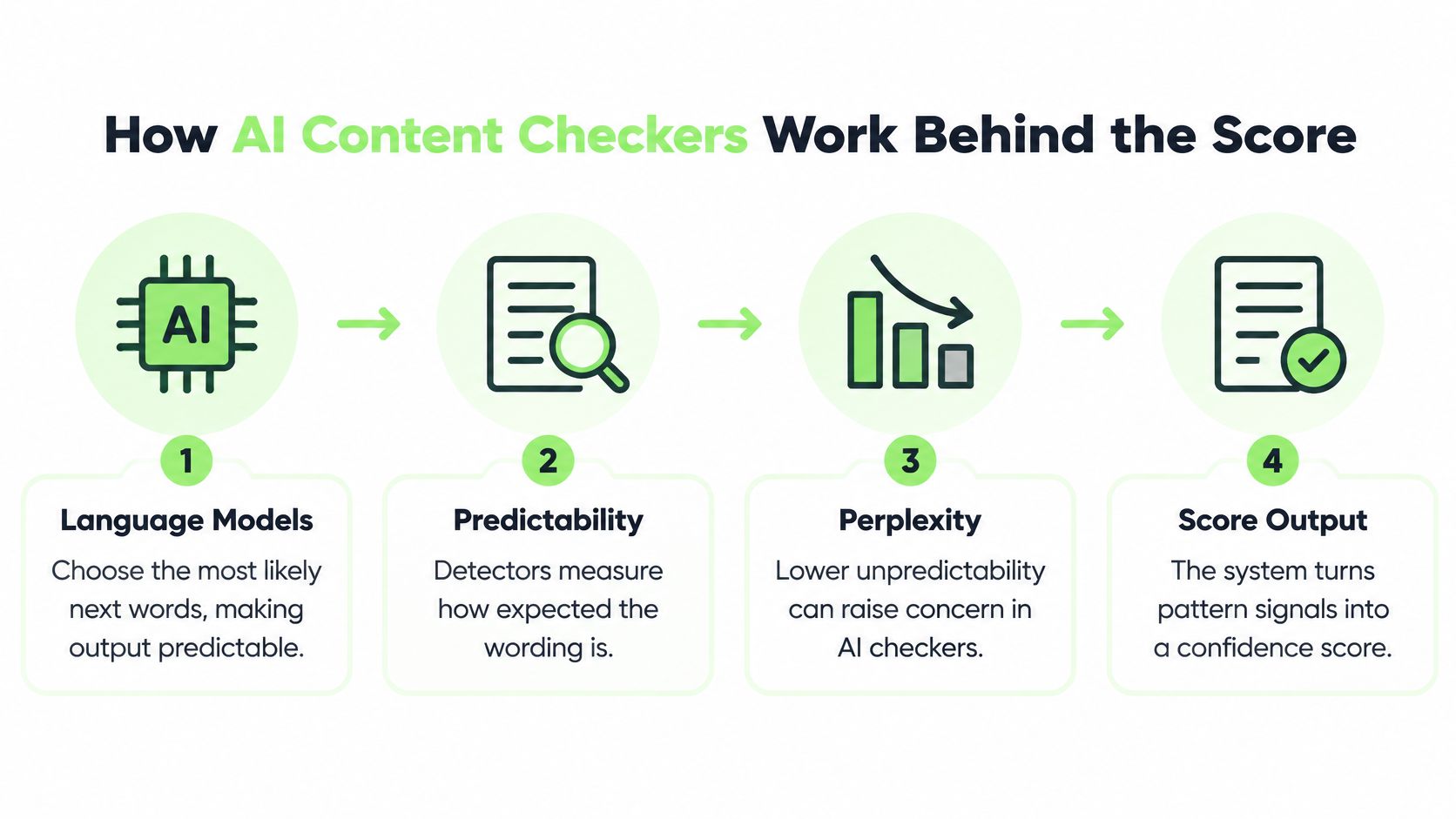
A typical text-checking sequence
Implementations differ, but a common workflow looks like this:
- Split the text into segments. The detector prepares passages it can evaluate.
- Measure linguistic signals. It examines predictability and regularity, among other features.
- Combine the evidence. A classifier produces a score from the signals.
- Display the result. The interface presents an overall reading, sometimes with highlighted passages.
The illustration summarises the pattern-based route, rather than every detector's internal design.
Short passages offer fewer opportunities to distinguish a persistent pattern from ordinary phrasing. Different tools also use different training examples, thresholds, and segment lengths, so disagreement isn't necessarily a software fault.
Highlighted sentences need particular care. A highlight indicates where a tool found a signal, not where it recovered evidence of a specific generation event. Don't read it as a reconstruction of the author's writing process.
How Accurate AI Content Checkers Really Are
A student receives a high AI score on a formal essay, while a publisher sees a similar score on an article draft. The number may look identical, but the decisions at stake are different. No checker is reliable enough to make a high-stakes decision alone. Accuracy depends on the text, the tool's classification rules, and what the evaluation counts as correct.
A false positive means human writing is flagged as AI-generated. A false negative means AI-generated writing passes as human. For a student, the first can trigger an unfair review. For a publisher, the second can leave AI-assisted material undisclosed. An EU compliance team, meanwhile, may need to assess transparency obligations rather than infer who wrote a passage. One score does not answer all three questions.
Read the metric before trusting the headline
Strict accuracy counts exact correct labels. Inclusive accuracy can also count specified borderline classifications as correct. The difference is like grading an answer as either precisely right or close enough under a stated rule. A more permissive rule can raise the reported result without making the detector itself more reliable.
The figures below come from particular evaluations. Treat each as evidence about the test conditions, not a forecast for every document.
Reported accuracy and error figures for AI detectors
| Study or test | Reported figure | What it tells you |
|---|---|---|
| 2026 comparison of Originality and Turnitin | Overall accuracy 0.69 and 0.61, respectively, in the published comparison | A result on one test set may not carry over to your material |
| 2024 study, medical-journal submissions | About 63% correct identification of AI content; false positives 24.5% to 25%, summarised in Illinois State University's detector guidance | Human writing can be flagged, so a high score needs context |
| 2024 study of 8 free tools | Broadly consistent results on human text, variable performance on AI text in the free-tool evaluation | Agreement on human samples does not establish performance on AI text |
| 2025 ACL study, 12 detectors | Most achieved 70-88% accuracy on baseline material in the ACL evaluation | Baseline results do not establish performance after editing |
A percentage is meaningful only alongside the sample, threshold, and error types. For example, a student reviewing a warning should focus on the risk of false positives, while a publisher checking disclosure practices may also care about false negatives. An EU compliance team should treat a text score as one part of its transparency process, not as a direct record of how the text was produced.
Test the material you actually handle
For a practical trial, assemble ten known-origin texts: human writing, raw AI output, and edited AI drafts. This is a small diagnostic exercise, not a formal validation study. Record incorrect classifications and note whether errors cluster around a particular kind of document.
The AI detector accuracy comparison can help you compare tools, but your own examples should guide the choice. Account for text length and editing level, too. A short passage gives a detector less evidence to assess, while polishing can change the signals it reads. A score is one signal, not a verdict.
Where AI Checkers Fail and How to Work Around It
Consider a student who writes a formal lab report in plain, precise language and receives a warning. Meanwhile, a freelancer lightly revises an AI draft and gets a lower score. Neither outcome is surprising when a detector relies on stylistic signals that editing can change.
The contrast is between how text sounds and how it was produced.

A study of detector robustness reported that simple manipulations reduced average detection accuracy to 22.14%, while an earlier paraphrased-essay evaluation discussed in that work reached only 26% accuracy. These are results under particular test conditions, not universal rates for every edited document.
Match the safeguard to the failure mode
Translation, non-native English writing, quotations, formulaic academic sections, and very short samples all deserve contextual review. Don't assume that a familiar academic phrase or restrained vocabulary identifies an AI author.
- Paraphrased or edited drafts: Preserve the original and revised versions. Compare what changed instead of treating a falling score as proof of human authorship.
- Quotations and templates: Run a separate check without quoted material, references, or required boilerplate. Keep both outputs and explain the difference.
- Translated writing: Record the source language and translation process. Don't apply an English-only evaluation assumption to every language.
- Formal student prose: Compare the passage with earlier work in the same genre, rather than with informal emails or classroom conversation.
- Short excerpts: Review the surrounding document before drawing conclusions about an isolated paragraph.
Our guide to an AI detection false positive explains how to organise a challenge when legitimate work is flagged. For permitted AI-assisted writing, Rankira's advice to build reader trust with human editing is useful when the objective is better communication rather than detector evasion.
Keep editing separate from verification
The practical question is whether revisions improve accuracy, clarity, and accountability. Deliberately adding mistakes to change a detector result doesn't answer that question.
This video provides another explanation to consider alongside the written checks.
Evaluate original and transformed text separately, and record uncertainty rather than hiding it behind a single confident label.
How Publishers, Educators, SEO Teams and Compliance Officers Use Scores
The same 62% reading can lead to different questions. A news editor reviewing a freelance feature needs to assess the reporting and authorship against the commission. A score can prompt a closer look, but drafts, interview notes, and a conversation with the writer provide context a detector cannot.
For a teacher, the relevant question is how the student developed the argument and whether the work fits their own learning. Comparing the essay with earlier writing and discussing the reasoning is more informative than treating a score as a verdict. The AI checker guide for teachers outlines a review focused on learning and evidence.
Editorial quality and academic integrity need different checks
An SEO lead auditing a hypothetical batch of 40 articles can use flagged passages to prioritise editing. The next step is to check whether each page gives specific, useful answers, then replace generic explanations with relevant details and supported comparisons. A detector score is not a forecast of search performance.
Teams exploring AI SEO should keep planning tools and editorial judgement distinct. Automation can help with production, while an editor checks whether a page answers the reader's actual question.
Practical actions by role
| Role | Typical question | Practical action |
|---|---|---|
| Publisher or editor | Does the submission meet the commission's authorship and reporting requirements? | Review drafts and sources before deciding |
| Educator | Does the work reflect the student's learning? | Compare earlier samples and discuss how the argument developed |
| SEO team | Which pages feel generic or under-edited? | Review flagged passages and add useful, specific detail |
| Compliance officer (EU) | Does this content require marking or disclosure? | Check the applicable duties and document the decision |
Compliance asks about disclosure, not just style
The European Commission's transparency guidelines explain that relevant Article 50 obligations apply from 2 August 2026. A limited transition until 2 December 2026 applies to some previously marketed systems. Duties differ for providers and deployers and depend on the circumstances, so an organisation must identify its role before deciding what applies.
For a covered AI-generated news illustration, a publisher should consider the machine-readable marking, any applicable visible disclosure, and an audit record. The text of Article 50 helps distinguish technical marking duties from deployer disclosure duties.
A student needs a fair assessment, an editor needs accountable reporting, and a compliance officer needs a defensible disclosure process.
A detector score is one signal, and its meaning depends on the decision at hand. A student's work calls for a fair, contextual review; a publisher's submission calls for evidence of reporting and authorship; a compliance team needs to determine whether disclosure rules apply. The score should inform those checks, not replace them.
Where Humantext.pro Fits Among Other AI Detectors
Compare GPTZero, Turnitin, ZeroGPT, Originality.ai, Copyleaks, and Humantext.pro by purpose, transparency, and data handling before comparing headline scores. A tool used in an institutional review needs different safeguards from a quick editorial check.
The useful question isn't which detector produces the strongest warning. It's whether you can understand the result, protect the submission, and take an appropriate next step.
Compare the workflow, not just the number
Criteria for comparing AI detectors
| Criterion | What to check | Why it matters |
|---|---|---|
| Media coverage | Does it check text only, or images, video and voice too? | Each media type needs its own test |
| Score transparency | Does it show a probability and which passages it flagged? | A single number hides where the signal comes from |
| Cross-checking | Are results verified against other detectors? | Shows whether a result holds across tools |
| Data handling | Is submitted content stored or shared? | Matters for unpublished manuscripts and student work |
| Language coverage | Which languages are supported and tested? | Multilingual writing needs relevant validation |
| Purpose fit | Detection only, or detection plus rewriting? | A humanizer edits text; a detector only scores it |
Our homepage describes a straightforward process: paste your text, check the AI score, then get the humanized text. That process places checking and revision in one workflow, but the stages serve different purposes. Checking estimates a pattern; revision changes the writing.
Humantext.pro's privacy approach is also relevant for sensitive drafts: we don't store or share submitted content. For confidential manuscripts or student work, data handling belongs in the selection criteria rather than being an afterthought.
Choose according to the decision
An educator should favour a workflow that supports documented review, student explanation, and institutional policy. A publisher handling mixed media should establish separate verification routes for files and text. A freelance writer working with permitted AI assistance may care more about locating awkward passages and preserving meaning during revision.
Cross-checking can reveal disagreement between detectors. It doesn't turn agreement into proof, particularly when tools may respond to similar linguistic features.
Editing boundary: Improve AI-assisted work only where that assistance is allowed. Don't use rewriting to conceal prohibited AI use in graded or contracted work.
Keep the original draft and check the rules governing the assignment or commission. A polished submission can still breach an agreement if its production method required disclosure and the author withheld it.
Read the Score Step by Step and Decide What to Do
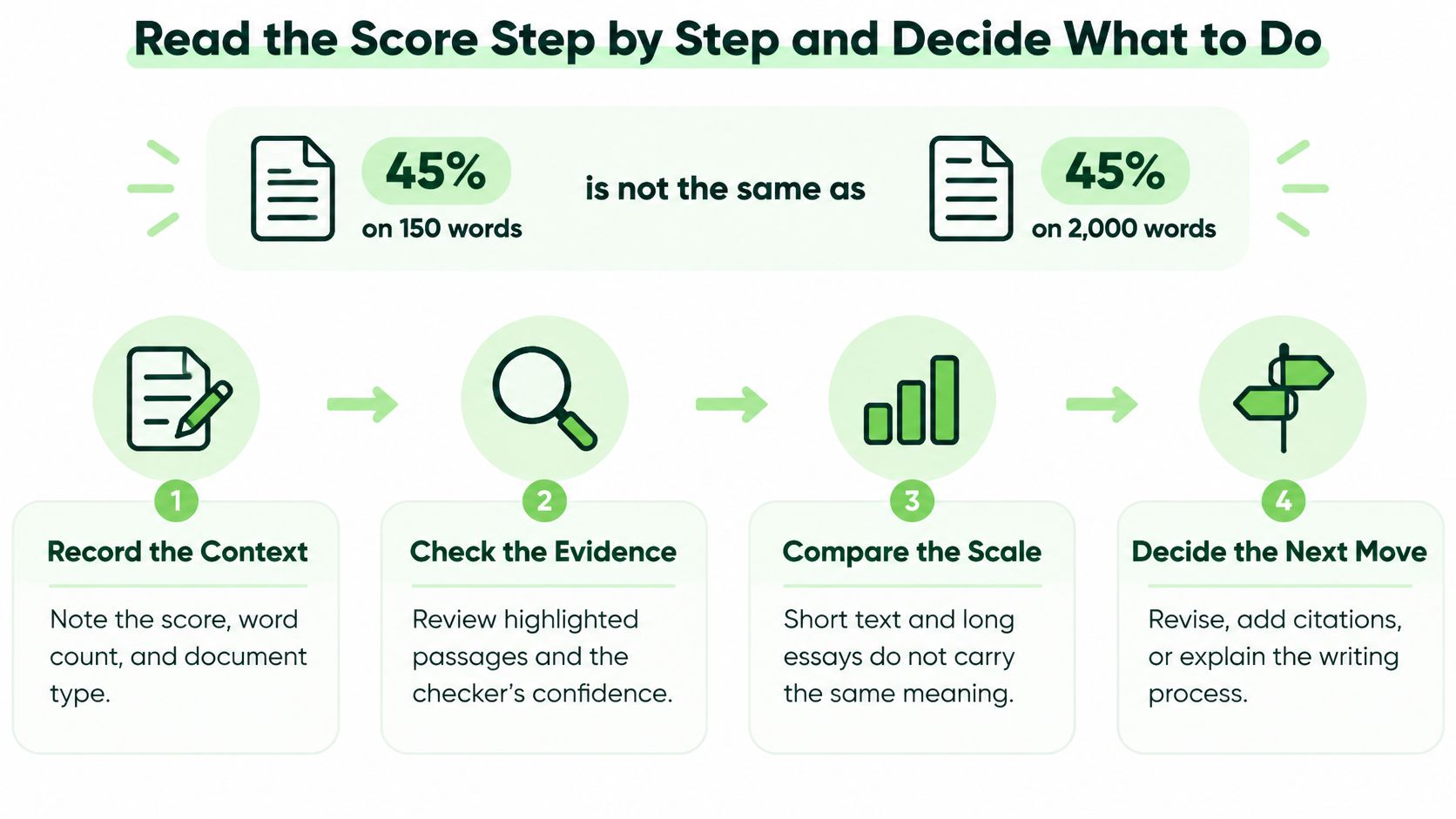
In a hypothetical comparison, a 45% score on a 150-word paragraph and a 45% score on a 2,000-word essay aren't equivalent evidence. The shorter passage may consist mainly of a definition; the essay may contain several sections with different writing styles and editing histories.
Neither result tells you what action to take until you establish the context. Start with the document and the decision you're responsible for, not with a preferred numerical cutoff.
Follow an evidence-led procedure
Record the tool and its settings. Save the tool name, date, available version information, threshold, and exact score label. This makes the result interpretable if the service changes or another reviewer repeats the check.
Check sample length. Note the word count and whether you submitted the full document or an excerpt. Treat very short material as insufficient for a confident authorship conclusion, and follow any documented minimum-length guidance.
Read the flagged passages. Open each highlighted section and identify what it contains. A methods template, a conventional introduction, and an unsupported factual claim need different kinds of review.
Compare process evidence. Examine drafts, revision history, source notes, and citations. Look for a plausible development of the work rather than demanding a perfectly continuous digital record that the author may never have created.
Ask for an explanation. Invite the author to explain the argument, reporting choices, or method in their own words. Keep the conversation relevant and non-accusatory; anxiety or difficulty speaking isn't evidence of AI use.
Account for transformations. Record quotations, translation, required templates, proofreading, and permitted AI editing. These details help explain what the detector received, rather than what the author originally wrote.
Document the decision. Preserve the original file, result, reviewer's reasoning, and applicable policy. Separate observed facts from interpretations, especially if another person may need to appeal or reassess the outcome.
Escalate only with corroboration. Seek independent evidence of a policy breach before beginning a consequential process. A detector warning combined with another detector warning isn't necessarily independent corroboration.
The illustration condenses the review into context, evidence, scale, and action.
Route the file to the right kind of check
A text checker can't authenticate a photograph, voice recording, or video. The European Commission's Article 50 FAQ addresses synthetic content across media types, reinforcing the need to preserve available markings through editing and distribution.
For a fast first pass, our free AI Detector checks whether text sounds AI-generated and returns an instant AI-probability score. Our Universal AI Scanner accepts an uploaded image, video, or voice file and returns an instant verdict with no signup required; we also offer video, image, voice, music, and text detectors, including tools labelled for Turnitin, Grammarly, ChatGPT, and Claude.
Treat those outputs as screening results, including when an interface uses the word verdict. Preserve the original upload before converting, compressing, or stripping metadata, and route uncertain material to someone qualified to review that media type.
Make a proportionate decision
Sometimes the appropriate outcome is a revision request. Sometimes it's a disclosure correction, a conversation, or no further action. Don't manufacture certainty just because the workflow expects a yes-or-no answer.
Write a short conclusion that names the evidence you relied on and the uncertainty that remains. The score starts the review; the evidence makes the decision.
Humantext.pro offers AI checking for text and media, alongside a text humanizer for improving permitted AI-assisted drafts while preserving meaning. Visit Humantext.pro to check a draft or upload a file, then use the result alongside your sources, revision history, and human judgment.
Jste připraveni přeměnit svůj obsah generovaný AI na přirozený, lidsky znějící text? Humantext.pro okamžitě vylepší váš text a zajistí, že bude znít přirozeně a autenticky. Vyzkoušejte náš bezplatný AI humanizér ještě dnes →
Související články
AI Hype vs Reality: What Actually Works in 2026
AI Hype vs Reality in 2026: Which Claims Hold Up, Where AI Fails, and Realistic Timelines for Business Use
How to Test AI: Metrics, Bias Checks and Detector Tests
How to test AI outputs step by step: set metrics, run bias and robustness checks, and verify text, image, video and voice content.
Most Natural AI Voice in 2026: 7 Top Picks Compared
Find the most natural AI voice tools in 2026, from ElevenLabs to Murf. Compare prosody, language support, and pricing, and learn how to test samples yourself.

