
Your Guide to Using an AI Bypass Tool
Discover how an AI bypass tool can make AI-generated text sound human and avoid detection. This guide explains the tech, its uses, and how it works.
An AI bypass tool is a piece of software that rewrites AI-generated text to make it sound more human, helping it sidestep detection by AI content checkers. You can think of it as a digital dialect coach—it takes robotic, predictable phrasing and morphs it into something that feels natural and authentic.
What Is an AI Bypass Tool and Why Is It Essential
We're in a new era of content creation where AIs write, and other AIs check their work. This cat-and-mouse game has created a huge need for tools that can bridge the gap between machine efficiency and genuine human expression. As AI becomes a go-to assistant for drafting everything from marketing copy to research papers, the technology designed to flag its output is becoming just as common.
The explosion of AI content generation tools has naturally led to a demand for ways to ensure that content doesn't sound like it was written by a machine. AI text often has subtle but distinct tells—like overly consistent sentence structures and a less-than-imaginative vocabulary—that detectors are specifically trained to sniff out. This is exactly where an AI bypass tool becomes so important.
The Growing Need for Humanization
For anyone creating content, getting flagged by an AI detector is a real problem. An article marked as AI-written could face penalties from search engines, lose credibility with readers, or, in an academic setting, even lead to accusations of misconduct. The goal isn't to trick anyone; it's to refine a useful draft into a polished final product that reflects real human thought.
Imagine a digital marketer using AI to whip up initial drafts for 20 product descriptions. The AI gets the basic information down quickly, but the text is sterile. It lacks the persuasive flair that actually sells products.
An AI bypass tool takes that raw, machine-generated output and breathes life into it. It rephrases sentences, swaps in more varied vocabulary, and adjusts the rhythm to mirror how a real person writes, turning a functional draft into compelling copy.
This process is critical for anyone who relies on AI for speed but can't afford to compromise on the quality and authenticity of their final work.
Who Benefits from an AI Bypass Tool
These tools are incredibly useful across several fields, helping professionals keep that human touch while still benefiting from AI's speed. Key users include:
- Marketers and SEO Specialists: They use these tools to scale up content production for blogs and websites without losing the natural tone that connects with audiences and ranks well on search engines. Actionable Insight: Use a bypass tool to humanize AI-generated meta descriptions and ad copy to improve click-through rates.
- Students and Academics: For refining essays and research papers, these tools help ensure their AI-assisted drafts meet institutional standards for originality and authentic writing. Actionable Insight: After generating a literature review draft with AI, use a bypass tool to rephrase it in your own academic voice before adding your critical analysis.
- Writers and Content Creators: Freelancers use them to blast through writer's block and speed up their workflow, transforming rough AI drafts into publishable articles that still carry their unique voice. Actionable Insight: If you're stuck on a paragraph, have an AI write a version, then immediately run it through a bypass tool to get a more natural-sounding starting point to edit.
Ultimately, an AI bypass tool like HumanText.pro serves as a critical last step in the modern content creation process. It makes sure the end product isn't just algorithmically correct, but also genuinely resonant and, most importantly, undetectable.
How AI Detectors Actually Work
To get around an AI detector, you first have to understand what you’re up against. Think of an AI detector less like a plagiarism checker and more like a forensic linguist. It’s not looking for copied words; it’s hunting for the subtle, almost invisible "fingerprints" that AI models leave all over their writing.
These models, for all their power, tend to produce text that’s just a little too perfect. It’s clean, it’s logical, but it often lacks the messy, unpredictable spark of human thought. AI detectors are trained on mountains of text—some from humans, some from machines—learning to spot those giveaways with scary accuracy.
This diagram breaks down the cat-and-mouse game between AI writers, detectors, and bypass tools.
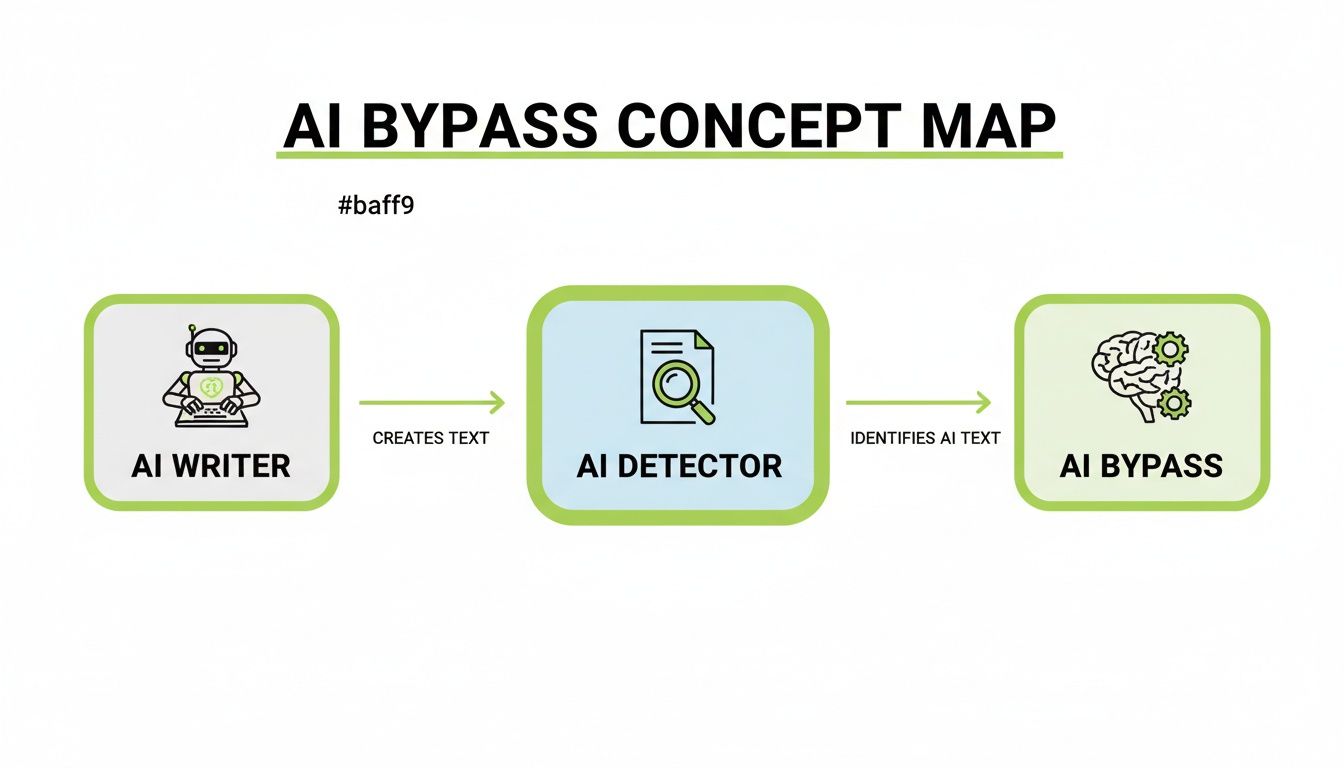
As you can see, the AI bypass tool steps in as a critical middleman. Its job is to take that machine-generated text and rough it up a bit, making it look and feel human before a detector ever gets a chance to scan it.
The Tell-Tale Signs of AI Writing
AI detectors are laser-focused on two main signals: perplexity and burstiness. Get your head around these two concepts, and you’ll instantly understand why AI-generated content so often feels slightly "off"—both to you and to the software designed to catch it.
Perplexity is just a fancy word for unpredictability. Real human writing is all over the place. We use weird idioms, choose surprising words, and sometimes write a sentence that’s just plain clunky. It keeps readers on their toes.
AI models, on the other hand, are built to play the odds. They're trained to pick the most statistically likely next word, every single time. This creates text with very low perplexity. It’s smooth and correct, but it’s also incredibly predictable.
A human might write, "The dog's tail thumped a frantic rhythm against the floor, a clear sign of its pure joy." An AI is more likely to say, "The dog was very happy. It wagged its tail with great excitement." The first sentence is far less predictable and has much higher perplexity.
Burstiness is all about rhythm and variation in sentence structure. Humans write in bursts. We’ll fire off a short, punchy sentence. Then follow it with a long, winding one full of clauses.
AI models struggle with this. They tend to produce sentences of eerily similar length and structure, one after another. This lack of variation—or low burstiness—is another huge red flag for detectors. If a paragraph is just a string of sentences all between 15 and 20 words long, it’s practically screaming "I was written by a machine!"
How Detectors Assign a Score
When you feed a piece of text into a detector, it dissects it sentence by sentence, analyzing these patterns. Then it spits out a probability score, usually a percentage, that represents how likely it thinks the text is AI-generated.
- High Perplexity & High Burstiness: The text is varied, unpredictable, and has the natural cadence of human writing. It’s likely to pass.
- Low Perplexity & Low Burstiness: The text is uniform, predictable, and has all the classic hallmarks of AI. It will almost certainly get flagged.
This presents a huge challenge, especially as AI becomes standard in the business world. With 72% of global companies expected to use AI in some capacity by 2026, the sheer volume of AI content is exploding. Marketers, who already make up 90% of AI users, are on the front lines, creating a massive need for tools that can keep their content sounding authentic. You can dive deeper into these trends in this PwC report on AI predictions.
The Role of an AI Bypass Tool
This is exactly where a sophisticated AI bypass tool like HumanText.pro comes into play. It doesn’t just do a simple find-and-replace on a few words. It fundamentally re-engineers the text from the ground up.
The tool actively works to inject both perplexity and burstiness. It systematically restructures sentences, introduces more nuanced vocabulary, and varies the rhythm of the writing to mimic how a real person thinks and types. This process transforms a flat, detectable piece of AI text into something that can confidently pass as human. By understanding these mechanics, you're better equipped to achieve truly undetectable AI writing.
Techniques for Humanizing AI Text
Turning robotic AI text into something that reads like it was written by a person involves more than just swapping out a few words. A good AI bypass tool is like a skilled editor—it fundamentally rebuilds the text's structure, rhythm, and vocabulary to capture the subtle imperfections of human creativity. It's a process that goes miles beyond simple synonym replacement.
These tools are trained on massive datasets of human-written content. HumanText.pro, for example, built its model on over 1.2 million human writing samples to learn the distinct patterns that separate our words from a machine's. They then use that knowledge to deconstruct and rebuild AI content from the ground up.
Varying Sentence Structure and Flow
One of the biggest giveaways of AI writing is its monotonous rhythm. AI models often spit out sentences of similar length and construction, creating a flat, predictable flow. The first step in humanization is to introduce structural variance.
This means actively breaking that uniformity. An AI bypass tool will shorten some sentences to be punchy and direct, while lengthening others with extra clauses to create more complex, flowing thoughts.
The goal is to replicate the natural "burstiness" of human communication. We don't speak or write in perfectly balanced sentences; our thoughts come in waves, and our writing should reflect that dynamic rhythm.
Elevating Vocabulary and Introducing Nuance
Beyond structure, vocabulary is a dead giveaway. AI models tend to pick the most statistically probable words, which often leads to safe but incredibly bland language. Human writers, on the other hand, pull from a richer, more nuanced lexicon.
An effective bypass tool will strategically replace generic words with more specific and evocative alternatives. It’s not just finding synonyms; it’s understanding the context to choose words that add depth and personality.
- Original AI Text: "The company's new product is very good."
- Humanized Text: "The company's latest offering is exceptionally innovative."
This shift does more than just sound better—it increases the text's perplexity, making it less predictable and harder for AI detectors to flag. And this matters more than ever. With the generative AI market projected to hit $98.1 billion by 2025, everyone from businesses to students needs to navigate increasingly strict detection. It's why tools like HumanText.pro, which boasts a 99% bypass rate on major detectors, are becoming so essential.
To get a sense of how these methods work in practice, let's break down the common techniques AI humanizers use.
Comparing AI Humanization Techniques
| Technique | What It Does | Simple Example |
|---|---|---|
| Paraphrasing & Restructuring | Rewrites sentences and paragraphs to change the core structure without losing the original meaning. | AI: "The report was finished by the team." Humanized: "The team finalized the report." |
| Vocabulary Enhancement | Replaces common, high-frequency words with more nuanced or less predictable synonyms. | AI: "The tool is good for business." Humanized: "The tool is invaluable for business." |
| Sentence Fragmentation & Fusion | Breaks long, complex sentences into shorter ones or combines choppy sentences for better flow. | AI: "The dog ran. It was fast. It chased the ball." Humanized: "The fast dog ran, chasing the ball." |
| Idiomatic Integration | Weaves in common idioms and colloquial phrases that sound natural to a native speaker. | AI: "Let's begin the project." Humanized: "Let's get the ball rolling on the project." |
Each of these techniques adds a layer of complexity and naturalness, making the text's statistical patterns much harder for a machine to identify as AI-generated.
A Practical Before and After Example
To see these techniques in action, let's look at a typical AI-generated paragraph and how a bypass tool would transform it.
Before (AI-Generated Text): "Artificial intelligence is changing many industries. It helps businesses automate tasks. This increases their efficiency. Companies can save money and time. The technology is developing quickly."
- Analysis: Notice the short, choppy sentences are all nearly the same length. The vocabulary ("changing," "helps," "good") is basic and repetitive. The flow is completely robotic.
After (Humanized Text): "Across countless industries, artificial intelligence is sparking a profound transformation. By automating routine tasks, it allows businesses to achieve unprecedented levels of efficiency. This strategic shift not only conserves valuable time and resources but also paves the way for rapid technological advancement."
- Analysis: The sentence structures are now varied, combining a longer introductory clause with a more direct statement. Words like "sparking a profound transformation" and "unprecedented" add nuance and increase perplexity. The transitions feel smoother, creating a far more cohesive and engaging paragraph.
Injecting Idioms and Natural Phrasing
Finally, the best humanizers add a final layer of authenticity by working in idioms, colloquialisms, and common turns of phrase. These are elements that AI models often struggle to use correctly because they defy logical, literal interpretation. When using AI writers, it's vital to focus on maintaining your authentic voice, as these human touches are what make the content feel genuine.
By weaving in phrases like "get a handle on" or "at the end of the day," the text starts to sound less like a formal report and more like something a real person would actually write. This is often the final touch that pushes the content over the finish line, making it truly undetectable. If you want to dive deeper into this topic, check out our guide on how to humanize AI-generated text.
Ultimately, humanizing AI text is a clever mix of structural re-engineering, lexical upgrades, and a subtle injection of personality. A top-tier AI bypass tool automates this complex process, turning sterile machine output into content that connects, persuades, and reads like it came from a human mind.
Ethical Guidelines for Using These Tools
Let's be clear: navigating the world of AI bypass tools comes with a heavy dose of responsibility. These tools are incredibly powerful assistants, but how you use them lands somewhere on a spectrum from smart and productive to deeply problematic. The whole game is knowing exactly where that line is.
Think of it this way: using a tool to clean up an AI-generated draft for your blog is a brilliant productivity hack. It helps you crush writer's block and get polished content out the door faster. But using that same tool to submit an AI-written paper for a class, passing it off as your own? That's crossing the line into academic dishonesty.
The healthiest and most ethical way to approach these tools is to treat them like a creative partner. They can augment your skills, not replace them entirely. They’re fantastic for churning out a first draft or untangling a clunky sentence, but the final piece has to have your unique insight, your expertise, and your voice.
Drawing the Line Between Ethical and Unethical Use
It really all boils down to intent and transparency. Are you using the tool to make your genuine work better and faster, or are you using it to deceive someone? Legitimate uses are all about boosting quality and productivity without pretending the work is something it isn't.
Unethical uses, on the other hand, are almost always about deception. This is where you find things like submitting AI-generated essays for a grade, creating fake product reviews, or churning out misleading content at a massive scale. This kind of misuse has real consequences, too, sometimes attracting legal attention.
For instance, Microsoft recently took legal action against a group of cybercriminals who were modifying AI services to get around safety features and generate harmful content. It’s a clear sign the industry is actively cracking down on bad actors.
This just underscores how important it is to use any ai bypass tool within a solid ethical framework. Your reputation—and in some cases, your legal standing—is on the line.
A Practical Checklist for Responsible Use
To make sure you’re always on the right side of that line, here’s a straightforward checklist. These are clear, actionable steps for using these tools responsibly, ensuring your final work is both valuable and truly yours.
Always Add Your Own Expertise: The tool should be your starting block, not the finish line. Once the text is humanized, your job is to go back and inject your personal stories, unique data, and expert perspectives. Practical Example: If you humanize a paragraph about marketing trends, add a sentence like, "In my own campaigns, I've seen a 30% increase in engagement by applying this very technique." That's an insight the AI can't generate.
Fact-Check Everything: AI models are notorious for "hallucinations"—making up facts that sound completely plausible but are flat-out wrong. You are the final editor and fact-checker. Actionable Insight: Before publishing, copy every statistic from your article into a separate document. Find and link to a primary source for each one. If you can't find a source, remove the stat.
Maintain Transparency When Required: In certain fields, like academia or journalism, honesty about your process is non-negotiable. If your institution or publication has a policy requiring you to disclose AI assistance, you must follow it. Honesty is how you build trust.
Never Use It for Deception: This is the golden rule. Never use an AI bypass tool to pass off work you didn't create as your own in any situation where originality is a core requirement. This includes school assignments, professional certifications, and any other context where plagiarism rules are in effect.
Stick to these guidelines, and you can confidently use these tools to ramp up your productivity without ever compromising your integrity. They become a powerful part of your workflow, helping you create better content faster while ensuring the final product is authentic, accurate, and ethically sound.
Choosing the Right AI Bypass Tool
Picking the right AI bypass tool feels a bit like navigating a crowded marketplace—not all of them are built the same. Some are little more than glorified synonym-swappers, while others perform a deep, linguistic overhaul. The best one for you really boils down to what you need, whether you're a student trying to polish an essay or a marketer trying to scale up content production.
Think of it like choosing a car. A basic paraphraser is like a scooter; it’ll get you from point A to B, but it’s not designed for the heavy lifting. A sophisticated AI humanizer, like HumanText.pro, is more like a high-performance vehicle, engineered to navigate tricky terrain (like advanced detectors) with precision and reliability.

This distinction has never been more important. As AI-assisted writing becomes the norm, the demand for effective humanizers has exploded. By 2026, a staggering 90% of content marketers will depend on AI for drafting content, a huge leap from the 71% who were just using it for brainstorming. With ChatGPT leading the charge at a 78% usage rate among marketers, AI detectors are constantly getting smarter. This is pushing users toward solutions like HumanText.pro, which is trained on 1.2 million human writing samples to produce genuinely natural-sounding text. You can dive deeper into the numbers with these AI in writing statistics from humanizeai.com.
Key Features to Look For
When you're kicking the tires on an AI bypass tool, a few critical features separate the contenders from the pretenders. If you prioritize these, you’ll end up with a tool that’s not just effective, but also easy to use and reliable.
High Success Rate Against Major Detectors: The whole point is to fly under the radar. The tool absolutely must be able to bypass top-tier detectors like Turnitin, GPTZero, and Grammarly. A claimed success rate of 99% or higher, like what HumanText.pro offers, is a good sign of a robust and frequently updated algorithm.
Preservation of Original Meaning: A great tool doesn't just shuffle words around; it respects your original message. It should refine the language without twisting your intended meaning into something unrecognizable.
User-Friendly Interface: The process should be dead simple: paste your text, click a button, and get your humanized version. A clean, intuitive interface makes the tool accessible to anyone, regardless of their tech skills.
No-Signup Free Trial: Trustworthy services let you try before you buy. A no-signup trial, even with a word limit like 500 words, lets you see the quality of the output for yourself before you commit.
These features are the bedrock of a solid AI bypass tool. Without them, you’re gambling with subpar results that might still get flagged.
Real-World Scenario: A Marketer’s Challenge
Let's put this into a real-world context. Meet Alex, a digital marketer tasked with creating 50 unique product descriptions for a new e-commerce launch. Using an AI writer, Alex gets the initial drafts done in a couple of hours—a job that would have taken days by hand.
But there’s a problem. The AI-generated text is bland and repetitive. It lacks the persuasive flair needed to actually sell products. Even worse, it’s easily flagged by AI detectors, which could hurt the site's SEO.
Alex needs a way to quickly humanize this entire batch of text, making sure each description is unique, compelling, and—most importantly—undetectable.
This is exactly where a high-quality AI bypass tool becomes indispensable. It solves the twin problems of quality and detectability, transforming a functional but robotic draft into engaging, sales-ready copy.
How HumanText.pro Solves the Problem
Using HumanText.pro, Alex can knock this challenge out of the park. Here’s how its features directly address the marketer's needs:
Paste and Humanize: Alex pastes the first AI-drafted description into the tool. The platform's algorithm, trained on millions of human writing samples, immediately gets to work.
Meaning Preservation: The tool rewrites the text, switching up sentence structures and improving vocabulary. The core features and benefits of the product are still there, but the tone is now more natural and persuasive.
Bypass Detection: With its claimed 99% bypass rate, Alex can be confident the new descriptions will sail past AI checks, protecting the website’s search ranking and credibility. When you need to get this done right, an effective AI detection remover is a game-changer.
Scale with Speed: The whole process is so fast that Alex can humanize all 50 descriptions in a fraction of the time it would take to edit them manually.
By choosing a tool with these specific capabilities, Alex turns a tedious, multi-day project into a quick, efficient task. The final product isn't just undetectable; it's also higher quality, directly helping the business's bottom line.
Frequently Asked Questions About AI Bypassing
As AI-assisted writing becomes more common, the questions are piling up. It's a new frontier, and it's smart to ask the tough questions. Let's tackle some of the most frequent ones to give you a clear, honest picture of how to navigate this technology well.
Is Using an AI Bypass Tool Considered Cheating?
This is the big one, and the answer isn't a simple yes or no. It all comes down to intent and context. An AI bypass tool is just that—a tool. Like any tool, its ethical use is defined by the person using it.
Think of it like a powerful calculator in a math class. If the goal of the assignment is to show your work on long division, using the calculator is obviously cheating. But if you're in a physics class solving a complex engineering problem, that same calculator is an essential, expected tool to get the job done.
It's the same principle here. Using an AI humanizer to refine your first draft of a blog post, brainstorm marketing ideas, or get past a stubborn case of writer's block is a perfectly legitimate and productive use of technology. But using it to submit an essay generated entirely by AI for a class that requires original thought? That crosses a clear line into academic dishonesty.
The ethical line is drawn at deception. If you're using the tool to augment your own work and make it better, you're on solid ground. The problem arises when you use it to pass off machine-generated work as your own in a context where that's explicitly forbidden.
Can Detectors Still Catch Humanized Text?
The relationship between AI humanizers and AI detectors is a constant cat-and-mouse game. As detection algorithms get smarter at spotting the statistical patterns of AI, the best humanizers get better at erasing them. While no tool can promise a 100% lifetime guarantee against all future detectors, top-tier solutions are incredibly effective.
A sophisticated tool like HumanText.pro isn't just swapping out a few words. It’s constantly updated and trained on massive datasets of human writing to mimic the subtle tells of human creativity—things like varied sentence lengths (burstiness) and unexpected word choices (perplexity), which are major red flags for detectors.
So, can a detector ever catch humanized text? It's possible, especially with more basic tools that just do simple synonym swaps. But high-quality humanizers that fundamentally restructure content have a very high success rate against even the most advanced detectors like Turnitin and GPTZero.
What Is the Difference Between a Bypass Tool and a Paraphraser?
This is a crucial distinction. They might both rewrite text, but they’re operating on completely different levels. A standard paraphraser is essentially a thesaurus on autopilot. Its main job is to switch out words and shuffle sentence order just enough to avoid direct plagiarism. The core structure and statistical signature of the AI-generated text often remain.
An AI bypass tool is a much more advanced piece of tech. It goes deeper, performing a full linguistic analysis to change the text's fundamental characteristics so they match human writing patterns.
Here’s the simple breakdown:
- Paraphraser: Focuses on surface-level changes to avoid duplication.
- AI Bypass Tool: Focuses on deep structural changes to mimic human writing and evade AI detection.
A bypass tool doesn't just reword; it re-writes. It actively messes with sentence length, introduces more nuanced vocabulary, and changes the rhythm of the text to make it statistically indistinguishable from something a person wrote from scratch.
How Do I Maintain Quality After Humanizing Text?
Getting a humanized draft is a massive head start, but it should never be the final step. The best way to use these tools is to treat their output as a highly polished first draft, not a finished product. Your expertise is still the most important ingredient.
Here are a few tips to make sure your final piece is top-notch:
- Proofread for Context and Tone: The tool is a language expert, but you're the subject matter expert. Read through the text to ensure the tone fits your brand or personal voice. Make sure no subtle meanings got lost in translation.
- Inject Personal Insights and Stories: This is where you make the content truly yours. Add a personal story, a unique data point from your own experience, or an opinion that only you can provide. This is the layer of authenticity no AI can ever replicate.
- Fact-Check Everything: AI models can sometimes "hallucinate" facts or pull outdated information. You are the final line of defense for accuracy. Always verify every statistic, date, and claim before you hit publish. Your credibility depends on it.
By following these steps, you can let the tool do the heavy lifting while you provide the critical final touches that make the content accurate, authentic, and truly representative of your expertise.
Ready to transform your AI drafts into undetectable, human-quality content? HumanText.pro offers an advanced AI humanizer that helps your text bypass even the toughest detectors while preserving its original meaning. Try it for free today and see the difference for yourself!
Ready to transform your AI-generated content into natural, human-like writing? Humantext.pro instantly refines your text, ensuring it reads naturally and authentically. Try our free AI humanizer today →
Related Articles

10 Blog Post Writing Tips That Get Results
Use these blog post writing tips to plan, structure, optimize, humanize, and promote posts that attract readers and drive action.

8 Animals That Fit “Animal with A”
Explore 8 memorable examples of an animal with a unique adaptation, from alpacas and axolotls to ants and aye-ayes, with creative prompts.

10 Creative Nonfiction Examples to Study
Explore 10 creative nonfiction examples with excerpts, craft analysis, techniques to emulate, essay tips, and practice prompts for stronger writing.

