What Is an AI Detection Remover and How Does It Work?
Discover what an AI detection remover is and how it helps you bypass AI detectors. Learn the technology, ethical uses, and how to choose the right tool.
So, what exactly is an AI detection remover? Think of it as a specialized editor for AI-generated text. These tools take content that sounds a bit stiff or robotic and rewrite it to flow naturally, helping it sail past the AI detection software that's becoming more common every day.
If you use AI to help with your writing, a tool like this is practically a must-have. It helps you refine those machine-made first drafts into engaging, polished content that won't get flagged. For instance, you could take an AI-generated paragraph for a marketing email, run it through the tool, and get back a version that sounds warmer and more persuasive, making it ready to send to your clients.
The New Challenge of AI Content Detection

The internet is flooded with content right now, and a huge chunk of it comes from powerful AI tools that make writing articles, essays, and reports feel almost instant. This explosion in AI-powered content creation has kicked off a brand new challenge: telling the difference between what a human wrote and what a machine generated.
This massive influx has sparked a digital cat-and-mouse game. To handle the wave of automated text, search engines, universities, and major content platforms have rolled out sophisticated AI detectors. These systems are trained to spot the subtle, tell-tale signs of AI—the predictable sentence structures, the lack of unique voice—and flag anything that doesn't feel quite human.
The Problem for Modern Creators
This creates a real headache for a lot of people. Marketers, students, and writers who rely on AI to work faster now face the risk of being penalized. Their work, even if it's well-researched and genuinely valuable, could get downranked or questioned just because an AI lent a hand in the drafting process.
The scale of this is staggering. By 2025, some analysts predict that 30–40% of all text on the web will come from AI systems. Other projections are even bolder, suggesting that number could hit 90% by the end of the year.
This is exactly where an AI detection remover becomes an indispensable part of the modern writer's toolkit. It’s not about cheating or being dishonest. It’s about taking a solid AI-generated draft and polishing it until it sounds authentic and human.
Refining, Not Deceiving
The goal here is simple: to preserve your own voice and make sure your work is judged on its ideas, not its origins. This process lets you keep the speed and efficiency of AI without sacrificing the quality and authenticity of the final piece.
By making AI text undetectable, you can sidestep unfair penalties while still producing great work. The objective is to:
- Enhance Readability: Turn clunky, robotic sentences into prose that flows smoothly and naturally. For example, changing "The utilization of this methodology results in an increase in efficiency" to "Using this method makes things more efficient."
- Preserve Originality: Keep the core message and ideas of your draft intact while elevating how they're delivered. The tool should change the style, not the substance.
- Avoid Penalties: Ensure your content gets a green light from detectors used by platforms like Google or academic institutions.
Ultimately, these tools bridge the gap between machine efficiency and human creativity. They help ensure your final output is not just effective, but truly authentic.
How AI Detectors Spot Machine-Written Text
To get the most out of an AI detection remover, you first have to know what you’re up against. Think of an AI detector as a linguistic detective, but instead of dusting for fingerprints, it's scanning for the subtle, almost invisible tells of a machine. It's not looking for one single giveaway, but a whole pattern of robotic traits.
These digital sleuths are trained on colossal datasets packed with millions of examples of both human and AI-generated writing. This deep dive into data, including an understanding GPT and Transformer mechanisms, teaches them to spot statistical patterns that even a seasoned editor would miss.
The Tell-Tale Signs of AI Writing
When an AI detector scans a piece of content, it’s primarily looking at two key metrics: perplexity and burstiness. These might sound like high-tech jargon, but they're actually simple concepts. Getting a handle on them is the first step toward creating content that flies under the radar.
- Perplexity (Predictability): This is just a fancy way of measuring how predictable your writing is. AI models are wired to pick the most statistically likely word to follow the last one. This creates text that is perfectly grammatical but often feels flat, bland, and a little too simple. It lacks surprise.
- Burstiness (Rhythm and Flow): This measures the natural variation in sentence structure. A human writer might craft a long, winding sentence to explore a complex thought, then follow it with a short, sharp one for emphasis. This creates a dynamic, "bursty" rhythm.
AI-generated text often misses this natural cadence. Its sentences tend to be uniform in length and structure, which creates a monotonous, almost hypnotic rhythm that detectors are trained to flag. It’s the difference between a handcrafted wooden table with unique grain patterns and a perfectly smooth, machine-molded piece of plastic.
Human writing is inherently varied. It has ebbs and flows, with a mix of simple and complex sentences. AI text often loses this rhythm, opting for a consistent, uniform structure that feels unnaturally perfect.
Practical Examples of AI Giveaways
Let's make this concrete. An AI might generate something like this: "The dog ran across the field. The dog was very fast. The dog enjoyed the run." Notice how the sentences are simple, repetitive, and totally predictable. This is a classic example of low perplexity and low burstiness.
A human writer might paint the same picture with more burstiness: "Unleashed, the golden retriever bolted across the open field, a blur of fur and unbridled joy. What a sprint!" The sentence lengths are different, the vocabulary is richer, and the whole thing just feels more authentic. An AI detection remover aims to perform this exact kind of transformation automatically.
Understanding these core principles is everything. A good AI detection remover doesn't just swap out a few words here and there. It fundamentally rewrites the text to inject that natural perplexity and burstiness that detectors look for. You can learn more about this process and discover if undetectable AI truly works in our detailed guide. This knowledge is your key to turning robotic drafts into content that genuinely connects with people.
The Technology Behind an AI Detection Remover
So, how does a tool like this actually pull off the magic trick of making AI text invisible to detectors? It’s not just a fancy thesaurus swapping out words. Think of it less like a simple paraphraser and more like a skilled digital artisan, taking a robotic draft and meticulously reshaping it with a human touch.
These tools are built on sophisticated language models that have been fed a massive diet of genuine human writing—millions of articles, essays, and reports. Instead of just changing words, they completely re-engineer the text from the ground up. They analyze everything from sentence structure and vocabulary to the overall rhythm, hunting for the tell-tale patterns that AI detectors are built to sniff out.
Erasing the Digital Fingerprints
The main goal is to pump up the text's perplexity and burstiness—those two key metrics we talked about earlier. AI writing tends to be very predictable and even-keeled. By mixing up sentence lengths, introducing more complex structures, and using less common word choices, the tool shatters that monotonous consistency.
Actionable Insight: Before humanizing a text, try reading it aloud. If it sounds monotonous or lacks a natural rhythm, it has low burstiness. A good humanizer will fix this by varying sentence length and structure. For example, it might combine two short sentences into a complex one or break a long sentence into shorter, punchier phrases.
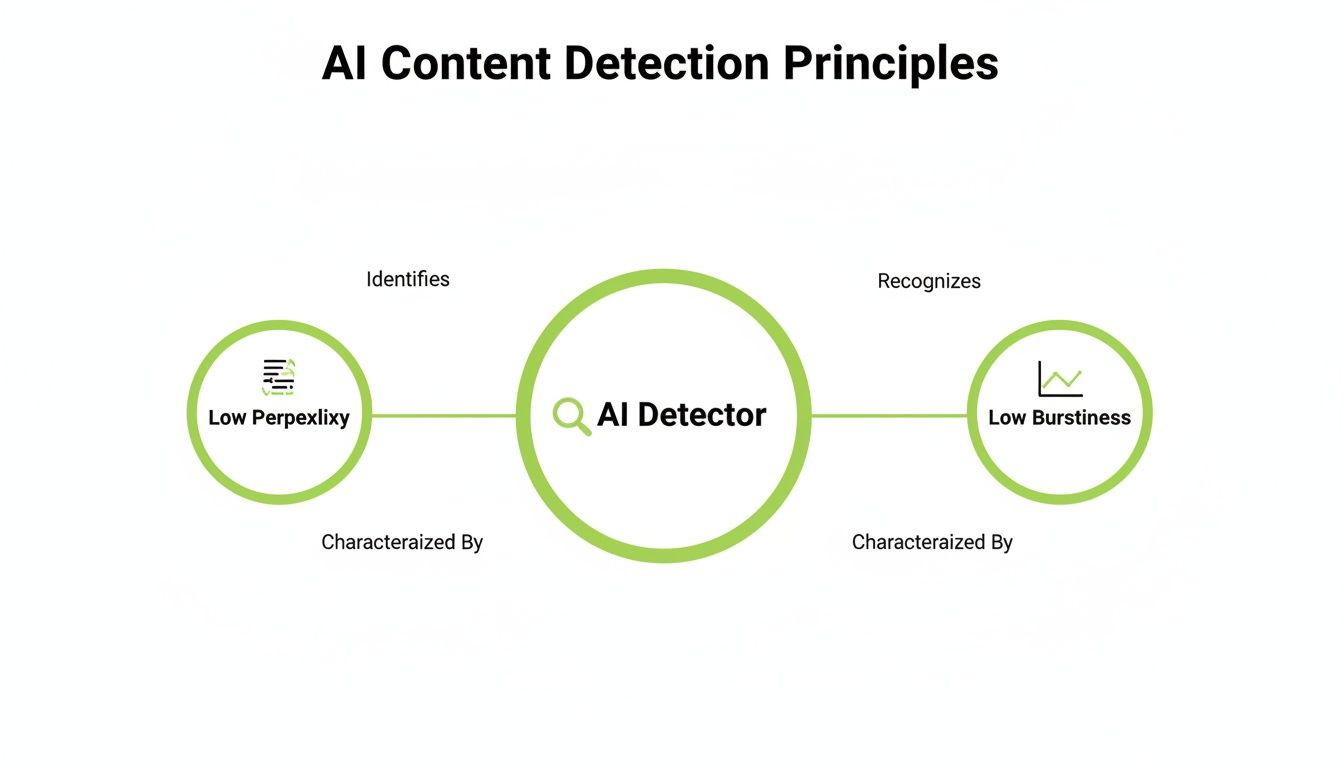
As you can see, the combination of low perplexity and low burstiness is the classic calling card of AI-generated content, creating a clear signal that detectors are trained to catch.
This whole process isn't just about making the text sound better. It’s about methodically erasing the statistical "tells" that scream "a machine wrote this!" The tool transforms a draft that might be grammatically perfect but utterly soulless into something that reads like it was written by a person from the very beginning, all while keeping the original meaning and ideas intact.
How Advanced Humanizers Get It Done
The best tools take this a huge step further by relying on enormous, high-quality datasets. A top-tier AI detection remover will use advanced linguistic modeling to create text that sounds truly natural.
An AI detection remover like HumanText.pro converts AI drafts into human-like text that gets past detectors like GPTZero and Turnitin with 99% success rates. This is possible because its models were trained on 1.2 million human writing samples to guarantee authenticity.
This kind of deep training allows the tool to produce undetectable essays, blogs, and other professional documents. It also protects user privacy by not storing any content and offers instant trials to test it out. You can dive deeper into the broader industry trends with these artificial intelligence statistics and findings.
By focusing on these deep structural and stylistic changes, an AI humanizer offers a solid solution for anyone who needs to polish their AI-assisted work into something undetectable. It's the essential bridge between machine efficiency and authentic human expression.
Using AI Detection Removers Ethically and Effectively
Let's get one thing straight: an AI detection remover isn't a magic wand for academic dishonesty. Thinking of it that way misses the point entirely. Instead, see it as a finishing tool—a polisher for content that starts with AI but ends with human insight and creativity.
The ethics of using a humanizer all boil down to your intent. Are you trying to pass off a raw, unedited AI draft as your own genius? That's a problem. Or are you using it to refine an AI-assisted draft, smoothing out the robotic language so your own ideas can shine through? That’s just smart workflow.
Actionable Insight: The most ethical workflow is a hybrid one. Use AI for the first 70% (research, outlining, drafting), and then use a humanizer for the next 20% (polishing language). The final 10% should always be your own review—fact-checking, adding personal anecdotes, and ensuring the tone matches your brand or academic voice.
Real-World Scenarios for Ethical Use
So, what does this look like in practice? It’s not about cheating; it’s about overcoming real-world bottlenecks without sacrificing quality. The key is always to add your own value, not to sidestep the work.
Here are a couple of common, responsible ways people use these tools:
For Content Marketers: A marketing team has an ambitious goal: publish 10 high-quality blog posts a week to drive their SEO strategy. They use AI to generate first drafts from detailed briefs, saving hundreds of hours. Then, they use a humanizer to polish the language, making it more engaging and ensuring it doesn't get flagged by spam filters. They can scale production without sounding like robots.
For Students: A history student is tackling a complex essay. They use AI to get a basic outline and organize their research. After writing the full essay themselves, they run it through a humanizer to smooth out awkward phrasing and improve the overall flow. This helps their unique analysis come through clearly, using the tool as a sophisticated proofreader rather than a ghostwriter.
Using an AI detection remover responsibly is about bridging the gap between machine efficiency and human creativity. It empowers you to refine AI-generated content into a final product that is polished, authentic, and adds genuine value.
Professionals Polishing Their Communication
The need for a human touch extends far beyond content teams and classrooms. For any professional, drafting reports, creating presentations, or answering client emails is a daily grind. AI can create a template or first draft in seconds, which is a massive time-saver.
But sending a generic, machine-written email can damage a client relationship. By running that draft through an AI detection remover, you can ensure the final message sounds personal, professional, and authentic. It’s all about maintaining a human connection in a world that’s moving faster than ever.
Understanding these applications is the first step. By learning how to avoid AI detection responsibly, you can make these tools a powerful and ethical part of your workflow.
Ethical Applications of AI Detection Removers Across Professions
To make this even clearer, let's look at how different professionals can ethically leverage AI humanizers to solve common challenges they face every day.
| User Profile | Common Challenge | Ethical Solution with an AI Detection Remover |
|---|---|---|
| SEO Specialist | Needs to produce large volumes of unique, high-quality content that ranks well and avoids search engine penalties for "unhelpful" AI text. | Generates keyword-optimized drafts with AI, then uses a humanizer to refine the syntax and flow, ensuring the final article is engaging and valuable for readers. |
| Non-Native English Speaker | Has excellent ideas but struggles with natural phrasing and idiomatic expressions, leading to text that sounds stilted or "foreign." | Writes their content first, then uses an AI humanizer as an advanced language tool to polish their writing, making it sound more fluent and natural. |
| Freelance Writer | Faces tight deadlines and needs to maximize efficiency to handle multiple clients without their writing style becoming repetitive or generic. | Uses AI for initial research and drafting, then applies a humanizer to add stylistic variety and a unique voice tailored to each client's brand. |
| Small Business Owner | Juggles all marketing tasks and needs to create compelling website copy, product descriptions, and social media posts quickly. | Creates functional first drafts with an AI assistant and then humanizes them to ensure the brand's personality and voice come through authentically. |
| Academic Researcher | Needs to summarize complex findings into clear, accessible language for grant proposals or publications but finds their text dense and jargon-heavy. | Runs their technical drafts through a humanizer to improve readability and flow, making their research more understandable to a broader audience without changing the core data. |
Ultimately, the goal isn't to hide the use of AI. It's to ensure the final product serves its human audience in the best way possible. When used with integrity, an AI detection remover is a powerful ally for clear, effective, and authentic communication.
How to Choose a Safe and Reliable AI Detection Remover

With so many tools flooding the market, picking a trustworthy AI detection remover can feel like navigating a minefield. Let’s be clear: not all humanizers are created equal. Some are just glorified paraphrasers that fold instantly against modern detectors, while others might quietly compromise your privacy.
Making an informed choice means looking past the flashy marketing claims. The right tool should feel like a reliable partner, one that slips into your workflow and delivers consistent, high-quality results every time. It’s all about focusing on the features that actually matter for performance, safety, and usability.
Key Criteria for Selecting a Tool
When you start comparing options, use this checklist to cut through the noise. These points are non-negotiable for anyone serious about producing authentic, undetectable content without opening the door to new risks.
A solid tool has to deliver on three core promises:
- Detection Bypass Success Rate: The entire point of the tool is to get past detectors. Look for platforms that are transparent about their success rates against the big names like GPTZero, Turnitin, and Originality.ai. Actionable Insight: Before committing, use a free trial. Take a sample AI text, run it through the humanizer, and then test the output on a free AI detector to verify the claim.
- Meaning Preservation: What good is undetectable text if it mangles your original message? A truly effective tool has to rewrite content without changing its core meaning. Test it out with something nuanced. If it spits out grammatical errors or warps your argument, it’s not the one for you.
- Privacy and Data Security: This is a huge one, and it’s often overlooked. A trustworthy provider will have a crystal-clear privacy policy stating that your content is never stored or used for training data. If a service is vague about how it handles your text, walk away.
Evaluating Usability and Features
Beyond those core criteria, think about the actual experience of using the tool. A clunky, complicated interface just slows you down, completely defeating the purpose of using AI to be more efficient in the first place. Look for a clean, intuitive design that makes the humanization process quick and painless.
It’s also worth noting the broader context here. The digital world is grappling with a surge in sophisticated fraud, mirroring the explosion in deepfake technology. For instance, deepfakes bypassed liveness detection 704% more effectively in 2023, which is seriously eroding online trust. This just underscores the growing need for authenticating technologies. A reliable humanizer helps ensure your content stays on the right side of that divide, proving its genuine, human-centric value. You can discover how deepfakes are impacting digital trust and see just how high the stakes are getting.
Your Questions, Answered
Jumping into the world of AI content can feel a bit like the wild west. It's natural to have questions. Here are some clear, no-nonsense answers to the most common things people ask about AI detection removers.
Is It Legal to Use an AI Detection Remover?
Yes, using an AI detection remover is perfectly legal. At their core, these tools are just sophisticated paraphrasers or style editors, much like a high-powered grammar checker. The real question isn't about legality—it's about how you use it.
Think of it this way: using a humanizer to polish your blog post or sharpen your marketing copy is a completely standard and smart practice. However, when it comes to schoolwork, you have to play by your institution's rules. Most academic integrity policies insist that the final submission reflects your own ideas and critical thinking, so always check their guidelines first.
Can Humanized Content Still Get Flagged?
While the best AI humanizers have incredibly high success rates, no tool can promise a 100% guarantee that will last forever. AI detection technology is always getting smarter, and it's a constant cat-and-mouse game between the detectors and the humanizers.
That said, top-tier tools are trained on massive libraries of genuine human writing. This allows them to produce text that is, statistically speaking, indistinguishable from something a person would write. It dramatically lowers the odds of being flagged by any current or near-future detector.
Will an AI Detection Remover Mess Up My Original Meaning?
A quality AI detection remover is built from the ground up to protect the core meaning, facts, and intent of your text. It’s not just swapping out words at random. Instead, it intelligently rephrases sentences and diversifies your vocabulary to add that human touch.
The whole point is to improve the flow and style without changing the substance. It's like handing your draft to a skilled editor who polishes your prose while keeping your original message completely intact. Your work stays accurate and true to your vision.
Ready to turn your AI drafts into undetectable, human-quality content? Give HumanText.pro a try today and see the difference for yourself. https://humantext.pro
Ready to transform your AI-generated content into natural, human-like writing? Humantext.pro instantly refines your text, ensuring it reads naturally and authentically. Try our free AI humanizer today →
Related Articles
AI Generated Text Detection: How It Actually Works
Explore AI generated text detection methods, accuracy limits, and how to choose the right tool for publishers, educators, and compliance workflows.
AI Humanizer Free Trial: Your Step-by-Step Playbook
Try an AI humanizer free trial the smart way. Learn what to expect, how to test quality, and how to choose the right paid plan for your workflow.
Sightengine API Review for Media Moderation
Explore how the Sightengine API handles image and video moderation. Learn about its accuracy, pricing, and when a browser-based checker is a better fit.

