
What Is an AI Humanizer Tool and How Does It Work
Discover what an AI humanizer tool is and how it refines AI text to sound more human. Learn how to bypass AI detection and improve your content quality.
An AI humanizer tool is basically a smart editor built to clean up AI-generated text. It takes content that sounds robotic and predictable and reworks its word choice, sentence structure, and rhythm to make it feel genuinely human—and slip past AI detectors.
What Is an AI Humanizer Tool and Why Do You Need One?
Imagine you have a personal assistant who's incredibly smart but also painfully literal. They draft your emails and reports, and all the information is correct, but the tone is stiff, repetitive, and totally devoid of personality.
An AI humanizer acts like a style coach for that assistant. It takes their robotic draft and injects it with a natural cadence and flow. It’s not just swapping out words like a basic thesaurus; it’s fundamentally re-engineering the text's underlying patterns.
Think of it like a musician taking a simple melody played by a computer. The original tune might be technically perfect but soulless. The musician adds variation, plays with the tempo, and introduces unexpected notes, turning a sterile sequence into a performance that actually connects with an audience. That's exactly what an AI humanizer tool does for machine-written content.
The Soaring Demand for Authentic AI Content
The explosive growth of these tools tells a clear story. The market is booming, with some undetectable AI platforms rocketing past 15 million users, a huge leap from just 10 million the year before. This surge points to a massive global demand for tools that add that crucial 'human touch' to AI content. You can dig deeper into these trends with these AI marketing statistics.
This demand isn't random; it's driven by a few key needs:
- Reader Engagement: Human-like content is simply more engaging. It builds trust, whether someone is reading a blog post or a marketing email.
- Avoiding AI Detection: With platforms from universities to search engines flagging AI content, producing text that reads as human-written is essential for students, writers, and marketers alike.
- Brand Voice Consistency: These tools help shape generic AI drafts to fit a specific, authentic brand personality, moving beyond the one-size-fits-all output.
To get a better sense of the transformation, let's look at a side-by-side comparison.
Comparing Raw AI Output with Humanized Text
This table provides a quick visual comparison of the core characteristics of raw AI output versus text that has been processed by a humanizer tool, highlighting the key improvements.
| Characteristic | Standard AI-Generated Text | Humanized AI Text |
|---|---|---|
| Sentence Structure | Often repetitive, with similar lengths and patterns (e.g., subject-verb-object). | Varied sentence lengths and structures, creating a more natural rhythm. |
| Word Choice | Tends to use predictable, high-frequency words and can feel generic. | Employs a wider, more nuanced vocabulary, including idioms and colloquialisms. |
| Rhythm and Flow | Can feel choppy or overly uniform due to statistical predictability. | Smooth, natural cadence that mimics human speech patterns. |
| Predictability | High predictability ("perplexity") makes it easy for detectors to flag. | Lower predictability, with unexpected phrasing that feels more creative and less machine-like. |
| Tone | Often neutral, formal, or lacking a distinct personality. | Can be adapted to specific tones—conversational, professional, witty, etc. |
As you can see, the goal isn't just to trick a detector; it's to create content that is genuinely better and more pleasant for a human to read.
At its core, an AI humanizer bridges the gap between machine efficiency and human creativity. It lets you produce content at scale without sacrificing the authenticity that builds real connections.
This is especially critical because AI detectors aren't foolproof. Academic and publishing detectors can have false positive rates around 1-2%, which means they sometimes flag perfectly human-written work as AI-generated. A quality humanizer helps ensure your content—whether it started as AI text or was just refined by you—hits the statistical markers of human authorship.
It’s not about deception; it’s about meeting a new standard of digital communication where authenticity is everything.
How AI Humanizers Mimic Human Writing
To get how an AI humanizer tool really works, you first need to see writing through the eyes of an AI detector. These detectors aren't reading for meaning or witty turns of phrase. They're cold, hard statistical analysts, scanning for the mathematical footprints that AI models leave behind.
The magic of a humanizer is its ability to scramble those predictable patterns. It fundamentally rewrites a text's statistical DNA to mirror the beautiful, chaotic, and wonderfully imperfect nature of human writing. This is a far cry from just swapping out a few words or running a basic paraphraser.
This is the core idea in action—transforming sterile, machine-generated text into something that feels authentic and human.
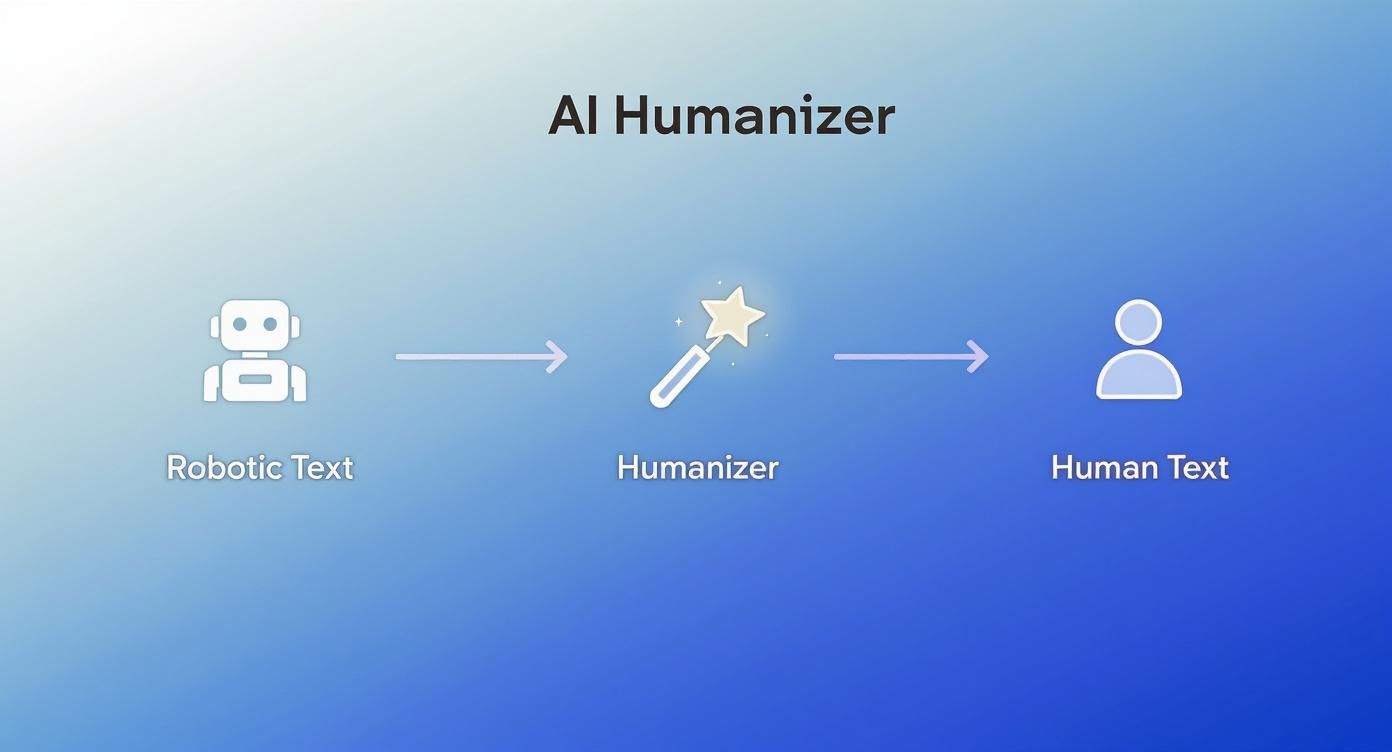
This transformation hinges on two core concepts that AI detectors are obsessed with: perplexity and burstiness.
Decoding Perplexity: The Element of Surprise
Perplexity is just a fancy way of measuring how predictable your word choices are. AI models, trained on mountains of data, tend to pick the most statistically likely word to come next. Think of it like a musician who only plays the three most common chords—it’s technically correct but completely soulless.
Human writing is the opposite. We’re full of surprises. We use less common words, unexpected phrasing, and creative analogies that a machine would never think of. This unpredictability is a hallmark of human authorship.
An AI humanizer tool actively injects this element of surprise by:
- Introducing Nuanced Vocabulary: It swaps out tired AI buzzwords for more specific, less obvious synonyms that actually fit the context.
- Restructuring Sentences: It reworks phrasing to break free from common AI sentence structures, creating a more unique and original flow.
- Adding Idiomatic Language: Where it makes sense, it weaves in colloquialisms and idioms that AI models are too timid to use.
Mastering Burstiness: The Rhythm of Writing
Burstiness is all about the variation in sentence length and structure. Ever read a paragraph where every single sentence is about the same length? It feels flat and robotic because it has zero burstiness.
Now, think about how people actually talk. We use a mix of short, punchy statements and longer, more descriptive sentences. That natural rhythm is burstiness, and it’s a dead giveaway of human writing. Raw AI text almost always fails this test, producing paragraphs with an unnervingly uniform sentence length.
"A high-quality humanizer doesn't just rewrite text; it recomposes it. It's like a skilled editor who understands the statistical rhythm of human language and adjusts the AI's output to match that organic beat."
An AI humanizer creates burstiness by deliberately mixing things up. It might slice a long, complex sentence into two shorter ones for impact, or it might combine a couple of simple ideas into a more sophisticated sentence. This process of converting AI text to human text is what makes the content feel authentic enough to slip past detectors. The goal is to give the text a conversational rhythm that a machine just can’t replicate on its own.
By manipulating both perplexity and burstiness, a good humanizer doesn’t just put a mask on robotic text. It performs a deep-level transformation, rebuilding the content from the ground up to reflect the genuine patterns of human creativity. The result is content that not only bypasses detectors but is also far more engaging for the actual humans you want to reach.
The Evolving Tech Race Between Detectors and Humanizers
The relationship between an AI humanizer tool and an AI detector is a fascinating, high-stakes arms race. It’s a constant cat-and-mouse game where every advance from one side immediately sparks a countermove from the other. This isn't just about outsmarting software; it's a dynamic competition that's actively shaping the future of digital content.
This endless back-and-forth is what drives the technology forward. As one side builds a more complex lock, the other is forced to engineer a more intricate key.

The Detector’s Advantage: Training Data
AI detectors get their edge by training on massive datasets, learning to spot the subtle statistical fingerprints that large language models leave behind. They’re looking for tell-tale signs of AI, like predictable word choices (low perplexity) and overly uniform sentence structures (low burstiness). Early AI content was a dead giveaway because it was just so bland and formulaic.
In response, the first generation of humanizers were really just glorified paraphrasers. They’d swap some words around and jumble the sentence order, but the core statistical signature—the robotic "feel"—was still there. It didn't take long for detectors to adapt and see right through these superficial tricks.
That initial failure was a wake-up call. It forced humanizer technology to get much smarter, moving way beyond simple rewrites. The goal shifted from just rephrasing content to fundamentally rewriting its statistical DNA.
This constant cycle of innovation is critical. A tool that worked flawlessly six months ago might be easily flagged today. The best humanizers are those built by teams that understand this ongoing battle and continuously update their models to stay ahead.
The money involved in this race is staggering. The AI detector market alone was valued at $1.08 billion and is projected to explode to $13.68 billion by 2035. This growth, detailed in a report about the growth of the AI detector market on novaoneadvisor.com, isn't just a number; it’s proof of the escalating demand to tell human and machine-generated text apart. That pressure, in turn, fuels the need for even better humanization tech.
The Humanizer’s Countermove: Mimicking Chaos
To beat modern detectors, a top-tier AI humanizer tool has to do more than make text sound good. It has to learn to mimic the beautiful, often messy, chaos of human writing. We’re inconsistent. We use surprising turns of phrase, vary our sentence rhythms, and make creative leaps a machine would never predict.
Modern humanizers are engineered to replicate this exact unpredictability. They do it by:
- Deep Structural Analysis: Instead of just swapping words, they analyze the entire text to identify and dismantle robotic patterns from the ground up.
- Injecting Variability: They deliberately introduce a wider range of vocabulary and more varied sentence structures, cranking up the perplexity and burstiness to human levels.
- Preserving Coherence: This is the hard part—doing all of the above without muddying the original meaning or making the text confusing.
This technological duel is precisely why choosing the right tool is so important. A basic paraphraser has zero chance against today's detectors. You need a tool built with this arms race in mind—one that understands the detector's playbook and knows exactly how to pass AI detection by fundamentally altering the text's statistical signature. This ensures your content not only reads like it was written by a person but also stays ahead of the curve in a world filled with AI.
Who Uses AI Humanizers and What They Achieve
Knowing how an AI humanizer tool works is one thing, but seeing who’s using it—and why—is where it all clicks. These tools aren't just for a small corner of the tech world. They've become a critical part of the workflow for a huge range of people who need to create authentic, high-quality content without spending all day on it.
From the student in the campus library to the marketer at a fast-growing agency, the reasons for using a humanizer are surprisingly diverse. Each person has a unique problem to solve, and these tools are the bridge that turns a sterile AI draft into something genuinely effective.
Students Crafting Original Academic Work
For students, the pressure is always on to produce original essays and research papers. AI can be an incredible partner for brainstorming or getting a first draft down, but just hitting "copy-paste" is a recipe for disaster. Raw AI output often violates academic integrity policies and gets instantly flagged by detectors like Turnitin.
This is where an AI humanizer tool acts like a sophisticated editing partner. It helps students take those AI-assisted drafts and rework the clunky phrasing and predictable sentence patterns. The process helps them submit work that has a natural, academic tone and, just as importantly, avoids getting a false positive from an overly sensitive detector.
Here’s the breakdown for students:
- Improving Writing Flow: They can transform a choppy, machine-generated paragraph into a smooth, coherent argument that sounds like their own voice.
- Avoiding Detection: Humanizing the text aligns it with the statistical patterns of human writing, which lowers the risk of being unfairly flagged by campus software.
- Learning Better Writing: By seeing the changes a humanizer suggests, students can actually learn to spot and fix robotic patterns in their own writing. It becomes a learning tool.
The point isn't to cheat; it's to use AI as a collaborator. A humanizer is the final, crucial step that bridges the gap between a machine's draft and a student's own polished work.
This is a massive deal for upholding academic standards while still letting students responsibly use new technologies as a genuine learning aid.
SEOs and Marketers Driving Engagement
In the digital marketing universe, content is everything—but only if it actually connects with people. Google’s helpful content guidelines make it crystal clear: they prioritize content made for humans, not just algorithms. Raw, generic AI text almost always fails this test because it lacks any real depth or brand personality.
For SEO specialists and content marketers, an AI humanizer tool is a game-changer. It lets them scale up content creation without sacrificing the authenticity that builds trust and keeps people reading. In fact, recent research shows that 93% of creators now use AI to generate content faster, and humanizers are the key to making that content perform.
Marketers use these tools to hit specific goals:
- Enhance Readability: They turn dense, robotic blocks of text into conversational, easy-to-read copy. This keeps visitors on the page longer, which is a fantastic signal for SEO.
- Maintain Brand Voice: A humanizer can take a generic AI draft and tweak it to match a specific brand’s tone—whether it's witty and informal, or authoritative and professional.
- Improve SEO Performance: By creating content that genuinely helps and engages readers, humanized text aligns perfectly with Google's people-first ranking philosophy.
Ultimately, this lets marketing teams produce more blog posts, emails, and social media updates while ensuring every single piece feels authentic and adds real value to their audience.
Bloggers and Creators Preserving Their Voice
Independent bloggers, writers, and content creators are often a one-person show. They have to publish consistently to grow an audience, but the creative well can run dry. AI is a great way to blast through writer's block and speed up drafting, but the big fear is losing the unique, personal style that made people follow them in the first place.
An AI humanizer tool works like a personal editor, helping these creators refine AI-generated ideas into content that sounds like them. It keeps the core message but injects the nuance, rhythm, and personality their readers have come to expect.
For a blogger, this means they can generate a draft on a complex topic and then use a humanizer to make it sound like they wrote every word from scratch. It’s a workflow that dramatically speeds up content production, freeing them up to focus on big-picture strategy and community engagement without ever compromising the personal touch that defines their brand.
Choosing the Right AI Humanizer Tool for Your Goals
With so many AI humanizer tools popping up, picking the right one can feel like searching for a needle in a haystack. Let’s be honest: not all of them are created equal. Some are just glorified paraphrasers that barely scratch the surface, leaving your content vulnerable to detectors. Others, however, perform a deep, structural rewrite that can sail past even the toughest AI scanners.
Making the right choice really boils down to two things: understanding your specific goals and knowing what features actually matter. Are you a student trying to polish an essay without triggering Turnitin, or a marketer churning out blog posts at scale? The perfect tool for one is rarely the best for the other. A solid evaluation process helps you cut through the marketing noise and find a platform that genuinely works.

This decision is only getting more important. The AI agents market, which powers this tech, is exploding—growing from an estimated $3.52 billion to $7.38 billion and forecasted to hit an incredible $47.1 billion by 2030. This rapid growth means more innovation and more specialized tools are on the horizon, targeting specific fields like legal or medical writing.
Core Criteria for Evaluating Any Humanizer
Before you pull out your credit card, you need to put every potential tool through its paces. Don't get distracted by flashy features; focus on the outcomes that actually move the needle: performance, quality, and ease of use.
Here are the non-negotiables to look for:
- Detection Bypass Effectiveness: This is the big one. Does the tool consistently get past top-tier detectors like GPTZero, Turnitin, and Originality.ai? Look for a tool with a proven track record, not just bold claims.
- Output Quality and Coherence: Evading a detector is pointless if the final text is a jumbled, awkward mess. The humanized content absolutely must be readable, grammatically sound, and, most importantly, preserve the original meaning.
- User-Friendliness: The whole point of using a tool is to make your life easier. A clean, intuitive interface that lets you get the job done in a few clicks isn't a "nice-to-have"—it's a must.
- Customization and Control: Can you tweak the tone of voice? Even more critical, can you lock in specific keywords, technical jargon, or brand names to prevent them from being changed? For any professional use case, this feature is essential.
A truly great AI humanizer doesn't just swap out words; it protects your core message while elevating its delivery. The ability to lock key terms ensures that technical accuracy and brand identity never get lost in the shuffle.
By prioritizing these factors, you can quickly weed out the weaker options. To see a detailed comparison of top performers, check out our guide on finding the best AI to human text converter for various needs.
When it's time to weigh your options, a structured approach is your best friend. A simple checklist can help you compare different tools objectively and score them based on what matters most to you.
Evaluation Checklist for AI Humanizer Tools
This checklist provides a practical framework to score and compare different AI humanizer tools. Use it to keep track of your findings and make an informed decision based on your specific needs.
| Feature/Criteria | Importance (High/Medium/Low) | Questions to Ask | Your Notes |
|---|---|---|---|
| Detection Bypass Rate | High | Does it consistently pass GPTZero, Originality.ai, etc.? What success rate does the provider claim or demonstrate? | |
| Output Readability | High | Is the text natural and fluent? Are there awkward phrases or grammatical errors? Does it sound human? | |
| Meaning Preservation | High | Does the output retain the original intent and key information? Are nuances lost? | |
| Keyword/Term Protection | High (for SEO/Technical) | Can I prevent specific words (brand names, technical terms, keywords) from being altered? How easy is this to do? | |
| Ease of Use (UI/UX) | Medium | Is the interface intuitive? How many clicks does it take to get a result? Is there a steep learning curve? | |
| Customization Options | Medium | Can I adjust the tone, style, or complexity of the output? Are there different "modes" for humanization? | |
| Speed and Performance | Medium | How quickly does it process the text? Does it handle large documents well? | |
| Privacy Policy | High (for sensitive content) | Does the tool store my data? Is my content used for training? Is the connection secure? | |
| Pricing and Value | Low | Does the pricing model fit my usage (e.g., subscription, pay-as-you-go)? Are the word limits reasonable? |
Once you've filled this out for a few contenders, the right choice often becomes much clearer. The tool that scores highest on your "High" importance criteria is likely your best bet.
How HumanText.pro Stacks Up
When you apply this framework, a tool like HumanText.pro really begins to shine, because it was built from the ground up to nail these core criteria. It’s designed for users who can't compromise on performance or quality but don't want to deal with a complicated setup.
Here’s a quick look at how it aligns with our evaluation points:
- High Bypass Rate: HumanText.pro is engineered to achieve up to a 99% bypass rate against the industry's toughest detectors. This isn't just about swapping synonyms; it uses advanced linguistic models to fundamentally change the text's statistical patterns.
- Meaning Preservation: The platform's core algorithm is obsessed with maintaining the intent and clarity of your original message. It restructures sentences and rephrases ideas without gutting the substance of your content.
- Instant and Simple Workflow: The interface is deliberately minimalist. You paste your text, see an instant AI score, and click one button to humanize. There's no learning curve, which means you can get results in seconds.
- Privacy-First Approach: This is huge for students and professionals. HumanText.pro does not store or share your content, period. Your work remains completely confidential.
This blend of high-powered performance and user-centric design makes it a reliable choice for anyone trying to bridge the gap between AI-driven efficiency and authentic, human communication.
Answering the Tough Questions About AI Humanizers
Even when you get what an AI humanizer tool does, it's normal to have some lingering questions. This technology is a mash-up of efficiency, creativity, and ethics, and using it the right way means getting straight answers. Let's tackle the biggest concerns people have before they jump in.
We'll cut through the noise and give you clear explanations so you can use this tech confidently and feel good about it.
Is Using an AI Humanizer Tool Considered Cheating?
This is the big one, and the honest answer is: it all comes down to your intent. There’s a world of difference between using a tool to mislead someone and using it to make your work better.
Think about it like this: is using a grammar checker like Grammarly cheating? What about hiring a human editor? Most of us would say no. These are tools for polishing a final product. An AI humanizer tool fits right in that category when you use it responsibly.
For professionals—marketers, bloggers, SEO specialists—it’s a productivity machine. It helps turn a robotic AI draft into something that actually sounds like your brand, and it does it fast. It’s about efficiency, not faking it.
The ethical line gets crossed when the goal is to deceive. If you use a humanizer to pass off a fully AI-generated essay as your own for a grade, that’s almost certainly a violation of academic integrity. It’s all about being transparent and following the rules of your school or industry.
For students, the smart way to use it is as a super-powered editing assistant. It can help you smooth out AI-assisted drafts to meet originality standards and, just as importantly, avoid getting flagged by over-sensitive detectors. The goal should always be to elevate your own ideas, not replace them.
Can Any Tool Guarantee 100% Undetectable Content?
Be very, very skeptical of any tool that promises a 100% guarantee forever. That’s a promise no one can actually keep.
The relationship between AI detectors and humanizers is a constant game of cat and mouse. As detection algorithms get smarter, humanizers have to evolve right alongside them. A tool that dodges every detector today might need an update six months from now to stay on top.
That said, high-quality humanizers are incredibly effective against current detectors because they do so much more than just swap out a few words. They go deep, changing the text’s statistical fingerprint—its perplexity and burstiness—to mirror the natural, sometimes unpredictable rhythm of human writing.
The best approach is to treat a humanizer like a powerful partner, not a magic wand.
- Let it do the heavy lifting: It can handle the deep structural and stylistic rewrites that are hard to do manually.
- Always do a final review: Read through the output and sprinkle in your own personal touch. This is your chance to fix any minor awkward phrases and make sure it’s perfect.
That final human pass is what really cements the content's authenticity and makes sure it stands the test of time.
Will Google Penalize Humanized AI Content?
This is a huge worry for anyone working in SEO and content marketing. The short answer is no—Google won't penalize your content just because an AI humanizer tool was part of the process.
Google has been pretty clear about their stance: they reward "helpful, reliable, people-first content," no matter how it’s made. Their algorithms are built to find and rank content that actually gives users value, not to police the writer's toolkit.
The problem with raw, unedited AI text is that it often fails the "helpful content" test. It can be generic, repetitive, and lack any real insight. It’s content written for machines, not people. An AI humanizer actually helps fix this. By making the text more readable and natural, it can improve user engagement signals like how long people stay on your page—which is a great thing for SEO.
When you use a humanizer to refine an AI draft and then add your own expertise and unique ideas, you’re creating exactly the kind of high-value content Google wants to rank.
What Is the Difference Between a Paraphraser and an AI Humanizer?
On the surface, they might look similar, but a basic paraphraser and a true AI humanizer tool are playing completely different games. Confusing the two is a common mistake that leads to clunky writing and content that still gets flagged.
A simple paraphraser is really just a fancy thesaurus. It just swaps words and phrases with synonyms. This often makes sentences sound awkward and unnatural, and it does absolutely nothing to change the underlying statistical patterns that AI detectors are looking for.
An AI humanizer, on the other hand, is doing a much deeper, more sophisticated rewrite.
- It re-engineers sentence structures: It mixes up sentence length and complexity to create a natural rhythm (that's burstiness).
- It makes word choice less predictable: It uses more interesting and nuanced vocabulary to add an element of surprise (that's perplexity).
- It alters the overall flow: It adjusts the cadence of the text so it sounds more like something a real person would write.
The goal isn't just to say the same thing in different words; it's to completely transform the text's statistical signature until it’s indistinguishable from human writing. It’s a much more complex process, and that’s what makes it the right choice for anyone serious about creating authentic, high-quality content.
Ready to transform your AI drafts into undetectable, human-quality content? HumanText.pro offers a powerful yet simple solution. Paste your text, check the AI score, and humanize it in a single click. Try it now and experience the difference for yourself at https://humantext.pro.
Ready to transform your AI-generated content into natural, human-like writing? Humantext.pro instantly refines your text, ensuring it reads naturally and authentically. Try our free AI humanizer today →
Related Articles

10 Blog Post Writing Tips That Get Results
Use these blog post writing tips to plan, structure, optimize, humanize, and promote posts that attract readers and drive action.

8 Animals That Fit “Animal with A”
Explore 8 memorable examples of an animal with a unique adaptation, from alpacas and axolotls to ants and aye-ayes, with creative prompts.

10 Creative Nonfiction Examples to Study
Explore 10 creative nonfiction examples with excerpts, craft analysis, techniques to emulate, essay tips, and practice prompts for stronger writing.

