AI To Human Text Your Guide to Authentic Writing
Master AI to human text conversion with our practical guide. Learn to edit AI writing for a natural voice, tone, and style that connects with real readers.
Converting AI to human text is all about taking that robotic, machine-generated content and breathing life into it. It’s the art of refining and editing until the text sounds natural, authentic, and genuinely engaging. You’re moving beyond the predictable, sterile patterns of raw AI output to add real personality and a human touch. It's a critical step if you want to actually connect with an audience and build their trust.
The Rise of AI and the Need for a Human Touch

AI-generated content has quickly become a standard tool in just about every content creator's kit, but its limitations are becoming painfully obvious. While tools like ChatGPT can pump out text at an incredible speed, the raw output often feels cold and completely misses the nuance that actually captivates human readers. This is where the skill of humanizing AI text becomes so valuable.
Since ChatGPT first launched, AI content production has absolutely exploded. By November 2024, an estimated 39% of all articles published online were generated by AI, officially surpassing human-written articles for the very first time. You can dig into the numbers in this eye-opening report on AI-driven articles. It shows just how baked-in these tools are to our workflows now.
Why Raw AI Content Falls Short
The problem isn't that AI is bad at writing. It’s that it mimics patterns without any real understanding, which results in content that screams "I was written by a robot." Without a human editor stepping in, these drafts can end up doing more harm to your brand than good.
Some of the dead giveaways of unedited AI text include:
- Predictable Phrasing: An over-reliance on clunky transition words like "furthermore," "moreover," and the dreaded "in conclusion."
- Lack of Personality: The text has no distinct voice, humor, or emotional depth. It's flat, making it almost impossible for readers to connect with.
- Monotonous Rhythm: Sentences often have a similar length and structure, which creates a boring, unengaging reading experience.
- Factual Inaccuracies: AI can state things that are flat-out wrong with complete confidence. You absolutely need a human expert to fact-check every single claim.
A thoughtful human editing process is what elevates a generic AI draft into a powerful piece of content that resonates with an audience, builds trust, and actually achieves its goals.
Ultimately, converting AI to human text isn’t about ditching the technology. It’s about creating a powerful partnership where the AI lays the foundation and a human provides the soul. If you're looking to really master this, our guide on how to make AI content undetectable offers even more practical strategies.
Spotting the Robot in Your Draft
Before you can start transforming AI-generated drafts into compelling, human-sounding content, you first have to learn how to diagnose the raw output. Think of yourself as a content detective, searching for the tell-tale clues that give away the text's machine origins.
This initial assessment is hands-down the most important part of the ai to human text conversion process. It builds your roadmap for every single edit you'll make.
Your First Stop: The AI Detector
The first stop for many writers is an AI detector tool like ZeroGPT. These platforms scan your text for patterns commonly found in large language models, spitting out a score that estimates the likelihood of AI generation.
While these scores are a decent starting point, don't treat them as a final judgment. Their real value is in flagging specific sentences or paragraphs that need the most help.
Here’s a look at an AI detector in action, highlighting the parts of a text that scream "robot."
See how the tool highlights specific phrases? That’s your visual cue for where a human reader is most likely to feel that robotic, uncanny valley effect.
Common AI Giveaways to Look For
Beyond automated tools, your own critical eye is your most powerful asset. AI models, for all their smarts, still fall into predictable habits. If you train yourself to spot these patterns, your editing will get faster and much more effective.
Keep an eye out for these classic signs of AI writing:
- Monotonous Sentence Rhythm: Read the text out loud. Seriously. Do the sentences all have a similar length and structure? AI often produces a steady, almost metronomic beat that feels unnatural and can bore a reader to tears.
- Overly Formal Transition Words: AI has a weird love affair with words like "furthermore," "moreover," "in addition," and "consequently." While these words have their place, overusing them makes the writing feel stiff and academic instead of conversational and engaging.
- Repetitive Phrasing and Ideas: You'll often spot the same concept explained multiple times using slightly different wording. AI has a habit of padding its output by rephrasing points, which leads to a bloated, redundant draft that lacks any real punch.
Key Takeaway: Your goal isn't just to fool a detector; it's to create a genuinely better reading experience. Use AI scores as a guide, but always trust your gut to identify passages that just don't have a natural, human flow.
This diagnostic phase sets the stage for making edits that actually matter. The table below breaks down the typical characteristics of raw AI output versus the qualities you should be aiming for in your revisions.
AI Text vs Human-Edited Text Characteristics
Here's a quick cheat sheet comparing the raw material you start with against the polished final product you're aiming for.
| Characteristic | Typical AI-Generated Text | Effective Human-Edited Text |
|---|---|---|
| Tone | Often neutral, formal, and lacking personality. | Distinctive, engaging, and aligned with a specific brand voice. |
| Sentence Structure | Repetitive and predictable, with similar lengths. | Varied and dynamic, mixing short, punchy sentences with longer, more complex ones. |
| Word Choice | Uses generic vocabulary and clichéd transition words. | Employs specific, vivid language, including idioms and colloquialisms where appropriate. |
| Flow | Can feel disjointed or overly structured with formulaic introductions and conclusions. | Seamless and logical, guiding the reader naturally from one idea to the next. |
By using this checklist approach—marrying automated detection with your own editorial judgment—you can systematically hunt down every robotic element in your draft. This clears the path for the next phase, where you'll start injecting the personality and nuance that only a human can provide.
How to Give Your Content a Human Voice
Once you've spotted the robotic weak spots in your draft, the real work begins. This is where you move past simple grammar fixes and into the art of stylistic editing, shaping the text to reflect a genuine, human personality. The goal is to make the content not just readable, but relatable.
This process involves a few key strategies, from mixing up your sentence structure to weaving in personal stories. It’s all about adding the color, rhythm, and nuance that AI models just can't replicate on their own.
A simple workflow can help visualize the core steps: draft your initial AI text, detect its robotic elements, and then revise it with a human touch.
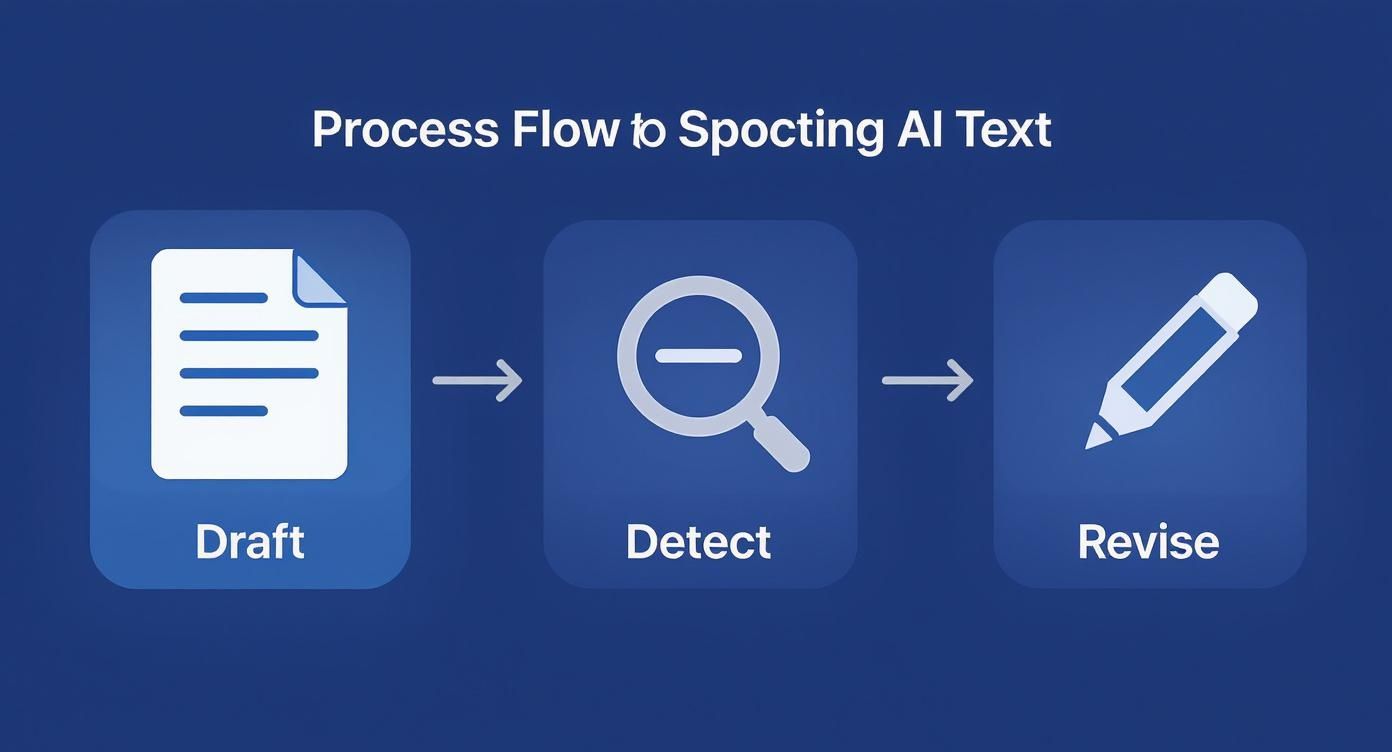
This visual drives home a key point: turning AI into human text isn't a one-and-done fix. It’s a cycle of refinement where each revision brings the content closer to sounding like something a real person would say.
Vary Your Sentence Structure
One of the fastest ways to sound less like a machine is to break up monotonous sentence patterns. AI often churns out paragraphs where every sentence has a similar length and structure, creating a dull, predictable rhythm that can send readers to sleep.
To fight this, consciously mix things up. Follow a long, descriptive sentence with a short, punchy one. This contrast creates a more dynamic and engaging flow that keeps your reader hooked.
Before (AI-Generated): Digital marketing is an essential component for modern businesses. It allows companies to reach a broader audience through various online channels. This strategy is important for growing brand awareness and driving sales.
After (Human-Edited): In today's market, digital marketing is non-negotiable. It’s how you connect with a massive online audience. Simply put, it grows your brand and drives sales.
See how the edited version feels more energetic and direct? That’s the power of varied sentence flow.
Inject Personality with Anecdotes and Idioms
AI-generated text has no lived experience. It can't share a personal story, make a witty observation, or use a colloquialism that makes the reader crack a smile. This is your biggest advantage as a human editor.
Try weaving in short, relevant anecdotes or personal insights. Instead of saying "it is important to be persistent," you could share a quick story about a time persistence paid off for you. This makes abstract concepts feel concrete and real.
Your personal stories are what make your content unique and memorable. An AI can state facts, but only you can share the wisdom gained from experience, building a much stronger connection with your audience.
On top of that, don't shy away from idioms and figures of speech. Phrases like "bite the bullet" or "a blessing in disguise" add a layer of cultural texture and personality that AI struggles to get right. They make your writing feel more conversational and less like a textbook.
Cut the Robotic Filler and Formalities
AI models are trained on massive datasets, including a lot of formal and academic writing. As a result, they often use unnecessary filler words and overly stiff language that weighs the text down. Be ruthless in cutting it out.
Scan your draft for fluff words and phrases that add zero real value.
- In order to -> To
- It is important to note that -> (Just state the point)
- For all intents and purposes -> Essentially
- Furthermore / Moreover -> And / Also / Or just start a new sentence
The sheer volume of AI-generated content is staggering. By 2025, AI is expected to be deeply embedded in professional life, with over 90% of tech workers using AI tools in their jobs. With ChatGPT alone hitting 800 million weekly active users, the amount of AI text being created is immense, making the need for a human touch more critical than ever. You can dig into more data on the incredible global growth of AI tools. Trimming this robotic language is the first step to making your content stand out from the noise.
Using AI Tools to Humanize Your Writing Faster
Let's be honest: manually editing every single sentence of an AI draft can be a soul-crushing, painstaking process. While your human oversight is absolutely essential for creating quality content, you don't have to tackle the entire rewrite from scratch.
A much smarter workflow is to use an AI-powered humanizer for a strategic first pass. This is how you speed things up without cutting corners.
Think of these tools not as a magic "fix-it" button, but as a skilled collaborator. They're fantastic at breaking up the repetitive sentence structures and predictable vocabulary that AI models tend to overuse. This gives you a much stronger foundation to build on, saving you a ton of time on the initial heavy lifting.
The Strategic Humanizer Workflow
The most effective way to use an AI humanizer is to make it part of a bigger editing process. You start with your raw AI draft, run it through the humanizer, and then you step back in as the final editor and creative director.
This approach blends the raw speed of automation with the critical judgment and nuance that only a human can bring.
Your role shifts from grunt-work rewriting to high-level refining. You're checking for contextual accuracy, making sure the brand voice is spot on, and adding those final, unique touches that make the piece truly yours. It’s a powerful way to accelerate the conversion of ai to human text without sacrificing an ounce of authenticity.
A great example of a tool designed for exactly this is HumanText.pro.
As you can see, the interface is dead simple. You paste your text, the tool generates a humanized version, and you get a fantastic starting point for your final polish.
Why This Blended Approach Works
This method is so efficient because it plays to the strengths of both human and machine. The AI handles the tedious, mechanical tasks of rephrasing and restructuring, while you get to focus on the high-level creative and strategic elements that actually connect with an audience.
This hybrid workflow isn't about letting AI do all the work. It's about intelligently delegating the most robotic parts of the editing process so you can focus on adding genuine value, personality, and insight.
The growth in this space is undeniable. The generative AI market, which includes a heavy focus on AI-to-human text tools, is exploding. It grew to around $44.9 billion in early 2025 and is projected to blast past $356 billion by 2030. You can dig deeper into these impressive generative AI market trends and what they mean for creators.
This rapid expansion signals a clear demand for tools that bridge the gap between machine efficiency and human creativity. As you refine your own process, you'll probably want to compare different humanizers. Check out our guide on the best AI to human text converter tools available to see which one fits your specific needs. By slotting the right tool into your workflow, you can produce high-quality, authentic content in a fraction of the time.
The Final Polish for Truly Human Content

After all the rewriting, stylistic tweaks, and structural changes, it's tempting to call it a day. But there’s one last phase that separates good content from truly great content: the final quality check.
This isn't just about scanning for typos. It's your last chance to make sure the text feels genuinely human-crafted and is ready to connect with a real audience. Skipping this step is like baking a beautiful cake and forgetting the frosting. It’s this final polish that solidifies the successful conversion from AI to human text.
The Power of Reading Aloud
One of the most effective yet overlooked editing techniques is simply to read your text out loud. Seriously. Your ears will catch awkward phrasing, clunky sentences, and unnatural rhythms that your eyes might just glide over. It forces you to slow down and experience the content the same way a reader would.
As you read, listen carefully for these tell-tale signs:
- Awkward Flow: Does one sentence stumble into the next, or is the transition smooth?
- Repetitive Rhythms: Do multiple sentences in a row have the exact same cadence and structure?
- Clunky Wording: Are there phrases that are just plain hard to say? If you trip over a sentence when speaking it, your reader will absolutely stumble over it in their head.
Hearing your words is the ultimate gut check for a conversational tone. If it sounds robotic when you speak it, it will feel robotic when someone reads it. This is your final test for a genuine human voice.
This simple auditory review helps you catch those last, lingering traces of AI stiffness that automated tools can’t always spot.
Final Verification and Pre-Publish Checklist
Before you hit "publish," it's a smart move to run your polished content through an AI detector one last time. This isn’t about chasing a perfect 100% score, but about validating all your hard work. Seeing a significantly lower AI probability score is concrete proof that your edits have successfully humanized the text.
Finally, a quick pre-publish checklist can prevent simple mistakes from undermining all your effort. A systematic final review ensures your content isn't just human-sounding, but also professional and authoritative.
- Proofread for Errors: Give it one last pass for any sneaky spelling, grammar, or punctuation mistakes.
- Confirm Brand Alignment: Does the tone, voice, and messaging perfectly match your brand's identity?
- Check for Clarity: Is every single point clear, concise, and easy for your target audience to understand?
This final check ensures your content is ready to make a real impact. For a deeper dive into making your text bulletproof, check out our detailed guide on how to avoid AI detection.
Got Questions About Humanizing AI Text? We Have Answers.
As AI-generated content becomes the new normal, the line between human and machine writing is getting blurrier by the day. It’s completely natural to have questions as you start navigating this new territory. It’s not just about how to do it, but why it even matters.
Let’s tackle some of the most common questions we hear from writers, marketers, and students trying to make sense of it all.
Does AI Detection Really Matter?
The short answer: It depends entirely on your goals.
For a student, submitting an AI-generated essay could set off academic integrity alarms in systems like Turnitin. For a content creator, the situation is a bit more complex. Google has been clear that it rewards helpful content, regardless of how it’s made. But your audience might not be so forgiving.
Many readers can just feel when they're reading something robotic, and that disconnect can seriously damage brand trust and engagement. Beyond that, some platforms might quietly downrank content that screams "automated." The real goal shouldn't be just tricking a detector—it should be creating a genuinely better experience for your reader.
Can’t I Just Use a Paraphrasing Tool?
Using a simple paraphrasing tool is a tempting shortcut, but they usually don't get you where you need to go. Most of these tools just perform a synonym-swap, which often results in clunky phrasing that butchers the original meaning. This approach rarely fixes the core problems with AI writing, like its monotonous sentence structure and total lack of personality.
A true AI humanizer does so much more than just rephrase. It completely reconstructs sentences, smooths out the flow, and adjusts the tone to create something that feels genuinely natural. It’s the difference between slapping a coat of paint on a crumbling wall and actually rebuilding the foundation.
What Makes Humanized Text So Much Better Anyway?
The benefits of humanizing AI text go way beyond simply flying under the detection radar. It’s about injecting the essential ingredients that make content actually connect with people.
- Authenticity: Humanized text has a real voice and personality, which is the bedrock of building trust with your audience.
- Emotional Connection: By weaving in stories, idioms, and a conversational tone, you can stir emotion and make your content stick in the reader's mind.
- Clarity and Nuance: A human touch catches the subtle contextual mistakes and weird phrasing an AI might miss, making sure your message lands exactly as you intended.
- Engagement: Varied sentence lengths and a dynamic rhythm are what keep readers glued to the page, lowering bounce rates and boosting the time they spend with your content.
Ultimately, you want to use AI for its incredible speed and efficiency, then layer on the creativity, empathy, and critical thinking that only a human can bring. That balanced approach is the real secret to producing amazing content at scale.
Ready to turn your AI drafts into undetectable, engaging content that connects? HumanText.pro uses advanced linguistic modeling to humanize your text in seconds, ensuring it sails past every major AI detector while sounding completely natural. Try it now and see for yourself: https://humantext.pro
Ready to transform your AI-generated content into natural, human-like writing? Humantext.pro instantly refines your text, ensuring it reads naturally and authentically. Try our free AI humanizer today →
Related Articles
AI Face Search Explained: Verify Identity and Stay Safe
Understand how AI face search works, including embeddings, accuracy, and legal issues. Learn to use these tools for personal safety and verify identity online.
Reverse Face Search: A Verification Safety Guide
Learn how reverse face search works, when to use it for safety, and how to pair it with AI image checks to verify online contacts and reused photos.
Face ID Search Explained: How It Works and How to Verify
Learn how face ID search works, why it differs from reverse image search, and how to verify identities and photos safely with practical checks and tools.

