
How to Ensure AI Content Is Clearly Labeled
Discover ethical strategies for making AI content clearly labeled and transparent, boosting trust and search visibility.
To get AI-generated content past the finish line, you first need to understand what you're up against. Think of AI detectors as pattern-recognition machines. They aren't just looking for plagiarism; they're hunting for the subtle, robotic fingerprints that AI models leave behind.
It all comes down to specific linguistic patterns, like predictable word choices (low perplexity) and painfully uniform sentence structures (low burstiness). That’s the stuff that screams "machine-written."
Why AI Detectors Can Spot Machine-Written Text

AI content detectors are trained on enormous datasets containing both human and AI text. This process teaches them to sniff out the tell-tale giveaways of a large language model (LLM).
They’re laser-focused on two core concepts:
- Perplexity: This is just a fancy term for how predictable a text is. AI models are trained to pick the most statistically likely next word, which often results in safe, uninspired language. Humans? We’re messy. We use unexpected metaphors, weird turns of phrase, and creative word choices that make our writing less predictable—and give it a higher perplexity score.
- Burstiness: This measures the rhythm and flow of writing. Humans write in bursts. We mix short, punchy sentences with longer, more complex ones. AI, on the other hand, tends to produce sentences of similar length and structure, creating a flat, monotonous cadence that detectors can easily flag.
The Arms Race Between Generation and Detection
It’s a constant cat-and-mouse game. As AI writing tools get smarter, so do the algorithms designed to bust them. This means you can't just hit "generate," copy, and paste anymore. Not if you care about authenticity.
An extensive case study recently put this to the test, running content from 14 popular AI writers through 11 different detectors. The results were pretty eye-opening. Even top-tier models like GPT-4o and Claude Sonnet got flagged, with detection rates soaring over 64%. The takeaway is clear: no AI tool can perfectly evade detection on its own.
This reality check proves that making AI content undetectable isn't about finding a magic tool. It's about a strategic editing process—one that injects the natural chaos of human writing back into the text.
The goal isn't just to fool a machine; it's to create content that genuinely connects with a human reader. When you focus on clarity, voice, and value, you naturally fix the very patterns that AI detectors are looking for.
Common AI Flaws That Trigger Detectors
To help you see exactly what these detectors latch onto, here’s a quick breakdown of common AI patterns and how to fix them.
AI Detector Triggers and Human Fixes
| Common AI Content Trait (Detector Trigger) | Why It Gets Flagged | How to Humanize It |
|---|---|---|
| Uniform Sentence Length | AI defaults to sentences of similar length, creating a robotic, monotonous rhythm (low burstiness). | Mix it up. Write a short, punchy sentence. Follow it with a long, descriptive one. Vary the cadence. |
| Predictable Word Choice | Models choose the most statistically probable words, avoiding unique slang, jargon, or creative phrasing (low perplexity). | Swap out generic verbs for stronger ones. Weave in personal anecdotes, industry-specific terms, and metaphors. |
| Overly Formal Tone | The default AI tone is often sterile and academic, lacking personality, humor, or a distinct point of view. | Inject your own voice. Ask questions. Use contractions. Add a bit of humor or a strong opinion. |
| Repetitive Transitions | Overusing words like "Moreover," "Furthermore," and "In conclusion" creates a formulaic, clunky flow. | Read it aloud. Use more natural transitions like "But here's the thing..." or simply start a new paragraph. |
| Lack of Personal Experience | AI generates information but lacks genuine stories, opinions, or first-hand insights. | Add a personal anecdote. Share a real-world example from your own experience. State a clear opinion. |
Knowing these triggers is the first step to dismantling them. When you understand what the detectors are looking for, you can start editing your AI-assisted content with a clear purpose.
For a deeper dive into the specific editing techniques that work, check out our complete guide on how to pass AI detection.
The Manual Art of Humanizing AI Text
While tools offer a tempting shortcut, the most reliable way to create truly undetectable AI content is by rolling up your sleeves and editing it yourself. This isn't about a quick spell-check. It's about fundamentally reshaping the text, infusing it with your unique human perspective.
Think of your AI draft as a block of marble. The basic shape is there, but it’s your job to chisel away the robotic edges and reveal the authentic piece within. This hands-on process transforms a sterile draft into a compelling article that not only sails past detectors but actually connects with your readers.
Inject Your Unique Voice and Personality
AI-generated text almost always lacks a distinct point of view. It’s informative but sterile, spitting out facts without the flavor of real-world experience. Your first and most important job is to inject your personality into the copy.
- Drop in Personal Anecdotes: Share a brief, relevant story from your experience. Instead of a flat statement like, "It's important to vary sentence structure," try something more personal: "I once spent an entire afternoon rewriting a single paragraph because it sounded so flat—that's when I truly learned the power of mixing short and long sentences."
- State Clear Opinions: Don't be afraid to take a stance. AI is trained to be neutral. Give the content a firm perspective with phrases like, "In my experience..." or "Here’s what I believe..."
- Use Industry-Specific Language: Every niche has its own lingo. Weaving in jargon or slang that your target audience uses makes the content feel more authentic and insider-driven.
This step is critical, especially now. The web is becoming saturated with machine-generated text. Current estimates suggest 30% to 40% of text on active web pages is already created by AI, with some projections nearing 90% by the end of the year.
However, as highlighted in these AI detection trends at Wellows.com, content that blends human edits with AI output seriously complicates detection accuracy.
Master Sentence Structure and Rhythm
One of the biggest giveaways of AI content is its monotonous, predictable rhythm. AI models tend to produce sentences of similar length and structure, creating a robotic flow that detectors easily flag. This is known as low burstiness.
To fight this, you need to intentionally vary your sentence structure.
Pro Tip: Read your content out loud. Your ears will catch the unnatural, repetitive cadence that your eyes might miss. If it sounds boring to say, it will be boring to read.
Think about how you talk. In a real conversation, you naturally mix short, punchy statements with longer, more descriptive thoughts. Your writing should do the same. Break up long, complex sentences. Then, combine a few simple ideas into a more elaborate sentence to add depth. This creates a natural ebb and flow that mimics human speech.
Refine Your Vocabulary and Word Choice
AI models are trained to pick the most statistically likely word, which often results in safe, predictable, and frankly, dull language. This is where your creativity becomes your biggest asset.
Your goal is to replace common, overused words with more vivid and surprising alternatives. Don’t just swap synonyms; think about the connotation and emotional impact of each word.
Take this bland, AI-generated sentence:
- "AI can help businesses improve their marketing efforts."
Now, let's give it a human touch:
- "AI can supercharge a business's marketing, turning generic campaigns into hyper-personalized conversations."
See the difference? "Supercharge" is far more dynamic than "help," and "hyper-personalized conversations" paints a much clearer picture than "marketing efforts."
For more advanced techniques on this, our full guide on how to humanize AI-generated text dives deeper into applying these principles at scale. This manual refinement is the final, crucial step in transforming an AI draft into something truly your own.
Using Tools for a Smarter Hybrid Workflow
Let’s be real. Editing AI text by hand is the gold standard for quality, but it’s not always practical when you’re staring down a deadline. This is where a smarter, hybrid workflow can be a lifesaver, combining the raw speed of AI generation with the critical final touch of human insight.
The goal here isn't to just use a basic paraphrasing tool. Those often just swap out synonyms, which can make the text sound even more clunky and unnatural. Instead, the modern approach uses specialized AI humanizer tools built to fix the core issues that trigger AI detectors—things like predictable sentence structures and a robotic vocabulary. They analyze the text for tells like low perplexity and then intelligently rework it to mimic the flow of natural human writing.
This creates a powerful middle step between getting your first draft and doing the final polish.
Adopting a Three-Stage Hybrid Process
The most effective hybrid workflow breaks the task into three clear stages. Think of it as a content assembly line: start with a machine, refine with a smarter machine, and finish with your own creative expertise. This process can save you hours while producing content that’s far less likely to get flagged.
Here’s what that looks like in practice:
- Generate Your First Draft: Use your go-to AI writer to crank out the initial version. The focus here is on getting the core ideas, research, and structure down on the page. Don't sweat the small stuff like tone or flow; this stage is all about efficiency.
- Run It Through a Humanizer: This is the game-changing middle step. Copy the raw AI output and paste it into a dedicated humanizer tool. This is where the robotic patterns get smoothed out, sentence lengths get varied, and all that predictable phrasing gets replaced.
- Perform a Final Manual Polish: The humanizer gets you 80% of the way there, but that last 20% is where you add the real magic. This is your chance to inject personal stories, add brand-specific examples, double-check the facts, and make sure the tone is a perfect match for your voice.
This tiered approach gives you the best of both worlds: the scale of AI without sacrificing the authenticity that only a human can bring to the table.
Choosing the Right Tool for the Job
Heads up: not all "AI to human text converters" are created equal. Many simple spinners and paraphrasers can actually degrade the quality and mangle the meaning of your content. When picking a tool to add to your workflow, you need one that’s laser-focused on preserving the core message while shaking up the linguistic structure.
The infographic below shows the key principles that an effective humanizing tool focuses on to make AI text undetectable.
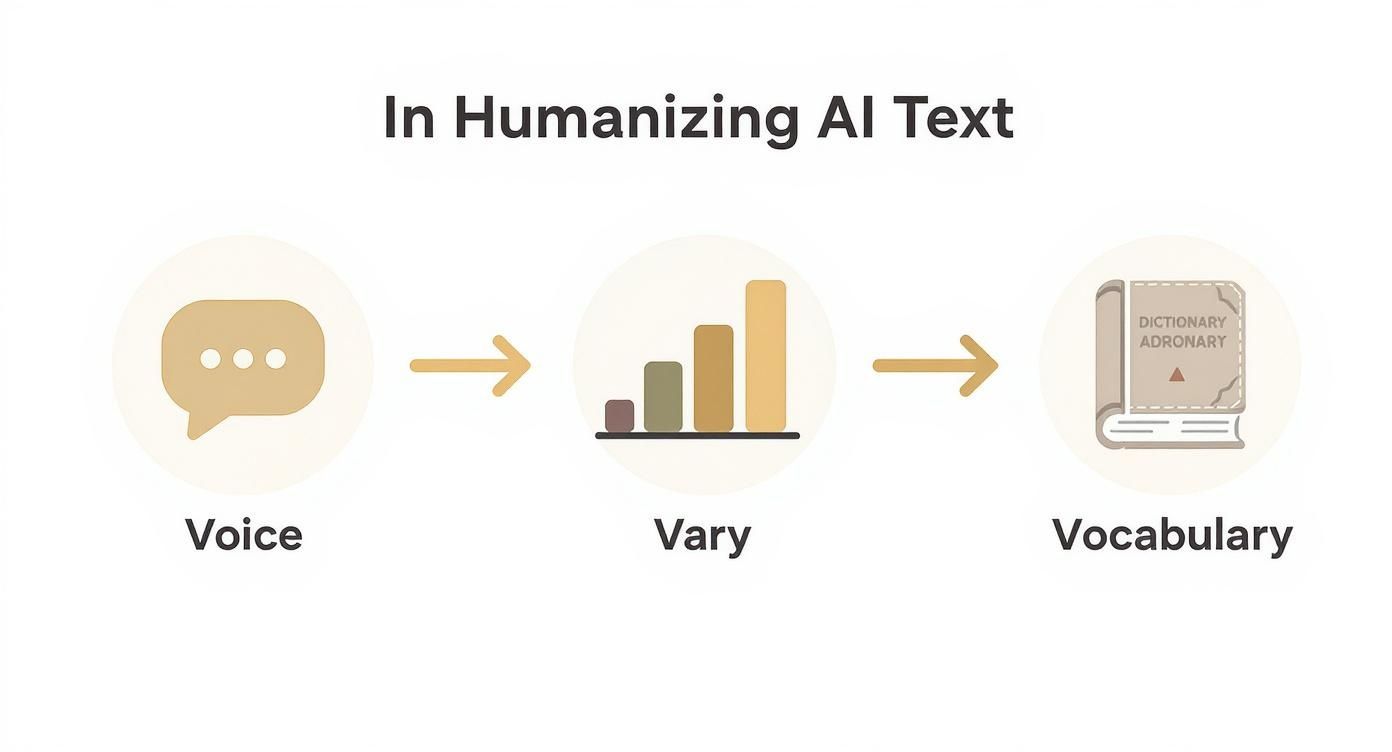
As you can see, this is about more than just swapping words. It's a fundamental shift in the text's voice, structure, and vocabulary to reflect actual human nuance.
The most powerful humanizer tools are those trained on vast datasets of actual human writing. This allows them to understand the subtle rhythms and unpredictable word choices that characterize authentic communication, making them far more effective than simple synonym-swappers.
This is exactly why your final manual review is so crucial. No tool can replicate your unique experiences or specific industry knowledge. For instance, a humanizer might make a paragraph about marketing sound more natural, but only you can add that real-world case study about a campaign you ran that either soared or flopped. That final layer of human insight is what makes the content truly unique and valuable.
As you explore your options, it pays to read reviews and comparisons to find the best AI to human text converter for what you need, whether it’s for academic writing, blog posts, or professional reports. This strategic blend of AI generation, tool-assisted humanization, and your final expert review is the key to producing high-quality, undetectable content at scale.
How to Test and Verify Your Content

You've done the hard work—editing, injecting personality, and restructuring your text. So, how do you know if it actually worked? You need a reliable way to check your content before hitting "publish."
This is your final quality control step. It’s about gaining the confidence that your content not only reads like a human wrote it but also sidesteps the tripwires that AI detectors look for. It's what separates a professional, polished piece from an amateur attempt.
Why You Should Never Rely on a Single Detector
Putting all your faith in one AI detector is a massive gamble. Each tool uses its own unique algorithm and is trained on different data, which means their results can be all over the map.
Seriously, you can paste the exact same text into two different tools and get wildly different scores. One might give you a glowing 100% human score, while another flags it as 60% AI. This doesn't mean the tools are broken; it just shows how complex and nuanced AI detection really is.
To get the real picture, you have to cross-reference your results. Think of it like getting a second opinion from a doctor before a major procedure.
- Run your text through at least two to three different detectors.
- Some of the most popular and respected options include GPTZero, Copyleaks, and Writer.
- Don't fixate on one perfect score—look for a general consensus.
If two out of three tools give you a high human score, you can feel much more confident that you're in the clear. This multi-tool approach helps you cover your bases and avoid the blind spots of any single algorithm.
Before we dive deeper, it's helpful to see how these tools stack up. They all approach detection a bit differently, and some are more prone to false positives than others.
Popular AI Detector Comparison
| Detector Tool | Primary Detection Method | Best For | Common False Positives |
|---|---|---|---|
| GPTZero | Measures perplexity (randomness) and burstiness (sentence variation). | General-purpose writing, academic papers, and identifying subtle AI patterns. | Can sometimes flag highly structured or formulaic human writing. |
| Copyleaks | Analyzes text for common AI markers and cross-references against a massive database. | Comprehensive detection, checking for plagiarism and AI in one go. | May flag content with common phrases or lists, even if human-written. |
| Writer | Focuses on stylistic patterns, word choice, and sentence structure common to specific AI models. | Marketing copy, corporate communications, and content from newer AI models. | Tends to be sensitive; can flag simple, direct human writing as AI-generated. |
| Originality.ai | A paid tool that uses a sophisticated algorithm trained to detect content from multiple LLMs. | SEO content, programmatic content, and agencies needing high accuracy. | Can be overly aggressive, sometimes flagging even heavily edited content. |
As you can see, each tool has its strengths and weaknesses. That’s why using a combination gives you a much more balanced and trustworthy assessment.
Interpreting the Results and What They Mean
Getting your scores back is one thing; knowing what to do with them is another. Chasing a perfect 0% AI score across the board is usually a waste of time. Why? Because even purely human-written text can sometimes trigger these detectors, especially if it's very concise or follows a standard format.
Instead of obsessing over perfection, aim to get your content into a "low-risk" zone.
A score that is 80% human or higher on multiple detectors is a strong indicator that your content has been sufficiently humanized. It shows you've successfully smoothed over the most obvious AI tells, like robotic sentence rhythms and predictable vocabulary.
These numbers give you a solid, data-backed check on your work. But remember, that's only half the battle. The scores tell you if you've dodged the algorithm, but they can't tell you if you've actually connected with your reader.
The Ultimate Verification: The Human Test
The most important check doesn't involve any software at all. It’s the simple, gut-level question: does this feel human? At the end of the day, you're writing for people, not for detection tools.
Ask yourself these final, critical questions:
- Does it sound like something a real person would say? Read it out loud. If you stumble over clunky phrases or the tone feels flat and monotonous, it still needs work.
- Does it offer real value and insight? Your content should do more than just list facts. It needs to answer your reader's questions with a unique perspective they can't get anywhere else.
- Does it make an emotional connection? Are there stories, opinions, or a distinct voice that makes the reader feel something?
This intuitive check is your ultimate seal of approval. It’s especially critical because people are surprisingly bad at spotting AI fakes on their own. Research on synthetic media found that humans correctly identify high-quality deepfake videos only about 24.5% of the time. You can read the full research about these deepfake statistics to see just how convincing AI has become.
When your content passes both the multi-tool algorithmic check and this final human test, you’ve got a winner—a piece that is not only undetectable but, more importantly, genuinely valuable to your audience.
Ethical Guidelines for Undetectable AI Content
https://www.youtube.com/embed/aGwYtUzMQUk
Being able to make AI content undetectable is a powerful skill, and it comes with real responsibility. Now that we’ve covered how to do it, we need to talk about why and when you should. The goal here isn't to deceive anyone. It's about using incredible tools to work faster and more creatively while keeping your integrity intact.
Think of it this way: the techniques in this guide are meant to help you transform a rough AI draft into a polished, high-quality piece that sounds like you. It's not about passing off a machine's work as your own where originality is a hard requirement.
Drawing a Clear Line in the Sand
The real ethical question isn't if you used AI, but how and for what purpose. There are some situations where trying to sneak past an AI detector is just plain wrong.
Here are the non-negotiable red flags:
- Academic Dishonesty: Submitting an AI-generated essay or report as your own work is fraud. It completely undermines the point of education and violates the academic integrity policies of pretty much every school on the planet.
- Creating Misinformation: This is a big one. Using these methods to pump out fake news, phony product reviews, or propaganda is dangerous. It's a harmful practice that erodes trust.
- Impersonation: Generating content that mimics a real person's writing style to trick people or misrepresent them is a massive ethical breach. Don't do it.
But for every misuse, there are dozens of legitimate, ethical ways to humanize AI text that are just part of a smart workflow.
The real distinction lies in intent. Are you using AI to assist and scale your genuine expertise, or are you using it to fake expertise you don't have? The former is innovation; the latter is deception.
Imagine a content marketer juggling three different company blogs. Using AI for first drafts lets them keep up with the workload. Humanizing that content ensures it meets the brand's quality standards, captures the right voice, and actually helps the reader. Here, the process is about efficiency, not dishonesty.
Aligning with Search Engine Guidelines
One of the biggest anxieties for marketers and creators is how Google feels about AI content. After years of speculation, their position is actually pretty straightforward.
Google doesn't penalize content just because AI was involved in creating it. Their focus has always been on the quality and helpfulness of the content, no matter how it was made.
Google’s guidelines reward content that shows E-E-A-T (Experience, Expertise, Authoritativeness, and Trustworthiness). Whether you wrote an article by hand or used an AI assistant for the first draft, the final piece is judged on the value it gives the reader.
It really boils down to this:
- Low-quality, unedited AI content that feels spammy or offers zero real insight will perform poorly. It always has.
- High-quality, human-edited AI content that is insightful, well-structured, and genuinely solves a searcher's problem will be rewarded.
The techniques for making AI content undetectable naturally push you toward what Google wants anyway. When you add personal stories, vary your sentence structures, and inject a unique voice, you’re inherently making the content better and more helpful for a human audience. That’s the whole game.
Transparency When It Matters
You probably don’t need to put a "written with AI assistance" disclaimer on every blog post. But in certain contexts, transparency is key to building trust.
If you're writing in a field where authority is everything—like medical, legal, or financial advice (often called YMYL or "Your Money or Your Life" topics)—being upfront about your process can actually strengthen your credibility.
Ultimately, the most ethical path is to treat AI as a powerful assistant, not a replacement for human knowledge, creativity, and judgment. Your primary goal should always be to produce the best, most helpful content for your audience. When you put their needs first, you'll find that ethical best practices and a winning content strategy are exactly the same thing.
Frequently Asked Questions
When you're navigating the world of AI content, a lot of questions pop up. It's totally normal. As the line between human and machine writing gets fuzzier, it pays to get clear on the details. Let's tackle some of the most common queries.
Can Google Detect AI Written Content?
Yes, Google can, but the real question is: do they care?
Google’s main game isn't about figuring out how you made your content. It's about whether that content is high-quality and genuinely helpful. Their spam-detection systems are built to find and bury low-value, spammy stuff—which, let's be honest, a lot of raw, unedited AI output qualifies as.
But when you use AI as a starting point and have a human expert come in to add real experience, unique insights, and a solid edit, that's a different story. Google is perfectly fine with AI-assisted content as long as it serves the reader well.
The bottom line: Google penalizes bad content, not AI content.
Is It Unethical to Make AI Content Undetectable?
This all comes down to intent. Think of it like any other powerful tool—it can be used for good or for bad.
Using humanization techniques to scale your blog with genuinely helpful articles is a smart, ethical use of technology. But using those same techniques to cheat on a school paper or spread misinformation? That’s clearly unethical.
The goal should always be to improve your workflow and create better content for your audience, not to trick them or pretend you have expertise you don't.
Which AI Content Detector Is the Most Accurate?
Here’s the tricky part: there is no single "most accurate" detector.
Every tool uses a slightly different algorithm and is trained on different data. This means you can run the same text through three different detectors and get three wildy different scores. One might say 80% AI, while another gives you a 95% human score.
This is exactly why you can't rely on just one tool. The best approach is to check your work across a few of the top platforms to look for a general consensus.
- GPTZero: A popular choice known for looking at "perplexity" and "burstiness."
- Copyleaks: A robust tool that bundles plagiarism checking with AI detection.
- Originality.ai: A paid tool that's a favorite among SEOs for its high sensitivity.
By triangulating the results, you get a much more reliable picture of how your content looks to these algorithms.
Can I Just Use ChatGPT to Rewrite Content?
Asking a model like ChatGPT to rewrite its own output is a common first step, but it rarely gets you all the way there. A simple rewrite might swap out some words and change a few sentences around, but it often just trades one set of AI patterns for another.
The new text might still have that unnaturally consistent sentence flow or use common AI phrases that the better detectors can spot. It’s a decent trick for a quick first pass, but it’s no substitute for a dedicated humanizer tool or a proper manual edit. Nothing beats a human touch for adding those personal stories, unique insights, and authentic voice that AI just can't fake.
Ready to turn your AI drafts into polished, high-quality content that sails past detectors? HumanText.pro uses sophisticated linguistic analysis to humanize your writing, preserving your core message while making it sound natural and authentic.
Try HumanText.pro for free and see the difference for yourself.
Ready to transform your AI-generated content into natural, human-like writing? Humantext.pro instantly refines your text, ensuring it reads naturally and authentically. Try our free AI humanizer today →
Related Articles
What Is AI Law and How It Shapes Content in 2026
What is AI law? Learn EU AI Act, US rules, liability and IP risks, plus practical steps for creators to stay compliant in 2026.

How to Write a Newsletter That Readers Trust
Learn how to write a newsletter that drives engagement. Master subject lines, mobile-first structure, AI humanization, and deliverability

How to Improve Writing Clarity That Actually Reads Well
Learn how to improve writing clarity with proven sentence-level edits, structure fixes, and before-and-after examples that make any draft sharper and more

