Your Guide to Using an Anti AI Detector Ethically
Discover how an anti AI detector works, why AI detection is flawed, and how to ethically create undetectable AI-assisted content for your projects.
An anti-AI detector isn't some shady hacking tool. It's simply software designed to take AI-generated text and tweak it so that it reads like it was written by a human, making it invisible to detection software. These tools are often called AI humanizers, and their job is to rewrite content by changing up the sentence structure, vocabulary, and rhythm to mimic a natural, human voice.
The Cat and Mouse Game of AI Content Creation
Welcome to the new reality of digital writing: a never-ending chase between AI content generators and the detectors built to sniff them out. Think of it as a high-tech cat-and-mouse game. Every time a new AI writing model comes out, a smarter detector isn't far behind. And right on its heels? An even better anti-AI detector. This cycle is the central challenge for writers today.
Let's be real—students, marketers, and creators are all using AI. It’s fantastic for getting unstuck, brainstorming ideas, and knocking out first drafts. The friction starts when that AI-assisted content needs to be submitted for a grade or published online. To be credible, it has to feel genuine. The problem is that raw AI text often leaves behind subtle "fingerprints," like predictable sentence patterns and a robotic lack of style, that detectors are built to find.
The Booming Detection Market
The scale of this back-and-forth is massive. Millions of articles, essays, and reports are scanned daily by tools plugged directly into academic platforms and content systems. This has kicked off a gold rush, creating a huge industry focused on spotting machine-written text.
Just how big is this market? According to one analysis, the global AI detector market was valued at USD 453.2 million and is expected to explode to USD 5,226.4 million by 2033. That reflects a jaw-dropping compound annual growth rate of 31.6%. You can learn more about these market projections and their impact.
This financial boom creates a powerful incentive for detectors to become even more aggressive, which, in turn, fuels the demand for effective humanization tools.
Finding a Path to Authenticity
The goal here isn't just about "beating" a piece of software. It’s about taking a useful but flawed AI draft and refining it into something that reflects real human thought and personality. This is exactly where tools designed to humanize text come in, bridging the gap between machine-like efficiency and human creativity.
Here’s what a typical anti-AI detector interface looks like, built for simplicity and speed.
The whole workflow is designed to be clean and intuitive: you paste your text, analyze it, and humanize it with one click. This is built for writers who need reliable results without a complicated process. At the end of the day, the challenge isn't just about getting a passing score; it's about reclaiming the natural voice in your writing.
How AI Detectors Spot Their Digital Fingerprints
To get around AI detectors, you first have to understand what they’re actually looking for. Think of AI-generated text as having a subtle but consistent “linguistic fingerprint.” It’s invisible to a casual reader, but it’s made of predictable patterns that specialized algorithms are trained to spot.
These tools aren't magic. They're just highly sophisticated pattern-recognition systems. They analyze text based on a couple of core principles that almost always separate machine writing from human writing. Once you get these principles, you'll see exactly where AI-generated content falls short—and why humanizing it works so well.
This map shows the push-and-pull relationship between AI content, the detectors built to sniff it out, and the humanizers designed to make it undetectable.
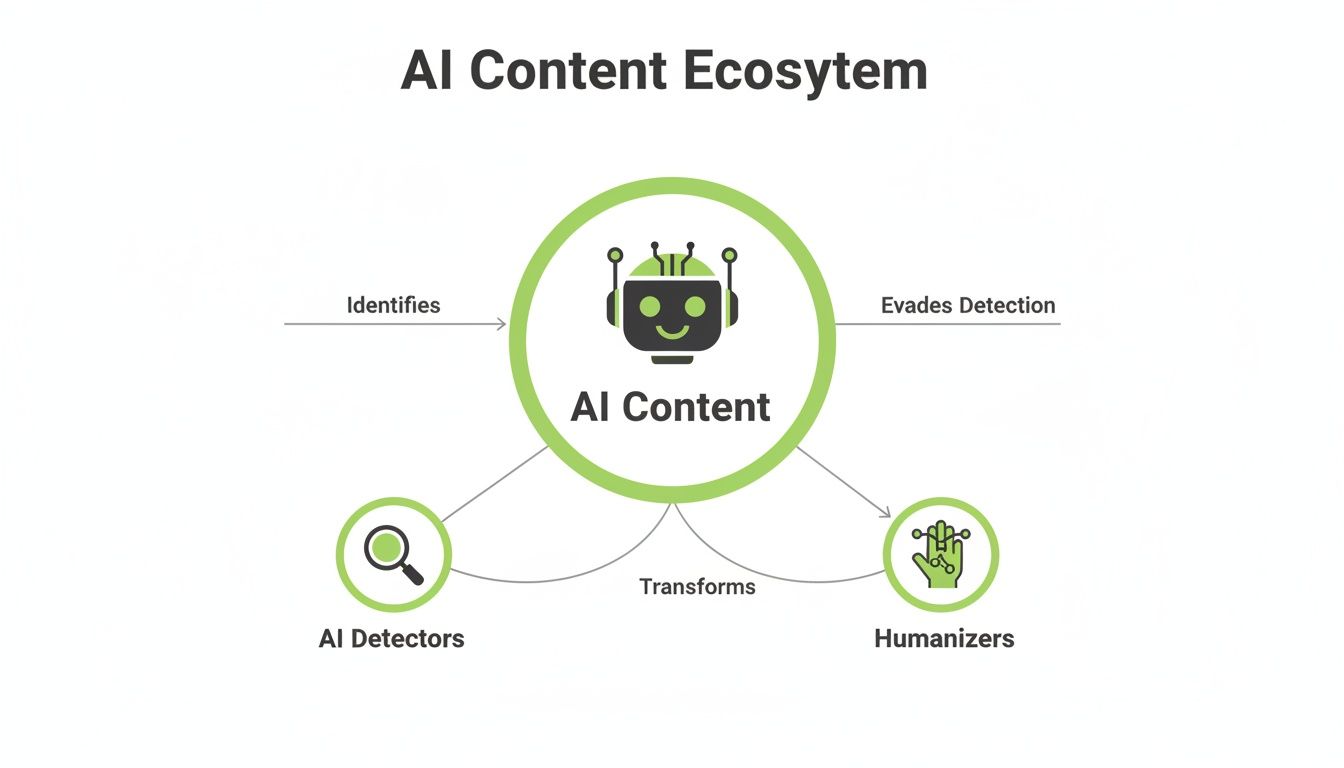
This whole ecosystem revolves around a central cat-and-mouse game: AI generates text, detectors scrutinize it, and humanizers refine it.
The Hunt for Predictability (Low Perplexity)
One of the biggest giveaways of AI content is how predictable it is. At their core, AI models are expert guessers. They’re trained to pick the most statistically probable next word, over and over again. This creates text that’s smooth and logical but often lacks any real spark or originality.
In technical terms, this is measured by perplexity. A low perplexity score means the text is very predictable, like a musician who only plays the same three chords in the same order. Human writing, on the other hand, is naturally more chaotic. It has a higher perplexity because we use unexpected words, weird phrasing, and creative sentence structures.
- Practical Example: An AI might complete the sentence "The sky is..." with "blue." It's the most common, statistically safe answer. A human writer, aiming for a more evocative tone, might choose "a bruised purple" or "the color of old television static." These less predictable choices increase perplexity.
Detectors are built to analyze this very quality. If a piece of writing is a little too perfect and its word choices are always the most obvious ones, it raises a red flag. It’s a classic sign that a machine was behind the keyboard.
Analyzing Sentence Variation (Burstiness)
Another key metric is burstiness. Human writing naturally ebbs and flows. We might write a few short, punchy sentences and then follow them up with a longer, more complex one. This variation in sentence length and structure creates a dynamic, engaging rhythm.
AI models? Not so much. They tend to produce sentences of a very uniform length and complexity. Their output is often steady and monotonous, lacking the "bursts" of creativity found in human prose. An AI detector measures this consistency; if the text is too flat, it's more likely to get flagged.
- Actionable Insight: After generating AI text, go through and intentionally break up the rhythm. Combine two short sentences into a longer one with a conjunction like "but" or "while." Then, take a long, complex sentence and split it into two or three short, impactful ones. This single editing pass can dramatically increase burstiness.
An effective anti-AI detector tool doesn't just swap out a few words. It intelligently restructures sentences, introduces varied rhythms, and breaks up that robotic uniformity to increase both perplexity and burstiness, making the text statistically indistinguishable from something a person wrote.
This detection arms race has been fueled by the sheer volume of AI content out there. ChatGPT's market dominance, for instance, has created a massive, uniform dataset for detectors to train on. In a recent year, ChatGPT held an incredible 60.2% of the global AI tool market share.
This has led to a surge in detection, with platforms like Turnitin reviewing 200 million student papers in a single year and flagging 11% of them for significant AI use. You can dive into more data on AI tool usage and its impact on Statista.com.
Common AI Detection Methods at a Glance
So, how do detectors actually pinpoint these digital fingerprints? They use several methods, and while the tech gets complicated, the basic approaches fall into a few main categories.
This table breaks down the most common techniques at a high level.
| Detection Method | What It Analyzes | Simple Analogy |
|---|---|---|
| Statistical Analysis | Predictability (Perplexity), sentence variation (Burstiness), and word frequency. | A music critic analyzing if a song is too simple and repetitive to be written by an experienced composer. |
| Classifier-Based Models | Complex, combined patterns learned from millions of human vs. AI writing samples. | A highly trained art expert who can spot a forgery by noticing thousands of tiny, subtle brushstrokes that don't "feel" right. |
| Forensic Analysis | Hidden metadata or digital artifacts left behind by a specific AI model. | A detective dusting for fingerprints at a crime scene. |
| Watermarking | Invisible signals or patterns embedded directly into the AI's output by its creators. | A hidden watermark on a banknote that's only visible under a special light. |
Each method has its strengths, but they all share a common vulnerability: they rely on patterns. And patterns can be intentionally disrupted. By understanding these techniques, it becomes much clearer how tools like ZeroGPT find their targets.
If you're interested in a deeper look at getting past a specific tool, check out our guide on how to bypass ZeroGPT detection.
Why AI Detector Scores Can Be Misleading
An AI detector's score can feel like a final verdict, but it’s far from infallible. These tools operate on probabilities, not certainties, which means their judgments are often just educated guesses. Relying on them completely is like trusting a weather app that’s only right some of the time—you might get sunshine, or you might get caught in a storm.
This built-in uncertainty leads to a significant and troubling problem: false positives. A false positive happens when text written entirely by a human is incorrectly flagged as being generated by AI. This isn't some rare glitch; it's a common flaw that can have serious consequences for students, writers, and professionals who suddenly find their authentic work unjustly questioned.
When Human Writing Looks Robotic
So, why does perfectly human work get mistaken for AI? The reasons often lie in writing styles that simply don't match what the detector considers "normal." Any strategy to navigate these tools must account for their inherent biases.
For instance, non-native English speakers often learn the language in a very structured, formal way. Their writing might naturally have lower "perplexity" and "burstiness"—the very traits detectors are trained to associate with machines. Similarly, writers in technical or academic fields are taught to be direct and precise, a style that can easily mimic the straightforward nature of AI-generated text.
Here are a few scenarios where human writers are at high risk of getting a false positive:
- Formal Academic Writing: Essays that follow strict structural rules and use formal language.
- Technical Documentation: Manuals or reports where clarity is prioritized over stylistic flair.
- Non-Native Speakers: Individuals whose sentence construction may be grammatically perfect but less varied.
A "100% Human" score isn't a guarantee of quality, just as a "90% AI" score isn't definitive proof of machine generation. These scores are merely data points, and they should be treated with healthy skepticism, not blind faith.
The Scale of the Problem
The explosive growth of AI detectors in education is a massive wake-up call. In a single academic year, Turnitin scrutinized 200 million papers and flagged 11% of them—that's 22 million documents—as containing more than 20% AI-generated content. While this highlights the scale of detection, it also underscores the immense pressure on students and the sky-high potential for error when millions of papers are scanned automatically.
When you're dealing with numbers that big, even a tiny error rate can affect thousands of individuals. A student could face accusations of academic dishonesty, or a professional writer could lose a client’s trust, all based on a flawed algorithmic score.
False Negatives: The AI That Slips Through
On the other side of the coin are false negatives, where AI-generated content successfully fools a detector and gets a "human" score. As language models become more sophisticated, their ability to mimic human writing improves, making them much harder to catch. This is especially true for content that's been lightly edited or passed through an AI humanizer.
The existence of both false positives and false negatives reveals a critical truth: AI detectors are simply not reliable enough to be the sole judge of a text's origin. They can be a useful tool for initial analysis, but their scores should never, ever override human judgment. For those looking to understand how humanizers work to combat these issues, you can learn more about whether undetectable AI truly works in our detailed guide. This context is crucial for anyone using AI-assisted writing tools responsibly.
Actionable Strategies for Humanizing AI Content
Knowing why AI detectors flag your content is half the battle. Knowing how to fix it is where the real work begins. Transforming robotic, predictable AI text into something that breathes with human personality isn’t magic—it’s about applying specific, hands-on writing techniques.
This is the playbook for turning a sterile first draft into compelling, authentic content that actually connects with readers and sails past detectors.
These manual strategies are the very foundation of how an effective anti-AI detector tool operates. Once you understand them, you'll appreciate the complex linguistic tweaks that humanizers apply automatically, saving you hours of tedious editing.
Master Sentence Structure and Flow
The number one giveaway of AI writing is its monotonous rhythm. AI models are trained on uniformity, so they often churn out sentences of similar length and structure, one after another. Your first job is to smash that pattern and introduce a natural cadence.
This is where you focus on increasing burstiness. Mix it up. Write a short, punchy sentence. Follow it with a long, flowing one that contains multiple clauses. That variation is the hallmark of human expression.
Before (AI-Generated):
"The implementation of new software systems can present significant challenges for organizations. Employees often require extensive training to adapt to the new workflows. This process can be time-consuming and may impact initial productivity levels."
After (Humanized):
"Rolling out new software is tough. Employees face a steep learning curve, and that adjustment period eats into productivity—it’s just part of the process."
The "after" version combines ideas, ditches the formal language, and varies sentence length, creating a far more engaging and human-like flow.
Inject Your Unique Voice and Personality
AI models don't have opinions, personal experiences, or a sense of humor. They can only mimic them based on training data. To truly humanize a piece of text, you have to infuse it with your own unique perspective. This is a critical step no machine can ever fully replicate.
Here’s how to do it:
- Add Personal Anecdotes: Share a brief, relevant story. Starting with "I remember a time when..." immediately signals a human touch. For instance, instead of saying AI improves workflow, describe a specific project where it cut your research time in half.
- Use Specific, Concrete Examples: Instead of saying "various factors," list them out. Ground abstract concepts in real-world scenarios your audience gets.
- Incorporate Idioms and Colloquialisms: Use phrases like "bite the bullet" or "a blessing in disguise." These are often too nuanced for AI to use correctly and naturally.
Interestingly, many of the principles for humanizing AI content overlap with general best practices for writing well. By focusing on voice and authenticity, you're not just bypassing detectors; you're becoming a better writer. For a deeper dive, explore these strategies for creating engaging content.
Diversify Your Vocabulary and Phrasing
AI models have a list of "favorite words." They lean heavily on certain formal and generic terms because they're statistically common in the data they were trained on. Your goal is to spot these repetitive words and swap them for more interesting, less predictable alternatives.
Think of it as adding seasoning to a bland dish. Ditch the dull verbs and adjectives for more dynamic ones.
| Common AI Word | Humanized Alternative |
|---|---|
| Furthermore | On top of that / Plus |
| Consequently | As a result / So |
| Crucial / Vital | Key / A must-have |
| In conclusion | To wrap it up / At the end of the day |
The best anti-AI detector techniques focus on making text less perfect. Human writing is filled with quirks, slightly unusual word choices, and intentional stylistic deviations. Embrace a little imperfection to achieve true authenticity.
Fact-Check and Add Critical Insight
Finally, never blindly trust the information an AI gives you. Language models are known to "hallucinate," confidently stating things that are flat-out wrong. The single most important humanizing step is to manually verify every single claim, statistic, and data point.
But don't stop at just being accurate. Go deeper by adding your own critical analysis.
- Question the AI's Output: Does this conclusion actually make sense? Is there another perspective to consider?
- Add Your Own Analysis: Explain why a particular fact matters or what its implications are. For example, if an AI states a market will grow by 10%, add your analysis on which specific segments will drive that growth.
- Connect Disparate Ideas: Draw connections between points that the AI was too linear to make.
This layer of human intellect and critical thinking is your ultimate defense against detection. It elevates the content from a simple summary of information into a valuable, insightful piece that is undeniably yours.
Navigating the Ethical Maze of AI Humanizers
The power of an anti AI detector tool raises a critical question: where does responsibility lie? On one hand, these tools are fantastic for polishing drafts and smashing through writer's block. On the other, they can be a shortcut to academic dishonesty. It's crucial to draw a firm line.
Think of an AI humanizer less like a magic wand that creates work from thin air and more like an incredibly advanced spell-checker. Its real job is to polish, clarify, and elevate text you've already conceptualized and structured. The core ideas, arguments, and insights have to start with you.
AI as a Launchpad, Not a Parachute
The most responsible way to approach AI humanizers is by treating AI-generated text as a starting point—a launchpad for your own thinking. AI is brilliant at spitting out a generic, foundational draft. It can summarize complex topics or outline key points in seconds, saving you a ton of time.
But that initial output is just raw material. Your job is to build on it, challenge its assumptions, and inject your unique perspective and analysis.
The ethical line is crossed the moment AI's contribution outweighs your own. If the final work doesn’t reflect your critical thinking, personal voice, and intellectual effort, you're no longer using a tool—you're delegating your responsibility.
This distinction is everything. Using an AI to help draft an outline or explain a tricky concept is just smart. But submitting a slightly rephrased AI essay as your own? That completely undermines academic and professional integrity.
The Pillars of Responsible Use
To stay on the right side of the ethical divide, stick to these guiding principles. They’ll help you use AI humanizers to improve your work without compromising your integrity.
- You Are the Author: The final piece must be a product of your intellectual labor. AI can help with sentence structure and word choice, but the analysis, evidence, and conclusions must be yours.
- Original Thought is King: Use AI to overcome a writing block, not a thinking block. The goal is to articulate your ideas more effectively, not to let the machine have the ideas for you.
- Fact-Checking is Non-Negotiable: You are 100% responsible for the accuracy of every claim in your work. AI models can and do make things up, so you have to verify every statistic, date, and fact on your own.
A Framework for Ethical Application
So, what does this look like in the real world? Let’s consider a couple of scenarios for ethically using an anti AI detector tool.
Ethical Use Case: A student uses ChatGPT to generate a summary of three different economic theories for an essay. She then writes her own analysis comparing and contrasting them. Finally, she uses an AI humanizer to refine her prose, ensuring it flows naturally and sounds human. Here, the AI served as a research assistant, but the critical thinking was entirely hers.
Unethical Use Case: A marketer generates an entire blog post with an AI tool, swaps a few words, and runs it through a humanizer to bypass detectors before publishing it as original content. This is basically plagiarism, as the core intellectual work was done by the machine, not the person.
By adopting this mindset, you can confidently use these powerful tools to become a more efficient and polished writer, all while keeping your integrity intact.
The Practical Application: An Anti AI Detector in Action
All the theory is great, but let's see how this works in the real world. This is where we go from abstract concepts to a hands-on look at how a tool can transform a flat, AI-generated paragraph into something that feels genuinely human. The whole process is built for speed and simplicity.
Let's start with a piece of text straight from an AI. It's clean, grammatically sound, and gets the point across. But it’s also a bit… lifeless. It has that predictable rhythm and safe word choice that AI detectors are trained to spot from a mile away. This is exactly the kind of writing that gets flagged for its robotic structure and low perplexity.
From Robotic to Realistic in Three Simple Steps
With a tool like HumanText.pro, the workflow is incredibly straightforward. The idea is to take that AI draft, let the technology pinpoint its machine-like traits, and then rewrite it to sound completely natural—all without changing the core message.
Here’s the breakdown in just three steps:
- Paste and Analyze: You kick things off by pasting your raw AI text right into the tool. It runs a quick scan and usually gives you a score showing how likely it is to be flagged by detectors.
- Humanize with One Click: This is the magic button. You hit "Humanize," and the algorithm gets to work. It’s not just swapping words; it’s restructuring sentences, varying the vocabulary, and tweaking the overall flow to make it less predictable.
- Review and Go: In seconds, you get the rewritten version. The output is ready to use, tweaked just enough to adopt the subtle quirks and nuances of human writing.
This image gives you a perfect before-and-after snapshot, showing how a high AI detection score gets flipped to a human one.

The real takeaway here is the dramatic shift in the text's DNA. The humanized version has more variety in sentence length and uses less common word combinations, making it statistically almost identical to something a person would write. To dive deeper into the tech that makes this possible, check out our full guide on the AI content humanizer.
Beyond a Single Tool
The benefits are clear: it's fast, easy, and it works. This shows how these tools can slide into an efficient and ethical writing process. While we’re focused on humanizers here, it’s worth remembering they are part of a much larger ecosystem of various AI content tools designed for all sorts of creative needs.
By handling the tedious parts of editing, an AI humanizer gives you back the time to focus on what really matters: the ideas, the arguments, and the unique insights that only a human can bring. It’s a smart way to polish AI-assisted drafts into truly authentic work.
Your Questions About AI Detectors, Answered
The world of AI writing and detection is full of gray areas. If you're feeling a bit lost, you're not alone. Let's clear up some of the most common questions we hear.
Can AI Detectors Ever Be 100 Percent Accurate?
Absolutely not. It's impossible for any AI detector to achieve 100% accuracy. These tools are built on probabilities and statistical patterns, not definitive proof. They're making an educated guess, not delivering a verdict.
This means they will always have a margin of error, leading to both false positives (flagging human writing as AI) and false negatives (missing AI-generated text). Things like your personal writing style, the topic's complexity, or even the specific AI model used can throw a detector off.
Think of a detection score as a suggestion, not a sentence. It's one data point that calls for a human review, not a final judgment. An anti-AI detector simply helps shift the text's statistical profile to look more like the patterns humans naturally create.
Is It Unethical to Use an Anti AI Detector Tool?
The ethics come down to one simple thing: your intent.
Are you using a tool to polish an AI-assisted draft, making it flow better and sound more like you? That's just smart editing. It’s no different from using a sophisticated grammar checker to refine your work.
But if your goal is to pass off 100% AI-generated work as your own original thought—especially in school or at work—you’ve crossed a line. The ethical approach is to use AI as a collaborator, not a ghostwriter. You supply the ideas, you have the final say, and you take responsibility for the finished product.
How Do AI Humanizers Actually Bypass Detection?
AI humanizers work by essentially reverse-engineering the detection process. They know what detectors are looking for and systematically dismantle those patterns.
They start by messing with the rhythm of the text, varying sentence lengths and structures to create more "burstiness"—that slightly unpredictable cadence of human writing. They also swap out common, high-probability AI word choices for less predictable vocabulary, which lowers the text's "perplexity."
In short, they take a piece of writing that is statistically too perfect and introduce the subtle, organic chaos that defines human expression, all without changing the core meaning.
Ready to turn your AI drafts into authentic, polished content that sails past detectors? With HumanText.pro, you can humanize your text with a single click, ensuring it sounds natural and is ready for your audience. Try it now and see the difference for yourself.
Ready to transform your AI-generated content into natural, human-like writing? Humantext.pro instantly refines your text, ensuring it reads naturally and authentically. Try our free AI humanizer today →
Related Articles
10 Different Words for Sad: Ranked by Intensity and Tone
Explore different words for sad, ranked by intensity, register, and context, with example sentences and usage notes for writers and students.
AI Detector Essay Checker: A Step-by-Step Guide
Learn to use an AI detector essay checker with practical steps for students and teachers. Verify text authenticity, interpret scores, and humanize AI content
10 Websites That Humanize AI Writing in 2026
Compare 10 websites that humanize ai writing by features, pricing, privacy, language support, and best use cases for writers, agencies, and educators.

