Understanding ZeroGPT: How AI Detectors Work and Transparent Content
Discover how ZeroGPT AI detectors work and how to create transparent, compliant content that reads naturally and earns trust.
To get past ZeroGPT, you need to think less like an algorithm and more like a human. This means rewriting AI-generated text to vary your sentence structures, sprinkle in unique vocabulary, and inject a personal, authentic tone. It’s a process of manual editing—adding those natural imperfections and using specialized tools to humanize the content. The goal is to steer clear of the predictable, sterile patterns that AI detectors are trained to spot from a mile away.
Why Bypassing ZeroGPT Is a Growing Concern

For students, writers, and marketers, figuring out how to navigate AI detection tools like ZeroGPT has become a common headache. The issue isn't about trying to be deceptive; it’s about fairness.
Plenty of people use AI as a writing assistant. It's great for brainstorming, smashing through writer's block, or just getting a basic structure down. The problem is, even heavily edited and originally conceived work can get incorrectly flagged as AI-generated.
This can lead to some serious fallout. A student could face academic penalties for an essay they genuinely wrote with a little AI help. A marketer might see their content get bounced by an automated platform check. Learning how to bypass ZeroGPT is really about making sure good, AI-assisted work gets judged on its own merit, not by a flawed algorithm. With the explosion of best AI writing software tools, this has become a bigger and bigger issue.
The Problem of False Positives
A huge driver of this concern is just how unreliable these detectors can be. While ZeroGPT talks a big game about its accuracy, real-world performance often tells a different story.
Despite claiming an impressive 98% accuracy rate, independent testing revealed that ZeroGPT actually detects AI-written content between only 35-65% of the time in real-world scenarios. More concerning for educators and content platforms, the tool demonstrates a high false positive rate of 66.64% when analyzing human-written text, meaning it frequently flags legitimate human content as AI-generated.
That high false positive rate is a massive problem. It means your completely original, human-written content can be misidentified, creating all sorts of unnecessary stress. The risk of being wrongly accused forces many people to look for ways to make their writing "detector-proof," even when it's entirely their own work.
Protecting Your Legitimate Work
At the end of the day, learning how to produce text that avoids detection is a defensive skill. It’s about making sure your hard work isn't unfairly shot down by a system that’s far from perfect.
This has become a crucial skill for anyone who responsibly integrates AI into their workflow. The whole point is to make the text align with the nuanced, varied, and sometimes imperfect style that humans write with—the very things that trip up detectors. An actionable insight here is to treat AI output as a rough first draft—never the final product. Your unique perspective and manual edits are what provide the true value and authenticity.
For a deeper dive, check out our guide on creating https://humantext.pro/blog/undetectable-ai to learn more about the specific techniques involved. As AI becomes just another tool in the modern writer's toolkit, proving your final product is authentic has become just as important as the writing itself.
How ZeroGPT Sniffs Out AI Content
To get your text past ZeroGPT, you first need to think like it. This isn't some black magic; it's a pattern-recognition game. Detectors like ZeroGPT have been trained on mountains of text—some written by humans, some by machines—and they’ve learned to spot the subtle fingerprints AI models leave behind.
Think of an AI as a student who's an absolute grammar nerd but has zero personality. It follows every rule to the letter, always picks the most statistically probable next word, and never takes a creative risk. This perfection is precisely what makes its writing feel sterile and, to a trained algorithm, incredibly suspicious.
The Tell-Tale Signs of AI Writing
ZeroGPT and its cousins are on the hunt for a few key linguistic signals that practically scream "robot."
The biggest one is low perplexity. It’s a technical term for something simple: the text is boringly predictable. AI models love common words and straightforward sentence structures because they are the safest statistical bet. It's the written equivalent of elevator music.
Another huge giveaway is a lack of burstiness. Humans are all over the place when we write. We’ll fire off a short, punchy sentence, then follow it up with a long, winding one full of clauses. AI, by default, tends to produce sentences of uniform length and rhythm, creating a monotonous drone that detectors can easily pick up on.
The great irony is that AI's biggest weakness is its consistency. It produces text that is so grammatically clean and structurally perfect that it stands out against the beautifully messy, varied, and imperfect nature of authentic human writing.
Practical Examples of Detection Triggers
Let's put this into perspective. It’s one thing to talk about theory, but seeing it in action makes it click.
- Typical AI Sentence: "The implementation of the new software system was completed successfully, resulting in a significant increase in operational efficiency for the entire organization."
- Human Equivalent: "We finally got the new software up and running. It was a grind, but wow, everything is moving so much faster now."
The AI version is technically perfect but completely soulless. It's stuffed with corporate jargon ("implementation," "operational efficiency") and feels like it was written by a committee. The human version is personal, uses a conversational tone ("wow," "grind"), and has a natural rhythm. It’s less “proper” but feels real, which is exactly the vibe you need to avoid getting flagged.
To make this even clearer, I've put together a table that breaks down the common signals that set off ZeroGPT's alarm bells. Understanding these differences is the key to humanizing your text effectively.
Common AI Writing Signals Flagged by ZeroGPT
| Detection Signal | Typical AI-Generated Pattern | Natural Human Writing Equivalent |
|---|---|---|
| Predictable Word Choice | Overuses common, high-frequency words without much flair. Think endless "utilize," "ensure," and "streamline." | Employs a richer, more diverse vocabulary, sprinkling in idioms, slang, or specific jargon where it feels right. |
| Uniform Sentence Structure | Sentences are often the same length and follow a monotonous subject-verb-object cadence. | Mixes short, direct statements with longer, more descriptive sentences to create a dynamic and engaging reading experience. |
| Flawless Grammar & Formality | Contains virtually no grammatical quirks, contractions, or casual phrasing, making it feel sterile and impersonal. | Often includes intentional fragments for effect, common contractions (like "it's" or "we'll"), and a more relaxed grammatical style. |
By really getting to grips with these core detection triggers—predictability, uniformity, and perfection—you can shift your editing strategy. You’ll stop just swapping out words and start actively dismantling the very patterns these algorithms are built to catch.
A Hands-On Method to Humanize Your AI Text
Knowing the theory is one thing, but making it work is another. Let’s walk through a repeatable process for taking a generic AI draft and turning it into something that can sail past ZeroGPT without a problem. The workflow is simple: start with a powerful first pass using an AI humanizer, then add your own strategic manual tweaks to really nail the authentic feel.
First, we need a typical piece of AI-generated text.
Before Humanization (Raw AI Output):
"The utilization of renewable energy sources is fundamentally important for mitigating the adverse effects of climate change. Solar and wind power represent viable alternatives to traditional fossil fuels, offering a sustainable path toward energy independence. Governments and corporations must collaborate to invest in the necessary infrastructure to facilitate this transition."
This paragraph is a perfect example of AI writing. It’s stiff, formal, and uses predictable words like "utilization" and "fundamentally." There's no voice, no rhythm—making it a dead giveaway for any detector.
The Initial Heavy Lifting with an AI Humanizer
Your first and most efficient move is to run this raw text through a good AI humanizer tool. Platforms like HumanText.pro are built to do this heavy lifting for you. They rewrite the content to introduce the very things detectors are scanning for: variations in sentence length, less predictable word choices, and a more natural cadence.
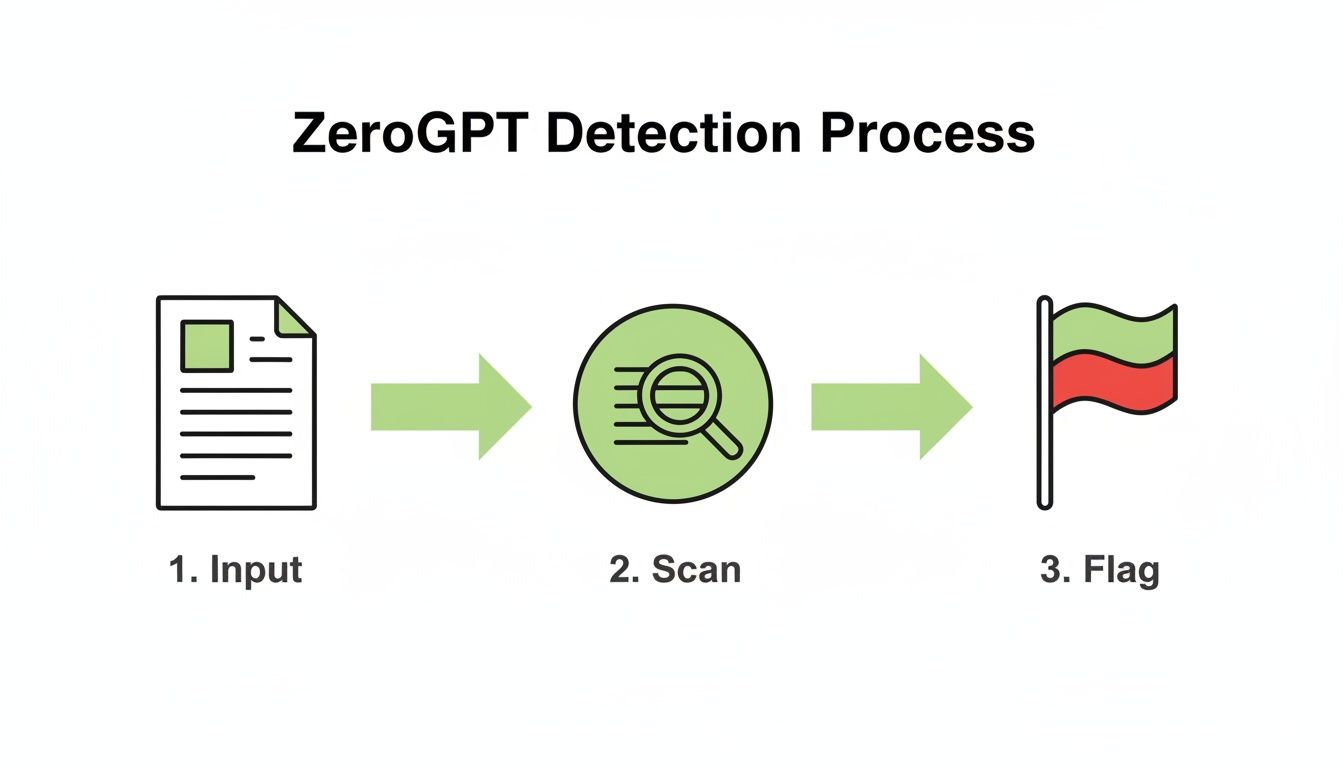
Just copy your text into the tool and let it work its magic. This single step breaks the most obvious AI patterns right away and saves you a ton of editing time.
After Humanizer Tool (First Pass):
"Using renewable energy is a huge deal if we want to fight back against climate change. Things like solar and wind are solid replacements for old-school fossil fuels and can help us become energy independent. To make it happen, governments and big companies really need to team up and fund the right infrastructure."
Already, this version is miles better. The language is more conversational ("huge deal," "team up"), and it just reads more like something a person would actually write. Now it's ready for the final, crucial step: manual polishing.
Polishing with a Personal Voice
Even after using a tool, adding your own touch is what seals the deal. This is where you inject your unique personality and some of those subtle "imperfections" that make writing feel real.
- Vary Sentence Length: Mix it up. Follow a long, descriptive sentence with a short, punchy one. This creates a natural rhythm that AI struggles to replicate. Example: Instead of two medium sentences, try one long one followed by a short one: "Even though solar and wind are solid replacements for old-school fossil fuels, we can't make the switch without serious investment. It's a team effort."
- Add Idioms or Anecdotes: Weave in common phrases, quick analogies, or personal asides. An AI wouldn’t say, "It was a real game-changer," but you would.
- Introduce Minor Imperfections: Don't be afraid of the occasional sentence fragment. Or starting a sentence with "And" or "But." Flawless grammar is a classic AI signature.
Here’s our paragraph after applying these final touches.
After Manual Polishing (Final Version):
"Look, using renewable energy is a huge deal if we want any chance of fighting back against climate change. It’s that simple. Things like solar and wind are solid replacements for old-school fossil fuels, and they offer a real shot at energy independence. But to make it happen, governments and big companies have to get on the same page and actually fund the right projects."
This final version has a distinct voice. It's confident, direct, and doesn't sound like it came out of a machine. It's the kind of writing that bypasses detection because it's genuinely human-sounding.
Advanced Techniques for Flying Under the Radar
Once you've got the hang of manual editing and using a solid tool like HumanText.pro, it’s time to level up. To make your content truly invisible to AI detectors, you need to understand what they’re actually looking for. It really boils down to two key concepts: perplexity and burstiness.
Think of perplexity as a measure of predictability. AI models are trained to pick the most statistically probable next word. This makes their writing safe and often a little boring. To increase perplexity, your job is to make less obvious word choices.
Burstiness, on the other hand, is all about rhythm. Humans don't write in uniform sentences. We mix it up—short, punchy statements followed by longer, more complex thoughts. AI struggles with this natural cadence, often producing text where every sentence is roughly the same length. It just feels flat.
Getting a Feel for Perplexity and Burstiness
Nailing these two elements is the secret sauce for bypassing detectors like ZeroGPT. It’s about more than just swapping out a few words with a thesaurus; it’s about fundamentally changing the structure and feel of the writing.
Vary Your Sentence Structures: This is huge. Make a conscious effort to blend simple, compound, and complex sentences. Follow up a long, winding sentence with a short, sharp one to make a point. For instance: "While comprehensive market analysis suggests a significant trend toward saturation over the next five years, the immediate takeaway is much simpler: adapt or disappear."
Embrace the Active Voice: AI loves the passive voice ("The decision was made by the committee"). It sounds detached and overly formal. Flip it to the active voice ("The committee made the decision") to make your writing more direct, confident, and, well, human. Actionable Tip: Search your document for words like "was," "by," and "been" to quickly spot passive constructions.
Weave in Unique Analogies: Try explaining a complex topic with a novel comparison. An AI might describe a difficult process in a very literal way. A human might say, "Launching this feature felt like trying to change a tire on a moving car." That kind of creative leap is a dead giveaway for human thought.
The best way to outsmart an algorithm is to stop thinking like one. Lean into the messy, unpredictable, and sometimes quirky patterns of human language. That’s where you have the edge.
The "Sandwich Method" for Seamless Integration
Here's another powerful strategy, especially when you need AI to handle the heavy lifting of factual or data-heavy content. I call it the "sandwich method." It lets you wrap AI-generated text in your own authentic voice.
The process is pretty simple:
- Top Slice (Your Insight): Start the section with your own original thought, a sharp observation, or a hook that grabs the reader. Example: "The latest market data tells a fascinating story, but not the one you'd expect."
- The Filling (AI Content): Drop in the AI-generated paragraph that covers the core facts or descriptions. Give it a quick polish for clarity, but don't overwork it.
- Bottom Slice (Your Analysis): Close out the section with your own conclusion, analysis, or a transition that tees up the next point. Example: "So what does this all mean for us? It means the old rules no longer apply."
Using this method helps you create a cohesive narrative where the AI-generated bits act as a bridge between your own ideas. The entire piece flows naturally, feeling like it came from a single, expert mind.
How to Test and Verify Your Content

You’ve put in the work. You’ve massaged the awkward phrasing, injected some personality, and fixed the robotic rhythm. But how do you know it’s enough? Just because a piece of text feels human to you doesn't mean it will pass an algorithmic scan.
This final verification step is your quality control. It’s what separates wishful thinking from a reliable workflow, giving you the confidence to hit publish or submit.
Relying on a single tool to check your work is a rookie mistake. Every AI detector uses a slightly different model, and what fools one might get instantly flagged by another. To genuinely sidestep ZeroGPT and its counterparts, you need a much smarter strategy.
Build a Cross-Verification Workflow
The only reliable approach is to cross-verify your content against a suite of top-tier detectors. Think of it like getting a second and third opinion before a big decision. This method ensures your text isn't just superficially tweaked to beat one specific algorithm—it's fundamentally human-sounding enough to pass multiple, varied checks.
Your testing toolkit should include a few heavy hitters:
- ZeroGPT: Start with your main target. If your content can’t get past this one, it’s definitely not ready.
- GPTZero: Often seen as one of the more stringent and sensitive detectors, getting a pass from GPTZero is a very strong sign of success.
- Turnitin: This is non-negotiable for students. Its detection engine is baked into countless academic platforms, making it the final boss for any school-related work.
By running your text through all three, you cover your bases from different angles and dramatically lower the risk of an unexpected flag. This process confirms your humanization efforts were actually effective. If you're curious about the data behind this, we break down why this multi-tool approach is so critical in our article exploring does undetectable AI work.
Don't just aim to pass one test; aim to create content that is fundamentally undetectable. A multi-tool verification process is the only way to be certain your humanization efforts have truly paid off.
A Final Pre-Flight Checklist
Before you call it done, run through this quick manual checklist. It’s your chance to catch any lingering AI tells that automated tools might overlook during your frantic editing.
- Check the Rhythm and Flow: Read the text out loud. Seriously. Does it sound like something a person would actually say, or does it have a flat, monotonous cadence? If you stumble over words, the sentence is too complex.
- Hunt for Repetitive Starters: Quickly scan the first word of each paragraph. Do you see a bunch of "Additionally," "Furthermore," or "In conclusion"? That’s a classic AI crutch. Vary them with more conversational transitions like "But here's the thing..." or "On top of that...".
- Confirm a Personal Voice: Is there a clear tone? Did you manage to weave in any unique analogies, personal asides, or idioms that give the text some actual personality?
- Look for Overly Formal Language: Did any stiff, academic-sounding words sneak back in? Swap them out for simpler, more direct alternatives that people use in everyday conversation. For example, change "utilize" to "use," or "facilitate" to "help."
This final human review, paired with your multi-tool scan, gives you the ultimate assurance. It’s the last, crucial step in a process designed to bypass ZeroGPT detection reliably and consistently.
Common Questions About Beating ZeroGPT
When you're trying to navigate the tricky world of AI detection, a few questions always seem to pop up. Let's tackle the big ones head-on.
Is It Actually Ethical to Bypass ZeroGPT?
This is the elephant in the room, and the answer comes down to one thing: intent.
If you're using AI to write a term paper from scratch and passing it off as your own work, you’re crossing a clear ethical line. That's academic dishonesty, plain and simple. The goal should never be to cheat or deceive.
But what if you're using AI as a supercharged brainstorming partner? Or as a tool to help you outline, draft, and refine your own original ideas? That’s a completely legitimate workflow. In that scenario, bypassing ZeroGPT isn't about cheating. It's a defensive move to ensure a flawed algorithm doesn't unfairly flag your final, human-polished work. You're protecting your authentic effort.
How Are AI Humanizers Different From Paraphrasers Like QuillBot?
On the surface, they can look pretty similar, but their core purpose is fundamentally different.
A classic paraphraser like QuillBot is designed to fight plagiarism. Its main job is to swap out synonyms and shuffle sentence structures to rephrase existing text. It’s all about changing what is said to avoid duplication. For example, it might change "The dog chased the ball" to "The sphere was pursued by the canine." The structure is similar, but the words are different.
An AI humanizer, on the other hand, is built from the ground up to beat AI detection. It goes way beyond simple word swaps. It digs into the very DNA of the text—things like perplexity and burstiness—to recreate the unique, unpredictable rhythm of human writing. For example, it might change that same sentence to "That dog really went for the ball, didn't he?" The entire tone, voice, and structure are altered to sound human.
The real difference is the objective. A paraphraser changes the words. A humanizer changes the style.
What Do I Do If My Content Is Still Getting Flagged?
It’s definitely frustrating to pour effort into humanizing your text, only to see it flagged anyway. Don't panic. This usually means a few robotic habits are still clinging on.
Here’s a quick troubleshooting checklist:
- Read It Out Loud. This is non-negotiable. Your ears will catch the stiff, monotonous cadence that your eyes skim over. If it sounds like a robot reading a script, it’s going to get flagged.
- Hunt Down Uniformity. Scan your text for sentences that are all roughly the same length. This is a dead giveaway for AI. Combine a few short ones, break up a long one, and rephrase them to create a more natural, varied flow.
- Inject More of You. Add a sharp analogy, a well-placed rhetorical question, or a quick personal aside. Sometimes these small, character-filled touches are the final push your content needs to feel genuinely human.
Often, it's just one or two paragraphs causing the problem. Try to isolate the flagged sections and give them one more round of manual polishing. Focus on making them sound more like a conversation and less like a textbook. That targeted fix usually does the trick.
Ready to stop worrying about AI detectors? HumanText.pro transforms your drafts into natural, human-sounding text that sails past detection. Give it a try and see the difference for yourself.
Ready to transform your AI-generated content into natural, human-like writing? Humantext.pro instantly refines your text, ensuring it reads naturally and authentically. Try our free AI humanizer today →
Related Articles
10 Websites That Humanize AI Writing in 2026
Compare 10 websites that humanize ai writing by features, pricing, privacy, language support, and best use cases for writers, agencies, and educators.
AI Generated Text Detection: How It Actually Works
Explore AI generated text detection methods, accuracy limits, and how to choose the right tool for publishers, educators, and compliance workflows.
AI Humanizer Free Trial: Your Step-by-Step Playbook
Try an AI humanizer free trial the smart way. Learn what to expect, how to test quality, and how to choose the right paid plan for your workflow.

