Master Your Writing: 10 Frequently Misused Words to Correct in 2025
Stop making common errors. This guide covers 10 frequently misused words with clear examples and tips to improve your writing and avoid AI detection.
In an age where AI writing assistants are becoming commonplace, a firm grasp of the English language is more critical than ever. Small, persistent errors with frequently misused words can instantly undermine your credibility, whether you're a student drafting an essay, a marketer creating web copy, or a researcher refining a paper. These subtle mistakes can make your writing seem careless or, even worse, robotic and easily flagged by AI detectors. Getting these details right is a hallmark of a careful and authoritative writer.
This guide is designed to be a practical, actionable resource. We will move beyond simple definitions to provide a clear framework for understanding and correctly using some of the most common and confusing word pairs in English. For each item on our list, you will find clear examples of incorrect usage, corrected versions, and straightforward explanations of the underlying rules. We also include simple memory tricks and quick practice sentences to help solidify your understanding, ensuring the right choice becomes second nature.
Mastering these distinctions is not just about avoiding errors; it’s about refining your communication for maximum clarity and impact. This precision is also key when guiding generative AI. Effective communication with AI, especially to prevent it from misusing words, often comes down to mastering AI prompts through prompt engineering. By sharpening your own language skills, you improve your ability to create, edit, and humanize content, regardless of its origin. Let’s dive in and elevate your writing from correct to truly exceptional.
1. Affect vs. Effect - Action (Verb) vs. Outcome (Noun)
The confusion between affect and effect is one of the most common grammatical hurdles, making it a frequent flag in AI-generated or unpolished writing. Mastering this pair is a quick way to elevate your content, ensuring it sounds more human and authoritative. The core distinction lies in their primary roles in a sentence: affect is an action word (a verb), while effect is a thing or result (a noun).
The Core Rule Explained
Affect is a verb that means "to influence or produce a change in something." Think of it as the action of impacting something else.
- Practical Example: The new algorithm will affect search rankings significantly.
Effect is a noun that means "a result or consequence." It is the outcome of an action.
- Practical Example: The new algorithm had a significant effect on search rankings.
Here’s a common misuse scenario and its correction:
- Incorrect: The change in policy will negatively effect our workflow.
- Correct: The change in policy will negatively affect our workflow.
- Correct: The negative effect of the policy change was a slower workflow.
Actionable Tips for Correct Usage
To keep these frequently misused words straight, use a simple mnemonic or a quick substitution test.
Memory Tip: RAVEN
Remember Affect Verb, Effect Noun. This simple acronym connects the first letter of each word to its primary grammatical function, making it easy to recall during writing or editing.
Actionable Insight: Try substituting the word "influence" (for affect) or "result" (for effect). If "influence" fits, you need the verb affect. If "result" makes sense, you need the noun effect. This distinction is not just about grammar; it's about clarity. Understanding the denotative vs. connotative meaning of words, like the precise difference between affect and effect, is key to powerful writing. You can learn more about word choice and meaning on our blog.
Quick Practice:
Fill in the blank: The speaker's passionate words had a profound ______ on the audience. (Answer: effect)
2. Their vs. There vs. They're - Possession vs. Location vs. Contraction
This trio of homophones is a classic culprit in writing errors, often slipping past even careful writers. Misusing their, there, and they're is a frequent red flag for AI detection tools and can instantly undermine the credibility of your content. Understanding the distinct role each word plays is crucial for producing clear, professional, and human-sounding text.

The Core Rule Explained
Each of these frequently misused words has a specific and unchangeable job. Mixing them up confuses possession with location or action.
Their is a possessive pronoun that shows ownership. It indicates that something belongs to "them."
- Practical Example: The team celebrated their recent victory.
There is an adverb that indicates a place or location. It can also be used to introduce a sentence.
- Practical Example: Please place the documents over there on the desk.
- Practical Example: There are several issues we need to address.
They're is a contraction of the words "they are." It combines a pronoun and a verb.
- Practical Example: They're scheduled to present the findings tomorrow.
Here’s a common misuse scenario and its correction:
- Incorrect: They're going to submit there assignment soon.
- Correct: They're going to submit their assignment soon.
- Correct: The students left their bags over there because they're going to the gym.
Actionable Tips for Correct Usage
To master this trio, rely on simple associations and a quick verbal check.
Memory Tip: HEIR, HERE, ARE
- Their has "heir" in it, and an heir inherits things (possession).
- There has "here" in it, signaling a location.
- They're has an apostrophe, which signals a contraction. If you can substitute "they are" into the sentence and it still makes sense, you've used it correctly.
Actionable Insight: Read your sentences aloud. The flow and meaning often sound incorrect when you use the wrong word. For instance, "They are car is parked over their" sounds obviously wrong when spoken, making it easier to spot the error. Among the many frequently misused words, this set is one of the easiest to master with these simple checks.
Quick Practice:
Fill in the blanks: __________ not sure if __________ going to leave __________ luggage over __________. (Answer: They're, they're, their, there)
3. Your vs. You're - Possession vs. Contraction
The mix-up between your and you're is deceptively simple yet remains one of the most persistent errors found in everything from student essays to professional blog posts. Because this mistake is so common, it’s a telltale sign of unedited or hastily written text. Correcting this simple error instantly boosts your credibility and makes your writing appear more polished and human-written.

The Core Rule Explained
Your is a possessive adjective used to show that something belongs to "you." Think of it as indicating ownership.
- Practical Example: Is this your final report?
You're is a contraction, a shortened form of "you are." The apostrophe stands in for the missing letter "a."
- Practical Example: You're going to do great on the presentation.
Here’s a common misuse scenario and its correction:
- Incorrect: Your going to need to revise this section.
- Correct: You're going to need to revise this section.
- Correct: Your feedback on my essay was helpful.
Actionable Tips for Correct Usage
To avoid this common slip-up among frequently misused words, use a simple substitution test that works every time.
Memory Tip: The "You Are" Test
Before you hit publish, mentally replace the word in your sentence with "you are." If the sentence still makes grammatical sense, you're is the correct choice. If it sounds wrong, you need the possessive your.
Actionable Insight: Use the search function (Ctrl+F or Cmd+F) in your document to find every instance of "your" and "you're." Quickly apply the "you are" test to each one. This takes less than a minute and catches every potential error. Mastering this rule is a foundational step in elevating your content. You can discover more ways to refine your writing on our blog.
Quick Practice:
Fill in the blank: I believe ______ next in line. (Answer: you're)
4. Its vs. It's - Possession vs. Contraction
The mix-up between its and it's is a classic grammatical error that instantly signals a lack of polish. Because this mistake often stems from a simple typo or oversight, it’s a common flaw in hastily written or AI-generated content. Correctly using these frequently misused words is a small but powerful detail that reinforces the credibility of your writing.
The Core Rule Explained
The distinction is straightforward: its shows ownership, while it's is a shortcut for "it is" or "it has."
Its is a possessive pronoun used to indicate that something belongs to a thing or an animal. Think of it like his or her—possessive words that don't need an apostrophe.
- Practical Example: The company updated its privacy policy.
It's is a contraction, a shortened form of "it is" or "it has." The apostrophe takes the place of the missing letter(s).
- Practical Example: It's essential to review the new privacy policy. (It is essential...)
Here’s a common misuse scenario and its correction:
- Incorrect: The software updated itself, but it's new features are confusing.
- Correct: The software updated itself, but its new features are confusing.
- Correct: It's confusing because the new features are not intuitive.
Actionable Tips for Correct Usage
The best way to avoid this error is to perform a quick mental check before finalizing your sentence.
Memory Tip: The 'It Is' Test
When you see "it's" in your writing, try expanding it to "it is" or "it has." If the sentence still makes sense, you've used it correctly. If the sentence becomes nonsensical, you need the possessive its.
Actionable Insight: In business and technical writing, pay extra attention to this pair in summaries and conclusions. Sentences like "The project achieved its goals, and it's now ready for launch" are common. Double-checking these final sections ensures your most important takeaways are error-free.
Quick Practice:
Fill in the blank: The phone is ringing, but ______ screen is blank. (Answer: its)
5. Than vs. Then - Comparison vs. Time/Consequence
Mixing up than and then is a common slip-up that can instantly make writing feel clunky or even automated. While they sound similar, their roles are completely distinct, and using them correctly is vital for clear communication. This is especially true in analytical or persuasive content where you are constantly comparing ideas or outlining sequential steps.
The Core Rule Explained
Than is a conjunction used to make comparisons between two or more things. If you are indicating that something is greater, lesser, better, or different, you need than.
- Practical Example: This new AI model generates text faster than its predecessor.
Then is an adverb that indicates time, sequence, or consequence. It answers the question "when?" or "what's next?".
- Practical Example: First, we gather the data, and then we analyze the results.
Here’s a frequent misuse and how to fix it:
- Incorrect: The second draft was much clearer then the first one.
- Correct: The second draft was much clearer than the first one.
- Correct: He reviewed the first draft, then he wrote a clearer second one.
Actionable Tips for Correct Usage
To avoid confusing these frequently misused words, focus on the context of your sentence: are you comparing or sequencing?
Memory Tip: Comparison vs. Time
Remember than is for comparison (both have an "a"). Then relates to time or sequence (both have an "e"). This simple letter association provides a quick mental check.
Actionable Insight: When writing instructions or a "how-to" guide, you will almost always use then to describe the sequence of steps. Conversely, in a product review or persuasive essay, you will frequently use than to compare features or arguments. Knowing the context helps you anticipate the correct word.
Quick Practice:
Fill in the blank: If the hypothesis is correct, ______ the results should be predictable. (Answer: then)
6. Accept vs. Except - Receive vs. Exclude
The mix-up between accept and except is a classic homophone error that can completely reverse the meaning of a sentence. Because they sound so similar in spoken language, they are often used incorrectly in writing, which can be a red flag for AI-generated or unpolished text. Understanding their distinct roles as words of inclusion versus exclusion is crucial for clear and credible communication.
The Core Rule Explained
Accept is a verb that means "to receive willingly" or "to agree to." It is a word of inclusion and agreement.
- Practical Example: Please accept my sincere apology for the delay.
Except is most commonly used as a preposition meaning "but not" or "other than." It is a word of exclusion.
- Practical Example: All departments submitted their reports except for marketing.
Here is a common misuse scenario and its correction:
- Incorrect: We will except all applications submitted by Friday.
- Correct: We will accept all applications submitted by Friday.
- Correct: Everyone except Sarah attended the meeting.
Actionable Tips for Correct Usage
To avoid confusing these frequently misused words, focus on their function in the sentence: one brings things in, while the other leaves things out.
Memory Tip: A for Admit, X for Exclude
The word accept begins with 'A', just like the words admit or agree. The word except begins with 'EX', which often signifies something is being left out, like in exclude or exit. This simple association makes it easy to choose the right word.
Actionable Insight: When writing about rules, policies, or terms and conditions, this distinction is critical. A sentence like "We accept all forms of payment except American Express" has a clear financial implication. Always double-check this pair in legal or transactional text to prevent costly confusion.
Quick Practice:
Fill in the blank: The store is open every day ______ on public holidays. (Answer: except)
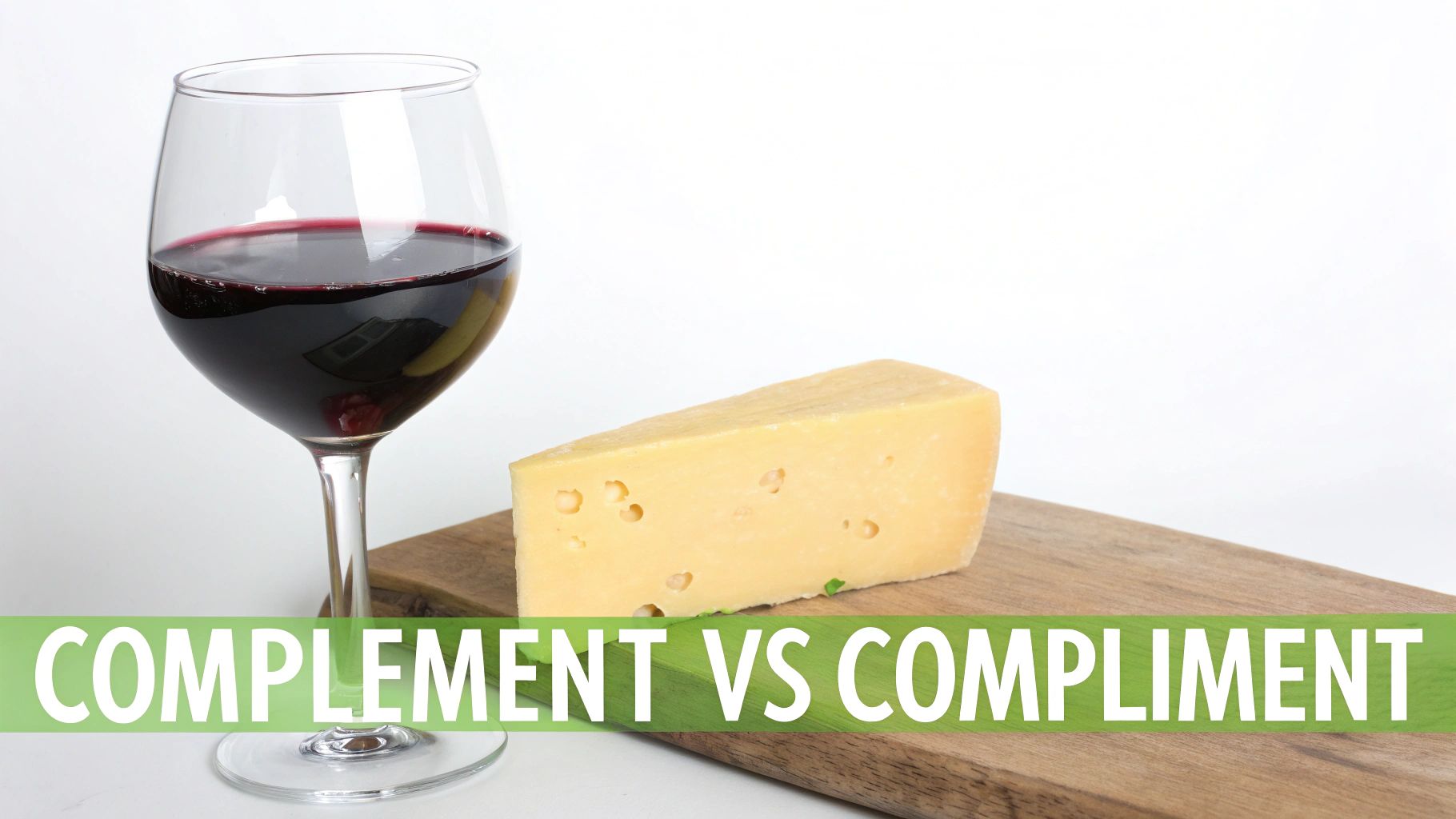
7. Complement vs. Compliment - Complete vs. Praise
As true homophones, complement and compliment sound identical but have vastly different meanings, making them frequently misused words in professional and marketing communications. Mistaking one for the other can confuse your message, suggesting a product praises a customer’s style when it actually completes it. Getting this pair right demonstrates attention to detail and enhances the credibility of your writing.
The Core Rule Explained
Complement (with an "e") is a verb or noun that refers to something that completes, enhances, or goes perfectly with something else.
- Practical Example: The new curtains complement the wall color perfectly.
Compliment (with an "i") is a verb or noun that means to express praise, admiration, or flattery.
- Practical Example: I must compliment the chef on this delicious meal.
Here is a common scenario where these words are mixed up, especially in marketing copy:
- Incorrect: Our new line of accessories will compliment your professional wardrobe.
- Correct: Our new line of accessories will complement your professional wardrobe.
- Correct: We received a compliment from a customer about our new accessories.
Actionable Tips for Correct Usage
To avoid this common error, focus on the vowel in the middle of each word. A simple mnemonic can help you remember which word to use in any context.
Memory Tip: "I" for Praise, "E" for Enhance
Think of the "i" in compliment as relating to "I," as in "I like your work" or "I admire that." The "e" in complement, on the other hand, connects to words like enhance or complete. This trick provides a quick mental check to ensure you're conveying the intended meaning.
Actionable Insight: When editing marketing or sales content, ask yourself: Is this about praising someone (the customer) or about completing a set (the product with the customer's style)? This question immediately clarifies whether you need the word with the "i" or the "e." Making this distinction sharpens your message and prevents miscommunication.
Quick Practice:
Fill in the blank: She paid him a lovely ______ on his presentation. (Answer: compliment)
8. Loose vs. Lose - Adjective (Free) vs. Verb (Misplace)
The confusion between loose and lose is a surprisingly common error that can undermine the professionalism of your writing. While it seems like a minor typo, this mistake frequently appears in instructions, emails, and even marketing copy, often making the text sound unpolished. Understanding their distinct roles as an adjective versus a verb is crucial for clear and credible communication.
The Core Rule Explained
Loose is an adjective that describes something as "not tight, not firmly attached, or free." It always describes a noun.
- Practical Example: The dog’s collar was too loose, and it slipped right off.
Lose is a verb that means "to misplace, to fail to win, or to be deprived of something." It is an action word.
- Practical Example: Be careful not to lose your keys on the trail.
Here’s a common misuse scenario and its correction:
- Incorrect: Make sure you don't loose sight of our primary objective.
- Correct: Make sure you don't lose sight of our primary objective.
- Correct: The screws on the chair were loose, making it unstable.
Actionable Tips for Correct Usage
To keep these frequently misused words straight, use a simple visual trick or a quick sound-based check.
Memory Tip: One 'o' is Gone
Think of the word lose as having already lost one of its 'o's. If you are writing about the action of misplacing or not winning something, you use the word with only one ‘o’. The word loose, with its extra 'o', looks like it has more space, just like a loose-fitting shirt.
Actionable Insight: The pronunciation test is highly effective. Loose rhymes with "goose" and has a soft 's' sound. Lose rhymes with "choose" and has a 'z' sound. Saying the sentence out loud can often reveal the correct choice. Precision in word choice is a hallmark of strong, human-like writing, and you can explore our guide to effective writing techniques to further refine your skills.
Quick Practice:
Fill in the blank: If you tighten that bolt, it won’t come ______. (Answer: loose)
9. Principal vs. Principle - Leader/Main vs. Fundamental Rule
The confusion between principal and principle is a classic case of homophone trouble that often appears in business, academic, and formal writing. Because they sound identical, it's easy to swap them, but doing so can change the entire meaning of a sentence. Correcting this common error is a simple step to make your writing appear more polished and professional, avoiding flags from AI detection tools that often spot such mistakes.
The Core Rule Explained
Principal can be a noun or an adjective, typically referring to someone or something of primary importance. As a noun, it means the head of a school or the main sum of money in a loan. As an adjective, it means "main" or "most important."
- Practical Example (Noun): The school principal addressed the students at the assembly.
- Practical Example (Adjective): The principal reason for our success is teamwork.
Principle is always a noun that means "a fundamental truth, rule, law, or belief." It refers to a standard or a moral code.
- Practical Example: Our company operates on the principle of complete transparency.
Here’s a common misuse scenario and its correction:
- Incorrect: The new manager is a person of high moral principals.
- Correct: The new manager is a person of high moral principles.
- Correct: The principal of the school is a person of high moral principles.
Actionable Tips for Correct Usage
To differentiate these frequently misused words, focus on a simple association that connects the spelling to the meaning.
Memory Tip: Your Princi-PAL is a Person
The word principal** ends in "pal," which is a simple reminder that it often refers to a person, like the head of your school. In contrast, a principle is a rule. This mnemonic provides a quick check when you're unsure which word to use.
Actionable Insight: When discussing finance, principal refers to the original sum of money invested or loaned. When discussing ethics or science, principle refers to a fundamental rule or law (e.g., Archimedes' principle). Linking the word to the specific field (finance vs. philosophy) can reinforce the correct usage.
Quick practice:
Fill in the blank: The ______ investment earned a significant amount of interest. (Answer: principal)
10. Ensure vs. Insure vs. Assure - Guarantee vs. Protect vs. Promise
The confusion between ensure, insure, and assure is particularly common in business and professional writing, often signaling a lack of precision. Getting these frequently misused words right demonstrates attention to detail and enhances the clarity of your message. Each word carries a distinct meaning related to guaranteeing an outcome, protecting against loss, or promising something to a person.
The Core Rule Explained
Ensure is a verb that means "to make certain something will happen." It is about taking action to guarantee a result.
- Practical Example: We must ensure that all data is backed up daily.
Insure is a verb that refers to protecting something financially by purchasing an insurance policy. It deals with monetary protection against risk.
- Practical Example: You should insure your new equipment against theft and damage.
Assure is a verb that means "to tell someone something positively to dispel any doubts." It is about providing confidence or a promise to a person.
- Practical Example: I assure you that the project will be completed on time.
Actionable Tips for Correct Usage
To differentiate these words, focus on what is being impacted: an outcome (ensure), a financial asset (insure), or a person's feelings (assure).
Memory Tip: The Three P's
Ensure you will Perform an action.
Insure you have a Policy.
Assure a Person.
Actionable Insight: In formal contracts or important business communications, use a find-and-replace search to audit all three words. For example, ensure the contract meets all requirements, insure the shipment against loss, and assure the client of your commitment. The strategic use of words like assure can be a powerful rhetorical tool. You can learn more about the art of rhetoric in writing on our blog.
Quick Practice:
Fill in the blank: The manager tried to ______ the team that the new software would be easy to learn. (Answer: assure)
10 Frequently Misused Word Pairs — Quick Comparison
| Term | Complexity 🔄 | Effort / Resources ⚡ | Expected outcome ⭐📊 | Ideal use cases 💡 | Key advantage |
|---|---|---|---|---|---|
| Affect vs Effect | 🔄 Low — verb vs noun | ⚡ Low — single-rule check | ⭐⭐⭐ — clearer causality; fewer detection flags 📊 | Academic, reports, marketing | Corrects core grammar; improves credibility |
| Their vs There vs They're | 🔄 Medium — three homophones | ⚡ Medium — contextual review/tools | ⭐⭐⭐ — major readability gains; lowers AI flags 📊 | General content, theses, conclusions | Fixes one of the most frequent errors |
| Your vs You're | 🔄 Low — possession vs contraction | ⚡ Low — simple substitution test | ⭐⭐ — immediate polish; fewer casual errors 📊 | Student essays, blogs, social copy | Quick rule; high ROI in editing |
| Its vs It's | 🔄 Low (counterintuitive apostrophe rule) | ⚡ Low — replace-with "it is" test | ⭐⭐ — signals careful editing; reduces sloppiness 📊 | Technical, business, research writing | Eliminates visible apostrophe mistakes |
| Than vs Then | 🔄 Low–Medium — comparison vs time | ⚡ Low — context read-aloud check | ⭐⭐ — preserves logic and timeline; clearer flow 📊 | Analytical essays, methods, reports | Prevents sequence/meaning errors |
| Accept vs Except | 🔄 Low–Medium — opposite meanings | ⚡ Low — substitution test ('receive'/'but not') | ⭐⭐ — avoids meaning reversal; improves precision 📊 | Formal correspondence, proposals | Prevents critical miscommunication |
| Complement vs Compliment | 🔄 Medium — true homophones | ⚡ Low — context cue audit | ⭐⭐ — protects tone and brand perception 📊 | Marketing, customer service, copywriting | Ensures correct nuance (complete vs praise) |
| Loose vs Lose | 🔄 Low — adjective vs verb | ⚡ Low — spelling mnemonic check | ⭐⭐ — clearer instructions; fewer misunderstandings 📊 | How‑to guides, manuals, UX copy | Improves instructional clarity |
| Principal vs Principle | 🔄 Medium — near-homophones (both nouns) | ⚡ Medium — context verification | ⭐⭐ — signals educated, accurate writing 📊 | Policy, academic, ethics discussions | Distinguishes person/amount vs fundamental rule |
| Ensure vs Insure vs Assure | 🔄 High — three distinct legal/financial senses | ⚡ Medium–High — careful editorial/legal review | ⭐⭐⭐ — critical for legal/financial credibility; avoids liability 📊 | Contracts, legal, finance, formal communications | Prevents costly misinterpretation; professional precision |
From Common Mistakes to Confident Communication
Navigating the landscape of English grammar can often feel like walking through a minefield of common errors. However, by taking the time to understand and master the ten frequently misused words and pairs we've explored, you've already taken a significant step toward elevating your writing. Moving beyond simple recognition to active correction is the true hallmark of a skilled communicator, transforming potential confusion into crystal-clear intent.
The journey doesn't stop here. This guide serves as both a reference and a launching pad. The key insights aren't just about memorizing rules; they are about understanding the logic behind them. Knowing that affect is almost always an action verb and effect is the resulting noun, or that the apostrophe in it's and you're signifies a contraction, provides a foundational framework you can apply to countless other writing challenges. These distinctions, while seemingly minor, are the building blocks of credibility and professionalism.
Your Actionable Path to Writing Mastery
To truly cement this knowledge, consistent practice is essential. Don't just read the rules; implement them. Here are your next steps to transition from passive learning to active mastery:
- Become a Word Detective: For the next week, actively hunt for these ten misused words in everything you read, from news articles and emails to social media posts. Notice when they are used correctly and identify instances of misuse. This active observation will sharpen your editorial eye.
- The "Proofread for One" Technique: During your next editing session, dedicate a specific pass-through to look for just one of these pairs, such as affect/effect. Then, do another pass for than/then. Focusing on one specific error at a time makes it significantly easier to catch mistakes your brain might otherwise overlook.
- Utilize the Mnemonics: Revisit the memory aids provided for each word pair. Whether it's the "RAVEN" trick for Affect/Effect or remembering the extra "O" in loose looks like a loose tire, these simple hooks can provide instant clarity when you're in doubt.
The Broader Impact of Precision
Why does this level of detail matter so much? Because precise language demonstrates care, expertise, and respect for your audience. In an academic paper, using principle instead of principal can undermine the authority of your argument. In a business proposal, confusing insure with ensure can create ambiguity and risk. For content creators and marketers, these errors can erode reader trust and damage brand reputation. Every correct word choice reinforces your message and solidifies your credibility.
Mastering these frequently misused words is a powerful investment in your communication skills. It empowers you to articulate your ideas with confidence and precision, ensuring your message is not just heard, but understood exactly as you intended. To further build on this foundation and cultivate a more intuitive grasp of language, you might also be interested in exploring different approaches to grammar learning that go beyond rote memorization. The ultimate goal is to make correct usage second nature, freeing you to focus on the power and creativity of your ideas.
Ready to take your writing to the next level? Even the most diligent writer can miss a subtle error, especially when using AI writing assistants. Humantext.pro is expertly designed to review your text, correcting awkward phrasing and common mistakes like the ones in this list, to ensure your content reads as if it were written by a seasoned human professional. Elevate your content and ensure it’s undetectable by AI detectors with a single click at Humantext.pro.
Ready to transform your AI-generated content into natural, human-like writing? Humantext.pro instantly refines your text, ensuring it reads naturally and authentically. Try our free AI humanizer today →
Related Articles
AI Generated Text Detection: How It Actually Works
Explore AI generated text detection methods, accuracy limits, and how to choose the right tool for publishers, educators, and compliance workflows.

AI Humanizer Free Trial: Your Step-by-Step Playbook
Try an AI humanizer free trial the smart way. Learn what to expect, how to test quality, and how to choose the right paid plan for your workflow.
Sightengine API Review for Media Moderation
Explore how the Sightengine API handles image and video moderation. Learn about its accuracy, pricing, and when a browser-based checker is a better fit.

