How to Bypass AI Detection in Your Writing
Learn how to bypass AI detection with proven techniques. Turn AI drafts into authentic, human-like content using manual edits and smart tools.
If you want to get past AI detection, you have to stop writing like a machine. It's really that simple. You need to break the predictable, statistical patterns that AI detectors are trained to sniff out by adding variety, a personal touch, and a more natural flow.
Understanding How AI Detectors Work

Before you can reliably sidestep AI detection, you need to know what you’re up against. Think of it like a game of chess—you can't win without understanding your opponent's strategy. Tools like GPTZero, Copyleaks, and Turnitin aren't reading your work for comprehension or grading your ideas. They're statistical analysts, pure and simple.
These detectors are designed to spot the linguistic fingerprints that large language models (LLMs) leave behind. They’ve been trained on massive datasets of both human and AI writing, learning to recognize the subtle but consistent patterns that give the game away. At their core, they run on probability, calculating how likely it is that a string of words was chosen by an algorithm instead of a person.
The Tell-Tale Signs of AI Writing
AI detectors zoom in on a few key metrics to make their call, but two stand out: perplexity and burstiness. If you get a handle on these, you’re halfway to beating the system.
- Perplexity: This is just a fancy word for predictability. AI-generated text usually has low perplexity because the model almost always picks the most statistically obvious next word. Humans, on the other hand, are less predictable. We make surprising word choices.
- Burstiness: This measures the rhythm and variation in your sentences. People naturally mix it up, writing short, punchy sentences followed by longer, more descriptive ones. AI often churns out text with a monotonous, uniform structure, which results in low burstiness.
To help you visualize what these detectors are looking for, here's a quick breakdown of the signals they use.
AI Detector Signals and What They Mean
This table gives you a quick reference for the key metrics AI detectors use and, more importantly, how you can influence them.
| Detector Signal | What It Measures | How to Influence It |
|---|---|---|
| Perplexity | The predictability of word choices. Low perplexity means the text is too obvious, a classic AI trait. | Use a richer, more varied vocabulary. Swap common words for more interesting synonyms. |
| Burstiness | The variation in sentence length and structure. Low burstiness indicates a monotonous, machine-like rhythm. | Mix short, direct sentences with longer, more complex ones. Break up paragraphs. |
| Repetition | The frequency of repeated phrases or sentence starters (e.g., "In addition," "Furthermore"). | Actively rephrase sentences to avoid starting them the same way. Use a thesaurus creatively. |
| Readability Score | How simple or complex the text is (e.g., Flesch-Kincaid). AI often defaults to a specific grade level. | Intentionally simplify complex sentences or add nuance to overly simple ones. Aim for a natural feel. |
| Statistical Patterns | The underlying probability distribution of words and phrases common to specific AI models. | Inject personal anecdotes, idioms, and colloquialisms that break typical AI patterns. |
By analyzing these characteristics, a detector spits out a probability score—its best guess on whether your text is human or AI.
A Rapidly Evolving Arms Race
The world of content generation and detection is a constant cat-and-mouse game. As AI models get smarter, detection tools have to scramble to keep up. This back-and-forth has fueled a massive industry, with the AI detection market projected to explode from USD 0.58 billion in 2025 to USD 2.06 billion by 2030.
This growth shows just how serious the demand is for reliable detection. At the same time, tools designed to evade detection are getting better, too, making it an incredibly complex field for everyone involved. You can explore more on the AI detection market's growth and complexity to see just how fast things are changing.
Key Takeaway: AI detectors are pattern-finders, not fact-checkers. They hunt for statistical uniformity in sentence structure and predictability in word choice—the two biggest giveaways of machine-generated text.
Knowing this is your biggest advantage. Every technique in this guide is about one thing: disrupting those patterns. By consciously adding some human randomness, varying your sentences, and using less predictable words, you can "humanize" your text until it's practically invisible to these algorithms. The goal isn't to trick a machine, but to refine an AI draft into something genuinely indistinguishable from your own work.
Core Manual Techniques to Humanize AI Text
While tools can offer a quick first pass, the most bulletproof way to bypass AI detection is by rolling up your sleeves and doing it manually. This is where you transform a sterile AI draft into something with a real pulse.
It’s all about intentionally breaking the predictable patterns that AI detectors are trained to spot. This isn't just about swapping a few words—it's about fundamentally reshaping the text to introduce the beautiful, messy, and unpredictable nature of human writing.
Vary Your Sentence Structure and Rhythm
Let's be honest: AI-generated content often has a painfully monotonous rhythm. Sentences tend to be the same length and follow similar structures, creating a flat, robotic cadence that screams "AI!" to detectors. Your first job is to demolish this uniformity.
- Mix It Up: Blend short, punchy sentences with longer, more descriptive ones. A quick, impactful statement grabs attention, while a longer sentence can flesh out a complex idea.
- Rephrase Openings: Ever notice how AI loves starting sentences the same way? If you see a string of paragraphs beginning with "The," "It is," or "In addition," it's time to rewrite.
- Use More Than Periods: Don't be afraid to use different punctuation. Em dashes—like this one—can create a dramatic pause, semicolons can link closely related ideas, and a well-placed question can pull the reader right in.
Think of your text as a piece of music. AI produces a steady, boring drumbeat. You want to add a melody, a few solos, and some surprising changes in tempo. That’s what makes it interesting and, most importantly, human.
Inject Your Authentic Voice and Perspective
AI models are trained on a massive ocean of public data, which is why their output sounds so generic. They can’t have opinions, share personal stories, or offer a unique take on a topic. You can, and you absolutely should.
This is probably the single most powerful technique you can use because you're adding something algorithms simply cannot replicate.
Expert Tip: An AI can summarize what's already known, but it can't create new knowledge from experience. Sharing a personal anecdote or a unique opinion is one of the fastest ways to make your text undetectable.
Imagine you're writing a post about project management software. An AI might list the features and benefits. You, however, can talk about that one time a specific feature saved a project from total disaster. That story is uniquely yours, and it instantly shatters the AI pattern. To go deeper, check out our in-depth guide on how to humanize AI text for more advanced strategies.
Swap Predictable Vocabulary for Nuanced Language
Language models work on probability, so they often pick the most common or statistically likely word for any given context. This leads to a vocabulary that is technically correct but incredibly bland.
- Before (AI-generated): "It is important to utilize a good strategy to enhance your results."
- After (Humanized): "A clever strategy is the secret sauce to supercharging your results."
See the difference? "Important" becomes "clever," "utilize" morphs into the idiom "secret sauce," and "enhance" gets a jolt of energy as "supercharging." The humanized version has personality.
Adopt an Active Voice
Another dead giveaway of AI writing is its love affair with the passive voice ("The report was written by the team"). This creates a detached, academic tone that feels stiff and unnatural in most contexts.
Switching to an active voice ("The team wrote the report") makes your writing more direct, confident, and engaging. Scan your draft specifically for passive constructions. Sentences using words like "was," "is," "are," "were," and "by" are prime candidates for a rewrite.
Here’s a quick comparison to see the impact.
| Passive Voice (Common in AI Text) | Active Voice (More Human-Like) |
|---|---|
| The decision was made by the committee. | The committee made the decision. |
| The problem is being investigated. | We're investigating the problem. |
| It has been observed that... | I've noticed that... |
This simple shift does more than just rearrange a few words; it changes the entire tone from observational to authoritative. When you combine these manual techniques, you're not just editing—you're layering in the very human qualities that AI detectors are designed to find missing.
Simple Tricks to Lower Detection Scores
While a deep, manual rewrite is the gold standard for creating undetectable content, sometimes you just need to make a few small tweaks that deliver big results. These simple tricks can disrupt the statistical patterns AI detectors look for, helping your text fly under the radar without a complete overhaul.
Think of them as quick-hit tactics to add another layer of humanization. The key thing to remember is that AI detection isn't about understanding meaning; it's about spotting mathematical predictability. By introducing small, deliberate inconsistencies, you can scramble the signals that scream "machine-written." These methods aren't a replacement for thorough editing, but they are powerful additions to your workflow.
Introduce Subtle Imperfections
AI-generated text is often too perfect. It's grammatically flawless and syntactically rigid. Real human writing? Not so much. Intentionally adding minor, natural-sounding imperfections can make your text feel far more authentic.
This doesn't mean you should litter your article with glaring errors. That just looks unprofessional. Instead, try these subtle tweaks:
- Use contractions freely. AI often defaults to formal language like "it is" or "you will." Swapping these for "it's" and "you'll" immediately creates a more conversational, human tone.
- Start a sentence with a conjunction. It’s perfectly natural in modern writing to start a sentence with "But," "And," or "So." AI models trained on formal text tend to avoid this, making it an easy pattern to break.
- Employ sentence fragments. When appropriate. A short, punchy fragment can add emphasis and vary the rhythm of your writing, breaking up the monotonous flow that detectors often flag.
These small changes mirror how people actually write and speak, making the text less sterile and statistically predictable.
Play with Punctuation and Syntax
AI models tend to use punctuation in a very standard, by-the-book way. You can disrupt this by getting a bit more creative with your punctuation and sentence structure. Even simple syntactic changes can significantly alter the "burstiness" of your text—a key metric for many detectors.
Key Takeaway: AI detectors are creatures of habit. They expect commas and periods in predictable places. By using less common punctuation like em dashes or semicolons, you can introduce a level of structural variation that looks more human.
For instance, instead of writing two separate sentences, connect them with an em dash for dramatic effect. Or, if two ideas are closely related, join them with a semicolon. This not only improves readability but also shatters the monotonous sentence structure that AI often produces. The goal is to make the text's rhythm less predictable. For more ideas on structural editing, you can explore our detailed guide to humanize AI-generated text.
Use Character Substitutions and Paraphrasing
This one is a bit more technical, but it can be surprisingly effective. Research shows that even tiny textual manipulations can confuse detection algorithms because they disrupt the expected character patterns. Techniques like using automatic paraphrasing tools or even swapping Latin characters for visually identical Unicode counterparts can drastically lower detection scores.
In fact, some studies show that simple paraphrasing can achieve up to a 99.96% human similarity score. Another found that adding a single extra space can drop a detector's confidence from 4.90% "fake" down to just 0.13%. These findings reveal that detectors often rely more on superficial text patterns than true semantic understanding.
These tricks, while powerful, should be used thoughtfully alongside deeper editing. Combining them ensures your content is not only less detectable but also high-quality and genuinely readable for your audience.
Using Paraphrasing and Humanizer Tools
Let's be real: manually rewriting every piece of AI-generated text is the surest way to get a human touch, but it's a massive time sink. This is where AI paraphrasing and humanizer tools come into play. They can be your secret weapon, dramatically speeding up the process by acting as a powerful first line of defense against detection.
These tools are built to do the heavy lifting. They restructure sentences, swap out predictable vocabulary, and break up the rigid statistical patterns that AI detectors are trained to spot.
But here's a crucial tip I've learned from experience: don't treat them as a one-click fix. That's a rookie mistake. The real power comes from a hybrid approach—let the tool do the initial transformation, then you step in for a final, critical human review to add the polish.
This diagram breaks down a simple workflow for making quick changes that can significantly lower detection scores.
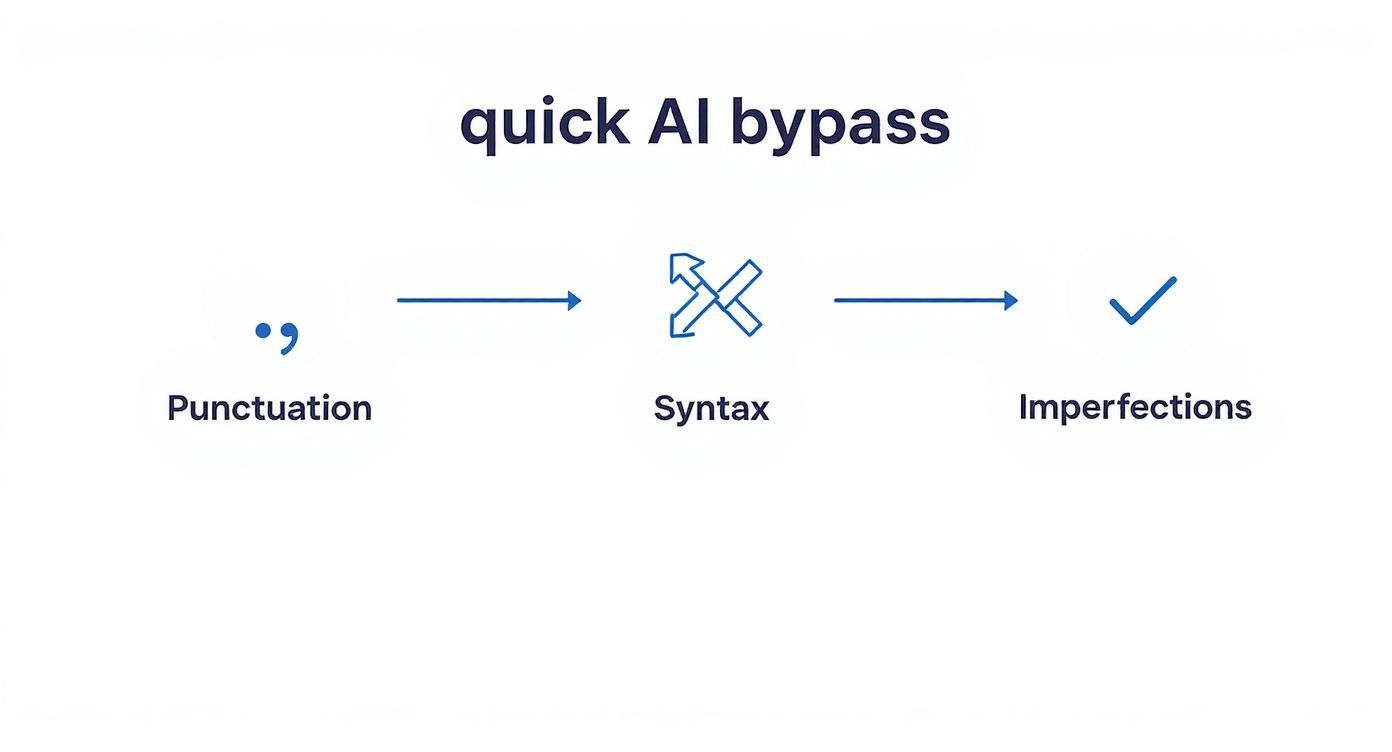
As you can see, focusing on the little things—punctuation, syntax, and even subtle imperfections—is a great way to disrupt the clean, predictable structure that screams "AI-written!"
Choosing the Right Tool for the Job
The market is flooded with options, and they're not all created equal. On one end of the spectrum, you have general paraphrasers like QuillBot. These are great for general rephrasing and improving clarity, but they aren't specifically built to outsmart sophisticated detectors. Think of them as intelligent thesauruses.
On the other end, you have specialized AI humanizers. Tools like HumanText.pro are engineered from the ground up with one clear mission: to convert AI text into natural, human-like writing that sails past detection. They do more than just swap synonyms; their advanced models rework sentence structure, rhythm, and flow to mimic how a real person writes.
A huge advantage of these specialized tools is their ability to preserve the original meaning while fundamentally altering the text’s underlying structure. This is non-negotiable for things like academic papers, professional reports, or SEO content where factual accuracy is everything.
Deciding between manual and tool-assisted rewriting often comes down to balancing time, quality, and budget. Each approach has its place.
Manual vs Tool-Assisted Rewriting
| Aspect | Manual Rewriting | Tool-Assisted Rewriting |
|---|---|---|
| Speed | Slow and time-consuming | Very fast (seconds to minutes) |
| Authenticity | Highest possible; infuses unique voice | Good, but needs a final human touch |
| Cost | "Free" but high opportunity cost (your time) | Typically requires a subscription |
| Effort | High mental and creative effort | Low initial effort |
| Consistency | Can vary based on writer's energy/skill | Highly consistent output |
| Best For | High-stakes content, short-form text | Bulk content, initial drafts, scaling production |
Ultimately, the best workflow combines the strengths of both. Use a tool to handle the initial heavy lifting, then apply your human expertise for the final polish.
The Hybrid Workflow in Action
Relying 100% on an automated tool can leave your text feeling a bit soulless or just slightly off. The smartest strategy is to let the tool tackle the time-consuming grunt work of restructuring, then you step in to add the final, irreplaceable human touch.
Let's say you've just generated a 1,000-word article. Instead of spending hours rewriting it from scratch, you run it through a humanizer. In a minute, the output is 80% of the way there. The robotic cadence is gone, and the predictable vocabulary has been refreshed.
Now, it's your turn to handle the last 20%. This is where you inject your unique voice, add a personal anecdote, fix any clunky phrasing the tool might have missed, and ensure the tone is a perfect match for your brand. We dive deeper into this final refinement process in our guide on how to convert AI text to human text.
This hybrid approach gives you the raw efficiency of a machine without sacrificing the authenticity that only a human can provide.
Manual Review Checklist for Humanized Text
After using a tool, your final manual review is the most important step. It’s your last chance to catch subtle mistakes and inject genuine personality. Seriously, don't skip this.
Here’s a quick checklist to guide your final read-through:
- Read it Aloud: Does any sentence sound weird or unnatural when you say it? Tools can sometimes produce grammatically correct but awkward phrasing.
- Check the Core Meaning: Did the tool accidentally twist the meaning of a key point? Double-check that all your main arguments are still accurate and intact.
- Inject Your Voice: Where can you add a personal story, a sharp opinion, or a bit of humor? This is the fastest way to make the text undeniably yours.
- Verify Facts and Figures: Always, always double-check any numbers, stats, names, or specific data points. AI tools can occasionally misinterpret or alter these crucial details.
This focused final review is what transforms a decent piece of AI-assisted content into a truly great one.
Ethical Considerations and Responsible Use
Knowing how to make AI-generated text fly under the radar opens up a world of efficiency, but it also hands you a significant amount of responsibility. These techniques are just tools. Like any tool, their value—and their danger—comes down to how you decide to use them.
This isn't just a technical conversation about fooling an algorithm. It's about your intent, your transparency, and how your content impacts the people who read it.
The real question isn't can you make AI text undetectable, but should you? The answer is all about context. In most professional settings, using AI as a high-powered assistant is perfectly fine—in fact, it’s often encouraged. It’s a fantastic way to smash through writer's block, get a first draft on the page, and scale up content for things like marketing or SEO.
Smart, Legitimate Ways to Use These Skills
When you’re using these humanizing techniques ethically, the goal is to boost your productivity, not to pull the wool over someone's eyes. You’re simply bridging the gap between a machine's sterile first draft and a polished, engaging piece of writing.
Think about these common scenarios:
- Content Marketing: A marketing team can use AI to generate dozens of social media post ideas, then apply these techniques to make sure every single one nails their brand's unique voice. It’s about consistency and quality at scale.
- Overcoming Writer's Block: A blogger staring at a blinking cursor can use AI to get ideas flowing. Then, they can rewrite that foundation, weaving in personal stories and unique insights to create something genuinely their own.
- SEO at Scale: An SEO specialist can produce baseline content for a bunch of web pages, then meticulously refine it to make sure it's actually helpful and reads naturally for visitors, which is exactly what Google wants to see.
In these situations, you’re aiming for efficiency without sacrificing quality. The final piece is still guided by human expertise, making it valuable and authentic.
Where the Ethical Lines Are Drawn
On the flip side, the line between responsible use and outright misconduct is crystal clear. Submitting a raw or lightly tweaked AI essay for a school assignment isn't a clever workaround—it's academic dishonesty, plain and simple. It completely undermines the whole point of learning.
The same goes for spreading misinformation. Using these methods to make fake news or deceptive content sound more credible is a deeply unethical move with serious, real-world consequences. It erodes public trust and pollutes the information ecosystem we all depend on.
The risks are growing at a frightening pace. Look beyond text to the world of deepfakes and AI-driven fraud, and you'll see the severe security threats these evasion methods pose. Between 2023 and 2025, the number of deepfake files skyrocketed by 1,500%, and related fraud attempts jumped a mind-boggling 3,000% worldwide. This explosion in malicious AI is creating a massive 'vulnerability gap' that defensive tools are struggling to close, showing just how much harm these tactics can cause. You can dig into more of these evolving security challenges and deepfake statistics on DeepStrike.io.
A Quick Framework for Responsible Use:
Before you start humanizing a piece of AI content, ask yourself three quick questions:
- What's my intent? Am I trying to make my workflow better, or am I trying to deceive someone?
- Am I passing this off as 100% my own original thought? In school or academia, transparency is everything.
- Is this content actually valuable? Google's helpful content guidelines reward quality, no matter how it was made. Focus on being useful, not just undetectable.
At the end of the day, these techniques should amplify your skills and creativity, not replace them. They’re here to assist, not to cheat. The responsibility is on you to use this powerful technology with integrity, making sure your final product is honest, valuable, and true to your own voice.
Common Questions About Bypassing AI Detection
Working with AI-generated text brings up a lot of practical questions. As you start blending AI into your writing workflow, you’ll naturally hit some gray areas and wonder about the real-world consequences of trying to make AI text sound human.
Let's dig into some of the most common questions people ask. My goal here is to give you clear, straightforward answers to help you find that sweet spot between AI speed and human authenticity.
How Accurate Are AI Detection Tools, Really?
This is the million-dollar question, and the honest answer is: not nearly as accurate as you'd think.
AI detectors aren't magical truth-tellers; they're sophisticated pattern-matchers. They analyze text for statistical markers common in AI writing—like predictable word choices and overly consistent sentence structures—and then assign a probability score. They can, and frequently do, get it wrong.
This leads to two big headaches:
- False Positives: This is when a detector flags 100% human-written text as AI-generated. I've seen this happen a lot with formal, structured content like academic papers or technical manuals—the very writing style that AI was trained on.
- False Negatives: This is when AI-generated text sails right through, getting a "human" score. This usually happens after a decent round of humanization or when the text comes from a newer AI model the detector hasn't been trained to recognize yet.
These tools look for things like low perplexity (predictable text) and uniform burstiness (consistent sentence length). Because they don't actually understand the content, they're easily fooled.
My Takeaway: Think of a high AI score as a helpful nudge that your writing needs more personality and variety, not as a final judgment. These tools are guides, not gospel.
Is Humanizing AI Content Considered Plagiarism?
No, humanizing AI content is not plagiarism. The two concepts deal with completely different ethical issues.
Plagiarism is when you steal another person's specific words or ideas and pass them off as your own. It involves a human creator whose work is being copied without giving them credit.
When you use an AI to generate a first draft and then you substantially rewrite, edit, and inject your own insights, the final piece is your work. You're the author. Think of the AI as a super-advanced brainstorming partner, not a source you're stealing from.
But—and this is a big but—the context matters.
- In School: Turning in raw AI output for an assignment, even if it passes a plagiarism check, almost certainly violates your school's academic integrity policy. The whole point is to demonstrate your thinking.
- At Work: In a professional setting, the focus shifts to quality and results. As long as the final content is accurate, valuable, and sounds like your brand, how it was created is far less important.
The key word here is transformation. If you’ve put in the work to make the text truly yours, you aren’t plagiarizing. You're just using a modern tool to get the job done faster.
What’s the Best Method to Bypass AI Detection?
The most effective, reliable method isn't a single trick—it's a hybrid workflow.
Relying only on a tool can leave your text feeling a bit hollow, while doing everything by hand can take forever. The magic happens when you combine the efficiency of AI with the irreplaceable touch of a human editor.
Here’s the process I've seen deliver the best results, time and time again:
- Generate with AI: Get your rough draft, outline, or core ideas down using your favorite language model.
- Humanize with a Tool: Run that draft through a quality AI humanizer. This does the heavy lifting, restructuring sentences, swapping out common AI vocabulary, and breaking up those robotic patterns.
- Do a Critical Manual Review: This is the step you absolutely cannot skip. Read the text aloud to catch clunky phrasing. Inject your personal voice with specific examples, anecdotes, or opinions. And for heaven's sake, double-check every fact and figure.
This layered approach gives you the best of both worlds: the speed of automation and the authenticity that can only come from a human mind.
Ready to turn your AI drafts into undetectable, human-quality content? HumanText.pro uses advanced models to humanize your text, helping you fly past the top AI detectors while keeping your core message intact. Give it a try and see the difference for yourself.
Ready to transform your AI-generated content into natural, human-like writing? Humantext.pro instantly refines your text, ensuring it reads naturally and authentically. Try our free AI humanizer today →
Related Articles
AI Face Search Explained: Verify Identity and Stay Safe
Understand how AI face search works, including embeddings, accuracy, and legal issues. Learn to use these tools for personal safety and verify identity online.
Reverse Face Search: A Verification Safety Guide
Learn how reverse face search works, when to use it for safety, and how to pair it with AI image checks to verify online contacts and reused photos.

Face ID Search Explained: How It Works and How to Verify
Learn how face ID search works, why it differs from reverse image search, and how to verify identities and photos safely with practical checks and tools.

