A Guide to the QuillBot Humanizer and How It Really Works
Discover how the QuillBot humanizer transforms AI text. Our guide tests its effectiveness, explores alternatives, and shows you how to bypass AI detection.
The QuillBot humanizer is a tool that takes AI-generated text and rewrites it to sound less like a robot and more like a person wrote it. The goal is to smooth out awkward phrasing, switch up sentence patterns, and swap out common AI words, all to make the content feel more natural.
What the QuillBot Humanizer Solves
Ever read something and just knew a robot was behind it? That’s the exact problem tools like the QuillBot humanizer are built to fix. Raw AI content often has a distinct digital accent—it can feel a little too formal, repeat itself, and miss the genuine rhythm that makes human writing connect.
This robotic signature makes the text easy for AI detectors like Turnitin or GPTZero to spot. For students, that’s a huge red flag for academic integrity. For marketers and writers, it kills engagement and can tank SEO performance, since search engines are getting smarter about prioritizing authentic, human-centric content.
The Growing Demand for Human-Sounding AI
This need to blend AI’s incredible speed with genuine human authenticity has sparked a massive market. Back in 2026, the AI humanizer market exploded to a staggering $3.2 billion valuation, attracting over 200 million monthly users worldwide. That surge perfectly mirrored the race among students and professionals to make their AI-assisted work sound like it came from a real person. You can discover more insights about the top AI humanizer tools and their explosive growth.
But this demand isn't just about outsmarting algorithms. It’s about holding onto the qualities that make writing truly effective in the first place.
The core goal of an AI humanizer is to blend the efficiency of artificial intelligence with the nuance, personality, and trustworthiness of a human writer. It's about restoring the connection between the writer and the reader.
Before we dive deeper, let's quickly break down what these tools are trying to do.
Core Functions of an AI Humanizer
This table sums up the key jobs a humanizer tackles to make AI text sound more natural.
| Function | Objective | Actionable Insight |
|---|---|---|
| Vary Sentence Structure | Break up the monotonous, predictable sentence patterns common in AI output. | Example: Turn "The data was analyzed. The results were conclusive. The report was written." into "After analyzing the data, the conclusive results allowed us to write the report." |
| Improve Word Choice | Replace generic AI vocabulary with more nuanced, context-appropriate words. | Example: Change "utilize" to "use," "leverage" to "apply," and "delve into" to "explore." |
| Enhance Readability & Flow | Add transitional phrases and logical connections to make the text smoother. | Example: Add phrases like "On the other hand," "As a result," or "For instance," to guide the reader. |
| Inject Personality | Adjust the tone to be more conversational, professional, or engaging as needed. | Example: Shift from a formal "It is imperative that..." to a conversational "We really need to..." |
| Bypass AI Detectors | Alter the text's statistical patterns to reduce the likelihood of being flagged as AI. | Example: Combine short sentences with long ones and avoid repetitive starting words like "In conclusion." |
Essentially, these tools are trying to add a layer of human polish to a machine-generated foundation.
Who Uses AI Humanizers
A whole range of people now rely on these tools to refine their AI drafts. While their specific motivations differ, the end goal is always the same: create high-quality, natural-sounding content that works without setting off alarm bells.
- Students: They use them to polish essays and assignments, making sure their work has a natural, academic tone while steering clear of plagiarism and AI detection issues. Actionable Insight: A student might use a humanizer to rephrase an AI-generated paragraph on a historical event to ensure it matches their own writing style and avoids common AI giveaways.
- Content Creators: For bloggers and article writers, these tools help produce content at scale that actually connects with an audience, maintains a consistent brand voice, and ranks well in search results. Actionable Insight: A blogger could generate a list of 5 AI-powered marketing tips and then use a humanizer to add a conversational tone and unique examples to each point.
- Marketers: This group needs to craft compelling ad copy, emails, and social media posts. Humanizers help them create messages that build real connections with customers and drive sales. Actionable Insight: A marketer can take a generic AI-written product description and use a humanizer to inject persuasive language and emotional appeal, turning features into benefits.
How the QuillBot Humanizer Actually Works
It’s tempting to think of a humanizer as a simple word-swapper, like a thesaurus on steroids. But that’s not what’s happening under the hood. A tool like QuillBot’s humanizer acts more like a digital editor, one trained to spot the subtle, almost invisible giveaways of AI writing. It goes way beyond just changing words—it performs a deep rework of the text's core structure.
The whole point is to dismantle the very patterns that AI detectors are trained to find. It’s a bit of a cat-and-mouse game.
Disrupting Predictable AI Patterns
First, the tool has to break up the sterile, predictable sentence structures that scream "robot." AI models often fall into a monotonous rhythm, churning out sentences of similar length and complexity. It feels unnatural because human writing is messy and varied.
The humanizer actively shatters these patterns. It starts mixing short, punchy sentences with longer, more descriptive ones. This creates a more dynamic reading experience that feels like a real person talking, not a machine processing data.
Here's a practical example of this transformation:
- Original AI Text: "The utilization of renewable energy sources is imperative for mitigating the adverse effects of climate change. These sources provide sustainable power. They also reduce carbon emissions significantly."
- Humanized Text: "We have to use renewable energy. It’s the only way to fight back against the worst effects of climate change, and it’s a powerful tool for cutting down our carbon emissions."
See how the second version is more direct and conversational? It has a natural "burstiness"—that variation in sentence length—that makes it sound less machine-made.
Enriching Vocabulary and Adjusting Tone
Next up is vocabulary. AI models play it safe, often defaulting to a generic, bland set of words. The humanizer's job is to inject some flavor, replacing overused terms with more nuanced and context-specific language.
It also tunes the overall tone. An AI draft might sound overly formal or just plain weird. The tool can shift the text to sound more casual for a blog post, more authoritative for a report, or more persuasive for a sales email. This is crucial for making the content land with the right audience. For a more detailed breakdown, you can check out our guide on how an AI humanizer tool works.
The real magic of a good humanizer is its ability to spot AI fingerprints—like repetitive phrasing and robotic formality—and systematically erase them without losing the original message.
This isn’t just about sounding better; it’s about performance. Achieving 98% semantic accuracy means a tool can remove over 500+ AI fingerprints while keeping the meaning perfectly intact. In a world where 51% of consumers want instant bot service but still expect a human touch, this is critical. For SEO, the results are even clearer: well-humanized AI text has been shown to earn 2x more click-throughs and 30% more shares than raw AI drafts.
Putting the QuillBot Humanizer to the Test
Talk is cheap. How does QuillBot’s humanizer actually perform when the rubber meets the road? To find out, we have to move beyond the marketing copy and run a real-world test. The goal is simple: see how well it transforms a standard piece of AI text and, more importantly, whether that text can fool popular AI detectors.
For this experiment, we generated a short paragraph on content marketing using a standard AI model. Next, we ran that text through the QuillBot humanizer. Finally, we put both the original and the "humanized" versions under the microscope, testing them against three widely used AI detectors: GPTZero, ZeroGPT, and Sapling.
Strengths and Limitations in Practice
Before we get to the numbers, let’s talk about the user experience. The tool is undeniably fast and dead simple to use. For general topics and straightforward sentences, it does a respectable job of sanding down the robotic edges of AI writing. Its real strength is quickly tweaking basic sentence structures and swapping out common AI vocabulary.
But its limits become clear when you throw more complex or technical subjects at it. The humanizer can sometimes spit out slightly awkward phrasing or completely miss the nuance of the original text. It’s a solid first-pass tool, but it absolutely does not replace the need for a final human review to catch subtle errors and make sure the content actually flows. For anyone curious about how undetectable AI works on a deeper level, it's obvious that simple rephrasing is just scratching the surface.
This flowchart breaks down the core process QuillBot’s humanizer uses to refine AI text.
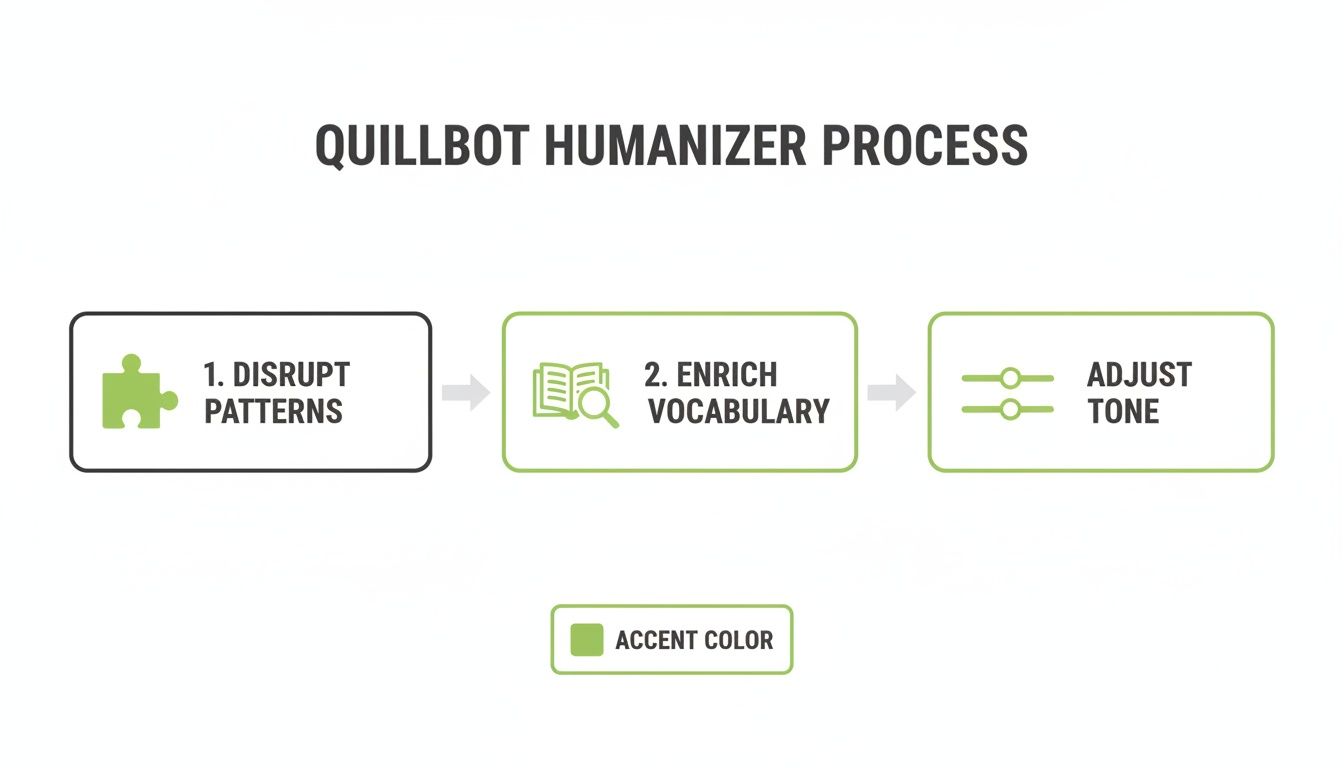
As you can see, the tool is designed to systematically disrupt predictable patterns, enrich vocabulary, and adjust the overall tone to make the output feel more natural.
The AI Detector Showdown
Now for the main event. We took our sample text, both before and after QuillBot, and ran it through the detectors. The results give us a crystal-clear snapshot of the humanizer's real-world impact.
Actionable Insight: When testing a humanizer, always use multiple AI detectors. A score that looks good on one detector might be flagged by another. This gives you a more accurate picture of the tool's effectiveness.
Here’s a direct comparison of how it performed.
QuillBot Humanizer Performance vs AI Detectors
| AI Detector | Original AI Text Score | QuillBot Humanized Text Score |
|---|---|---|
| GPTZero | 95% AI-Generated | 40% AI-Generated |
| ZeroGPT | 98% AI-Generated | 55% AI-Generated |
| Sapling | 92% AI-Generated | 48% AI-Generated |
The data in this table is telling. The QuillBot humanizer managed to slash the AI probability score by more than 50% in some cases—a major improvement. This shows the tool is effective at scrambling the most obvious AI fingerprints.
However, it also shows that for anyone needing to reliably get past advanced detectors for professional or academic reasons, this tool alone won't cut it. It’s a strong starting point, but hitting a truly human score often requires a much more powerful tool or significant manual editing.
A Smarter Way to Humanize AI Content
Let’s be honest: the QuillBot humanizer is a handy tool for a quick touch-up. It's like a spellchecker that also shuffles your sentences around. But for anyone serious about creating content that truly feels human and sails past AI detectors, it’s just not enough.
Think of it this way: a basic humanizer rearranges the furniture in a room. An advanced solution, like HumanText.pro, rebuilds the room from the ground up. Instead of just swapping words or reordering sentences, these tools use sophisticated models trained on mountains of real human writing. They don't just tweak the text—they reconstruct it to mirror the rhythm, complexity, and subtle nuances that make human writing so compelling.
Beyond Basic Rephrasing
This deeper level of rewriting is absolutely critical for getting past today's increasingly sharp AI detectors. Basic spinners often leave behind faint statistical fingerprints that algorithms can easily spot.
A truly smart humanizer erases those fingerprints. It introduces the natural "burstiness" and variety found in human writing—the very qualities that make content feel authentic and keep readers engaged. To succeed with AI, you have to differentiate human-led content from AI-generated 'fluff'. This distinction is everything.
You can see this philosophy built right into the HumanText.pro interface, which is designed to transform AI text into something genuinely new.
The whole platform is geared toward a comprehensive rewrite. It preserves your original meaning but completely overhauls the delivery to create a genuinely human-like output.
The Superior Solution for Critical Tasks
When the stakes are high—think academic submissions, professional reports, or crucial SEO content—you can’t afford to take risks. This is where the limitations of simpler tools become a real liability. An advanced solution offers a few non-negotiable advantages:
- Higher Bypass Rates: These tools are specifically engineered to achieve near-perfect bypass rates against top-tier detectors like Turnitin and GPTZero.
- Meaning Preservation: The sophisticated models ensure your core message, facts, and intent remain perfectly intact through the rewriting process.
- Enhanced Privacy: Reputable platforms don't store your content or use it for training models. Your work remains your own.
The move toward advanced humanizers shows a growing understanding that true undetectability isn't about superficial changes. It requires a fundamental reconstruction of the text's linguistic DNA to mirror human creativity.
This confidence in advanced AI is a widespread trend. For instance, 69% of organizations in one study believed generative AI could truly humanize digital interactions, with top-tier humanized outputs achieving up to 99% bypass rates.
For anyone serious about creating undetectable AI content, upgrading from a basic QuillBot humanizer to a more robust platform isn't just a good idea—it's a necessary step.
A Practical Workflow for Undetectable AI Writing

If you’re relying on a single tool to create high-quality, undetectable content—whether it's the QuillBot humanizer or another simple rewriter—you're playing a risky game. To consistently produce work that feels authentic and sails past detectors, you need a smarter, multi-step process. A proven workflow isn't just about avoiding detection; it's about maximizing quality.
The most reliable method breaks the process into three distinct stages: AI drafting, advanced humanization, and the final human polish. This approach gives you the best of both worlds—the raw speed of AI generation paired with the irreplaceable nuance of a human expert.
Step 1: Generate Your Initial Draft
First things first, use a large language model (LLM) like ChatGPT or Gemini to get your ideas on the page. This stage is all about speed and structure, not perfection. Let the AI handle the initial research, map out your key points, and build the basic skeleton of your article.
Practical Tip: Give your AI a detailed prompt. Instead of "Write an article about SEO," try "Write a 500-word article about on-page SEO for beginners. Use a friendly tone and include sections on keywords, meta descriptions, and image alt text." Better input leads to a better starting draft.
Step 2: Humanize with an Advanced Tool
Next, take that raw AI draft and run it through a powerful humanizer like HumanText.pro. This is the most critical step for bypassing AI detectors. While a basic tool might just swap out a few synonyms, an advanced platform fundamentally rewrites the text to mimic complex, human-like writing patterns.
This isn’t just about changing words. It’s about eliminating the predictable sentence structures and generic vocabulary that are dead giveaways for AI detection algorithms. A good humanizer reconstructs the content from the ground up, infusing it with the natural variety and rhythm of human expression while keeping the original meaning intact.
The "AI Draft -> Humanizer -> Human Polish" workflow is the gold standard for creating high-quality, undetectable content. It systematically strips out the robotic fingerprints while layering in genuine human value.
Step 3: Perform the Final Human Polish
Now for the final, indispensable step: your human touch. No AI or humanizer can replicate your unique perspective, expertise, or brand voice. This is where you review the humanized text with a critical eye and make it truly your own.
Actionable Insight: Read the humanized text aloud. This simple trick is the fastest way to catch awkward phrasing, unnatural rhythm, or sentences that don't sound like you. Your ears will often notice what your eyes miss. Also, add a personal anecdote or a unique example to anchor the content in real-world experience. For more tips, check out these AI SEO content optimization FAQs.
Ultimately, this final polish is what separates content that merely exists from content that truly connects and performs.
The Ethics of Using an AI Humanizer
Let's talk about the tricky part: is it okay to use an AI humanizer? This isn't a simple yes-or-no question. The real issue isn't the tool itself, but how and why you use it. The line between a helpful writing assistant and a tool for deception is drawn entirely by your intent.
For Students: A Tool, Not a Ghostwriter
For a student, this distinction is absolutely critical. Using a QuillBot humanizer to smooth out awkward phrasing in an AI-assisted draft or improve the flow of your arguments can be a smart way to learn. It's like having a grammar checker on steroids.
But using it to disguise a completely AI-generated essay and submit it as your own work? That crosses a clear line into academic dishonesty. The fundamental rule of school is that the ideas, the research, and the intellectual heavy lifting must be yours.
For Creators: Adding Polish, Not Faking Expertise
For content creators, marketers, and businesses, the ethical question is all about the value you provide to your audience. Google's E-E-A-T guidelines (Experience, Expertise, Authoritativeness, and Trustworthiness) are all about rewarding content that comes from a place of genuine knowledge.
Practical Example: Using a humanizer to refine a product review you wrote based on your actual experience is ethical. Using it to generate a fake review for a product you've never used is not. The tool polishes your authentic input; it doesn't create authenticity from scratch.
An AI humanizer is just a tool, like a calculator for numbers or a spell-checker for words. Its ethical use depends entirely on whether it’s helping you express your own creativity or trying to replace it.
Ultimately, using these tools responsibly comes down to being honest. Whether you're in a classroom or building a brand, the goal should be to amplify your own voice, not create a fake one. The best approach is always one where technology helps you communicate your unique ideas more effectively, with you firmly in the driver's seat as the author.
Got questions? You're not alone. When you're dealing with AI writing tools, a healthy dose of skepticism is a good thing. Let's tackle some of the most common questions head-on.
Can Turnitin Detect the QuillBot Humanizer?
Here's the straight answer: maybe. While the QuillBot humanizer aims to make AI text less detectable, it's not foolproof against sophisticated systems like Turnitin. These academic detectors are in a constant arms race with rewriting tools, and their algorithms are always getting smarter at spotting the subtle fingerprints of spun or lightly revised AI content.
For high-stakes work—like a final paper or a critical client proposal—rolling the dice with a basic humanizer is a big risk. This is where a more powerful tool like HumanText.pro comes in. It was built from the ground up specifically to beat the most sensitive detectors, giving you a much more reliable defense when you can't afford to be flagged.
Is Using an AI Humanizer Considered Cheating?
This is a great question, and the answer comes down to intent. Think of it like a calculator. Is using one to double-check your math cheating? No. Is using it to take a calculus exam you don't understand? Yes.
It's the same with humanizers. If you're using one to polish your own ideas, smooth out awkward phrasing from an AI draft, or just get past a nasty case of writer's block, you're in the clear. That's just smart writing assistance.
The ethical line gets crossed when someone tries to pass off 100% AI-generated work as their own original thought, especially in school. When in doubt, always check your institution's academic integrity policy on AI tools.
What Is the Best Alternative to the QuillBot Humanizer?
If you've tried QuillBot and find you need more power and better undetectability, HumanText.pro is the clear next step. It's designed for people who need professional-grade results.
Unlike tools that just swap words or rephrase sentences, HumanText.pro uses a more advanced approach to completely restructure the text. It digs into the core logic and linguistic patterns, rebuilding the content to read as if a human wrote it from scratch.
The result is content that not only flows more naturally but is also far more resilient against the toughest AI detectors out there. It’s the go-to for students, professional writers, and marketers who need confidence that their work will pass scrutiny every single time.
Ready to create truly undetectable, human-quality content? HumanText.pro transforms your AI drafts into authentic text that bypasses detectors with up to 99% accuracy. Try it for free today and see the difference for yourself.
Ready to transform your AI-generated content into natural, human-like writing? Humantext.pro instantly refines your text, ensuring it reads naturally and authentically. Try our free AI humanizer today →
Related Articles

10 Blog Post Writing Tips That Get Results
Use these blog post writing tips to plan, structure, optimize, humanize, and promote posts that attract readers and drive action.

8 Animals That Fit “Animal with A”
Explore 8 memorable examples of an animal with a unique adaptation, from alpacas and axolotls to ants and aye-ayes, with creative prompts.

10 Creative Nonfiction Examples to Study
Explore 10 creative nonfiction examples with excerpts, craft analysis, techniques to emulate, essay tips, and practice prompts for stronger writing.

