Reveal: rewrite ai text to Sound Natural and Engaging
Discover how to rewrite ai text to sound natural and engaging with practical steps, examples, and the right tools.
So, what does it actually mean to rewrite AI text? It’s the art of taking robotic, machine-generated output and transforming it into something that sounds genuinely human. This isn't just a minor tweak; it's essential. Raw AI drafts often lack a real voice, feel sterile, and can get flagged by detection tools, making them useless for connecting with a real audience.
Why Raw AI Content Fails to Connect
Let's be clear: AI-generated content is an incredible starting point. A massive time-saver. But on its own, it often feels cold and impersonal. It completely misses the subtle quirks, personal stories, and unique voice that make writing compelling. This isn't just a "vibe"—it's a pattern that today's advanced detection tools are built to sniff out.
Think about it. Tools like an audio file to text converter can spit out a transcript in seconds, but that raw text is rarely ready for primetime. It lacks the polish and natural rhythm needed for an engaging blog post. AI content generators have the same problem. The text is grammatically perfect, sure, but it screams "I was written by a machine" through a handful of common tells.
The Telltale Signs of AI Writing
AI content tends to fall into predictable traps, making it easy to spot for both human readers and sophisticated algorithms. Once you know what to look for, you can start fixing it.
Here are the most common issues I see:
- Repetitive Sentence Structures: AI loves a good formula. It will often use the same sentence format over and over, creating a rhythm so monotonous it could put you to sleep. Actionable Insight: Look for paragraphs where multiple sentences start with "The company..." or "This is...". Your first task is to break that pattern.
- Overly Formal Tone: The content can sound like it was written for a stuffy academic journal, even when it's supposed to be a casual blog post. It lacks the conversational feel of real human writing.
- Generic Phrasing: AI leans heavily on clichés and common phrases like "in the digital age" or "unlock the potential." Practical Example: Search your document for these phrases and replace them with something more specific and original. Instead of "unlock the potential," try "get the most out of every feature."
- Lack of a Personal Voice: This is the big one. There are no personal anecdotes, no strong opinions, no distinct personality. It just feels... empty.

This is why a simple edit isn't enough. You need a complete rewrite to infuse the text with a human touch.
To really see the difference, let’s compare the characteristics of a raw AI draft versus a piece of content that's been properly humanized.
Raw AI Text vs Humanized AI Text
| Characteristic | Raw AI Text | Humanized Text |
|---|---|---|
| Tone | Formal, generic, overly uniform | Conversational, engaging, varies appropriately |
| Sentence Structure | Repetitive, predictable lengths | Varied, mixes short and long sentences |
| Word Choice | Relies on common words and clichés | Uses unique phrasing, idioms, and specific vocabulary |
| Flow & Rhythm | Monotonous and choppy | Natural, a smooth transitions between ideas |
| Personal Touch | Lacks anecdotes, opinions, or personality | Includes personal stories, insights, and a clear voice |
| Originality | Often rephrases existing information | Presents fresh perspectives and unique insights |
As you can see, the goal is to move from something that merely presents information to something that truly communicates it with style and personality.
How AI Detectors Spot Machine-Written Text
Top-tier detectors like Turnitin and GPTZero are more than just keyword scanners. They dig into deep linguistic patterns. They analyze things like low "perplexity" (how predictable the word choices are) and "burstiness" (the natural variation in sentence length). These are the classic fingerprints of machine writing.
For example, GPTZero has demonstrated a 99% accuracy rate when distinguishing between clean AI text and human-written samples. That’s a sobering statistic if you’re just hitting “publish” on a raw draft.
But here’s the most important takeaway: the goal isn't just to sneak past a detector. It's to create content that builds trust, resonates with your audience, and actually achieves what you set out to do, whether that's for a school paper, a business report, or a marketing campaign.
Turning that raw material into something valuable requires more than just swapping out a few synonyms. It’s a deep humanization process. For a closer look at the tools that can help, check out our guide on how to use an AI content humanizer to kickstart your editing.
Your Pre-Rewrite Strategy Session
Jumping straight into editing a raw AI draft is like trying to build a house without a blueprint. It's messy, you'll probably miss something important, and you'll almost certainly end up redoing half your work.
Before you touch a single word, a quick strategy session can save you hours of headaches.
Think of this as setting the guardrails for your project. By figuring out what you actually need the content to do, you can guide your edits with purpose. This is how you move from a generic, soulless document to a piece of content that's targeted, accurate, and actually connects with a reader.

This initial phase is all about asking the right questions before you start writing. It ensures the final piece isn't just human-sounding, but also strategically sound.
Start with a Fact-Check
AI models are notorious for "hallucinating." They'll confidently state incorrect facts, invent statistics out of thin air, or cite sources that don't exist. Your first job is to play detective and assume nothing is true until you've verified it.
- Verify every number. If the AI claims "87% of marketers use video," your immediate next step is finding the original study. Actionable Insight: Don't just Google the statistic. Try searching for
[original source "87% of marketers use video"]to find the primary report instead of an article that just repeated the claim. - Check all claims. Did the AI mention a specific historical event or a technical process? A quick search can confirm whether it's accurate or a complete fabrication.
- Confirm sources. If the AI was kind enough to provide sources, check them. You'll often find the links are dead, go to an irrelevant page, or the content doesn't even support the claim.
This isn't just about accuracy—it's about credibility. Publishing misinformation will damage your reputation far more than robotic-sounding text ever could.
A great rewrite is built on a foundation of truth. Spending five minutes verifying a statistic is always better than spending hours on damage control after publishing incorrect information. It's a non-negotiable step in producing trustworthy content.
Define Your Audience and Voice
Once the facts are straight, it's time to figure out who you're talking to and how you want to sound. AI defaults to a bland, one-size-fits-all tone that rarely connects with anyone. It's your job to give it a personality.
Ask yourself these simple questions:
- Who is this for? Are they a beginner who needs simple explanations, or an expert who already knows the industry jargon? Practical Example: If you're writing for beginners, you'd swap "leverage synergistic platforms" for "use tools that work well together."
- What's the right tone? Should it be professional and authoritative? Casual and witty? Empathetic and reassuring?
- What's the one thing they should remember? If your reader walks away with just one key takeaway, what should it be? Actionable Insight: Write this one takeaway on a sticky note and keep it on your monitor as you edit. It keeps your rewrite focused.
Having clear answers here helps you make intentional choices as you rewrite. Every sentence you adjust should be in service of your audience and your core message.
Practical Techniques for Humanizing AI Text
Once you have your strategy straight, the real work begins. This is where you roll up your sleeves and do more than just proofread. You're injecting a genuine human heartbeat into a sterile AI draft. Think of it less like fixing typos and more like crafting a voice and rhythm that actually connects with a reader.
To truly rewrite AI text so it's undetectable, you have to dismantle its predictable patterns from the ground up. This means changing the structure, adding some stylistic flair, and consciously injecting personality where there is none.
Let's get into the tactics that actually make this happen.
Dismantle Monotonous Sentence Structures
AI-generated content often has a flat, metronomic rhythm. Sentence after sentence follows a similar length and structure, which makes for a pretty dull reading experience. Your first job is to break that up.
Think of it like music. A great song isn't just one note played over and over; it has fast parts, slow parts, quiet moments, and loud crescendos. Your writing needs that same variety.
- Mix it up: Combine short, punchy sentences for impact with longer, more descriptive ones that provide context. Practical Example: Follow a long sentence explaining a complex idea with a short one like, "Here's what that means." It gives the reader a moment to breathe.
- Vary the openings: Stop starting every sentence with "The..." or "It is...". Actionable Insight: Use a free online tool to analyze your sentence starters. If you see too much repetition, rephrase those sentences to start with a subordinate clause or a transitional phrase.
This one change can dramatically improve the energy of your content, making it feel less like a machine-generated report and more like a conversation.
Inject Personality and a Human Voice
This is, by far, the most critical part of humanizing AI text. An AI can't share a personal story, express a genuine opinion, or use a niche colloquialism that makes your specific audience nod in agreement. That’s all on you.
The goal is to add elements that prove a human mind was behind the words.
- Use anecdotes: A short, relevant personal story can illustrate a point far better than a dry explanation. Instead of saying, "It's important to be organized," try something like, "I once missed a massive deadline because my notes were a complete mess—a mistake I never made again."
- Ask rhetorical questions: Pulling the reader in with questions like, "But how do you actually put that into practice?" makes them feel like part of a dialogue.
- Add industry-specific idioms: Using language your specific audience understands shows you're one of them. Practical Example: If you’re writing for software developers, a phrase like "it’s time to refactor that process" will build instant rapport.
The core difference between AI and human writing often boils down to experience. AI summarizes information; humans synthesize it through the lens of their own lives. Weaving in those personal touches is the fastest way to build a real connection.
For a deeper look, our guide on a ChatGPT humanizer offers more strategies for turning AI drafts into authentic content. This goes beyond simple editing; it's about a deeper level of crafting, like mastering information synthesis to create something truly insightful.
Diversify Vocabulary and Kill AI Buzzwords
AI models have their favorite words. They constantly lean on generic, safe terms that lack any real punch. Your rewrite needs to hunt these down and replace them with more vivid and precise alternatives.
It helps to create a "hit list" of words to search and destroy.
- Instead of "important," try "essential," "critical," "crucial," or "vital."
- Instead of "shows," consider "demonstrates," "illustrates," "reveals," or "highlights."
- Instead of "good," use "effective," "valuable," "beneficial," or "high-quality."
Here’s a quick before-and-after to show you what I mean:
AI-Generated Text (Before): "It is important to use different sentence structures in writing. This makes the content more interesting for the reader. Using the same structure repeatedly can be boring. Therefore, writers should vary their sentences."
Humanized Text (After): "Ever read something so monotonous it almost put you to sleep? That's what happens when every sentence sounds the same. Mixing short, punchy statements with longer, more descriptive thoughts is crucial. It creates a natural rhythm that keeps your reader engaged and wanting more."
See the difference? We added a rhetorical question, swapped "important" for "crucial," and created a much more conversational flow. These small adjustments add up, transforming the text from robotic to relatable and giving it the authentic voice it was missing.
Creating an Efficient AI Rewriting Workflow
Let's be honest: manually rewriting every single line of AI-generated content is a recipe for burnout. It’s painfully slow, and if you're working at any kind of scale, it's just not sustainable. A much smarter approach is a hybrid workflow—one that combines the raw speed of specialized tools with the irreplaceable nuance of your own human expertise.
This method isn’t about letting a machine do all the work. It’s about offloading the most tedious, mechanical parts of the rewrite so you can stay in the driver's seat for the final, most important creative calls. Think of it as working smarter, not harder, to produce authentic-sounding content at a much faster clip.
The whole idea boils down to a three-stage process: get your initial draft from your favorite AI, use an AI humanizer for the heavy lifting, and then apply your own final polish.
This little diagram breaks down the core areas to hit when you rewrite AI text using this hybrid model.
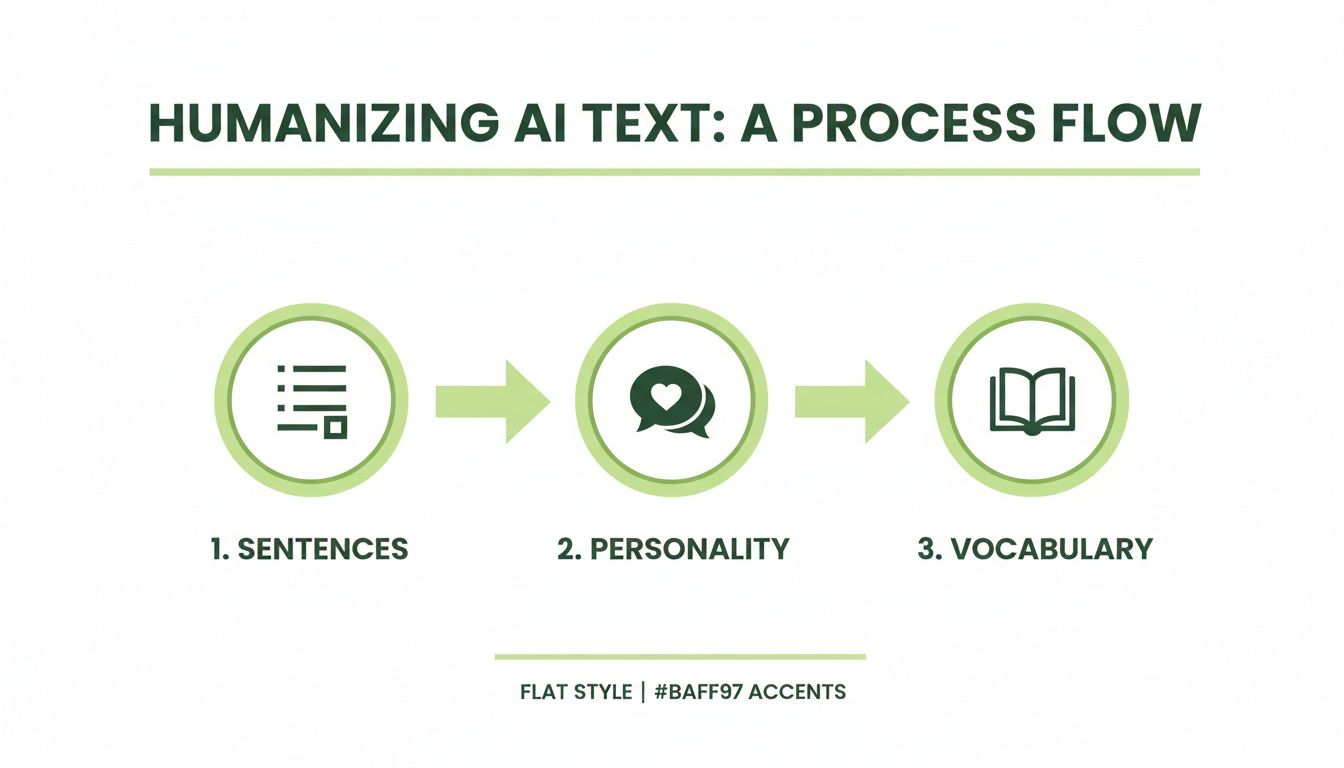
It highlights the three pillars of humanization: shaking up sentence structures, injecting a unique personality, and diversifying the vocabulary. These are exactly where a specialized tool can give you a massive head start.
The Role of an AI Humanizer
So what is an AI humanizer? Think of it as an expert assistant built specifically to catch and fix the classic giveaways of machine-written text. It instantly handles that first grueling pass of edits, targeting robotic phrasing, predictable sentence patterns, and other dead giveaways that scream "AI wrote this!"
The market for these tools has exploded as freelance writers and SEOs look for ways to make AI content undetectable. This has pushed platforms like HumanText.pro to the forefront. Their tool, trained on a massive dataset of human writing, claims a 99% bypass rate against major detectors. If you're curious about the technical side, you can read up on the challenges of AI detection benchmarking.
By running your draft through a tool like this first, you’re saving yourself a ton of time. Instead of painstakingly hunting down every awkward phrase, the tool does the initial sweep for you in seconds.
Building Your Hybrid Workflow
A great hybrid process is simple and repeatable. It turns a daunting rewrite into a manageable series of steps, letting you save your brainpower for where it really matters: the final creative polish.
Here’s a practical workflow you can start using today:
- Generate the First Draft: Use your go-to AI content generator—whether it's ChatGPT, Jasper, or something else—to create the initial version of your text.
- Run It Through an AI Humanizer: This is the game-changing middle step. Just copy the raw AI output and paste it into a tool like HumanText.pro.
- Analyze and Rework: The tool scans the text for AI patterns and then generates a humanized version, automatically rephrasing sentences and swapping out common AI word choices.
- Apply Your Final Human Polish: Now comes the fun part. With the grunt work done, you can focus on adding your unique voice, weaving in personal anecdotes, and layering in your strategic insights. Actionable Insight: Do this final pass in a separate document. This prevents you from being too influenced by the original structure and helps you find a more natural flow.
This hybrid approach isn't about taking shortcuts—it’s about efficiency. The goal isn't to remove the human touch, but to amplify it. By letting a tool handle the tedious structural fixes, you free up your creative energy for higher-level editing and storytelling.
Before we compare the two approaches side-by-side, let's look at how this plays out in practice.
Manual vs Hybrid Rewriting Workflow
To really see the difference, this table breaks down the time, effort, and typical outcomes of going it alone versus using a hybrid workflow.
| Metric | Manual Rewriting | Hybrid Workflow (with HumanText.pro) |
|---|---|---|
| Time Investment | High (30-60 mins per 1,000 words) | Low (5-15 mins per 1,000 words) |
| Effort Required | Exhausting; involves line-by-line edits | Minimal; focus on high-level polishing |
| Consistency | Can vary depending on your energy levels | High, as the tool handles initial patterns |
| Detector Bypass | Hit-or-miss; depends on your skill | High (claimed 99% bypass rate) |
| Scalability | Very difficult to scale for high volume | Excellent for producing content at scale |
As you can see, the hybrid model doesn't just save time; it creates a more sustainable and scalable process. You can maintain quality and authenticity while dramatically increasing your output, which is a massive win for any content creator.
How to Verify Your Rewritten Content
You’ve done the hard work of rewriting the AI text, but you're not at the finish line just yet. This final check isn't just about tricking an algorithm; it's about gaining total confidence that your content is polished, authentic, and ready for your audience.
It’s a huge mistake to see AI detectors as a simple pass/fail gate. Think of them as diagnostic tools instead. A platform like GPTZero can flag specific sentences that still have those faint, tell-tale echoes of their AI origins, giving you a precise roadmap for your final polish.
This last quality check ensures your content connects with readers on a human level, free from any of that distracting, machine-like stiffness. It’s your final seal of approval before you hit publish.
Interpreting AI Detector Results
Running your text through a detector is the easy part. The real skill is in understanding what the results actually mean, especially when you don't get a perfect 100% human score. Don't panic if a few sentences are highlighted—this is actually valuable feedback.
Look for patterns in what the tool flags:
- Predictable Transitions: Does the detector highlight robotic phrases like "In conclusion," "Furthermore," or "Additionally"? These are classic AI crutches. Actionable Insight: Replace "In conclusion" with something more natural like, "So what's the bottom line?"
- Uniform Sentence Length: If the flagged sentences are all about the same length, it’s a good sign the rhythm still feels too mechanical.
- Overly Formal Phrasing: Sometimes, a detector picks up on unnecessarily complex words or stiff sentence structures that a real person just wouldn't use in conversation. Practical Example: A flagged sentence like "It is imperative to facilitate..." could become "We need to make it easy for..."
Think of a flagged sentence not as a failure, but as an opportunity. It’s the detector telling you, "Hey, this part could use a little more personality." Use these hints to make targeted, high-impact final edits.
This verification process is also a fantastic way to learn about your own editing blind spots. Over time, you'll get much faster at spotting and fixing AI tells on your own. If you're curious about the mechanics behind these tools, you can learn more about whether undetectable AI truly works.
When Your Content Still Gets Flagged
So what happens if, after all that effort, your text still gets a high AI score? First off, it’s crucial to remember that these tools have limitations. The academic world's struggle with AI detection has only intensified since ChatGPT's debut, with plagiarism checkers like Turnitin constantly evolving to catch bypass attempts.
But it’s not a perfect science. A 2025 study found that even simple human edits could dramatically increase false positives, making some detectors less reliable in the real world. You can read the full research on detector benchmarking to see just how complex it is.
If you're staring down a stubborn AI score, here are a few final things to try:
- Read It Aloud: This is the ultimate test. If it sounds clunky or unnatural when you say it out loud, it’s going to read that way, too. This is the most practical and effective way to catch awkward phrasing.
- Focus on the "Why": Go back to the sentences that were flagged. Instead of just swapping out words, ask yourself why that sentence is there. Rephrase it to convey your genuine intent or a unique perspective.
- Let It Rest: Step away for an hour or even a full day. When you come back with fresh eyes, those awkward phrases and AI tells often become painfully obvious.
This final check is your stamp of approval, confirming that your content isn't just "detector-proof," but genuinely human.
Of course. Here is the rewritten section, crafted to sound like an experienced human expert, following all the provided style and formatting guidelines.
Your Questions About Rewriting AI Content, Answered
Once you start using AI as a writing partner, a lot of questions pop up. It’s one thing to generate a first draft, but it’s another thing entirely to shape that raw material into something authentic and effective. Let's tackle some of the most common hurdles people face when they start to rewrite AI text.
Think of this as a quick field guide for handling the tricky parts, from staying on the right side of ethical lines to keeping your brand's personality intact.
Is It Unethical to Use an AI Humanizer?
This is the big one, and the answer isn't a simple yes or no. It really boils down to intent. Are you using it to polish your ideas, smooth out awkward phrasing, and get past writer's block? That's just smart. It's no different than using a powerful grammar checker or thesaurus.
Where it gets dicey is in situations where originality is the entire point, like an academic paper. Trying to pass off AI work as 100% your own in that context is a fast track to academic dishonesty. But for most professional writers, marketers, and business owners, the goal is quality and authenticity—the tools you use to get there are secondary.
The golden rule is this: use these tools to enhance your own expertise, not to fake it. Your job is to add the unique insights, the critical thinking, and the final layer of your own voice. The moment you stop fact-checking and adding real value is the moment you cross the line.
How Can I Maintain a Consistent Brand Voice with AI?
This is a massive challenge. AI has a nasty habit of defaulting to a bland, generic, "helpful assistant" tone that can strip all the personality out of your brand. The best defense is a strong offense: a rock-solid brand voice guide.
Don't just have a vague idea of your voice. Write it down. Your guide should be a practical checklist you use during the final human editing pass.
Include things like:
- Word Banks: A list of on-brand words you love and, just as crucial, a "never say this" list of words you hate. Practical Example: For a casual tech brand, your 'love' list might include "intuitive" and "seamless," while your 'hate' list includes "utilize" and "leverage."
- Tone & Personality: Are you witty and irreverent? Authoritative and formal? Empathetic and warm? Get specific.
- Rhythm & Flow: Do you prefer short, punchy sentences or longer, more descriptive ones?
- Formatting Quirks: How do you use bolding, headings, or lists? Consistency here makes a huge difference.
By deliberately checking every humanized piece against this guide, you can weld all your content together with a single, recognizable voice.
What If a Detector Flags My 100% Human-Written Text?
First off, don't panic. This is incredibly frustrating, but it happens all the time. AI detectors aren't gospel; they're pattern-matching tools that make mistakes. They often flag human writing that's very formal, fact-heavy, or follows a predictable structure—things a good writer might do on purpose.
If this happens to you, take a deep breath. Read your text out loud. You'll quickly hear the parts that sound a bit stiff or robotic, even if a human wrote them. Try breaking up some sentences, adding a personal aside, or injecting a more conversational phrase.
Actionable Insight: If a specific paragraph is flagged, try adding a short, personal opinion or question at the beginning or end. For example, add "And this is the part that always surprises people:" before the flagged text. This simple addition can often be enough to break the AI pattern.
If you're in an academic or formal setting, be prepared to show your work—outlines, earlier drafts, or research notes can quickly prove your authorship and shut down any false accusations.
Ready to turn your AI drafts into content that's genuinely yours? HumanText.pro is built to help you refine text, sail past detectors, and reclaim your authentic voice. Give it a try for free and feel the difference.
Ready to transform your AI-generated content into natural, human-like writing? Humantext.pro instantly refines your text, ensuring it reads naturally and authentically. Try our free AI humanizer today →
Related Articles
AI Writing Detector Free: 10 Tools Worth Testing
Compare 10 AI writing detector free options for accuracy, privacy, limits, and practical use by students, editors, and publishers.
What Is Natural Language and How Does It Shape AI
Learn what is natural language, how its layers of meaning work, why ambiguity matters, and how NLP and AI turn human communication into usable technology.
AI Detector Score: What It Means and How to Use It
Understand AI detector scores, learn how they are calculated, and discover practical ways to interpret and use them for quality assurance and compliance.

