Turn AI Writing Into Human Content That Ranks
Learn how to turn AI writing into human content. Our guide offers practical steps to humanize AI text, improve SEO, and build reader trust.
To truly transform AI writing into something that sounds human, you have to go beyond simple edits. The secret is to treat the AI-generated text as nothing more than raw clay. Your job is to reshape it strategically, layering in your personal voice, emotional nuance, and authentic experience.
The process isn't about just fixing grammar; it's about a fundamental overhaul focusing on structural reshaping, tone adjustment, and adding unique insights that a machine simply can't invent.
Why Humanizing AI Content Is Non-Negotiable

We're drowning in a sea of generic, AI-generated articles. In this environment, creating content with a genuine human touch isn't just a nice-to-have—it's your most critical competitive advantage.
While AI is fantastic for banging out initial drafts and outlines, its output often lacks the very qualities that build a loyal audience and earn trust from search engines. The difference between a raw AI draft and a human-edited piece isn't just about sounding less robotic. It’s about delivering real value that connects on a deeper level. Readers can feel when an article is just a rehash of existing information versus a piece written by someone with actual skin in the game.
The Real Value of Authenticity
Authenticity isn't about tricking an AI detector. It's about creating content that actually connects, persuades, and builds a relationship with the person on the other side of the screen.
Think about the last article you truly loved. I bet it had a distinct personality, told a compelling story, or offered a perspective that made you think. Those are the elements that AI, by its very nature, struggles to create.
That's because real human writing is shaped by things like:
- Lived Experiences: Weaving in a personal anecdote or a specific, quirky case study adds a layer of credibility that AI just can’t fake.
- Emotional Nuance: A human can subtly shift the tone to spark curiosity, build empathy, or generate excitement, making the content far more memorable.
- Unique Perspectives: An expert can offer a contrarian opinion or a novel insight that challenges the reader's assumptions—something an AI trained on consensus is designed to avoid.
"The goal isn’t to simply fool an algorithm; it's to earn the trust of a human being. When you focus on adding real-world insights and a genuine voice, you create an asset that both readers and search engines reward."
The data doesn't lie. One analysis found that human-authored articles attract 5.44 times more traffic and keep readers engaged for 41% longer compared to purely AI-written content. The reason is simple: people crave the nuanced connection and authentic voice that only a human touch can provide.
To give you a clearer picture, let's break down the core differences between a first-draft AI output and a piece that's been properly humanized.
AI Draft vs Human-Edited Content At a Glance
This table quickly summarizes the key differences between a raw AI draft and a properly humanized piece of content, highlighting the value added in each area.
| Attribute | Typical AI Draft | Human-Edited Final Content |
|---|---|---|
| Voice & Tone | Generic, formal, and often robotic. Lacks a distinct personality. | Consistent, authentic, and adapted to the specific audience. |
| Structure & Flow | Follows a predictable, formulaic structure. Can feel disjointed. | Natural, logical flow with varied sentence structures for better rhythm. |
| Credibility | Relies on summarized, publicly available information. | Enhanced with personal anecdotes, unique data, or expert insights. |
| Originality | Often rephrases existing content, lacking a novel perspective. | Offers a fresh angle, a contrarian view, or a unique synthesis of ideas. |
| Emotional Impact | Fact-based and emotionally flat. Fails to build a connection. | Evokes emotion (empathy, curiosity, trust) to engage the reader. |
As you can see, the human editor's role is to inject the very qualities that make content valuable and memorable.
Moving Beyond Simple Edits
To really turn AI writing into human content, you need a systematic approach that goes far beyond a quick grammar check. It involves fundamentally reshaping the narrative, injecting your unique voice, and polishing the final text until it has a natural rhythm.
Mastering this process is key. For a deeper dive into the specific techniques, our comprehensive guide on how to make AI content undetectable is a great place to start. When you adopt this mindset, you stop being an editor and start being a creator—transforming a generic draft into a powerful piece of content that actually stands out.
Crafting Prompts That Demand a Human-Like Draft
The secret to turning robotic AI text into something that breathes with life starts way before you even generate the first word. If you feed the AI a generic prompt, you're going to get a generic, soulless draft back. That just means more cleanup work for you.
To get a truly superior starting point, you have to move beyond one-line commands. It’s about crafting prompts with depth, personality, and specific, un-AI-like constraints. Think of yourself as a director guiding an actor. You wouldn't just say, "Act sad." You'd give them a character, a motive, and a scene. It's the same with AI.
Give Your AI a Backstory
One of the most powerful things you can do is assign the AI a detailed persona. This immediately frames the entire output from a specific point of view, stopping it from defaulting to that bland, all-knowing encyclopedia voice we've all come to dread.
Try injecting a few of these elements into your next prompt:
- Define a Role: Is the writer a skeptical industry veteran? An enthusiastic newcomer? A data-obsessed analyst?
- Specify Experience: Give them a history. For instance, "You are a content marketer who spent 10 years in the trenches at B2B SaaS startups."
- Set a Motive: What’s their goal? "You want to share hard-won advice to help younger marketers avoid the same mistakes you made."
This kind of detail forces the AI to adopt a much more nuanced and believable voice right out of the gate.
A well-defined persona is the single fastest way to get an AI draft that feels less like a summary and more like a story. It provides a built-in filter for tone, word choice, and perspective.
Setting the Stylistic Rules
Once you've established who the AI is, you need to tell it how to write. This is where you control the rhythm and texture of the language, breaking it out of its default robotic cadence.
Consider adding a few ground rules like these:
- Vary Sentence Structure: "Incorporate a mix of short, punchy sentences and longer, more descriptive ones."
- Use Conversational Elements: "Include rhetorical questions and use contractions like 'it's' and 'you're' to create a conversational feel."
- Incorporate Analogies: "Explain complex technical concepts using simple, real-world analogies."
These rules are critical for shattering the monotonous patterns that scream "AI-generated." As you experiment, you'll figure out which instructions work best for your needs—a crucial skill when learning how to avoid AI detection by simply creating better source material to begin with.
Let’s look at a quick comparison. The difference is night and day.
Generic Prompt: "Write a paragraph about the importance of SEO."
Persona-Driven Prompt: "Write a paragraph about the importance of SEO. Write as a seasoned SEO consultant who is slightly jaded by flashy trends. Your tone should be direct and a bit cynical but ultimately helpful. Emphasize that consistent, boring work beats chasing shiny objects every time."
See the difference? The second prompt is going to deliver a draft that already has a unique voice and a strong opinion, giving you a much, much better foundation to build upon.
Reshaping the Narrative and Structural Flow
So, you've got your draft from the AI. Now the real work begins. The first, and most obvious, giveaway of AI-generated content isn't the word choice—it's the rigid, predictable architecture of the article itself.
AI models are trained to be logical. They almost always spit out a standard formula: an introduction, a few logically ordered points, and a neat summary. It’s clean, it’s organized, and it’s completely robotic. A human writer, on the other hand, knows that the best way to tell a story or make a point isn't always a straight line.
Your first editing pass shouldn’t be about tweaking sentences. It’s about taking a sledgehammer to the article’s blueprint.
Ditching the Predictable Outline
Think like a storyteller, not an encyclopedia. The default AI structure is built for efficient information delivery, but humans crave an experience. We want a narrative that pulls us through the content in a compelling, sometimes surprising, way.
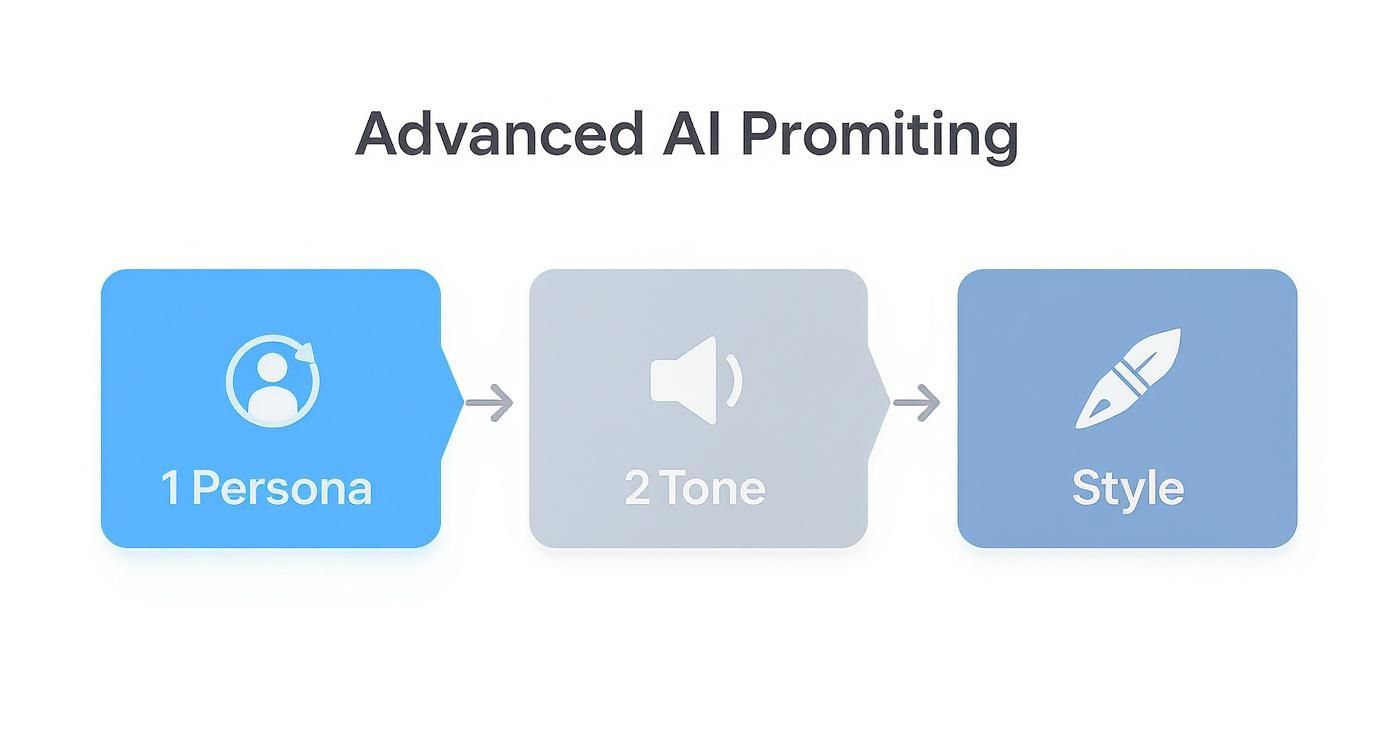
To get a better starting point and make this whole process easier, you should be front-loading your prompts with a clear persona, tone, and style. Giving the AI a strong identity from the get-go provides a much better foundation to build on.
This flowchart breaks down the kind of advanced prompting that sets you up for success before you even generate the first word.
With your draft in hand, it's time to get tactical. Look for opportunities to shake things up. Could you scrap the bland intro and open with a shocking statistic instead? What happens if you reorder the main sections? Does it build a more persuasive case?
Here are a few big-picture edits to start with:
- Reorder Your Sections: Don't bury your best point in the middle. Find the most powerful, interesting, or controversial section and ask yourself if it could work as a hook right at the beginning.
- Merge and Strengthen: AI often creates thin, underdeveloped paragraphs that touch on similar ideas. Find these and combine them. Fusing two weak points can create one much more robust argument with better context.
- Cut Redundant Sentences: AI loves to repeat itself, saying the same thing in slightly different ways to pad out the word count. Be ruthless. Every sentence that doesn't add new value has to go. It tightens your writing and, more importantly, respects your reader's time.
Think of this stage as architectural renovation. Before you start painting the walls (word choice) or arranging the furniture (formatting), you need to make sure the rooms are in the right place and the foundation is solid.
For instance, an AI draft about SEO might dutifully list "keyword research," then "on-page SEO," then "backlinks." It's logical, but boring. A human editor might reframe it by starting with a quick story about a common on-page mistake they once made, making the topic instantly more relatable before diving into the technicals.
This structural overhaul is the single most important step in turning a robotic list of facts into a natural, engaging piece that keeps people reading. You’re building a flow that feels intuitive and intentional, not one that was generated by an algorithm.
Make It Sound Like You: Injecting Your Authentic Voice and Experience
Alright, the structure is solid. Now for the most important part—the step that actually separates compelling content from robotic fluff. This is where you infuse the generic draft with your unique personality, expertise, and stories. It’s the one thing an algorithm can't truly fake.
Think about it: an AI generates text by predicting the next word based on a massive dataset of existing content. It has no memories, no bad days at the office, no "aha!" moments in the shower, and definitely no controversial opinions.
That's your unfair advantage.
Adding these distinctly human elements is what elevates an article from merely informative to truly memorable and trustworthy. This is how you breathe life into the crucial elements of E-E-A-T (Experience, Expertise, Authoritativeness, Trustworthiness) that both Google and your readers are desperate to see.
Weave in Real-World Stories and Case Studies
The quickest way to sound authentic is to tell a story. It doesn't have to be some epic tale, either. A small, relevant anecdote can completely transform a dry section, making an abstract concept feel concrete and relatable.
For instance, the AI draft might give you something bland like, "It is important to A/B test headlines."
You can turn that into this:
"I once spent a week crafting what I thought was the perfect headline, only to watch it get demolished in a test against a simple, five-word alternative I almost deleted. That one test boosted our click-through rate by 37% and taught me to never, ever trust my gut over the data."
See the difference? That little story adds personality, drops in a specific number, and proves you’ve actually been in the trenches. It builds a connection that a sterile statement never could.
The same goes for examples. Ditch the generic placeholders and talk about a real project, a past client, or a specific problem you solved. This immediately showcases your expertise and gives your content a layer of authority that can't be faked.
Get Conversational and Have an Opinion
AI writing is painfully neutral. It’s programmed to be agreeable and avoid taking a strong stance on anything. To sound like a real person, you need to do the exact opposite.
- Ditch the Formality: Swap out stiff words. Instead of "utilize," just say "use." Replace "therefore" with "so." And turn "it is essential to" into "you need to." Write like you talk.
- Use a Little Industry Jargon: Don't overdo it, but sprinkling in a few terms that only someone "in the know" would use is a great way to signal to your target audience that you're one of them.
- Take a Stand: Don't be afraid to challenge a common belief or pick a side. An AI might say, "There are several ways to approach this." You should be saying, "Honestly, for most businesses, Method A is a complete waste of time. Here's why."
This evolution toward more sophisticated, conversational language is a clear trend as creators work to bridge the gap between sterile AI output and genuine human connection.
Ultimately, the smartest content strategies use AI for what it's good at—getting a first draft on the page—but rely on human writers to personalize the final product. That's what makes content truly connect. To learn more about this hybrid approach, check out this insightful analysis of AI versus human content.
By injecting your unique voice, you transform a commodity into something genuinely valuable.
Fine-Tuning the Rhythm and Flow

You’ve got a solid structure and the right voice. Now for the final, crucial step: polishing the micro-details that create a natural reading rhythm. This is where the magic happens. AI-generated text often feels monotonous, lacking the varied cadence of human speech. But you can fix it.
This stage is all about making the text glide effortlessly from one idea to the next. Think of it as the last 10% of the work that makes 90% of the difference in how human the content feels to a real reader.
Find Your Written Cadence
Have you ever noticed how authentic human writing rarely uses sentences of the same length over and over? AI, on the other hand, loves uniformity. To break this robotic pattern, you have to consciously mix things up.
Try reading a paragraph out loud. Does it sound choppy and predictable? Or does it flow like a conversation? The goal is to create a rhythm that keeps the reader engaged, not lulled into a trance by repetitive sentence construction.
Here’s a simple framework to guide you:
- Short, punchy sentences. Use these to make a bold statement or emphasize a key point. They stop the reader and demand attention.
- Medium-length sentences. These are your workhorses. They should carry the bulk of your information clearly and concisely.
- Long, flowing sentences. Use these sparingly to connect complex ideas or add descriptive detail, creating a more sophisticated feel.
By mixing these three types, you transform a flat wall of text into something with musicality and pace. It’s a core part of the final push to make your content undeniably human.
The best writers understand that rhythm isn't just for poets. It’s a powerful tool for holding a reader’s attention and making your message stick. A monotonous rhythm is an invitation for your reader to click away.
Embrace Human Imperfections
Another dead giveaway of AI text is its flawless, almost sterile grammar. It avoids contractions and never dares to start a sentence with "And" or "But." Real people, however, do this all the time. It’s what makes writing sound conversational and approachable.
Don't be afraid to break a few old-school grammar rules if it makes your writing sound more natural. This is about connection, not about passing an English exam from 1985.
Here are a few "imperfections" to weave into your text:
- Use Contractions: Swap "it is" for "it's," "you are" for "you're," and "do not" for "don't." It instantly makes the tone more relaxed.
- Start with Conjunctions: Beginning a sentence with "But," "So," or "And" is a powerful way to create a smooth transition between thoughts. It mimics the way people actually speak.
Think of it this way: AI writing is perfectly pressed and starched, while human writing is more like a comfortable, broken-in pair of jeans. One is sterile; the other has character. As you refine your conclusion, consider exploring our guide on good transition words for a conclusion to make your endings even more impactful.
Of course. Here is the rewritten section, crafted to sound completely human-written and natural, following all the provided guidelines and examples.
Your Questions About Humanizing AI, Answered
As you get into the rhythm of turning AI drafts into human-sounding content, a few key questions always pop up. Let's tackle the big ones head-on so you can refine your workflow and get consistently better results.
Will AI Detectors Still Flag My Content After I’ve Edited It?
Honestly, they might. But that shouldn't be your main worry.
AI detectors aren't magic; they're pattern-spotting tools. They look for the statistical fingerprints language models leave behind—things like perfectly predictable sentence structures and an oddly uniform choice of words. Heavy editing scrambles those patterns, making your content far less likely to get flagged.
But here’s the thing: trying to get a 100% human score is the wrong goal. Your real objective is to create something exceptional for a human reader. Google has been crystal clear that they reward high-quality, helpful content, no matter how it started. If your edits inject real experience, a genuine voice, and unique value, you're focusing on what actually moves the needle for SEO and builds an audience that trusts you.
The real test isn't a detection score. It's whether a person finds your content valuable, engaging, and trustworthy. Focus on the reader, and the algorithms will follow.
How Much Time Should I Realistically Spend Editing an AI Draft?
Here’s a good rule of thumb: plan to spend at least as much time editing and rewriting as the AI saved you on the first draft. If an AI cranked out a draft in one hour that would have taken you four, you should still expect to spend at least three hours shaping it into something great.
For a 2,000-word article, this can easily be a two- to four-hour job. This isn't just about catching typos. We're talking about structural overhauls, digging deeper into the topic, checking every fact, and weaving in your own perspective. Rushing the edit is the single biggest mistake you can make. It’s what leads to that bland, forgettable content that doesn't connect with anyone.
Think of the AI draft as raw clay, not a half-finished sculpture.
What's the Single Most Important Step to Make AI Writing Sound Human?
Without a doubt, it’s injecting personal experience and a unique perspective.
AI models are incredible at summarizing everything that’s already on the internet. What they absolutely cannot do is have a real-world experience, form a gut opinion, or connect two seemingly unrelated ideas into a fresh analogy.
The most powerful edit you can make is to add a short, relevant story from your own life. Share an opinion that goes against the grain. Draw a comparison no one else has made. This is what adds authenticity and authority—the "E" (Experience) and "A" (Authoritativeness) in Google's E-E-A-T guidelines. It’s the one thing an AI simply can’t fake, and it instantly transforms your content from a commodity into an asset.
Ready to transform your drafts effortlessly? HumanText.pro converts your AI text into natural, undetectable content in seconds. Try it now and see the difference for yourself.
Ready to transform your AI-generated content into natural, human-like writing? Humantext.pro instantly refines your text, ensuring it reads naturally and authentically. Try our free AI humanizer today →
Related Articles
What Is AI Law and How It Shapes Content in 2026
What is AI law? Learn EU AI Act, US rules, liability and IP risks, plus practical steps for creators to stay compliant in 2026.

How to Write a Newsletter That Readers Trust
Learn how to write a newsletter that drives engagement. Master subject lines, mobile-first structure, AI humanization, and deliverability

How to Improve Writing Clarity That Actually Reads Well
Learn how to improve writing clarity with proven sentence-level edits, structure fixes, and before-and-after examples that make any draft sharper and more

