Undetectable ai writer: What It Is and How It Works (undetectable ai writer)
Discover what an undetectable ai writer is and how to craft high-quality, human-like content with AI—ethics, transparency, and best practices.
Let's be honest, the term "undetectable AI writer" sounds a bit like something out of a spy movie. But it’s not some magical tool that generates flawless, human-like content from scratch. In reality, it’s a specialized AI humanizer that takes a machine-generated draft and gives it a soul.
It's all about transforming that robotic, predictable text into something with natural rhythm and personality, making it virtually indistinguishable from what a person would write. This step is becoming essential for anyone who needs to get their content past the ever-watchful eyes of AI detection scanners.
What Is an Undetectable AI Writer
Let's cut through the marketing fluff. An "undetectable AI writer" isn't a content generator. Instead, think of it as a master editor for your AI assistant.
A tool like ChatGPT can churn out a technically correct article, sure, but it often lacks that crucial human touch. The writing can feel sterile, with rigid sentence structures and a strangely repetitive vocabulary—exactly the kind of digital fingerprint that AI detectors are designed to spot.
The Core Problem with Standard AI Text
The biggest hurdle with standard AI-generated content is that it leaves behind a distinct digital signature. AI models are trained on logic and predictability, which results in text that often gets flagged by detectors like Turnitin or GPTZero.
This creates a serious headache for a lot of people:
- Students find themselves up against academic integrity checks that scan millions of assignments.
- Marketers need reliable SEO content that not only ranks on search engines but also earns the trust of human readers.
- Writers are trying to increase their output without producing content that feels robotic and fails to connect with an audience.
An undetectable AI writer, or humanizer, tackles this problem head-on. It intentionally weaves in the subtle imperfections and variations that make human writing feel authentic. It mimics the natural flow, diverse word choice, and varied sentence lengths that signal genuine human effort.
To give you a clearer picture, here’s a quick breakdown of the differences.
AI-Generated Text vs Humanized Text at a Glance
This table highlights the key differences between standard AI output and content refined by an undetectable AI writer.
| Characteristic | Standard AI-Generated Text | Humanized AI Text |
|---|---|---|
| Sentence Structure | Often repetitive and uniform in length. | Varied and dynamic, mixing short and long sentences. |
| Word Choice | Predictable, sometimes uses overly complex words. | Natural and contextual, with more common vocabulary. |
| Flow & Rhythm | Can feel choppy or overly logical. | Smooth and conversational, with a natural cadence. |
| Predictability | High; follows common patterns AI detectors look for. | Low; introduces subtle variations and imperfections. |
| Originality | Tends to rephrase common knowledge from its training data. | Infuses personality and a unique point of view. |
| Detection Risk | Easily flagged by AI detection tools. | Designed to appear human and bypass detectors. |
As you can see, the goal isn't just to fool a scanner—it's to create content that is genuinely better and more engaging for the end reader.
The Growing Need for AI Humanization
The demand for these humanizing tools is exploding. By 2026, it’s expected that a staggering 90% of content marketers worldwide will be using AI writing tools. This has created a massive market where making AI text sound human isn't just a luxury—it's a necessity.
AI humanizers are reportedly hitting up to a 95% success rate in bypassing detectors, a figure that manual rewriting struggles to match. If you want to dig deeper into these numbers, you can explore more insights on AI writing statistics to see what this trend means for you. To get the full picture, it's also helpful to look at the broader landscape of AI tools for content creators, which covers everything from generating text to polishing the final draft.
How AI Detection Tools Work
To understand why you'd even need an undetectable AI writer, you first have to get inside the head of the "other side." Think of AI detection tools as linguistic detectives. They're not just reading your words; they're dusting for digital fingerprints and analyzing the patterns left behind.
These digital sleuths are trained on mountains of data—millions of examples of both human and machine-written text. This process teaches them to spot the subtle, almost invisible signatures that AI models tend to leave. Their entire investigation boils down to a few key pieces of evidence.
The Telltale Signs of AI Writing
At the core of AI detection are two concepts that sound complex but are actually pretty simple: perplexity and burstiness.
Perplexity is basically a measure of how predictable a piece of text is. AI models, especially the earlier ones, are trained to pick the most likely, most statistically probable next word. This creates text that’s often grammatically flawless but feels a bit bland and lacks surprise. The result? Very low perplexity.
Burstiness, on the other hand, is all about variety. Humans write in bursts. We’ll fire off a short, punchy sentence, then follow it with a longer one that meanders and explains. AI writing often lacks this natural rhythm, churning out sentences of similar length and structure, which flags it for low burstiness.
Actionable Insight: To increase perplexity and burstiness, intentionally break up sentence flow. If your AI draft gives you three medium-length sentences, rewrite them as one short question, one long explanatory sentence, and a final, punchy statement. This variation is a key signal of human writing.
The goal is to take those predictable AI drafts and transform them into something that feels authentically human, just like this concept map shows.
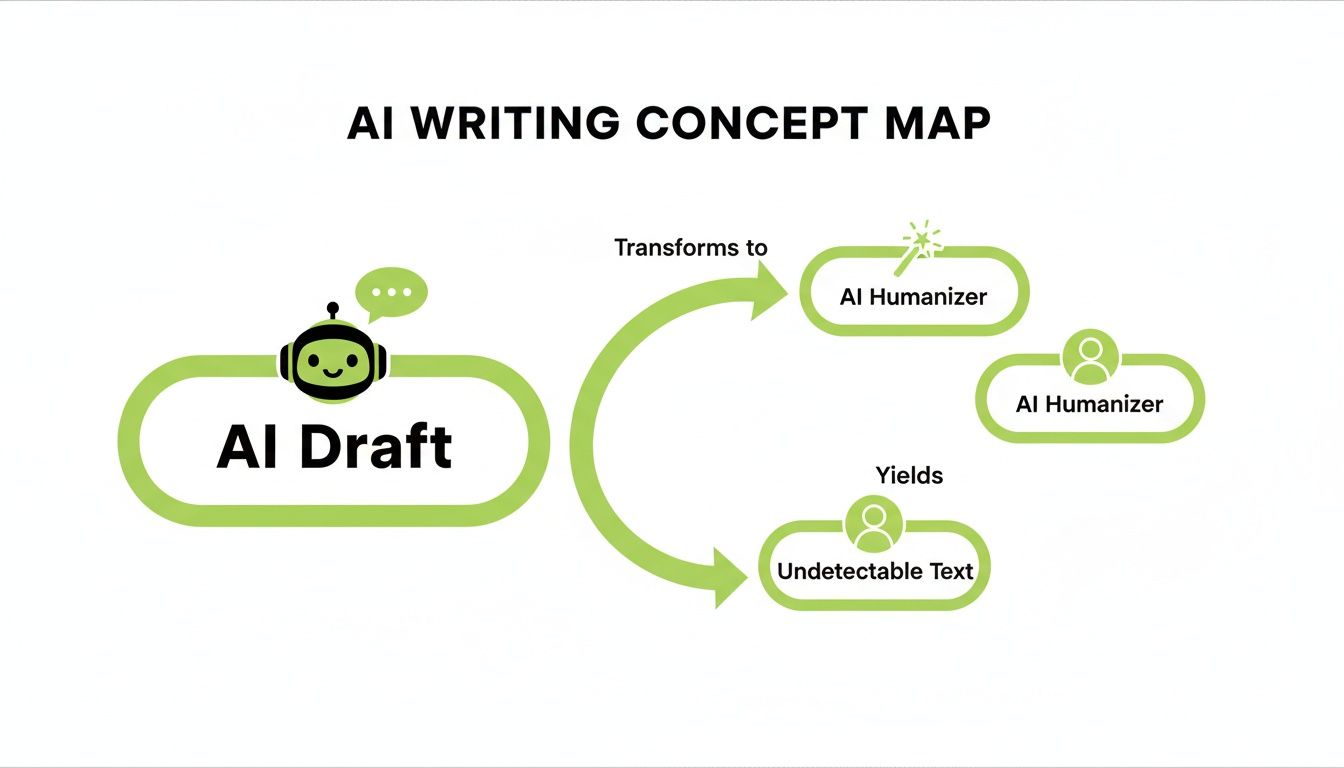
This visual breaks it down: a raw AI draft gets refined by a humanizer to mimic natural human writing patterns, effectively wiping away the digital fingerprints that detectors are designed to find.
A Practical Example of AI Detection
Let's see this in action. Imagine a standard AI model generates this sentence:
- AI-Generated Text: "The utilization of advanced technological solutions is imperative for fostering innovation within contemporary organizational frameworks."
Grammatically, it's perfect. But it’s also stiff, formal, and loaded with buzzwords. It has low perplexity because words like "utilization" and "imperative" are classic AI go-tos, and it contributes to a pattern of low burstiness.
Now, how would a person say the same thing?
- Human-Written Text: "Companies need to use better tech if they actually want to come up with new ideas."
This version is direct, simple, and uses everyday language. Its structure is less predictable, making it a much tougher target for any AI detector. This is exactly the kind of transformation an AI humanizer aims for—making the final text read naturally.
The Constant Cat-and-Mouse Game
It's crucial to remember that this whole field is in constant motion. As AI writing tools get smarter, so do the detectors built to sniff them out. The developers behind platforms like Turnitin and GPTZero are constantly feeding their algorithms new data to sharpen their accuracy.
This creates a perpetual cat-and-mouse game. An undetectable AI writer that works perfectly today might need an update tomorrow to stay ahead. This is why a simple paraphrasing tool just doesn't cut it anymore; true humanization requires deep, structural changes to the text. For a deeper dive, you can learn more about how to bypass tools like ZeroGPT by getting to know their specific detection methods.
Ultimately, the goal is always to create content that is fundamentally human in its construction, not just superficially tweaked.
Practical Strategies to Humanize AI Content
Knowing how AI detectors work is one thing. Actually getting your content past them is another game entirely. This is where we move from theory to practice.
To create content that sails past detection tools, you need a solid toolkit of strategies that can transform robotic text into something genuinely human. This isn't about simple word swapping; it's about fundamentally rewriting the text's DNA.
Let’s dive into the battle-tested methods that will make your AI-generated content truly undetectable.
Manual Humanization Techniques
Rolling up your sleeves and manually refining AI text gives you absolute control over the final product. These techniques are all about breaking the predictable patterns AI models lean on, making your content feel far more authentic and personal.
1. Vary Your Sentence Structure
AI writing often falls into a monotonous rhythm, churning out sentences of similar length and structure. To break this, you have to intentionally mix things up.
Practical Example:
- AI Version: "The market experienced significant growth. The new product launch was successful. The company's revenue increased."
- Humanized Version: "After the new product launch crushed expectations, the company saw a huge jump in revenue. It was a massive win for the whole market."
Start sentences differently. Avoid the classic AI trap of beginning every sentence with "The," "It," or a basic subject-verb combo. Use introductory clauses, questions, or natural transition words.
2. Inject Personal Stories and Anecdotes
Nothing screams "human" louder than a personal touch. AI models can't share genuine experiences or opinions because, well, they don't have any.
Sprinkle in a brief, relevant story or a personal observation. This not only makes the content more engaging but also introduces a level of unpredictability that AI struggles to mimic.
Before (AI-Generated): "Effective time management is a crucial skill for productivity. It involves prioritizing tasks and allocating time accordingly."
After (Humanized): "I used to be terrible at managing my time until I discovered a simple trick. Now, I spend five minutes every morning just listing my top three priorities, and it's been a game-changer."
3. Use Idioms and Colloquialisms
AI tools often default to formal, almost academic language. Weaving in common idioms, slang, or conversational phrases can instantly make your writing feel more natural.
- Actionable Tip: Instead of "It is of paramount importance," try "It's a huge deal." Replace "subsequently" with "after that." Swap "in conclusion" for "so, what's the bottom line?" These simple switches dramatically lower the robotic feel.
The Hybrid Approach: A Human-AI Partnership
For many, the most efficient path forward is a hybrid one. This method uses AI for what it does best—generating a solid first draft quickly—and then brings in a human editor for that crucial final polish. It's the perfect balance of speed and quality.
This approach lets you scale content production without sacrificing the authenticity needed to connect with readers and bypass detection. The AI handles the heavy lifting of research and structure, while the human editor focuses on nuance, tone, and flow.
The effectiveness of these strategies can vary, especially as detection tools get smarter. Take Turnitin, a leading tool used by over 16,000 institutions. It now processes more than 65 million student submissions annually with its AI detection feature. While manual edits can work, dedicated AI humanization tools often perform better, with tests showing 95% success rates in reducing detection scores in minutes.
A Concrete Before-and-After Example
Let's see these principles in action by transforming a classic robotic sentence.
- Original AI Text: "The utilization of renewable energy sources, such as solar and wind power, is paramount for ensuring long-term environmental sustainability and mitigating the adverse effects of climate change."
This sentence is a perfect example of AI-speak. It’s clunky, overly formal, and stuffed with predictable vocabulary. Now, let's humanize it.
- Humanized Version: "Honestly, switching to solar and wind is a no-brainer if we actually want to protect the planet. It's one of the clearest paths we have to fight back against climate change before things get worse."
Notice the difference?
- Tone: The revised text is conversational ("Honestly," "no-brainer").
- Word Choice: It replaces "utilization" and "paramount" with simpler, more direct language.
- Structure: It breaks one long, complex sentence into two shorter, more digestible ones.
By applying these skills, you move beyond simple editing and start fundamentally reshaping your content. For a deeper dive with even more techniques, check out our guide on how to humanize AI-generated text. It will give you an even bigger toolkit to ensure every piece you produce feels genuinely human.
Finding the Right AI Humanizer
Navigating the world of AI detection can feel like walking through a minefield. You need a reliable tool that doesn't just get your text past the scanners, but actually improves its quality. This is where a dedicated AI humanizer becomes your most important ally, acting as a bridge between robotic drafts and authentic, engaging content.
While plenty of tools claim to be an undetectable AI writer, the best ones go far beyond simple word-swapping. They’re built on sophisticated models that genuinely understand the nuances of human language, ensuring your final text is both safe to use and a pleasure to read.
What Makes a Top-Tier AI Humanizer
A premier AI humanizer like HumanText.pro operates on a completely different level than a basic paraphrasing tool. It doesn't just change a few words; it fundamentally reconstructs the text's linguistic DNA. This is done by training its models on vast datasets—in our case, over a million human writing samples—to learn the subtle rhythms, diverse vocabulary, and varied sentence structures that define human writing.
The core function is to analyze and rewrite text to increase its "perplexity" and "burstiness," the very metrics AI detectors use to spot machine-generated content. This process ensures the output reads naturally while preserving the original message's intent and accuracy. It’s the difference between a clumsy disguise and a seamless transformation.
The interface of a quality tool is built for speed and clarity, allowing you to see results instantly. This screenshot shows just how straightforward the workflow is: you paste your text and get an immediate analysis.
This visual demonstrates the simplicity of the process—you input your AI text on the left and get a humanized, detector-safe version on the right, complete with a new AI score.
Core Features That Deliver Results
When choosing an AI humanizer, a few features are non-negotiable for achieving truly undetectable content. These are the pillars that support a reliable and effective tool, giving you the confidence to work without worry.
Here’s what to look for:
- Instant AI Score Analysis: Before you even humanize your text, you need to know where you stand. A good tool provides an immediate detection score, showing you exactly how AI-like your content appears to major scanners. This benchmark is crucial for understanding the risk.
- One-Click Humanization: Speed is everything. The ability to transform an entire document with a single click saves valuable time. This feature should rewrite the text to bypass detectors while meticulously preserving the original meaning, so you don't have to spend hours re-editing.
- Proven Bypass Rate: The tool must have a demonstrated history of success against leading detectors. Look for platforms that are transparent about their performance against tough scanners like Turnitin, GPTZero, and others. A high bypass rate is the ultimate proof of effectiveness.
Actionable Insight: A powerful AI humanizer doesn't just help you avoid detection; it forces you to produce better content. By refining robotic drafts, it pushes the final product to be more engaging, readable, and valuable for your audience.
A Practical User Scenario
Let's walk through a typical situation to see how these features come together. Imagine you're a student with an essay draft generated by an AI assistant. You know it’s well-researched but sounds stiff and is almost certain to get flagged by your university’s software.
- Paste and Analyze: You copy your AI-generated text and paste it into the humanizer. Instantly, it shows you a high AI detection score—say, 92% AI. Now you have a clear picture of the problem.
- Humanize with One Click: You press the "humanize" button. The tool's advanced algorithms get to work, rephrasing sentences, varying structure, and swapping predictable words for more nuanced alternatives.
- Review and Finalize: Within seconds, you get the revised text. You scan it and see that the core arguments are intact, but the tone is more natural and the flow is significantly smoother. The new detection score is now a mere 8% AI, well within the safe zone.
This streamlined process removes all the guesswork and anxiety, delivering a reliable result every time.
Essential Benefits Beyond Detection
Beyond just bypassing scanners, the right tool offers critical advantages that support your workflow and protect your information. These benefits are just as important as the technical features.
- Data Privacy: Your content is your own. A trustworthy service will never store, share, or use your text to train their models. This commitment to privacy is essential, especially when you're working with sensitive academic or professional documents.
- No-Signup Free Trial: You should be able to test the tool's capabilities without having to commit. A no-signup trial that lets you process a decent number of words (like 500 words) lets you experience the results firsthand.
- Versatility: The tool should be flexible enough to handle various content types, from academic essays and research papers to SEO articles and marketing copy. This ensures it's a valuable asset across all your writing projects.
Putting an AI Humanizer to the Test
Talk is cheap. Theories and strategies are great, but the real proof is seeing a tool work right before your eyes. This is where we stop talking about what an undetectable AI writer can do and start showing its impact on a piece of standard, out-of-the-box AI content.
The plan is simple. We’ll grab a raw output from ChatGPT, run it through a popular AI detector to get a baseline score, and then process that exact same text with an AI humanizer to see what happens.
The Before and After Comparison
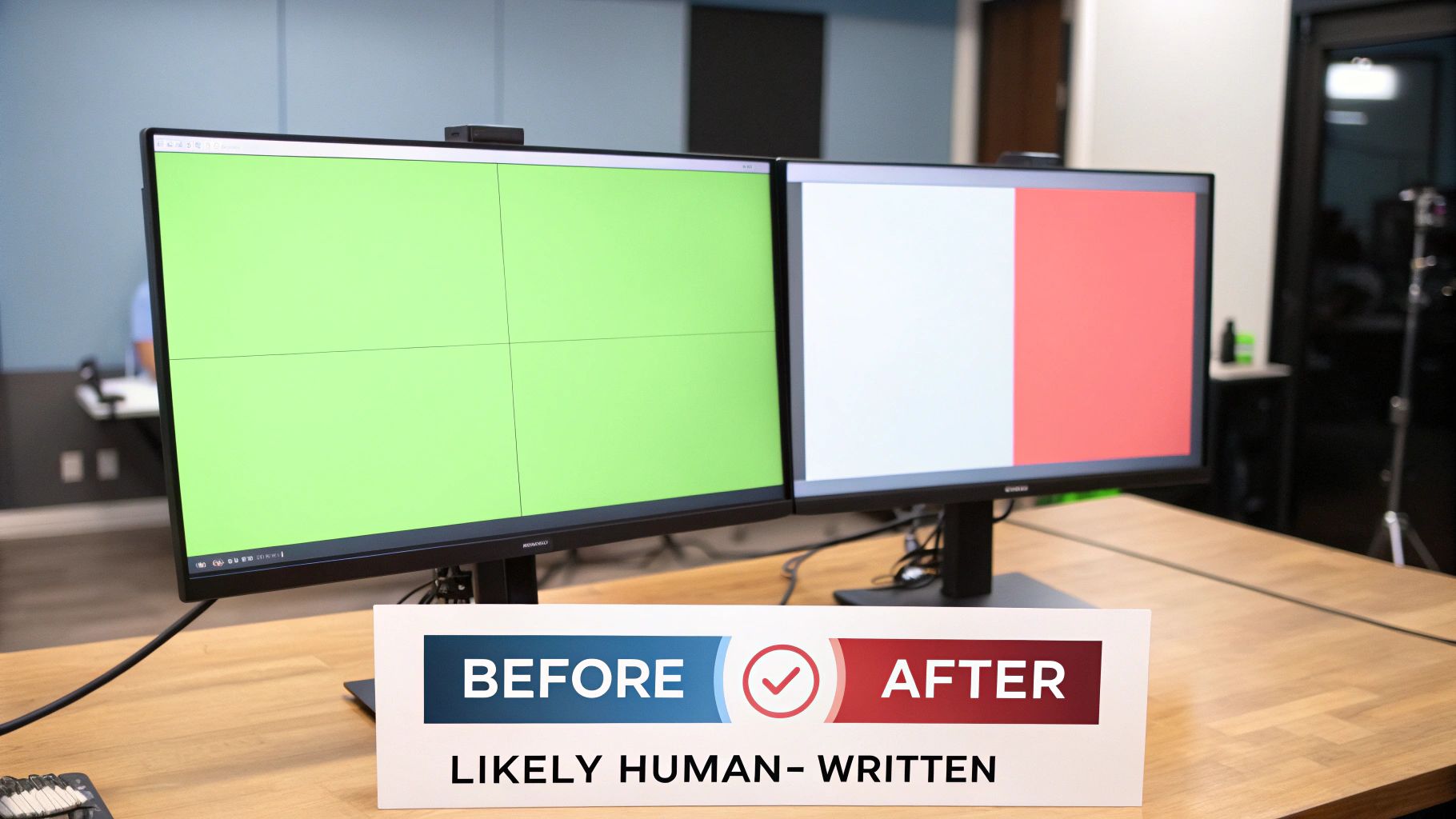
Let’s start with a classic AI-generated paragraph about the benefits of remote work. When we paste this text into a detector like GPTZero, the result is exactly what you'd expect: a whopping 98% AI score. The detector immediately flags the robotic sentence structure and predictable vocabulary, leaving no doubt it was machine-generated.
Now for the fun part. We take that same paragraph and feed it to a humanizer. With a single click, the tool gets to work—it doesn’t just swap out a few words here and there, it completely rewrites the content to introduce authentic human variation.
When we run this revised version back through the detector, the score plummets. The tool now confidently labels the text as "Likely Human-Written," letting it sail past a scan that it failed just moments before.
Analyzing the Key Changes
So, what alchemy happened behind the scenes to trigger such a dramatic shift? It all comes down to a few key linguistic tweaks that mimic how people actually write.
- Varied Sentence Structure: The humanized text breaks up the monotonous rhythm of the original AI draft by mixing short, punchy sentences with longer, more descriptive ones.
- Nuanced Vocabulary: Generic AI buzzwords are replaced with more natural, context-aware language. The result sounds less like an academic paper and more like a real conversation.
- Improved Flow and Cadence: The new version just reads better. It uses transitional phrases that connect ideas smoothly, creating a logical and engaging flow for the reader.
These subtle yet powerful adjustments are what make the content fly under the radar.
The Challenge of AI Detector Accuracy
This kind of demonstration is crucial, especially when you consider how inconsistent many AI detectors can be. Their unreliability is precisely why a good humanizer is so valuable.
Recent benchmark tests reveal a wide gap in performance among popular detection tools. Take a look at the data below.
AI Detector Performance Benchmark
The following table shows the accuracy of various AI detectors from recent benchmark tests. The inconsistency highlights why a reliable humanization tool is often a necessary safeguard.
| AI Detector | AI Text Detection Accuracy | Human Text Detection Accuracy |
|---|---|---|
| Pangram Labs | 100% | 100% |
| CopyLeaks | 100% | 100% |
| Winston AI | 99.7% | 91.7% |
| Originality | 99.5% | 83.1% |
| GPTZero | 84.8% | 96.6% |
| ZeroGPT | 71.9% | 94.7% |
As you can see, while a few tools perform exceptionally well, many others struggle, particularly with correctly identifying human-written text. This inconsistency is a major problem. For example, another demo showed raw AI text scoring 73% AI, a number that dropped to less than 1% after being run through a quality humanizer. To see the full performance breakdown, you can check out more data on the best AI detector tools.
User Testimonial: "As a student with a tight deadline, getting flagged for AI was my biggest fear. I used a humanizer on my draft, and it passed Turnitin without any issues. It saved me a ton of stress and time."
This kind of real-world feedback says it all. A proven humanizer provides a critical layer of security, whether you're a student trying to avoid false positives from academic software or a marketer who needs to produce trustworthy content at scale.
Navigating the Ethics of AI Content
As tools like undetectable AI writers become more common, figuring out how to use them responsibly is a huge deal. This isn't about finding a clever way to cheat the system. It’s about using powerful technology as an assistant to amplify your own skills and creativity. For anyone using these tools, drawing a firm line between ethical assistance and academic dishonesty is absolutely essential.
The whole game is about smart, responsible use. Think of an AI writer as a brainstorming partner or a tool to bust through writer's block by getting a rough first draft on the page. From there, it's your job to take that raw material, inject your unique voice, add your personal insights, and fact-check everything.
The Right Way to Use AI
The ethical question really boils down to two things: intent and transparency. The goal should always be to enhance human writing, not to replace critical thinking or take credit for work you didn't do.
Here are a few responsible ways to use AI as a writing assistant:
- Brainstorming and Outlining: Use AI to explore different angles for a topic or to get a solid structure for a complex article.
- Creating a First Draft: Let the AI do the initial heavy lifting, giving you a foundation that you can then build upon with your own expertise.
- Refining and Polishing: Use an AI humanizer to smooth out clunky phrasing or improve the flow of a draft you’ve already written and edited yourself.
This approach keeps you—the human—firmly in the driver's seat. The final piece reflects your ideas and your hard work, with AI acting as a tool that just helped speed things up. As we think about what AI can do for content, it’s vital to consider the broader ethics of writing with AI.
What Google and Academia Say
Both search engines and schools are figuring out how to deal with the rise of AI. Luckily, their emerging policies give us a pretty clear roadmap for what’s acceptable.
Google has been direct about it: they reward high-quality, helpful content, no matter how it was made. They penalize unedited, low-value AI spam, but well-crafted, human-reviewed content is perfectly fine. The focus is on the final quality and the value it provides to the reader.
Similarly, many universities are creating policies that allow AI for specific tasks like brainstorming or grammar checks, but only if the core ideas and the final submission are the student's own work. Always, always check your own institution's specific guidelines. For a deeper dive into the nuances of AI detection and ethical use, you can explore our resources on creating undetectable AI content.
The Golden Rule: Use AI to assist your thinking, not replace it. The final work should always be a product of your own effort, knowledge, and unique voice.
Frequently Asked Questions
When you start digging into AI content, a lot of questions pop up about ethics, accuracy, and the tools themselves. Getting straight answers is key to using an undetectable AI writer the right way. Let's tackle the most common questions to clear up any confusion.
Is It Illegal to Use an Undetectable AI Writer?
In a word, no. Using an undetectable AI writer isn't illegal. What really matters is how and why you're using it. For marketing or business content, it's pretty standard practice to take an AI draft and polish it to match your brand's voice and quality standards.
But in academic settings, it's a completely different ballgame. You absolutely have to follow your school's academic integrity policy on AI. The only ethical way forward is to use these tools as a writing assistant—to sharpen your own ideas, not to pass off a machine's work as your own original thought.
Can AI Detectors Ever Be 100 Percent Accurate?
Not right now, and maybe not ever. No AI detector is foolproof. They’re in a constant game of catch-up with the AI writing models they’re trying to spot, and they're notorious for "false positives"—flagging perfectly human-written text as AI. This unreliability is exactly why you can't trust a simple detection score.
Actionable Insight: A good AI humanizer gives you a critical layer of protection. It fundamentally rewrites the text to mimic human writing patterns, which makes it far less likely to get flagged by those flawed detectors. This acts as a safeguard against both actual AI detection and the headache of being falsely accused by an inaccurate scanner.
How Is an AI Humanizer Different from a Paraphraser?
Think of a basic paraphrasing tool as a painter with only one brush. It just swaps out words for synonyms, often leading to awkward phrasing that sounds clunky and unnatural. AI detectors can still easily spot this because the robotic sentence structure hasn't really changed.
A sophisticated AI humanizer, on the other hand, is like a master linguist. It performs a complete overhaul of the text from the ground up.
- It rebuilds sentence structures for a more natural, varied rhythm.
- It upgrades the vocabulary with words that are more nuanced and fit the context better.
- It fine-tunes the flow and cadence to sound like something a real person would write, based on patterns from millions of human examples.
Ultimately, it’s not just about changing words. It's about transforming the content’s entire linguistic fingerprint from robotic to genuinely human.
Ready to turn your AI drafts into undetectable, human-quality content? Give HumanText.pro a try and see how our advanced AI humanizer can refine your writing, sail past detectors, and keep your original message intact with a single click. Start your free trial at HumanText.pro.
Ready to transform your AI-generated content into natural, human-like writing? Humantext.pro instantly refines your text, ensuring it reads naturally and authentically. Try our free AI humanizer today →
Related Articles

10 Blog Post Writing Tips That Get Results
Use these blog post writing tips to plan, structure, optimize, humanize, and promote posts that attract readers and drive action.

8 Animals That Fit “Animal with A”
Explore 8 memorable examples of an animal with a unique adaptation, from alpacas and axolotls to ants and aye-ayes, with creative prompts.

10 Creative Nonfiction Examples to Study
Explore 10 creative nonfiction examples with excerpts, craft analysis, techniques to emulate, essay tips, and practice prompts for stronger writing.

