Guide pratique pour utiliser un humaniseur IA pour les dissertations
Transformez les brouillons IA en dissertations authentiques et indétectables. Découvrez comment un humaniseur IA pour dissertations vous aide à affiner le ton, améliorer le flux et répondre aux standards académiques.
Soyons honnêtes : les dissertations brutes générées par IA ont souvent l'air… plates. Elles peuvent maîtriser les faits et la structure, mais il leur manque l'étincelle — cette voix personnelle et ce rythme subtil que les professeurs reconnaissent instantanément comme humains. Les structures de phrases deviennent répétitives, le vocabulaire peut ressembler un peu trop à un dictionnaire des synonymes ambulant, et le tout se lit simplement comme si une machine l'avait écrit.
Parce que, eh bien, c'est une machine qui l'a écrit.

Cette qualité mécanique est un signe révélateur flagrant pour les outils de détection IA comme Turnitin et GPTZero. Ces systèmes deviennent incroyablement doués pour identifier les empreintes classiques de l'écriture IA.
Les signes révélateurs de l'écriture IA
Les modèles d'IA, malgré toute leur puissance, tendent à tomber dans des patterns prévisibles. Un lecteur expérimenté — ou un algorithme de détection — peut les repérer de loin.
Voici les signaux d'alarme les plus courants :
- Cadence uniforme des phrases : L'IA produit souvent des paragraphes où chaque phrase fait à peu près la même longueur. Cela crée un rythme monotone, presque hypnotique, qui ne semble tout simplement pas naturel. Conseil pratique : Lisez votre texte à voix haute. Si vous sonnez comme un robot, c'est probablement un robot qui l'a écrit. Utilisez un humaniseur IA pour introduire des longueurs de phrases variées.
- Vocabulaire forcé : Il peut utiliser un mot impressionnant correctement, mais dans un endroit où un mot plus simple sonnerait plus authentique. Le résultat semble maladroit et exagéré. Exemple : Une IA pourrait écrire « La pérégrination du protagoniste fut ardue », quand « Le voyage du protagoniste fut difficile » sonne plus naturel et est tout aussi efficace.
- L'absence du « vous » : Le texte est souvent stérile et manque d'une perspective unique. Il n'y a pas d'anecdotes personnelles, pas d'opinions subtiles, et aucune des particularités qui font que votre écriture sonne comme vous.
C'est exactement là qu'un humaniseur IA pour dissertations devient si précieux. Il ne s'agit pas de tromper un détecteur ; il s'agit de raffiner un premier brouillon. Pensez-y comme un partenaire d'édition avancé qui aide à polir les bords robotiques de votre travail assisté par IA, le faisant sonner véritablement humain.
Un bon humaniseur comble le fossé entre l'efficacité de l'IA et l'authenticité de l'expression réelle. Il garde vos idées centrales intactes tout en affinant le langage pour répondre aux attentes académiques.
Pour voir à quoi cela ressemble en pratique, comparons la production typique d'un rédacteur IA avec une version humanisée.
Écriture IA vs écriture humanisée en un coup d'œil
| Caractéristique | Dissertation typique générée par IA | Dissertation humanisée |
|---|---|---|
| Structure des phrases | Souvent uniforme et prévisible. | Variée, avec un mélange de phrases longues et courtes. |
| Ton de voix | Formel, générique et objectif. | Reflète une voix personnelle ; peut être persuasif ou analytique. |
| Choix des mots | Peut utiliser des mots trop complexes ou des phrases répétitives. | Naturel, précis et adapté au contexte. |
| Flux et rythme | Peut sembler haché ou monotone. | Transitions fluides et cadence naturelle. |
| Originalité | Manque de perspectives uniques ou d'un point de vue distinct. | Intègre une perspective personnelle et un phrasé unique. |
L'objectif est de faire passer votre brouillon de la colonne de gauche à celle de droite, le transformant d'une collection de faits en un écrit convaincant.
Des outils comme HumanText.pro sont conçus exactement pour cela. Ils analysent le phrasé maladroit et robotique et le restructurent pour qu'il coule naturellement, injectant le type de variation qu'on trouve dans une écriture humaine solide. Bien sûr, un outil n'est jamais meilleur que l'écrivain qui l'utilise, donc une solide maîtrise des principes de l'écriture efficace reste votre meilleur atout dans cette étape de polissage final.
Le besoin de cette étape de raffinement explose. Le marché de l'écriture IA est passé de 392 millions de dollars en 2022 à plus de 536 millions de dollars en 2024, ce qui montre combien de personnes utilisent ces outils. Utiliser un humaniseur est l'étape finale critique de ce processus — c'est ainsi que vous transformez un brouillon assisté par IA en une dissertation polie qui démontre véritablement votre propre effort et perspicacité.
Préparer votre brouillon IA : le secret d'un excellent résultat
La qualité finale de votre dissertation humanisée n'est aussi bonne que le brouillon avec lequel vous commencez. Un humaniseur IA est un puissant polisseur, mais il ne peut pas transformer un bloc de bois brut en chef-d'œuvre si la sculpture initiale est ratée. Meilleure est la matière première, plus époustouflant sera le résultat.
Cela signifie que votre première étape n'est même pas d'utiliser l'outil — c'est de préparer le texte généré par IA pour celui-ci. L'objectif est de nettoyer les bases pour que l'humaniseur puisse se concentrer sur l'important : ajouter de la nuance, raffiner le ton et injecter un flux naturel et humain.
Créez des prompts qui font le gros du travail pour vous
Tout le processus commence avec le prompt que vous donnez à l'IA. Des instructions vagues vous donneront toujours une dissertation générique et robotique qui nécessite un travail considérable. Un meilleur point de départ vient d'être incroyablement spécifique.
Exemple pratique : prompt générique vs. spécifique
Ne demandez pas simplement ceci :
- « Écris une dissertation sur les causes de la Révolution américaine. »
Donnez plutôt à l'IA une feuille de route détaillée :
- « Écris une dissertation de 1 000 mots pour un cours d'histoire universitaire de première année sur les causes principales de la Révolution américaine. Commence par une thèse forte. Consacre des paragraphes séparés aux pressions économiques du Stamp Act, à l'impact philosophique des penseurs des Lumières, et aux troubles sociaux suite au Massacre de Boston. Conclus en résumant comment ces facteurs ont rendu le conflit inévitable. Garde le ton formel et académique. »
Ce niveau de détail force l'IA à produire un brouillon beaucoup plus organisé et ciblé dès le départ, vous épargnant un temps considérable de restructuration.
Devenez un vérificateur de faits impitoyable
Les modèles d'IA sont tristement célèbres pour leurs « hallucinations », ce qui est une façon polie de dire qu'ils inventent des choses avec assurance. Ils inventent des dates, attribuent mal des citations ou créent des statistiques de toutes pièces. Rendre une dissertation avec de faux faits est l'un des moyens les plus rapides de perdre des points et de la crédibilité.
Avant même de penser à humaniser, vous devez vérifier chaque affirmation que fait l'IA.
Conseil pratique : Traitez le brouillon IA initial comme un point de départ pour votre recherche, pas comme un produit fini. Votre travail est de confirmer manuellement chaque date, nom, statistique et citation par rapport à des sources académiques fiables. Un moyen rapide de le faire est de copier une affirmation spécifique du texte IA et de la coller dans un moteur de recherche avec « site:.edu » ou « site:.gov » pour la vérifier contre des sources de confiance. Ne sautez pas cette étape.
Une fois vos faits verrouillés, il est temps de faire une pré-édition rapide. Voici une checklist pratique de pré-édition :
- Éliminez les phrases répétitives : L'IA adore-t-elle commencer les phrases par « De plus », « Par ailleurs » ou « En conclusion » ? Traquez-les et remplacez-les. Utilisez CTRL+F pour trouver et éliminer ces mots.
- Corrigez les phrases maladroites : Lisez le texte à voix haute. Si vous butez sur une phrase ou qu'elle sonne bizarre, réécrivez-la pour qu'elle coule mieux.
- Vérifiez la logique : Assurez-vous que chaque paragraphe se connecte bien au précédent. L'argumentation doit se construire logiquement d'un point au suivant.
Voici l'interface de HumanText.pro. Une fois votre brouillon propre et vérifié, c'est là que vous le collerez pour commencer la vraie magie.
Faire ce travail de préparation rend le travail de l'outil beaucoup plus facile et mène à une dissertation finale bien meilleure. Honnêtement, c'est une étape critique si vous voulez vraiment améliorer votre écriture académique et ne pas simplement tourner en rond.
Comment utiliser efficacement un humaniseur de dissertations IA
Bien, passons au concret et mettons l'outil au travail. Utiliser un humaniseur IA pour dissertations est assez simple en surface, mais il y a une énorme différence entre un bon résultat et un excellent résultat. Tout se résume à une approche plus réfléchie.
Nous allons parcourir le processus avec un exemple concret pour vous montrer comment transformer avec confiance ce brouillon IA maladroit en quelque chose dont vous serez fier.
Disons que vous travaillez sur une analyse littéraire de Gatsby le Magnifique. Vous demandez un point de départ à une IA, et elle vous donne quelque chose comme ceci :
Brouillon IA original :
« F. Scott Fitzgerald utilise la lumière verte au bout du quai de Daisy comme un symbole significatif. Ce symbole représente le rêve inaccessible de Gatsby et l'influence corruptrice du Rêve Américain. La lumière est un phare distant et éphémère qui guide les ambitions de Gatsby mais reste ultimement hors de sa portée, illustrant ainsi la futilité de sa quête. »
Le paragraphe n'est pas faux, mais il est douloureusement prévisible. Il a cette sensation classique d'IA — un ton formel, presque robotique et une structure standard. C'est la matière première parfaite pour un outil comme HumanText.pro.
De brouillon robotique à dissertation raffinée
La première étape est aussi simple qu'elle en a l'air : collez simplement votre texte préparé dans l'interface de l'humaniseur. La plupart des outils, HumanText.pro inclus, vous donneront immédiatement un score initial de détection IA. Pensez-y comme votre ligne de base — il vous montre à quel point votre texte est susceptible d'être signalé avant que vous n'ayez fait de changements.
L'organigramme ci-dessous décompose le simple travail de préparation qui devrait se faire avant même d'arriver à cette étape.
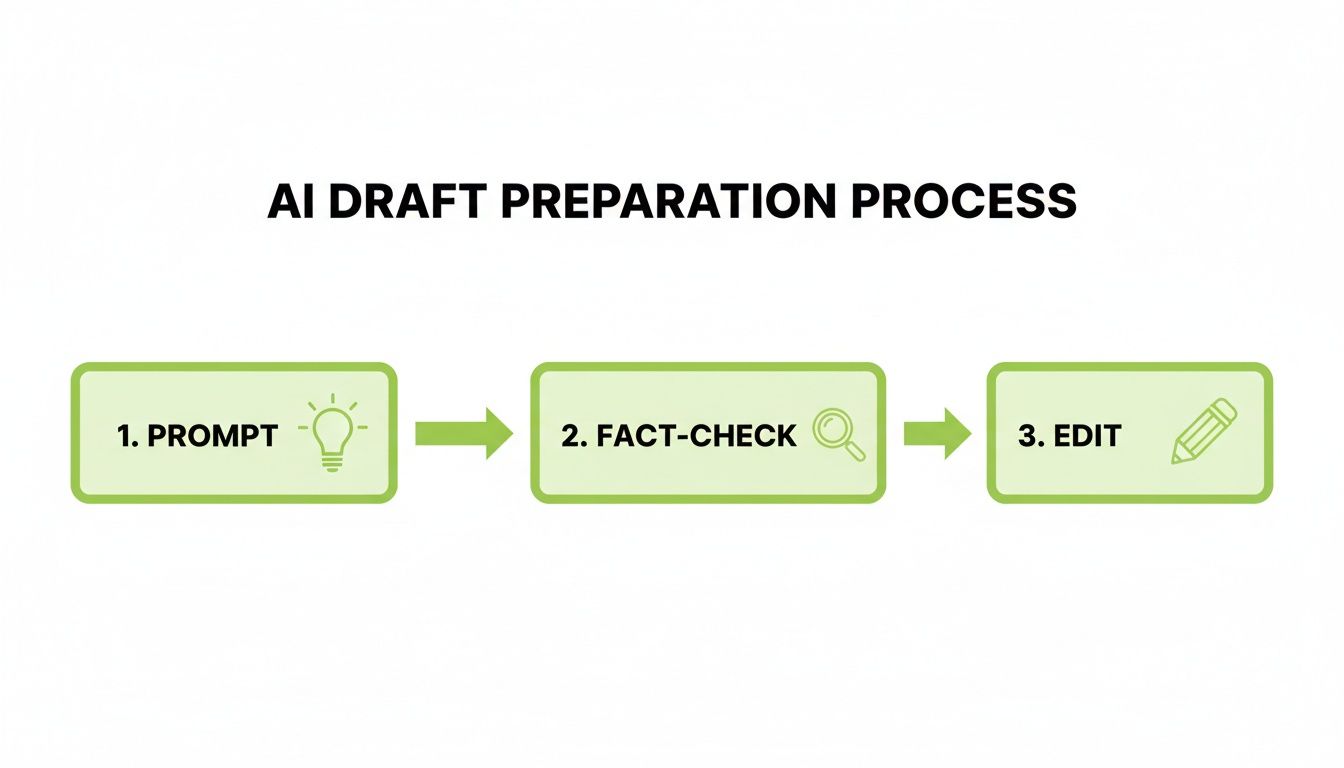
Suivre ce flux de travail — donner des prompts détaillés à l'IA, vérifier ses faits et faire une pré-édition rapide — signifie que le texte que vous humanisez est déjà solide.
Une fois que vous appuyez sur le bouton « humaniser », le vrai travail commence. L'outil générera une nouvelle version, la montrant souvent côte à côte avec votre brouillon original. Cette comparaison est la partie la plus importante de tout le processus.
Réviser et affiner la version humanisée
Votre objectif n'est pas d'accepter aveuglément le nouveau texte. Vous devez l'évaluer de manière critique. Voici une checklist pratique pour réviser la sortie :
- A-t-il gardé mon sens ? L'argument central doit rester intact. Dans notre exemple de Gatsby, le point sur la lumière verte symbolisant un rêve inaccessible est non négociable.
- La structure des phrases est-elle meilleure ? Cherchez un changement de rythme. Les meilleurs résultats mélangent des phrases plus courtes et percutantes avec des plus longues et descriptives. Conseil pratique : Si la version humanisée semble encore monotone, combinez manuellement deux phrases courtes ou divisez-en une longue en deux.
- Le choix des mots est-il plus naturel ? A-t-il juste échangé des synonymes, ou a-t-il réellement amélioré le langage ? La nouvelle version devrait sembler authentique, pas comme si quelqu'un avait juste utilisé un dictionnaire des synonymes.
Alors, à quoi pourrait ressembler la version humanisée de notre paragraphe sur Gatsby ?
Version humanisée :
« De l'autre côté de la baie, Fitzgerald place la lumière verte sur le quai de Daisy — un petit symbole distant portant un poids immense. C'est plus qu'une simple lumière ; elle incarne le rêve impossible de Gatsby, tordu par la fausse promesse du Rêve Américain. Pour lui, cette lueur éphémère est un guide constant, mais sa distance capture parfaitement la futilité tragique de son ambition. »
Vous voyez la différence ? Le message central est identique, mais le flux et la voix sont radicalement différents. Les phrases varient en longueur, et des expressions comme « portant un poids immense » et « futilité tragique » ajoutent une couche d'analyse qui semble tout simplement plus humaine.
C'est exactement le type de transformation qu'un humaniseur de qualité devrait livrer. Pour approfondir comment différents outils y parviennent, vous pouvez en apprendre plus sur les mécanismes d'un outil humaniseur IA et voir ce qui rend certains plus efficaces que d'autres.
Votre étape finale est de relire la nouvelle version une dernière fois, en faisant les derniers ajustements pour vous assurer qu'elle sonne exactement comme vous.
Le processus critique de révision post-humanisation
Passer votre dissertation par un humaniseur IA n'est pas la fin de la route ; c'est plutôt le début du dernier tour. Appuyer sur le bouton « humaniser » vous donne un solide nouveau brouillon, mais le vrai travail — la partie qui le rend vôtre — vient ensuite. C'est ici que vous reclamez votre voix et vous assurez que la dissertation n'est pas juste indétectable, mais reflète véritablement votre compréhension.
Pensez-y comme votre contrôle qualité personnel. Sauter cette étape, c'est comme ne relire que la première moitié de votre travail. Vous risquez de soumettre quelque chose qui ne maîtrise pas tout à fait vos arguments ou, pire, qui ne sonne pas du tout comme vous. L'objectif est de passer d'un texte techniquement « humain » à un écrit dont vous êtes fier de porter le nom.
Validez avec des détecteurs IA indépendants
Première chose, vous devez vérifier que l'outil a effectivement fait son travail. Bien qu'une plateforme comme HumanText.pro ait un excellent bilan, vous ne devriez jamais vous fier uniquement à sa parole. Testez toujours le résultat avec quelques détecteurs IA tiers indépendants.
Copiez votre texte fraîchement humanisé et collez-le dans différents vérificateurs. GPTZero et Copyleaks sont de bons choix parce qu'ils utilisent souvent des algorithmes différents pour repérer les patterns IA, vous donnant un consensus plus fiable.
- Ce qu'il faut chercher : Le résultat idéal est un score « écrit par un humain » ou « probablement humain » partout.
- Et s'il est signalé ? Pas de panique. Parfois un seul détecteur est un peu sensible. Étape à suivre : Retournez à la phrase ou au paragraphe signalé. Souvent, le problème est un vocabulaire trop complexe ou une structure très prévisible. Réécrivez manuellement juste cette partie pour la simplifier, puis relancez la vérification. C'est tout ce qu'il faut pour faire pencher la balance.
Cette étape vous donne une ligne de base objective, confirmant que le texte s'est débarrassé de ses empreintes IA les plus évidentes avant que vous ne plongiez dans les parties plus nuancées de la révision.
Effectuez une vérification de préservation du sens
Cette prochaine étape est absolument non négociable, surtout pour tout travail académique. Vous devez vous assurer que l'humaniseur n'a pas accidentellement déformé vos arguments centraux, mal représenté des données ou changé le sens de vos citations. L'IA peut parfois aplatir la nuance, reformulant une phrase d'une manière qui altère complètement son implication.
Le travail d'un humaniseur est de changer la livraison, pas le message. Votre sens original doit rester parfaitement intact. Un petit changement de formulation peut avoir un impact énorme sur l'intégrité de votre argument.
Voici un exemple concret de ce qui peut mal tourner. Disons que votre brouillon original disait :
- « L'étude suggère une corrélation, mais ne confirme pas de causalité. »
Un outil de paraphrase trop enthousiaste pourrait produire ceci :
- « L'étude prouve un lien entre les deux facteurs. »
C'est une erreur critique. « Corrélation » et « prouve un lien » sont à des kilomètres l'un de l'autre en termes académiques. Conseil pratique : Ouvrez deux fenêtres côte à côte : votre brouillon IA original à gauche et la version humanisée à droite. Lisez-les paragraphe par paragraphe pour vous assurer qu'aucun détail crucial n'a été perdu en cours de route.
Avec la croissance rapide de l'IA, ce type de supervision humaine est plus important que jamais. L'adoption de l'IA générative en entreprise est passée d'environ 32,5% en 2023 à 65% en 2024. À mesure que ces outils deviennent une partie plus importante de nos flux de travail, la responsabilité de vérifier leur production repose carrément sur nous, les utilisateurs. Vous pouvez en lire plus sur ces statistiques surprenantes d'agents IA et ce qu'elles signifient pour l'avenir.
Injectez votre voix personnelle
Enfin, et le plus important, faites en sorte que la dissertation sonne comme vous. Un bon humaniseur IA vous donne un canevas propre et naturel, mais c'est vous l'artiste qui ajoute les touches finales et personnelles. C'est ce qui transforme le texte de simplement « indétectable » à véritablement « authentique ».
Lisez toute la dissertation à voix haute. Sérieusement. Coule-t-elle avec votre cadence naturelle ? Utilise-t-elle des mots que vous utiliseriez vraiment ?
- Ajustez les choix de mots : Échangez tout mot qui semble trop guindé, trop simple ou qui ne fait tout simplement pas partie de votre vocabulaire. Exemple : Si l'humaniseur a écrit « par conséquent », mais que vous dites toujours « donc », faites ce simple changement. Ça compte.
- Ajustez le flux des phrases : Trouvez un rythme qui vous convient. Combinez des phrases courtes et hachées pour un flux plus fluide, ou divisez les longues et complexes pour rendre un point plus percutant.
- Ajoutez vos particularités : Peut-être avez-vous une façon spécifique de faire la transition entre les paragraphes ou une expression préférée. Réintégrez-les.
Cette édition finale est ce qui vous donne la pleine propriété du travail. Vous avez utilisé la technologie comme un assistant puissant, mais le produit final est un reflet direct de votre propre pensée, de votre propre effort et de votre propre voix.
Naviguer l'éthique et l'intégrité académique
Utiliser un humaniseur IA pour dissertations soulève une grande question : où tracez-vous la ligne entre un assistant d'édition intelligent et un outil pour tricher ?
La réponse se résume vraiment à votre intention. Le chemin éthique est de le traiter comme un correcteur grammatical super-puissant ou un partenaire de brainstorming. Il est là pour vous aider à polir vos propres idées, pas les inventer pour vous. Pensez-y comme un outil pour amplifier votre travail, pas pour remplacer votre pensée critique.
La bonne façon d'utiliser un humaniseur IA
L'utilisation responsable consiste à améliorer la qualité et la clarté de ce que vous avez déjà écrit. Il ne s'agit pas juste de passer les détecteurs ; il s'agit de préserver votre intégrité en tant qu'étudiant et écrivain.
Voici quelques façons éthiquement correctes d'utiliser un humaniseur :
- Améliorer la lisibilité : Exemple : Vous avez écrit un paragraphe complexe sur la mitose cellulaire qui semble dense. Un humaniseur peut aider à le reformuler avec des structures de phrases plus simples sans changer les faits scientifiques, rendant votre point plus clair pour le lecteur.
- Surmonter le syndrome de la page blanche : Parfois, voir vos propres idées formulées différemment est l'étincelle dont vous avez besoin pour faire de nouvelles connexions et vous débloquer.
- Affiner le langage : Pour les non-natifs anglophones, un humaniseur peut être un moyen fantastique de s'assurer que votre langage sonne naturel et précis.
Conseil pratique : Avant d'utiliser tout outil IA, consultez la politique d'intégrité académique de votre école. Beaucoup d'universités ont maintenant des directives spécifiques sur l'utilisation de l'IA. Si la politique n'est pas claire, demandez directement à votre professeur. Un simple e-mail disant « J'utilise des outils IA pour m'aider à éditer ma grammaire et le flux de mes phrases, est-ce acceptable ? » peut vous épargner beaucoup d'ennuis.
Les non-négociables de l'intégrité académique
Peu importe les outils que vous utilisez, certaines règles sont gravées dans le marbre. La politique d'intégrité académique de votre école est le guide ultime, et vous pouvez parier qu'elle a des règles strictes sur le plagiat et l'originalité.
Premièrement, vous devez citer correctement chaque source. Un humaniseur IA ne change rien à cela. Les idées et données que vous utilisez appartiennent toujours à leurs auteurs originaux, et ils méritent d'être crédités. Déformer les sources est une faute académique grave.
Deuxièmement, l'argument central et l'analyse doivent être les vôtres. Utiliser l'IA pour générer une dissertation entière puis l'humaniser pour couvrir vos traces est de la malhonnêteté académique pure et simple. Bien que le débat sur la question de savoir si les étudiants devraient utiliser l'IA continue d'évoluer, déformer l'origine de votre travail n'est jamais acceptable. Si vous voulez comprendre comment ces outils fonctionnent à un niveau plus profond, consultez notre guide sur la production d'une IA véritablement indétectable.
Au bout du compte, votre nom est sur ce travail. Utilisez ces outils comme un système de soutien pour vous aider à présenter vos propres connaissances et perspectives de la manière la plus efficace possible.
Questions courantes sur les humaniseurs IA pour dissertations
Alors que les écrivains et étudiants commencent à explorer un humaniseur IA pour dissertations, les mêmes questions ont tendance à revenir. Obtenir des réponses directes est essentiel pour utiliser ces outils correctement — tant efficacement que de manière responsable.
Un humaniseur garantira-t-il que ma dissertation passe Turnitin ?
Allons droit au but : aucun outil ne peut offrir une garantie à 100%. Bien que les meilleurs humaniseurs soient incroyablement sophistiqués — certains revendiquant même jusqu'à 99% d'efficacité contre des détecteurs comme Turnitin — le logiciel de détection devient toujours plus intelligent. Ce qui fonctionne parfaitement aujourd'hui pourrait être légèrement moins efficace dans un mois.
Pensez à un humaniseur comme votre partenaire d'édition le plus avancé, pas comme une cape d'invisibilité magique. Après avoir passé votre texte, votre travail n'est pas terminé. L'étape finale cruciale est de le relire vous-même, en lissant les phrases maladroites et en y tissant votre propre touche personnelle.
Conseil pratique : Créez une routine de « vérification finale ». Après l'humanisation, passez le texte par deux détecteurs gratuits différents (comme GPTZero et Copyleaks). Puis, lisez toute la dissertation à voix haute pour repérer les formulations maladroites. Ce processus en plusieurs étapes vous donne la confiance maximale avant la soumission.
Ce petit travail supplémentaire prend peut-être cinq minutes, mais il en vaut la peine en termes de tranquillité d'esprit.
Un humaniseur IA peut-il changer le sens de ma dissertation ?
C'est une question majeure. Les humaniseurs de haute qualité sont conçus avec un principe fondamental : préserver le message. Ils sont construits pour retravailler vos structures de phrases et remplacer le vocabulaire robotique tout en laissant vos arguments, données et citations complètement intacts. Mais, et c'est important, il y a toujours un petit risque de glissement accidentel de sens.
Par exemple, un changement de mot subtil pourrait aplatir un argument nuancé en quelque chose de trop simpliste. Une statistique reformulée pourrait perdre son contexte. C'est exactement pourquoi une relecture attentive, côte à côte, de votre brouillon original et de la version humanisée n'est pas juste une suggestion — c'est non négociable.
Portez une attention particulière à ces domaines :
- Les termes techniques ou le langage spécifique à la discipline.
- Tout chiffre spécifique, point de données ou statistiques.
- Le ton et la force généraux de votre argument.
Exemple pratique : Si votre texte original dit « La politique a eu un effet marginal », l'humaniseur ne doit pas le changer en « La politique a eu un effet mineur ». Bien que similaires, « marginal » a un sens économique ou statistique spécifique qui pourrait être crucial. C'est le niveau de détail que vous devez vérifier.
Est-il éthique d'utiliser un humaniseur IA pour l'école ?
L'éthique ici dépend vraiment de votre intention.
Si vous utilisez un humaniseur pour polir vos propres idées, rendre un paragraphe dense plus lisible ou surmonter un terrible syndrome de la page blanche, vous utilisez essentiellement un outil d'édition très avancé. C'est dans la même catégorie qu'utiliser un correcteur grammatical premium comme Grammarly pour affiner votre écriture.
La ligne est franchie quand l'outil remplace votre propre effort. L'utiliser pour déguiser un travail qui n'est pas le vôtre ou pour faire passer un travail 100% généré par IA comme le vôtre est de la malhonnêteté académique, tout simplement. Cela devient un problème quand l'outil remplace votre réflexion au lieu de simplement la soutenir.
Règle pratique : Si les idées centrales, la recherche et les arguments sont les vôtres, utiliser un outil pour améliorer le langage est généralement de l'édition éthique. Si l'IA a généré les idées centrales et que vous ne faites que nettoyer, vous êtes en zone dangereuse. Vérifiez toujours les politiques spécifiques de votre institution sur l'utilisation des outils IA.
Prêt à voir comment un humaniseur avancé peut élever vos brouillons IA en dissertations polies et authentiques ? Essayez Humantext.pro dès aujourd'hui. Il est conçu pour affiner votre écriture tout en gardant votre voix unique au premier plan. Commencez gratuitement.
Prêt à transformer votre contenu généré par l'IA en une écriture naturelle et humaine ? Humantext.pro affine instantanément votre texte, garantissant une lecture naturelle et authentique. Essayez notre humaniseur d'IA gratuit aujourd'hui →
Articles Connexes
AI Face Search Explained: Verify Identity and Stay Safe
Understand how AI face search works, including embeddings, accuracy, and legal issues. Learn to use these tools for personal safety and verify identity online.
Reverse Face Search: A Verification Safety Guide
Learn how reverse face search works, when to use it for safety, and how to pair it with AI image checks to verify online contacts and reused photos.

Face ID Search Explained: How It Works and How to Verify
Learn how face ID search works, why it differs from reverse image search, and how to verify identities and photos safely with practical checks and tools.

