Storytelling in Marketing That Drives Real Results
Learn how storytelling in marketing drives results, craft memorable campaigns, measure outcomes, and avoid common pitfalls with practical frameworks.
You're reviewing a campaign draft that looks ready to launch. The offer is clear, the benefits are accurate, and the proof checks out. Yet the message still sounds like something any competitor could publish, and adding warmer language hasn't made it more distinctive.
The missing ingredient might not be a stronger adjective. It might be a story that helps the reader recognize a situation, understand what needs to change, and see why your offer belongs in that change.
Why Marketing Stories Change the Audience Experience
Consider a hypothetical campaign for project-management software. The first version describes shared task lists, approval workflows, and a central dashboard. It's useful information, but the reader must translate those capabilities into a reason to care.
The alternative begins with a familiar moment: a project lead opens an approval thread and discovers that everyone reviewed a different draft. The campaign then demonstrates how the team identifies the current version, assigns responsibility, and moves the work forward.
The product hasn't changed. Neither has the available proof. What changes is the reader's starting point: instead of evaluating an inventory of features, they're following a recognizable problem toward a practical resolution.
Give the audience a role
Storytelling in marketing is the purposeful organization of audience insight, human perspective, tension, and evidence. It isn't decorative drama added after the selling points. It's a way to make the relationship between a problem and a proposed solution understandable.
That distinction matters when a team debates whether a campaign needs more emotion. The better question is whether readers can locate themselves in the message.
- Recognizable context: Where is the audience when the problem becomes noticeable?
- Meaningful change: What becomes possible, easier, or clearer?
- Credible connection: What demonstrates that the offer can help?
For teams collecting ideas about collaborative work and communication, 1chat's resource collection is somewhere to browse the blog for teams. Use outside reading to sharpen your questions, then validate the story against your own customers' experience.
Practical rule: If removing the customer's situation leaves the message unchanged, you may have promotional copy rather than a customer-centered story.
A founder anecdote can qualify, but only when its meaning extends beyond the founder. An educator's classroom challenge, a creator's learning experience, and an agency's customer campaign can all use the same discipline: connect a specific situation to a useful change.
The creative task is choosing what to include. The marketing task is determining whether that choice helps the audience understand, remember, trust, or act.
Understanding the Core Components of Marketing Storytelling
A marketing story is a route map. Features describe what the company offers; the narrative establishes where the audience starts, what blocks progress, and why a particular route is worth considering.
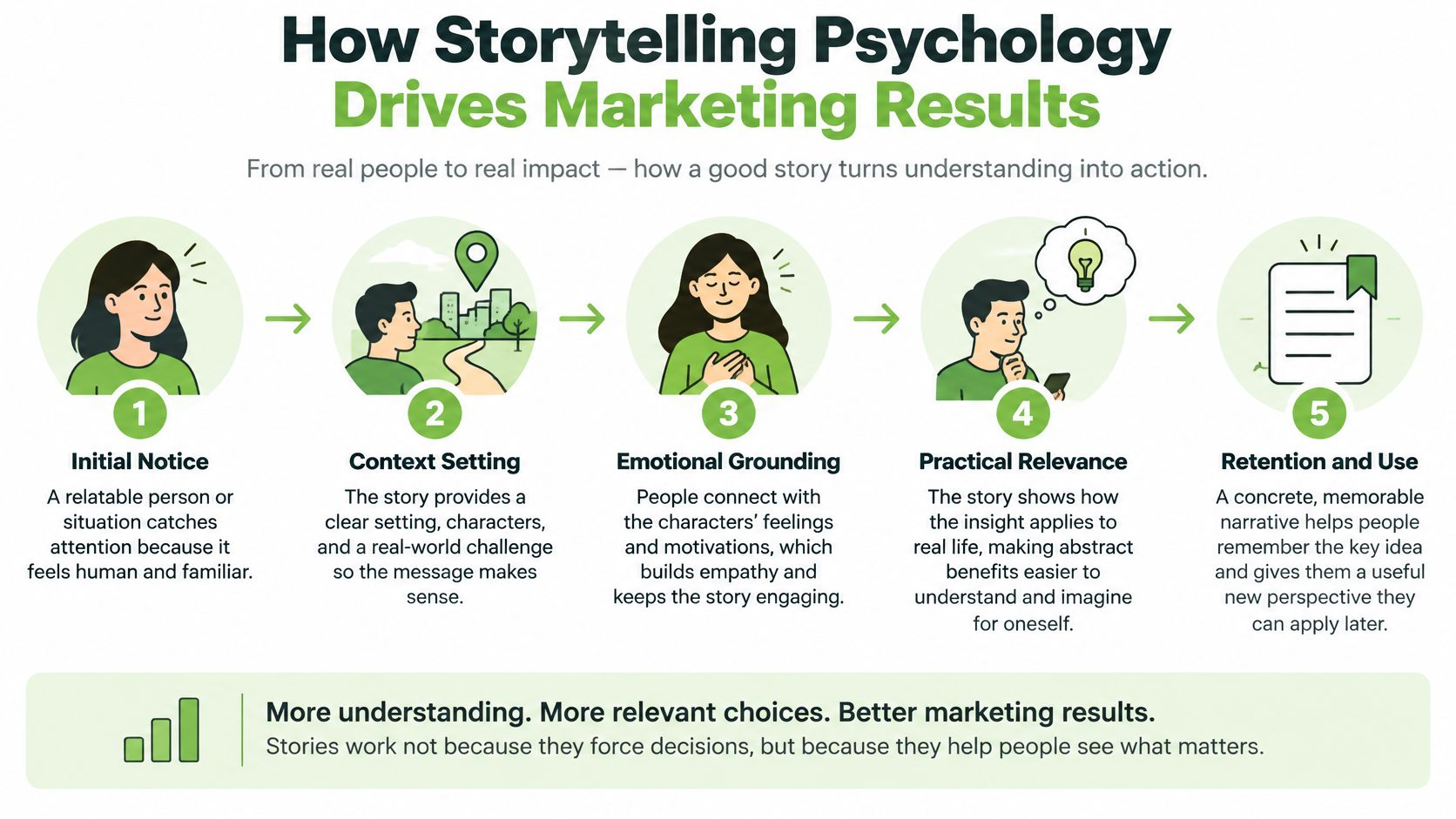
The psychology flow below provides a useful lens for reviewing that journey.
Identify the essential ingredients
Start with the audience, meaning the people you need to reach, and the character, meaning the person whose experience readers follow. Their desire gives the story direction; an obstacle prevents easy progress.
Tension comes from what remains unresolved. Perspective determines whose experience readers encounter, while evidence supports the claims you make. The resulting change must connect to a purpose, such as helping someone evaluate a product or try a new practice.
These ingredients don't require a fictional plot. A product demonstration can contain them, and a slogan can lack them even when it sounds emotional.
- Hypothetical software example: Replace “Centralized approvals for busy teams” with a demonstration of a coordinator finding conflicting feedback, gathering reviewers around the current draft, and confirming who approves it.
- Hypothetical maker example: Replace “Designed with practical storage” with a sequence showing a commuter searching for a travel pass, followed by a demonstration of the bag's accessible pocket.
Neither example proves an outcome. Each establishes a situation in which the feature's value can be examined.
Connect narrative to evaluation
A 2024 peer-reviewed study of 305 previous online purchasers found that storytelling elements significantly influenced perceived usefulness, ease of use, and social influence, which mediated relationships with behavioral intention and perceived brand image. That's more specific than saying audiences enjoy stories: the researchers examined how people evaluated the brand and their intentions.
For advertising applications, Adwave's guide to building narrative ads that convert offers a relevant companion resource when translating a story into an ad brief.
Use the accompanying video as another prompt for reviewing how a message develops.
When assessing a draft, ask whether the reader can identify the person, the difficulty, and the supported change. If those remain vague, polish won't repair the underlying narrative.
How Storytelling Psychology Drives Marketing Results
A story isn't a shortcut around rational evaluation. Treat it as a way to organize the information someone needs to notice, interpret, and assess.
Consider a hypothetical scheduling-service campaign. “Flexible booking” is abstract. Showing a parent trying to arrange an appointment around school pickup makes the benefit concrete, but that scene alone doesn't establish reliability, affordability, or suitability.
Separate the responses you want
Attention means someone notices. Comprehension means they understand the point. Recall means they can retrieve it later. Trust concerns credibility, and action requires a reason to proceed.
These responses shouldn't be treated as interchangeable. A surprising opening might attract viewers who never understand the offer. A moving customer account might be memorable while leaving the brand unidentified.
Use the following as design hypotheses rather than promises:
- Concrete situations: Test whether a recognizable setting makes an unfamiliar benefit easier to explain.
- Unresolved questions: Give viewers a reason to continue, without withholding essential information just to create suspense.
- Emotional recognition: Use feelings appropriate to the situation, such as frustration, relief, curiosity, or pride.
- Credible evidence: Place demonstrations, documented outcomes, and relevant limitations where readers begin evaluating the claim.
The digital-storytelling research discussed earlier supports examining brand evaluation and intention, not assuming automatic persuasion. The practical lesson is to identify the response a particular narrative choice is meant to influence.
Keep persuasion accountable
For the scheduling example, the parent's predicament establishes relevance. An actual booking demonstration explains the process. Clear availability and cancellation information address practical uncertainty, while a suitable next step lets the reader assess their options.
Notice what isn't necessary: an exaggerated crisis or a miraculous ending. Ordinary uncertainty can provide enough tension when it reflects a genuine decision.
A reader can care about the character and still have good reasons not to buy.
The same distinction applies to techniques such as specificity, contrast, and framing. This guide to persuasive writing techniques can help you review those choices without substituting persuasive language for substantiation.
Use the checklist below to connect the psychological questions to concrete creative decisions.
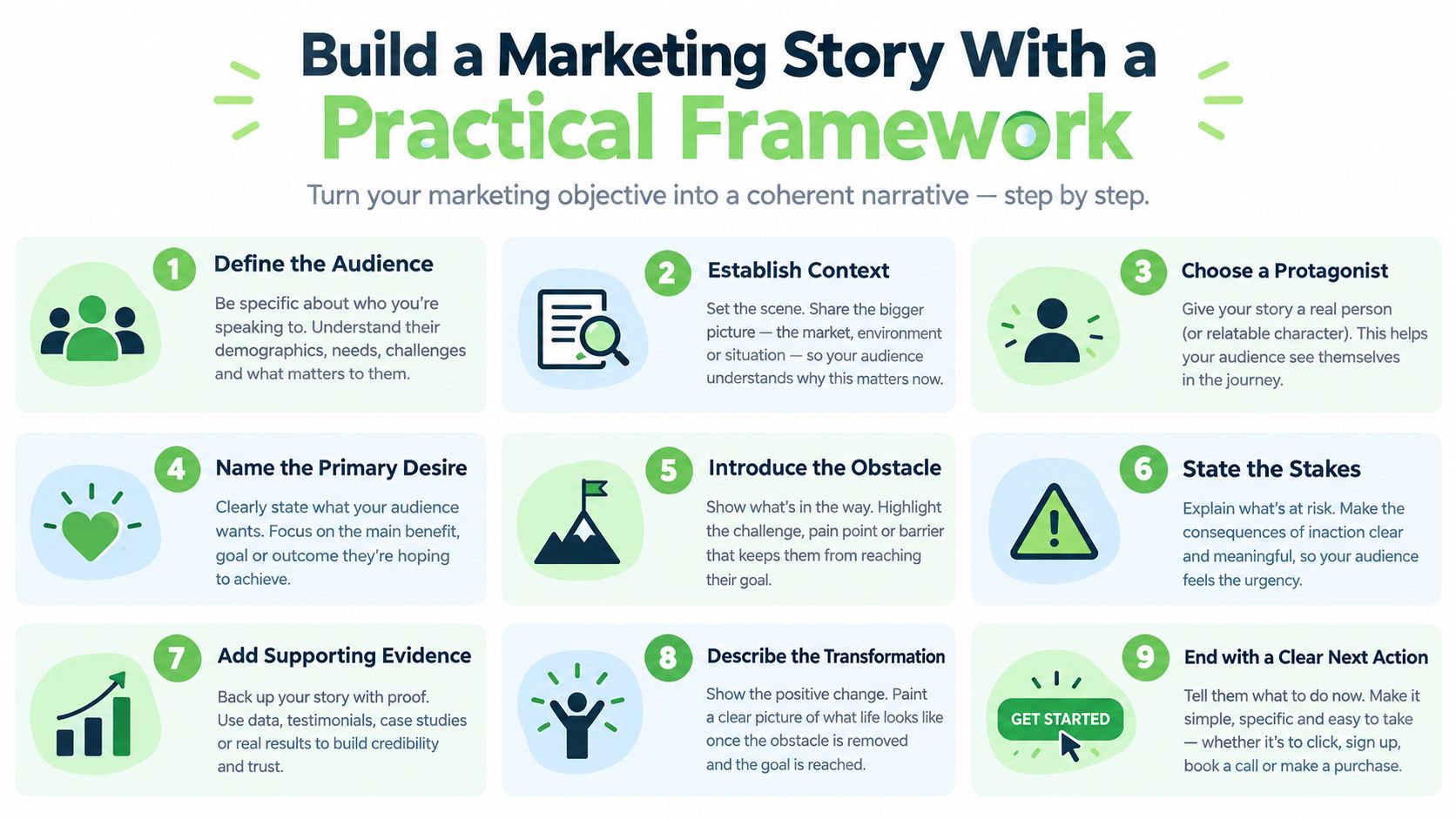
Before approving a campaign, name the intended connection: “This scene should help this audience understand this benefit.” That statement is narrow enough to test and specific enough to revise when the response differs from your expectation.
Build a Marketing Story With a Practical Framework
Begin with a decision the audience needs to make, not a plot you'd like to tell. A compelling founder memory may be irrelevant to someone comparing implementation requirements.
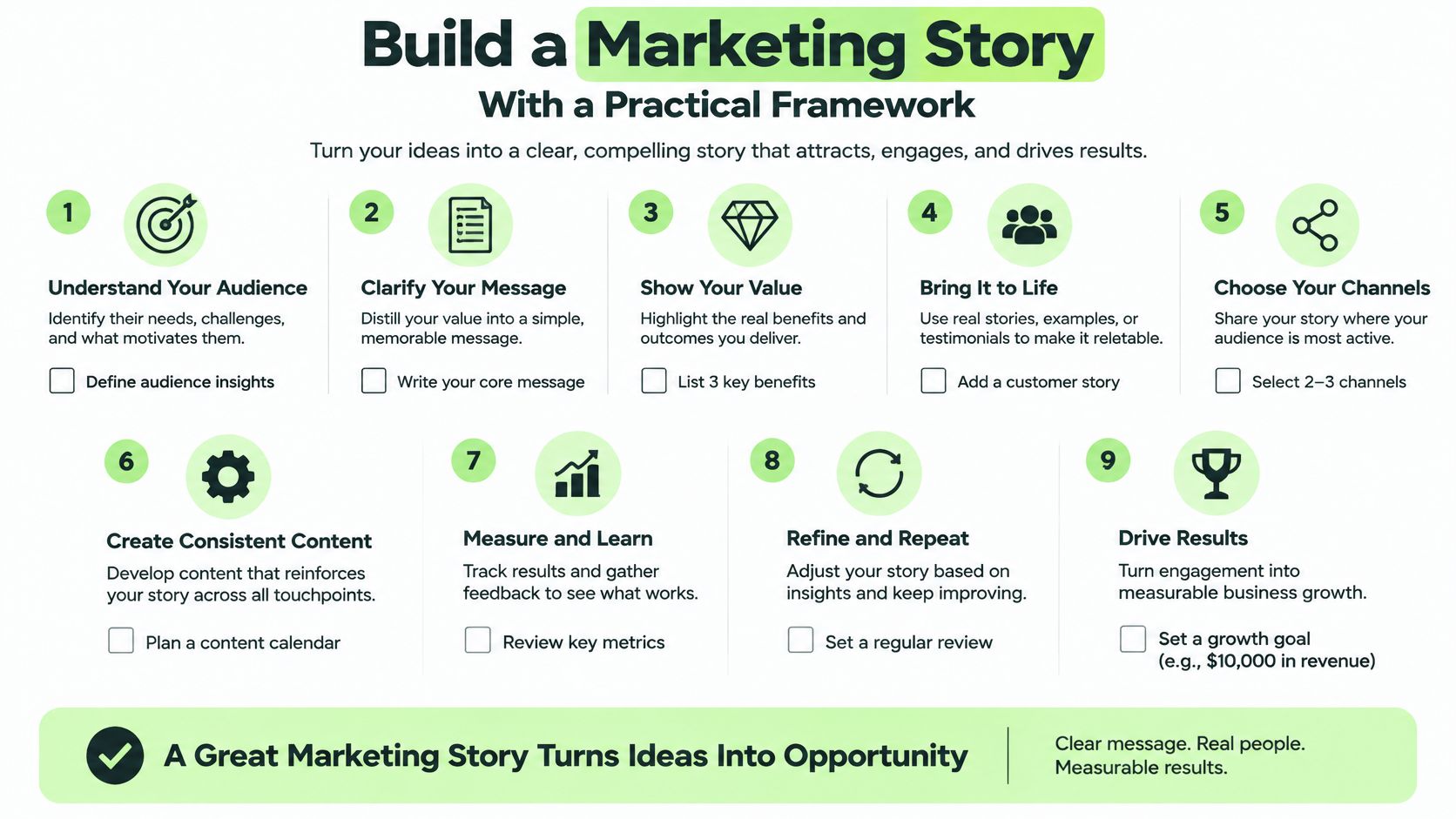
The framework below keeps the story tied to that decision.
Draft the narrative blueprint
- Define the audience and context: Specify who's making the decision and what has happened to make it timely. “A department manager replacing a confusing handover process” is more useful than “busy professionals.”
- Choose the protagonist: Select someone whose experience illuminates that decision. Let them make choices rather than merely receive help from the brand.
- Name the primary desire: Focus on the progress they want. Keep secondary benefits in supporting roles.
- Introduce the obstacle and stakes: Explain what prevents progress and why it matters. A missed handover might mean duplicated work, not organizational disaster.
- Add supporting evidence: Identify what can substantiate the proposed solution, such as a workflow demonstration or an approved customer account.
- Describe the transformation: State what changes and what remains difficult.
- End with the next action: Match the invitation to the reader's readiness, whether that's exploring an example, comparing options, or requesting a demonstration.
A 2015 survey of UK adults found that 79% welcomed brands telling stories, with respondents favoring ordinary people or customers over celebrities. That finding supports looking for relevant everyday experiences rather than assuming the protagonist needs status or fame.
Find material before inventing scenes
Ask customers what triggered their search, what they tried previously, and what nearly stopped the purchase. Review support conversations for misunderstandings and sales questions for unresolved concerns, using appropriate permission and privacy safeguards.
Collect the exact circumstances as carefully as the conclusion. A customer saying that a handover became clearer is useful; knowing which instruction had previously confused colleagues gives a writer something concrete to explain.
For campaign planning around that material, Find Startup Idea's practical 2026 marketing playbook is a companion resource. Keep the narrative brief connected to the wider objective and channel plan.
Adapt the blueprint to readiness
At awareness, emphasize the situation and its meaning. During consideration, explain the mechanism and alternatives. Near decision, give more room to evidence, limitations, and implementation.
A hypothetical origin-story outline might describe a maker encountering an awkward fastening and developing an alternative. A social-video outline could show the awkward moment and the revised design in use.
A customer case-study skeleton needs more: original conditions, evaluation criteria, implementation, documented outcomes, and remaining constraints. If any of those are missing, mark the gap before assigning the draft rather than asking a writer to make the ending sound convincing.
Apply Storytelling Across Formats and Audiences
An educator opens a lesson with a hypothetical classroom problem: students can follow a worked example but struggle to explain their own reasoning. Instead of announcing another technique, the educator demonstrates an unclear explanation, revises it, and invites students to try.
A content creator could use a related structure to document changing a personal practice. The useful material would be the initial assumption, the attempted change, and the observed experience, not a polished claim that the method works for everyone.
A publisher might commission a customer account that examines how someone evaluated competing approaches. An agency could connect a brand's origin to that same audience concern, while keeping historical claims separate from current product proof.
Choosing a Marketing Story Format
| Application | Best Objective | Useful Story Material | Strong Proof | Natural Next Action |
|---|---|---|---|---|
| Founder or maker narrative | Explain purpose | A documented problem behind the product | Design records and demonstrations | Explore the design |
| Social video | Introduce a behavior change | A visible difficulty and attempted solution | An observable process | Try the demonstrated action |
| Educational content | Build understanding | A learner's misconception | Worked examples | Complete an exercise |
| Customer case study | Support evaluation | Selection, implementation, and outcomes | Approved records with context | Discuss a similar requirement |
| Agency campaign | Connect brand and audience | Customer insight and relevant brand history | Verified claims across assets | Visit the relevant landing page |
Let the format serve the explanation
For a maker narrative, a close-up of a prototype may communicate more than a lengthy biography. For a social video, show the behavior viewers need to understand rather than spending the opening on a company introduction.
Don't assume shorter is always better. Research comparing storytelling-advertisement durations found that longer story videos produced more positive brand-image and brand-identity perceptions and increased purchase intention among the college-student participants studied. The defined sample matters, so treat duration as something to test, not a universal rule.
Long-form customer stories offer space for quantified proof when you possess verified records. Put the baseline, outcome, measurement period, and qualifications beside the result rather than isolating an impressive figure.
Repurpose the central meaning, not the entire script. A social asset might show the turning point, an email might explain why it mattered, and a case study might document the process behind it.
Use content marketing best practices to coordinate those assets. Keep the audience's next question consistent even when each format answers it differently.
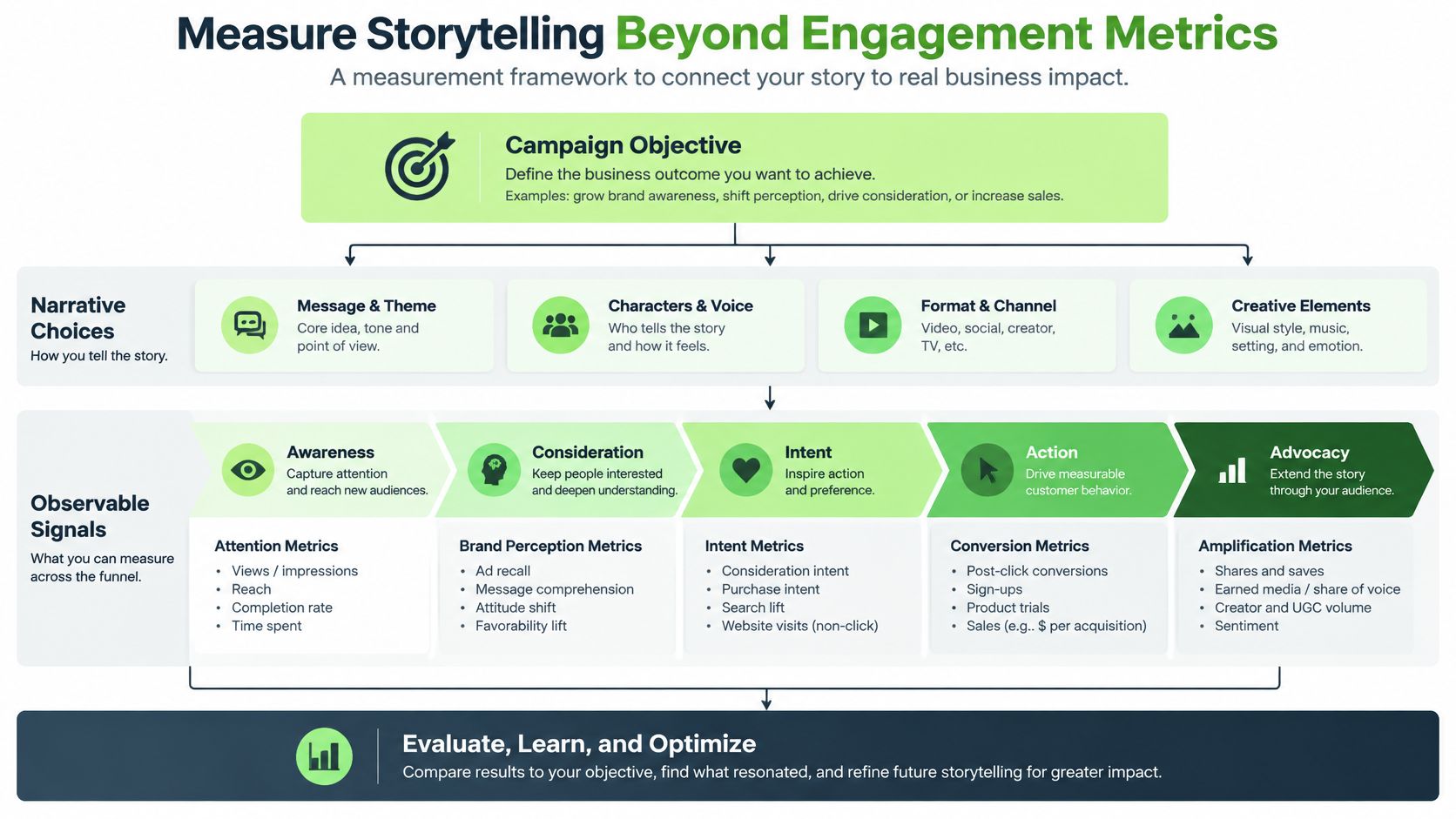
Measure Storytelling Beyond Engagement Metrics
A completed video view tells you something different from a qualified inquiry. Neither replaces the other, but only the latter directly indicates that someone has progressed toward a commercial conversation.
Start with the campaign objective, then select signals that can answer whether the story helped. Don't choose a metric because the publishing platform displays it prominently.
Compare signals with decisions
| Response | Useful Signals | What You Still Need to Establish |
|---|---|---|
| Attention | Views, starts, completion | Whether the intended audience watched |
| Memory | Unaided recall and message association | Whether people remembered the brand and relevant benefit |
| Resonance and trust | Comment quality, perceived sincerity, attitude feedback | Whether reactions reflect credible understanding |
| Action | Relevant clicks, demonstration requests, qualified leads | Whether the next step matched the objective |
| Commercial impact | Conversion, revenue per visitor, retention, referrals | Whether the story contributed beyond other influences |
A 2026 bibliometric review of storytelling measurement identified a persistent divide between quantitative and qualitative measures and described the influence of platforms, influencers, and audience demographics. That makes a combination of behavioral evidence and audience interpretation more useful than an engagement total alone.
The measurement hierarchy below can help organize those questions before publication.
Learn from a reported conversion test
A controlled 14-day product-page test reported that an expandable brand-story section increased conversion from 1.56% to 1.84% and generated $273,662 in incremental revenue. The stronger placement appeared after product recommendations.
That's a reported case study, not a forecast for your site. Its practical value lies in the testable implementation: a defined story element, a comparison page, and commercial outcomes.
For your own test, retain a control and change a meaningful narrative variable, such as customer perspective or proof placement. Keep the offer and surrounding experience stable, set the measurement window in advance, and account for traffic requirements before interpreting results.
Segment results by relevant audiences without treating tiny groups as reliable conclusions. Brand-search lift can complement campaign data, but other activity may influence it; exposure-based conversion cohorts also require care because people who choose to read a story may already be more interested.
Measurement discipline: Decide what would count as useful evidence before you see the results.
A structured approach to marketing campaign optimization helps turn those findings into a revision decision rather than a celebratory screenshot.
Avoid Common Storytelling Mistakes in Campaigns
An engaging story can still be a poor campaign. The audience may enjoy the characters while misunderstanding the offer, doubting the evidence, or overlooking the next step.
The correction isn't always more storytelling. Sometimes it's less setup, a more relevant protagonist, or a clearer explanation.
Replace weak choices with useful ones
- Brand-first openings: Instead of beginning with the company's achievements, open with the decision the audience faces. Introduce company history only when it helps explain that decision.
- Invented audience certainty: Replace an assumed persona's worries with findings from interviews and customer questions. If you use an illustrative scenario, identify it as hypothetical.
- Inflated conflict: Swap a dramatic threat for the actual inconvenience or risk. An approval delay doesn't need to become a business-ending crisis.
- Unsupported proof: Replace “transformed the entire operation” with a documented change and its limits. Remove claims you can't substantiate.
- Unnecessary length: Cut scenes that don't advance understanding. More footage isn't the same as a more developed narrative.
- Attention-only reporting: Replace a success declaration based on views with an assessment of the campaign's intended response.
Review AI assistance without confusing polish and authenticity
AI-assisted drafting and fully synthetic storytelling aren't equivalent. Using a tool to reorganize an approved customer account differs from generating a customer, experience, or testimonial that never existed.
Recent consumer survey reporting on AI-generated marketing found that 7% said visible AI-generated marketing increased trust, while 31% said it reduced trust; 91% expected brands to disclose AI use. Those findings justify careful disclosure and sincerity testing, not a blanket assumption that all AI assistance produces the same response.
Replace generic emotional language with verifiable circumstances. Instead of claiming a customer “felt empowered,” describe the choice they could make, unless the customer expressed that feeling and approved its use.
Before publication, assign a human reviewer to check factual support, emotional honesty, audience relevance, narrative clarity, permission, disclosure, and measurement readiness. Ask test readers what felt credible and what felt manufactured.
Natural language isn't proof of a real experience. A fluent draft still needs accountable sourcing, and a disclosure doesn't excuse a fabricated story.
Create and Improve Your Next Marketing Story
Choose an existing campaign with a clear audience and an identifiable next action. You don't need a new brand narrative to begin testing better storytelling.
Use these compact briefs to make the work assignable.
Reusable working templates
- Brand-story prompt: Describe the situation that led us to act, the audience concern it revealed, the choice we made, and the evidence that connects that choice to our current offer.
- Campaign arc: Our audience faces [situation], wants [progress], and encounters [obstacle]. Show [relevant action], support it with [evidence], and invite [next step].
- Measurement brief: We expect [narrative change] to influence [response]. Compare it with [control], measure [primary outcome], and review [audience feedback and commercial evidence].
Consider a hypothetical software customer who understands the feature list but can't picture implementation. Revise the campaign around a documented setup process rather than adding another broad benefit.
Show the responsibilities, demonstrate the relevant steps, and disclose requirements. Test that version against the existing feature-led page, tracking qualified demonstration requests alongside questions about implementation.
Make revision part of production
A survey-based study found that 76% of its 50 respondents reported purchasing because of brand storytelling. Its small sample makes the finding directional, not a universal benchmark, which is why your own evidence matters.
Marketers can start with a landing page. Creators can revise an opening scene, educators can test a worked example, and agencies can incorporate the narrative hypothesis into client briefs.
Review audience relevance, factual support, emotional credibility, channel fit, disclosure, and the commercial next step before launch. After publication, use the findings to decide whether to clarify the explanation, strengthen the proof, change the format, or retire the story.
Humantext.pro offers an AI detector and text humanizer for reviewing content and improving AI-assisted drafts while preserving their meaning. Visit Humantext.pro to refine a marketing narrative's clarity and flow, then review its evidence, human perspective, and disclosure before publishing.
Prêt à transformer votre contenu généré par l'IA en une écriture naturelle et humaine ? Humantext.pro affine instantanément votre texte, garantissant une lecture naturelle et authentique. Essayez notre humaniseur d'IA gratuit aujourd'hui →
Articles Connexes
Conversion Rate Improvement That Actually Moves the Needle
A hands-on guide to conversion rate improvement using proven CRO methods. Audit, test, and optimize for measurable lift without guesswork.
Marketing Campaign Optimization: The Complete 2026 Guide
Learn marketing campaign optimization with proven frameworks, KPIs, and channel tactics. Includes A/B testing, incrementality, personalization

AI Writing Detector Free: 10 Tools Worth Testing
Compare 10 AI writing detector free options for accuracy, privacy, limits, and practical use by students, editors, and publishers.

