Making Your AI Paraphraser Undetectable: A Practical Guide
Discover how to make your AI paraphraser undetectable. Our guide offers proven techniques and a real-world workflow to bypass AI detection like a pro.
Running your text through an AI paraphraser and calling it a day just doesn't cut it anymore. While these tools are great for a first pass, they almost always leave behind subtle clues that advanced scanners can spot from a mile away.
The real secret to making AI-generated text undetectable is knowing why it gets flagged in the first place, then rolling up your sleeves for a bit of human-powered editing.
Why AI Paraphrasing Still Gets Detected
Let's be real: hitting the "paraphrase" button and hoping for the best is a losing game. Even when the grammar is perfect and the vocabulary seems impressive, AI-spun text often fails to get past detectors like GPTZero or Originality.ai. The problem isn't just about swapping out words; it's about the machine's predictable, robotic DNA.
To understand why this happens, you have to remember how these models are built. The world of AI for content creation is based on algorithms trained to predict the most probable next word in a sequence. This creates a very consistent—but very unnatural—rhythm and structure.
The Digital Fingerprints of AI
Modern AI detectors are designed to sniff out these machine-like patterns. They aren't just looking for bad grammar; they're hunting for these digital fingerprints:
- Predictable Sentence Structures: AI loves uniformity. It often produces sentences of similar length and format, one after another, creating a monotonous flow. A human writer, on the other hand, naturally mixes short, punchy statements with longer, more descriptive ones.
- Awkward Word Choices: Paraphrasing tools sometimes grab synonyms that are technically correct but just feel off in context. For instance, an AI might change "he started the car" to "he commenced the vehicle," which is a dead giveaway. This robotic precision is a tell-tale sign.
- A Missing Voice: The text often feels generic, lacking the distinct personality, opinion, or unique perspective that defines authentic human writing. It’s technically correct but has no soul.
This is exactly why a deeper, human-led editing process is non-negotiable. Trying to fool detection tools with a simple rephraser is a battle you'll likely lose.
And the data backs this up. The RAID benchmark, a major study that tested 12 leading detectors, found that Originality.ai achieved a staggering 96% accuracy rate on paraphrased AI content. That means even text that has been "spun" still sets off the alarms.
The core issue is that basic paraphrasers just swap words around. They don't change the text's underlying DNA. To become undetectable, you need to rewrite the structure, rhythm, and voice—the very essence of the writing itself.
Understanding these flaws is the first step toward fixing them. If you want to dig deeper into the cat-and-mouse game between AI writers and detectors, our guide on does undetectable AI work breaks down the challenges and solutions.
At the end of the day, the goal isn't just to trick a machine. It's to create content that actually connects with a human reader.
Common AI Writing Patterns That Trigger Detectors
To help you spot these issues in your own text, here’s a quick reference table. Think of these as the red flags you need to hunt down and eliminate during your editing process.
| AI Writing Trait (Red Flag) | Why It's Detected | How to Fix It (Actionable Insight) |
|---|---|---|
| Uniform Sentence Length | AI models create a monotonous rhythm by defaulting to sentences of similar lengths. | Actionable Insight: After generating text, actively look for a paragraph where all sentences are roughly the same length. Break one long sentence into two short ones, or combine two short sentences into a more complex one. |
| Overly Formal Vocabulary | Paraphrasers often use clunky, academic-sounding synonyms ("utilize," "commence") instead of simple words. | Actionable Insight: Use your word processor's "Find and Replace" function. Search for common AI words like "utilize," "leverage," and "thus," and replace them with simpler alternatives like "use," "use," and "so." |
| Predictable Transitions | Reliance on generic phrases like "Furthermore," "In conclusion," or "Moreover" to start paragraphs. | Actionable Insight: Instead of using a transition word, start your new paragraph by directly referencing an idea from the previous one. For example, "This marketing challenge..." connects back more naturally than "Furthermore...". |
| Lack of Personal Anecdotes | The text feels sterile and lacks personal stories, opinions, or unique insights. | Actionable Insight: Find a generic statement in the text and add a short, personal "for example" story. Turn "customer service is important" into "I once had a client who doubled their retention just by improving their customer service." |
| Perfectly Balanced Structure | Every paragraph is a similar length, and every list has the same number of items. Humans are messier. | Actionable Insight: Intentionally make your paragraphs different lengths. Have a short, one-sentence paragraph for emphasis, followed by a longer, more detailed one. |
| Passive Voice Overuse | AI often defaults to passive voice ("the report was written by...") which can sound weak and indirect. | Actionable Insight: Scan your document for the word "by." It's often a sign of passive voice. Rewrite sentences like "The decision was made by the committee" to the more direct "The committee made the decision." |
Think of this table as your editing checklist. When you start spotting these patterns, you’re no longer just editing—you're actively de-roboting your content.
My Proven Workflow for Humanizing AI Content
If you want to create content that actually connects with readers and sails past AI detectors, you have to go deeper than just swapping out a few words. The real magic lies in a multi-layered editing workflow that fundamentally rewrites the text’s structural and stylistic DNA.
This isn't about finding a single magic trick. It's a systematic process. First, you have to understand what you're up against. AI detection tools aren't looking for bad writing; they're looking for predictable, machine-made patterns. Think of them as digital fingerprints left behind by the algorithm.
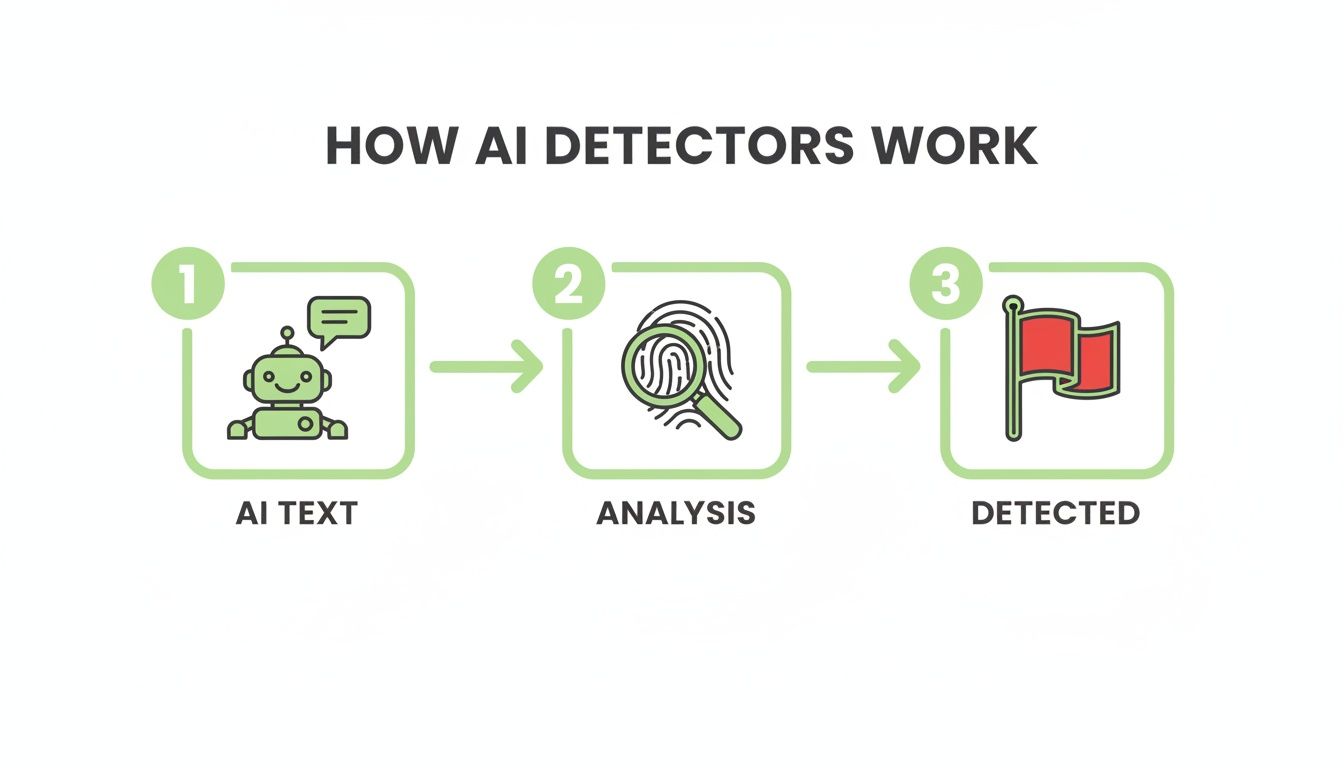
As you can see, AI-generated content has tell-tale signs—things like unnaturally consistent sentence structures and a limited vocabulary. Detectors are trained to spot these. Your job is to meticulously erase every single one.
First Pass: Wreck the Structure
The first layer of humanization is all about demolition. You need to break up the monotonous rhythm that AI text is famous for. AI-generated paragraphs and sentences often have a very uniform, singsong length. Your initial goal is to shatter that uniformity.
- Vary Sentence Length: This is huge. Mix short, punchy sentences with longer, more descriptive ones. This simple change alone mimics the natural cadence of human thought and makes the text far more engaging.
- Reorder Paragraphs: Don't be precious about the AI's original flow. If an idea is buried in the middle, move it to the front. If two paragraphs feel weak on their own, combine them into one powerhouse.
- Mess Up the Lists: AI loves perfectly symmetrical bullet points. You can make them feel more organic by adding a short introductory or concluding sentence to an item, effectively turning it into a mini-paragraph.
Practical Example:
- AI Output: The system integrates multiple data streams. It analyzes user behavior in real-time. It then generates personalized recommendations.
- Human Edit: The system works by integrating multiple data streams to analyze user behavior in real-time. The result? Personalized recommendations, generated on the fly. It's incredibly effective.
This simple edit combines two sentences, shortens another, and adds a punchy closing thought, instantly breaking the robotic rhythm.
Second Pass: Inject Your Voice and Style
Once the structure feels less like a metronome, it’s time to inject your personality. This is where you turn generic, robotic statements into prose that sounds like you.
The single most effective way to humanize text is to add something the AI can never have: personal experience. Weave in a quick anecdote, a strong opinion, or a real-world example from your own work. This instantly adds a layer of authenticity that machines just can't fake.
This is also the stage where you hunt down and kill clunky, formal words that AI paraphrasers love to use. Swap "utilize" for "use." Change "commence" to "start." Simple, direct language almost always reads as more human.
Just look at this classic "before and after":
- AI-Generated: "The implementation of this strategy necessitates a comprehensive analysis of market trends."
- Humanized: "Before we can use this strategy, we really need to dig into what's happening in the market."
The humanized version isn’t just simpler; it’s more direct and conversational. It completely erases the AI's sterile tone.
Many AI humanizer tools, like the one from HumanText.pro, are designed to automate some of this stylistic heavy lifting. Still, a final manual review is non-negotiable to make sure the output truly matches your brand's voice.
By tackling the edit in two distinct passes—first structure, then style—you can confidently transform any AI-assisted draft into undetectable, high-quality content that people actually want to read.
Advanced Techniques for Truly Undetectable Paraphrasing
Okay, this is where the real work begins. Moving beyond basic sentence shuffling is what separates passable AI-assisted content from truly great, undetectable writing. The final polish isn't about rewriting anymore; it's about layering in all the subtle, human stuff that AI models just can't seem to get right.
This is your chance to enrich the text, to inject genuine nuance and make it completely your own.

This final pass is where you fuse the raw output of an AI paraphraser undetectable by scanners with the irreplaceable touch of your own expertise.
Master the Art of Concept Layering
One of the most powerful methods I use is what I call concept layering. It's simple: you take the AI-generated text as a foundation, but you manually weave in your own analysis and perspective to connect the dots. AI is great at spitting out facts, but it’s terrible at forming original opinions or drawing insightful conclusions from them.
Let's say an AI gives you a list of three industry trends. Your job is to add the "so what?"
- AI Foundation: "Trend A is growing. Trend B is emerging. Trend C is slowing down."
- Human Layer (Practical Example): "What's fascinating is how Trend A is directly causing Trend C's decline. We're seeing companies shift their entire ad spend from traditional print (Trend C) to influencer marketing (Trend A). I saw this firsthand with a client last quarter—their investment in A completely cannibalized their market for C."
See the difference? You didn't just add words; you added value and a viewpoint a machine could never come up with.
The goal of concept layering is to move from simply reporting information to interpreting it. This shift is a fundamentally human act and one of the clearest signals to both readers and detectors that a real person is behind the keyboard.
Inject Niche Jargon and Cultural Nuance
AI models are trained on a massive, generalized buffet of internet text. Because of this, they almost always miss the specific jargon, inside jokes, and cultural references that resonate with a real, niche audience. Sprinkling these in makes your content feel instantly authentic.
Think about the specific language your readers use every day. Writing for software developers? Mentioning "yak shaving" or "code smells" will sound far more genuine than a bland, generic explanation. If you're targeting marketing pros, a quick reference to a classic "Got Milk?" campaign or a recent viral TikTok trend adds an immediate layer of shared understanding.
Actionable Tips for This Stage:
- Idiomatic Expressions: Weave in common phrases like "bite the bullet" or "hit the ground running." AI tends to be overly literal and avoids these, but humans use them constantly. Example: Change "It was a difficult but necessary decision" to "We had to bite the bullet on that decision."
- Cultural Touchstones: Reference a popular movie, a well-known book, or a recent event that's relevant to your audience. This creates an instant connection. Example: "Trying to launch without a strategy is like trying to hit 88 mph without a flux capacitor—it just won't work."
- Niche-Specific Terminology: Don't be afraid to use the acronyms and technical terms your community uses. It’s a shortcut to showing you're an insider. Example for marketers: Instead of "analyzing user data," use "digging into GA4 metrics to find conversion paths."
By consciously embedding these human-centric details, you’re adding a final, powerful layer of authenticity. This ensures your content doesn't just pass a detector—it genuinely connects with the people you’re trying to reach.
Choosing the Right AI Humanizer for Your Needs
With so many tools promising to make your text detector-proof, picking the right one can feel like navigating a minefield. The truth is, not all "humanizers" are created equal.
Most standard paraphrasers are little more than a thesaurus on steroids. They swap out words, maybe shuffle a sentence around, and call it a day. This is a fast track to getting flagged by modern AI detectors, which are wise to these simple tricks.
A true AI paraphraser undetectable by today's scanners is a different beast entirely. It's not just finding synonyms; it’s trained to understand and replicate the subtle, complex patterns of human writing—things like varied sentence flow, natural idioms, and contextual word choice. That distinction is everything.
Standard Paraphrasers vs Specialized AI Humanizers
Think of a basic paraphraser as a tool that changes the words but misses the music. It might turn "The company's profits increased" into "The corporation's earnings ascended," which is technically correct but sounds clunky and unnatural.
Specialized AI humanizers go much, much deeper. They act more like a skilled editor than a simple word-swapper.
- They Focus on Rhythm and Flow: These tools break up predictable, robotic sentence lengths. They'll mix short, punchy statements with longer, more descriptive ones to create a natural cadence that real people use.
- They Improve Word Choice Contextually: Instead of just grabbing a synonym from a list, they understand the context of your writing. This means they choose words that fit the desired tone and sound genuinely human.
- They Preserve Your Original Meaning: A good humanizer's top priority is keeping your core message intact. It refines the delivery without sacrificing the substance, ensuring your intended meaning doesn't get lost in translation.
This whole process is a bit like how dedicated platforms like AI resume builders optimize content for automated screening software. They aren't just rewriting; they're strategically modifying text to get past a specific algorithmic gatekeeper. Same principle, different application.
A Framework for Evaluating Your Options
Before you commit to a tool, you need a quick way to test it. What you need depends entirely on your goal. Are you a student trying to polish an essay, or a content marketer trying to scale blog production without getting penalized?
Your choice of tool should align directly with your end goal. A marketer might prioritize speed and SEO features, while a student needs a tool that excels at creating nuanced, academic-sounding prose that maintains factual accuracy.
This choice is happening in a booming market. The AI detection tool sector, currently valued at around $500 million, is projected to explode to $2.98 billion by 2033. Meanwhile, the paraphrasing tool market is set to more than triple. This shows a massive demand for solutions on both sides of the fence.
When you're testing options, look beyond the marketing hype. Check for user reviews and claimed bypass rates against multiple detectors. Just as important, review the tool’s privacy policy. You don't want your content being used to train other models without your consent.
To see how different platforms stack up, check out our detailed guide on choosing the right AI humanizer tool for your specific needs.
How to Test Your Content Against AI Detectors
So you’ve chopped, changed, and polished your AI text. It feels more human, but how can you be sure? Trusting your gut isn’t a strategy. You need to actually put your new content to the test and see if it can slip past the very detectors you’re trying to avoid.
This isn’t just about getting a pass/fail grade. It's about collecting real data to see what’s working and what isn’t. By testing your content at three distinct stages, you can see exactly how much your edits are helping and pinpoint any stubborn AI fingerprints that are still hanging around.

A Practical Testing Methodology
To get a clear picture of your progress, you need a consistent process. I recommend running your text through at least two reliable detectors, like Originality.ai and GPTZero, at each major phase of your workflow. Don’t just test the final version—test all three.
Here's the workflow I use:
- Test 1: The Raw AI Output. First things first, copy the text straight from your AI generator and paste it into the detectors. This is your baseline. Unsurprisingly, it will almost certainly come back as 100% AI. Jot down that score.
- Test 2: The Paraphraser's Attempt. Next, take that same text and run it through your AI paraphrasing tool. Test that new output. This step shows you how much heavy lifting the paraphraser is actually doing on its own. The score will probably improve, but it's still likely to get flagged (e.g., maybe it drops to 65% AI).
- Test 3: The Humanized Draft. Finally, test your fully edited, polished, human-touched version. This is the moment of truth. The goal is to see a score that is overwhelmingly human, proving your manual edits made all the difference (aiming for 90%+ human).
What to Do When Detectors Disagree
You'll quickly notice that different detectors give you different scores. GPTZero might say your text is "likely human" while Originality.ai still flags a few sentences. This is completely normal; each tool has its own algorithm and focuses on different patterns.
Don't panic. Use this conflicting feedback to your advantage.
Instead of chasing a perfect 0% AI score on every single platform, aim for a consistently high human score across the board. If one detector highlights a specific sentence that others missed, that's a gift. Go back and rework that specific phrase using the techniques we’ve already covered.
We’ve seen firsthand just how good top-tier detectors have become at spotting lazy edits. A landmark RAID study found that Originality.ai identified paraphrased AI text with 96.7% accuracy—that’s even higher than its 85% accuracy on raw AI outputs. It’s a stark reminder that just using an AI paraphraser undetectable by scanners isn't a viable strategy without significant manual work.
If your content is still getting flagged after all your hard work, it's usually not a lost cause. Often, the problem boils down to a single clunky sentence or an overly formal phrase you missed. For more targeted advice, our guide on how to bypass ZeroGPT offers specific tactics for tackling one of the most common detectors out there.
By testing methodically, you turn a frustrating guessing game into a data-driven process.
Got Questions? We've Got Answers
Diving into AI content can bring up a lot of questions. Let's tackle some of the most common ones we hear about making AI text sound human and bypass detectors.
Can You Really Make AI Content 100% Undetectable?
Honestly? Anyone promising a magic 100% undetectable score against every future scanner is selling snake oil. It’s just not possible.
But you can get your content to a point where it's statistically indistinguishable from something a person wrote. The secret isn't a single tool, but a smart workflow. When you pair a top-notch AI humanizer with your own manual edits—tweaking the structure, injecting your voice, and smoothing out the flow—you can consistently sail past today's best detectors.
Think of it less as a guarantee and more as a robust process for creating genuinely authentic-sounding content.
What Are the Ethical Lines When Using These Tools?
This is a big one, and it's crucial to get right. Ethically, these tools are best used as writing assistants. They're there to help you refine your own ideas, not to plagiarize, deceive, or pass off purely AI-generated work as your own in academic settings where it's forbidden.
Here’s how to think about it:
- For students: It's about polishing a draft you’ve already thought through and written, not generating an entire essay from a single prompt.
- For professionals: It's a way to scale up content creation efficiently while ensuring the final product is original and high-quality.
Always, always check your school's academic integrity policy or your company's guidelines on AI use. The goal is to enhance your work, not to replace the critical thinking and effort that goes into it.
Can't I Just Change a Few Words Myself?
If only it were that simple! Just swapping a few words here and there is one of the least effective things you can do.
Modern AI detectors are sophisticated. They don't just look at words; they analyze deep patterns like sentence length variation (what experts call "burstiness") and the predictability of word choices ("perplexity"). A quick, superficial edit won't touch these underlying digital fingerprints.
To actually make a difference, you have to fundamentally rework the text. That means restructuring sentences, injecting a unique authorial voice, and varying the rhythm of your paragraphs. A light touch just won't cut it against today's algorithms, which is why a full humanization process is so important.
Will Using an AI Humanizer Hurt My SEO?
When you do it right, it should actually improve your SEO.
Google and other search engines are getting smarter about rewarding helpful, human-first content. A basic, robotic-sounding AI article can kill your rankings by boring readers and sending your bounce rate through the roof.
But when you use a thoughtful process to create well-written, engaging content that happens to be undetectable, you're creating a better experience for your visitors. Engaged readers are one of the strongest positive signals you can send to search engines. Your focus should always be on delivering value to the reader, not just tricking a detector. In the long run, authentic, quality content always wins.
Ready to turn your AI drafts into content that reads like it was written by a pro? Give Humantext.pro a try and feel the difference. Just paste your text, see your score, and get a polished, human-sounding version in seconds.
Start your free trial at https://humantext.pro and see what truly humanized AI writing can do.
Ready to transform your AI-generated content into natural, human-like writing? Humantext.pro instantly refines your text, ensuring it reads naturally and authentically. Try our free AI humanizer today →
Related Articles
10 Different Words for Sad: Ranked by Intensity and Tone
Explore different words for sad, ranked by intensity, register, and context, with example sentences and usage notes for writers and students.
AI Detector Essay Checker: A Step-by-Step Guide
Learn to use an AI detector essay checker with practical steps for students and teachers. Verify text authenticity, interpret scores, and humanize AI content
10 Websites That Humanize AI Writing in 2026
Compare 10 websites that humanize ai writing by features, pricing, privacy, language support, and best use cases for writers, agencies, and educators.

