AI to Human Text A Practical Guide
Transform robotic AI to human text that connects with your audience. Learn a proven process for editing and humanizing AI content for genuine engagement.
Turning raw AI output into human-quality text is all about transforming a sterile, machine-generated draft into something that actually connects with people. The real work involves spotting those robotic tells—like predictable sentence structures and a complete lack of personality—and then layering in the nuance, stories, and genuine experience that only a person can provide.
Why AI-Generated Text Often Misses the Mark
Let's be real—even the most sophisticated AI tools can churn out content that feels hollow and lifeless. This isn't a knock on the technology itself, but an honest look at its limits. Once you can pinpoint exactly why it feels off, you can start turning a generic piece into content that builds real trust with your readers.
AI models are trained on colossal datasets of existing text. They are masters of recognizing and replicating patterns, not of genuine understanding or lived experience. This is precisely why their writing is riddled with common "tells" that scream "a robot wrote this."
The Robotic Giveaways
You can usually spot raw AI content from a mile away if you know what to look for.
- Flawless but Monotonous Grammar: AI almost never makes a grammatical slip-up, but its sentence structures can be painfully repetitive. You’ll often find the same sentence format repeated over and over, creating a dull, predictable rhythm that puts readers to sleep.
- A Lack of Personal Perspective: Great content is colored by anecdotes, opinions, and hard-won insights. AI has no personal history. It can't share a story about a project that went sideways or offer a truly unique, contrarian viewpoint that makes you think.
- The Overly Formal Tone: Many AI tools default to a professional, almost academic tone that feels stiff and distant. This sterile language just doesn't connect with readers on an emotional level, making the content instantly forgettable.
The explosion of AI in content creation is impossible to ignore. Since ChatGPT hit the scene, the volume of AI-generated articles has surged, making up nearly 39% of all published web articles by late 2023. The catch? This content often tanks in search rankings, proving it just doesn't have what it takes for organic reach. You can dig deeper into these AI content trends and their performance on Graphite.io.
The biggest pitfall of AI writing is its ability to state facts without any context or emotional weight. It can tell you what happened, but it can't explain why it matters to your reader.
For instance, an AI can generate a perfectly accurate description of a new marketing strategy. A human writer, on the other hand, might add a short story about how that same strategy bombed for them once, what they learned from the failure, and how readers can avoid making the same mistake.
That's the critical difference. It separates merely informative content from truly valuable content. Getting a handle on this gap is the first real step to effectively converting AI to human text.
A Repeatable Framework for Humanizing AI Content
Knowing AI text often feels flat and robotic is one thing, but actually fixing it is another challenge entirely. The good news? You don't need to reinvent the wheel every time. With a solid process, you can turn this tedious task into a smooth, efficient part of your workflow for getting true human-sounding content.
The core idea is to work from the outside in—starting with broad, structural edits before diving into the finer details of voice and personality. It’s a bit like building a house: you pour the foundation and put up the frame long before you start choosing paint colors. The goal is to layer in the human elements systematically.
This simple flow chart breaks down the initial strategic steps. It's all about spotting the classic AI tells, understanding where the tech falls short, and then building a clear roadmap for your edits.
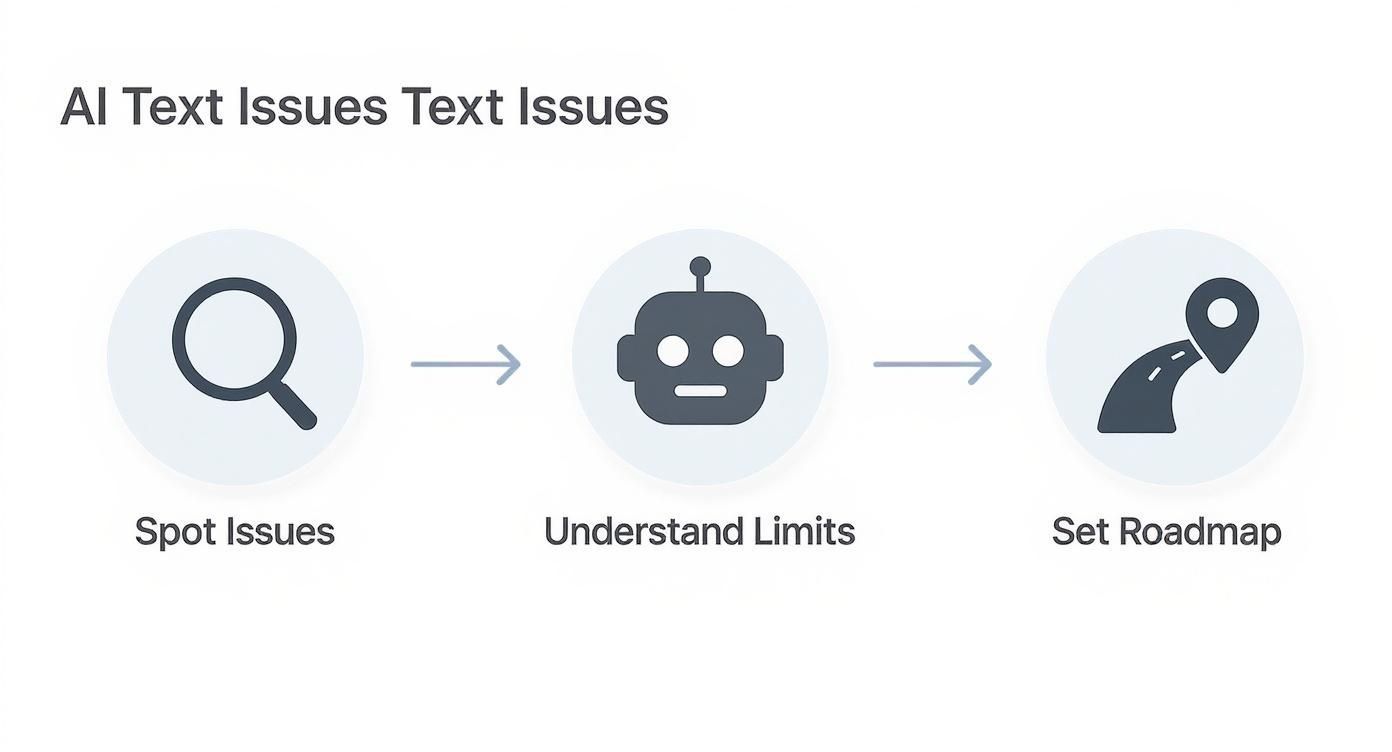
This visual gets to the heart of the matter: humanization isn't just about swapping out a few words. It's a structured approach that starts with a proper diagnosis before you even think about the cure.
To get a clearer picture of what we're aiming for, let's compare the raw output with the end goal.
AI vs Humanized Text Characteristics
| Characteristic | Typical AI Output | Humanized Content Goal |
|---|---|---|
| Tone & Voice | Monotonous, overly formal, or generic "helpful" tone. | Authentic, brand-aligned voice with a consistent personality. |
| Sentence Flow | Repetitive sentence structures and predictable rhythm. | Varied sentence lengths creating a natural, engaging rhythm. |
| Transitions | Abrupt or uses cliché phrases like "In conclusion..." | Smooth, logical bridges between ideas that guide the reader. |
| Word Choice | Overuses complex, jargon-heavy, or clichéd words. | Precise, evocative language that is clear and easy to read. |
| Expertise | Often regurgitates known facts without unique insight. | Includes original data, personal anecdotes, or unique POVs. |
| Factuality | Can contain subtle inaccuracies or "hallucinations." | Meticulously verified facts and properly cited sources. |
| Reader Connection | Lacks empathy; addresses a generic "user." | Speaks directly to a specific audience, asking questions. |
This table highlights the shift from a machine-generated draft to a piece of content that actually connects with a human reader. Now, let's break down how to get there.
Start with the Narrative Flow
Before you touch a single word, read the entire AI draft from start to finish. Does the argument actually hold together? Does it tell a coherent story? AI is great at assembling facts, but it often completely misses the narrative arc that makes a piece compelling.
Your first job is to act as a structural editor. This is big-picture stuff.
- Reorder entire paragraphs: Move sections around to build a more logical and persuasive argument.
- Strengthen the transitions: Add your own sentences to bridge the gaps between ideas, making the journey seamless for the reader.
- Cut the fluff: AI has a bad habit of including information that, while technically accurate, doesn't serve the main point. Be ruthless. If it doesn't add value, chop it out.
By 2025, a staggering 90% of content marketers plan to use AI for content creation, a massive jump from just a few years ago. The most common uses are for outlining (71.7%) and drafting text (57.4%), which proves that pros see AI as a starting point, not the finish line. The real magic happens when a human editor shapes that raw output into something truly effective. You can find more of these insights at Siege Media.
A great human editor doesn't just fix AI content; they give it a purpose. They ensure every sentence works to guide the reader toward a specific understanding or action.
Inject Personality and Rhythm
Once the structure is solid, it's time to breathe some life into the text. This is where you swap that sterile, robotic tone for your unique brand voice. The key here is variability—in your sentence length, word choice, and overall rhythm.
For instance, an AI might spit out a paragraph where every single sentence is about 15 words long. Your job is to break that up. Follow a long, descriptive sentence with a short, punchy one. This creates a cadence that keeps the reader hooked and makes the whole thing feel more like a conversation.
You should also look for opportunities to weave in personal insights or ask questions. A simple line like, "But have you ever run into this problem?" can instantly make the content feel more personal, pulling the reader right into the discussion.
Verify Everything and Add Unique Expertise
Last but not least, never, ever trust an AI draft's facts without checking them. AI models are notorious for "hallucinating" information and presenting it with absolute confidence. Double-check every statistic, claim, and reference.
But don't just stop at verifying—elevate the content. This is your chance to add the kind of expertise that no algorithm can replicate. Share your own data, drop in a relevant case study, or offer a perspective that challenges a common assumption in your field. This final layer of real-world expertise is what transforms a generic AI article into an authoritative resource people will actually trust and share.
Finding Your Voice in an AI Draft

Once you've wrestled the AI-generated structure into something sensible, the real work begins. This is where you stop being an editor and start being a writer. It’s the process of taking generic, robotic text and injecting your brand’s unique personality into every sentence. This is the heart of converting ai to human text.
Most AI models are programmed to play it safe. They spit out content with a neutral, often stiffly formal tone because it's the lowest common denominator. Your first job is to knock that formality down a few pegs to match who you're actually talking to. Are they industry veterans or total beginners? The answer changes everything.
Adjusting Formality and Tone
Think of it like getting dressed for an event. You wouldn't show up to a casual coffee meeting in a three-piece suit. In the same way, a B2B tech blog shouldn't sound like a dissertation defense. It needs to feel like a smart colleague sharing great advice.
A quick win here is to hunt down and destroy corporate jargon and replace it with direct, simple language.
Instead of: "It is imperative to utilize..."
Try: "You need to use..."
Instead of: "The aforementioned strategy facilitates..."
Try: "This strategy helps you..."
This simple swap instantly makes the writing more approachable. You're not dumbing anything down; you're just making it easier to connect with the person on the other side of the screen.
Your brand's voice is its personality. It's the consistent and recognizable way you communicate with your audience, turning one-time readers into a loyal community.
Weaving in Your Unique Perspective
Beyond tone, what truly makes writing human is perspective. An AI can pull together facts from across the web, but it can’t share a personal story, a lesson you learned the hard way, or a slightly controversial take that makes your content stick.
Look for opportunities to inject your own viewpoint. This doesn’t mean you have to shoehorn a long anecdote into every section. Often, a single sentence is all it takes.
For example, an AI might generate a generic list of a marketing tool's benefits. You can immediately make it better by adding your own experience:
"While the analytics dashboard is powerful, I’ve found the real game-changer is the A/B testing feature. It helped our team increase conversions by 15% in just one month by testing different headlines."
That tiny addition does three critical things:
- Builds Credibility: It proves you've actually used the tool.
- Adds Value: It provides a specific, tangible outcome.
- Creates Connection: It feels like a real tip from a real person.
These layers of personal insight are what separate authentic, valuable content from a sterile AI draft. Making this a consistent part of your editing process is how you ensure your audience feels like they're listening to an expert, not just reading a machine's summary.
After you’ve polished the structure and voice of your AI draft, it’s time for the most important step—the one that separates forgettable content from authoritative resources. This is where you move beyond simple editing and into the realm of true subject matter expertise.
It’s an area where AI, for all its power, still comes up remarkably short.
AI models are famous for "hallucinating," a polite term for making things up with complete and utter confidence. This isn't a rare bug; it's a core feature of how they work. That's why a rigorous fact-checking process is absolutely non-negotiable.
Before you even think about hitting publish, every single statistic, claim, and reference must be checked against a reliable source. Assuming the AI got it right is a fast track to destroying your credibility.
Go Beyond Correcting—Inject Real Insight
Verification is just the starting line. The real magic happens when you elevate the content by weaving in your own proprietary data, expert commentary, or unique perspectives drawn from personal experience. This is what turns a generic article into something genuinely valuable.
This is how you become an authority, not just a content producer.
Here are a few ways to add your unique fingerprint:
- Share a Personal Case Study: Instead of a generic example, detail a specific project you actually worked on. Lay out the challenge, the exact steps you took, and the final outcome—numbers and all.
- Feature a Client Success Story: With their permission, of course. Use real-world examples of how a client successfully applied the concepts you’re writing about. It adds powerful social proof and makes your advice feel more tangible.
- Present a Contrarian View: Don't be afraid to challenge a widely held belief in your industry. A well-reasoned argument that goes against the grain is memorable. It shows you're not just repeating information; you're thinking critically about it.
This layering of authentic experience is your biggest advantage. The sheer scale of AI adoption means the internet is being flooded with generic, surface-level content. With tools like ChatGPT projected to hit over 800 million weekly users by 2025, your unique expertise is the only thing that will make your work stand out. You can find more of these eye-opening stats and their impact on content over at Exploding Topics.
An AI can summarize the what. A human expert explains the so what. That distinction is the difference between content that merely informs and content that actually influences.
From Fact-Checker to Authority
Ultimately, this part of the ai to human text process is about taking ownership. It’s about taking the raw material from the AI and fundamentally reshaping it with your hard-won knowledge.
Think of the AI draft as a pile of bricks. Your job is to be the architect—the one who arranges them into a sturdy, impressive structure that no one else could build. By adding your unique perspective, you aren't just correcting potential errors. You are building trust and establishing your voice as an indispensable resource.
A Final Quality Check for Your Humanized Content
You've done the heavy lifting—editing for tone, fact-checking, and weaving in your brand's unique voice. But before you hit "publish," there's one last hurdle. This is your final quality assurance checkpoint, the moment you confirm your efforts actually worked.
It’s tempting to just plug the text into an AI detector and call it a day if you get a good score. Don't do it. While these tools can offer a quick gut-check, they are far from infallible. Their algorithms are inconsistent at best, sometimes flagging genuinely human writing as AI and vice versa.
The most reliable detector for human-like content is, unsurprisingly, a human. Trust your own judgment and the feedback of others over any automated score.
Putting Your Content to the Human Test
The real validation comes from methods that catch the subtle issues automated tools always miss. This is how you spot the clunky phrasing, the awkward transitions, and the sentences that just don't land right.
Start with a classic writer's trick: read the entire piece out loud. Your ears will catch robotic rhythms and clunky sentences that your eyes might skim right over. If you find yourself stumbling over a phrase or running out of breath, that section needs another look. It's a dead giveaway.
Next, find a fresh pair of eyes. Send the draft to a trusted colleague and ask for their honest, no-holds-barred feedback. Don't just ask if they "like it." Ask specific questions:
- Does this sound like a real person wrote it?
- Are there any parts that feel clunky or confusing?
- Does the content connect with you at all?
After you've stared at a document for hours, you become blind to its flaws. A second opinion is invaluable for anyone serious about mastering the ai to human text conversion process.
Final SEO and Intent Alignment Checks
Humanizing your content is critical, but not at the expense of your search performance. Before you push it live, give it one last SEO pass to ensure your edits didn't accidentally water down your keyword focus.
Quickly confirm your primary keyword is still in key spots like the title, intro, and relevant subheadings. More importantly, read the content one last time with search intent in mind. Does your article still directly and clearly answer the question someone would type into Google? Authentic, human-sounding content is a massive part of a positive user experience, which is exactly what search engines are trying to reward.
For those looking to build out their process, exploring different ways to humanize AI text for free can add new techniques to your toolkit. This final check ensures your authentic, polished content also has the best possible chance to be found by the right people.
Common Questions About Humanizing AI Text
As you start weaving AI into your content workflow, questions are bound to pop up. It makes sense. Turning robotic text into something genuinely human is still new territory for a lot of people, and it’s natural to wonder how it affects everything from your SEO to your daily schedule. Let’s clear the air on some of the most common uncertainties.
Getting this right means having straightforward answers you can trust. Below, we'll tackle the practical realities of humanizing AI content, giving you the confidence to polish your drafts without any guesswork.
Can Google Detect AI-Generated Content?
This is the big one, and the answer isn't a simple yes or no. Google's official line is that it rewards high-quality, helpful content—it doesn’t care how that content was made. The focus isn't on the "who" (or "what") behind the keyboard, but on the value the reader gets.
Here’s the catch: raw, unedited AI text almost never meets that quality standard. It often lacks real depth, originality, and the E-E-A-T (Experience, Expertise, Authoritativeness, and Trustworthiness) signals that are so critical for ranking well.
So, while Google isn’t penalizing content just because it was made by AI, it absolutely penalizes the low-quality, generic output that unedited AI tools are famous for. Humanizing your text is how you bridge that gap and ensure your content meets Google's quality standards.
How Much Time Should Humanizing Take?
There’s no magic number here. The time you’ll spend really depends on a few key things:
- Content Length: A quick 500-word blog post might only take 20-30 minutes to humanize. A deep-dive 3,000-word guide? That could easily take a few hours of focused editing.
- Topic Complexity: A simple listicle is a breeze compared to a dense, technical article that demands rigorous fact-checking and adding your own expert insights.
- Initial AI Quality: The better your initial prompt and the more advanced the AI model you used, the less cleanup you'll have on the back end.
As a general rule of thumb, I'd suggest budgeting about 30-50% of the time it would normally take you to write the same article from scratch. That gives you enough runway to handle bigger structural edits, check your facts, and inject your own voice without feeling rushed.
What Are the Best Tools for the Humanization Process?
Your AI writer is just the starting point. A truly effective workflow needs a solid supporting cast of tools to help you polish, refine, and double-check your work. Think of it as your digital editing suite.
The goal isn't just to make content sound human; it's to ensure it's accurate, original, and easy for your audience to actually read. The right tools make this process systematic instead of just subjective.
Beyond your main AI generator, your toolkit should probably include:
- A Robust Grammar and Style Checker: Tools like Grammarly or ProWritingAid go way beyond basic spell-checking. They can help you vary your sentence structures and boost overall readability.
- A Plagiarism Detector: This is non-negotiable. Always run your final draft through a tool like Copyscape to make sure the AI hasn't accidentally lifted text from its training data.
- Readability Analyzers: I love the Hemingway App for this. It’s brilliant at spotting overly complex sentences and sneaky passive voice, helping you make your writing more direct and engaging.
For a deeper dive into the strategic side of this, our guide on how to make AI content undetectable offers even more techniques and insights.
Ready to transform your AI drafts into content that truly connects? With Humantext.pro, you can instantly humanize your text, ensuring it reads naturally while bypassing AI detectors. Try it now and see the difference for yourself at https://humantext.pro.
Ready to transform your AI-generated content into natural, human-like writing? Humantext.pro instantly refines your text, ensuring it reads naturally and authentically. Try our free AI humanizer today →
Related Articles
AI Face Search Explained: Verify Identity and Stay Safe
Understand how AI face search works, including embeddings, accuracy, and legal issues. Learn to use these tools for personal safety and verify identity online.

Reverse Face Search: A Verification Safety Guide
Learn how reverse face search works, when to use it for safety, and how to pair it with AI image checks to verify online contacts and reused photos.

Face ID Search Explained: How It Works and How to Verify
Learn how face ID search works, why it differs from reverse image search, and how to verify identities and photos safely with practical checks and tools.

