
Discover How to bypass Copyleaks: Ethical Tips for Higher-Quality Content
Discover ethical, high-quality writing techniques that help bypass Copyleaks and improve your content's originality, readability, and engagement.
Let’s get one thing straight: when we talk about how to “bypass Copyleaks,” we’re not talking about cheating. The real goal is to refine and humanize AI-assisted content so it reflects your unique voice and avoids the frustrating trap of a false positive.
This is about moving past basic paraphrasing. It’s about diving into your sentence structures, diversifying your vocabulary, and injecting your personal perspective. When you do this, you’re not just making content undetectable—you’re making it genuinely better.
Why 'Bypass Copyleaks' Is More Than Just Cheating

It’s incredibly frustrating to pour your effort into a project, only to see an AI detector slap a "100% AI-generated" label on it. This feeling is all too common for writers and students who use AI as a brainstorming partner or a first-draft assistant, not as a ghostwriter.
The term "bypass Copyleaks" might sound shady, but for many, it’s about a practical need: avoiding the pitfalls of oversensitive detection tools. These platforms are programmed to spot patterns, but sometimes their judgment is flawed.
Their algorithms often flag content for traits that are hallmarks of raw AI output:
- Predictable Sentence Structures: AI models often fall into a rhythmic rut, producing sentences of similar length and construction. For example, an AI might generate a paragraph where every sentence is between 10-15 words long, creating a monotonous flow that detectors can spot a mile away.
- Sterile Vocabulary: Without a human touch, AI writing can feel a bit bland. It tends to stick to common words and steer clear of unique phrasing or idioms. An actionable insight is to search for generic adjectives like "important" or "effective" and replace them with more descriptive words like "pivotal," "indispensable," or "transformative."
- Flawless, Uniform Grammar: While grammatically perfect, raw AI text often lacks the subtle imperfections and stylistic quirks that make human writing feel authentic.
This guide reframes the whole process as an ethical editing strategy. It’s not about tricking software; it’s about elevating your own work. By learning to humanize your AI-assisted drafts, you make them more engaging, more authentic, and—as a direct result—undetectable because they are fundamentally your own. For a deeper dive, check out our strategies for creating undetectable AI.
The Rise of False Positives
As detection tools have rolled out across universities and publishing houses, a huge number of people are now trying to "bypass" them—not to cheat, but to ensure their legitimate, AI-assisted work isn't misjudged. When Turnitin launched its AI detection in April 2023, its own testing revealed that "borderline" essays could be misclassified nearly half the time.
This reality has fueled a massive interest in humanization platforms like HumanText.pro. People need a way to reclaim their work from faulty algorithms.
To better understand why this happens, it helps to see what these detectors are looking for. They’re comparing text against a statistical model of what AI usually produces.
AI Text Signals vs Human Writing Traits
This table breaks down the common patterns that AI detectors like Copyleaks flag versus the qualities that define authentic human writing.
| AI-Generated Text Signal | Authentic Human Writing Trait | Why It Matters for Detection |
|---|---|---|
| Uniform Sentence Length | Varied sentence structures—short, punchy sentences mixed with longer, complex ones. | Predictable rhythm is a major red flag for AI. Variation feels natural to human readers and scanners. |
| Low Perplexity | Higher perplexity, with unexpected word choices, idioms, and unique phrasing. | Perplexity measures randomness. AI text is statistically predictable; human language is less so. |
| Perfect, Simple Grammar | Occasional stylistic fragments, complex punctuation (like em dashes), and a distinct personal voice. | Humans bend grammar rules for effect. AI usually plays it safe, resulting in a robotic feel. |
| Generic Vocabulary | Specific, nuanced vocabulary, including jargon, analogies, and personal anecdotes. | Human writers draw from personal experience, which enriches their word choice far beyond a standard AI model. |
| Lack of Personal Tone | A clear, consistent voice that conveys emotion, opinion, and personality. | AI struggles to fake genuine perspective. A strong, authentic tone is difficult for detectors to label as machine-generated. |
This comparison shows it's not about one single factor, but a combination of traits. By focusing on shifting your text from the left column to the right, you're not just dodging a detector—you're becoming a better editor of AI-assisted content.
The core issue is that while AI detectors are becoming more advanced, they still operate on statistical probabilities. They don't understand context or intent; they only see patterns. This is why a human touch is still the most powerful tool in your writing arsenal.
Ultimately, the goal is to produce work that is undeniably yours. By focusing on adding unique insights, varying your writing style, and polishing the final draft, you're not just bypassing a tool—you're mastering the art of modern, AI-assisted writing.
Why Basic Paraphrasing Fails Modern AI Detectors
If you think swapping a few synonyms or running your text through a basic "spinner" is enough to fly under the radar of Copyleaks, it's time for a reality check. Those old-school tricks are completely transparent to modern AI detectors, which are built to look far beyond simple word changes.
These tools don't just scan for copied phrases anymore. They analyze the deep, underlying statistical patterns that give AI-generated content its signature robotic feel. It’s like trying to disguise a robot by putting a different hat on it—the stiff, mechanical movements give it away every single time.
Beyond Simple Word Swapping
Today’s detectors analyze the very rhythm and flow of your writing. They’ve been trained on massive libraries of human and AI text, learning to spot the subtle but consistent fingerprints that machines leave behind.
They focus on core metrics you might not even think about:
- Perplexity: This is a fancy term for how predictable your text is. Human writing is often surprising; we use unexpected word choices and phrasing. AI, on the other hand, tends to pick the most statistically likely word, which makes its output feel smooth but ultimately predictable.
- Burstiness: This refers to the variation in sentence length and structure. Humans naturally write with a mix of short, punchy sentences and longer, more descriptive ones. AI models often fall into a monotonous rhythm of sentences with similar lengths, which is a dead giveaway for a detector.
A simple paraphrase might change the words on the page, but it rarely fixes that underlying structural predictability.
A Real-World Paraphrasing Failure
Let's look at a quick example of how a paraphrased sentence can still scream "robot."
Original AI Text: The proliferation of digital technologies has fundamentally altered the communication landscape, creating new opportunities for global connectivity.
Basic Paraphrased Text: The spread of digital tools has basically changed how we communicate, making new ways for people worldwide to connect.
Sure, the words are different, but the core structure and predictable flow are still there. The second sentence still lacks the nuance and natural complexity of something a person would write. An advanced detector sees right through this. The goal isn’t just to find a new way to say something, but to completely rethink how it's being said.
This is exactly why a more thoughtful, structural approach is non-negotiable for getting past Copyleaks. Benchmark tests consistently show that crude tricks like synonym swapping just don't cut it. Simple paraphrasing has been shown to reduce AI detection scores to about 28.7%. In stark contrast, a properly tuned AI humanization workflow—which addresses these deeper structural issues—can hit a success rate closer to 95%.
Ultimately, figuring out whether undetectable AI works means moving past surface-level edits. True humanization is all about breaking up those predictable patterns and injecting a unique, authentic voice into the text.
A Practical Workflow for Making AI Content Your Own
Forget the generic advice. If you want to create content that feels genuinely human, you need a hands-on, multi-layered process. This isn't about simple edits; it's about fundamentally rethinking how AI-generated text is built. The goal is to break its monotonous, predictable rhythm and transform it into something dynamic and authentic.
This workflow isn't just about tweaking words to get past a detector like Copyleaks. It's a real strategy for infusing your unique voice, varying sentence complexity, and turning robotic paragraphs into something that actually sounds like you.
Reframe Monotonous Paragraph Structures
AI models are trained to be logical, which often means they fall into repetitive paragraph patterns. You'll see it all the time: a topic sentence, three supporting points, and a neat summary. Your first job is to blow up that rigid formula.
Actionable Insight: Look for a paragraph with a list-like structure. Instead of just editing the sentences, try combining two points into a single, more complex sentence or pulling one point out to stand on its own for emphasis. This disrupts the predictable beat that AI detectors are trained to catch.
Here’s a perfect example of what I mean:
Before (AI-Generated):
"Digital marketing is important for modern businesses. It allows companies to reach a wider audience. It also provides measurable results through analytics. Finally, it is more cost-effective than traditional advertising."
Structurally, it’s fine. But it's painfully robotic.
After (Humanized):
"In today's market, ignoring digital marketing is like opening a store but not telling anyone where it is. It's not just about reaching a wider audience or getting better analytics—it's about survival. Plus, it's often far more cost-effective than old-school print ads."
See the difference? The human version uses an analogy, mashes ideas together, and has a much more natural, conversational flow. It completely shatters that rigid "Point 1, Point 2, Point 3" structure.
Inject Your Unique Voice and Anecdotes
Your most powerful weapon against AI detection is you. AI has no life experiences, no strong opinions, and no funny stories from last year's conference. Adding these elements is the fastest way to make content undeniably yours.
Practical Example: If you are writing about project management software, don't just list its features. Add a sentence like, "I once managed a project where we missed a deadline simply because tasks weren't visible to the whole team—a problem that a tool like Asana would have solved instantly." This personal touch is something an AI cannot generate.
Instead of just spitting out facts, try weaving in:
- Personal Stories: A short, relevant anecdote can bring a dry topic to life.
- Strong Opinions: Don't be afraid to take a stance. AI is built to be neutral; a clear point of view is a massive human signal.
- Specific Examples: Swap out the AI's generic examples for highly specific, real-world scenarios it would never come up with on its own.
This is a screenshot from the HumanText.pro homepage, which is all about transforming AI text into human-like content. Notice how clean the interface is—it's designed for a simple input-output process, reinforcing how a tool like this can easily fit into your editing workflow.
Vary Sentence Length and Complexity
One of the biggest tells of AI writing is its rhythmic consistency. This trait is known as low burstiness. Human writing, on the other hand, is all over the place. We use short, punchy statements. Then we follow them up with long, flowing sentences that explain a complex idea.
To get this effect, you have to actively edit your draft with sentence variety in mind.
- Find a long, complex sentence and break it into two or three shorter ones for impact.
- Spot a series of short, choppy sentences and combine them using conjunctions to create a more sophisticated thought.
Before (AI-Generated):
"The system was implemented to increase efficiency. The goal was to reduce manual errors. It was also intended to streamline operations."
After (Humanized):
"The system's core purpose? To boost efficiency. By cutting down on manual errors, it was designed to completely streamline our day-to-day operations."
The edited version kicks off with a question fragment and combines two ideas into a single, more dynamic sentence. This creates a rhythm that feels much more human. This process is absolutely central to any effective strategy to bypass AI detection. By focusing on these deep structural and stylistic changes, you're not just fooling a detector; you're creating better, more engaging content.
Using AI Humanizer Tools the Right Way
AI humanizer tools can be incredible allies in your writing workflow, but let's be clear: they aren't magic buttons. I like to think of them less as a one-click fix and more as a sophisticated co-pilot that helps me navigate the final, tricky parts of the editing process.
These platforms use some pretty advanced linguistic models to analyze and rework AI drafts. Their main job is to smooth out the robotic rhythms, predictable sentence structures, and other tell-tale patterns that detectors like Copyleaks are designed to catch.
The key to getting great results is treating the humanizer as the first step of your final polish, not the last. It’s a partnership. You feed it a decent draft, the algorithm restructures and refines it, and then you step back in to add the final, irreplaceable human touch.
This simple visual breaks down what that process actually looks like.
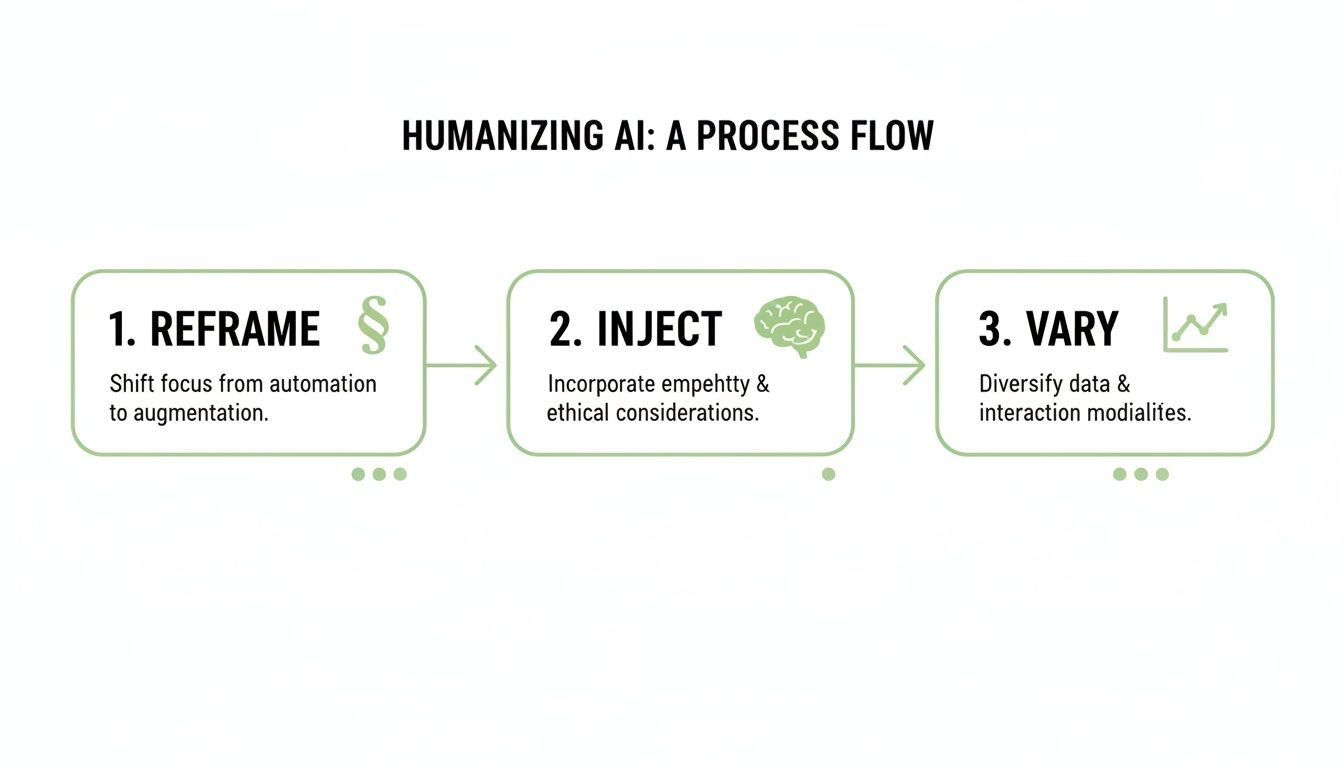
As you can see, it's about much more than just swapping out words. Real humanization comes from restructuring the core ideas, injecting personal insight, and creating a varied, interesting style.
Prepping Your Draft for the Humanizer
You've heard it before: garbage in, garbage out. This couldn't be more true here. The quality of your initial AI-generated text directly shapes what the humanizer can do with it. Before you even think about pasting your content into a tool like HumanText.pro, spend five minutes prepping it.
First, quickly scan for any obvious factual errors or really awkward phrasing. AI can still get things wrong, and there's no point asking a humanizer to polish a sentence that's factually incorrect. Cleaning this up first lets the tool focus on its real job: improving the flow and natural language.
Next, break up those massive, dense paragraphs. Seriously, just hitting the "Enter" key a few times gives the tool much better raw material to work with. It's a tiny effort that leads to a more nuanced and readable final product.
Performing the Final Manual Polish
Alright, the humanizer has worked its magic. Now it's your turn. What you have now is a much-improved first draft, but it’s still missing your unique signature. This is where you elevate the text from merely "undetectable" to genuinely compelling.
My number one tip? Read the whole thing out loud. It feels a bit strange at first, but it’s the single most effective way to catch phrases that still sound slightly off. If you stumble while reading a sentence, your audience will definitely struggle with it.
The real goal of this final polish isn't just to bypass Copyleaks; it's to make the text sound like it came from you. Weave in a personal anecdote, a strong opinion, or a unique analogy that only you could come up with. That's the ultimate human fingerprint.
A Checklist for Evaluating the Output
Once you've added your personal flair, run the text through a quick quality check. Don't just look for AI patterns—evaluate it as a piece of writing. Here’s a simple checklist I use for my final review.
- Does it still have the right tone? The content should match its purpose, whether it's a formal academic paper or a casual blog post. Make sure the humanizer didn't accidentally make your serious essay sound too chatty.
- Are all the facts still accurate? Did the tool inadvertently change key facts, names, or numbers? I always double-check every data point to make sure nothing got twisted in the rewrite.
- Is the meaning still crystal clear? Sometimes, restructuring sentences can muddy the waters. If a sentence has become confusing, rewrite it for clarity.
- Have I added my unique voice? This is the most important step. Your perspective is what makes the content truly human. Have you put your own stamp on it?
Where’s the Ethical Line with AI Writing?
In the explosion of AI tools, it’s easy to feel like you’re in a moral gray area. When does using AI as a smart assistant cross the line into academic dishonesty or misrepresentation?
Let’s tackle this head-on. The answer boils down to two things: intent and execution.
Using an AI to brainstorm an outline, polish a clunky sentence, or suggest a better word is just an advanced form of editing. It's really no different than cracking open a thesaurus or running your text through a grammar checker. You're using a tool to improve your own work.
The ethical line gets crossed when the AI stops being a tool and starts being a substitute for your own thinking. Submitting an essay that was 100% machine-generated, without any significant input or original thought from you, shifts from assistance to outright deception. This is what most university integrity policies are designed to prevent.
The Goal Is Augmentation, Not Deception
Think of AI as a hyper-intelligent collaborator, not a ghostwriter. Its job is to enhance your skills, not to cover up a lack of them.
When you approach AI with this mindset, the ethical picture becomes much clearer. The goal isn't to trick a detector like Copyleaks; it's to produce a final piece of work that is a genuine reflection of your knowledge and your unique voice.
The core principle is simple: the final work must be substantively your own. If the AI-assisted text truly represents your ideas and perspective—just expressed more clearly—you are on solid ethical ground.
This distinction is crucial in all kinds of writing. For example, when exploring AI social media content creation, the aim is to produce authentic, engaging material, even with a machine's help. The principles of originality and owning your voice apply everywhere.
Practical Guidelines for Staying Ethical
To make sure you stay on the right side of academic and professional standards, it helps to set some personal ground rules. These tips will help you use AI writing tools as an ethical partner.
- Use AI for Ideation, Not Creation. Practical Example: Prompt an AI with "Generate five potential blog post titles about the ethics of AI in marketing." Use these titles to inspire your own unique angle, rather than asking it to write the full article.
- Focus on Refining Your Own Drafts. This is a game-changer. Paste sentences or paragraphs you've already written into an AI tool and ask for feedback. Prompt it to "make this sound more professional" or "simplify this complex idea." This keeps your core thoughts completely intact.
- Always Add Your Unique Insight. The most human part of any text is personal perspective. Weave in your own opinions, experiences, or specific examples that an AI could never come up with. This is your ultimate ethical safeguard.
- Fact-Check Everything. AI models are notorious for making things up, a phenomenon known as "hallucination." By verifying every statistic, quote, and claim, you're taking full ownership of the content's accuracy—a cornerstone of academic and professional responsibility.
Ultimately, navigating this new landscape is about maintaining your intellectual honesty. The real goal is to make your AI-assisted work a better, sharper version of your own thinking, not a replacement for it.
Common Questions About Humanizing for Copyleaks
Even with a solid workflow, some practical questions always pop up when you're trying to get AI-generated text over the finish line. Let's tackle the most common ones I hear, clearing up the process and sticking to the ethical strategies we've talked about.
Can Copyleaks Actually Detect Models Like ChatGPT-4 and Google Gemini?
Absolutely. Copyleaks and other top-tier detectors are in a constant state of evolution. They're specifically trained to pick up on the statistical fingerprints left by the latest large language models, including GPT-4, Gemini, and Claude.
They look at things like sentence predictability (what experts call perplexity) and the uniformity of sentence structures (known as burstiness). This is exactly why simply running your text through a basic paraphrasing tool is a recipe for failure. You have to fundamentally change the text's DNA—its structure, rhythm, and voice—not just swap out a few words.
Is Using an AI Humanizer Tool Considered Cheating?
This is the big one, and the answer comes down to intent and the specific rules you're operating under. If you're using a humanizer to refine a draft you’ve already worked on, smooth out the language, and help inject your own style, it’s really just an advanced editing tool. Think of it like a super-powered grammar checker.
The ethical line gets crossed when the tool becomes a substitute for your own critical thinking and effort, not a supplement to it. If you're trying to pass off work that isn't substantively yours or you're breaking a clear academic integrity policy, then yes, it’s cheating.
What’s the Single Best Way to Make AI Text Sound Human?
Everyone looks for a silver bullet, but it's less about a single "technique" and more about a mindset shift. While mixing up sentence lengths and vocabulary is a great start, the most powerful thing you can do is inject your genuine, un-promptable perspective.
AI models are pattern-matching machines; they have no lived experiences, no quirky opinions, and no unique memories. Adding those is the fastest way to break the robotic mold. Try adding just one of these:
- A specific, real-world example from your own knowledge.
- A quick, relevant personal story that proves a point.
- A strong, unique opinion that an AI would never come up with on its own.
These are the elements that make writing yours. Think of the AI detection world like a cat-and-mouse game between cybersecurity experts and hackers. Any static trick to "bypass" a detector is temporary by nature. The only sustainable strategy is to focus on creating genuinely human-sounding content by blending your authentic ideas with varied writing structures. Often, this is where dedicated humanizer platforms can give you an edge, as they adapt to the latest detection updates. You can discover more AI statistics and trends to get a better sense of this dynamic environment.
Ready to turn your AI drafts into content that sounds authentically human? HumanText.pro uses advanced linguistic modeling to help you rewrite robotic text, producing high-quality work that reads naturally and passes detection. Give it a try and see the difference for yourself at https://humantext.pro.
Ready to transform your AI-generated content into natural, human-like writing? Humantext.pro instantly refines your text, ensuring it reads naturally and authentically. Try our free AI humanizer today →
Related Articles
10 Websites That Humanize AI Writing in 2026
Compare 10 websites that humanize ai writing by features, pricing, privacy, language support, and best use cases for writers, agencies, and educators.
AI Generated Text Detection: How It Actually Works
Explore AI generated text detection methods, accuracy limits, and how to choose the right tool for publishers, educators, and compliance workflows.
AI Humanizer Free Trial: Your Step-by-Step Playbook
Try an AI humanizer free trial the smart way. Learn what to expect, how to test quality, and how to choose the right paid plan for your workflow.

