How to Bypass Originality AI And Humanize Your Content
Learn how to bypass Originality AI with proven techniques. Our guide shows you how to humanize AI text to avoid detection and ensure your content passes.
The most effective way to handle a tool like Originality.AI is to "humanize" your text. This means taking an AI-generated draft and thoroughly rewriting it to introduce varied sentence structures, incorporate unique vocabulary, and add your own personal insights. It’s a process of either manual editing for nuance and flow or, in some cases, using an AI humanizer tool to automatically rework the writing patterns that detectors are trained to flag.
The Reality of Flawed AI Detection
Let's be clear: AI-generated content is a massive advantage for writers, marketers, and students. But it comes with a major catch—flawed AI detectors. These tools are designed to spot machine-written text, but they often end up penalizing legitimate, AI-assisted work.
Imagine a busy marketer using an AI assistant to create a first draft for a blog post. They spend hours editing it, weaving in their own expertise and brand voice, only to see it flagged as 100% AI. Suddenly, that article is at risk of being de-ranked by search engines. Scenarios like this are happening every day.
The problem is that these detectors don’t measure truth, quality, or value. They measure patterns. They’re looking for the predictable sentence structures and common word choices that large language models tend to produce. This creates a frustrating trap where even heavily edited, high-quality content can trigger a false positive, putting your hard work in jeopardy.
Why "Humanization" Is a Necessary Skill
This guide isn't about promoting academic dishonesty or churning out spam. It's about a crucial strategy for modern writers: humanization.
Humanization is the art of refining AI-assisted writing into high-quality, undetectable content that reflects genuine human nuance. It’s about taking the raw efficiency of AI and layering it with the creativity, voice, and unique perspective that only a person can provide.
This approach is essential for anyone using AI tools responsibly:
- Students who use AI for brainstorming but write their own final essays.
- Content creators who rely on AI for initial outlines and research.
- SEO specialists who need to produce high-volume content without getting penalized.
Focusing on humanization isn't about trying to cheat the system. It's about ensuring the system doesn't unfairly cheat you out of credit for your unique contributions and diligent editing.
Moving Beyond Guesswork
The goal here is to navigate this new landscape effectively. To do that, you need a practical, repeatable method to get past Originality.AI and other detectors without gutting the quality of your work. This means learning how these detectors think, what they look for, and exactly how to edit your text to avoid their algorithmic tripwires.
This guide provides that clear roadmap. We’ll break down the specific mechanics of AI detection, demonstrate actionable manual editing techniques, and introduce workflows that help you produce authentic, effective content. Think of it as your practical guide to ensuring your work is judged on its merit, not on the tools you used to create it.
How AI Detectors Actually Work
If you want to get past AI detection, you first have to understand your opponent. AI detectors aren't magic—they're just highly sophisticated pattern-recognition tools. They’ve been trained on enormous libraries of text, learning to spot the subtle, statistical fingerprints that machine-generated writing leaves behind.
These tools don’t care if your writing is good or bad, true or false. They’re simply hunting for tells. To do this, services like Originality.ai or GPTZero analyze two core linguistic traits: perplexity and burstiness. Getting a feel for these two concepts is the difference between blindly swapping words and editing with purpose.
The Predictability Problem: Perplexity
Perplexity is just a fancy word for how predictable your writing is. You can think of it as a "surprise" score. Human writing is naturally a bit chaotic and surprising. We use weird analogies, mix common words with obscure ones, and generally keep things interesting.
AI models, however, are built to pick the most statistically likely next word. This makes their output sound logical and grammatically clean, but it's also incredibly safe. The word choices are expected, which results in a low perplexity score—a massive red flag for any detector.
Practical Example: An AI might generate: "The economic downturn had a significant negative impact on the global financial markets." It's technically perfect but boring. A human might write: "The economy's nosedive sent shockwaves through global markets, leaving investors scrambling for cover." The second version is far less predictable and has a much higher perplexity.
The Rhythm of Writing: Burstiness
Burstiness is all about the rhythm and structure of your sentences. Humans write in fits and starts. We’ll follow a long, winding sentence with a short, punchy one for emphasis. This creates a natural cadence that machines find hard to mimic.
AI-generated text, by contrast, often sounds monotonous. The sentences tend to be of similar length and structure, creating a uniform, robotic flow. This lack of variation, or low burstiness, is another dead giveaway for detection software.
The diagram below maps out this entire ecosystem, showing how AI writers, human editors, and detection tools all interact.
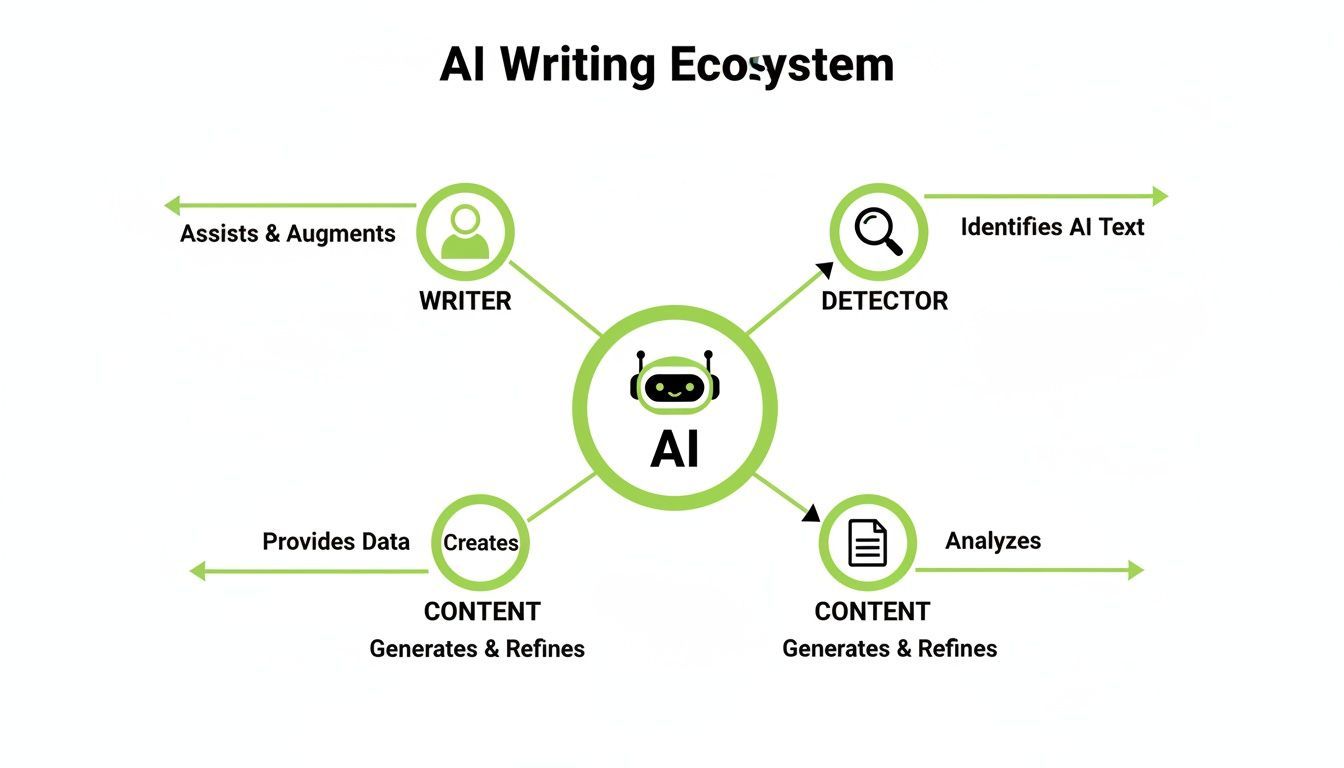
As you can see, the patterns in the content are central to this whole game, influencing everything from creation to detection.
Why Detectors Are Not Foolproof
Here's the kicker: understanding these patterns is your advantage because AI detectors are notoriously unreliable. Between 2023 and 2025, these tools became a staple in academia and publishing, but their accuracy is still a huge problem.
In one 2026 benchmark of 30 major detectors, only two managed to correctly identify 100% of both human and AI text. Many popular tools only caught 44–56% of AI content while still flagging genuine human writing as machine-generated. This gap between their claims and reality is what makes "bypass originality AI" workflows so necessary for many writers.
This imperfection means even your own original work, or heavily edited AI drafts, can get unfairly flagged. Exploring how to navigate this is crucial, and you can learn more by checking out our guide on whether undetectable AI really works.
To help you start editing with a clearer goal, here's a direct comparison of the patterns detectors are looking for versus the hallmarks of authentic human writing.
AI Writing Patterns vs. Human Writing Patterns
This table breaks down the core differences AI detectors are trained to spot. Use it as a mental checklist when you're editing an AI draft.
| Characteristic | Typical AI-Generated Text | Authentic Human Writing |
|---|---|---|
| Perplexity | Low and predictable. Uses common, high-frequency words and phrases. | High and varied. Mixes simple and complex vocabulary, uses idioms, and creates surprise. |
| Burstiness | Low and uniform. Sentence lengths and structures are consistently similar. | High and dynamic. Varies between long, descriptive sentences and short, impactful ones. |
| Vocabulary | Often repeats specific "AI-favored" words (e.g., "delve," "meticulous," "harness"). | Uses a richer, more diverse vocabulary, including slang, jargon, and personal anecdotes. |
| Flow & Tone | Overly formal, objective, and lacks a distinct personal voice or emotion. | Can be conversational, persuasive, or emotional. Contains a unique authorial voice. |
By focusing your edits on transforming the AI patterns in the middle column into the human patterns on the right, you move from simple paraphrasing to true humanization. You're not just changing words; you're fundamentally altering the statistical foundation of the text.
Getting Your Hands Dirty: Manual Edits to Humanize AI Content
Knowing what AI detectors look for is one thing. Actually rolling up your sleeves to dismantle those patterns is where the real work begins. This is how you transform robotic, predictable text into something with a genuine human heartbeat.
We're going beyond generic advice like "add your personal voice." Instead, we'll focus on repeatable, tactical methods you can use right now to make your content invisible to platforms like Originality AI.
Mastering these hands-on skills gives you total control over the final draft. You can preserve the core message while completely changing the underlying structure that triggers detection, ensuring your AI-assisted work is never unfairly penalized.
Master Sentence Fusion and Fission
One of the quickest ways to improve "burstiness"—that natural variation in sentence length—is a technique I call Sentence Fusion and Fission. It's a simple idea: find paragraphs where all the sentences are roughly the same length and start mixing things up.
AI loves a steady rhythm of medium-length, declarative sentences. Your job is to break that rhythm.
- Fusion (Combining Sentences): Look for short, related sentences. Merge them using conjunctions (and, but, so), semicolons, or by turning one into a subordinate clause.
- Fission (Splitting Sentences): Find those long, complex sentences and chop them into two or more shorter, punchier statements for impact.
Here's what this looks like in practice:
AI-Generated Text:
The company launched a new marketing campaign. The campaign was intended to increase brand awareness. It targeted a younger demographic with social media ads. The results of the campaign were successful.
Humanized with Fusion & Fission:
Aiming to boost brand awareness, the company launched a new marketing campaign. It proved to be a success, targeting a younger demographic with social media ads.
See how we combined four choppy sentences into two more dynamic ones? That simple edit immediately makes the text feel less robotic and improves its flow.
Execute an Active Voice Overhaul
AI models often lean on the passive voice because it sounds formal and objective. The problem? It also makes writing feel weak, distant, and academic. An Active Voice Overhaul is your chance to hunt down those passive constructions and flip them into something more direct and engaging.
The trick is to find sentences where the subject is being acted upon, rather than doing the action. Keep an eye out for phrases like "was done by" or "is considered to be."
Passive AI Example:
The report was written by the research team, and the findings were presented by the project manager.
Active Voice Overhaul:
The research team wrote the report, and the project manager presented the findings.
This small shift makes the writing feel more confident and is much easier for a reader to follow. It replaces the stuffy tone common in AI drafts with a more direct, human style. For a deeper look at this, check out our full guide on how to humanize AI-generated text.
Weave In Idioms and Analogies
AI-generated text is almost always painfully literal. It avoids figures of speech, idioms, and analogies because they're tricky to use correctly. For a human editor, this is a golden opportunity.
Sprinkling in a few culturally relevant idioms or a clever analogy is a fantastic way to inject personality and boost the text's "perplexity"—its unpredictability. An AI would never come up with a phrase like "it's not rocket science" or "let's not beat around the bush."
Actionable Example: Instead of the AI saying, "The task was very difficult," you might write, "Getting that server back online was like trying to nail jello to a wall." This creates a memorable mental image and adds a layer of originality that detectors just aren't trained to expect.
A word of caution: don't overdo it. Too many idioms can make your writing sound cheesy. But one or two well-placed phrases per section can be incredibly effective.
Simplify and Specify Your Language
AI has a bad habit of using overly formal words when a simpler one would do. It will say "utilize" instead of "use," or "commence" instead of "start." It also loves vague generalities.
The Simplify and Specify method has two parts:
- Simplify: Hunt down unnecessarily complex words and swap them for their simpler, more common synonyms.
- Specify: Replace vague statements with concrete details, hard numbers, or specific examples.
AI's Vague Language:
The new software provides a multitude of benefits for businesses, substantially enhancing operational efficiency.
Simplified & Specified Text:
The new software helps businesses cut project delivery times by up to 30%. It automates daily timesheets and flags budget overruns in real-time.
By replacing "multitude of benefits" with a specific stat (30%) and explaining exactly how it improves efficiency, you make the text more credible, valuable, and human. When you combine these manual techniques, you create a layered defense against detection, turning a generic AI draft into a polished, authentic piece of content.
Using AI Humanizers for Speed and Scale
Manual editing is the gold standard for refining an AI draft, but let's be honest—it takes a lot of time. When you're staring down a tight deadline or have a mountain of content to get through, spending hours massaging every sentence just isn't practical.
This is exactly where AI humanizer tools come in. They perfectly bridge the gap between a raw AI draft and polished, human-sounding content that’s ready to publish.
For anyone creating content in bulk, these tools are a lifesaver. Picture a content marketer who needs to crank out five solid SEO blog posts in a single day. Manually rewriting each one would be a nightmare. A modern, accelerated workflow is the only way to get it done.
This approach lets you keep up the pace without sacrificing the subtle touches needed to bypass Originality AI and other advanced detectors. It's a smart strategy for anyone who needs to publish confidently and quickly.
The Modern Humanizer Workflow
An efficient workflow using a humanizer is surprisingly simple. It can turn a multi-hour editing slog into a task that takes just a few minutes.
Here’s a practical, step-by-step example:
- Get Your First Draft: Start by having an LLM like ChatGPT or Claude generate a solid draft based on your outline and research. Let's say you're writing a product description.
- Paste and Analyze: Copy the entire AI-generated description and pop it into a humanizer tool. The AI draft might say: "Our new CRM is a robust solution designed to optimize customer interactions and streamline sales processes."
- Humanize the Text: With a single click, the tool gets to work rewriting the content. It might produce: "Tired of juggling customer emails and sales notes? Our new CRM simplifies everything, so you can focus on building relationships and closing deals faster."
- Quick Review: The final step is a quick once-over by you. Check that the new text aligns with your brand's voice and add any final personal touches. The entire process takes less than a minute.
This process is a massive accelerator. It frees you up to focus on big-picture strategy and final polish instead of getting bogged down in tedious sentence-level edits.
The real magic of an AI humanizer is its ability to automatically mimic human writing patterns. It intelligently varies sentence length, diversifies word choice, and adjusts the rhythm to erase the predictable, robotic signatures that AI detectors are trained to spot.
It's More Than Just Paraphrasing
It's really important to understand that a good humanizer does far more than a basic paraphrasing tool. A simple paraphraser just swaps words for synonyms, which often results in clunky, unnatural phrasing.
A true humanizer, on the other hand, analyzes the text on a much deeper level. If you're curious about the mechanics, you can dive deeper into how an AI humanizer tool actually works.
These platforms are trained on massive datasets of real human writing, so they understand the nuances of style, tone, and rhythm. They specifically adjust the text's perplexity and burstiness—the very metrics AI detectors use for their analysis. The result is content that preserves the original meaning but is statistically indistinguishable from something a person wrote from scratch.
This is incredibly useful for any task that demands a quick turnaround without sacrificing authenticity. For instance, if you’re using AI-powered LinkedIn post generators, running the output through a humanizer can be the final step to make sure the posts sound genuinely personal and engaging, not formulaic. By making these tools part of your workflow, you can scale your content output without raising red flags.
How to Check If Your Humanization Efforts Actually Worked
So you've spent time carefully editing your AI draft, or maybe you ran it through a humanizer tool. How do you know if you actually succeeded? You need proof.
Just crossing your fingers and hoping your content will pass is a huge gamble. An even bigger mistake I see people make is relying on a single AI detector for the final verdict. That's a recipe for disaster.
Different detectors use slightly different algorithms and training data. This means one tool might give you a thumbs-up while another flags your work as 100% AI-generated. To confidently get past detectors like Originality.ai, you need a much smarter, data-backed approach. The only real solution is a multi-checker testing strategy.
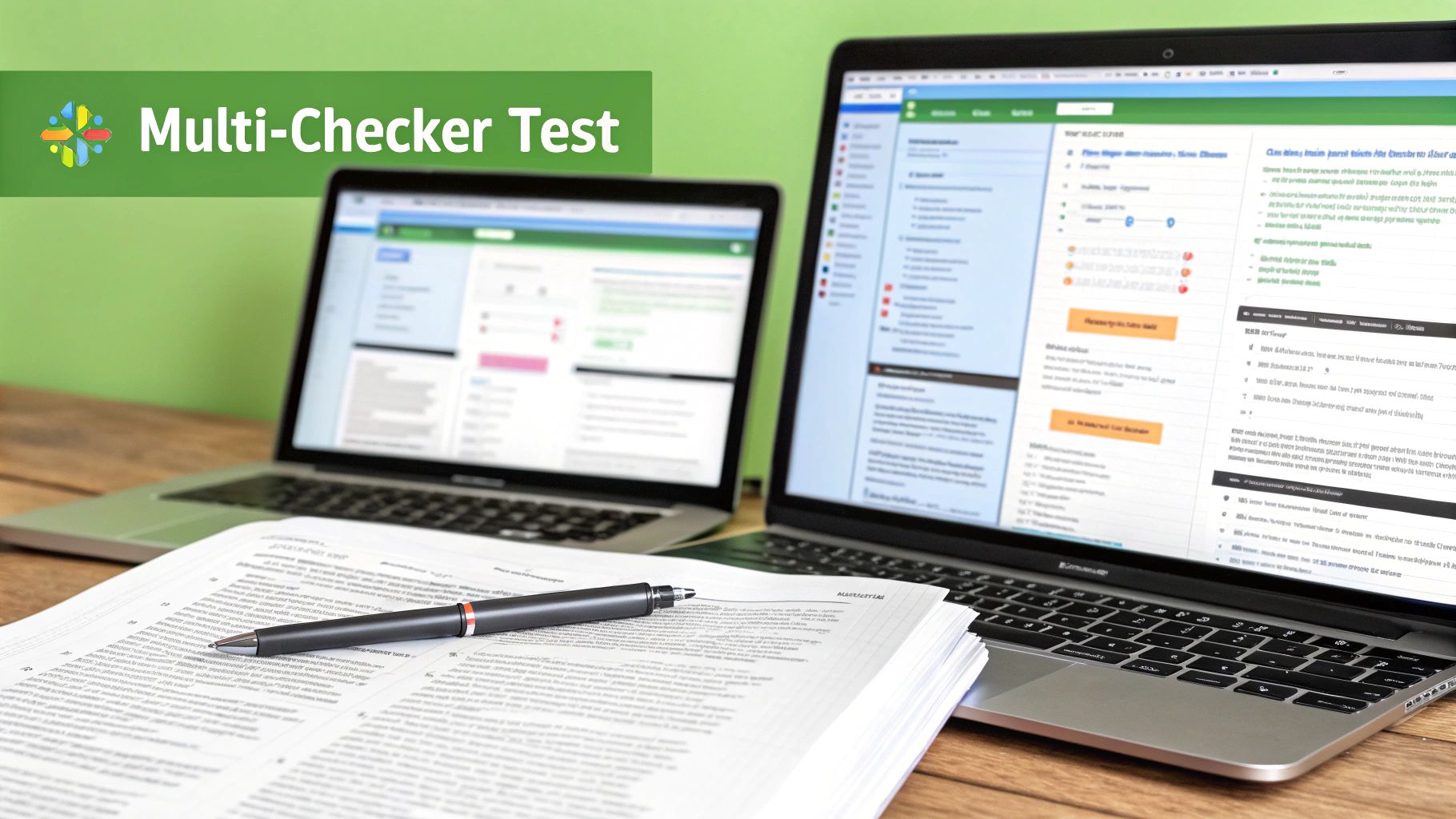
This process takes the anxiety and guesswork out of the equation. It gives you cold, hard data to confirm your humanization efforts paid off before you hit publish or turn in your assignment.
Building Your Testing Gauntlet
The core idea is simple: don't put all your faith in one opinion. Instead, run your final, polished text through a small gauntlet of at least three reputable and distinct AI checkers. This triangulation method gives you a much more reliable picture of how various systems will perceive your content.
Here's a solid starting lineup for your testing gauntlet:
- Originality.ai: You have to test against the tool you’re specifically trying to bypass. Its analysis is known for being stricter, so getting a pass here is a very strong signal.
- GPTZero: This is a popular and widely used detector, especially in academic circles. It gives you a good baseline for general detection capabilities.
- ZeroGPT: Another free and easy-to-use option that provides a useful third data point to either confirm or question your other results.
By cross-referencing these tools, you protect yourself from the quirks and potential false positives of any single platform. Think of it like getting a second medical opinion—you want to confirm the diagnosis before you act.
How to Read Your Test Results
Once you have your scores, what do they actually mean? It's pretty rare to get identical results across the board. You’ll almost certainly see some variation, and learning how to interpret these sometimes-conflicting scores is the real key.
Actionable Insight: The goal isn't necessarily a perfect 0% AI score everywhere, though that's obviously ideal. The real objective is to consistently fall below a low-risk threshold across all the detectors you use. A safe target is to get a score below 10% AI probability on every single platform.
If two out of three checkers give you a very low AI score (like under 10%) while one flags it a bit higher (say, 30-40%), you're probably in a safe zone.
However, if even one tool flags your content as 80% or 90% AI, that’s a major red flag. It means a significant pattern was detected, and you absolutely should go back to that part of your text for another round of edits.
In the quest to make AI content undetectable, some people also use a specialized AI bypasser tool designed to rewrite text specifically to evade these systems. No matter which method you use, this multi-check validation is the final, essential step to make sure your workflow is effective and your content is truly ready.
Walking the Ethical Tightrope of AI Writing
Using tools to humanize an AI draft walks a fine line between smart efficiency and outright cheating. Knowing exactly where that line is drawn is the key to protecting your academic or professional reputation. The real difference comes down to your intent and who truly owns the final work.
It’s one thing to leverage AI as an assistant to brainstorm ideas, smash through writer's block, or sketch out a rough first draft. In that scenario, AI is just a tool, no different from a thesaurus or a grammar checker. The final piece is still fundamentally yours—shaped by your insights, critical thinking, and heavy editing.
Academic Integrity and Professional Standards
The line gets crossed when you use AI to generate a complete piece of work and then pass it off as your own. That’s just a high-tech form of plagiarism, plain and simple.
Every university has a strict honor code, and every publisher has content guidelines. Violating them can bring serious consequences, from a failing grade to getting fired or facing legal trouble.
Before you use any AI tool for a graded assignment or a professional publication, you absolutely must:
- Check your institution's policy: Many universities now have specific rules for AI. Claiming you didn't know won't save you.
- Understand publisher guidelines: Reputable publications often demand you disclose any AI assistance and will reject content that isn't substantially original.
- Prioritize your own voice: The final work has to reflect your thoughts and analytical skills. If you couldn't stand up and defend the ideas as your own, you've gone too far.
Responsible Use vs. Blatant Misuse
The goal of "humanizing" should be to make sure your genuinely refined, AI-assisted work isn't unfairly flagged by flawed detectors. It's about getting credit for your own intellectual labor, not about tricking someone into thinking a machine's work is yours.
When you use AI responsibly, you are the author; the AI is just the co-pilot.
Practical Insight: This ethical puzzle sits at the heart of our current tech moment. The focus should always be on using AI to enhance human creativity and intellect, not to sidestep personal integrity and accountability.
Global statistics on AI misuse show that detection and bypass tools are locked in a constant arms race. While detectors are needed to curb abuse, their guesswork nature can wrongly penalize the honest use of tools like ChatGPT. This is where services like HumanText.pro come in—they focus on improving the text’s readability and preserving your original intent, not just crudely manipulating words to fool a machine. This helps you stay on the right side of institutional policies.
You can find more insights on the alarming growth of AI-driven fraud on sumsub.com.
Ultimately, the responsibility is yours. Use AI to augment your abilities, fact-check every single claim, and inject every piece with your unique perspective. That’s the only ethical—and sustainable—way forward.
Common Questions About AI Detection
Navigating the world of AI content and detection can feel like walking through a minefield. Let's clear up some of the most common questions people have when trying to get their work past tools like Originality AI.
Are AI Detectors Like Originality AI Ever 100% Accurate?
Absolutely not. AI detectors are not, and were never designed to be, 100% infallible. Independent tests have consistently shown they have some serious limitations.
These tools can, and often do, flag completely human-written content as AI-generated. This is what's known as a false positive, and it's a huge problem. On the flip side, they can also miss machine-written text, especially if it's been edited. The accuracy swings wildly depending on the AI model that wrote the text and how much a human has refined it. This is exactly why you should never trust a single detector's score as the final verdict.
Is It Unethical to Bypass AI Detection?
This is the big question, and the answer comes down to one thing: intent. The ethics of bypassing AI detection hinge entirely on why you're doing it and the rules you're playing by.
If you generate an entire essay with AI and slap your name on it, submitting it as your own original thought—that's clear-cut academic dishonesty. No gray area there.
But what if you're using AI as a collaborator? For brainstorming, outlining, or getting a rough first draft on the page, which you then substantially rewrite with your own ideas, analysis, and voice? That’s a legitimate and increasingly common workflow for professionals everywhere.
Actionable Advice: The golden rule is simple: follow the specific guidelines of your institution or publisher. Humanization tools are meant to ensure your final, human-refined work isn’t unfairly punished by a flawed detector, not to help you cheat.
What’s the Single Best Way to Make AI Text Undectable?
There's no magic bullet, and a layered approach is always your best bet. But if I had to pick the single most powerful technique, it's this: vary your sentence structure and length.
AI models tend to fall into a monotonous, predictable rhythm. They churn out sentences that are all roughly the same length and structure, which feels robotic.
By consciously breaking up those long, winding sentences and combining short, punchy ones, you introduce a more dynamic, natural flow. This variety is what experts call "burstiness," and it's a key signal AI detectors look for. Master this one skill, and you’ll be well on your way to disrupting the very patterns these tools are trained to spot.
Ready to see how easy it is to polish your AI-assisted content? HumanText.pro can transform a robotic draft into natural, human-sounding text in seconds. Try our AI humanizer for free and see the difference for yourself.
Ready to transform your AI-generated content into natural, human-like writing? Humantext.pro instantly refines your text, ensuring it reads naturally and authentically. Try our free AI humanizer today →
Related Articles
10 Websites That Humanize AI Writing in 2026
Compare 10 websites that humanize ai writing by features, pricing, privacy, language support, and best use cases for writers, agencies, and educators.
AI Generated Text Detection: How It Actually Works
Explore AI generated text detection methods, accuracy limits, and how to choose the right tool for publishers, educators, and compliance workflows.
AI Humanizer Free Trial: Your Step-by-Step Playbook
Try an AI humanizer free trial the smart way. Learn what to expect, how to test quality, and how to choose the right paid plan for your workflow.

