How to Humanize AI Content for Better Engagement
Discover how to humanize AI content with proven techniques. Turn robotic text into authentic, engaging content that connects with readers and ranks higher.
Humanizing AI-generated content isn't just about cleaning up a few awkward phrases. It's about injecting your unique perspective, telling personal stories, and rigorously fact-checking what the machine spits out. This is how you transform a generic, robotic draft into something that genuinely represents your brand and connects with people.
By adding this human touch, you close the gap between automated speed and the authentic connection readers crave.
Why Your AI Content Is Not Connecting with Readers

Let's be real—you can spot raw AI text from a mile away. It often feels sterile and repetitive, completely lacking the spark that makes an article stick in your memory. While AI is a fantastic assistant for churning out outlines and first drafts at lightning speed, its initial output almost never resonates on a human level.
This disconnect happens because AI models are trained on massive datasets to recognize patterns, not to have life experiences. The result is content that might be logically sound but is almost always emotionally empty.
The Missing Human Element
So, what’s actually missing? It’s the stuff that makes content feel real: genuine personality, emotional depth, and a unique perspective. AI just can’t replicate these nuances because it can't:
- Share personal anecdotes: An AI has never failed at a project and learned a valuable lesson from it. But that's often the most compelling part of a blog post.
- Express genuine opinions: It can summarize common viewpoints from its training data, but it can’t form its own unique, experience-based perspective.
- Grasp subtle cultural context: AI often misses the boat on irony, inside jokes, or specific cultural references that make writing feel authentic and relatable.
Without these crucial ingredients, the content is just a collection of facts instead of a compelling story. Readers don't just want information; they want to feel a connection with the writer and the brand. Our comprehensive guide on how to turn AI writing into human text dives deeper into bridging this exact gap.
The Tangible Business Benefits of a Human Touch
Skipping the humanization step is a huge missed opportunity. Adding that human layer does more than just make your content "sound better"—it delivers real, measurable business results. By 2025, it's estimated that over 60% of all online content will be created or assisted by AI. In a sea of robotic articles, authenticity becomes your sharpest competitive edge.
To put it in perspective, let’s compare the two approaches side-by-side.
AI Content vs Humanized AI Content at a Glance
This table breaks down the key differences between leaving your AI content as-is versus taking the time to refine it.
| Attribute | Raw AI Content | Humanized AI Content |
|---|---|---|
| Tone & Voice | Generic, formal, often inconsistent | Authentic, consistent, reflects brand personality |
| Engagement | Low time-on-page, high bounce rates | Higher engagement, longer reading times |
| Credibility | Lacks authority, feels untrustworthy | Builds trust through E-E-A-T signals |
| SEO Performance | Risks being flagged as unhelpful content | Aligns with "helpful content" updates, ranks better |
| Originality | Often rehashes existing information | Includes unique insights, stories, and opinions |
| Readability | Can be repetitive and unnaturally structured | Flows naturally with varied sentence structure |
As you can see, the effort to humanize pays off in every key area, from reader trust to search engine performance.
Humanized AI content isn't just a stylistic choice; it's a strategic imperative. Data shows it can double engagement rates, reduce bounce rates by 25%, and increase time on page by 35%. Users simply trust and spend more time with content that feels real.
These engagement signals are gold for your SEO. Search engines are getting smarter, prioritizing content that demonstrates experience, expertise, authoritativeness, and trustworthiness (E-E-A-T). A robotic, soulless article completely fails this test. Humanizing your AI content directly strengthens your ability to build reader trust and, as a result, climb the search rankings.
Crafting Prompts That Generate Better First Drafts

The secret to spending less time editing is starting with a better first draft. Simple, right? But it means we have to move beyond lazy commands like "write a blog post about X."
Mastering how to humanize AI content actually begins the moment you write your first instruction. You need to stop thinking of your prompt as a simple request and start treating it as a detailed creative brief for your AI assistant.
By front-loading your effort and giving the AI clear, specific, and layered instructions, you guide it toward generating text that already has the seeds of personality and style baked in. This dramatically cuts down on the heavy lifting you'll have to do later. The goal is to get a draft that's already 80% of the way there, not some generic blob of text you have to wrestle into shape.
Adopt a Persona with Role-Playing
One of the quickest ways to inject a human-like tone is to make the AI play a character. Instead of just asking for content, tell the AI who it should be while writing. It's a simple shift in framing that changes everything.
For instance, a generic prompt gets you generic content. A role-playing prompt gets you a specific voice.
"Act as a seasoned marketing strategist with 15 years of experience advising SaaS startups. You have a friendly, encouraging, and slightly witty tone. Write an introduction to a blog post explaining the common pitfalls of early-stage content marketing."
This prompt gives the AI a personality to embody. Suddenly, it has a backstory, a level of expertise, and a voice to mimic. The result is a much more nuanced and engaging first draft than a bland command could ever produce.
Layer in Specific Stylistic Instructions
Beyond the persona, you have to give the AI concrete rules for its writing style. Left to its own devices, an AI will often default to predictable patterns—think complex vocabulary and stuffy, academic sentence structures. You can fight this by setting explicit stylistic guardrails right in the prompt.
Try adding instructions like these to your prompts:
- Write at an 8th-grade reading level. This forces the AI to use simpler language and skip the jargon.
- Vary sentence length. Tell it to mix short, punchy sentences with longer, more descriptive ones to create a natural rhythm.
- Use active voice. This makes the writing more direct, confident, and much easier to read.
- Incorporate rhetorical questions. This is a classic human writing trick to engage the reader directly.
By layering these instructions, you're essentially programming the AI to sidestep its own worst habits and adopt the traits of strong, human-centric writing from the get-go.
Provide Concrete Examples and Frameworks
AI learns from examples. If you want it to write in a specific format or style, the best thing you can do is show it exactly what you mean. This is way more effective than just describing it.
Let's say you want a blog post introduction that follows the classic "Problem-Agitate-Solution" (PAS) framework. Your prompt could look something like this:
"Write a 150-word blog post introduction about the challenges of remote team communication. Follow the PAS framework. For example: Start by stating the problem (e.g., 'Remote teams often feel disconnected.'). Then, agitate the problem (e.g., 'This leads to missed deadlines and declining morale.'). Finally, hint at the solution that the blog post will provide (e.g., 'But what if a few simple communication habits could change everything?')."
By providing a clear framework and a mini-example, you remove all the guesswork. The AI has a blueprint to follow, which leads to a structured and effective output that needs minimal tweaking. This level of detail is the key to crafting prompts that genuinely help humanize AI content before you even lay a finger on the edit button.
Your Hands-On Guide to Editing AI-Generated Text
Once your AI assistant spits out that first draft, the real work begins. This is where you step in to transform a structurally sound but soulless piece of text into something that actually connects with a reader. Think of yourself as a sculptor. The AI gives you a block of marble—the basic shape is there, but the artistry comes from your hands.
Skipping this editing phase is non-negotiable if you're serious about creating high-quality, memorable content. It’s the difference between an article that gets a click and one that earns a bookmark, a share, and a loyal reader.
Inject Your Unique Perspective and Stories
The most powerful tool you have for humanizing content is your own experience. An AI can scrape the internet and summarize information, but it can’t share a personal story, a hard-won lesson, or a unique opinion based on years in your field. This is your biggest advantage.
Scan the draft for opportunities to add that personal touch. Did the AI mention a common industry challenge? Don't just let that statement hang there. Jump in with a brief anecdote about how you navigated that exact problem. This turns an abstract concept into a relatable, memorable narrative.
Key Takeaway: AI provides the information; you provide the insight. Your personal stories, opinions, and real-world examples are what build trust and make your content impossible to replicate.
These additions don’t need to be long-winded. A simple sentence starting with, "In my experience..." or "I once worked with a client who..." can instantly inject authenticity and show readers there's a real, experienced human behind the words. For a deeper dive, check out our guide on how to convert AI text into a human voice.
Refine the Rhythm and Flow
AI-generated text often has a monotonous, almost hypnotic, sentence structure. It tends to string together a series of medium-length, grammatically correct sentences that are an absolute slog to read. Your job is to break up that robotic rhythm.
The best trick? Read the content out loud. It’s the fastest way to catch awkward phrasing and repetitive sentence patterns.
- Vary Your Sentence Length: Mix short, punchy sentences with longer, more descriptive ones. A short sentence adds emphasis. A longer one can provide context and detail.
- Use Natural Transitions: Weave in words and phrases like "But here's the thing," "On the other hand," or "For example." These create a smoother, more logical flow between ideas.
- Break Up Paragraphs: Keep paragraphs short—ideally one to three sentences. This creates white space, making the content less intimidating and easier to scan on any screen.
Think of it like adding dynamics to a piece of music. You’re creating a rhythm that keeps the reader engaged and guides them effortlessly through your article.
Eliminate Common AI Tells
AI models have distinct writing habits that are dead giveaways. Learning to spot and eliminate these "AI tells" is crucial for making your content feel genuinely human.
Be on the lookout for these common patterns:
- Repetitive Phrases: AI loves starting paragraphs with phrases like "It is important to note," "In conclusion," or "Furthermore." Hunt these down and rephrase them.
- Overly Formal Tone: AI often defaults to a stuffy, academic tone. Swap out words like "utilize" for "use" and "commence" for "start." Keep it conversational.
- Excessive Hedging: Look for weak phrases like "it could be argued" or "it seems that." AI overuses these. Make definitive statements to sound more confident and authoritative.
Even with the latest models, human-written content still excels at building trust. Recent metrics show that human-generated content drives approximately 47% higher user engagement than its AI counterpart. Readers can often sense the authenticity in human writing, which is why personal stories and credible author bios remain so powerful. Find out more about what Google prefers in 2025 on theadfirm.net.
The Ultimate AI Editing Checklist
To streamline your process, use this checklist every time you edit an AI-generated draft. It’ll keep you focused on the humanizing steps that matter most.
- Add Personal Anecdotes: Have I inserted at least one personal story or unique example?
- State a Clear Opinion: Have I shared my own perspective instead of just summarizing facts?
- Check the Tone: Does this sound like my brand voice (e.g., conversational, witty, professional)?
- Vary Sentence Structure: Have I mixed short, medium, and long sentences?
- Read It Aloud: Does the text flow naturally when I say it?
- Cut Repetitive Starters: Have I nuked generic intros like "In the world of..." or "It is crucial to..."?
- Simplify Vocabulary: Have I replaced complex AI words with simpler, more direct language?
- Verify All Facts: Have I double-checked every statistic, date, and claim for accuracy?
- Strengthen the Intro & Conclusion: Does the opening hook the reader? Does the ending provide a clear, memorable takeaway?
- Add Formatting for Readability: Have I used headings, bullet points, and bold text to break things up?
By methodically working through these steps, you build a reliable system for transforming any AI draft into a polished, engaging, and genuinely human piece of content. This isn't just about editing; it's about reclaiming your voice and making sure your content truly connects.
Building an Efficient AI Humanizing Workflow
Manual editing is where you inject true personality, but you need a smart process. Building a repeatable workflow helps you consistently humanize AI content at scale without letting quality slip. This isn't about finding a magic "humanize" button; it's about creating a multi-stage system that uses tools as assistants, not replacements.
Think of it as an assembly line for authenticity. Every step has a clear purpose, from initial quality checks to the final polish. This ensures the end product is both efficient to produce and genuinely connects with your audience.
Establish a Baseline with an AI Detector
Before you touch a single word, you need to know what you're up against. Run the raw AI draft through a detection tool to get a crucial baseline score. Don't panic if the percentage is high—you're just gathering data.
Tools like Originality.ai or GPTZero can scan your text and give you a probability score, highlighting the sections that scream "robot." This initial check becomes your road map, showing you which paragraphs need the most love. Knowing your intro scored 95% AI while a middle section scored 50% helps you focus your energy where it matters most.
Use a Humanizer for the Heavy Lifting
This is where specialized tools like HumanText.pro come into the picture. A good AI humanizer is built to attack the most robotic parts of a draft—rephrasing awkward sentences, improving flow, and swapping out repetitive words. It's the perfect second step after your detection scan.
This simple three-step model is a great way to think about the editing process: inject your unique insights, refine the robotic language, and eliminate the fluff.
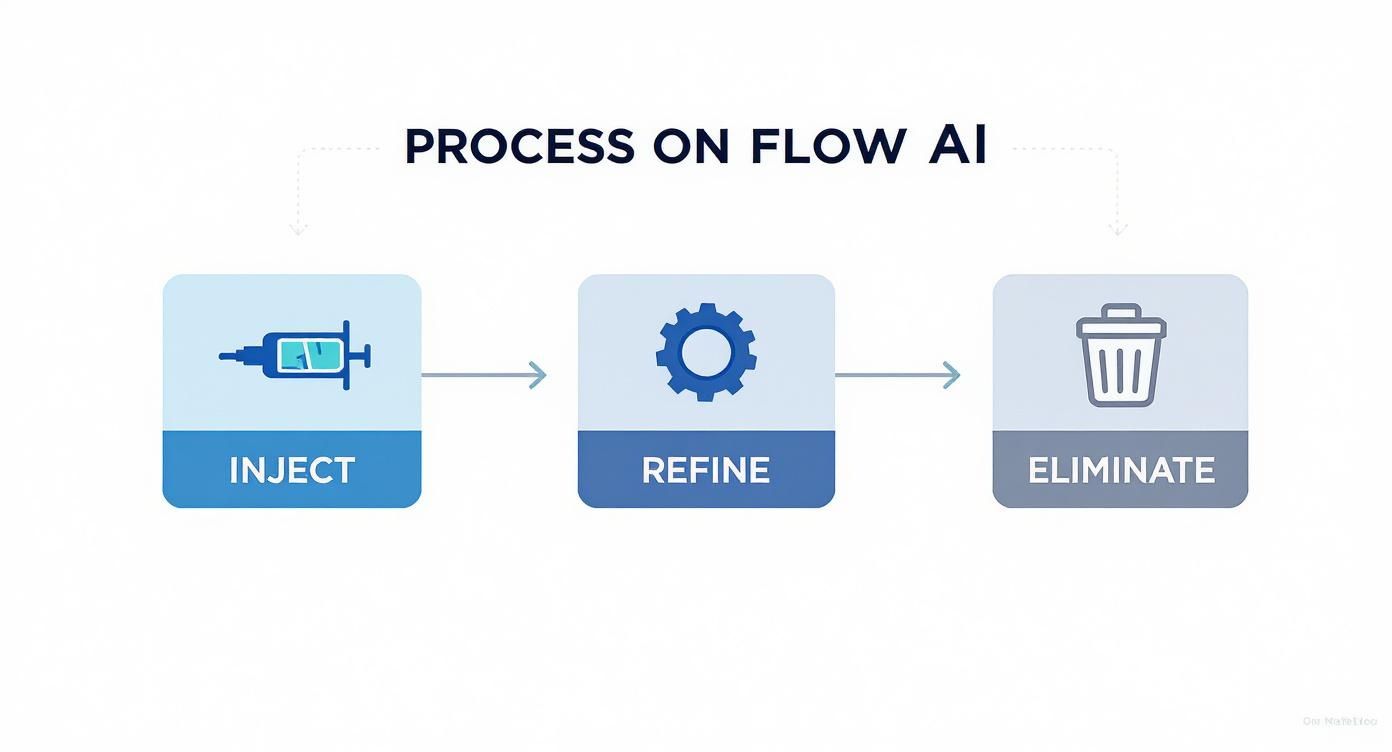
The real takeaway here is that humanization isn't one single action. It's a combination of creative additions, technical refinement, and ruthless editing.
Instead of burning an hour rewriting every clunky sentence yourself, you let a humanizer handle the initial "de-robotizing." This frees up your creative energy for the most critical part: adding your unique value. For more options, you can check out our detailed comparison of the best AI to human text converters on the market.
Important Reminder: An AI humanizer is a powerful assistant, but it's not a final solution. Its job is to hand you a much better second draft to work from, saving you from the tedious grind of basic sentence restructuring. Your manual edit is still absolutely essential.
Perform Your Crucial Manual Edit
With the most obvious AI tells smoothed over, you can now focus on what truly matters. This is where you bring in the techniques we discussed earlier:
- Inject Personal Stories: Weave in a brief, relevant anecdote from your experience.
- Add Unique Opinions: State your perspective clearly and confidently.
- Refine the Brand Voice: Tweak the language so it sounds unmistakably like you.
- Fact-Check Everything: Never trust an AI. Verify every statistic, date, and claim.
This manual pass is completely non-negotiable. It's the step that elevates your content from merely "undetectable" to genuinely valuable and trustworthy. The humanizer handles the grammar and structure; you handle the soul.
The Final Test and Polish
After your manual edits are done, run the content through the AI detector one last time. This final check verifies that your changes worked and gives you the confidence to hit "publish."
This entire workflow—Detect > Humanize > Edit > Re-test—transforms the daunting task of editing AI content into a manageable, efficient system. It ensures you catch robotic text, use tools smartly, and spend your valuable time on the high-impact creative work that only a human can do.
See the Transformation with Before and After Examples
Theory is one thing, but seeing these edits in action is what really makes the process click. We can talk all day about adding personality or simplifying language, but nothing hits home like a direct comparison.
Let's break down a couple of real-world scenarios. We'll look at the initial robotic AI draft and then see how just a few strategic tweaks can completely transform it into something that feels authentic and actually connects with a reader.
Example 1: The Blog Post Introduction
A blog post intro has one job: hook the reader and make them need to keep scrolling. AI is notoriously bad at this, often spitting out generic, keyword-stuffed openings that are predictable and dull.
🤖 Before: AI Draft
It is imperative for modern businesses to establish a robust online presence. The utilization of social media marketing strategies is a pivotal component of this endeavor. This article will explore various effective techniques for leveraging social media platforms to enhance brand visibility and drive customer engagement.
This is technically correct, but it's completely lifeless. It’s a textbook example of AI-speak, loaded with tells like "imperative," "utilization," and "pivotal component." No one talks like this.
✍️ After: Humanized Version
Ever feel like you’re shouting into the social media void? You spend hours crafting the perfect posts, only to be met with a few half-hearted likes. I’ve been there, and it’s beyond frustrating.
But what if a few simple shifts in your strategy could turn those whispers into a real conversation? Forget the complex jargon—we're going to break down the practical steps that actually move the needle on engagement and get your brand seen by the right people.
What Changed and Why?
- Relatable Hook: It kicks off with a question that taps directly into a common frustration. Instant connection.
- Personal Touch: Using "I’ve been there" immediately builds rapport and establishes empathy.
- Conversational Language: Phrases like "shouting into the void" and "move the needle" are what real people actually say.
- Clear Promise: It tells the reader exactly what they’ll get, framed in simple, benefit-driven terms.
Example 2: The Product Description
Product descriptions need to sell a feeling or a solution, not just list features. AI almost always defaults to the latter, creating dry, uninspired copy that fails to persuade.
🤖 Before: AI Draft
The “Aura” smart mug is an innovative beverage container engineered with high-grade stainless steel and advanced temperature-control technology. It possesses a 14-ounce capacity and features an integrated LED display to indicate the current temperature of the liquid within. Its battery is long-lasting, providing hours of optimal temperature maintenance.
While informative, this has zero persuasive power. It reads like a technical manual, not a compelling reason to click "buy."
✍️ After: Humanized Version
Say goodbye to lukewarm coffee for good. The Aura smart mug is your new secret weapon for that perfect sip, every single time—from the first pour to the last drop.
We designed it with a sleek, 14-ounce stainless steel body that feels great in your hand and a simple LED display that tells you when your drink is just right. Imagine your morning brew staying at that ideal temperature for hours, not minutes. That's not just a feature; it's a better start to your day.
Key Insight: The best product descriptions sell the benefit, not just the feature. Instead of "long-lasting battery," the humanized version frames it as "your morning brew staying at that ideal temperature for hours."
The revised version connects the product's specs to the user's daily life. It focuses on solving a real problem (lukewarm coffee) and paints a picture of a better morning routine, which makes the product instantly more desirable. As you can see, a little bit of human insight goes a very long way.
Got Questions About Humanizing AI? We Have Answers
Diving into AI-assisted content can feel a bit like the wild west. It's exciting, powerful, but also full of questions. As you start weaving these tools into your workflow, it's totally normal to wonder about ethics, efficiency, and what actually works.
Let's clear the air. This section tackles the most common questions head-on, from figuring out when to stop editing to understanding what Google really thinks about AI. Think of it as your final gut-check before you go all-in.
How Much Editing Does AI Content Really Need?
There's no magic number, but here’s a solid rule of thumb I've landed on: dedicate at least 20-30% of your total content creation time to the human editing phase. If an AI spits out a 1,000-word draft in 10 minutes, you should plan to spend a good 20-30 minutes making it your own.
And we're not just talking about fixing a few commas. The real work is in fundamentally reshaping the content. You need to:
- Inject your unique voice and share a personal story or two.
- Fact-check every claim and statistic. Never trust, always verify.
- Break up those robotic sentence structures and improve the rhythm.
Your job is done when the article stops just presenting information and starts telling a story from a perspective someone can trust—yours. Read it out loud. If it sounds like something you’d actually say to a friend or colleague, you're on the right track.
Is It Unethical to Use AI to Write Content?
Using AI to write isn't inherently unethical. The ethics come down to two things: transparency and intent. It helps to think of AI as an incredibly advanced tool, like a super-powered calculator or grammar checker. The ethical line gets crossed when you try to pass off AI work as 100% your own, especially in places like academia or professional settings where originality is everything.
The key is to use it responsibly. Be upfront about using AI when it's appropriate, and always—always—take full ownership of the final content's quality and accuracy. The most ethical way to humanize AI content is to treat it as a first draft, not a final product.
Will Google Penalize Me for Using AI Content?
Let's bust this myth right now. Google's official stance is that it rewards helpful, high-quality content, no matter how it was made. They don't care about the tool; they care about the output. Google isn't against AI content; it's against bad content that just happens to be made by AI.
The problem is, raw, unedited AI text almost always fails Google's E-E-A-T (Experience, Expertise, Authoritativeness, and Trustworthiness) test. It's generic. It lacks the personal experience and unique insights that signal a quality piece of content.
That's why humanizing your AI drafts is so critical for SEO. When you add your own expertise, stories, and fact-checking, you're creating the exact kind of helpful content Google wants to rank. You don't get penalized for using AI; you get penalized for publishing lazy, low-value stuff.
Can AI Humanizers Perfectly Replicate Human Writing?
AI humanizers are fantastic for rewriting text and stripping out the most obvious AI giveaways. They can do wonders for restructuring sentences and making a draft sound more natural.
But they can't perfectly replicate the spark of human creativity and lived experience. A tool can't invent a personal story from your childhood, form a truly unique opinion, or understand the inside jokes of your specific audience.
Think of these tools as a powerful assistant editor. They do the heavy lifting of de-robotizing a draft. But that final, essential layer of authenticity—the stories, the personality, the soul—that has to come from you.
Ready to turn those robotic drafts into content that truly connects? HumanText.pro is built to handle the heavy lifting, transforming AI text into natural, human-sounding content that sails past detection. Try it now and see the difference for yourself.
Ready to transform your AI-generated content into natural, human-like writing? Humantext.pro instantly refines your text, ensuring it reads naturally and authentically. Try our free AI humanizer today →
Related Articles
AI Face Search Explained: Verify Identity and Stay Safe
Understand how AI face search works, including embeddings, accuracy, and legal issues. Learn to use these tools for personal safety and verify identity online.

Reverse Face Search: A Verification Safety Guide
Learn how reverse face search works, when to use it for safety, and how to pair it with AI image checks to verify online contacts and reused photos.

Face ID Search Explained: How It Works and How to Verify
Learn how face ID search works, why it differs from reverse image search, and how to verify identities and photos safely with practical checks and tools.

