Convert AI Text to Human Writing That Truly Connects
Learn how to convert AI text to human writing with our guide. We share practical editing strategies and tools to make your AI content authentic and engaging.
To really convert AI text into human writing, you have to do more than just clean up a few words. It's about injecting personality, weaving in your unique insights, and finding a natural rhythm that connects with people. This means strategically rewriting predictable phrases, mixing up your sentence structures, and letting your own voice shine through to create something that actually resonates—and sails past AI detectors.
Why Humanizing AI Content Is a Non-Negotiable Skill
Think of AI-generated text as a fantastic starting point, but rarely the finish line. Raw AI output often has tell-tale signs of its origin. It can be bland, a bit repetitive, and just lacks the subtle quirks that build trust with an audience.
Relying on unedited AI content is like serving a meal with all the right ingredients but zero seasoning. Sure, it’s technically complete, but it’s not going to leave a lasting impression. That’s why the ability to humanize this content has quickly become a vital skill for anyone creating content today. Readers are getting savvier, and search engines are getting much better at prioritizing content that shows genuine expertise and delivers real value.
The Telltale Signs of Robotic Writing
So, what exactly gives AI-generated text away? Once you know what to look for, the patterns become glaringly obvious.
- Repetitive Sentence Starters: AI models often fall into a rut, starting one sentence after another with the same phrase or structure.
- Overly Formal Tone: The writing can sound unnaturally academic or stuffy, using jargon where simpler, more direct language would work better.
- Lack of a Personal Voice: You won't find any opinions, personal stories, or unique perspectives that signal a real person is behind the keyboard.
- Perfectly Uniform Structure: You’ll notice paragraphs and sentences often have a similar, monotonous length, creating a rhythm that just feels robotic.
The core challenge is that while AI can replicate information, it cannot replicate experience. Your unique insights, stories, and even your mistakes are what make your content trustworthy and memorable.
This is exactly why a hybrid approach is becoming the new standard in content creation. AI can dramatically speed things up—sometimes doubling or tripling your output—by handling the heavy lifting of research and drafting.
But the final, essential step always requires a human touch to add the emotional depth and authentic tone that actually connects with readers. To learn more about how these hybrid strategies are taking over, check out this analysis from Wildnet Technologies. This guide will give you the framework to master this crucial skill, turning generic drafts into compelling, authentic pieces.
My Go-To Workflow for Humanizing AI Content
Turning a sterile, robotic AI draft into something that actually connects with a reader isn't about just fixing a few typos. It's a structured process. You have to move past simple edits and start by really listening to the AI's output—not just for errors, but for its fundamental tone and rhythm. Only then can you start the real work of rewriting it into something human.
This whole process is about bridging the gap between a machine's first draft and content that feels authentic and trustworthy.
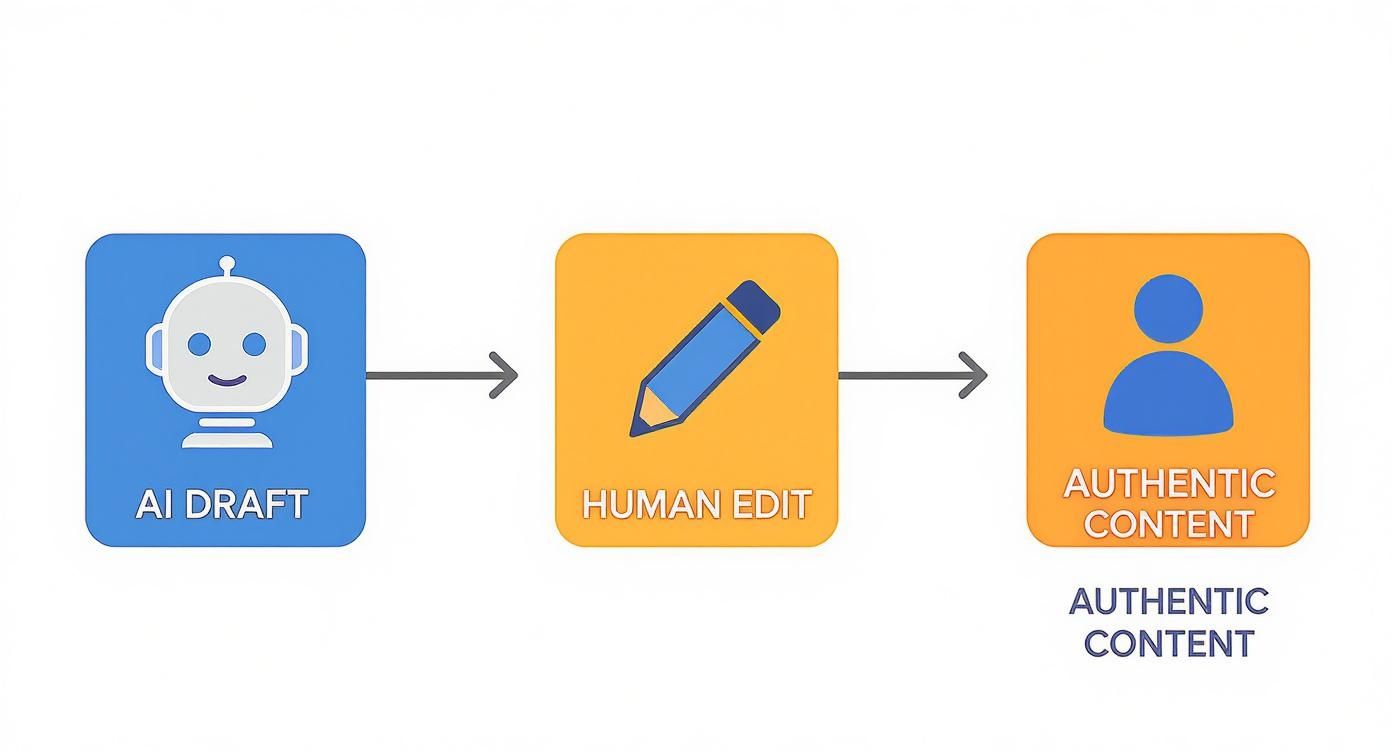
The key takeaway here is that human editing isn't just a final polish. It's the active, transformative step that turns raw data into a story that actually resonates.
First, Analyze the Raw AI Draft
Before you touch a single word, read the entire AI draft out loud. Seriously. It’s the fastest way to hear the rhythm. Does it flow like a conversation, or does it sound like a droning, monotonous machine?
Next, dig for the core message. AI tools are great at pulling together facts, but they often bury the main point under a pile of generic fluff. Your first mission is to find the most valuable idea in that text and make sure it’s front and center.
This is also where you hunt for "AI hallucinations"—those weird moments when the model confidently states something that is flat-out wrong. Fact-check every single statistic, date, and claim. This is a non-negotiable step. Your credibility depends on it.
Inject Your Own Voice and Experience
Here’s where the magic really happens. AI has no personal history, no opinions, and no anecdotes. Those are the very things that build a genuine connection with your reader. Your goal is to weave your own personality directly into the fabric of the text.
Here are a few practical ways to do that:
- Share a Personal Story: Instead of a generic example like, "Many businesses struggle with marketing," try something real. "In my first year as a marketer, I made the classic mistake of focusing only on metrics and completely ignoring the story."
- Take a Stance: AI loves to be neutral. Don't be. If the tool gives you a balanced overview, add your professional opinion to give the content a sharp, clear point of view.
- Write Like You Talk: Chop up those long, complicated sentences. Swap out corporate jargon for words you'd actually use in a conversation with a colleague.
My favorite gut-check question is simple: "Would I ever actually say this out loud?" If the answer is no, that sentence gets rewritten until it sounds like me.
The difference between a raw AI draft and a polished, human-edited piece is night and day. It's about transforming predictable, sterile text into something with personality and authority.
This table breaks down the transformation you're aiming for:
Key Differences Between AI Text and Human-Edited Content
| Characteristic | Raw AI Text | Human-Edited Text |
|---|---|---|
| Tone of Voice | Often generic, neutral, and overly formal. | Authentic, opinionated, and tailored to the audience. |
| Sentence Structure | Repetitive patterns, similar sentence lengths. | Varied sentence lengths create a dynamic reading rhythm. |
| Credibility | Can contain "hallucinations" or unsourced claims. | Fact-checked, supported by personal anecdotes and real-world examples. |
| Flow & Cohesion | Paragraphs can feel disconnected or abrupt. | Smooth transitions guide the reader logically through the content. |
| Originality | Tends to rehash common knowledge without a unique angle. | Offers a distinct perspective, personal insights, and a clear point of view. |
| Emotional Connection | Lacks empathy, humor, or any real personality. | Connects with the reader through storytelling and genuine emotion. |
Ultimately, the goal is to add layers of nuance, credibility, and personality that a machine simply can't replicate on its own.
Refine Sentence Structure and Flow
AI-generated text almost always falls into a rut of predictable sentence structures. You'll see sentence after sentence of the same length, often starting the same way. It’s boring, and it’s a dead giveaway that a machine wrote it. To truly convert AI text to human writing, you have to smash those patterns.
Vary your sentence length—a lot. Mix short, punchy statements with longer, more descriptive sentences. This creates a rhythm that keeps your reader engaged. Then, use natural transitional phrases so each paragraph flows logically into the next, making the whole piece feel like a single, cohesive thought.
This is all about making the content feel effortless to read. When you get this right, you're also learning how to avoid AI detection, because natural linguistic variation is one of the clearest signs of a human hand at work.
Using Tools to Speed Up the Humanization Process
Manual editing is where the real magic happens, but let's be realistic—it's not always fast. Smartly using the right tools can slash your editing time, letting you focus your energy on the creative touches that truly matter. The goal isn't to replace your judgment, but to build a workflow where technology does the heavy lifting.
This means layering different tools to handle specific jobs. A dedicated AI humanizer can tackle the initial, clunky rephrasing. A grammar checker can polish the style. And a readability tool can ensure your message is crystal clear.
This approach helps you efficiently convert AI text to human writing without ever sacrificing quality. The right tech stack acts as your co-pilot, not the pilot. It flags awkward phrasing and suggests better words, freeing you up to focus on strategy, storytelling, and injecting your unique voice into the piece.
Building Your Humanization Tech Stack
An efficient workflow needs more than just one tool. It's about strategically combining different technologies to fix everything from clunky sentence structures to stylistic flair.
Your toolkit should include a mix of these:
- AI to Human Text Converters: These are your foundation. They're specifically built to rewrite robotic sentences into more natural, varied prose. By altering sentence structures and word choices, they chip away at the predictability that AI detectors flag. For a detailed breakdown, check out our guide on the best AI to human text converters out there.
- Advanced Grammar Checkers: Think way beyond basic spellcheck. Tools like Grammarly or ProWritingAid offer sharp suggestions on tone, clarity, and style. They're great for spotting passive voice, simplifying tangled sentences, and making your writing sound more confident and direct.
- Readability Analyzers: I'm a big fan of tools like the Hemingway App. They instantly highlight overly long sentences and complex words, helping you make your content more accessible and engaging for everyone.
The most effective approach is a blended one. Use an AI humanizer for the first pass, a grammar tool for the stylistic polish, and a readability checker for the final once-over. This creates a powerful, multi-step editing process that catches nearly everything.
Take a look at a typical interface for an AI humanizer. It's designed for speed.
As you can see, the process is dead simple: paste your text, and the tool provides a rewritten version designed to sound more natural. The real key, though, is to treat this output as a new, improved draft—not the final product.
The Bigger Picture in AI-Assisted Writing
The push for tools that convert AI text to human-sounding prose is just one piece of a much larger trend. By 2025, AI-driven technologies are expected to fundamentally change how we create and consume communication that feels human.
Just look at the numbers. The AI speech translation market alone is projected to hit $5.73 billion by 2028. It’s also estimated that over 75% of global companies will depend on AI translation tools by the end of 2025. This signals a massive global demand for AI that can deliver natural, context-aware communication.
Ultimately, these tools are powerful assistants. They can handle the repetitive, formulaic parts of rewriting, but the final spark of authenticity—the stories, the opinions, the unique voice—that has to come from you.
Go Deeper: Advanced Moves for Genuinely Human Content
Getting the basics right will get your AI content to a passing grade. But if you want to create something memorable—something with an authoritative human touch that truly connects—you need to go deeper. This is where you move beyond simple edits and intentionally add the "soul" that algorithms just can't fake.
This is about more than just finding a better way to phrase things; it’s about infusing your unique perspective into every single paragraph.

This is the real work of how to convert ai text to human writing that resonates.
Weave in Real Stories
Humans are wired for stories, not data dumps. Even in the most technical article, a brief, relevant story can make a complex idea stick. An AI might explain a marketing concept with a bland, generic example, but you can make it real.
Instead of saying, "Consistent branding is important for recognition," tell a quick story from your own experience. "I once worked with a startup that changed its logo colors three times in six months. Their audience was completely lost. It was a painful lesson that consistency isn't just a buzzword—it’s the bedrock of trust."
That tiny narrative does more to persuade and connect than pages of robotic explanation ever could. It provides context and builds an immediate, empathetic bond with your reader.
Change Up Your Cadence
One of the biggest tells of AI writing is its monotonous rhythm. Sentences are often the same length, and paragraphs are uniform blocks of text. Your first job is to break that pattern.
- Mix Your Sentence Lengths: Follow a long, descriptive sentence with a short, punchy one. It grabs attention. It keeps the reader engaged.
- Vary Your Paragraph Size: Just like sentences, your paragraphs shouldn't all look the same. Use a single-sentence paragraph for emphasis. Use longer ones for deeper explanations.
This variation mimics how a real person thinks and speaks, making the text feel more conversational and less like it was assembled by a machine. It’s a subtle but powerful way to make your content breathe.
Inject Your Actual Personality and Opinions
AI models are designed to be neutral, objective, and frankly, boring. Your greatest advantage is that you are not. Don't be afraid to take a stand.
Injecting your genuine personality—your opinions, your humor, your unique point of view—is what makes your content yours.
AI can tell your readers what something is, but only you can tell them why it matters from your point of view. This is the absolute core of creating authentic content.
Consider challenging a common assumption in your field. If everyone says to post on social media daily, you could argue, "Everyone screams 'post daily,' but I’ve found that three high-impact posts a week build a far more engaged community than seven mediocre ones ever could."
This confident, opinionated stance builds authority and gives your audience a real reason to remember you. It’s the final, critical layer that transforms a generic AI draft into something people actually want to read and share.
Where Trust and Authenticity Fit In with AI
When you start using AI tools to get your content out faster, you also take on a big responsibility to your audience. The whole discussion around how to convert ai text to human writing isn't just a technical puzzle—it's an ethical one. At its heart, it's about a single, crucial thing: trust.
Your readers come to you expecting honesty. Whether they're reading your blog, a research paper, or a marketing email, there’s an unspoken agreement that the words represent real expertise and genuine effort. If you blur the lines between an AI assistant and the final author too much, that trust can disappear in a flash.
Transparency is almost always the right call, but what that looks like really depends on what you're writing.
When to Disclose That You're Using AI
In some fields, hiding your use of AI isn't just bad manners; it's a serious ethical problem. Think about academia or journalism—fields built on originality and verifiable sources. Passing off a heavily AI-generated paper as entirely your own work is fundamentally deceptive in that context.
But for a company blog or some social media ads? The game is different. The reader's primary concern is the quality and value of the content itself. They care more about getting helpful, engaging information than about the specifics of how the first draft came to be.
Here’s a simple way to think about it:
- Academic and Journalistic Work: Full disclosure is non-negotiable. You need to acknowledge the role AI played, just as you'd cite any other research tool or source.
- Creative or Opinion-Based Pieces: If your name is on it, your voice and ideas have to be the star of the show. AI can be a great partner for brainstorming or outlining, but the soul of the piece must be yours.
- Marketing and Business Content: Disclosure is less of a concern here, but accountability is absolute. You are responsible for every single word on that page.
The golden rule is to take complete ownership. It doesn't matter how the first draft was born; you are the publisher. That means you have to rigorously fact-check every claim, inject your own unique perspective, and stand behind the final product as your own expert work.
Your Human Touch Is Actually an SEO Superpower
Being authentic isn't just about doing the right thing; it’s also a smart SEO strategy. Google’s guidelines have shifted heavily toward content that demonstrates real expertise, authoritativeness, and trustworthiness—what they call E-A-T. They want to rank content made for people, not just for algorithms.
This means your human touch—the personal stories, the unique opinions, the hard-won insights—is more valuable than ever.
When you thoroughly edit and enrich an AI draft, you're not just making it sound better; you're directly aligning it with what search engines want to reward. You’re signaling that a real expert is behind the curtain, which builds credibility with both your readers and the algorithms. This is a huge reason why it pays to understand how to pass AI detection and ensure your content truly reflects human effort. The goal, always, is to create trustworthy content that genuinely serves your audience.
Common Questions About Humanizing AI Text
As you start turning AI drafts into human-sounding content, a few questions pop up time and time again. Getting straight answers to these will help you build a smarter, more effective workflow. Let’s tackle the big ones.
Can AI Detectors Reliably Spot AI Content?
The short answer is no, not perfectly. While AI detection tools are getting better, they are far from foolproof.
These detectors are basically looking for mathematical patterns common in machine-generated text. Think of things like low perplexity (predictable word choices) and burstiness (sentences that are all the same length and structure). By intentionally mixing things up—varying your sentence structures, injecting a personal story, or using richer vocabulary—you can pretty easily make your content fly under the radar.
But here’s the thing: the goal should never be just to trick a tool. Your focus should always be on creating genuinely valuable, engaging content for your reader. Bypassing detection is just a happy byproduct of good, thorough human editing.
Should I Write from Scratch or Edit AI Drafts?
This really comes down to your own expertise and what you're working on.
If you're a seasoned expert on a topic, writing from a blank page might actually be faster. Why? Because your authentic voice and insights will flow naturally right from the start. You won't have to "un-do" any of the AI's robotic phrasing.
On the other hand, for complex subjects that demand a ton of research, an AI draft is an incredible starting point. It can pull together facts and outline a structure in minutes, saving you hours of grunt work. For most people, a hybrid approach works best: let the AI do the heavy lifting, then come in with your expertise to rewrite, refine, and add that crucial human touch.
What Is the Most Important Edit for Humanizing AI Text?
Without a doubt, the single most impactful edit you can make is injecting your genuine voice. This goes way beyond fixing grammar or sentence flow. It's about adding your unique experiences, opinions, and perspective.
For example, an AI might spit out a generic statement like, "Effective marketing is important for business growth."
To humanize it, you could rewrite it from your own point of view: "In my 10 years in this field, I've learned that authentic marketing isn't just important—it's everything. It's the one thing that builds a real connection." That small shift from a bland fact to a personal conviction is something an AI just can't fake, and it builds instant trust with your reader.
How Do I Verify Facts from an AI Tool?
Never, ever take AI-generated facts at face value. AI models can "hallucinate," which is a polite way of saying they can confidently make stuff up and present it as truth. You have to treat every statistic, date, or specific claim with a healthy dose of skepticism.
Always cross-reference any data point with reputable, primary sources. Think of the AI draft as a helpful research assistant that gives you starting points, not as a final source of truth. Protecting your credibility through rigorous fact-checking isn't just a suggestion; it's a non-negotiable step in this process.
Ready to transform your AI drafts into undetectable, human-quality content in seconds? HumanText.pro uses advanced models to humanize your text, helping you bypass AI detectors while preserving your core message. Try it for free today at https://humantext.pro.
Ready to transform your AI-generated content into natural, human-like writing? Humantext.pro instantly refines your text, ensuring it reads naturally and authentically. Try our free AI humanizer today →
Related Articles
What Is AI Law and How It Shapes Content in 2026
What is AI law? Learn EU AI Act, US rules, liability and IP risks, plus practical steps for creators to stay compliant in 2026.

How to Write a Newsletter That Readers Trust
Learn how to write a newsletter that drives engagement. Master subject lines, mobile-first structure, AI humanization, and deliverability

How to Improve Writing Clarity That Actually Reads Well
Learn how to improve writing clarity with proven sentence-level edits, structure fixes, and before-and-after examples that make any draft sharper and more

