How to Write SEO Articles That Consistently Rank
Discover how to write SEO articles that drive real traffic. Our guide breaks down keyword strategy, content structure, on-page SEO, and humanizing AI.
Writing a high-ranking SEO article is about so much more than just slotting in keywords. It’s about creating comprehensive content that absolutely nails user intent, is a breeze to read, and is perfectly tuned for search engines. This means you've got to blend deep keyword research with a clear, engaging writing style to become the best possible answer for a specific query.
The Real Blueprint for High-Ranking Content
Let’s be real: getting content to rank in today's crowded space is tough. The old playbook of stuffing keywords into a 500-word article is dead and gone. Success now hinges on creating content that genuinely helps your audience while signaling expertise and trustworthiness to Google. It's a repeatable system that’s part art, part science.
This process is about building a real asset for your business, not just chasing quick wins. It's about understanding how the pillars of a great SEO article fit together—from decoding what a user really wants, to mastering keyword research, to creating a smooth, enjoyable reading experience. Before you even type a single word, it's critical to have a foundational SEO strategy to guide your efforts.
The Modern SEO Writing Workflow
To give you a clear roadmap, we can break the whole process down into three core phases: research, writing, and publishing. It’s a simple, logical flow that keeps you on track.
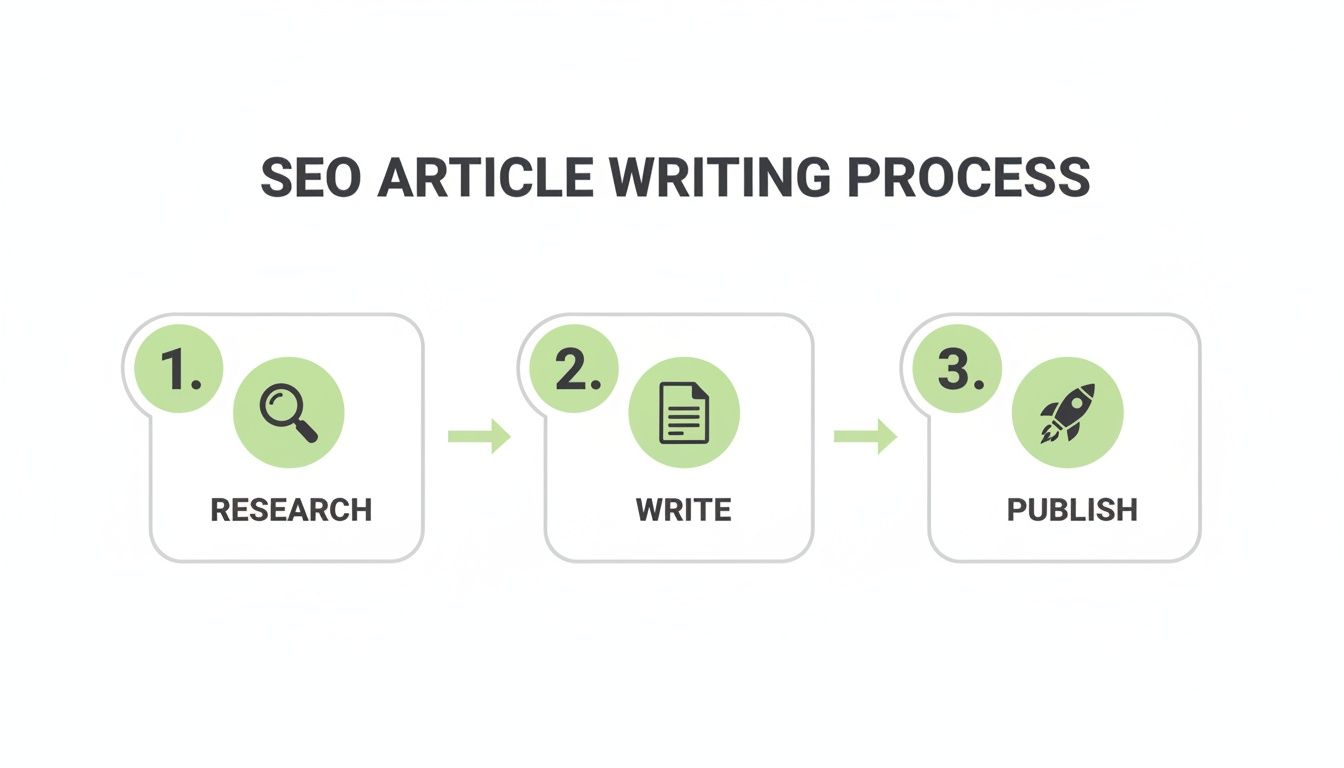
Each stage builds directly on the last, making sure your final article is strategic, well-crafted, and ready for maximum visibility. The research sets your foundation, the writing brings it to life, and publishing gets it in front of the right people.
One of the most powerful strategies today is simply going deeper than the competition. Seriously. Did you know that content over 3,000 words can attract 3x more traffic compared to average-length articles? These powerhouse pieces also tend to get 4x more shares and 3.5x more backlinks, proving that both people and search engines reward thoroughness.
While the average word count for a page on Google's first page hovers around 1,447 words, the articles that truly dominate their topics often go much, much deeper.
The goal isn't just to write more; it's to provide more value. A longer article naturally allows you to cover more subtopics, answer more related questions, and establish greater topical authority.
This guide will walk you through that exact process. We’ll show you how each piece of the puzzle fits together to create content that doesn't just rank, but also builds lasting authority and trust with your readers. And even with AI in the mix, creating content that feels human is non-negotiable. It's a skill you can learn, and it's essential for creating undetectable AI that truly connects with readers and satisfies search quality standards.
To summarize the journey ahead, here’s a quick overview of the entire workflow we’ll be covering.
The SEO Article Writing Workflow at a Glance
| Phase | Primary Goal | Key Actions |
|---|---|---|
| 1. Research | Understand user intent and the competitive landscape. | Keyword research, SERP analysis, identifying primary & secondary keywords, mapping out user journey. |
| 2. Writing | Create high-value, comprehensive, and engaging content. | Outlining, drafting, incorporating keywords naturally, optimizing for readability, writing compelling headlines. |
| 3. Publishing & Optimization | Prepare the article for search engines and users. | On-page SEO (meta tags, URLs), adding internal links, compressing images, final proofreading, promotion. |
This table lays out the strategic path from an idea to a high-performing piece of content. Let’s dive into the first phase.
Finding Keywords That Drive Real Business Results
Great SEO writing doesn’t start when you open a blank document. It starts way earlier, with the strategic work of figuring out exactly what your audience is typing into Google. More importantly, you need to understand why they're searching for it.
This is where you stop being a simple content creator and start thinking like a strategist. Forget just grabbing a list of high-volume keywords from a tool. The real work—the work that gets results—happens when you dissect the search engine results page (SERP) for your target queries.
Let Google Tell You What to Write
Think of the SERP as your ultimate cheat sheet. It’s Google literally showing you the exact types of content it already loves and rewards for any given topic.
Before you write a single word, open an incognito window and search for your main keyword. What do you see?
- Listicles everywhere? If the top results are all "10 Best..." or "7 Ways To...," that's your sign. People want quick, scannable comparisons.
- Massive guides? Titles like "The Ultimate Guide to..." or "How to Do X (A Complete Tutorial)" mean searchers are in research mode. They want a deep, comprehensive answer.
- Comparison posts? A page full of "X vs. Y" articles tells you the user is stuck in the decision-making phase. They need a head-to-head breakdown.
- "What is..." articles? Lots of definitional content means you're dealing with a top-of-funnel audience just starting to learn.
This simple observation is how you decode search intent. Trying to rank a dense "how-to" guide when Google is clearly rewarding listicles is an uphill battle you’ll almost never win, no matter how amazing your writing is.
The Untapped Power of Long-Tail Keywords
Chasing broad, high-volume keywords like "SEO articles" is tempting, but it's also a fantastic way to get buried by competitors with massive authority. The real opportunity for most of us lies in long-tail keywords.
These are the longer, more specific phrases that signal someone is much closer to making a decision or solving a very specific problem.
Think about it. The person searching for "SEO" is just browsing. But the person searching for "how to write seo articles for a service business" has a specific, urgent need. That search might have way less volume, but the conversion potential is through the roof.
Your best content ideas almost always come directly from the questions your audience is already asking. These questions are a goldmine for creating content that genuinely ends their search.
A brilliant place to find these gems is right inside Google's own "People Also Ask" (PAA) section. It's an incredible, free resource that shows you the exact related questions people are actively searching for.
Mine "People Also Ask" for Your Article Outline
Let's make this practical. Say your core topic is "how to write seo articles." The PAA box will likely serve up questions like:
- How do you structure an SEO article?
- What is the ideal word count for an SEO post?
- Is keyword density still important in 2024?
- How do you find keywords for an article?
Boom. You just found the main H3 subheadings for your article. By answering each of these questions directly and thoroughly, you’re not just helping your reader—you're also structuring your content in a way that makes it easier for Google to feature you in its rich snippets.
This flips your content strategy from guesswork into a data-backed plan. You're systematically addressing every relevant question, building a resource that’s miles ahead of what your competitors are offering.
The Competitor Gap Analysis: Steal Their Traffic
Here's another powerful move: find the keywords your competitors rank for that you don't. This is called a content gap analysis.
Most major SEO tools, like Ahrefs or Semrush, have a feature for this. You plug in your domain and a few of your top competitors, and the tool spits out a list of keywords where they're visible and you're not.
Focus on keywords where your competitors are on page one, but you're nowhere to be found. This tells you two critical things:
- The keyword is relevant and valuable in your industry.
- There's a clear opening for you to create something better and steal that traffic.
When you find a juicy keyword this way, don't just mimic what your competitor did. Your goal isn't to be just as good; it's to be 10x better. Analyze their piece. Is it full of outdated stats? Does it lack real, practical examples? Is the formatting a nightmare?
That's your opportunity. Go create the definitive resource on that topic, and you won't just compete—you'll dominate.
Structuring Your Article for Engagement and SEO
You've done the hard work of keyword research. Now comes the part that separates the pros from the amateurs: building a structure that hooks readers and makes Google happy.

Let's be blunt: a massive wall of text is the fastest way to get someone to hit the back button. That click sends a clear signal to Google that your content isn't helpful, and your rankings will suffer for it. A logical, scannable structure isn't just nice to have—it's non-negotiable.
The backbone of any great article is its hierarchy of headings. Think of your article's title as the H1 tag. Your main sections get H2s, and the supporting points within those sections get H3s. This creates a clean, logical flow that guides both readers and search engine crawlers through your content with ease.
The Anatomy of an SEO Article Structure
A well-structured article is more than just headings; it's a complete framework designed for readability and engagement. Every piece has a job to do, all aimed at keeping the reader on the page.
Here’s a practical blueprint you can use for almost any topic:
- H1 The Title Tag: This is your sales pitch on Google's results page. It has to be compelling and include your main keyword.
- Introduction: Your hook. Grab the reader’s attention by hitting on their pain point and promising a clear solution.
- H2 Core Section 1: Dive into your first major point, using H3s to break down the details.
- H2 Core Section 2: Keep building your argument with more in-depth sections.
- Conclusion: Sum up the key takeaways and give a clear call to action (CTA). What should the reader do next?
This framework acts as a skeleton for your content, making dense information much easier to digest. The goal is to make it effortless for someone to scan your article and find exactly what they're looking for in seconds.
Writing an Introduction That Actually Hooks Readers
Your introduction has one job: convince the reader to keep scrolling. You have about three seconds to get it done. No long, winding preambles. Get straight to the point.
A powerful intro usually has three key elements:
- Empathize with the Problem: Acknowledge the reader's challenge right away. For instance, "Struggling to get your articles to rank on Google?"
- Promise a Solution: Clearly state how your article solves that problem. "This guide breaks down the exact steps to create content that climbs the SERPs."
- Establish Credibility (Optional): Briefly mention why you're qualified to give advice. "After growing organic traffic by 250% using this method..."
This formula works because it immediately validates the reader's search and confirms they've landed in the right place. By creating this clear path, you dramatically increase the chances they'll stick around. If you want to get your drafts done even faster, it's worth learning how to write blog posts faster without sacrificing quality.
Optimizing Your Title Tag and Meta Description
While they aren't technically part of your on-page structure, your title tag and meta description are your article's storefront on Google. A weak title can cripple even the best content.
Consider this: title tags between 40-60 characters see an 8.9% higher click-through rate (CTR) than longer ones. And with the first organic result on Google getting an average 39.8% CTR, that top spot is incredibly valuable. Your meta description needs to be a compelling, 150-160 character summary that hits the searcher's pain point and makes them want to click your link over a competitor's. You can find more SEO statistics over at seosherpa.com.
A brilliant article with a boring title is like a fantastic store with a hidden entrance. You have to make it incredibly easy and appealing for people to come inside.
Ultimately, structuring an SEO article is all about user experience. When you use short paragraphs, clear headings, bullet points, and smart formatting, you improve scannability. This keeps visitors on your page longer—a powerful signal to Google that your content is high-quality and deserves to rank.
Executing Flawless On-Page SEO
Once your article is structured, it's time to get tactical. This is where we roll up our sleeves and handle the on-page optimizations that signal relevance to Google. Think of this as weaving your keyword strategy directly into the fabric of your content.
This isn't about old-school keyword stuffing. It's about making your article's topic crystal clear to both your readers and the search engine crawlers.
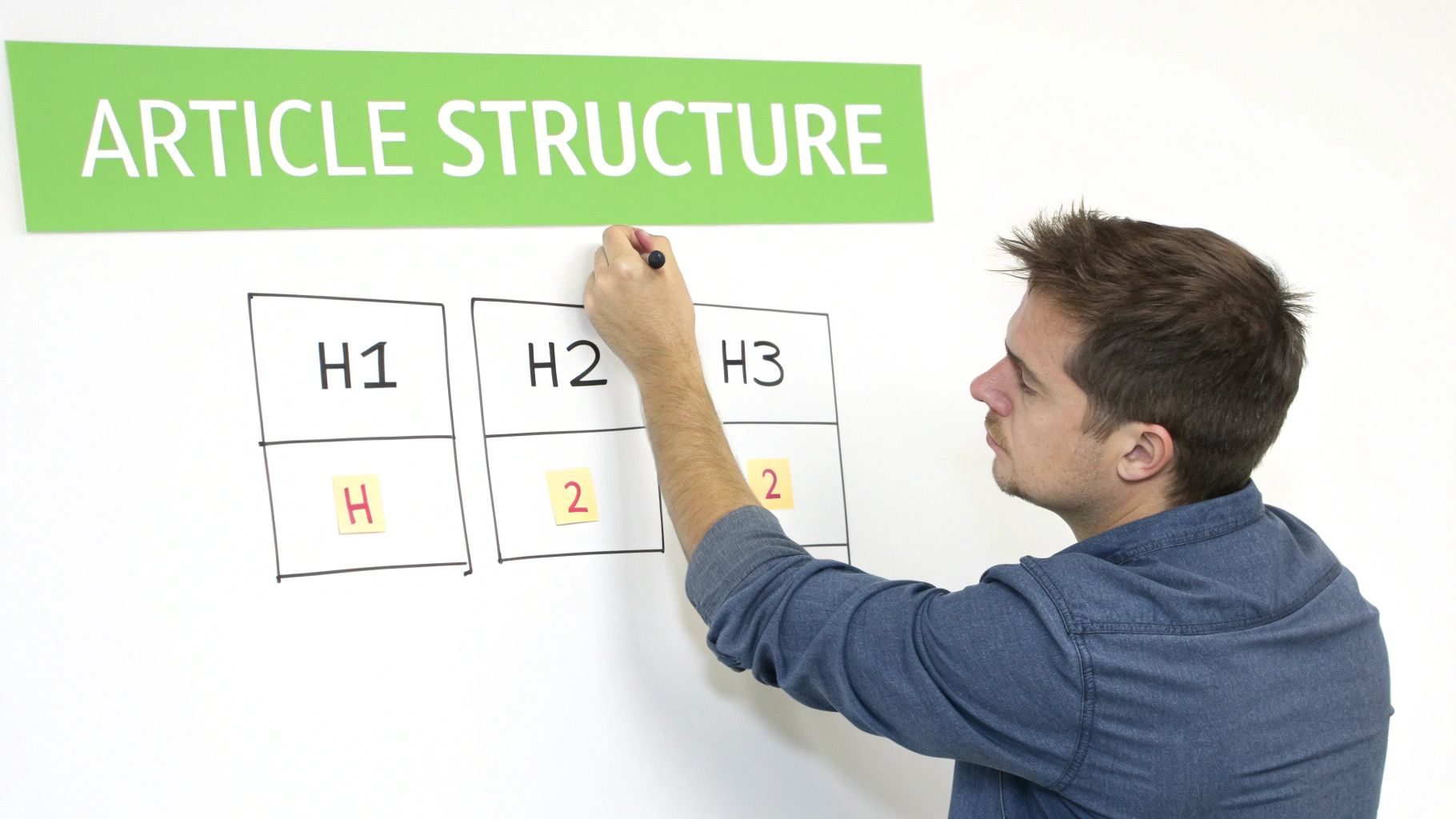
The process boils down to optimizing a handful of small but critical elements. When you get these right consistently, they combine to create a powerful signal of topical authority. Let's skip the outdated advice and focus on what actually moves the needle today.
Your On-Page SEO Checklist
Consider these the non-negotiables for every single article you publish. Nailing these fundamentals gives you a massive advantage right out of the gate, ensuring your content is primed for visibility from the moment it goes live.
- Title Tag & H1: Your primary keyword needs to be in both. Ideally, place it naturally toward the beginning of your title tag and your main H1 heading.
- Meta Description: This doesn't directly impact rankings, but a killer meta description that includes your keyword drives a higher click-through rate. A better CTR is a positive signal to Google.
- URL Slug: Keep it short, sweet, and descriptive. Your primary keyword belongs here. For this article, a perfect URL would be
/blog/how-to-write-seo-articles. - Introduction: Work your target keyword into the first 100-150 words. This immediately confirms the article's topic for both users and search engines.
- Subheadings (H2s & H3s): Sprinkle your primary keyword and a few secondary keywords throughout your subheadings where they fit naturally. This reinforces your main themes and makes the content skimmable.
By ticking these boxes, you send a clear, cohesive message to search engines. There's no ambiguity about what your article covers.
Beyond Keywords: Topical Authority and E-E-A-T
Modern SEO has moved far beyond just repeating a single keyword. It’s about proving you have comprehensive knowledge on a subject. This is where semantic keywords and topical authority come into play. Search engines are smart enough now to understand synonyms, related concepts, and the overall context of a topic.
For instance, any solid article on "how to write seo articles" should naturally include terms like:
- Keyword research
- User intent
- On-page optimization
- Internal linking
- Content structure
- SERP analysis
When you incorporate these related terms, you're signaling to Google that you aren't just targeting a keyword—you're a genuine authority on the topic. This depth is a huge part of building trust and demonstrating E-E-A-T (Experience, Expertise, Authoritativeness, Trustworthiness).
Your content has to prove it's credible, and one of the best ways to do that is through smart linking.
The Art of Strategic Linking
Links are the currency of the web. How you use them inside your article can seriously impact its performance. You need to master two types: internal and external.
Internal Links: Guiding Users and Spreading Authority
Internal links are simply links that point to another page on your own website. They are incredibly powerful for a few reasons:
- They create a logical path for users, guiding them to other relevant content and keeping them on your site longer.
- They help search engines find and index your content more efficiently, mapping out a clear site architecture.
- They distribute "link equity" (or authority) across your site. Linking from a high-performing article to a new one can give it an instant SEO boost.
As a rule of thumb, always look for opportunities to link to 2-5 other relevant posts on your site. Use descriptive anchor text—the clickable words—that provides context, like "dig deeper into our keyword research strategies" instead of a generic "click here."
External Links: Borrowing Credibility
External links are those that point to pages on other websites. It might feel strange to send people away from your site, but linking out to high-authority, reputable sources is actually a positive SEO signal.
It shows you've done your homework and are backing up your claims with credible information. This directly supports the "Trustworthiness" pillar of E-E-A-T. A good practice is to link to non-competing, authoritative sources—like university studies, industry reports, or respected publications—whenever you cite a statistic or a specific fact. This small act can dramatically boost your content's credibility in the eyes of both users and Google.
Using AI as Your Co-Pilot, Not Your Ghostwriter

Let's get one thing straight: AI is an incredible tool for getting things done faster, but it's a terrible substitute for real, human expertise. Think of it as your co-pilot. It handles the heavy lifting and grunt work, but you're still the one flying the plane.
This hybrid approach is where the magic happens. You combine the machine's speed with your irreplaceable insight. An AI can spit out a structured outline or a rough draft in minutes, saving you hours of staring at a blank page. Your job is to take that generic output and turn it into something genuinely helpful.
Prompting AI for Better SEO Drafts
The quality of your AI draft comes down to one thing: the quality of your prompt. If you give it a lazy request like "write a blog post about SEO articles," you'll get a generic, unusable mess. You have to get specific.
A powerful prompt gives the AI context and constraints. Think of it like a creative brief for your robot assistant.
Here’s what a good prompt looks like:
- Target Keyword: "The main keyword is 'how to write seo articles.'"
- Audience: "I'm writing for beginner to intermediate content marketers who know the basics but need a practical workflow."
- Key Topics: "Make sure you include sections on keyword research, article structure, and on-page SEO. Also, touch on why user intent is so important."
- Tone of Voice: "Keep the tone informative and encouraging, but a little informal—like an expert talking to a colleague."
See the difference? This level of detail guides the AI to create a solid foundation. It gives you a skeleton to work with, which is where your real value comes in.
AI can assemble the parts, but it can't provide the soul. Your expertise, personal stories, and unique voice are what turn a generic draft into a high-ranking asset that builds trust with readers.
This strategy isn't just a theory; it's becoming the industry standard. Data shows that 65% of companies get better SEO results when they use AI, yet a whopping 86% of marketers still edit those drafts. And while 73% of consumers say they trust AI-generated content, it's that human touch that satisfies Google's E-E-A-T guidelines.
The Essential Humanization Workflow
Once the AI hands over its draft, the real work starts. Your mission is to inject the human elements that a machine simply can't replicate. This is how you create articles that don't just rank but actually resonate with people. For a deeper dive, exploring the top AI tools for content marketing can give you even more firepower.
Here’s a checklist to guide your humanizing process:
- Fact-Check Everything. AI models are notorious for "hallucinating" facts or pulling outdated information. Verify every statistic, claim, and technical detail with credible, current sources. Don't trust, just verify.
- Inject Your Brand Voice. Rewrite clunky, robotic sentences to match your brand’s personality. Is your tone witty? Authoritative? Empathetic? The AI draft is a blank canvas; you're the artist.
- Add Personal Anecdotes. Nothing builds trust like a real story. Share a personal experience. For example, "I once spent a week targeting a keyword, only to realize the search intent was completely wrong. Here's what that taught me..."
- Weave in Expert Insights. This is your secret weapon. Add your own opinions, predictions, or "pro tips" that can only come from experience. This is what will separate your article from the thousand others on the same topic.
This process is all about adding layers of value that the machine missed. If you want to get really good at this, it helps to learn how to expertly turn AI writing into human-sounding text. Mastering this skill is what bridges the gap between AI efficiency and authentic connection, creating content that is truly helpful for people.
Common Questions About Writing SEO Articles
Once you start writing SEO content, you'll notice the same few questions pop up over and over. They’re the sticking points that can slow you down or make you second-guess your strategy. Let’s clear the air and tackle the most common ones I hear from writers.
How Long Should an SEO Article Actually Be?
There’s no magic number here, but let me be blunt: comprehensive content almost always wins. If you look at the data, the average first-page result on Google is around 1,447 words. But the articles that truly own a topic and build authority often sail past 3,000 words.
The real answer, though, isn’t about hitting a specific word count. It’s about satisfying user intent and outclassing the competition. Your one and only goal should be to cover the topic more thoroughly and helpfully than anyone else already on page one.
Before you even type a word, go look at the top-ranking pages for your keyword. If they're all 2,500-word deep dives, your snappy 500-word post isn't going to make a dent. Focus on being the last click a searcher needs to make. Let that be your guide for length.
Your goal isn't just a high word count; it's total comprehensiveness. You want to create a resource so valuable that the reader’s search ends with your article.
Is Keyword Density Still a Thing in SEO?
No. The old-school tactic of hitting a specific "keyword density" percentage is dead, and frankly, it's a good way to get penalized. Forcing your keyword into every other sentence just makes for a clunky, awful reading experience.
Modern search engines are way smarter than that. They focus on topical relevance and understanding natural language. Of course, your main keyword still needs to appear in a few strategic spots:
- The main title tag and your H1 heading.
- Somewhere in the first 100-150 words of your intro.
- In a couple of your H2 or H3 subheadings, but only where it sounds natural.
Beyond that, shift your focus to weaving in related ideas, synonyms, and long-tail variations. Always write for a human first. If your content sounds robotic, you're doing it wrong. Google is smart enough to figure out your topic without you beating it over the head with the same exact phrase.
How Often Should I Update Old SEO Articles?
Refreshing existing content is one of the most powerful—and most overlooked—SEO strategies out there. It’s almost always easier to get a ranking boost for an old post than to get a brand-new article to rank from scratch.
A good rule of thumb is to audit your most important articles at least once a year. Keep an eye out for content with declining traffic, outdated stats, or broken links.
A "content refresh" isn't just fixing typos. It can involve:
- Updating data and swapping old statistics for current ones.
- Adding new sections to cover recent developments or answer new questions.
- Replacing dated screenshots or images with fresh visuals.
- Improving your internal linking by pointing to newer, relevant articles on your site.
This tells Google that your content is still fresh, relevant, and valuable, which can lead to a nice bump in the rankings.
Can I Succeed at SEO Writing Without Expensive Tools?
Absolutely. While premium tools like Ahrefs or Semrush are fantastic for speeding up your workflow with deep analytics, you can get incredible results with free resources. In fact, your most powerful tool is Google itself.
For research, Google is your best friend. The "People Also Ask" box, the "Related searches" at the bottom of the page, and the search bar’s autocomplete feature are goldmines for understanding what users actually want to know. You can even use the Google Keyword Planner to get keyword volume data for free.
When it comes to on-page SEO, there are plenty of free browser extensions that can check your headings, title tags, and other elements. At the end of the day, no tool can replace your ability to create truly helpful, well-researched content that serves your audience better than anyone else.
Ready to make your AI drafts sound genuinely human and bypass AI detectors with ease? HumanText.pro transforms robotic text into natural, engaging content in seconds. Try it for free and see the difference.
Ready to transform your AI-generated content into natural, human-like writing? Humantext.pro instantly refines your text, ensuring it reads naturally and authentically. Try our free AI humanizer today →
Related Articles

What Is AI Law and How It Shapes Content in 2026
What is AI law? Learn EU AI Act, US rules, liability and IP risks, plus practical steps for creators to stay compliant in 2026.

How to Write a Newsletter That Readers Trust
Learn how to write a newsletter that drives engagement. Master subject lines, mobile-first structure, AI humanization, and deliverability

How to Improve Writing Clarity That Actually Reads Well
Learn how to improve writing clarity with proven sentence-level edits, structure fixes, and before-and-after examples that make any draft sharper and more

