Humanize ai text: Transform AI Drafts into Engaging, Human Content
Discover practical tips to humanize ai text and turn plain drafts into relatable, engaging articles your readers will love.
To "humanize" AI text is to take a robotic, often generic draft and breathe life into it, transforming it into something that feels like it was written by an actual person. It’s all about editing for tone, flow, and personality—the very things that build a real connection and earn your audience's trust. This final, human-led step is what makes AI-assisted content not just usable, but genuinely engaging.
Why Raw AI Content Fails to Connect
Let's be real: content straight out of an AI generator often feels... empty. Sure, it's usually grammatically sound and follows a logical path, but it’s missing the spark that makes writing truly compelling. This sterile quality isn't just a style issue; it actively works against you.
Readers have a built-in detector for machine-made content. The predictable sentence patterns, the complete lack of genuine emotion, and the stiff, overly formal tone create an invisible wall. This disconnect stops readers from trusting your message, which chips away at your brand's credibility. And in the long run, content that doesn't connect also doesn't perform—search engines are getting smarter about prioritizing content that shows real-world expertise and provides authentic value.
The Giveaways of AI-Generated Text
The first step to fixing raw AI output is learning to spot its tell-tale signs. Most drafts share a few common flaws:
- Repetitive Sentence Structures: AI models love patterns. You'll often see them starting sentences the same way or using the same grammatical formula over and over again.
- A Sterile and Generic Tone: Without a human guiding it, the text has zero personality. It doesn’t sound witty, authoritative, or empathetic—it just sounds like a machine reporting facts.
- Lack of Personal Insight: An AI can't share a personal story, a funny anecdote, or a unique perspective learned from experience. This absence makes the content feel cold and detached.
The core problem is that AI-generated text is built on prediction, not experience. It assembles words based on statistical probability, resulting in content that is technically correct but emotionally and intellectually empty.
To give you a clearer picture, here’s a quick comparison of the common traits of raw AI-generated text versus text that has been thoughtfully humanized.
AI Text vs Humanized Text Key Differences
| Characteristic | Raw AI Text | Humanized Text |
|---|---|---|
| Sentence Structure | Often repetitive, predictable patterns | Varied lengths and rhythms for better flow |
| Tone of Voice | Formal, neutral, or generic | Authentic, matches the brand and audience |
| Word Choice | Often uses clichés, jargon, and complex words | Precise, vivid, and natural language |
| Perspective | Lacks personal anecdotes or unique insights | Includes stories, examples, and expert opinion |
| Emotional Connection | Factual and detached, lacks empathy | Builds rapport and emotional resonance |
| Rhythm and Flow | Can be clunky or monotonous | Smooth and conversational, easy to read |
As you can see, the difference isn't just about grammar; it's about creating an entirely different reading experience.
A Foundational Workflow for Transformation
Effectively humanizing AI text requires a repeatable process. You're not just swapping out a few words; you're fundamentally reshaping the content from the ground up. This has become a core skill in modern content strategy, especially since 90% of content marketers plan to use AI tools by 2025. Professionals are leaning on AI for grunt work like outlining and drafting, making this final humanization step more critical than ever. You can dig deeper into these trends in recent AI writing statistics.
A simple, three-part framework can help you turn sterile AI output into something genuinely helpful and authentic.
This flowchart breaks down the workflow: start by generating the draft, then refine the mechanics, and finally, personalize it with a human touch.
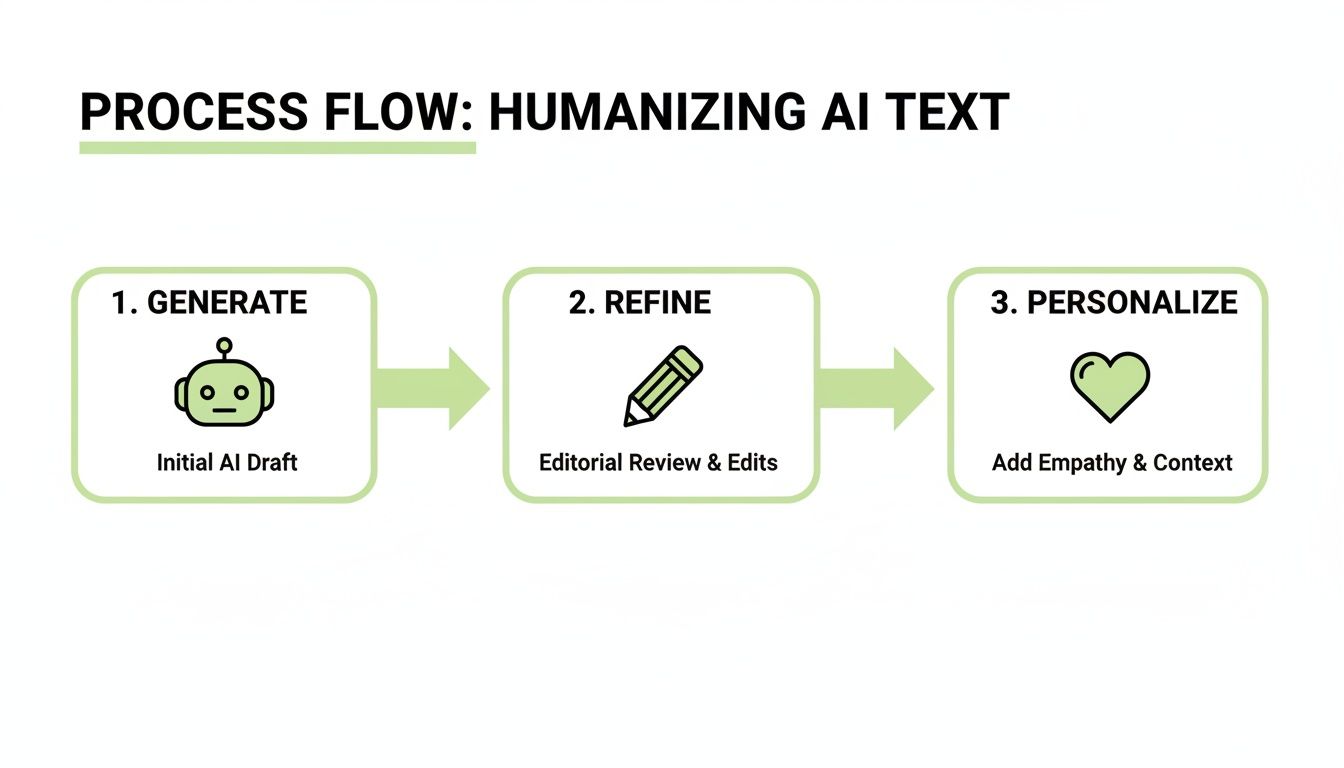
This process makes it clear that the AI draft is just the starting block. The real magic—and the real value—happens during the human-led refinement and personalization stages.
Refining the Structural Foundation of Your Draft
This is where the real work begins—the part that goes way beyond a simple spell check. To truly humanize AI text, you have to start with a structural teardown. The first thing you'll notice about most AI drafts is the dense, uniform paragraphs. They often look like impenetrable walls of text that make a reader’s eyes glaze over before they even start.
Your first mission is to improve readability by getting aggressive with your paragraph breaks. Aim for just one or two sentences each. This creates crucial white space, making the content feel less intimidating and a whole lot easier to scan. This isn't just a style choice; it's a fundamental edit that respects your reader's attention span.
Tackling Repetitive Sentence Starters
Once you’ve broken up the text into bite-sized chunks, the next robotic flaw usually becomes obvious: repetitive sentence structures. AI models love falling into predictable loops, starting sentences with the same old words like "Additionally," "Furthermore," or "In addition." This kind of predictability is a dead giveaway that a machine did the writing.
Fixing this means consciously varying your sentence openings. This simple change dramatically improves the rhythm and flow, making the whole thing sound more natural and conversational.
Let's look at a quick before-and-after.
AI-Generated Text (Before):
In addition, the system offers robust analytics. Furthermore, these analytics help track user engagement. Additionally, the dashboard is fully customizable.
Humanized Text (After):
The system offers robust analytics that are perfect for tracking user engagement. You can even customize the entire dashboard to fit your needs.
The difference is night and day. The human version combines ideas, ditches the clunky transition words, and reads like a genuine thought rather than a robotic list of features. If you want more tips on making this part of the process faster, check out our guide on how to write blog posts faster.
Simplifying Overly Complex Language
AI often tries to sound smart by using unnecessarily big words and tangled sentence structures. It's your job to act as a translator. Your goal is to simplify this language to make it clear, direct, and easy to understand. Swap out jargon for plain English and slice long, winding sentences into shorter, punchier ones.
Think of it like this: your goal isn't to sound smart; it's to make your reader feel smart. Clear and simple communication always wins.
This has become a huge deal in education, too. A 2025 survey showed that 88% of students now use generative AI for schoolwork like explaining complex topics and summarizing articles. That's a massive jump from just 53% the year before. It really underscores the growing need for people to translate dense, AI-generated text into clear, human-readable prose. You can see all the data in the full student generative AI survey.
By focusing on these foundational edits first—breaking up paragraphs, varying sentence starters, and simplifying complex language—you lay down a solid, readable structure. With this clean draft, you're now ready for the next stage: injecting your own unique voice and personality.
Giving Your Content a Soul: Your Authentic Brand Voice
Now that you have a clean, logical structure, it’s time for the magic. This is where you go from readable to memorable. To truly move beyond AI-generated text, you have to inject your unique brand voice—that distinct personality that turns a generic document into a genuine conversation.
Think of it this way: your brand voice is the consistent personality people come to know. Are you witty and playful? Authoritative and formal? Or maybe empathetic and supportive? An AI can only mimic a voice; it can’t have one. Your job is to make that mimicry feel like an authentic representation of who you are.
If you haven’t already, try to nail down three to five adjectives that describe how you want to sound. This becomes your compass for every edit you make from here on out.
Weave In Personal Stories and Scenarios
One of the fastest ways to build a connection with a reader is through storytelling. This is a massive weak spot for AI. It can't share a hard-won lesson from a past failure or an anecdote about a real-world client success. This is your chance to add immense value.
Look for spots in the draft where a short, relatable story can make a point better than a dry explanation ever could. Instead of just stating a fact, frame it within a personal experience.
- AI Version: "Using brand-specific terminology is important for consistency."
- Humanized Version: "I once worked with a client who kept using generic marketing terms, and their message got completely lost. We swapped them for their unique internal phrases, and suddenly, their content just clicked with their audience."
See the difference? That little story doesn't just explain the idea; it shows its real-world impact and makes your advice feel instantly more credible.
Write Like You Talk
Stiff, academic language is a dead giveaway of raw AI output. To make your content feel human, you need to loosen up. A great trick is to read your sentences out loud. Do they sound like something you'd actually say to a friend or colleague? If not, it's time to revise.
The goal is to make your reader feel like they're hearing from a real person, not a program. A conversational tone breaks down barriers and invites them in.
Here are a few simple ways to make your writing more conversational:
- Use Rhetorical Questions: Questions like, "But how do you actually do that?" pull the reader into a dialogue.
- Address the Reader Directly: Using "you" and "your" makes the content feel personal and immediately relevant.
- Swap Formal Words for Simple Ones: Ditch words like "utilize" for "use," or "subsequently" for "next."
This is a core part of the final polishing stage. For example, our tool HumanText.pro is designed to help you catch and refine these last robotic phrases to ensure your real voice comes through.

By focusing on these human elements, you transform that sterile AI draft from a simple information dump into a powerful tool for connection. You're not just editing words; you're adding your soul to the page.
Once you've nailed the basics—fixing the clunky phrasing and injecting your brand's voice—it's time for the final polish. This is where you elevate your content from merely "fixed" to genuinely compelling. These are the subtle, human touches that AI just can't replicate on its own, the kind that make your writing feel alive and memorable.

We're going beyond just grammar and flow. We’re getting into the techniques that engage a reader's senses and make complex ideas click.
Use Analogies to Make the Complex Simple
Let's be honest, AI can explain things, but it often does so in a painfully literal way. It gives you the "what" but completely misses the "it's like..." that creates real understanding. A good analogy is a shortcut to an "aha!" moment for your reader.
Think of it this way: AI gives you the raw recipe and ingredients. A human writer explains that folding the flour is like "gently tucking a baby into bed." One is just information; the other is a feeling, an understanding. That's where your creativity makes all the difference.
This push for more relatable, human-like AI content isn't a small trend. The global generative AI market is on track to blow past $66.62 billion by the end of 2025. That kind of money shows that making AI sound human is central to how businesses are innovating. You can read more about the booming generative AI market on mend.io.
Weave in Sensory Language
AI-generated text usually describes things factually, but it struggles to paint a picture. It tells you a room is "well-lit" but misses the "warm afternoon sun streaming through the window."
Your job is to add words that appeal to sight, sound, smell, taste, and touch. This simple layer can transform a dry, boring description into an experience your reader can actually imagine.
Turn Statistics into a Story
AI loves to drop stats into a paragraph like isolated facts. It's up to you to give them meaning and make them part of a narrative. Don't just state a number; explain why it matters to your reader.
For example, instead of a flat "75% of users prefer this feature," try something like, "Three out of every four people chose this feature for a reason—it saves them nearly an hour of work each day." By reframing the data, you make it more impactful and a whole lot easier to remember.
Data tells a story, but only if you give it a voice. Wrap your statistics in a narrative that highlights their significance and emotional impact.
Run a Final Check with a Humanizer Tool
Before you hit "publish," it's always a good idea to run one last check. After you've been staring at a document for a while, it’s easy to miss subtle robotic patterns that might still be lurking in the text.
This is where an AI humanizer tool like HumanText.pro becomes a crucial final step.
Just paste your edited text into the tool for an objective analysis. It can help you catch any last bits of awkward phrasing or predictable sentence structures you may have overlooked. Think of it as a quality control check that ensures your content is polished, natural, and ready to connect with your audience. It's the final step that lets you publish with total confidence.
Humanization Checklist Before You Publish
Before you send your content out into the world, run through this quick checklist. It's a final gut check to ensure you've truly transformed that AI draft into something that speaks to people.
| Checklist Item | Yes/No | Notes for Improvement |
|---|---|---|
| Does the introduction hook the reader with a unique idea, not a generic statement? | ||
| Have I replaced all jargon and corporate-speak with simpler, clearer language? | ||
| Does the tone match my brand's voice and the specific audience for this piece? | ||
| Have I added personal anecdotes, examples, or analogies to make it relatable? | ||
| Did I read the entire piece out loud to catch awkward phrasing? | ||
| Are the sentence structures varied (a mix of long and short)? | ||
| Is the formatting easy to scan (short paragraphs, bold text, lists)? | ||
| Does the conclusion leave the reader with a memorable takeaway or clear next step? |
If you can confidently check "Yes" on all of these, you're ready to publish. If not, the "Notes" column is your final to-do list for creating content that truly shines.
Common Mistakes to Avoid When Humanizing AI Content
Even with a solid workflow, it’s surprisingly easy to fall into a few common traps when you humanize AI text. Knowing what these pitfalls are from the start will save you a ton of time and lead to much better, more authentic content down the road.

One of the biggest issues I see is over-editing. You get so focused on making the text sound human that you accidentally sand away the core message or, even worse, introduce inaccuracies. Remember, the goal is to refine and polish, not rewrite the whole thing from memory.
Another frequent misstep is missing the subtle AI "tells"—those little robotic phrases and structures that sneak past a quick edit. They’re the dead giveaways that a machine wrote the first draft.
Spotting Lingering AI Tells
AI models have verbal tics, just like people. Once you learn what they are, you’ll see them everywhere. Keep an eye out for these:
- Hedging Language: Phrases like "it is important to note," "it can be said," or the classic "in conclusion" are pure AI filler. They add words but zero value. Just delete them.
- Excessive Formality: AI loves to sound smart by using complex words where simple ones work better. Swap out "utilize" for "use," "commence" for "start," and "facilitate" for "help." Your readers will thank you.
- Perfectly Uniform Lists: You'll notice AI-generated bullet points often have an unnatural symmetry. Every item is the same length and follows the exact same grammatical structure. Real human writing is a little messier, so vary your sentence structure and length.
The best humanization isn't about adding fancy words or complex sentences. It's about stripping away the robotic scaffolding to let a clear, simple idea shine through.
Forgetting to rigorously fact-check every single claim is another dangerous oversight. AI can and will present false information with complete confidence. You absolutely must verify every statistic, date, and "fact" it gives you. Treat every draft as a starting point, never a source of truth.
The Tone and Fact-Checking Problem
Finally, a major error is forcing a tone that just doesn't fit. If your brand is serious and authoritative, injecting a bunch of casual slang will feel jarring and fake. Tone needs to be consistent to build trust with your audience.
These mistakes are often why content still gets flagged by detectors, even after an edit. Perfecting your process is crucial, and our guide on how to avoid AI detection (https://humantext.pro/blog/how-to-avoid-ai-detection) dives deeper into strategies for creating content that truly reads like it was written by a person.
Think of each mistake as a learning opportunity. Spotting these issues sharpens your editing skills and makes your entire workflow more efficient. By staying mindful of these pitfalls, you can consistently transform AI drafts into compelling, trustworthy content that actually connects with your readers.
Got Questions? We've Got Answers
Even with a solid game plan, you're bound to run into a few questions. Let's tackle some of the most common ones we hear about making AI text feel human. This should help clear things up so you can edit with total confidence.
How Long Does It Really Take to Humanize a 1000-Word Article?
Honestly, it varies. If you know the topic inside and out and the AI gave you a decent starting point, you might be done in 30 minutes. If the draft is a mess or the subject is complex, it could easily take an hour or more.
A skilled editor isn't just swapping words; they're fact-checking, restructuring paragraphs, injecting personal stories, and adjusting the tone. The goal isn't just to be fast, but to be effective. Following a structured process like the one we've laid out here is the key to doing it efficiently.
Can AI Detectors Always Spot AI-Generated Text?
Nope. AI detectors aren't foolproof, not by a long shot. They're designed to hunt for patterns typical of machine writing—things like predictable sentence structures and a lack of linguistic surprise (what experts call low perplexity).
But here’s the catch: as AI models get smarter and editors get better at this process, the detectors struggle to keep up. The most reliable strategy is a one-two punch: do a thorough manual edit, then run it through a humanizer tool for a final polish. This combination makes it incredibly difficult for any system to flag your work.
The best way to beat AI detection isn't to trick the software. It's to create genuinely valuable, human-centric content that a detector simply can't distinguish from something written from scratch.
Is It Unethical to Use AI and Then Humanize It?
This comes down to accountability, not dishonesty. Using AI as a starting point—for brainstorming, outlining, or drafting—is quickly becoming standard practice. Think of it as a very advanced assistant.
The ethical line gets crossed when someone hits "generate" and publishes the raw, unverified output as their own expert work. The very act of humanizing AI text is what makes it ethically sound. You're fact-checking, adding your unique perspective, and ensuring the final piece is accurate and valuable. You’re taking a machine's draft and transforming it into a piece you can proudly stand behind.
Ready to transform your AI-generated content into natural, human-like writing? Humantext.pro instantly refines your text, ensuring it reads naturally and authentically. Try our free AI humanizer today →
Related Articles
AI Face Search Explained: Verify Identity and Stay Safe
Understand how AI face search works, including embeddings, accuracy, and legal issues. Learn to use these tools for personal safety and verify identity online.

Reverse Face Search: A Verification Safety Guide
Learn how reverse face search works, when to use it for safety, and how to pair it with AI image checks to verify online contacts and reused photos.

Face ID Search Explained: How It Works and How to Verify
Learn how face ID search works, why it differs from reverse image search, and how to verify identities and photos safely with practical checks and tools.

