Incorporating Paraphrasing Restating or Generating in New Form: A Guide
Learn incorporating paraphrasing restating or generating in new form so drafts stay clear, cited, and original. Step-by-step checks inside.
You've got a source open beside your draft, and your latest sentence still sounds suspiciously like the original. You replace a verb, swap an adjective, and read it again. It's smoother, but you're not sure it's yours.
That uncertainty is useful. When you're incorporating paraphrasing, restating, or generating in new form into your writing, fluency isn't the finish line. You need to preserve the meaning, build a different sentence, and make clear which ideas came from someone else.
Choose Paraphrase Summary or Quotation
Say your draft contains this borrowed-sounding sentence: Students who record excessive quotations during note-taking may reproduce excessive quotations in their final papers. Before reaching for synonyms, decide what job that material needs to do.
Does your reader need the reasoning, just the conclusion, or the author's exact expression? Those choices call for different methods.
Paraphrase, summary, and quotation at a glance
| Method | Length versus the source | Use it when | Citation |
|---|---|---|---|
| Paraphrase | About the same detail and length | Readers need the reasoning, but the sentence must fit your voice | Yes, always |
| Summary | Condensed to the central point | Only the conclusion or finding is needed | Yes, always |
| Quotation | Exact words inside quotation marks | The precise wording matters; keep quotes near 10 percent of a research paper | Yes, plus quotation marks |
Harvard's source-use guidance distinguishes a paraphrase, which normally preserves approximately the source passage's detail and length, from a condensed summary and an exact quotation. The practical benchmark in Purdue OWL's paraphrase exercises is that direct quotations should generally make up only about 10% of a final research paper, not that writers should fill a quota.
Match the method to the reader's need
Start with the paraphrase row. If your paragraph explains how note-taking affects drafting, keep the relationship between those actions. A restatement that mentions only excessive quotation would lose the useful explanation of where the problem begins.
For a client update, you might restate a selected methods passage in accessible language while preserving the details the client needs. If you compress an entire methods paragraph into a short sentence and discard supporting detail, you're probably summarizing. That's fine, provided the shorter version serves the reader.
The summary row fits a literature review that needs only a source's central finding. The trade-off is detail: you gain space, but readers can't inspect the original reasoning through your sentence alone.
Choose the quotation row when expression matters, such as a definition you're analyzing or a legal phrase whose wording affects interpretation. Copy the language accurately and attach the required citation. Don't quote merely because rewriting feels difficult.
Keep your voice separate from borrowed material
A personal essay presents a different challenge: outside language can crowd out the experiences and observations readers need from you. For that context, Mrs. College Counselor's essay guidance for college-bound students is a useful companion to source-use decisions.
Practical rule: Choose the method before changing the words. Otherwise, you can spend time polishing detail the paragraph never needed.
Open your current draft and mark each borrowed sentence P, S, or Q. Don't rewrite yet. First decide whether each sentence needs to preserve detail, condense an idea, or retain exact language.
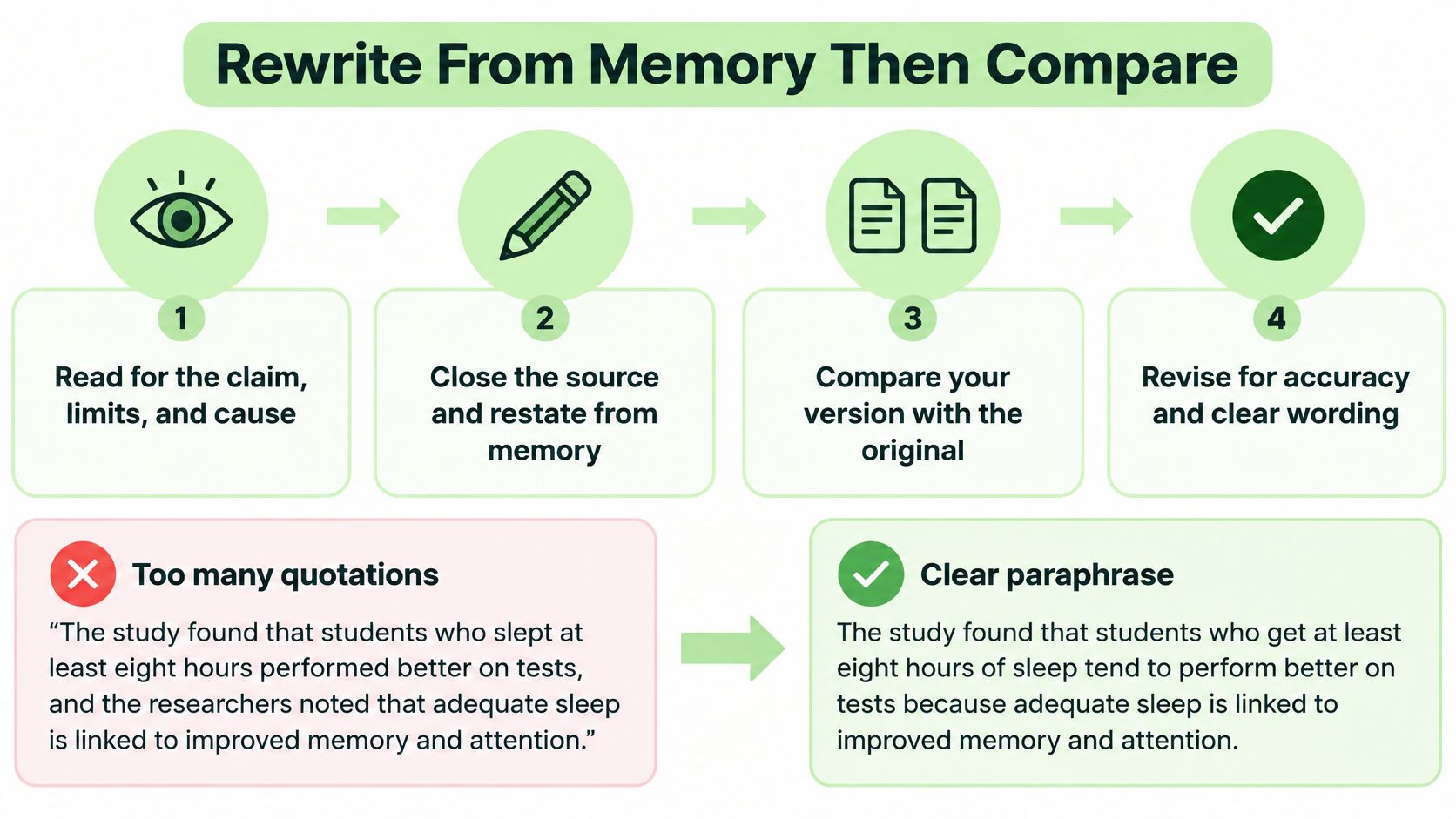
Rewrite From Memory Then Compare
The hardest habit to break is editing while staring at the source. Its sentence pattern stays in view, so your new version often follows the same path with different vocabulary.
A memory rewrite creates distance between understanding the idea and expressing it. You're not testing perfect recall. You're giving yourself room to build a sentence rather than decorate an existing one.
Separate understanding from drafting
Purdue OWL's paraphrasing guidance recommends setting the original aside, checking your rendition for accuracy, marking uniquely borrowed phrases with quotation marks, and recording source details.
Read for the claim, limits, and cause. Identify who does what, under which conditions, and with what degree of certainty. Note names, figures, and limiting words such as may, only, or some. The common slip is remembering the headline while forgetting the qualification.
Close the source and restate from memory. Explain the idea as you would to a classmate who hasn't read it. Try opening with the consequence when the source opens with the action. Don't replace technical terms just to appear different.
Compare your version with the original. Check each essential claim, including the actors and any causal relationship. If you've added a benefit, explanation, or recommendation that the source never supplied, remove it or identify it separately as your interpretation.
Revise for accuracy and clear wording. Repair omissions, quote distinctive language you retain, and save the full citation, including a page number when applicable. A correct sentence without recoverable source details creates avoidable work at submission time.
Use the process as a drafting loop rather than a one-way march toward completion.
Compare the sentence shape, not just the vocabulary
Consider this teaching passage, constructed to illustrate the note-taking problem:
Students who collect excessive quotations in their notes may carry that habit into their final papers.
| Weak synonym swap | Better restatement |
|---|---|
| Students who gather too many quotations in their notes may bring that habit into their final papers. | A quotation-heavy final paper can begin with the way a student takes notes: collecting passages to copy rather than ideas to explain. |
The weak version substitutes gather for collect and too many for excessive. The opening, clause order, and movement toward the final paper remain almost unchanged. That's patchwriting: working along the source's language instead of reconstructing the thought.
The better version begins with the consequence and then explains its connection to note-taking. It retains possibility rather than claiming that quotation-heavy notes always produce quotation-heavy papers. For an actual borrowed passage, the citation would remain attached.
There's a trade-off. The new sentence is more independent in structure, but its explanatory ending deserves close comparison with the actual source. If the source doesn't support that contrast between copying passages and explaining ideas, trim the ending.
Write from memory to gain independence. Compare with the source to regain precision.
Try this on a paragraph today, not the entire document. If you can't reconstruct the idea without peeking, return to reading and explain it aloud before drafting again. Difficulty restating a passage often means you haven't yet identified its central claim.
Score the Rewrite on Five Checks
Keep a rewrite only when it passes every check. Different vocabulary is useful evidence of revision, but it can't compensate for a changed claim, an unreadable sentence, or missing credit.
Use a pass-or-revise quality gate
Five checks before a restatement stays in the draft
| Check | Look at | Pass | Fail and redo |
|---|---|---|---|
| Semantic preservation | Claims, entities, numbers, negation, modality | Every essential point matches | A may became a did, or a figure moved |
| Structural transformation | Clause order, sentence breaks, grammatical frame | The shape is genuinely different | Only synonyms changed |
| Lexical diversity | Multiword sequences | Distinctive phrases are gone or quoted | A string of source words remains unmarked |
| Fluency and grammar | Agreement, cohesion, referents | It reads cleanly aloud | The new sentence is awkward or ambiguous |
| Attribution integrity | Citations and quotation marks | Source credit is still attached | Wording changed but the citation vanished |
Semantic preservation comes first because a polished error is still an error. Compare verbs and qualifications before judging style. May reduce describes a possibility; reduces presents a stronger claim.
Structural transformation asks whether you've rebuilt the explanation. You might change which idea leads, divide a crowded sentence, or turn an abstract noun into an action. Moving a phrase without changing the underlying sentence pattern isn't much of a transformation.
Lexical diversity doesn't mean banning necessary vocabulary. Keep terms such as citation, paraphrase, and established product names when they're the clearest choices. Focus on distinctive strings of borrowed expression, not a thesaurus-driven hunt for unusual substitutes.
Make controlled changes rather than random ones
In the student-paraphrasing study published by Universitas Suryakancana, 41.51% combined word substitution with word-order changes, while 45.28% used more than one strategy. The reported tendency toward substitution and condensation helps explain why writers need to practice structural changes deliberately.
Use this working rule: make at least two controlled transformations, then verify the result. That's an editing exercise, not a mathematical guarantee of originality.
- Change the starting point. Lead with the effect instead of the researcher, provided the emphasis remains faithful.
- Change the grammatical frame. Turn an abstract construction into an action, or reorganize related clauses.
- Check the cost. Confirm that the changes haven't hidden the actor, strengthened certainty, or removed a condition.
Read the result aloud for fluency. Pronouns deserve special attention: after combining sentences, they might refer to students, teachers, or tools. Replace the pronoun with the noun if readers would have to guess.
Try a worked semantic check
Suppose a source says a method may reduce overquotation. These margin judgments address meaning only; a complete pass still requires the other checks.
| Sample sentence | Margin judgment |
|---|---|
| This method reduces overquotation. | Revise: possibility became certainty. |
| This method may reduce overquotation. | Pass on meaning: the qualification remains. |
| This method prevents plagiarism. | Revise: both the outcome and strength changed. |
Use a short margin stamp: PASS when all checks hold; REVISE when any check fails. Don't average the results. Excellent grammar doesn't cancel an unsupported claim.
Keep Credit and Add Your Own Point
Changing wording doesn't transfer ownership of an idea. The practical failure is easy to miss: a writer produces an accurate, tidy restatement and then treats it as independent knowledge.
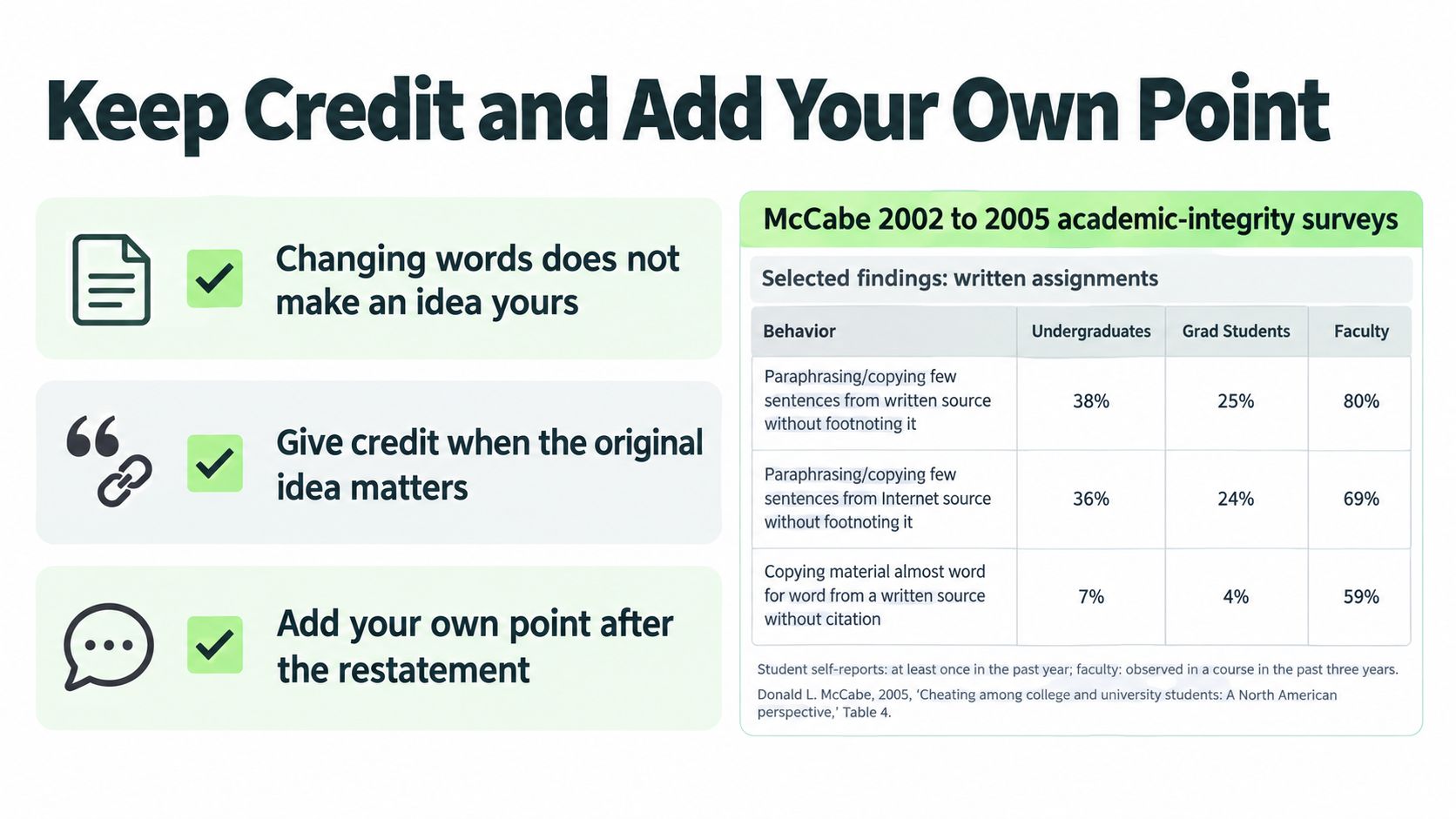
Donald McCabe's academic-integrity surveys, conducted from 2002 to 2005, documented students admitting the uncited behaviors listed below, as reported in Plagiarism.org's account of the surveys.
Survey figures on paraphrasing or copying without citation, 2002 to 2005
| Behavior | Undergraduates | Graduates |
|---|---|---|
| Paraphrasing or copying a few sentences from an internet source without a footnote | 36% | 24% |
| Paraphrasing or copying a few sentences from printed or written sources without citation | 38% | 25% |
| Copying material almost word for word without citation | 7% | 4% |
These historical self-reports describe admitted behavior, not the reasons students acted that way. They can support a discussion of uncited source use, but they don't establish that confusion, workload, or access to technology caused it.
Keep that distinction visible as you draft.
Build a paragraph with separate jobs
A useful paragraph gives borrowed evidence a purpose without letting it replace your thinking. Harvard's guidance on integrating sources recommends introducing source material in your voice and explaining how it contributes to your argument.
Use this sequence:
- Make your claim. State the point your paragraph will develop.
- Present the evidence. Add an accurate paraphrase with the detail your argument needs.
- Attach the citation. Make its scope clear rather than leaving readers to guess which sentence it supports.
- Interpret the evidence. Explain whether it supports, limits, or complicates your claim.
Here's a model built around the note-taking example. The citation label marks where the source reference belongs:
Writing instruction should address how students collect material, not just how they edit final drafts. A quotation-heavy paper may begin with note-taking practices that favor copying passages over explaining ideas (source citation). This suggests that asking students to restate an idea while taking notes could make later revision more manageable.
The opening is the writer's claim. The middle sentence carries the borrowed explanation. The final sentence proposes an instructional response and signals that it's an interpretation, not an additional finding from the source.
Add analysis without inventing evidence
Your contribution might identify a limitation, connect the evidence to a particular task, or explain why the finding matters. You don't need to manufacture a new cause or claim that the source proves your entire argument.
Keep technical terms when necessary, but rebuild the surrounding explanation. For help placing the reference correctly, use our guide to how to cite a paraphrase.
Margin test: Highlight borrowed material in one color and your commentary in another. A paragraph that's all evidence or all unsupported interpretation needs another pass.
As a conservative drafting habit, cite an idea you learned from a particular source rather than assuming that new wording makes it yours. Then ask what you want readers to understand about that idea. That answer is where your own point begins.
Treat AI Output as a Draft to Revise
A more human-sounding paraphrase can still be too close to its source. A model can smooth transitions while preserving the same argument sequence, repeating unsupported claims, or removing qualifications you needed to retain.
Review the draft beside the material it relies on, not just in a clean document window.
Separate authorship decisions from style changes
The U.S. Copyright Office's guidance on AI-generated material explains that copyright protects human creativity, that prompts alone are generally insufficient, and that sufficient human control over expressive elements can include creative arrangement or substantial modification. AI assistance also doesn't automatically prevent protection for the human-authored portions of a larger work.
That's a copyright question, not permission to submit AI-assisted work under every assignment or editorial policy. Check the applicable rules separately.
Keep a revision record that identifies your decisions:
- Structure: Explain why you reordered the argument or changed the opening.
- Selection: Note which examples you retained, rejected, or replaced.
- Verification: Record claims you checked against original sources.
- Expression: Save drafts showing meaningful changes to wording and emphasis.
For example, replacing a generic introduction with your own comparison and removing an unsupported conclusion shows more substantive judgment than accepting every suggestion. The point isn't to accumulate edits. It's to make deliberate choices you can explain.
When comparing drafting support, AIDictation's guide to writing assistants can help you consider the available options. Pair tool selection with clear boundaries about what assistance your assignment permits; our guide to AI writing assistance offers additional context.
Treat detector results as uncertain signals
A detector score can't settle whether a passage preserves meaning, credits its sources, or contains your own reasoning. In a 2025 NAACL study, a detector ensemble's accuracy fell from 0.7751 initially to 0.6816 on paraphrased samples.
That finding concerns a particular evaluation, not a universal error rate. It's enough to challenge the idea that a single score can prove authorship.
For another perspective on AI-assisted writing, consider the following video alongside your institution's or publisher's policy.
If scores conflict, examine draft history, source notes, citations, and the writer's ability to explain the argument. For teachers, a conversation about how the paragraph developed is more informative than an accusation based solely on a probability label.
Be especially cautious when evaluating non-native English writers whose prose sounds formal or formulaic. Don't ask them to make correct language less natural to satisfy a detector.
Never strip citations, insert deliberate mistakes, or scramble sentences to chase a preferred result. Those changes make the work harder to trust, regardless of what a tool reports.
Revise One Passage Before You Submit
Choose the paragraph that still sounds borrowed. Fixing that passage carefully will teach you more than running the entire document through another automatic rewrite.
Make a manageable revision
- Mark the source use. Label borrowed sentences P, S, or Q.
- Reconstruct the paragraph. Close the source and draft a different structure from memory.
- Apply the quality gate. Keep only sentences that pass every check.
- Finish the argument. Attach source credit and add your interpretation.
- Save your decisions. If you started with AI output, record the substantive changes you made.
Compare the completed paragraph with the original before moving on. If it's accurate but clumsy, work on improving writing clarity, not on making it artificially different.
Keep any automated pass optional
After your human revision, our AI-text humanizer, paraphrasing tools, and sentence, paragraph, and essay rewriters offer an optional polishing pass. The humanizer aims to preserve the original message while making the text sound human-written.
Our homepage describes the process as pasting your text, checking the AI score, and getting the humanized text. Treat that score as a risk signal, not permission to remove attribution. For unpublished student or client work, check the platform's privacy terms and any applicable sharing restrictions before pasting text.
Humantext.pro offers paraphrasing and rewriting tools for polishing a passage after you've checked its meaning and source credit. Visit Humantext.pro to try a revision, then compare the result with your source and keep only changes you can explain.
Ready to transform your AI-generated content into natural, human-like writing? Humantext.pro instantly refines your text, ensuring it reads naturally and authentically. Try our free AI humanizer today →
Related Articles
AI Content Checker: How It Works and What Scores Mean
How an AI content checker works, how accurate it is, where it fails, and how to read its score before you act on it.
AI Hype vs Reality: What Actually Works in 2026
AI Hype vs Reality in 2026: Which Claims Hold Up, Where AI Fails, and Realistic Timelines for Business Use
How to Test AI: Metrics, Bias Checks and Detector Tests
How to test AI outputs step by step: set metrics, run bias and robustness checks, and verify text, image, video and voice content.

