Your Guide to Using an AI Humanizer for Natural Sounding Content
Discover how an AI humanizer transforms robotic text into engaging content. Learn to improve SEO, refine your writing, and use these powerful tools effectively.
An AI humanizer is a tool that takes AI-generated text and polishes it to sound less robotic and more natural. It's more than a simple grammar check; it tweaks sentence structures, adjusts the tone, and varies word choice to mimic the subtle rhythms of authentic human writing, helping the content get past AI detection.
From Robotic to Realistic: What Is an AI Humanizer?

Have you ever read something from an AI and felt like something was just… off? The text is flawless on the surface—perfect grammar, solid facts—but it's missing a spark. It feels predictable, a little too uniform, and completely devoid of personality. Those are the classic tells of machine-generated content, and it's the exact problem an AI humanizer is built to fix.
Think of it like this: a computer can play a piano piece with perfect technical accuracy, hitting every single note correctly. But a skilled musician does more than hit the notes. They add soul. They play with the tempo, dynamics, and emotion, turning a mechanical sequence into a moving performance. An AI humanizer acts as that musician for your text, transforming a robotic draft into something that truly connects with a human reader.
Why Do We Even Need to Humanize AI Content?
The main issue with raw AI output is its predictability. AI models are trained to pick the most statistically likely word to follow the previous one. This creates content that often feels:
- Rhythmically Monotonous: Sentences all have similar lengths and structures, which makes for a flat, unengaging read.
- Lacking Nuance: The text often misses the subtle idioms, cultural references, and emotional undertones that people use without a second thought.
- Easily Detectable: AI detection algorithms are designed to spot these predictable patterns, flagging the content as machine-generated. This can be a real problem for SEO, academic submissions, and keeping your brand voice authentic.
This has led to a massive surge in demand for these tools, reflecting a broad need for content that feels genuine. For example, Undetectable AI shot up from 10 million to over 15 million users in a very short time, mostly driven by worries over AI content authenticity. Interestingly, many users were also concerned about detectors falsely flagging their own human-written work.
An AI humanizer doesn’t just swap out words. It reshapes the very rhythm and flow of the text. The goal is to introduce the beautiful imperfections of human communication, making the content more relatable and trustworthy.
By tackling these shortcomings, an AI humanizer becomes an essential editing partner. It bridges the gap between machine efficiency and human creativity, making sure the final product doesn't just inform, but actually engages and persuades its audience. You can learn more about this process in our deep-dive on the AI humanizer tool.
How an AI Humanizer Actually Works

To really get what an AI humanizer does, let's start with an analogy. Think of a simple AI paraphraser as a novice cook just following a recipe. It sees "salt" and swaps it for a "salt substitute"—a basic word-for-word exchange. The result is technically food, but it's bland and uninspired.
An AI humanizer, on the other hand, is like a master chef. The chef understands the chemistry of flavors and textures. They don't just swap ingredients; they recompose the entire dish, balancing acidity, adding crunch, and plating it beautifully.
That’s what a humanizer does. It doesn’t just change words. It fundamentally rebuilds the sentence structure, rhythm, and flow to make it feel like a person wrote it.
Finding the AI Fingerprint
First, the humanizer has to play detective. It hunts for the tell-tale signs of machine writing—the digital "fingerprints" that AI detectors are trained to spot. The two biggest clues are perplexity and burstiness.
Perplexity: This is a fancy term for how predictable text is. AI models are trained to pick the most statistically likely next word, which makes their writing very safe and, frankly, a little boring. Human writing is all over the place; we use weird phrases and unexpected turns, giving our text high perplexity.
Burstiness: This measures the variety in sentence length and structure. People naturally mix short, punchy sentences with longer, more descriptive ones. AI often falls into a monotonous rhythm where every sentence is about the same length. This lack of variation signals low burstiness.
The tool scans your text, flagging sections with low perplexity and low burstiness. These are the dead giveaways that a machine was involved.
Rebuilding with a Human Touch
Once the robotic parts are identified, the real work begins. The humanizer uses a whole toolbox of techniques to inject that messy, creative, human-like variability back into the text.
It’s not a single fix but a layered process. The tool systematically breaks down the predictable AI structure and rebuilds it with natural complexity and rhythm.
An AI humanizer is trained on millions of examples of authentic human writing—from blogs to books to conversations. It learns our rhythms, our idioms, and even our happy accidents, then applies those patterns to the machine-generated text.
This deep training is what allows it to go far beyond just rewording things.
Core Humanization Techniques
So, what’s happening under the hood? Here are the main methods a humanizer uses to transform your text:
Varying Sentence Structure: The tool actively dismantles monotonous sentence patterns. It might merge two short, choppy sentences into a more complex one or slice a long, rambling sentence in half for more impact. This directly boosts the text's burstiness.
Injecting Idiomatic Language: AI models usually steer clear of idioms and slang because they aren't statistically common. A good humanizer will intelligently add these phrases where they fit. For example, changing "it was very expensive" to "it cost an arm and a leg" instantly makes the tone more conversational.
Making Smart Vocabulary Changes: This isn't just a synonym swap. The tool chooses words that better fit the specific tone and nuance you're aiming for. It might replace a generic verb like "walked" with something more vivid like "strolled" or "trudged." Some advanced tools can even adjust word choices to hit specific readability scores, which is a huge deal for connecting with your audience.
Improving Flow and Transitions: Finally, the tool polishes the connections between your ideas. It adds smoother transition words and ensures one thought flows logically into the next, getting rid of that slightly disjointed feel that often plagues AI drafts.
By weaving all these techniques together, an AI humanizer does more than just hide the fact that AI wrote the first draft. It genuinely improves the writing, making it more engaging, persuasive, and much better at connecting with real people.
Who Needs an AI Humanizer, and Why?
The demand for authentic, human-sounding content isn't just a niche problem—it’s a reality across dozens of professional and academic fields. An AI humanizer plays a distinct, yet equally critical, role for marketers, students, and writers. Each group faces unique hurdles with AI-generated text, and a humanizer acts as the specialized tool to bridge the gap between machine efficiency and human connection.
For some, it’s about keeping a brand voice consistent. For others, it’s about making sure their own academic style shines through. The common thread? The need for content that actually connects with a real person on the other side of the screen.
Marketers and SEO Specialists
Content marketers are fighting for attention in a crowded space where engagement and search engine visibility are everything. Let's be honest, raw AI text often feels sterile and personality-free, which is the kiss of death for brand building. Worse, it can sometimes get flagged by AI detectors, which could potentially impact search rankings down the line.
An AI humanizer helps marketers clear these hurdles in a few smart ways:
- Keeps Readers Engaged: By smoothing out robotic sentences and injecting a more conversational feel, humanized content makes people want to stick around. That improved user experience sends all the right signals to search engines.
- Maintains a Consistent Brand Voice: A good humanizer can be tweaked to match a brand's specific personality. This ensures that blog posts, social media updates, and product descriptions all sound like they came from the same team.
- Sharpens SEO Performance: Content that reads naturally is just more likely to get shared and linked to. More importantly, it helps navigate the world of AI detection, lowering the risk of being deprioritized by search algorithms that might favor human-first content.
The market for AI-powered content tools is exploding, with projections showing growth from $2.15 billion to nearly $10.59 billion by 2033. As AI becomes a standard part of the toolkit, the need for tools that add that essential human touch back in will only get bigger. You can read more about the growth of AI humanizers on skywork.ai.
Students and Academics
In academia, clarity, originality, and integrity are non-negotiable. While AI can be a fantastic research partner, just copy-pasting its output is a fast track to problems with plagiarism checkers and academic dishonesty accusations. When used ethically, an AI humanizer is a powerful editing tool that helps students refine their work.
For a student, the goal isn't to have AI write their essay. It's to use AI as a starting point for research and then use a humanizer as a sophisticated editing tool to ensure the final draft reflects their own voice and understanding.
This isn't about cheating the system; it's about polishing the final product. The tool helps a student translate an AI-assisted outline or rough draft into an essay that genuinely sounds like them. This process strips away the generic, flat tone that academic integrity software often flags, helping to avoid false positives and ensuring the final paper is a true reflection of the student's own refined work.
Writers and Bloggers
For professional writers, bloggers, and content creators, an AI humanizer is less of a replacement and more of a powerful assistant. It’s not here to take over the creative process but to enhance it, especially when a deadline is looming or writer's block hits.
Think of it as the final coat of paint. A writer can structure their ideas and even get AI to help with a first draft. Then, the humanizer steps in to speed up the editing. It catches clunky phrases and improves the flow, freeing the writer up to focus on the things that really matter—storytelling, adding unique insights, and making sure the facts are straight.
By taking care of the sentence-level tweaks, the tool lets writers produce more high-quality content, faster, without watering down the unique voice that their audience loves. It's all about scaling up output while making sure every single article feels authentic and engaging.
As you can see, the core function of an AI humanizer—refining text to sound more natural—has different but equally valuable applications depending on who’s using it. The table below breaks down these benefits more clearly.
AI Humanizer Benefits Across Different Fields
| User Group | Primary Benefit | Example Use Case |
|---|---|---|
| Students & Academics | Preserving Academic Integrity & Voice | Refining an AI-generated research summary to match their personal writing style for an essay, ensuring originality. |
| Marketers & SEOs | Enhancing Engagement & SEO | Converting a generic, AI-written blog post into a conversational article that reflects the brand’s voice and keeps readers on the page longer. |
| Writers & Bloggers | Increasing Efficiency & Maintaining Quality | Quickly polishing a first draft of an article, fixing awkward phrasing so they can focus on adding personal stories and expert insights. |
Ultimately, whether you're trying to rank on Google, submit a paper, or publish your next viral blog post, the goal is the same: to communicate effectively. An AI humanizer is simply another tool in the modern writer's arsenal to help make that happen.
A Step-by-Step Guide to Humanizing Your Content
So, you have a robotic-sounding draft and you want to turn it into something that connects with real people. Perfect. The process is simpler than you might think, and it's less about a magic "fix it" button and more about a smart, repeatable workflow. Think of an AI humanizer as your brilliant assistant—it does the heavy lifting, but you're still the director.
We’ll walk through generating your first draft, guiding the humanizer, and then adding that final, irreplaceable human polish. This approach ensures your content not only flies past AI detectors but actually sounds like you and hits your goals.
Step 1: Generate Your Initial AI Draft
First things first, you need some raw material. Fire up your go-to AI writer—whether it's ChatGPT, Jasper, or Claude—and generate that initial draft. The goal here is just to get the core ideas, facts, and basic structure onto the page. Don't sweat it if the prose feels a little stiff or bland. That’s exactly what we’re here to fix.
This first step is the starting point for everyone, from marketers trying to nail their ad copy to students looking to smooth out an essay.
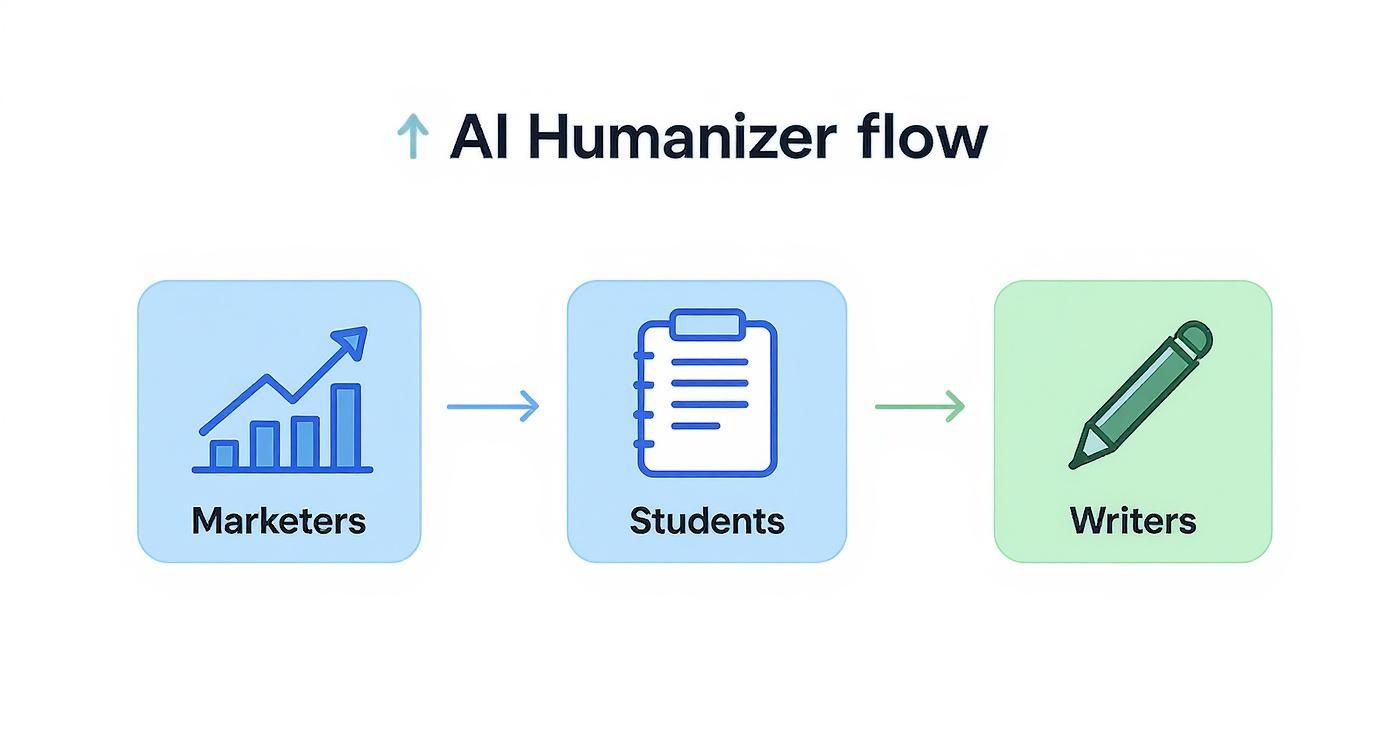
As you can see, whether you're chasing SEO rankings, academic integrity, or just trying to write more efficiently, the journey begins with that AI-generated text.
Step 2: Select Your Settings and Humanize
Got your draft? Great. Now, copy and paste it into your AI humanizer of choice. This is where you shift from creator to conductor. Before you hit that "Humanize" button, take a second to look at the settings. Most quality tools give you some control over the output. You can usually tweak things like:
- Tone: Are you aiming for professional, conversational, witty, or academic?
- Style: Is this for a blog post, a research paper, or some snappy marketing copy?
- Readability: Do you need simple, accessible language or something more technical for a niche audience?
Dialing in these settings is critical. It tells the tool how to rewrite, not just what to rewrite. It’s the difference between a simple word-swapper and a true writing partner that understands context.
Pro-Tip: Garbage in, garbage out. The clearer your initial AI draft is, the better your humanized version will be. A strong foundation makes all the difference.
Step 3: Review and Refine the Humanized Output
Once the tool has worked its magic, you'll get a revised text. While the results can be shockingly good, your work isn't quite done. This review stage is where you reclaim the content as your own. Read through the new version with a critical eye, checking for a few key things.
First, did the core meaning survive the trip? The goal is to improve the delivery, not change the facts. Next, read it out loud. Seriously. It’s the fastest way to catch awkward phrasing or a rhythm that just feels "off." For a deeper dive on this, check out our guide on converting AI to human text.
Finally, and most importantly, it's time to add your unique human touch. This is what makes the content truly yours.
- Inject Personal Anecdotes: Share a short, relevant story. What's an experience you had that an AI couldn't?
- Include Unique Insights: Add your expert opinion. What's a takeaway only you can provide?
- Verify Key Data: Always double-check stats and crucial facts. Make sure they're 100% accurate.
By layering your own expertise over the humanized draft, you create something that is not only original and valuable but completely undetectable. This final manual polish separates good content from truly great content.
Navigating the Ethics of Humanized AI Content
Let's be clear: using an AI humanizer isn't just about the technology—it's about responsibility. As these tools get smarter, they raise some serious ethical questions for everyone, from students burning the midnight oil to marketers on a deadline. The real issue isn't if you use one, but how you use it.
It all boils down to a simple but critical distinction: are you enhancing your own work or are you misrepresenting where it came from? Think of it this way: using a humanizer to polish an AI-assisted draft is like using a super-powered grammar checker. But using it to pass off a completely machine-written piece as your own original thought? That crosses a major ethical line.
Maintaining Academic and Professional Integrity
For students, that line is bright red. Universities have iron-clad policies on plagiarism and originality, and trying to disguise an AI-generated essay is a surefire way to violate them. The smart, ethical approach is to treat AI as your research assistant and the humanizer as a final editing tool, ensuring the work you submit genuinely reflects your own understanding and voice.
In the professional world, the stakes shift from grades to trust. If you're a writer or marketer, your clients and audience are paying for authenticity, not a clever machine. Transparency is everything. Using an AI humanizer to speed up your workflow is fine, but you're still the one accountable for the quality, accuracy, and originality of the final piece. And, of course, always follow your company's internal policies on AI use.
The goal of an ethical user isn't to deceive, but to improve. An AI humanizer should be a bridge to better communication, not a mask to hide behind. It’s a tool for refinement, not misrepresentation.
Adopting this mindset is crucial. It ensures that while you're working to make your content flow naturally, you're doing it for the right reasons—to boost quality, not to claim unearned credit. You can explore more strategies in our guide on how to make AI content undetectable ethically.
Recognizing the Limitations of Humanizers
Even the best AI humanizer isn't perfect. While it's great at tweaking sentence structure and tone, it is not a subject-matter expert. Relying on it completely can lead to subtle but significant problems that only a human eye can catch.
Keep these limitations in mind:
- Factual Inaccuracies: The tool might rephrase a sentence in a way that accidentally changes its meaning. Always, always double-check critical data, statistics, and claims.
- Loss of Nuance: A humanizer can't possibly grasp the deep, specialized context of your topic. It can sometimes sand down the expert nuance that makes your content truly valuable.
- Privacy Risks: The technology itself brings up valid concerns. In fact, a striking 63% of customers worry that generative AI might compromise their personal data. That's a huge number, highlighting the need to be cautious with the information you feed into these tools.
Ultimately, these tools are powerful assistants, not replacements for your brain. By understanding what they can do—and what they can't—you can use an AI humanizer effectively and ethically. That's how you build trust with your audience while creating high-quality, authentic content.
Common Questions About AI Humanizers
As AI writers become a standard part of our work, it’s only natural to have questions about the tools used to polish their output. An AI humanizer is a serious asset in any writer's toolkit, but it's smart to be curious about how it works, where its limits are, and its proper place in your workflow.
This section tackles the most frequent questions we get from students, marketers, and writers. Our goal is to give you clear, straight answers that cut through the noise and help you use these tools with confidence. We'll cover everything from beating detectors to the real difference between humanizing and just paraphrasing.
Can AI Detectors Still Flag Humanized Content?
This is the big one, and the honest answer is: it’s a constant cat-and-mouse game. While top-tier AI humanizers are incredibly good at rewriting text to fly under the radar of today's best detectors, the technology on both sides is always evolving. What works perfectly today might be a little less effective against a new algorithm tomorrow.
But the best strategy isn't just about fooling software. The most advanced humanizers focus on genuinely making the writing better. They work to increase the text's "perplexity" (making it less predictable) and "burstiness" (varying sentence length and structure), which are the core markers of authentic human writing. This approach is far more durable than just trying to find a temporary loophole.
For any content where the stakes are high—like a final paper or a major piece of marketing content—your last step should always be a manual review.
An AI humanizer should be your 95% solution. Your own critical eye and final polish provide the last 5%, ensuring the content is not only undetectable but also high-quality, accurate, and truly in your voice.
Think of it as a partnership. The tool gets you most of the way there, but your human touch is the ultimate seal of authenticity.
Is Using an AI Humanizer Considered Cheating?
Context is everything here. There's no single "yes" or "no" answer because what counts as cheating depends entirely on the rules of your environment and the expectations of your audience or institution.
Let's break it down by a couple of scenarios:
In an Academic Setting: Using a humanizer to disguise a paper written 100% by AI and passing it off as your own would almost certainly violate academic integrity policies. That’s a clear misrepresentation of your work. However, using it to refine an AI-assisted draft that you've already heavily edited and structured yourself? That falls into a grayer area, much like using a very advanced grammar checker. The key is intent and transparency.
In a Professional Setting: For marketers, writers, and other pros, the rules are different. Using an AI humanizer to get content created faster is generally fine, as long as you take full responsibility for the final product. Your client or boss trusts you to deliver accurate, effective content. As long as you fulfill that promise, the tools you use are usually your own business.
The golden rule is simple: always be transparent and follow the guidelines of your school or workplace. When in doubt, just ask.
What's the Difference Between an AI Humanizer and a Paraphraser?
This is a common point of confusion, but the distinction is critical. While both tools rewrite text, they work on fundamentally different principles and have very different goals. A standard paraphrasing tool has one main job: to rephrase text to avoid plagiarism. It does this by swapping out synonyms and shuffling sentence structures around.
An AI humanizer does a much deeper, more sophisticated analysis. It isn't just trying to avoid duplicate content; its primary mission is to erase the robotic fingerprints left by AI writing.
Here’s a simple table to lay out the key differences:
| Feature | Paraphrasing Tool | AI Humanizer |
|---|---|---|
| Primary Goal | Avoid plagiarism by rephrasing text. | Make AI text sound natural and bypass detection. |
| Core Method | Swaps synonyms and changes sentence order. | Analyzes and adjusts perplexity, burstiness, and flow. |
| Focus | Word-level and sentence-level changes. | Structural, rhythmic, and stylistic transformation. |
| Outcome | Text that is different but can still sound robotic. | Text that reads with a more authentic, human cadence. |
In short, a paraphraser changes the words. An AI humanizer changes the way the words feel, creating a much more natural reading experience.
Are Free AI Humanizer Tools Reliable?
Plenty of free AI humanizers are out there, and they can be a good place to start for casual use or for running very short bits of text. They offer a no-cost way to get a feel for how the technology works and can produce decent results for low-stakes tasks.
However, these free options almost always come with some serious strings attached. You'll often run into:
- Strict Word Count Caps: You might only be able to process a couple of hundred words at a time, making them useless for essays or articles.
- Less Advanced Algorithms: The tech behind free tools is often a generation or two behind premium versions. This means the output sounds less natural and is more likely to get flagged by detectors.
- Ads and Slower Speeds: Free services are usually cluttered with ads and can be slow to process your text due to heavy server loads.
- Limited Features: You probably won't get access to settings that let you control the tone, style, or purpose of the humanized text.
For any serious work—whether it’s professional marketing content, important school assignments, or projects for clients—investing in a premium tool is almost always the right call. Paid services deliver more reliable and sophisticated results, offer better privacy, and provide customer support, ensuring your final content meets a high standard of quality.
Ready to transform your AI drafts into undetectable, human-quality content? Humantext.pro uses advanced linguistic modeling to ensure your text bypasses AI detectors while preserving its original meaning and clarity. Try it for free today and see the difference for yourself at https://humantext.pro.
Ready to transform your AI-generated content into natural, human-like writing? Humantext.pro instantly refines your text, ensuring it reads naturally and authentically. Try our free AI humanizer today →
Related Articles
AI Face Search Explained: Verify Identity and Stay Safe
Understand how AI face search works, including embeddings, accuracy, and legal issues. Learn to use these tools for personal safety and verify identity online.

Reverse Face Search: A Verification Safety Guide
Learn how reverse face search works, when to use it for safety, and how to pair it with AI image checks to verify online contacts and reused photos.

Face ID Search Explained: How It Works and How to Verify
Learn how face ID search works, why it differs from reverse image search, and how to verify identities and photos safely with practical checks and tools.

