Ai Text Humanizer: Transform Robotic Copy into Natural, Engaging Content
ai text humanizer transforms robotic copy into natural, readable content - discover how it works and boost engagement in minutes.
Let's be honest: in a world suddenly flooded with AI-generated content, the demand for something that feels real has never been higher. An AI text humanizer is a tool designed to tackle this exact problem. It takes robotic-sounding AI writing and refines it, making it natural, engaging, and—crucially—undetectable by AI detectors.
Think of it as the bridge between machine efficiency and genuine human expression.
Why AI Text Humanizers Are Becoming Essential
The explosion of AI writing tools has created a new kind of headache. The content they produce, while fast, often feels lifeless and impersonal. It's missing the subtle rhythm, the varied sentence structures, and the unique voice that makes human writing connect with readers.
This robotic output isn't just a style issue; it's a real risk. Increasingly sophisticated AI detection systems are being used by search engines, universities, and content platforms. For anyone creating content, getting flagged can be a major setback.
An AI text humanizer acts like a specialized editor. It goes way beyond simple grammar checks or swapping out a few synonyms. Instead, it rewrites AI-generated drafts by analyzing and reworking the very patterns that give the text away as machine-made.
Think of it this way: An AI writer builds the frame of a house—it’s functional, but cold and empty. The AI text humanizer is the interior designer who comes in to add personality, warmth, and style, making it actually feel like a home.
This final step is becoming critical for anyone who relies on AI to help create content. It ensures the final product not only reads well but also holds onto its credibility and authenticity.
Bridging the Gap Between Robots and Readers
The core problem with raw AI text is its predictability. Because these models are trained on massive datasets, they tend to fall back on common phrasings and stiff, overly formal sentence structures. An AI text humanizer fixes this by:
- Varying sentence length and complexity to create a more dynamic, less monotonous reading experience.
- Introducing natural language elements, like idioms or contractions, where it makes sense to do so.
- Adjusting the tone and flow to perfectly match the intended audience, whether you're writing an academic paper or a casual blog post.
For marketers, students, and writers, this technology is a game-changer. It lets them produce high-quality, undetectable content without having to spend hours manually rewriting every sentence. If you're looking to produce content more efficiently, check out our guide on how to write blog posts faster.
By understanding what these tools do, you can use AI as a powerful assistant while making sure your final output is polished, engaging, and genuinely human.
How an AI Text Humanizer Actually Works
Ever wonder what's going on under the hood of an AI text humanizer? It’s not just a glorified thesaurus swapping out words. Think of it more like a skilled translator. But instead of turning Spanish into English, it translates stiff, robotic AI text into the kind of natural, flowing language a real person would write.
The process starts the moment you paste in your text. The tool immediately scans for common AI fingerprints—the little giveaways that scream "a machine wrote this." We’re talking about things like predictable sentence structures, a boring rhythm, and an over-reliance on formal, almost sterile vocabulary. These are the exact patterns that AI detection algorithms are trained to sniff out.
Once it has a map of the robotic weak points, the real magic begins. The humanizer doesn't just paraphrase; it performs a deep-level rewrite, overhauling the style, tone, and structure from the ground up.
The Transformation Process
At its core, the technology is all about mimicking the beautiful, natural messiness of human writing. It’s not about perfection; it’s about authenticity. This is done through a few key adjustments.
- Sentence Structure Variation: The tool actively breaks up monotonous sentence patterns. It will mix short, punchy statements with longer, more descriptive ones to create a rhythm that feels natural to a human reader.
- Vocabulary Enrichment: Forget generic AI words. A good humanizer digs deeper, replacing them with more nuanced, context-aware language. It often sprinkles in common idioms or conversational phrases to add that essential human touch.
- Tone and Flow Adjustment: The tool can shift the entire vibe of the text. It can take something that sounds like an academic paper and make it casual, professional, or persuasive, making sure the whole piece flows logically from one idea to the next.
This diagram gives you a simple visual of how it works—taking that clunky AI output and refining it into something polished and human.
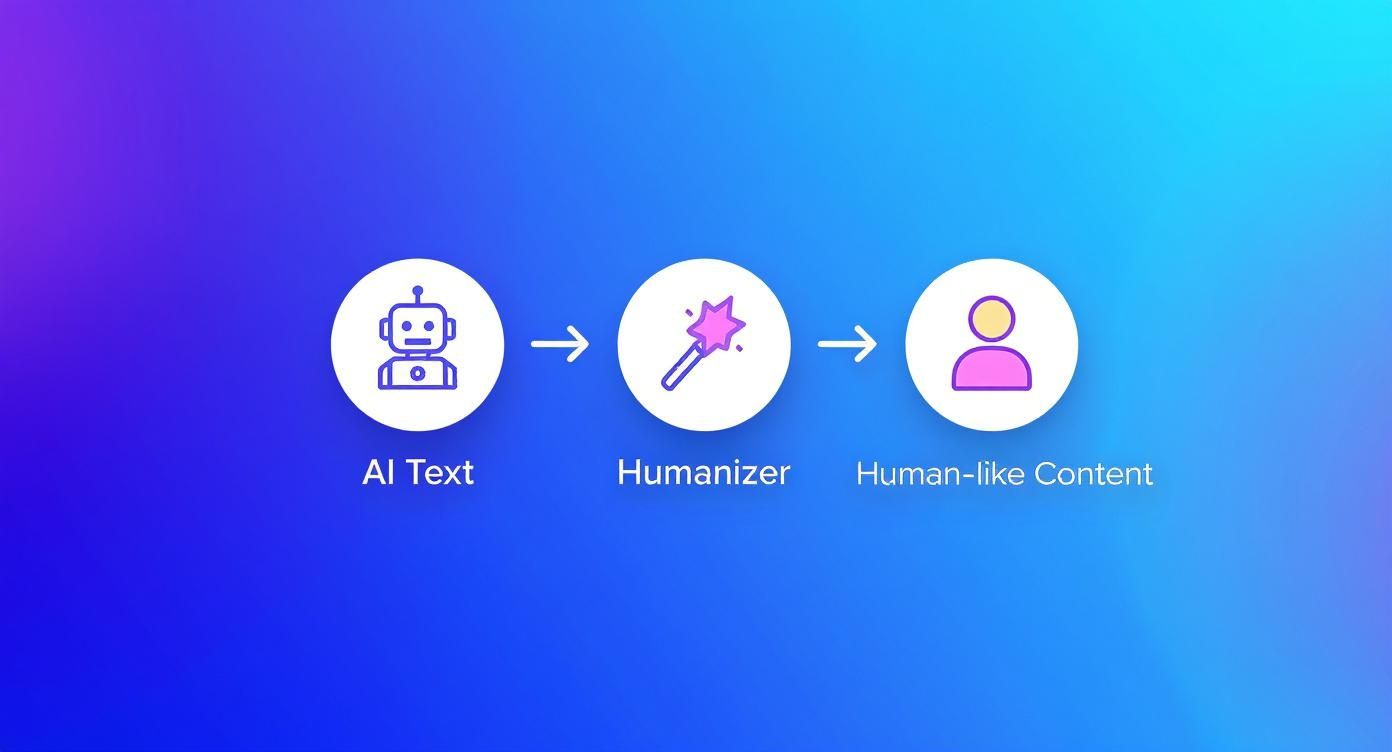
It’s a neat summary of a complex process, showing the humanizer as that crucial bridge between raw AI generation and content that actually connects with people.
Bypassing Detectors with Stylistic Changes
Just how effective is this? Pretty impressive, actually. One detailed study analyzing over two million humanized texts found that top-tier tools can achieve up to a 98% success rate at bypassing major AI detectors like Turnitin and GPTZero.
But it's not just about fooling detectors. The same study showed that these tools improve the natural flow and readability of text by about 73% on average, all while maintaining 100% of the original meaning and facts. You can dig into the numbers yourself and read the full research on AI humanizer effectiveness.
In essence, an AI text humanizer deconstructs the robotic blueprint of AI-generated content and rebuilds it using the principles of human communication. It adds the subtle imperfections and stylistic quirks that make writing feel authentic and trustworthy.
By fundamentally changing the text's structure, vocabulary, and tone, the final output doesn't just resonate better with your audience—it also sidesteps the pattern-matching algorithms that AI detectors rely on. This dual-purpose power is what makes these tools a must-have for anyone serious about creating content today.
What Are the Real Benefits of Using a Humanizer?

It’s one thing to understand how an AI text humanizer works, but the real question is: what can it actually do for you? What's the payoff?
The most immediate win is its power to sail past AI detectors. In a world where authenticity is king, having your work flagged as AI-generated can hurt your credibility, get you penalized in school, or even ding your search engine rankings. A humanizer is designed to spot and rewrite the robotic patterns these detectors are trained to find, giving you content that reads like it was written by a person, for a person.
But it goes deeper than just dodging detectors. Humanized content genuinely performs better, especially for SEO. Search engines like Google are obsessed with user experience. When a humanizer smooths out clunky, robotic text, it improves readability and flow, which keeps people on your page longer. These are powerful signals that tell search engines your content is the real deal, worthy of a higher spot in the rankings.
To see the difference in action, let's break down the "before and after" of using a humanizer.
This table shows how a typical piece of AI-generated text transforms into something much more effective once it's been humanized.
AI-Generated Text vs Humanized Text
| Characteristic | Standard AI-Generated Text | Humanized AI Text |
|---|---|---|
| Flow & Readability | Often disjointed, with predictable sentence structures. | Smooth and natural, with varied sentence lengths and better transitions. |
| Tone & Voice | Tends to be generic, neutral, and lacking in personality. | Adapts to a specific voice—conversational, professional, or academic. |
| Word Choice | Relies on common, repetitive words and phrases. | Uses more nuanced vocabulary and avoids AI clichés. |
| Engagement | Can feel dry and distant, failing to connect with the reader. | More engaging and persuasive, building a connection with the audience. |
| AI Detector Score | High probability of being flagged as AI-generated. | Low to zero probability of detection, reads as human-written. |
As you can see, the shift isn't just cosmetic. It's about turning a functional but lifeless piece of text into content that truly connects and performs.
Must-Have Features in a Great Humanizer
Not all humanizers are built the same. If you're looking for a tool that will genuinely improve your workflow and output, there are a few key features you should never compromise on.
Here’s what separates the good from the great:
- Multiple Writing Modes: A top-tier tool lets you switch between different tones. Need to sound academic for a research paper? Done. Conversational for a blog post? Easy. This flexibility is non-negotiable for anyone creating content for different audiences.
- Core Message Preservation: The best humanizers don't just swap out words. They intelligently restructure sentences and paragraphs while keeping your original meaning perfectly intact. Your facts and key points remain accurate, just presented better.
- Multilingual Support: If you have a global audience, the ability to humanize text in different languages is a game-changer. It helps you maintain a consistent, authentic voice no matter where your readers are.
These tools are at the heart of a massive industry shift. The generative AI content market is expected to rocket from $14.8 billion to over $80.12 billion by 2030. Within that boom, humanizers with versatile writing modes are leading the charge, with some platforms reporting user satisfaction rates as high as 93%. You can discover more insights on the growth of AI content tools and see the impact for yourself.
But the single biggest benefit? Pure, unadulterated efficiency. An AI text humanizer saves you countless hours of painstaking manual editing. It turns a mind-numbing rewrite into a task that takes just a few seconds.
This is huge. It lets writers, marketers, and students produce more content without sacrificing the quality or unique voice that makes people pay attention. It handles the most tedious part of working with AI, freeing you up to focus on the things that really matter—like strategy, research, and big-picture creativity.
Real-World Applications for Different Users

The theory behind an AI text humanizer is interesting, sure, but its real magic happens out in the wild. Different people have different content headaches, and this is where the tool becomes more than just a novelty—it becomes a core part of how things get done.
Whether you're a one-person shop or part of a huge team, the pressure for authentic, high-quality content is universal. You can see this demand reflected in the numbers. The generative AI market, which includes these humanizing tools, was pegged at around $66.89 billion and is expected to rocket to $442.07 billion by 2031. More telling is the user base for humanizers, which has already blown past 15 million globally—a massive jump from 10 million just the year before. You can discover more insights about AI marketing statistics to see how deeply these tools are weaving into the industry.
This explosive growth isn't just a trend. It's a direct answer to real needs in different professional fields. Let's dig into a few of them.
For Content Marketers and SEO Specialists
In marketing, content is currency. For anyone in this space, an AI text humanizer is a game-changer for creating blog posts that don't just rank, but actually connect with people. By sanding off the robotic edges and giving the text a natural rhythm, it can directly improve SEO metrics like dwell time and user engagement.
This process helps marketers do three critical things:
- Scale content creation without sounding like a broken record or losing the unique brand voice that builds trust.
- Enhance readability, making complicated subjects easy to digest and keeping visitors on the page longer.
- Slash editing time, freeing up hours that are better spent on strategy and promotion.
The end result is content that feels genuine, climbs higher in search results, and ultimately brings in more organic traffic and conversions.
By turning generic AI output into a compelling story, marketers can keep up with a demanding publishing schedule while making sure every single article feels like it was written for a real person.
For Students and Academics
In the academic world, the way you write and the originality of your work are everything. Students often turn to AI for brainstorming or drafting, but submitting that raw output is a recipe for a bad grade or even an academic integrity flag. An AI text humanizer acts like a sophisticated writing partner, helping to sharpen style and improve clarity.
A student can take an AI-generated draft and use the tool to transform clunky sentences into polished, academic prose that actually reflects their own understanding. Let’s be clear: this isn't about cheating. It's about using a tool to elevate the quality of your own writing, ensuring the final paper is clear, well-structured, and doesn't have the tell-tale AI fingerprints that detection software like Turnitin might spot. It's about polishing the final product while keeping the student's original research and ideas intact.
Ethical Considerations and Responsible Use
Let's be clear: like any powerful tool, an AI text humanizer comes with a responsibility to use it the right way. The core principle is simple: these tools are for enhancement, not deception. Think of it as a sophisticated co-pilot that helps you refine and polish your writing, not a shortcut for passing off someone else's work as your own.
This distinction is absolutely critical, especially in academic and professional settings. For a student, there's a huge difference between improving the style and flow of a well-researched essay versus trying to hide the fact that you didn't write the core content in the first place. One is smart editing; the other is academic dishonesty.
The goal is to elevate your own work, not to misrepresent its origin. Responsible use means taking full ownership of the final product—including its ideas, its facts, and its accuracy.
Upholding Integrity and Authenticity
For professionals, ethical use is all about maintaining your brand's integrity and accuracy. An AI text humanizer can definitely speed up content creation, but the final output still has your name—or your company's name—on it. That means the job of fact-checking and ensuring the content truly reflects your brand's voice remains firmly in your hands.
To keep your work authentic and credible, stick to these best practices:
- Always Review and Edit: Never, ever publish humanized text without giving it a thorough final read. You're the final judge of factual accuracy, tone, and overall quality.
- Take Full Ownership: At the end of the day, the final piece is your creation. You are accountable for its message, its claims, and the impact it has on your audience.
- Avoid Academic Misconduct: If you're a student, use these tools to learn how to improve your writing style on your own work. Don't use them to try and get around plagiarism rules or submit AI-generated assignments.
Ultimately, an AI text humanizer is a powerful assistant for refining your message and making sure it connects with real people. To learn more about creating content that stays authentic while still getting past detectors, you might want to read our guide on how to make AI content undetectable the right way. By using it as a final polish rather than a ghostwriter, you build credibility and produce work that is both high-quality and ethically sound.
Your Practical Guide to Using an AI Text Humanizer
So, you’re ready to see how this actually works. Let’s get into it.
Getting started is refreshingly simple. The whole process boils down to a quick, three-step routine you can use for any piece of content. This is how you take a clunky AI draft and turn it into something polished and natural-sounding in just a few moments.
First, you need your raw material. This is the text straight from your AI of choice—whether that's ChatGPT, Gemini, or another tool. Don't stress about making it perfect at this stage. Just get all the main ideas and facts down on the page.
Then, you bring that draft into the humanizer.
The Humanization Workflow
This is where the magic happens. Following a consistent process is the key to getting great results every single time, letting you skip hours of tedious manual editing.
- Generate Your Base Text: Use your favorite AI writing assistant to create the first draft of your article, essay, or report. The goal here is just to cover all your key points and information.
- Copy and Paste: Grab the entire AI-generated text and paste it directly into the input box of an AI text humanizer like HumanText.pro.
- Humanize and Review: Hit the button and let the tool work. It will instantly get to work rewriting your content, varying sentence structures, swapping out common AI word choices, and smoothing out the robotic rhythm.
Here’s a look at the simple, clean interface. You drop your text on the left and get the humanized version on the right.
This side-by-side layout is perfect for a quick comparison, so you can immediately see the stylistic improvements the tool made.
The Final Human Touch
Now, this last step is non-negotiable, even with the best technology. Always give the output a final read-through. This is your chance to make sure the text sounds exactly like you and meets your standards.
Scan for any lingering awkward phrases the tool might have missed, and most importantly, double-check that all your facts and key details are still accurate.
Remember, the goal of an AI text humanizer is to assist, not replace. A quick final read-through ensures the content is not only undetectable but also genuinely high-quality and true to your original intent.
This final check is what separates good content from truly great content. For a more detailed look at this process, check out our guide on how to effectively convert AI text to human writing.
When you blend the speed of AI with your own personal oversight, you get authentic, engaging content that actually connects with your audience.
Frequently Asked Questions About AI Text Humanizers
New technology always brings up good questions. When you're thinking about using an ai text humanizer, you want to make sure you know exactly what you're getting into. Let's clear up some of the most common questions we hear.
Getting these answers straight will help you use these tools the right way—effectively, ethically, and without any lingering doubts.
Can Humanized Text Still Be Detected by AI Checkers?
This is the big one, and the honest answer is: it’s an ongoing cat-and-mouse game. High-quality humanizers do an incredible job, often hitting success rates of 98% or higher against major detectors like Turnitin and GPTZero. They work by fundamentally changing the statistical patterns and predictable structures that AI checkers are trained to spot.
However, anyone promising a permanent, 100% foolproof guarantee isn't being realistic. AI detection is always getting smarter, and in response, humanizers are constantly evolving. Think of a humanizer as your most skilled editor, not an invisibility cloak. The best practice is to use the tool to do the heavy lifting, then give it a final read-through to add your own personal flair.
Is Using an AI Text Humanizer Cheating or Plagiarism?
This all comes down to intent. Are you enhancing your own work or trying to pass off someone else's (or some AI's) as your own original thought?
Using a humanizer to polish your own researched draft—to make it flow better, sound more natural, and connect with your audience—is just smart editing. It’s not much different from using a grammar checker to fix mistakes or a thesaurus to find a better word. The core ideas are still yours.
The ethical line is crossed when you use a tool to disguise AI-generated content that you're submitting as your own original work, especially in school. It's about making your work better, not faking it.
Always, always follow your school's or company's academic integrity policies. The responsible way to use an ai text humanizer is to elevate your own ideas, not to skip the hard work of research and critical thinking.
How Does Humanizing Content Affect Its SEO Value?
While it's not a direct ranking factor, humanizing your AI text has a huge positive impact on your SEO. Search engines like Google are obsessed with user experience. If your content sounds robotic and clunky, people will click away immediately. That sends a strong signal to Google that your page isn't helpful.
A good humanizer boosts the metrics that search engines care about:
- Increased Dwell Time: When content is natural and enjoyable to read, people stick around longer.
- Lower Bounce Rate: Engaging writing keeps users on the page instead of making them hit the "back" button.
- Improved User Satisfaction: Content that truly connects with people is far more likely to get shared and earn valuable backlinks.
Bottom line: when you make your content better for human readers, you're also making it much more appealing to the algorithms that decide who ranks first.
Ready to turn your AI drafts into undetectable, engaging content? HumanText.pro gives you the power to humanize your text in seconds, bypass AI detectors, and connect with your audience. Try it for free today!
Ready to transform your AI-generated content into natural, human-like writing? Humantext.pro instantly refines your text, ensuring it reads naturally and authentically. Try our free AI humanizer today →
Related Articles
AI Face Search Explained: Verify Identity and Stay Safe
Understand how AI face search works, including embeddings, accuracy, and legal issues. Learn to use these tools for personal safety and verify identity online.

Reverse Face Search: A Verification Safety Guide
Learn how reverse face search works, when to use it for safety, and how to pair it with AI image checks to verify online contacts and reused photos.

Face ID Search Explained: How It Works and How to Verify
Learn how face ID search works, why it differs from reverse image search, and how to verify identities and photos safely with practical checks and tools.

