Your Complete Guide to Making AI Content Undetectable
Learn to create AI-generated content responsibly with transparency and detector-friendly practices. Discover guidelines for trustworthy AI outputs.
To make AI-generated content truly undetectable, you have to do more than just swap out a few words. You need to fundamentally reshape its robotic DNA into something that reads, feels, and flows like it was written by a human. This means getting your hands dirty with a strategic editing process—varying your sentences, injecting a real voice, and picking words with intention.
It's a process that can be sped up with tools like HumanText.pro, but the goal is always the same: to transform that sterile first draft into content that not only bypasses detectors but actually connects with a reader.
Why AI Content Gets Flagged and What to Do About It
Ever spend time guiding an AI to produce a draft, only to see it immediately flagged by a detector? It’s a maddeningly common experience. For students navigating academic integrity rules or marketers watching their content get buried by search engines, AI detection can feel like a major roadblock.
The truth is, even the most advanced AI models have "tells." They lean towards overly uniform sentence lengths, predictable vocabulary, and a formal, almost sterile tone that lacks the natural rhythm of human writing. AI detectors are built specifically to sniff out these giveaways.
The Real-World Consequences
Getting your content flagged isn't just a technical failure; it has real, tangible consequences. A blogger, for example, might see their articles penalized by search engines that prioritize an authentic user experience. A student could face tough questions about academic integrity, even if they only used AI ethically for brainstorming or creating an outline.
Here's what is often on the line:
- Damaged Credibility: Nothing erodes an audience's trust faster than content that feels like it was churned out by a machine.
- Poor SEO Performance: Google's algorithms are getting smarter about identifying and downranking content that seems robotic or created just to game the system.
- Academic Misconduct: In any school setting, submitting AI-generated text as your own can lead to serious academic penalties.
Humanization: The Modern Solution
The answer isn’t to ditch AI altogether, but to treat its output as a starting point. This is where "humanization" comes in. It’s the art of editing an AI draft to infuse it with your unique voice, your perspective, and your style. This isn't about deception; it's about elevating a machine's draft to a human's standard of quality.
The core idea is simple: treat AI as a brilliant but unpolished assistant. Your job is to be the editor-in-chief, adding the nuance, emotion, and creative spark that technology simply can't replicate.
Think of it like this: AI gives you the raw lumber—the basic structure and facts. You, the human editor, are the carpenter who cuts, shapes, and sands that lumber into a finished piece of furniture. This thoughtful editing process, sometimes accelerated with specialized tools like HumanText.pro, is how you create content that is not just undetectable, but genuinely worth reading.
How AI Detectors Spot Artificially-Generated Content
To consistently get your AI-assisted content past detectors, you have to learn to think like they do. These aren't magic boxes; they're sophisticated pattern-recognition tools fed a massive diet of human and AI writing. Over time, they've learned to spot the nearly invisible fingerprints that AI leaves behind.
AI models often create text that is, for lack of a better term, too perfect. They function by predicting the most probable next word in a sequence. This creates sentences that are grammatically flawless but completely lack the spark and occasional weirdness of human expression. That statistical predictability is a dead giveaway.
The whole game is about transforming that robotic, flagged text into something that reads like it was written by a person. This flowchart breaks down the basic process:
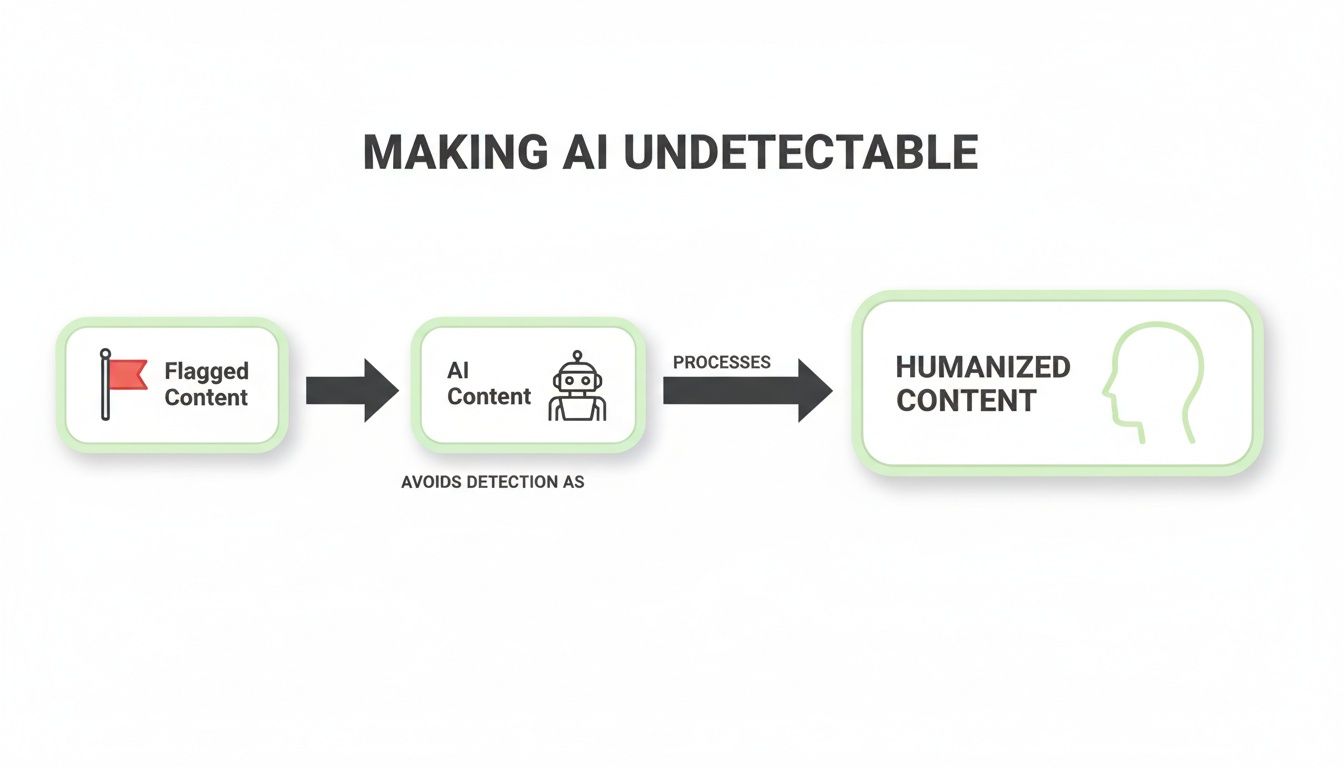
That middle step—the humanization—is where the real work happens. It's the bridge that takes your content from the "flagged" pile over to the "human-written" side.
Perplexity and Burstiness: The Two Telltale Signs
AI detectors lean heavily on two key metrics: perplexity and burstiness. They sound a bit academic, but the ideas behind them are actually pretty simple.
- Perplexity is just a fancy way of measuring how predictable text is. An AI's output usually has low perplexity because it sticks to common words and simple sentence structures. Human writing, full of surprises and more complex vocabulary, has high perplexity.
- Burstiness measures the rhythm and flow of your sentences. Humans write in bursts—a short, punchy sentence followed by a long, winding one, then a medium one. AI models tend to produce sentences of uniform length, creating a monotonous, robotic rhythm that detectors can spot a mile away.
Think of it like a heartbeat. A real human heartbeat has a slightly irregular rhythm, speeding up and slowing down. An AI writes like a flawless metronome, ticking along at a perfectly steady pace. That unnatural consistency is what gets it flagged every time.
To fly under the radar, you have to deliberately shatter these patterns. That means injecting your personal style, varying sentence length, and swapping out predictable words for more interesting ones.
This has become a constant cat-and-mouse game. As detectors get smarter, our editing has to get sharper. Industry experts agree that the only real long-term strategy is to focus on quality, originality, and a solid editorial pass—not just trying to trick the software. Well-edited content with a clear point of view and natural variation is simply much less likely to trigger an alert. If you want to go deeper, there's some fascinating research behind artificial writing and its detection.
The table below breaks down the common AI writing traits and how to swap them for more human-like alternatives.
AI Writing Patterns vs Humanized Alternatives
| AI Writing Trait | Why It Gets Flagged | Humanized Alternative |
|---|---|---|
| Uniform Sentence Length | Creates a robotic, monotonous rhythm. Lacks natural "burstiness." | Mix short, direct sentences with longer, more complex ones to create a varied cadence. |
| Predictable Word Choice | Uses the most statistically common words (low perplexity). Sounds generic and bland. | Introduce unique vocabulary, idioms, and even industry-specific jargon. Use a thesaurus for inspiration. |
| Flawless Grammar & Syntax | Text is often too perfect, lacking the minor imperfections and stylistic choices of human writing. | Use contractions (it's, you're). Occasionally start sentences with "And" or "But." Use fragments for effect. |
| Overly Formal Tone | Defaults to a formal, academic tone, avoiding personal pronouns and conversational language. | Inject your personality. Use "I," "we," and "you." Ask rhetorical questions to engage the reader directly. |
| Generic Transitions | Relies on clichéd transitions like "In conclusion," "Furthermore," or "Moreover." | Use more natural segues like "But here's the thing," "Now, let's talk about," or simply start a new paragraph. |
| Lack of Personal Experience | Content is purely informational, with no anecdotes, opinions, or personal stories. | Weave in real-world examples, personal experiences, or strong opinions to add authenticity and credibility. |
By consciously editing for these "humanized" traits, you're not just tricking a detector; you're fundamentally improving the quality and readability of the content.
Create a Quick Personal Style Guide
One of the most effective ways to humanize AI text is to develop a personal style guide. This isn't some massive, formal document. Think of it more as a simple checklist of your unique writing quirks that you can glance at before you start editing.
Your guide might include things like:
- Your Preferred Tone: Are you witty and informal? Authoritative and direct? Conversational?
- Your Go-To Phrases: Do you have certain transitions or sayings you use all the time? (e.g., "The bottom line is...")
- Your Cadence: Do you like starting paragraphs with a short, sharp sentence?
- Words You Hate: Are there robotic words like "utilize," "leverage," or "delve" that you always swap out?
By consciously filtering an AI draft through your personal style, you overwrite its generic patterns with your own voice. This makes the content authentically yours and much more difficult for any algorithm to flag. A tool like HumanText.pro is built to analyze text for these very patterns, giving you a baseline score before you even start editing. That initial check is a huge help—it tells you exactly where to focus your energy.
Your Manual Editing Workflow for Authentic Content
This is where the real work begins. Turning a flat, robotic AI draft into something that sounds genuinely human isn't a single trick—it's a layered editing process. By focusing on a few key areas, you can systematically erase the tell-tale signs of AI and inject your own voice, making your content truly undetectable.
The goal here is simple. First, break the monotonous patterns AI detectors are trained to find. Second, infuse the text with the personality and nuance that convinces a human reader they're in good hands.
Master the Art of Sentence Variation
The most glaring flaw in AI writing is its predictable rhythm. AI models love churning out sentences of similar length and structure, creating a monotonous flow that just screams "robot." Your first job is to shatter that uniformity.
Think of your content like a piece of music. It needs a beat—a mix of short, staccato notes and longer, flowing melodies.
- Combine short, punchy sentences to make a strong point.
- Follow up with a longer, more detailed sentence that unpacks that idea.
- Use a medium-length sentence to pivot to the next thought.
This technique, known as improving burstiness, is one of the most effective ways to make AI undetectable. It mimics the natural cadence of human speech and thought, something algorithms just can't replicate.
Before: AI content often lacks varied sentence structure. This makes it sound robotic and predictable to readers. It is important for writers to edit this for better flow.
After: AI content has a fatal flaw: its rhythm is flat. Everything sounds the same. To fix it, you have to consciously break up that monotony, mixing short, sharp statements with longer, more descriptive sentences to create a natural, engaging flow.
The "after" version is more dynamic, more conversational, and immediately feels more human.
Restructure Paragraphs for Better Flow
Just as you vary your sentences, you need to reshape your paragraphs. AI often spits out dense, uniform blocks of text where each paragraph dutifully covers one point before marching on to the next.
This is your chance to really guide the reader's experience.
- Merge Short Paragraphs: If you have a couple of short paragraphs that are closely related, combine them. This can create a more cohesive and powerful argument.
- Split Long Paragraphs: On the flip side, if an AI has created a monstrous wall of text, break it apart. Carve it into smaller, more digestible chunks, each focused on a single, clear idea. This instantly improves readability.
This isn't just cosmetic. It changes how the information is processed, making the logic feel more organic and less like a machine-generated outline. A key part of manual editing is refining content to be truly authentic, like when crafting truly engaging social media captions instead of settling for the AI's first draft.
Swap Robotic Vocabulary for Human Language
AI models have their favorite words, and they are often formal, stuffy, and completely overused. Words like "delve," "leverage," "utilize," and "furthermore" are red flags for both detectors and actual human readers.
Your mission is to hunt down these robotic words and replace them with natural alternatives.
| AI's Favorite Word | Human-Sounding Swap |
|---|---|
| Delve into | Let's explore, Let's look at |
| Leverage | Use, Take advantage of |
| Furthermore | Also, On top of that, Plus |
| In conclusion | So, what's the bottom line? |
| Pivotal | Key, Crucial, Important |
This isn’t about just opening a thesaurus. It’s about choosing words that fit your specific tone. Don't be afraid to use idioms, contractions ("it's," "don't," "you're"), and even an occasional sentence fragment. For effect. These are the stylistic quirks that signal a human is at the keyboard.
Inject Your Unique Voice and Perspective
This is the final, most crucial layer. AI can give you facts, but it can't give you lived experience, personal opinions, or a unique perspective. This is where you truly make the content your own.
- Add Personal Anecdotes: Start a section with a short, relatable story.
- State Your Opinion: Don't just present information—react to it. Use phrases like, "What I find most interesting is..." or "Frankly, I think this is a mistake because..."
- Ask Rhetorical Questions: Engage the reader directly. "But what does this actually mean for you?" This simple technique creates a conversational feel that AI struggles to mimic.
By weaving your own thoughts and experiences into the text, you move beyond simply humanizing the language. You give the content a soul. This final polish ensures the piece isn't just a collection of algorithmically generated sentences; it’s a genuine piece of communication that connects with your audience.
Using AI Humanizers to Speed Up Your Workflow
Let's be honest: editing AI text by hand is the surest way to get a high-quality result, but it can be a soul-crushing time sink. When you've got deadlines breathing down your neck or need to produce content at scale, spending hours massaging every draft just isn't realistic.
This is where AI humanizers come into play. Think of them not as a magic "one-click fix" but as an incredibly powerful editing assistant.
Tools like HumanText.pro are built to do the initial heavy lifting. They scan your AI-generated draft and instantly rewrite the core linguistic patterns—the predictable sentence structures, the slightly-off vocabulary, the robotic cadence—that detectors are trained to sniff out. This first pass can save you an enormous amount of time and mental energy.
Instead of meticulously rewording every sentence yourself, you let the tool handle the most tedious, mechanical parts. That frees you up to focus on what actually matters: adding your unique insights, personal stories, and expert perspective.
The Hybrid Workflow: A Practical Approach
The smartest way to make AI content undetectable isn't a battle between manual editing and AI humanizers. It's about combining their strengths into a hybrid workflow that gives you both speed and quality.
The whole approach breaks down into a simple, repeatable process:
- Generate Your First Draft: Use your go-to AI model (like ChatGPT, Claude, or Gemini) to create the initial content. Give it a solid prompt to get a well-structured starting point.
- Run It Through a Humanizer: Copy that raw AI output and paste it directly into a tool like HumanText.pro. This step immediately smooths out the robotic feel and diversifies the word choice.
- Do a Final Manual Polish: With the most obvious AI tells already gone, your final review is so much faster. This is where you inject your personal voice, double-check the facts, and make sure the content perfectly aligns with your brand.
This hybrid method transforms the humanization process from a daunting rewrite into a quick final touch-up.
By automating the most mechanical parts of editing, you save your creative energy for the high-impact touches that only a human can provide. It's all about working smarter, not harder.
The demand for these tools has exploded, especially since platforms like Turnitin rolled out sophisticated AI detection. The good news? Research shows these humanization tools are remarkably effective, successfully bypassing detectors 95% of the time and landing an average detection score of just 18.3%.
Seeing the Difference in Action
The impact of a good AI humanizer is often immediate and dramatic. It can take a piece of text that would be instantly flagged and turn it into something that reads as completely human-written. This isn't just about swapping a few words; it's about fundamentally changing the text’s underlying rhythm and structure.
For example, a raw AI draft might get a score of over 90% AI-detected on a tool like GPTZero. After a single pass through a powerful humanizer, that same text can drop to less than 10%, making it functionally invisible to detectors. You can learn more about how a top-tier AI humanizer gets these results in our detailed guide.
This kind of transformation is critical for anyone producing content for SEO, marketing, or professional communication. For a bigger picture of how AI is changing the game, this guide on AI social media content creation highlights different workflows where humanization is becoming a non-negotiable step.
Ultimately, a quality humanizer gives you a massive head start, letting you produce authentic, high-quality content faster than ever before.
How to Be Sure Your Content Passes the Test
So you’ve put in the work. You’ve taken that sterile AI draft, sliced it up, added your own flavor, and polished it until it shines. It feels human. But how do you know?
Guessing isn't a strategy. To be confident your content can slip past sophisticated AI detectors, you need a deliberate, repeatable testing process. This is your quality assurance step, moving you from hoping your content passes to knowing it will.
Running your text through the same kind of digital gatekeepers that might flag it is the only way to be sure your work is ready for whatever comes next—be it a blog post, an academic paper, or a client deliverable.
Building Your Detection Toolkit
Here’s a hard truth: not all AI detectors are built the same. Some are hyper-sensitive to robotic sentence structures, while others get tripped up by predictable word choices. Relying on a single checker is like getting a second opinion from the same doctor—it can create a dangerous false sense of security.
To get a true read, you need to check your work against a few of the heavy hitters.
- GPTZero: This is one of the big ones, often seen as an industry benchmark. It gives you an overall probability score but, more importantly, highlights the specific sentences it finds suspicious.
- Copyleaks: Favored by a lot of universities and businesses for its accuracy. It provides a really detailed breakdown, analyzing the AI probability paragraph by paragraph.
- Writer.com: A great first stop. This free tool gives a simple "human-generated content" score that’s perfect for a quick gut check before you dive into more detailed analysis.
The goal isn't just a green "pass" score. The real gold is in the sentences that get flagged. Those highlighted sections are your roadmap, pointing you directly to the spots that need one final, surgical edit.
When your content can pass all three of these, you can be pretty damn confident it's undetectable across the board. The whole debate about whether undetectable AI truly works often boils down to this multi-layered verification process.
The Test-and-Refine Loop
The most effective way to make AI undetectable is to stop thinking of testing as a one-and-done event. It’s not a finish line; it’s a feedback loop. You test, you analyze, you edit, and you repeat. This cycle transforms the process from random guesswork into a methodical hunt for leftover AI patterns.
Here’s what that looks like in practice:
- Run Your First Scan: Take your polished draft and paste it into your main tool (GPTZero is a good starting point). Don't freak out if it doesn't score 100% human right away. Almost nothing does.
- Hunt for the Hotspots: Now, look closely at the results. The detector will almost certainly highlight a few specific sentences or phrases that set off its alarms. These are your "hotspots."
- Make Targeted Edits: Head back to your document and focus only on those highlighted sections. Don't rewrite the whole thing. Just tweak the problem spots. Rephrase a sentence, split a long one in two, or merge it with the one before it. Your only job is to break the pattern the detector caught.
- Go Again: Paste the newly tweaked version back into the detector. You should see a much better score. If a few spots are still flagged, give them another quick polish and test again.
Rinse and repeat this cycle until you're consistently getting a high "human" score from multiple checkers. This simple loop removes all the uncertainty from the equation. It gives you hard data to guide your final edits and the confidence that your content is authentic, polished, and truly ready to go.
The Ethics of Humanizing AI Content
Let's have an honest conversation about using this technology responsibly. Knowing how to make AI undetectable isn't just a technical skill; it comes with some serious ethical guardrails. The goal should always be to elevate AI-assisted drafts to meet human standards of quality—not to deceive people or cheat in academic settings.
The line between smart use and misuse is actually pretty clear. Submitting a humanized essay for a class where original thought is the whole point? That's academic dishonesty, plain and simple. But using these same techniques in a professional context is often a smart, efficient strategy.
Appropriate Use Cases
Where does this fit into a professional workflow? Here are a few common scenarios:
- Overcoming AI Bias: Language models aren't perfect. They can spit out text that's biased or culturally tone-deaf. Humanizing the content is essential to fix these very real flaws.
- Avoiding False Positives: AI detectors can be unreliable. We’ve seen skilled writers get their own, 100% human-written work flagged. Polishing text with these methods helps ensure authentic writing isn't accidentally penalized.
- Scaling Marketing Content: For businesses, humanizing AI drafts allows for the efficient creation of high-quality blog posts, emails, and social media updates that still carry a genuine brand voice.
The core principle comes down to transparency and intent. Are you refining a tool's output to create better, more authentic content for your audience? Or are you trying to pass off a machine's work as your own original thought where it's forbidden?
This distinction is crucial. It’s the difference between using a powerful tool correctly and using it to build a house of cards. For a deeper look, our guide on how to make AI content undetectable explores these boundaries in more detail.
Ultimately, the responsibility falls on you, the user, to apply these methods ethically. Think of AI as a powerful assistant—not a substitute for genuine effort and integrity.
Your Questions Answered: Making AI Content Work
As you start using these techniques, a few practical questions always pop up. Let's tackle the big ones so you can move forward with confidence.
Can Humanized Content Still Get Flagged?
The honest answer? Yes, it's possible. While a powerful tool like HumanText.pro hits a 99% bypass rate, the tech on both sides is always evolving. No solution is a magic bullet that will work forever against every future detector.
Think of it as a two-step verification for your content. Use an AI humanizer to do the heavy lifting—fixing the robotic sentence structures and predictable word choice. Then, you swoop in for a final, personal pass. This hybrid approach is your best defense against even the most advanced checks.
Is This Ethical for Schoolwork?
In almost every case, no. Submitting AI-generated or even humanized text as your own for an academic assignment is a fast track to violating academic integrity rules. These tools are designed for professional work—think marketing content, SEO articles, or business emails—not for faking original thought in a classroom.
Always, always check your school's specific AI policy. The goal is to make your work better, not to pass off a machine's work as your own.
What's More Important: Sentence Structure or Word Choice?
This is a great question. While both matter, sentence structure usually gives you more bang for your buck in beating detectors.
AI models have a tell: they write with a very steady, monotonous rhythm. Researchers call this low "burstiness." By simply mixing short, punchy sentences with longer, more descriptive ones, you break that predictable cadence. It’s the single biggest red flag for AI detectors, so disrupting it makes a huge difference. Fixing word choice is important for style, but breaking the robotic rhythm is where you should start.
Ready to turn your AI drafts into content that sounds genuinely human? HumanText.pro uses advanced linguistic modeling to rewrite your text, helping you get past AI detectors in seconds. Try it now and see the difference for yourself.
Ready to transform your AI-generated content into natural, human-like writing? Humantext.pro instantly refines your text, ensuring it reads naturally and authentically. Try our free AI humanizer today →
Related Articles
AI Generated Text Detection: How It Actually Works
Explore AI generated text detection methods, accuracy limits, and how to choose the right tool for publishers, educators, and compliance workflows.
AI Humanizer Free Trial: Your Step-by-Step Playbook
Try an AI humanizer free trial the smart way. Learn what to expect, how to test quality, and how to choose the right paid plan for your workflow.
Sightengine API Review for Media Moderation
Explore how the Sightengine API handles image and video moderation. Learn about its accuracy, pricing, and when a browser-based checker is a better fit.

