A Guide to Pass AI Detection and Humanize Your Content
Discover how to pass AI detection with proven strategies. Our guide offers actionable techniques and insights to humanize your content and bypass AI detectors.
If you want to consistently sail past AI detectors, you first have to get inside their heads. It’s not about magic; it's about understanding what they're trained to spot: predictability and uniformity.
The secret is to take that clean, logical AI draft and mess it up a bit—just like a human would. By intentionally varying your sentence structures and swapping out common word choices for more unique ones, you can mimic the slightly chaotic, natural rhythm of human writing. This manual touch is the most reliable way I've found to make content truly undetectable.
Understanding How AI Detectors Actually Work

Tools like GPTZero or Turnitin's AI detector aren't reading your content for meaning or nuance. They’re running a mathematical analysis.
Think of them as statisticians, not literary critics. They’ve been trained on massive libraries of human-written text, learning all of our wonderful quirks, messy habits, and unpredictable phrasing. When they scan your article, they’re just looking for the tell-tale mathematical fingerprints of a machine.
There are two big statistical patterns that Large Language Models (LLMs) leave behind. Once you understand these signals, you can start systematically dismantling them.
The Problem of Low Perplexity
Perplexity is just a fancy term for how predictable a string of words is. Human writers are gloriously unpredictable. We use weird idioms, create strange metaphors, and combine words in ways that are technically correct but statistically unlikely.
AI models, on their own, do the opposite. They're designed to pick the most statistically probable next word.
This creates text that feels safe, logical, and often a little bland. For example, an AI is highly likely to follow "The data suggests..." with "...that a new approach is necessary." It’s correct but boring. A human might write, "The data is screaming at us to try something new." This low perplexity is a huge red flag for any detector.
Key Takeaway: AI-generated text often sounds like a brilliant student who has memorized a thesaurus but has zero life experience. It always picks the most common, "correct" word, creating a predictable rhythm that detectors can spot a mile away.
The Telltale Sign of Low Burstiness
Burstiness measures the variation in your sentence length and structure. Think about how you talk. You might use a short, punchy sentence. Then, you might follow it with a long, winding one that explores a more complex idea. That's high burstiness.
AI models often struggle with this natural cadence. They tend to produce sentences of a similar length and structure, creating a monotonous, almost hypnotic flow. This uniform rhythm is another dead giveaway, a clear digital fingerprint that detectors are built to find. This is a critical area where you can learn more about crafting undetectable AI content.
Here’s a quick breakdown of what these detectors are hunting for and how you can fight back.
AI Writing Patterns and Humanization Solutions
| AI Detection Signal | What It Means In Practice | Your Human-Touch Fix |
|---|---|---|
| Low Perplexity | The text uses very common and predictable word sequences. Think "in conclusion," "it is important to note," etc. | Swap common words for more interesting synonyms. Introduce idioms, analogies, or personal anecdotes. Rephrase sentences to be less direct. |
| Low Burstiness | Sentences are all roughly the same length and follow similar grammatical patterns (e.g., Subject-Verb-Object over and over). | Actively mix short, punchy sentences with longer, more complex ones. Use sentence fragments for emphasis. Start sentences differently (e.g., with a prepositional phrase or adverb). |
| Uniform Flow | Paragraphs are often of similar length and the transitions between them feel formulaic ("Furthermore," "Moreover," "Additionally"). | Vary paragraph length. Use natural, conversational transitions like "But here's the thing," "Now, let's talk about," or simply start a new, related thought. |
| Lack of Voice | The tone is neutral, objective, and lacks any discernible personality. It feels like a textbook. | Inject your own voice. Ask rhetorical questions. Use contractions ("it's" instead of "it is"). Add personal opinions or brief asides. |
By focusing your editing efforts on these specific areas, you're no longer just guessing—you're strategically targeting the core metrics that detection systems rely on.
In this constant cat-and-mouse game between AI writers and detectors, good old-fashioned manual editing is still the king. It’s been shown to slash AI detection rates from a staggering 82% down to just 21.5% on average. That’s not just a theory; it's what we see in test after test across tools like GPTZero and Originality.AI.
By deliberately working to increase both perplexity and burstiness, you are directly undermining the detector's entire model, laying the foundation to transform that robotic draft into something genuinely human.
Getting Your Hands Dirty: Practical Humanization Techniques
Alright, now that you know what AI detectors are sniffing out, it's time to roll up your sleeves. This isn't about torching the whole draft and starting from scratch. Think of yourself as an editor, not just a writer. You're strategically injecting a bit of human chaos into the machine's perfect, sterile order.
Your main goal is to manually crank up the text’s perplexity and burstiness. These hands-on edits are, without a doubt, the most effective way to sail past AI detection. You're essentially swapping out predictable, machine-like patterns for your own unique, human fingerprint.
Mix Up Your Sentences to Boost Burstiness
The dead giveaway of an AI draft is often its monotonous rhythm. Sentence after sentence of similar length, creating a robotic, predictable cadence that can put a reader to sleep. Your first mission is to smash that pattern.
- Vary the Length: Intentionally mix short, punchy sentences with longer, more descriptive ones. A short sentence lands a point. Hard. A longer one gives you room to explain, add color, and build a more complex thought.
- Use Fragments: Sometimes, a single word works. Really. It’s a great way to add emphasis and make your writing feel more conversational.
- Change Your Openings: Don't let every sentence start the same way ("The company did this," "The software does that"). Kick things off with a prepositional phrase, an adverb, or a dependent clause to create a much more dynamic flow.
Here’s a classic AI-generated example.
AI Draft: The marketing team must utilize social media platforms to enhance customer engagement. This strategy is important for building brand loyalty. The company can achieve better results by posting consistently.
Grammatically, it’s fine. But it’s completely soulless. Now, let’s inject some life into it.
Humanized Version: To truly connect with customers, the marketing team needs to get active on social media. Why? Because it’s the modern key to building real brand loyalty. Consistent posting, thoughtful replies, genuine connection—that’s what drives results.
See the difference? We mixed up the sentence lengths, threw in a question, and even used a fragment for a little extra punch. The rhythm immediately feels more natural and engaging.
Ditch Predictable Words for More Engaging Language
Next up: perplexity. You need to hunt down the AI's favorite ten-dollar words. Language models are trained on mountains of formal text, so they have a tendency to lean on words that sound official but are totally devoid of personality. Time for a "word-ectomy."
Start by making a "hit list" of common AI words and swapping them for more natural alternatives. This simple change is a powerhouse move for getting your content to pass AI checks.
| Common AI Word | Better Human Alternative |
|---|---|
| Utilize | Use, try, go with |
| Seamless | Easy, smooth, simple |
| Delve into | Look at, explore, figure out |
| Consequently | So, because of this |
| Moreover | Also, plus, on top of that |
Putting this into practice is easy. Let's take another stiff, AI-generated sentence.
AI Draft: Moreover, it is imperative to delve into the data to formulate a comprehensive strategy.
Now, let's just say it like a person.
Humanized Version: Plus, we need to really dig into the data to figure out a solid plan.
The meaning is identical, but the tone is a world away. It's direct, it's conversational, and it’s way less predictable for a detection algorithm.
Actionable Tip: Keep a running list of your own "AI tells"—those quirky words you notice popping up in your drafts again and again. After a few editing sessions, you'll have a custom cheat sheet that makes this process so much faster.
Inject Your Authentic Voice and Personality
This is the final, and most crucial, layer. An AI has no life experience. It has no opinions, no sense of humor, no stories to tell. Adding these uniquely human elements is your ultimate defense against detection because, by definition, they can only come from you.
- Tell a Quick Story: Weave in a short, relevant personal anecdote. Starting a sentence with "I remember trying this for the first time and..." instantly makes the content more authentic and relatable.
- Ask Rhetorical Questions: Pull your reader into the conversation. "But what does this actually mean for your bottom line?" It forces them to pause and think, breaking up the passive reading experience.
- Use Contractions: This is such a simple but powerful trick. Writing "it's," "you're," and "don't" instead of "it is," "you are," and "do not" instantly makes your tone feel more natural and less like a textbook. AI models often avoid contractions unless you specifically tell them to use them.
- State an Opinion: Don't be afraid to have a point of view. An AI is programmed for neutrality, but humans have perspectives. Phrases like "In my experience..." or "Frankly, I think..." introduce a personality that algorithms struggle to replicate.
These manual edits do more than just help you fly under the AI detection radar. They transform a generic, forgettable article into something compelling that actually connects with a real person. It’s the difference between a machine monologue and a human conversation.
Building a Repeatable Workflow for Humanizing AI Content
Knowing a few editing tricks is one thing. Consistently applying them to make AI content undetectable is something else entirely. If you really want to pass AI detection every time, you need a system—a repeatable process that takes the guesswork out of it.
Without a solid workflow, you're just making random edits and hoping for the best. That's a recipe for inconsistent results, especially when you're on a deadline. A structured, multi-pass approach lets you focus on specific improvements at each stage, making the whole process faster and far more effective.
Think of it as a quality control checklist for turning robotic text into something with a real pulse. This flowchart breaks down the core idea into three simple, focused stages.
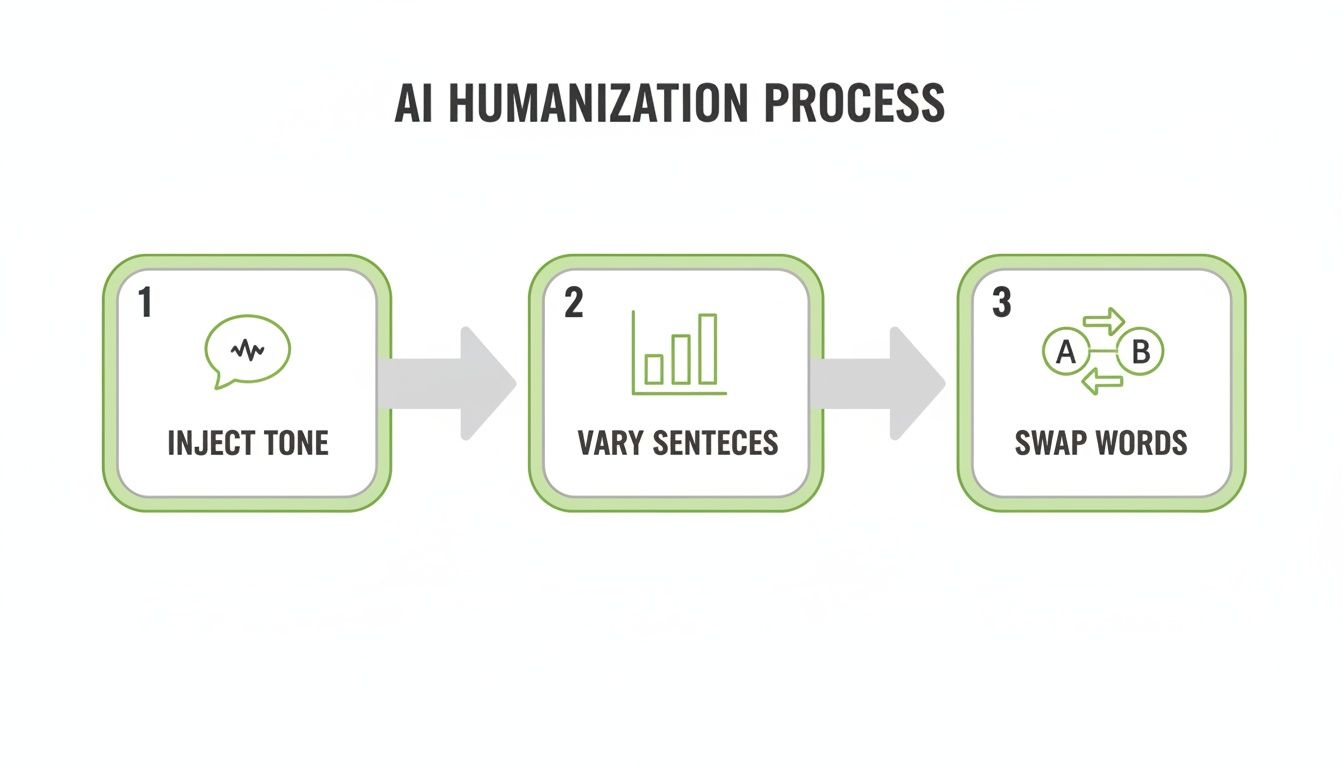
As you can see, it’s not about one magic fix. It’s about layering your edits, starting with big-picture voice and then drilling down to the word-by-word details.
First Pass: The Big Picture & Voice Edit
Your first read-through isn't for catching typos or swapping words. It’s about the big stuff: structure, flow, and most importantly, voice. A raw AI draft might be factually correct, but it almost always lacks a real point of view. This is where you make the article yours.
Read the whole draft from start to finish. Does it actually flow like a real conversation, or does it feel like a textbook? Is there any personality, or is it just a dry recitation of facts?
- Inject Your Perspective: This is the most powerful humanizing signal you have. Add personal anecdotes, opinions, or unique insights. A simple phrase like, "In my experience..." or "Here’s what I’ve learned..." is something an AI just can't fake authentically.
- Fix the Narrative Flow: AI often lays out information in a painfully linear way. Break that predictable pattern. Move paragraphs around to build suspense, create a stronger argument, or just make it a more interesting read.
- Adjust the Tone: Is the tone right for your audience? AI often defaults to a formal, academic voice when you need something more casual and engaging. Now is the time to dial in that overall feel before you get bogged down in the details.
This first pass is all about transforming the AI’s logical skeleton into content with a human heartbeat.
My Personal Tip: I always read the raw AI draft aloud on my first pass. Your ears will catch things your eyes miss—monotonous sentence rhythms, awkward phrasing, and robotic sentences. If it sounds weird when you say it, it's definitely going to read weird.
Second Pass: The Sentence-Level Polish
Okay, with the structure and voice locked in, it’s time to get surgical. This second pass is all about the sentence-level details. Your goal here is to directly attack the low perplexity and low burstiness signals that AI detectors are trained to find. You’re making the text statistically messy, just like human writing.
Here’s your checklist for this pass:
- Vary Sentence Length: Hunt down paragraphs where every sentence is roughly the same length. This is a dead giveaway. Combine two short sentences or break up a long one to create a more dynamic, natural rhythm.
- Swap Predictable Words: Find and kill common AI crutch words. Get rid of "utilize," "seamless," "delve," and "moreover." Replace them with more natural, conversational alternatives.
- Use Contractions: Change "it is" to "it's" and "you will" to "you'll." This is a dead-simple edit that instantly makes the text feel less stiff and more human.
- Add Rhetorical Questions: Pull the reader into the conversation. Dropping in a question like, "But how does that actually work in practice?" breaks up the passive flow and mimics how real people talk and think.
This pass isn't about rewriting huge sections. It's about making small, targeted changes that, when combined, have a massive impact on the detection score.
Final Pass: The All-Important Testing Phase
You wouldn't launch a website without testing it on different browsers, right? The same logic applies here. Don't publish your content without running it through a few different AI detectors.
Relying on a single tool is one of the biggest mistakes people make. Each detector uses a slightly different algorithm, so what passes on one might get flagged on another.
I recommend cross-referencing with at least two or three leading tools—think GPTZero, Originality.ai, and Turnitin's detector if you have access. Your goal is to get a consensus.
When the results come back, don't just glance at the overall score. The real gold is in the parts they highlight. Most detectors will show you the exact sentences they think are AI-generated. Go back to those highlighted sections and apply another round of humanizing edits. Maybe you need to rephrase a complex sentence or swap out another predictable word. Often, these final, targeted tweaks are all you need to get a "human-written" score across the board.
Picking the Right AI Humanizer Tool for the Job

Alright, you've got a solid humanization workflow. Now you might be thinking about adding a dedicated tool to speed things up. But here’s the catch: the market is absolutely flooded with options, and frankly, most of them aren't worth your time.
Choosing the wrong one doesn't just waste money; it wastes hours of your day and leaves you with content that still gets flagged by AI detectors. It's frustrating.
The real trick is knowing the difference between a simple "paraphraser" and a true AI humanizer. A basic spinner tool just swaps out words for synonyms—an old-school trick that modern detectors like Turnitin see right through. A genuine humanizer is a different beast entirely. It's trained on massive libraries of human-written text to fundamentally restructure sentences, introduce varied syntax, and tweak the tone just right to fly under the radar.
Core Criteria for Evaluating Any Tool
When you’re vetting a tool, ignore the flashy marketing promises. Your decision should boil down to a handful of non-negotiable criteria that separate the effective tools from the glorified thesauruses.
Ultimately, the only question that matters is: does it actually work? Look for tools that are transparent about their success rates against a range of popular detectors, not just one they know they can beat.
Here’s what I always check for:
- Detection Bypass Rate: Does the tool consistently get a "human" score on tough platforms like GPTZero, Originality.ai, and Sapling? A reliable tool has to be effective against multiple algorithms.
- Meaning Preservation: The output has to say what you originally meant. If the tool rewrites your text into something that's factually wrong or just plain gibberish, it's completely useless.
- Usability: The interface needs to be clean, fast, and intuitive. You shouldn't have to fight the software to get a result; it should fit smoothly into how you already work.
It also helps to understand what you're trying to fix in the first place. Playing around with a tool like an AI Post Generator gives you a feel for the kind of robotic output you need to humanize. This context helps you appreciate the subtle but critical improvements a good humanizer makes.
The Overlooked Factor: Data Privacy
This is the one thing most people forget to check, and it’s arguably the most important. When you paste your article into a random online tool, where does that data go? Some services store your text and might even use it to train their own AI models.
That’s a massive risk. Your content—whether it's for a client, a sensitive research paper, or your company's next big marketing plan—is your intellectual property. Handing it over to a service with a sketchy privacy policy is a gamble you just shouldn't take.
Privacy Check: Always, always read the tool's privacy policy. Look for explicit guarantees that your text will not be stored, shared, or used for training purposes. A trustworthy service will make this promise clear and upfront.
Choosing a tool that respects your privacy ensures your work remains yours and yours alone. For a deep dive into which tools meet these standards, check out our detailed breakdown of the best AI humanizer options available.
From Basic to Advanced: A Quick Comparison
To put this all into perspective, let's look at the different tiers of tools out there. Knowing this hierarchy helps you pinpoint what you actually need for your specific quality and undetectability goals.
| Tool Type | How It Works | Common Outcome |
|---|---|---|
| Simple Paraphraser | Swaps individual words with synonyms. May slightly reorder clauses. | Often sounds awkward or "spun." Fails most modern AI detectors. |
| Basic AI Rewriter | Uses AI to rewrite sentences one by one. Lacks a holistic view of the text. | Improves on paraphrasing but still has a robotic feel. Struggles with tough detectors like Turnitin. |
| Advanced Humanizer | Rebuilds text using models trained on human writing. Focuses on flow, rhythm, and structure. | Produces natural, undetectable output that preserves the original meaning. |
At the end of the day, investing in an advanced humanizer saves a ton of editing time and gives you a final product you can trust. It’s the most reliable path to consistently pass AI detection without sacrificing the quality of your content.
Using AI Humanizers Ethically and Responsibly
Getting your content to pass AI detection is one thing. Doing it responsibly is another entirely. There’s a sharp line between using AI as a powerful assistant and using it to outright deceive people, and that line is drawn with intent. It’s the difference between streamlining your workflow and committing academic fraud or just flooding the internet with low-quality, automated junk.
The goal isn't just to be undetectable. It’s to produce high-quality, honest work that you can actually stand behind. When you think ethically from the start, you ensure the final product has integrity, whether you're submitting an essay to a professor or publishing an article for your audience.
The Clear Line for Students
For students, the rules are pretty much non-negotiable. Universities build their academic integrity policies around original thought, critical analysis, and proper citation. Taking an AI-generated essay, running it through a humanizer, and submitting it to a system like Turnitin isn't a clever workaround—it's a clear violation of those principles.
That whole approach misses the point of the assignment in the first place, which is to learn, synthesize information, and articulate your own unique arguments. The ethical way to use AI in school looks completely different.
- Brainstorming and Outlining: Using AI to kickstart your work by exploring topics, structuring an outline, or getting a handle on complex ideas is perfectly legitimate.
- Drafting Support: It can be a great tool for rephrasing a clunky sentence or finding a better word, almost like a super-powered thesaurus.
- Never for Final Submission: The core of the work—the arguments, the analysis, the conclusions—has to be yours. Period.
Key Takeaway: Think of an AI humanizer as a final polisher for your own ideas, not a ghostwriter for work you didn't do. The second it's used to take credit for thinking that isn't yours, you've crossed a serious ethical line.
Best Practices for Professionals
For marketers, writers, and SEOs, the ethical game is more about audience trust and content quality. Your readers come to you for expertise, authenticity, and real value. Just humanizing a generic AI draft and hitting "publish" is a fast way to betray that trust and damage your brand.
In a professional setting, responsibility means protecting your brand’s unique voice and making sure every single piece of content is factually accurate and genuinely useful. Your reputation is built on the quality of your work, not the quantity.
Here’s a quick checklist to keep things ethical and responsible:
- Fact-Check Everything: AI models are notorious for making things up. This phenomenon, often called "hallucination," is a real problem. Always, always verify every statistic, claim, and quote with a reputable source.
- Inject Real Expertise: Use the AI draft as a skeleton. The real value—the meat—comes when you add your own insights, personal experiences, and industry-specific knowledge that no machine could ever have.
- Preserve Your Brand Voice: A humanizer might smooth out sentence structures, but you are the guardian of your brand's personality. Make sure the final text sounds like you, not a generic robot.
- Uphold Data Privacy: As a professional, handling data ethically is non-negotiable. If you're using AI tools in a business context, it's worth reviewing an AI GDPR Compliance Guide to ensure you have all your legal and ethical bases covered.
At the end of the day, the most ethical approach is also the most effective one. Content that is carefully edited, fact-checked, and infused with genuine human expertise doesn't just pass AI detection—it performs better with search engines and connects more deeply with your audience. The goal is to augment your intelligence, not replace it.
A Few Common Questions About Bypassing AI Detectors
Even with a solid game plan, a few questions always pop up when you're trying to get AI-generated text to fly under the radar. Let's tackle some of the most common ones I hear. Getting these sorted will help you edit with a lot more confidence.
Can AI Detectors Ever Be 100% Accurate?
Nope. And it's pretty unlikely they ever will be.
You have to think of AI detectors as probabilistic tools, not as infallible judges. They're built to spot statistical patterns that tend to show up in machine writing. They don't deal in certainties, which means they get things wrong—a lot.
- False Positives: This is when the detector screams "AI!" at something a human wrote. It's common with straightforward, factual writing that naturally lacks complex sentence structures.
- False Negatives: This is the opposite—an AI-generated piece slips by completely undetected. A little bit of smart editing is often all it takes to fool the algorithm.
Here's a better way to look at it: A detector's score isn't a verdict. It’s a guide. A high AI score just highlights the sentences that sound the most robotic, showing you exactly where to focus your editing efforts. For example, if a tool flags "It is crucial to implement the new system," you know to change it to something like, "Look, we've got to get this new system up and running."
Will Humanizing My AI Content Hurt My SEO?
It’s actually the other way around—it will almost certainly help it. This is a huge misconception that comes from a fear of getting slapped with a Google penalty. But if you think about what Google actually wants, humanizing your content aligns perfectly with their goals.
Search engines are designed to reward content that is helpful, reliable, and gives the reader a good experience. This is the entire point of Google's E-E-A-T (Experience, Expertise, Authoritativeness, and Trustworthiness) guidelines.
Generic, robotic AI text bombs on all of these fronts. It doesn't have the unique voice or firsthand experience that signals real expertise. When you rewrite that text to be more authentic and engaging, you're making it better for people. And making content better for people is the best signal you can possibly send to search engines. If you want to go deeper, you can also read about whether undetectable AI truly works in our comprehensive guide.
Is It Wrong to Use Tools to Pass AI Detection?
The ethics here really boil down to two things: your intent and the final product. The tool itself is just code; what you do with it is what matters.
If you’re using AI to get past writer's block or map out a first draft, and then you meticulously edit that output to reflect your own knowledge and voice, that’s just a smart workflow. You're using a tool to assist your own intelligence, not to replace it.
The ethical line gets crossed when the goal is to deceive.
- For Students: Submitting an AI-generated essay that's just been run through a humanizer is academic dishonesty, plain and simple. The whole point of an assignment is to learn and think critically.
- For Professionals: The standard is simple: are you being honest and providing value? If a tool helps you produce genuinely helpful, high-quality content for your audience more efficiently, you're using it responsibly. If you're using it to churn out low-quality, inaccurate articles just for the sake of volume, that's unethical and will eventually sink your brand.
The responsible approach is pretty clear. Use AI as your starting block, but always ensure the final piece is fact-checked, filled with your own unique perspective, and actually helps the reader. That's how you create content that's not just "undetectable," but genuinely good.
Ready to transform your AI-generated content into natural, human-like writing? Humantext.pro instantly refines your text, ensuring it reads naturally and authentically. Try our free AI humanizer today →
Related Articles
What Is AI Law and How It Shapes Content in 2026
What is AI law? Learn EU AI Act, US rules, liability and IP risks, plus practical steps for creators to stay compliant in 2026.

How to Write a Newsletter That Readers Trust
Learn how to write a newsletter that drives engagement. Master subject lines, mobile-first structure, AI humanization, and deliverability

How to Improve Writing Clarity That Actually Reads Well
Learn how to improve writing clarity with proven sentence-level edits, structure fixes, and before-and-after examples that make any draft sharper and more

