An Ethical Guide to Avoid AI Detection for Writers
Learn how to avoid AI detection ethically. Our guide helps you transform AI drafts into authentic, human-like content that bypasses modern detectors.
If you want to avoid AI detection, you have to do more than just edit an AI-generated draft. You need to completely transform it into something that sounds authentically human. This means going beyond simple tweaks and really weaving in your own unique voice, messing with sentence structures, and adding personal insights. The goal is to replace those robotic, predictable patterns with natural, engaging prose.
Why Avoiding AI Detection Matters Now More Than Ever

In a world overflowing with AI writing tools, knowing how to "humanize" your content isn't just a neat trick anymore—it’s a crucial professional skill. The real problem isn't about using AI; it's about the serious consequences of sounding like it. Even if you use an AI ethically for brainstorming or a first draft, the raw output can still trigger detectors, leading to some serious, and often unfair, penalties.
For a student, a flagged essay could spiral into an academic integrity hearing. For professional writers and marketers, submitting content that fails a detection scan can mean rejected work, damaged client relationships, and a nosedive in SEO as search engines double down on authentic, human-first content.
The Rise of AI Scrutiny
The pressure is on because the tools for policing AI are spreading like wildfire. The global AI detector market has ballooned to USD 0.69 billion, thanks to a jaw-dropping 55% surge in adoption rates. This isn't just a trend; it's a full-blown panic. An estimated 80% of enterprises and academic institutions are scrambling to integrate these tools into their workflows, all in the name of protecting content integrity.
This intense scrutiny has created a high-stakes game where just writing well isn't enough. You have to write in a way that is unmistakably, undeniably human.
The biggest risk isn’t just getting flagged by a tool. It's producing content that feels hollow, generic, and lacks the very nuance and personality that makes readers trust you. Clarity and polish are no longer enough; humanness is the new standard.
The Core Problem with AI Drafts
The fundamental issue is that AI models are designed to be predictable. They churn out text that's often grammatically perfect but stylistically flat and rhythmically monotonous. This is exactly what AI detectors are trained to hunt for.
Think about the real-world impact:
- Students: An MBA applicant might use an AI to polish their essay, only for it to end up sounding like hundreds of others, completely stripped of the personal stories that admissions officers actually care about.
- Marketers: An SEO team could scale up content production with AI, but if the articles lack a unique perspective or a genuine voice, they won't engage readers and will ultimately tank in the rankings.
- Freelancers: A writer could lose a valuable contract because their submitted draft, while technically flawless, got flagged for sounding robotic and unoriginal.
This guide gives you an ethical workflow to navigate this new reality. I’ll show you how to take an AI-assisted draft and turn it into a final piece that is genuinely yours—one that passes detection with confidence and, more importantly, connects with your audience.
A Look Under the Hood of AI Detection Tools

If you want to create text that bypasses AI detection, you first have to think like a detector. These tools aren't running on magic. They’re sophisticated pattern-recognition systems trained on enormous libraries of both human and machine-generated text.
Their entire job is to spot the statistical fingerprints that AI language models leave behind—patterns that are incredibly common in AI writing but almost nonexistent in how humans express themselves. It’s less about catching a single weird phrase and more about analyzing the entire text for a consistent, predictable, and frankly, boring structure.
Perplexity and Burstiness: The Two Telltale Signs
Two core concepts drive almost all AI detection: perplexity and burstiness. They sound a bit academic, but the ideas are surprisingly simple and get right to the heart of why AI text often feels so lifeless.
Perplexity is just a fancy way of measuring how predictable your writing is. AI models are trained to pick the most statistically likely word to follow the last one. This creates text with very low perplexity—it's smooth, it's logical, but it’s also completely expected.
Human writing is the opposite. We’re full of surprises. We use odd word choices, creative metaphors, and twist our sentence structures for effect. This makes our writing far less predictable and gives it a higher perplexity score.
An AI might write: "The economy is a complex system influenced by many factors, including fiscal policy, market trends, and consumer behavior."
A human might write: "The economy is a messy, tangled web, tugged in a hundred different directions by everything from a government budget decision to what people are putting in their shopping carts."
The first sentence is fine. It’s also forgettable. The second one is vivid, a little chaotic, and much harder to predict—exactly the kind of human creativity that detectors are trained to spot.
Burstiness, on the other hand, is all about rhythm. Think about how you talk or write. You might use a long, winding sentence to explain a complex idea, then follow it up with a short, punchy one for emphasis. This creates a dynamic, "bursty" flow.
AI models struggle with this. They tend to generate sentences of similar length and structure, one after another. This results in a monotonous, robotic cadence that lacks the natural peaks and valleys of human writing. We actually have a whole guide on how to bypass ZeroGPT by tweaking these very patterns.
Why Being Too Perfect Is a Dead Giveaway
Beyond those two metrics, detectors are essentially hunting for anything that’s just too consistent. They flag text that feels unnaturally clean and orderly.
- Uniform Vocabulary: AI loves to play it safe. It sticks to a standard, middle-of-the-road vocabulary, avoiding the slang, idioms, or niche terms a real person would naturally use.
- Repetitive Structures: Ever notice how an AI draft will use the same sentence opener or transition phrase over and over? A human might use a "not just X, but also Y" structure once for impact, but an AI will lean on it because it's a statistically effective pattern.
- Flawless Logic: Human thought isn't always linear. We add personal asides, connect ideas in slightly unconventional ways, and sometimes take small detours. AI text marches from point A to B to C with perfect, unwavering logic, which can feel strangely tidy.
At the end of the day, these tools are built to spot the absence of human chaos. They flag text that is too predictable, too clean, and too rhythmically flat. Understanding this is the single most important step in turning a generic AI draft into something that sounds, feels, and reads as genuinely human. Your goal isn't just to fool a machine—it's to inject your writing with the very personality and beautiful imperfection that the machine can't replicate.
Alright, let’s get our hands dirty. Moving past the theory of how AI detectors think, it's time to talk about the actual process of turning a flat, robotic draft into something that breathes. The core of this isn't just a simple edit; it's a deep, manual rewrite aimed at layering in the very things algorithms are trained to smooth over: chaos, personality, and a natural rhythm.
This workflow is about more than just swapping out a few words. It's about taking ownership of the content and making it undeniably yours. Forget the predictable sentence structures and sterile language. We're going to inject some life back into the text, one sentence at a time.
Inject Your Unique Voice and Tone
The quickest way to avoid AI detection is to sound like yourself, not a generic encyclopedia entry. AI models don't have a personality; they just stitch together a convincing imitation based on their training data. Your first job is to overwrite that bland, default voice with your own.
This starts with your word choice. Ditch the formal, "safe" words for the ones you'd actually use in a conversation. Do you say "consequently," or do you just say "so"? Would you write "it is imperative," or "you've got to"? Choosing the latter not only makes your writing more authentic but also immediately boosts its "perplexity"—a key metric detectors look for.
Let's look at a real example:
- AI Draft: "Effective time management is a critical skill for professional success. It involves prioritizing tasks, setting achievable goals, and minimizing distractions to optimize productivity."
- Humanized Version: "If you want to get ahead, you have to get a grip on your time. It’s all about figuring out what’s actually important, setting goals you can hit without burning out, and learning to shut out the noise."
See the difference? The second version is direct, uses casual language ("get a grip," "shut out the noise"), and has a clear point of view. It’s no longer a sterile definition; it’s actionable advice from one person to another.
Break Up the Rhythmic Monotony
One of the biggest AI tells is its tendency to produce sentences of similar length and structure. This creates a droning, monotonous rhythm that detector algorithms can spot a mile away. Your goal is to introduce burstiness—the natural, varied cadence of human writing.
Go through your draft with this singular focus. Mix it up.
- Actionable Tip: Read your text out loud. If it sounds like a robot or a GPS voice, you know you have a rhythm problem. A good, human cadence has peaks and valleys.
- Combine a few short, choppy sentences into a longer, more complex one.
- Break down a long, winding sentence into two or three short, punchy statements.
- Check your sentence starters. If you see a bunch of sentences in a row starting with "The..." or "It is...", it's time to rewrite.
This rhythmic variation does more than just trick a detector; it keeps the reader engaged. Think of it like music. A good melody needs a mix of long notes and short, staccato beats to be interesting.
A key takeaway from admissions experts is that AI-polished essays often lose "the natural rhythm and rawness that signal human presence." Your goal is to preserve—or re-inject—that raw, authentic cadence.
Layer in Nuance with Idioms and Analogies
AI thinks in literal, logical terms. People don't. We communicate through layers of meaning, using metaphors, analogies, and cultural idioms to make complex ideas stick. Sprinkling these into your text is a powerful way to add an unmistakably human signature.
An AI might explain a concept directly. A human writer will often reach for a comparison to make it click.
- AI Explanation: "Market volatility requires a diversified investment portfolio to mitigate risk."
- Human Analogy: "Thinking about market volatility is like getting ready for unpredictable weather. You don't just pack a raincoat; you bring sunscreen and a sweater, too. A diversified portfolio is your all-weather gear for your finances."
The analogy doesn't just explain the idea; it makes it memorable and tangible. Idioms do the same thing. Phrases like "bite the bullet," "on the same page," or "a blessing in disguise" are steeped in cultural context that AI often fumbles. Weaving them in naturally shows a human mind at work.
Add Unique Insights and Personal Experience
This is arguably the most important step. An AI can only rehash the information it was trained on; it can't create new knowledge or share a personal story. This is your biggest advantage, so use it.
Look for any opportunity to add details that could only come from you.
- Practical Example: Instead of writing, "Customer feedback is important," try, "Last month, a single customer email about a checkout bug led us to fix an issue that boosted our conversion rate by 5%. That's why we read every single message."
- Share a short, relevant anecdote.
- Reference a specific, real-world example you've personally encountered.
- Offer an opinion or a contrarian take on a common idea.
This transforms the content from a generic summary into something truly valuable and original. Instead of just stating a fact, you’re providing context, proof, and a perspective that an AI simply cannot replicate.
To see how these principles work in practice, let's compare the before and after. This table breaks down the key differences between typical AI-generated content and effectively humanized text, providing a clear roadmap for your own editing process.
AI Text vs Humanized Text A Practical Comparison
| Characteristic | Raw AI-Generated Text | Humanized Text Example |
|---|---|---|
| Voice & Tone | "Utilizing social media is essential for modern brand growth." | "If your brand isn't on social media, you're practically invisible." |
| Sentence Structure | "The system is efficient. The system is reliable. The system is secure." | "The system is efficient and reliable. But more importantly? It's secure." |
| Nuance | "The project encountered unforeseen difficulties." | "The project went completely off the rails about halfway through." |
| Unique Insight | "Data analysis is important for making informed business decisions." | "Last quarter, we almost missed a huge trend until I dug into the raw server logs—a perfect example of why you can't just trust the dashboard." |
By systematically applying these four techniques—finding your voice, varying the rhythm, adding nuance, and layering in personal insight—you move far beyond simple proofreading. You are fundamentally restructuring the text, overwriting the AI's predictable patterns with your own beautifully imperfect, unmistakably human signature.
Using AI Humanizers to Accelerate Your Workflow
While manually editing every word gives you total control, let's be realistic—it's not always practical. Content deadlines are tight, and a deep, from-scratch rewrite takes hours you might not have. This is exactly where AI humanizers come in, acting as a powerful accelerator to help you avoid ai detection without the manual grind.
These aren't just glorified synonym-swappers. An advanced AI humanizer, like HumanText.pro, is built to analyze AI-generated drafts for the exact patterns detectors hunt for—low perplexity, monotonous sentence rhythm, and predictable vocabulary. It then intelligently rewrites the content to sound more natural and varied, all while keeping your core message perfectly intact.
The Hybrid Workflow: Blending AI Speed with a Human Touch
The smartest way to work isn't a hands-off, one-click fix. It’s a hybrid approach that combines the raw speed of AI with the irreplaceable creativity of a human editor. You get the best of both worlds, letting you produce high-quality, undetectable content at a much faster clip.
Here’s what that looks like in practice:
- Generate a Solid First Draft: Use an AI model to get your initial ideas down. If you're exploring options, this breakdown of the best AI content creation tools is a great starting point for finding a generator that fits your needs.
- Run It Through a Humanizer: This is where the heavy lifting happens. Paste your AI draft into a tool like HumanText.pro. It will automatically handle the most tedious structural and stylistic edits, breaking up robotic sentence patterns and varying word choice.
- Perform a Final Polish: With the most obvious AI tells already gone, your manual review becomes much faster. Now you can focus on injecting your unique voice, adding personal anecdotes, and making sure the tone is a perfect match for your brand or assignment.
This hybrid model lets you consistently bypass detectors like GPTZero and Turnitin without dedicating hours to a full rewrite. You can learn more about how an AI humanizer tool makes this happen in our detailed guide.
Why Humanizers Suddenly Became Essential
The need for these tools didn't just appear out of nowhere. As consumers faced $12.5 billion in fraud losses—a 25% spike largely driven by AI-powered scams—robotic-sounding copy quickly became a red flag for untrustworthiness.
For marketers and content creators, this meant that generic AI drafts could instantly destroy trust and kill conversions. Humanizers became a critical tool for transforming that text into natural, credible prose that could pass up to 99% of checks while preserving the original meaning.
This simple process flow breaks down the core steps a humanizer takes to transform raw AI text.
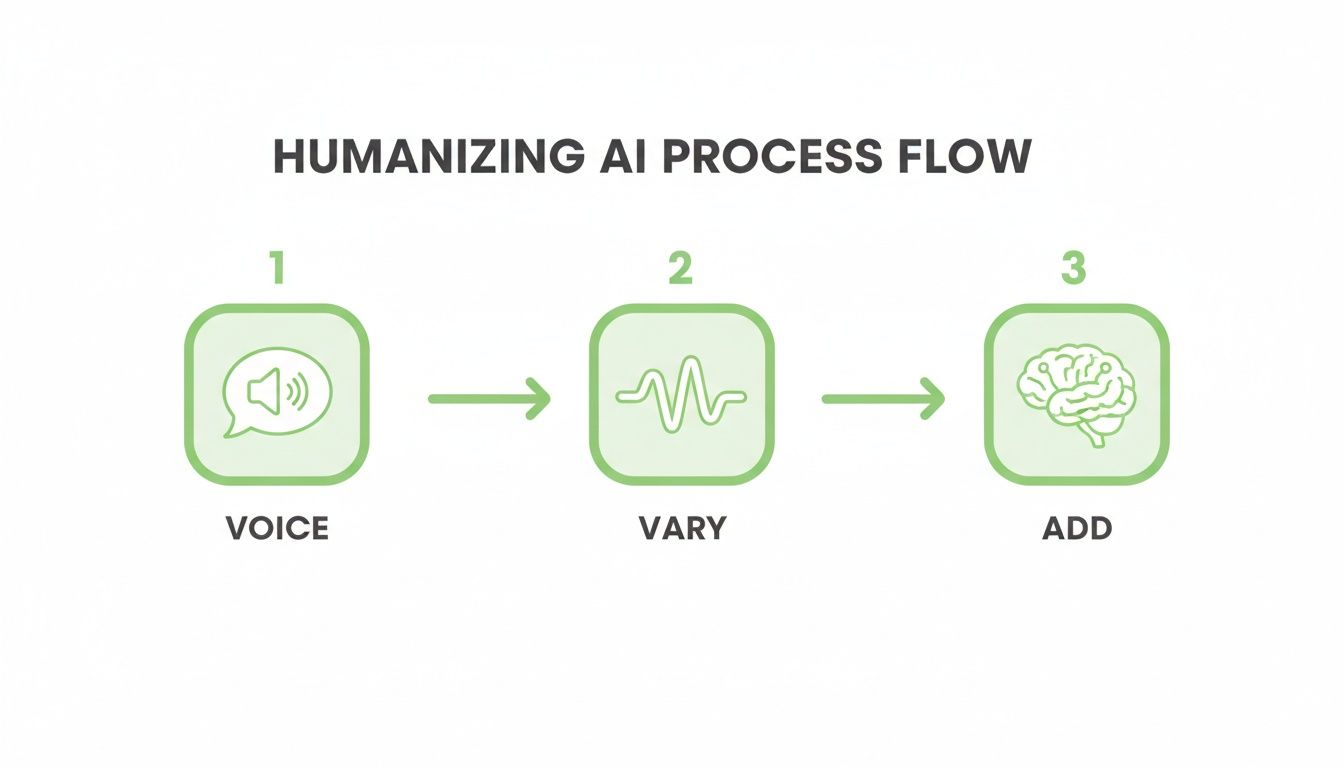
The diagram shows how these tools analyze a text before injecting a unique voice, varying sentence structure, and adding contextual nuance—the three pillars of making AI content sound truly human.
Putting a Humanizer Into Action
Getting started with a tool like HumanText.pro is incredibly straightforward. You don't need to be a tech wizard. The interface is designed for speed, letting you process text and see the results in seconds. Just paste your text, click a button, and the platform generates a humanized version that serves as a strong foundation for your final polish.
By bringing an AI humanizer into your workflow, you’re not just trying to trick a detector. You’re strategically reclaiming hours of editing time, freeing you up to focus on the high-level creative work that actually sets your content apart.
Ultimately, this hybrid approach respects both the power of AI and the necessity of human oversight. It's a practical, efficient, and ethical way to meet modern content demands without sacrificing the authenticity and quality that resonate with real people.
How Better Prompts Reduce Detection Risk from the Start

The best way to avoid ai detection is to tackle the problem at the source. Instead of spending hours editing a robotic first draft, you can drastically reduce that work by getting better raw material from the AI in the first place.
It all comes down to proactive prompt engineering.
Think of it like this: you can ask a chef to "make dinner," or you can give them a detailed recipe with specific ingredients and cooking instructions. The second approach will always get you closer to what you actually want. The same logic applies to AI. A better, more detailed prompt coaxes the model into producing more natural-sounding text right out of the gate.
Specify a Distinct Tone and Persona
An AI's default voice is a dead giveaway—a bland, neutral mix of encyclopedia and corporate brochure. You need to break this pattern immediately. Don't just ask for an article; tell the AI who should be writing it.
- Weak Prompt: "Write an article about the benefits of remote work."
- Strong Prompt: "Write an article about the benefits of remote work. Adopt the persona of a seasoned tech blogger who has worked remotely for over a decade. Use a skeptical but ultimately optimistic tone, and include a short personal anecdote about overcoming a remote work challenge."
This simple tweak forces the AI to abandon its generic voice and adopt a human-like perspective, complete with a hint of personality and lived experience.
Demand Sentence Variety and Storytelling
As we’ve discussed, AI-generated text often has a monotonous, predictable rhythm. You can fight this directly in your prompt. Explicitly ask the model for varied sentence structures. It's a command they are surprisingly good at following.
Go a step further and ask for storytelling elements. Humans communicate through stories and analogies; AI defaults to facts and lists. Requesting a narrative element adds layers of nuance that make the text far less predictable.
Actionable Tip: Add this phrase to your prompt: "Vary sentence structure to create a dynamic reading experience, mixing short, impactful statements with longer, more detailed sentences." This direct instruction often produces much better results.
This principle of detailed instruction applies across all AI mediums. For example, learning to craft compelling prompts for AI book cover design is crucial for getting good visual results, just as it is for text. The core idea is the same: the more creative and specific your instructions, the better the output.
Prohibit Common AI Writing Crutches
AI models have stylistic tics they lean on heavily. They love overusing transitional phrases ("Furthermore," "In addition," "Moreover") and fall back on predictable sentence formulas like "It's not just X, it's Y."
You can tell the AI to knock it off. Add negative constraints to your prompt to steer it away from these robotic habits.
- Practical Example: "Write an article about sustainable gardening. Do not use the words 'Furthermore,' 'Moreover,' 'In conclusion,' or 'Additionally.' Avoid any sentence starting with 'It is important to note that...'"
- "Write the text but do not use common transitional phrases like 'In addition,' 'Moreover,' or 'Therefore.'"
- "Avoid any sentence structures that set up and then negate an idea, such as 'It's more than just...'"
By proactively telling the AI what not to do, you get a cleaner draft that feels more original. This upfront effort makes the entire humanization process faster and more effective. Your prompt is the foundation—a strong one makes everything that follows easier.
Navigating the Ethics of Using AI Writing Tools
For students and professionals alike, the line between using AI as a helpful assistant and outright cheating can feel a bit blurry. The ethical path forward, though, is actually quite clear: use AI to enhance your own ideas, not to fake them. The core principle here is ownership.
Think of it as an ethical partnership. You can absolutely use these tools to brainstorm, tighten up your phrasing, or smash through writer’s block. But you, and only you, remain the author. The final piece has to reflect your unique insights, and you’re fully on the hook for its accuracy and integrity.
Drawing a Firm Ethical Line
The real difference comes down to intent. Are you using the tool to make your original argument clearer, or are you asking it to create the argument for you?
- Ethical Use (Actionable Insight): You write, "Our company's new software improves workflow efficiency." You then ask an AI, "Rephrase this to be more vivid and benefit-oriented for a marketing email." The AI suggests, "Stop wrestling with clunky workflows and let our new software streamline your entire process, giving you back hours in your day." You used AI to improve your idea, not to generate it.
- Unethical Use: Prompting an AI with, "Write a paragraph about the causes of the Civil War," and then slapping that output into your document as if you wrote it.
This distinction is more critical than ever as detection technology gets smarter. The AI fraud detection space has become a real-time arms race, with 65% of detector developers now using advanced NLP to get 35% better accuracy against AI text. With 80% of universities and firms mandating clean workflows, submitting raw AI drafts is a direct path to academic penalties or serious SEO damage.
Using AI isn't the problem; outsourcing your thinking is. The goal is to produce work that is authentically yours—enhanced by technology, not created by it. Taking full ownership means fact-checking every claim and properly citing every source.
Ultimately, your reputation is on the line. Committing to a responsible, ethical workflow ensures you meet modern standards of quality without deceiving your audience or institution. To really get into the weeds on this, check out our practical guide on how to make AI content undetectable by ethically refining AI drafts into your own work.
Common Questions Answered
When you're working with AI-generated text, a few key questions always seem to pop up. Let's tackle them head-on, based on what we've seen in the field.
Is Trying to Avoid AI Detection Unethical?
Honestly, it all comes down to your intent. Using AI as a brainstorming partner, a tool to get past writer's block, or a way to polish your own ideas is a perfectly legitimate use of the technology. In that case, "humanizing" the text is just about making sure the final piece actually sounds like you.
The ethical line gets crossed when the goal is deception. If someone uses AI to plagiarize, make things up, or pass off work as their own for something like a school assignment where originality is the whole point, then yes, that's a problem.
Do AI Detectors Make Mistakes?
Absolutely. It happens all the time. AI detectors are not infallible and often produce "false positives"—meaning they flag 100% human-written content as being AI-generated. This is a huge issue that many people don't realize.
These tools work by spotting statistical patterns, like overly consistent sentence lengths or predictable word choices that are common in machine-generated text. But sometimes humans write simply, and AI can write with complexity. Because of this overlap, there's always a margin for error, which is why you can't blindly trust a detector's score without applying your own judgment.
Will an AI Humanizer Guarantee I Can Bypass Detectors?
While a great tool like HumanText.pro is built from the ground up to dramatically shift the odds in your favor, no tool can promise a 100% guarantee. Why? Because the technology on both sides is in a constant cat-and-mouse game. Detectors get smarter, and humanizers adapt.
Think of a humanizer as the most powerful first step in your editing workflow. It does the heavy lifting of restructuring and rephrasing, but the final, personal touch should always come from you. A quick manual review is what makes the content truly yours.
Ready to see the difference for yourself? HumanText.pro can take your AI drafts and give them a genuine, human-sounding voice in seconds. Try it for free and get started!
Ready to transform your AI-generated content into natural, human-like writing? Humantext.pro instantly refines your text, ensuring it reads naturally and authentically. Try our free AI humanizer today →
Related Articles
What Is AI Law and How It Shapes Content in 2026
What is AI law? Learn EU AI Act, US rules, liability and IP risks, plus practical steps for creators to stay compliant in 2026.

How to Write a Newsletter That Readers Trust
Learn how to write a newsletter that drives engagement. Master subject lines, mobile-first structure, AI humanization, and deliverability

How to Improve Writing Clarity That Actually Reads Well
Learn how to improve writing clarity with proven sentence-level edits, structure fixes, and before-and-after examples that make any draft sharper and more

