
12 Best Undetectable AI Free Tools & Methods for 2025
Discover the top undetectable AI free tools and methods to humanize text. Our 2025 guide tests and reviews free AI writers that bypass detection ethically.
Welcome to the essential guide for anyone using AI to generate text, from students and marketers to researchers and content creators. As AI writing assistants become indispensable, the challenge of passing AI detection tools like Turnitin and GPTZero has grown significantly. This isn't just about bypassing a check; it's about refining AI-generated drafts into content that is truly human-sounding, nuanced, and original. The primary goal is to leverage AI for efficiency without sacrificing quality or authenticity.
In this comprehensive listicle, we dive deep into 12 of the best free tools and methods to create undetectable AI free content. We move beyond simple feature lists, offering real-world tests, step-by-step usage guides with screenshots, and an honest look at the pros, cons, and crucial ethical considerations of each resource. This guide is built to be a practical resource, providing direct links and actionable insights to help you choose the right platform for your specific needs.
Whether you need to humanize an AI-generated essay, a series of blog posts, or professional marketing copy, this article will equip you with the strategies and resources to produce high-quality, humanized text that stands up to scrutiny. We will explore a range of solutions, from dedicated AI humanizers to essential grammar checkers and writing aids that help you infuse your unique voice into AI drafts. By the end, you'll understand how to effectively make your AI content undetectable and polished for any audience.
1. Humantext.pro
Humantext.pro establishes itself as a premier solution for transforming AI-generated content into natural, human-like text that effectively bypasses AI detectors. It is engineered for users who require both speed and reliability, delivering a refined output that maintains the original message's core intent and tone. The platform’s standout feature is its integrated AI detection score, which provides instant feedback before and after the humanization process, allowing you to verify its effectiveness in real time.
This tool is a strong contender for anyone looking for undetectable ai free options, especially for initial drafts or smaller projects. The workflow is streamlined for maximum efficiency: simply paste your text, and the system instantly analyzes it. With a single click, it rewrites the content, stripping away the robotic patterns that AI checkers are trained to identify. This process is powered by a model trained on over 1.2 million human writing samples, ensuring a high degree of nuance and clarity in the final text.
Key Strengths and Use Cases
Humantext.pro excels in scenarios where authenticity is paramount. Its simple, one-click process makes it a go-to resource for a diverse range of users.
- For Students: It helps refine AI-assisted research drafts for essays and reports, ensuring the final submission reflects a natural writing style. The tool is positioned for ethical use, such as improving clarity and flow rather than circumventing academic integrity policies.
- For Content Creators: SEO specialists and bloggers can use it to quickly humanize AI-generated articles, making them more engaging for readers and less likely to be flagged by search engine algorithms that may penalize robotic content.
- For Professionals: It offers a privacy-first approach, stating that user content is not stored or shared. This is a critical advantage for users working with sensitive client information, proprietary data, or confidential reports.
Access and Limitations
Getting started with Humantext.pro is straightforward. The platform offers a completely free trial that allows you to process up to 500 words without requiring any sign-up, registration, or credit card details. This frictionless entry point is perfect for testing its capabilities. For users with higher volume needs, paid plans are available, and you will need to visit the website's pricing page for the most current tiers. While highly effective for English, its multilingual capabilities are still in development, which is a consideration for non-English content.
2. Grammarly
Grammarly is an AI-powered writing assistant that refines text by correcting grammar, spelling, and punctuation while offering suggestions for tone and clarity. While not explicitly designed as an AI humanizer, its real-time feedback can be strategically used to revise AI-generated content, making it sound more natural and less robotic. This indirect approach is a powerful, free method for making AI text less predictable and more human-like, helping to create undetectable ai free of the common patterns AI detectors flag.

It stands out due to its ubiquitous integration across browsers, desktop apps, and mobile keyboards, making it incredibly accessible. By accepting Grammarly’s suggestions for sentence restructuring, word choice, and conciseness, you are actively altering the original AI output. This process naturally breaks up the uniform sentence structures and vocabulary that AI detectors often identify.
Key Features and Usage Tips
Grammarly's strength lies in its user-friendly interface and actionable advice.
- Real-Time Feedback: Paste your AI draft into the Grammarly editor. It immediately highlights issues and provides one-click suggestions to improve flow and reduce predictability.
- Tone Adjustments: Use the tone detector to ensure the writing aligns with your intended audience, whether formal, confident, or friendly. Adjusting tone often involves changing phrasing, which helps evade detection.
- Clarity and Conciseness: The tool excels at shortening wordy phrases and rephrasing complex sentences for better readability, a key step in humanizing AI content. For a deeper understanding of how these revisions impact AI detection, explore strategies for passing AI detection checks.
Grammarly’s free version is robust for fundamental revisions. The Premium plan unlocks advanced features like the plagiarism checker and more sophisticated tone suggestions, but the free tool is sufficient for the core task of humanizing AI text.
| Feature | Free Version | Premium Version | Use Case for Evading Detection |
|---|---|---|---|
| Grammar/Spelling | ✅ | ✅ | Corrects basic errors that can make text feel stiff or unnatural. |
| Clarity Rewrites | ✅ | ✅ | Rewords sentences to be clearer, altering AI's original structure. |
| Tone Suggestions | Limited | Advanced | Fine-tunes the writing style to be more engaging and human. |
| Plagiarism Checker | ❌ | ✅ | Ensures originality but is not directly for AI detection evasion. |
Website: https://www.grammarly.com
3. ProWritingAid
ProWritingAid is a comprehensive style editor and writing mentor designed for long-form content. While its primary goal is to improve writing quality, its detailed reports can be instrumental in humanizing AI-generated text. By analyzing elements like sentence length variation, overused words, and transitions, it guides you to make nuanced edits that break the monotonous patterns typical of AI, helping you create undetectable ai free content that reads authentically.
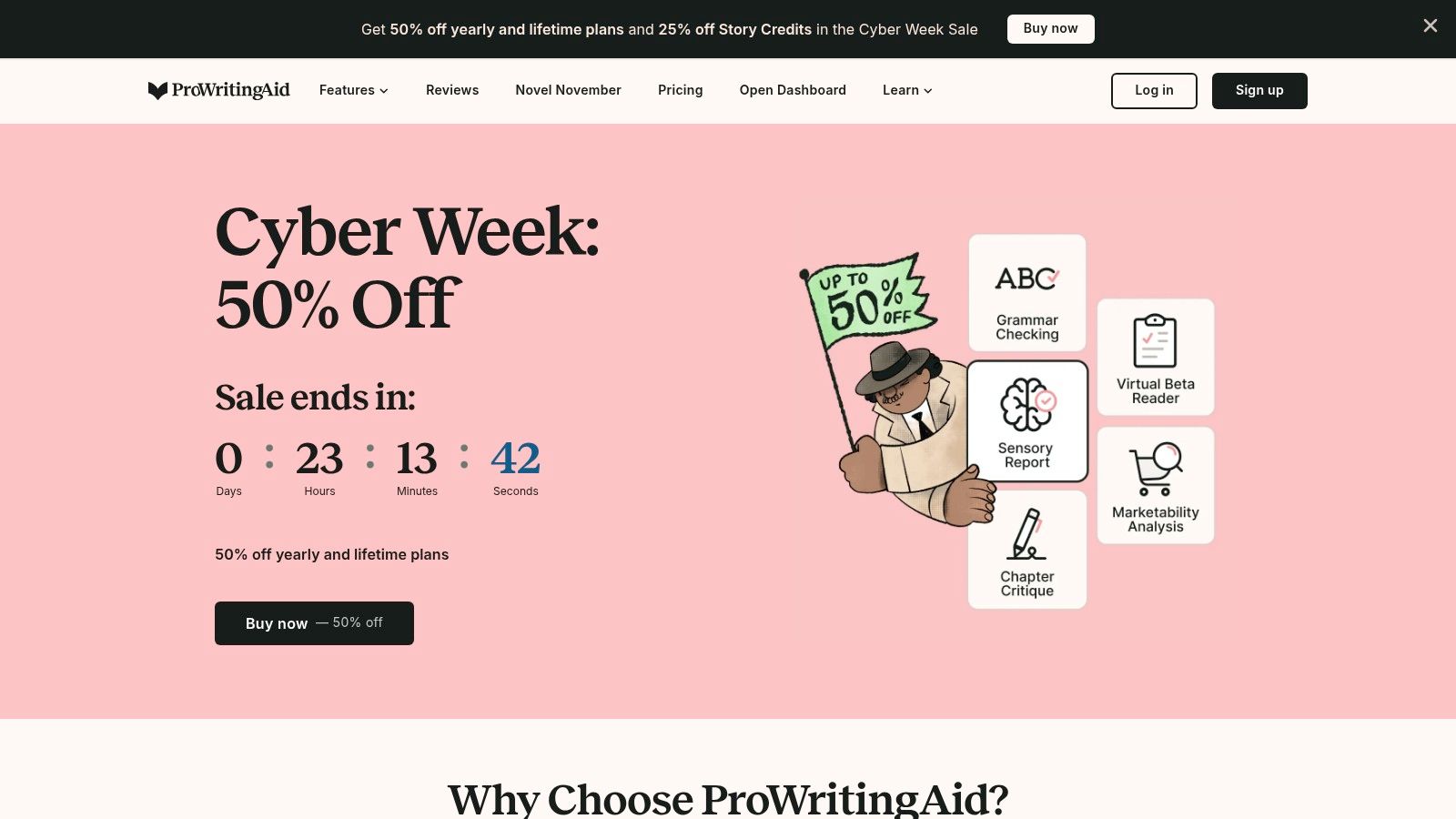
It stands out by offering over 20 in-depth writing reports that go far beyond basic grammar checks. This analytical approach encourages you to deconstruct and rebuild AI drafts, altering their foundational structure. For authors, students, and professionals, ProWritingAid provides the tools to not just revise but to understand why certain changes make the text more human and engaging, a key factor in evading AI detection.
Key Features and Usage Tips
ProWritingAid's strength lies in its deep, educational analytics that empower better self-editing.
- Style and Readability Reports: Paste your AI content and run the Style and Readability reports. These will highlight passive voice, clichés, and overly complex sentences that are common AI artifacts. Addressing these suggestions diversifies the text.
- Sentence Length Variation: Use the "Sentence Length" report to visualize your text's flow. AI often produces sentences of similar length; manually adjusting them based on this report's graph is a powerful humanization technique.
- Overused Words Report: This feature identifies repetitive words and phrases, a tell-tale sign of AI generation. Replacing these with more varied vocabulary helps the content appear more natural.
The free version provides access to the online editor with a 500-word limit, which is useful for shorter pieces. The Premium version unlocks unlimited word counts, desktop app integration, and more advanced reports.
| Feature | Free Version | Premium Version | Use Case for Evading Detection |
|---|---|---|---|
| Grammar/Style Check | ✅ (500 words) | ✅ | Catches robotic phrasing and improves overall writing style. |
| 20+ Writing Reports | ✅ (500 words) | ✅ | Provides deep analysis to restructure AI text patterns. |
| Sentence Length Tool | ✅ (500 words) | ✅ | Helps vary sentence structure to mimic human writing rhythms. |
| Integrations | Limited (Browser Extensions) | Extensive | Allows for in-depth editing directly in your writing app. |
Website: https://prowritingaid.com
4. Hemingway Editor
Hemingway Editor is a minimalist writing tool focused on improving clarity and readability. It doesn't rewrite text like a paraphraser but instead highlights complex sentences, passive voice, and excessive adverbs, forcing you to manually revise your AI-generated draft. This manual intervention is highly effective for breaking AI patterns. By simplifying sentences and rephrasing flagged sections, you naturally create undetectable ai free text that is more direct and human-sounding.
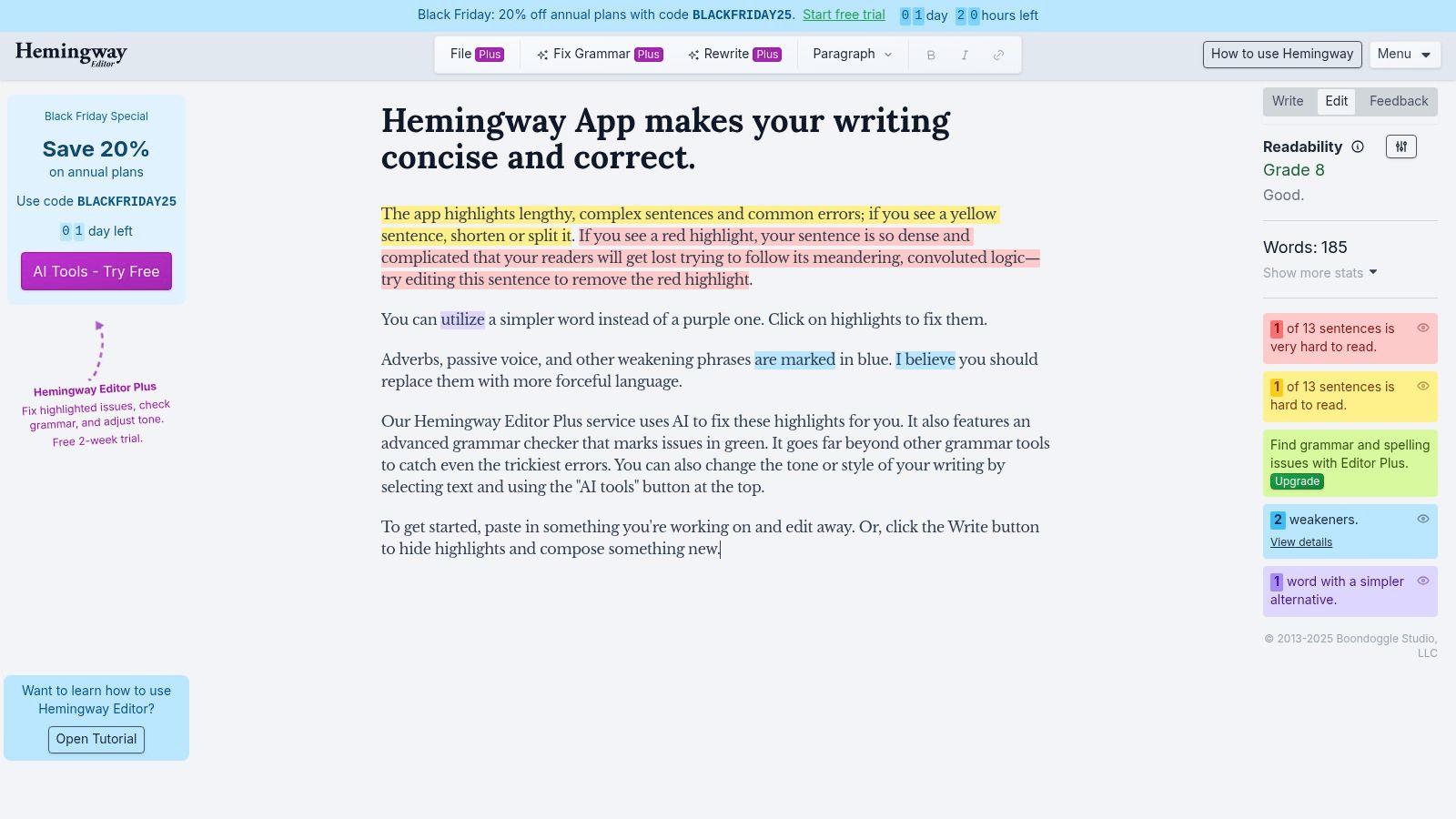
The platform stands out due to its simplicity and focus on powerful, concise writing. While AI models often produce overly complex or verbose sentences, Hemingway’s color-coded feedback immediately shows you where to cut the fluff. This process encourages you to think critically about sentence structure and word choice, which is a key step in distancing the text from its robotic origins and making it your own.
Key Features and Usage Tips
Hemingway’s strength lies in its straightforward, actionable feedback that forces meaningful edits.
- Sentence Complexity Highlighting: Paste your text into the editor. It will highlight lengthy, "very hard to read" sentences in red and "hard to read" sentences in yellow. Splitting or simplifying these is the fastest way to alter AI structure.
- Passive Voice and Adverb Detection: The tool flags passive voice (in green) and adverbs (in blue), both of which are common in generic AI writing. Removing them makes your prose more active and impactful.
- Readability Grade: Aim for a lower readability grade (e.g., Grade 8 or 9) for your content. This forces you to use simpler words and shorter sentences, a style that often bypasses AI detection.
The web-based editor is completely free, while a paid desktop app is available for offline use. For humanizing AI content, the free version provides all the necessary functionality.
| Feature | Free Version | Desktop App (Paid) | Use Case for Evading Detection |
|---|---|---|---|
| Readability Grade | ✅ | ✅ | Guides you to simplify text, breaking down complex AI syntax. |
| Sentence Highlighting | ✅ | ✅ | Visually pinpoints where to make structural edits. |
| Passive Voice Detection | ✅ | ✅ | Helps you convert passive sentences to active, human-like ones. |
| Offline Access | ❌ | ✅ | Not required for the core task of revising AI content. |
Website: https://hemingwayapp.com
5. Turnitin
Turnitin is the academic standard for originality checking, used by universities worldwide to detect plagiarism. While not an AI humanizer, it serves a critical and different purpose for users: it acts as the ultimate testbed. By understanding how the most sophisticated academic detector analyzes text, you can refine your AI-generated content to pass its scrutiny. Using Turnitin, typically through institutional access, allows you to see what an advanced system flags, providing invaluable insight for creating undetectable ai free of similarity issues.
It stands out because it's often the final barrier your content will face in an academic setting. Unlike public tools, Turnitin compares submissions against a massive, proprietary database of student papers, academic journals, and web content. Accessing its similarity report before final submission gives you a clear roadmap of which sentences or phrases are too close to existing sources or may appear unoriginal, guiding your humanization efforts precisely.
Key Features and Usage Tips
Turnitin's value is in its powerful analysis rather than direct editing features.
- Originality Reports: Submit your humanized AI draft to see a Similarity Score. This report highlights passages that match its database, showing you exactly where further paraphrasing and restructuring are needed.
- Source Matching: The report links highlighted text to the original sources it found. This helps you understand if your AI-generated text accidentally mirrored existing academic or web content too closely.
- Strategic Revisions: Use the feedback not to just change a few words, but to fundamentally rewrite the flagged sections in your own voice, ensuring both originality and a more human-like structure.
Access is almost exclusively through educational institutions, so it is not a direct-to-consumer tool. It serves as a verification step, not a creation tool.
| Feature | Availability | Use Case for Evading Detection |
|---|---|---|
| Similarity Score | ✅ (Via Institution) | Provides a quantifiable measure of your text's originality to aim for. |
| Highlighted Matches | ✅ (Via Institution) | Pinpoints exact phrases that are unoriginal or patterned. |
| Source Comparison | ✅ (Via Institution) | Helps identify and properly cite or rephrase problematic sentences. |
| AI Writing Detection | ✅ (Educator side) | The ultimate test to see if your humanization efforts pass a rigorous check. |
Website: https://www.turnitin.com
6. Copyleaks
Copyleaks is primarily known as a high-end plagiarism and AI content detector, but it serves a crucial reverse role for writers aiming for undetectable ai free content. By using Copyleaks’ AI detector to scan your text, you can see precisely which sentences or phrases are flagged as AI-generated. This diagnostic approach allows you to manually rewrite only the problematic sections instead of overhauling the entire document, making your humanization efforts more targeted and efficient.
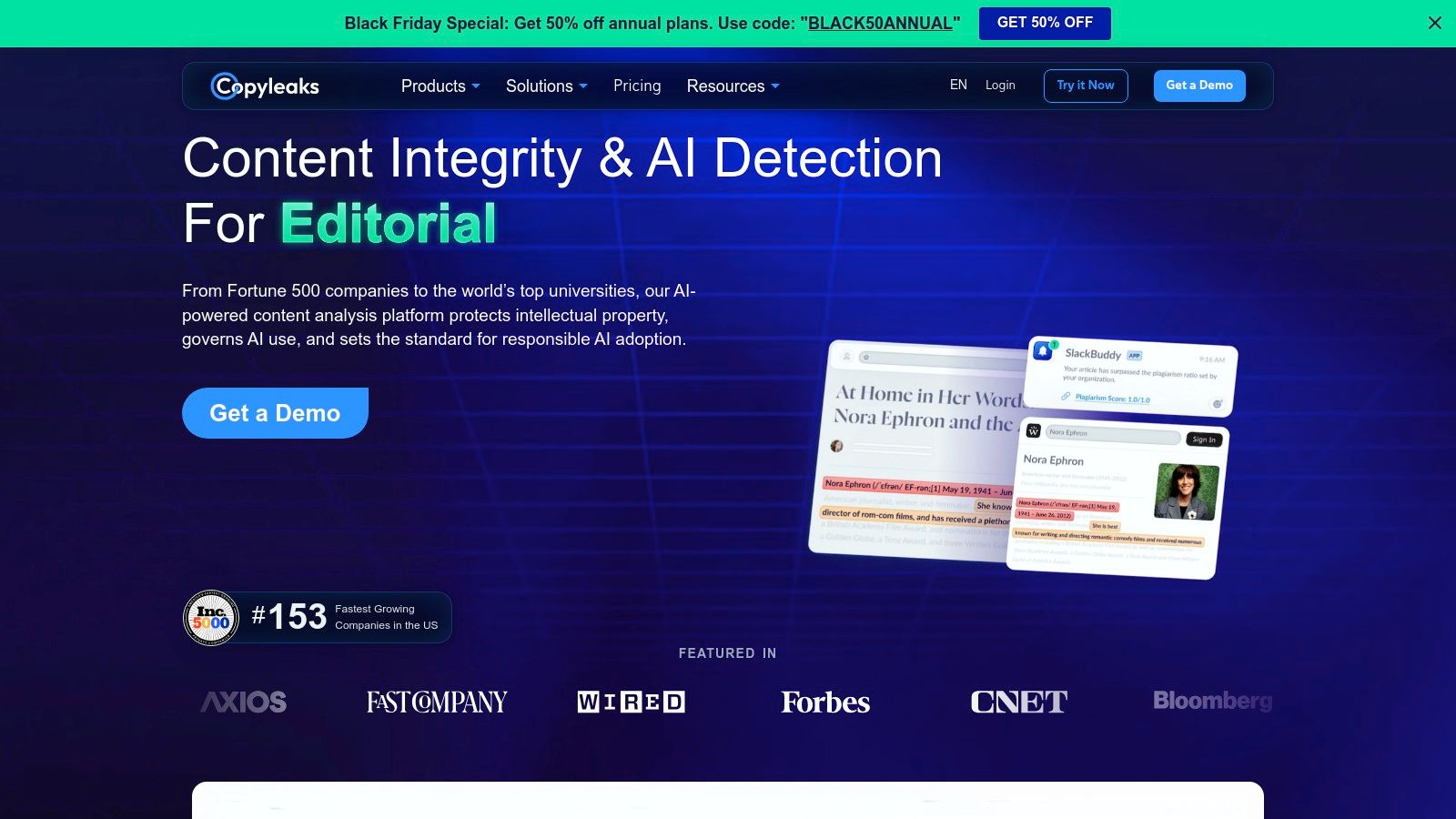
It stands out because it offers one of the most widely used detection technologies for free, giving you a direct look at what popular tools see. Rather than guessing which parts of your text sound robotic, Copyleaks highlights them with a high degree of certainty. This empowers you to refine your content with precision, focusing on the exact patterns that trigger detection algorithms and learning how to avoid them in future writing.
Key Features and Usage Tips
Copyleaks’ strength is its direct, no-frills analysis, providing a clear pass-or-fail verdict on your text.
- Direct AI Scan: Paste your AI-generated text directly into its free online AI content detector. The tool will quickly scan the content and give you a result, often highlighting sentences it identifies as AI-written.
- Iterative Rewriting: Use the highlighted sections as a guide for your revisions. Rewrite the flagged sentences to vary sentence structure, inject personal tone, and add complexity.
- Re-Scan for Verification: After making your edits, re-scan the text to confirm that it now passes as human-written. This iterative process is key to effectively humanizing your content.
While Copyleaks offers extensive paid plans with API access and plagiarism checks for educational institutions and businesses, its free AI detector is a powerful and accessible tool for individual content creators.
| Feature | Free Version | Premium Version | Use Case for Evading Detection |
|---|---|---|---|
| AI Content Detection | ✅ | ✅ | Identifies specific sentences that trigger AI detectors. |
| Highlighted Text | ✅ | ✅ | Pinpoints exact areas needing manual rewriting and humanization. |
| Plagiarism Checker | Limited | Advanced | Ensures originality but is separate from AI detection. |
| API & LMS Integration | ❌ | ✅ | Not relevant for individual writers humanizing content. |
Website: https://copyleaks.com
7. Originality.ai
Originality.ai is an advanced AI detector and plagiarism checker designed for serious content publishers, SEO agencies, and editorial teams. While it's primarily a detection tool, it serves a crucial reverse role for those seeking to create undetectable AI content. By running your humanized text through its scanner, you can gain confidence that your revisions have successfully removed the statistical patterns that AI detectors look for. It provides a benchmark to test the effectiveness of your efforts to make undetectable ai free of robotic traits.
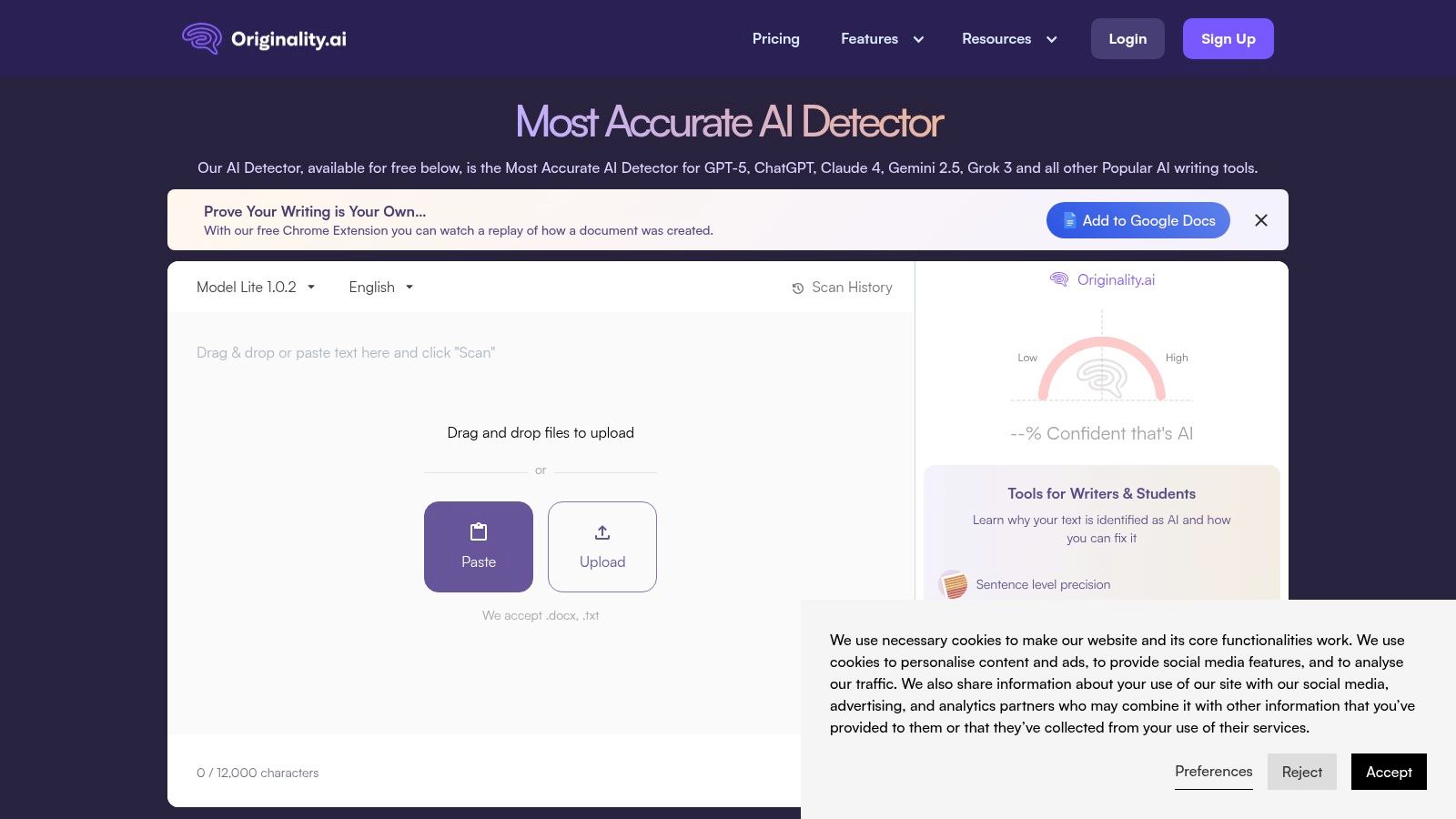
It stands out because it's one of the few platforms built with professional content operations in mind, offering features like team management and site-wide scans. Using Originality.ai as a final checkpoint allows you to verify that your manually edited or tool-assisted text passes a stringent test before publication. This verification step is vital for anyone who needs to ensure their content is consistently perceived as human-written.
Key Features and Usage Tips
Originality.ai’s strength lies in its detailed, document-level analysis and accuracy, providing a clear pass/fail grade for your content.
- AI Detection Score: Paste your text and receive a percentage score indicating the probability of AI generation. Aim for a score close to 100% Original (human) to be confident it will evade other detectors.
- Sentence Highlighting: The tool highlights specific sentences it flags as likely AI-generated, giving you precise areas to focus your rewriting efforts on.
- Plagiarism Checking: It simultaneously checks for plagiarism, ensuring your content is both original and human-sounding, a dual-check that is essential for professional publishing. For more insights on bypassing these tools, learn how to create content that can get past even the most advanced detectors like Originality.ai.
While Originality.ai operates on a pay-as-you-go credit system rather than a free plan, its low cost per scan makes it an accessible tool for final verification.
| Feature | Pay-As-You-Go | Subscription | Use Case for Evading Detection |
|---|---|---|---|
| AI Detection | ✅ | ✅ | Verifies if humanization efforts were successful against a top detector. |
| Plagiarism Scan | ✅ | ✅ | Ensures content is unique in addition to being undetectable. |
| Team Management | ❌ | ✅ | Allows teams to maintain a consistent quality standard for humanization. |
| Shareable Reports | ✅ | ✅ | Provides clear proof of a document's originality and human score. |
Website: https://originality.ai
8. Quetext
Quetext is primarily known as a straightforward plagiarism checker, but its utility extends to making AI-generated text more unique. By running your AI content through Quetext, you can identify phrases or sentences that are too similar to existing online sources. This process is crucial because AI models often inadvertently replicate common phrasing from their training data, a key signal for AI detectors. Addressing these flagged sections forces you to rewrite and rephrase, naturally humanizing the content and helping you create undetectable ai free text that passes originality checks.
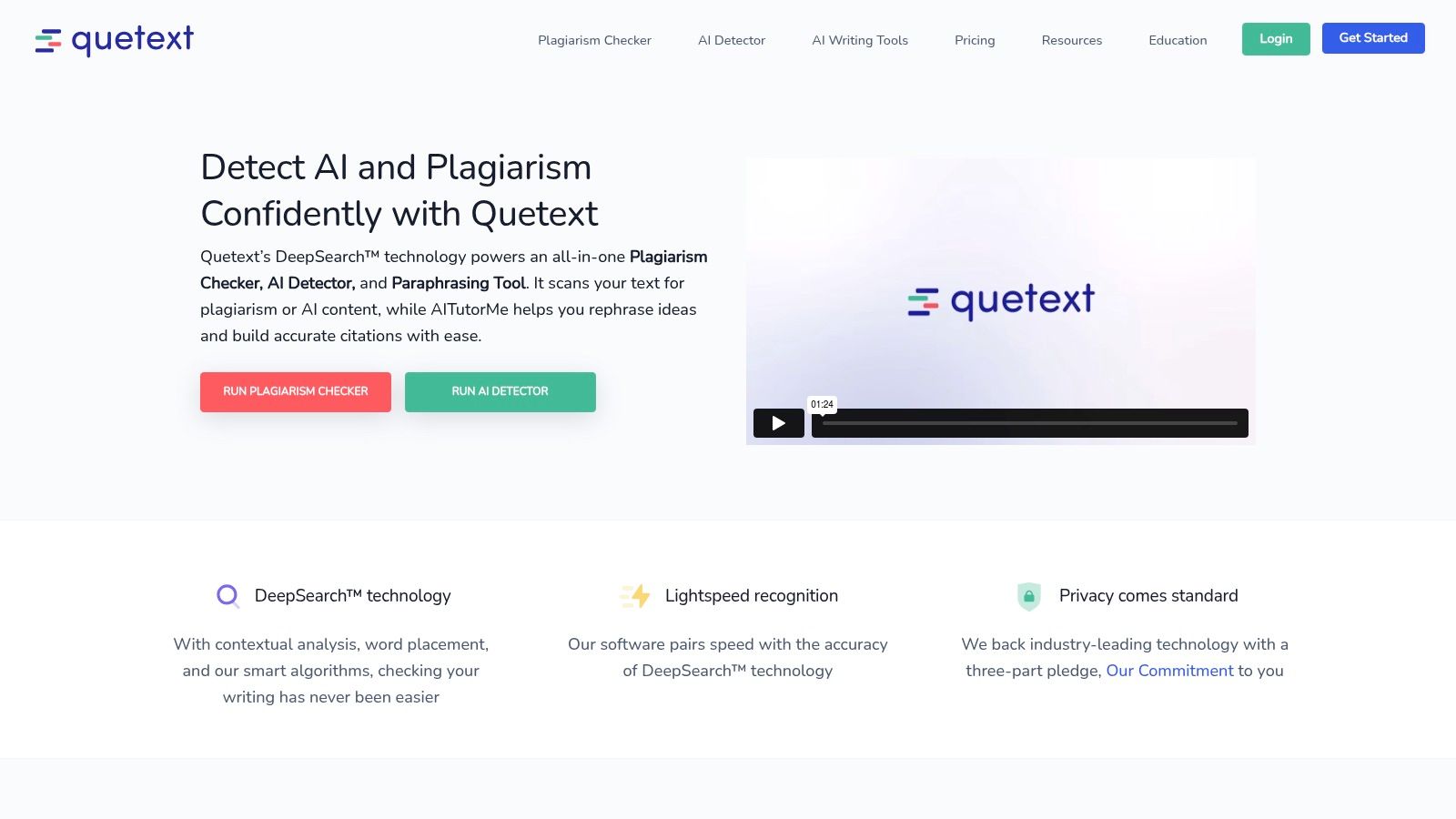
The platform stands out for its simplicity and visual feedback. The ColorGrade™ feature highlights potential matches with varying colors, making it easy to see which parts of your text need the most attention. Instead of just avoiding AI patterns, you are actively ensuring the content is original and distinct from what is already published online. This dual-purpose check for both plagiarism and common AI phrasing is an effective, indirect method for bypassing detection.
Key Features and Usage Tips
Quetext’s strength is its user-friendly interface that provides clear, actionable feedback.
- ColorGrade™ Feedback: Paste your AI-generated text into the checker. The tool highlights sentences that match web sources, guiding you on which parts to rewrite for improved originality and a less robotic feel.
- Originality Score: Use the overall originality score as a benchmark. Aim for a high score by rewriting flagged sections until the text is sufficiently unique.
- Citation Assistance: While designed for academic integrity, the citation tool can help you properly attribute sources if your AI pulls specific data, adding a layer of credibility that AI detectors often scrutinize.
The free version allows for limited checks, which is perfect for occasional use. The Pro plan unlocks deeper scans and unlimited checks, better suited for high-volume content creators.
| Feature | Free Version | Pro Version | Use Case for Evading Detection |
|---|---|---|---|
| Plagiarism Check | Limited | Unlimited | Identifies and helps eliminate common phrases flagged by detectors. |
| ColorGrade™ | ✅ | ✅ | Visually pinpoints text that needs rewriting for humanization. |
| Originality Score | ✅ | ✅ | Provides a clear metric for how unique and human-like your text is. |
| Citation Assistant | ✅ | ✅ | Helps properly source information, adding an element of human research. |
Website: https://www.quetext.com
9. Purdue OWL (Online Writing Lab)
Purdue OWL is an authoritative academic resource rather than an automated tool, but its value in creating human-like text is immense. It teaches the foundational principles of effective writing, such as proper citation, paraphrasing techniques, and sentence structure, which are essential for transforming generic AI output into credible, original work. By applying its guidelines, you can manually rewrite AI content to ensure it is not only grammatically correct but also intellectually sound and properly attributed, making it a truly undetectable ai free resource for academic integrity.

It stands out because it empowers you with knowledge instead of just providing a quick fix. Learning how to properly paraphrase, summarize, and cite sources according to established standards (like APA or MLA) is a surefire way to alter AI-generated text significantly. This manual, knowledge-based approach fundamentally changes the content's structure and vocabulary, making it far more nuanced than what automated spinners can achieve.
Key Features and Usage Tips
Purdue OWL's strength lies in its detailed, example-rich guides that teach you how to write better.
- Paraphrasing and Summarizing Guides: Use the detailed tutorials to learn how to rephrase AI-generated sentences in your own voice while maintaining the original meaning, a core skill for evading detection.
- Citation Formatting: AI tools often fabricate sources or format citations incorrectly. Use OWL’s guides to properly cite all information, adding a layer of authenticity and academic rigor.
- Writing Style and Grammar Rules: Explore sections on sentence clarity, conciseness, and active vs. passive voice to manually refine AI text, breaking up its predictable patterns. For a deeper dive, learn more about how these principles can improve your academic writing.
As a completely free educational resource, Purdue OWL provides an invaluable, albeit manual, method for humanizing AI content.
| Feature | Availability | Use Case for Evading Detection |
|---|---|---|
| Citation and Formatting Guides | ✅ | Ensures proper source attribution, adding a human touch of academic diligence. |
| Paraphrasing Tutorials | ✅ | Teaches you to rewrite AI text in a unique voice, fundamentally altering its structure. |
| Grammar and Mechanics Guides | ✅ | Helps you refine sentence construction to move beyond typical AI patterns. |
| Automated Checking Tool | ❌ | Requires manual application of principles; no instant rewriting or detection scanning. |
Website: https://owl.purdue.edu
10. Zotero
Zotero is a free, open-source reference management tool designed to help users collect, organize, and cite research sources. While not an AI humanizer, it is a crucial ally in creating authentic, well-supported content that inherently bypasses AI detection. By integrating and properly citing high-quality sources, you add a layer of originality and verifiable depth that AI-generated text often lacks, helping to produce undetectable ai free of generic, unsourced claims.

It stands out because it encourages a research-first workflow. Instead of just paraphrasing AI output, Zotero pushes you to ground your text in credible evidence. This process naturally diversifies sentence structure and vocabulary as you synthesize information from multiple authors, making the final piece fundamentally more human and less predictable to AI detectors that scan for uniformity.
Key Features and Usage Tips
Zotero's strength is its seamless integration into the research and writing process, promoting originality through proper scholarship.
- One-Click Web Clipper: Use the browser extension to instantly save articles, web pages, and PDFs to your library. Incorporating unique data from these sources is a key way to make AI content distinct.
- Automatic Bibliography Generation: Effortlessly add citations and bibliographies to your documents in thousands of styles. This not only avoids plagiarism but also signals a human research process.
- Structured Note-Taking: Link notes directly to your sources within Zotero. This helps you synthesize information in your own words before adding it to your draft, effectively "humanizing" the content at its core.
The platform is completely free, with optional paid plans for expanded cloud storage if you need to sync very large libraries. For students, researchers, and writers, its free features are more than sufficient for bolstering content authenticity.
| Feature | Availability | Use Case for Evading Detection |
|---|---|---|
| Source Collection | ✅ | Gathers unique, verifiable information to add depth beyond generic AI text. |
| Citation Management | ✅ | Adds a layer of academic rigor that AI detectors recognize as human-like. |
| Word Processor Plugin | ✅ | Integrates real references directly into text, breaking up AI patterns. |
| Group Libraries | ✅ | Facilitates collaborative research, introducing multiple human perspectives. |
Website: https://www.zotero.org
11. Mendeley
Mendeley is a reference manager primarily used by academics to organize research papers and generate citations, but it offers an unconventional method for humanizing AI text. While not a direct paraphraser, its core function of integrating credible sources can be used to manually revise AI-generated content. By forcing you to incorporate, cite, and synthesize real academic literature, it helps break the stylistic and structural patterns of AI, resulting in text that is both more authoritative and undetectable ai free of generic AI signatures.
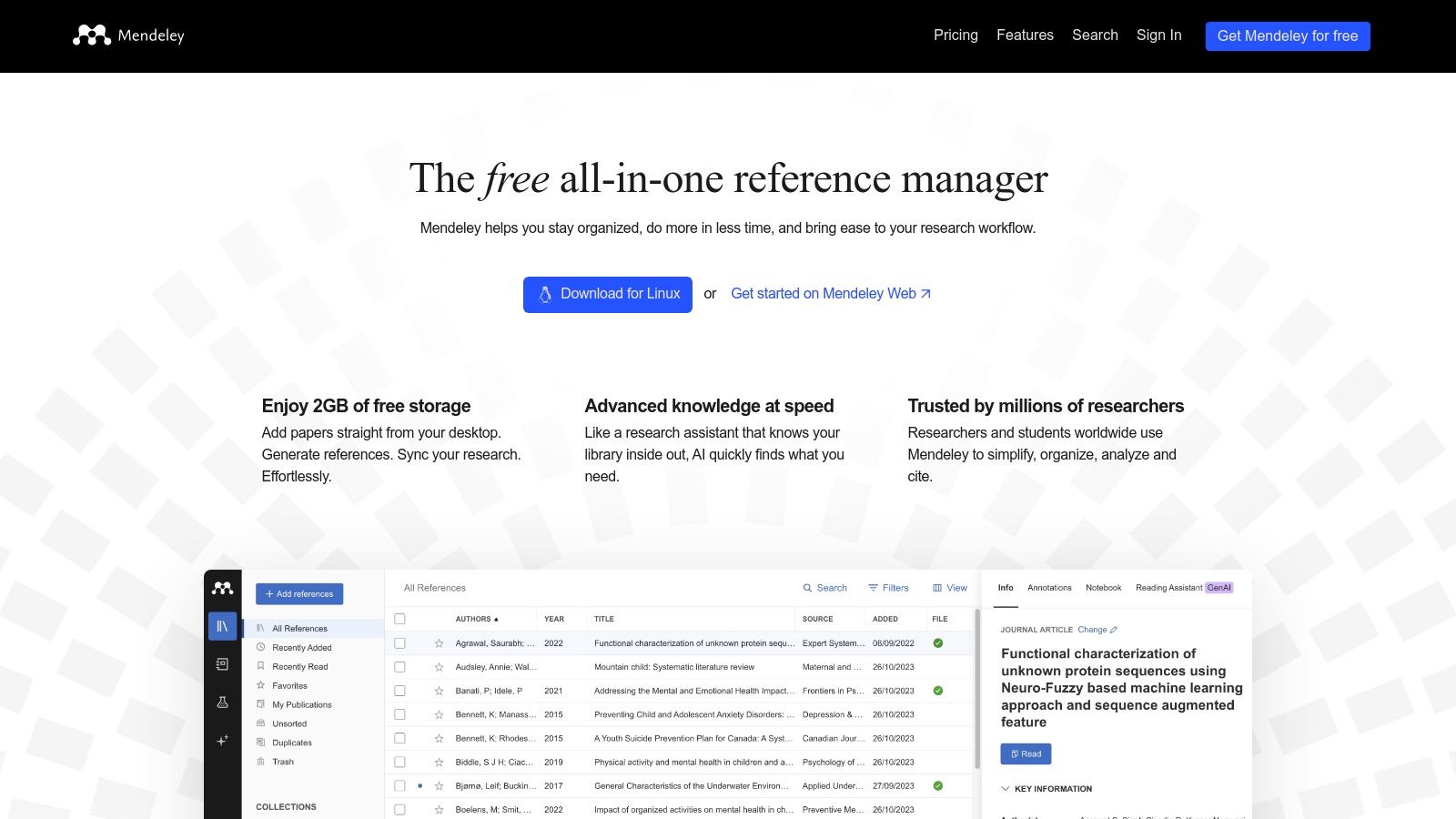
This tool stands out because it shifts the focus from simple rewording to substantive enhancement. Instead of just changing words, you are introducing new concepts and evidence from established sources, which inherently diversifies sentence structure, vocabulary, and analytical depth. This manual, source-based approach is a robust way to ensure your content passes AI detection by grounding it in verifiable human knowledge and analysis.
Key Features and Usage Tips
Mendeley's value lies in its research-oriented workflow, which indirectly humanizes your content.
- Literature Search: Use its built-in search to find relevant papers on your topic. Integrating findings from these sources naturally rephrases AI-generated claims and adds credibility.
- Citation Plug-ins: Install the plug-in for Microsoft Word or LibreOffice. As you rewrite AI text to include a source, use the plug-in to insert a citation. This process forces you to re-evaluate and rephrase every sentence you support with evidence.
- PDF Annotation: Highlight key passages and add notes to PDFs directly within Mendeley. Use these annotated points to replace generic AI statements with specific, well-supported arguments.
The free version of Mendeley offers substantial storage and is perfectly adequate for this purpose. A free account is required for access.
| Feature | Free Version | Premium Version | Use Case for Evading Detection |
|---|---|---|---|
| PDF Organization | ✅ | More Storage | Organizes source material for systematic content revision. |
| Citation Plug-ins | ✅ | ✅ | Forces manual rewriting by integrating external citations. |
| Literature Search | ✅ | ✅ | Finds unique information to replace generic AI content. |
| Collaboration | Private Groups | More Groups | Not directly used for AI detection evasion. |
Website: https://www.mendeley.com
12. Scribbr
Scribbr offers a unique, human-powered approach to refining AI-generated text, primarily through its professional editing and proofreading services. While its core offerings are paid, its free citation tools and writing resources can be used to manually improve AI content. The true value for creating undetectable ai free text, however, lies in using its human editors to add the nuance, critical thought, and stylistic variation that automated tools often miss, effectively erasing any AI footprint.
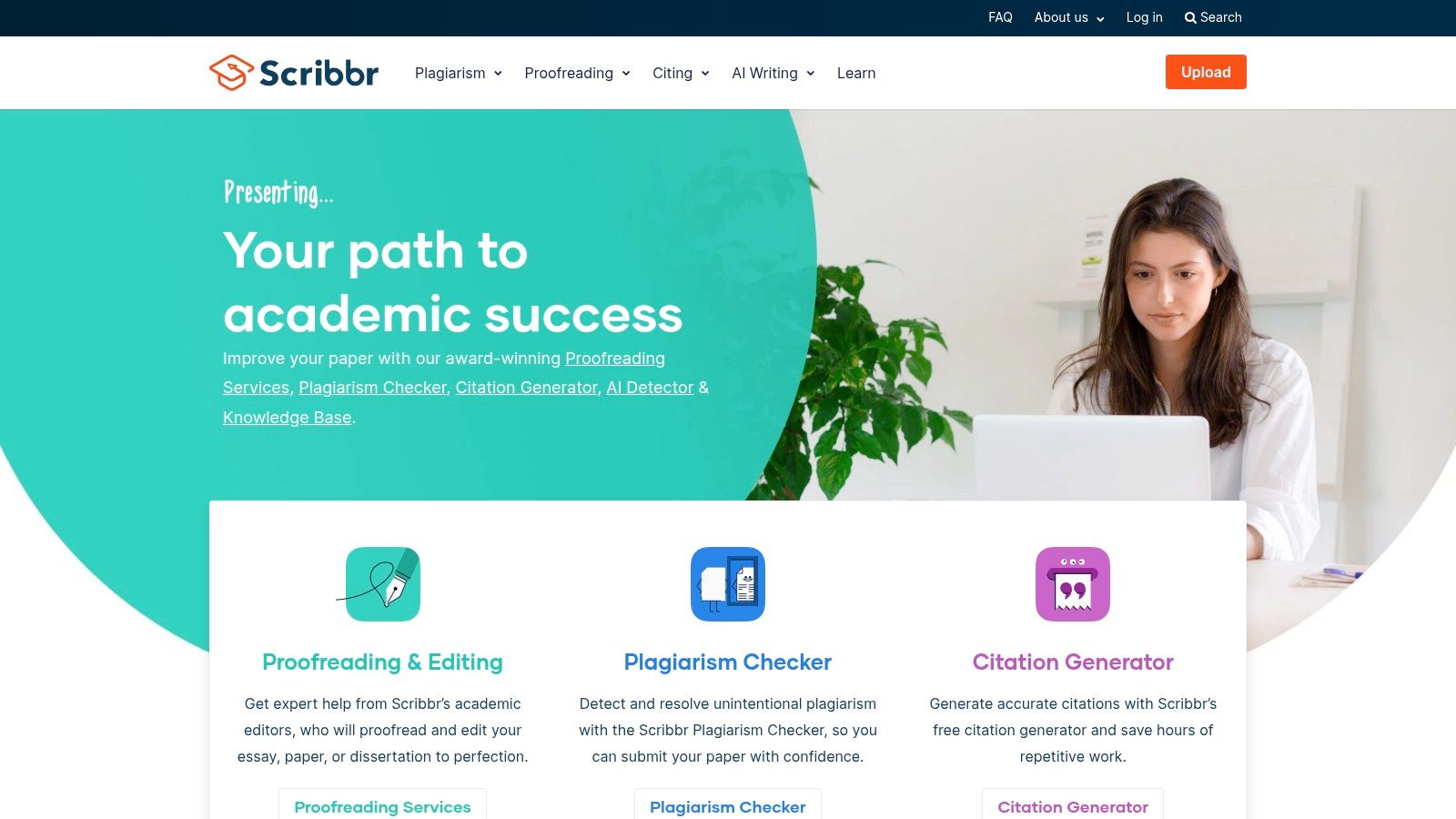
It stands out by connecting users with subject-matter experts who don't just correct grammar but improve the structure, clarity, and flow of an argument. This level of revision is far more profound than simple paraphrasing. An expert editor can identify and rectify the logical inconsistencies or overly simplistic sentence patterns typical of AI, ensuring the final text is intellectually sound and stylistically human. This manual refinement is the most reliable way to bypass advanced AI detection.
Key Features and Usage Tips
Scribbr’s strength is its blend of human expertise and helpful automated tools, ideal for academic and professional writing.
- Human Editing Service: Submit your AI-generated draft for proofreading and editing. You can choose your turnaround time, and an editor specializing in your field will refine the text. This is a paid but highly effective method for humanization.
- Citation Generators: Use the free APA, MLA, and Chicago style citation generators to correctly format references. AI often makes mistakes with citations, and correcting them manually adds a layer of human oversight.
- Plagiarism Checker: While primarily for originality, running your text through its checker can help identify if the AI has inadvertently replicated existing content too closely, a common red flag.
The paid editing service is the main draw for guaranteed humanization, but leveraging the free academic tools helps add crucial human touches to your AI draft.
| Feature | Free Tools | Paid Services | Use Case for Evading Detection |
|---|---|---|---|
| Citation Generators | ✅ | ✅ | Manually corrects AI-generated citation errors, a human touch. |
| Plagiarism Checker | ❌ | ✅ | Identifies unoriginal phrasing that can also trigger AI detectors. |
| Human Proofreading | ❌ | ✅ | Provides deep, nuanced edits that erase AI patterns completely. |
| Structure & Clarity | ❌ | ✅ | Expert editors restructure text for logic and flow, a key human skill. |
Website: https://www.scribbr.com
Undetectable AI Free — 12-Resource Comparison
| Tool | Core features | Quality (★) | Value (💰) | Target (👥) | Unique (✨) |
|---|---|---|---|---|---|
| HumanText.pro 🏆 | Paste → AI-score → humanize; privacy-first workflow | ★★★★☆ | 💰 Free 500‑word trial; simple paid tiers | 👥 Students, writers, marketers, teams | ✨ Claims up to 99% detector bypass; instant, meaning-preserving humanization |
| Grammarly | Real-time grammar, tone, clarity; plagiarism (Premium) | ★★★★☆ | 💰 Freemium; Premium for advanced features | 👥 General writers, professionals | ✨ Best-in-class integrations (Chrome/Docs/Word) |
| ProWritingAid | 20+ style reports; in-app lessons & analytics | ★★★★☆ | 💰 Freemium; periodic lifetime deals | 👥 Authors, long-form editors, students | ✨ Deep stylistic diagnostics + learning tools |
| Hemingway Editor | Readability grade, passive voice & complexity highlighting | ★★★☆☆ | 💰 Free web; one-time desktop fee | 👥 Writers wanting clarity & brevity | ✨ Ultra-simple, fast clarity pass |
| Turnitin | Originality/similarity reports; LMS integrations | ★★★★★ | 💰 Institution-licensed (no consumer plan) | 👥 Educators & institutions | ✨ Academic-standard database & feedback studio |
| Copyleaks | Plagiarism & AI-content detection; API & LMS plugins | ★★★★☆ | 💰 Tiered paid plans for orgs | 👥 Businesses, educators | ✨ Enterprise APIs + transparent similarity reports |
| Originality.ai | Team management, plagiarism scanning, site monitoring | ★★★★☆ | 💰 Paid; scales with volume | 👥 Publishers, SEO teams, agencies | ✨ Team/audit features & site‑wide monitoring |
| Quetext | Visual ColorGrade matches; citation suggestions | ★★★☆☆ | 💰 Freemium; Pro for bulk checks | 👥 Students, freelancers | ✨ Simple visual highlighting for quick checks |
| Purdue OWL | Citation guides (APA/MLA/Chicago), academic writing tutorials | ★★★★★ | 💰 Free | 👥 Students, researchers | ✨ Authoritative, comprehensive citation & integrity guidance |
| Zotero | Reference manager, web clipper, bibliography generation | ★★★★★ | 💰 Free core; paid sync storage | 👥 Researchers, students | ✨ Open-source + collaborative group libraries |
| Mendeley | PDF management, citation plugins, literature discovery | ★★★★☆ | 💰 Free account; paid storage tiers | 👥 Academics, researchers | ✨ PDF annotation + discovery features |
| Scribbr | Human proofreading, plagiarism checks, citation tools | ★★★★★ | 💰 Paid per word/page (turnaround-based) | 👥 Students & researchers needing edits | ✨ Human editors with subject-specific feedback |
Final Thoughts: Balancing AI Efficiency with Human Authenticity
Navigating the landscape of AI-generated content can feel like a high-stakes game of cat and mouse. As AI detectors become more sophisticated, the demand for tools that can humanize text and ensure it passes scrutiny has skyrocketed. Throughout this guide, we've explored a comprehensive toolkit, from dedicated paraphrasers and humanizers to foundational writing aids, all designed to help you produce high-quality, authentic-sounding content. The journey to creating undetectable AI free of flags is not about finding a single magic button, but about developing a strategic workflow that blends artificial intelligence with your own human ingenuity.
The key takeaway is that no single tool is a complete solution. A powerful humanizer might bypass a detector, but it won't add the critical thought or unique perspective that only you can provide. Similarly, a grammar checker like Grammarly can polish your syntax, but it can't verify your facts or strengthen your core argument. The most effective approach is a layered one, combining technology with traditional writing best practices.
Key Insights and Strategic Takeaways
Reflecting on the tools and methods covered, several core principles emerge for anyone aiming to produce detector-proof content:
- Humanization is More Than Paraphrasing: True humanization involves adjusting sentence structure, varying word choice, and injecting a natural, sometimes imperfect, rhythm into the text. Tools can assist with this, but the final pass should always involve your own editorial judgment to ensure the tone and voice are consistent and authentic.
- The Foundational Tools Still Matter: Don't underestimate the power of classic writing aids like the Hemingway Editor or resources like Purdue OWL. These tools force you to simplify complex AI-generated sentences and adhere to established writing conventions, which inherently makes your content sound more human and less robotic.
- Verification is Non-Negotiable: Always run your final draft through a reliable AI detector like Copyleaks or Originality.ai. This crucial step acts as your final quality check, providing peace of mind and validating that your humanization efforts were successful. Never assume your text is undetectable without testing it.
Choosing the Right Tool for Your Needs
Selecting the right combination of tools depends entirely on your specific goals and context. For students and academics, the priority is maintaining academic integrity. This means using AI as a brainstorming partner and then relying heavily on citation managers like Zotero and style guides to build a credible, well-researched paper. Your focus should be on refining AI-generated drafts with your own analysis and rigorous citation.
For content creators and SEO specialists, efficiency is often paramount. Your workflow might start with an AI-generated draft, move to a humanizer to quickly address perplexity and burstiness, and finish with a grammar and style check to ensure readability and engagement. The goal is to scale production while maintaining a consistent brand voice that connects with your audience. Remember, creating undetectable AI free of robotic language is essential for ranking and building trust.
Ultimately, these tools should be viewed as collaborators, not replacements. They are here to augment your skills, break through writer's block, and handle the repetitive aspects of writing, freeing you up to focus on what matters most: your ideas, your story, and your unique human perspective. By embracing this hybrid approach, you can harness the incredible power of AI without sacrificing the authenticity that makes your writing truly valuable and impactful.
Ready to take the guesswork out of humanizing your content? For a fast, reliable, and free solution designed specifically to make AI text undetectable, try Humantext.pro. It provides a powerful one-click process to help you bypass detectors and ensure your writing sounds genuinely human. Visit Humantext.pro to transform your AI drafts today.
Ready to transform your AI-generated content into natural, human-like writing? Humantext.pro instantly refines your text, ensuring it reads naturally and authentically. Try our free AI humanizer today →
Related Articles
AI Face Search Explained: Verify Identity and Stay Safe
Understand how AI face search works, including embeddings, accuracy, and legal issues. Learn to use these tools for personal safety and verify identity online.

Reverse Face Search: A Verification Safety Guide
Learn how reverse face search works, when to use it for safety, and how to pair it with AI image checks to verify online contacts and reused photos.

Face ID Search Explained: How It Works and How to Verify
Learn how face ID search works, why it differs from reverse image search, and how to verify identities and photos safely with practical checks and tools.

